This paper conceptualizes double materiality assessment (DMA) in social and environmental accounting (SEA) as an organizational change process. By shifting the focus from technical compliance to transformative practice, it seeks to open new avenues for research on how DMA can drive substantive sustainability impact within organizations.
The study employs a longitudinal, revelatory single-case study design of a multinational resource-based company. Through abductive reasoning, empirical data are iteratively analyzed and integrated with organizational change theory to develop an enhanced process model and a conceptual grammar for DMA.
The analysis identifies four key drivers: attitude, engagement, accountability, and progression, that enable and shape the organizational change potential of DMA. The findings demonstrate that DMA unfolds as a negotiated, recursive process, embedded in cultural, institutional, and political dynamics, rather than as a linear compliance exercise. The enhanced DMA process model shows how organizations can move from symbolic implementation to substantive transformation through iterative sensemaking, distributed agency, and embedded accountability, induced by DMA engagement.
This paper advances theory by articulating a grammar of DMA that foregrounds its socio-economic and political dimensions, moving beyond technical-rational models. It conceptualizes DMA as an active agent in organizational change, offering a new lens for studying the dynamics and impact of SEA. Practically, it provides a structured process and actionable drivers for integrating sustainability into organizational systems and decision-making, supporting both compliance and meaningful transformation.
Introduction
“Materiality, like beauty, is in the eye of the beholder” (Hicks, 1964, p. 159). As one of the fundamental principles of accounting, the specific nature of materiality has attracted attention in research and practice for decades, as well as from those responsible for setting frameworks and reporting standards (e.g. Edgley, 2014; Frishkoff, 1970; Hicks, 1964; Holmes, 1972; Messier et al., 2005). Generally, the concept of materiality signifies the importance of information for decision-making purposes (Frishkoff, 1970). Materiality originally stems from financial accounting as a principle requiring annual financial statements to measure and report items of a size that would impact the annual result and thus be of material relevance for stakeholders (Messier et al., 2005). In social and environmental accounting (SEA)[1], materiality broadens and challenges this traditional definition by including significant environmental, social and governance (ESG) information in materiality considerations (Calabrese et al., 2016). Consequently, the process of evaluating the relevance of an organization's sustainability topics to its stakeholders becomes a central SEA exercise (Beske et al., 2020). However, because this process involves diverse and often organization-specific approaches, a shared understanding of what constitutes an effective materiality assessment has been difficult to develop (Jebe, 2019; Jørgensen et al., 2021; Reimsbach et al., 2020). This is exacerbated by the large number of stakeholders, who often have highly divergent views, compared to the single investor focus of financial materiality (Stocker et al., 2020). Accordingly, differing judgements on the relevance of decisions – often even within the same organization – have resulted in varying interpretations of the nature of corporate accountability and material sustainability information (Giacomini et al., 2025; Puroila and Mäkelä, 2019). Thus, SEA materiality is both contested and shaped by contextual management, stakeholder interests, regulatory pressures and economic and ideological trends (Boiral, 2021; Clark, 2021; Lehner et al., 2022). While financial materiality is largely based on calculations such as earnings sensitivity, there are indications to suggest that materiality in SEA should be viewed more as a socio-economic and political construct than a technical-rational one (Carpenter et al., 1994; Eccles, 2020; Lai et al., 2017).
In the context of recent frameworks such as the European Sustainability Reporting Standards (ESRS), a materiality assessment process involves making informed decisions about which sustainability topics to include or exclude in accounting and reporting from both outside-in and inside-out perspectives (i.e. double materiality assessment, DMA). It also requires the determination of corresponding policies, actions, metrics (i.e. KPIs) and targets (Baumüller and Sopp, 2022; Cooper and Michelon, 2022). This forward-looking approach should help organizations to establish ESG governance and align their sustainability strategy and risk assessment with their operations and processes (Green and Cheng, 2019). Thus, while DMA requires the disclosure of metrics, it also provides nature-driven insights to inform the creation of later-disclosed policies, actions and targets (Mio et al., 2020; Sepúlveda-Alzate et al., 2021). In this sense, a DMA process can be interpreted as the beginning of an organizational journey towards a more sustainable future, as desired by stakeholders, but often contested (Puroila and Mäkelä, 2019). Perspectives established in institutional and organizational theory (e.g. dual institutional logic, organizational learning and sensemaking, institutional isomorphism, dynamic capabilities) help to illustrate why such processes can be transformative (Argyris and Schön, 1978; DiMaggio and Powell, 1983; Maitlis and Christianson, 2014; Teece et al., 1997; Thornton and Ocasio, 2008). For example, double-loop learning highlights that DMA can lead not only to new actions (single-loop), but to rethinking underlying assumptions about sustainability and strategy (Argyris and Schön, 1978). Moreover, DMA can become capability-building mechanisms by reconfiguring resources and structures to embed sustainability, sensing stakeholder needs and seizing opportunities (Teece et al., 1997). However, and despite this beneficial potential, organizations often struggle to balance external sustainability reporting obligations with internal strategic, operational and process changes driven by market demands when undergoing DMA (Bouten and Hoozée, 2013; Hawn and Ioannou, 2016; Larrinaga-González et al., 2001). Consequently, integrating a DMA process into an organization's systems can present significant challenges in terms of change management (Bebbington and Fraser, 2014; Lozano, 2013; Passetti et al., 2018). Existing research shows that SEA intersects with organizational change by challenging existing strategic priorities, expanding performance boundaries and prompting adjustments to operations and processes (Gray, 2010; Stubbs and Higgins, 2014). Therefore, integrating SEA into core decision-making often requires changes to governance structures, accountability mechanisms and cultural norms (Contrafatto and Burns, 2013). This establishes materiality as a pivotal arena for institutionalizing and negotiating change (Adams and McNicholas, 2007). One prominent reference in organizational change literature is Kotter's (1996) eight-step change model, which is a useful practical tool for change management and leadership as it provides intuitive guidelines on how organizations can respond to changes in their surroundings and contexts within complex, multi-stakeholder environments (e.g. sustainability transitions) (Appelbaum et al., 2012).
This paper argues that the process of DMA, which results in policies, actions, metrics and targets, provides organizations with an opportunity for change. This is a necessity, given the increasing expectations for organizations to take responsibility for their environment and the broader society (Leong and Hazelton, 2019; Manninen and Huiskonen, 2022; Tilt, 2006). However, little research has emerged on the socio-economic and political factors impacting DMA and serving as prerequisites for change (Ardiana, 2021). Addressing this gap in current research, this paper aims to theorize DMA not as a static or technical compliance activity, but as a dynamic organizational change process. It first identifies key drivers of change in DMA as a processual “grammar” that can address existing challenges in SEA and provide a framework for understanding and researching the organizational impact of an in-depth, stakeholder-driven DMA as basis for future sustainability activities including reporting. It then integrates these drivers into an enhanced DMA process model that incorporates an organizational change perspective, using Kotter's (1996) eight-step change model as a reference point. Consequently, this study offers a theoretical lens through which to conceptualize DMA, viewing it not merely as a technical exercise, but as a transformative process embedded in socio-economic and political contexts. By positioning DMA as active agent in organizational change, it advances the understanding of DMA's institutional and organizational dimensions within SEA research. Empirically, this paper presents a longitudinal, revelatory single-case study in which a comprehensive materiality assessment was first conducted in 2015. This assessment informed the development of the sustainability strategy. The materiality assessment process was expanded and updated in 2021, when a DMA was carried out, despite it only becoming mandatory in 2025. Data sources include interviews, observations and various documents. In the analytical process, this study employs abductive reasoning (Dubois and Gadde, 2002), aggregating data iteratively between empirical analysis and theoretical perspectives.
The remainder of this paper is structured as follows. First, it introduces the concept of materiality and its operationalization through the DMA process. Second, it reviews the literature on organizational change and connects it to SEA. Third, based on the empirical case, it identifies key drivers of change as a “grammar” and develops an enhanced DMA process model. Finally, this paper discusses theoretical and practical implications and outlines the directions for future research.
The dynamics of DMA processes
Materiality assessment, and especially DMA, is widely recognized as core instrument within SEA, guiding the development and implementation of effective sustainability strategies (Mio et al., 2020; Whitehead, 2017). Through this process, organizations identify those sustainability topics that significantly influence their operations, processes and stakeholder's interests (Calabrese et al., 2016; Ruiz-Lozano et al., 2021). These topics are not only used to structure sustainability or integrated reporting, but also serve as the foundation for implementing policies, actions, metrics, and targets (Jones, 2016; Khan et al., 2016). As noted above, a variety of frameworks and reporting standards have emerged and promulgated several approaches to materiality assessment (Baumüller and Sopp, 2022; Cooper and Michelon, 2022). As the publisher of one of the most widely used sustainability standards, the Global Reporting Initiative (GRI) defines material topics as those that have the greatest impact on the economy, environment and society of organizations, with an additional focus on human rights (GRI, 2021; Perera-Aldama, 2023). While this definition proposes a “single materiality”, the EU's sustainability standard developments include considerations on the so-called “double materiality” (Baumüller and Sopp, 2022). This concept was originally defined by the EU's Non-Financial Reporting Directive (NFRD) in 2019 and is also anchored in the EU's Corporate Sustainability Reporting Directive (CSRD) (Monciardini et al., 2020). The double materiality concept is also applied in the European Sustainability Reporting Standards (ESRS), which were developed by the European Financial Reporting Advisory Group (EFRAG) and are referenced in the CSRD. Organizations must address the ESRS starting from the 2024/2025 reporting period (depending on their size) (Baumüller and Sopp, 2022; Fiandrino, 2022). According to the double materiality concept, information is considered material if one of the following two perspectives applies: (1) the outside-in perspective, which considers the expected effects of the environment, society, or governance on business value (i.e. financial materiality assessment); or (2) the inside-out perspective, which considers the expected effects of organizations on the environment, society, or governance (i.e. impact materiality assessment) (EFRAG, 2022). Furthermore, the double materiality concept encompasses the entire value chain of organizations and includes both upstream stakeholders (e.g. business partners, investors and suppliers) and downstream stakeholders (e.g. customers, local communities and regulatory authorities), as well as the organization's own operations (e.g. employees and shareholders) (EFRAG, 2022).
Thus, the process of DMA is increasingly complex due to the high density of information, the wide range of sustainability concerns, and the large number of stakeholders involved (Abhayawansa, 2022). It is widely recognized as a challenging task (Jebe, 2019; Jørgensen et al., 2021; Reimsbach et al., 2020) and many organizations struggle to implement it (KPMG, 2013; Moroney and Trotman, 2016). In order to address these challenges, EFRAG introduced guidance in 2023 to support organizations that are required to account for and report on their sustainability topics (EFRAG, 2023). However, EFRAG states:
ESRS do not mandate how the materiality assessment process shall be conducted or designed by organizations. This is because no one process would suit all types of economic activities, organizational structures, locations of operations or upstream and downstream value chains of all organizations applying ESRS (EFRAG, 2023, p. 13).
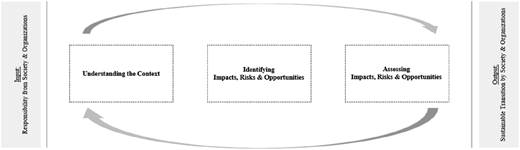
Nevertheless, EFRAG's (2023) illustrative example of a DMA process presented in Figure 1 identifies three possible steps: (1) understanding the context in order to develop an overview of key activities, business relationships, and stakeholders; (2) identifying actual and potential impacts, risks, and opportunities relating to sustainability matters across the upstream and downstream value chains, as well as in the organization's own operations; and (3) assessing and determining material impacts, risks, and opportunities undergoing impact and financial materiality assessments.
At the theoretical level, a materiality assessment process, especially under the DMA approach, introduces multiple institutional logics (Thornton and Ocasio, 2008), which requires organizations to balance economic performance with normative sustainability expectations. This draws organizations into deeper engagement with a broader range of stakeholders, including employees, local communities, suppliers and other actors in the value chain, who were often peripheral to traditional financial materiality assessments (Giacomini et al., 2025; Puroila and Mäkelä, 2019). When sustainability issues, particularly those concerning the upstream and downstream value chain, are analyzed systematically, conflicts, dependencies, and externalities that are not visible within the organizational boundary alone tend to surface (Manninen and Huiskonen, 2022; Quattrone et al., 2021). Such revelations often demand deeper organizational reflection, which aligns with organizational learning theory, particularly double-loop learning (Argyris and Schön, 1978), whereby organizations not only revise their actions, but also their underlying assumptions and norms. Furthermore, this can be viewed as a mechanism of organizational sensemaking (Maitlis and Christianson, 2014), as organizations evolve in response to environmental pressures and through recursive interactions with their environment (Weick, 1995). Building further on institutional theory, DiMaggio and Powell (1983) argue that organizations tend to become more similar over time in a process known as institutional isomorphism, as they respond to pressures from their environments. These pressures can be coercive (e.g. regulations such as the CSRD or ESRS), mimetic (e.g. imitating industry leaders), or normative (e.g. professional standards). In the context of SEA, the growing adoption of DMA frameworks and sustainability reporting standards creates such pressures, prompting organizations to adopt similar sustainability practices, including structured DMA (Leong and Hazelton, 2019). However, the dynamic capabilities framework (Teece et al., 1997; Teece, 2007) suggests that adapting effectively to complex and evolving environments requires more than just compliance. This involves an organization's ability to build, integrate and reconfigure internal and external competencies in order to address rapidly changing conditions (Teece, 2007). From this perspective, a DMA process can be viewed as a mechanism through which organizations identify and capitalize on opportunities, allocate resources, and formalize new practices in response to stakeholder expectations (Tilt, 2006).
In summary, a DMA process informs society about the various implications of sustainability performance, shaping perceptions of what is important and what organizations are held accountable for (Beske et al., 2020; Calabrese et al., 2016; Mio et al., 2020). However, the fact that “no one process would suit all types of organizations” (EFRAG, 2023) presents several challenges. Firstly, organizations may perform DMA superficially to appear compliant with regulatory or stakeholder expectations without genuinely integrating sustainability into their core strategies, operations and processes (Deloitte, 2023; KPMG, 2014), which is known as symbolic compliance (Meyer and Rowan, 1977). Secondly, greenwashing may occur when organizations use SEA to create the impression of commitment to ESG, which may not reflect their actual practices. This can involve selective disclosure, exaggerating minor environmental or social efforts or focusing on easily measurable aspects while ignoring more complex issues (Ferrero-Ferrero et al., 2021; Laufer, 2003; Zharfpeykan, 2021). Finally, if a DMA process is not perceived as legitimate and trustworthy, its transformative potential for driving organizational change is significantly limited (Jebe, 2019; Jørgensen et al., 2021; Reimsbach et al., 2020).
SEA and organizational change
In general, organizational change refers to the dynamic process through which organizations modify their strategies, structures, processes or culture in order to adapt to internal and external pressures (Tushman and Romanelli, 1985). These pressures can be external, such as market competition, regulatory changes or technological advancements, or internal, such as capabilities, culture or leadership (Schein, 1992). In the context of SEA, such change is often not just operational but ontological – it redefines how organizations perceive their role and responsibility in society (Adams and McNicholas, 2007). Adopting SEA instruments can disrupt prevailing assumptions and internal logic, prompting organizations to question what constitutes accountability, success and relevance (Contrafatto and Burns, 2013). These accounting practices, particularly DMA processes, serve as boundary objects, translating complex external demands into internal discourse and decision-making processes (Adams and McNicholas, 2007; Contrafatto and Burns, 2013). Furthermore, SEA exposes organizations to new stakeholder demands, often necessitating the incorporation of previously marginalized voices (Stubbs and Higgins, 2014). As Gray (2010) suggests, these interventions challenge the ideological foundations of corporate behavior by expanding the boundaries of performance evaluation beyond financial metrics. In doing so, SEA becomes a means through which organizational change is initiated, negotiated, and institutionalized, embedding sustainability into the very fabric of how organizations operate, reflect, and evolve (Bebbington and Fraser, 2014).
There are several models that can help organizations navigate the complexities of change. These include Lewin's (1947) theory of change, Kotter's (1996) eight-step change model, Hiatt's (2006) ADKAR model and Weick and Quinn's (1999) emergent change model. Lewin's (1947) theory of change has greatly influenced research and practice in organizational change. According to this theory, the first stage of change involves creating the perception that change is needed (unfreezing the old norm), followed by movement towards the desired behavior in the second stage, before finally refreezing and solidifying the new norm in the third stage. However, By (2005) has argued that the theory neglects external influences on the organization, and Lozano (2013) has noted that it does not specify how change is achieved through the different stages. Consequently, organizational change has evolved from a top-down process to one that emerges from the bottom up (By, 2005). One example that aligns with this development is Kotter's (1996) change model, which comprises eight steps: (1) establishing a sense of need and urgency, (2) creating a guiding coalition, (3) developing a vision and strategy, (4) communicating the vision of the change, (5) empowering broad-based action, (6) generating short-term wins, (7) consolidating gains and producing further change, and (8) anchoring new approaches and instituting change. However, this model is over 25 years old and has been criticized for lacking academic rigor (Appelbaum et al., 2012; Stouten et al., 2018). Thus, Appelbaum et al.’s (2012) literature review critically analyzed the application of Kotter's (1996) change model based on more recent studies of organizational change, finding strong support for the change steps in a more modern and emergent context. Moreover, Stouten et al. (2018) provided empirical evidence for the prescribed steps in Kotter's (1996) change model, while critically comparing it with other interpretations of organizational change. One of the main strengths of Kotter's (1996) change model is that it breaks change down into manageable steps, ensuring logical progression from identifying the need for change to embedding it within the organization. This structured approach reduces uncertainty and increases the likelihood of success (Appelbaum et al., 2012; Stouten et al., 2018). Furthermore, compared to other models, Kotter's (1996) change model addresses leadership engagement and resistance from employees and stakeholders – critical factors for effective transformation (Schein, 1992). What's more, many change initiatives fail because organizations revert to old habits once the initial push is over. Here, Kotter's (1996) final step (i.e. anchoring new approaches and instituting change) ensures that the transformation becomes embedded in the organization's culture and daily operations (Bass, 1990). Thus, Kotter's (1996) structured approach is particularly effective in guiding complex change processes, such as DMA. Consequently, this paper argues that Kotter's (1996) eight-step change model can provide a useful basis for analyzing DMA in terms of a broad and inclusive SEA instrument.
Methodology
Research strategy
In line with the aim of this paper, which is to theorize DMA not as a static or technical compliance activity, but as a dynamic organizational change process, this research gap is addressed through an embedded, longitudinal, revelatory single-case study (Yin, 2018). The case study is conducted at multiple levels of analysis, including formal and informal structures and organizational practices. According to Dubois and Gadde (2002), “the natural choice would be to go deeper into one case instead of increasing the number of cases, when the problem is directed towards analysis of a number of interdependent variables in complex structures” (p. 558) – a situation that arises in a DMA process. Thus, this study adopts a qualitative research design. Generally, the maturity of SEA research allows for both deductive and inductive research strategies (Edmondson and McManus, 2007). As the aim is not to generalize the findings statistically, but rather to promote analytical generalization and provide indications and methodological foundations for further inquiries (Parker and Northcott, 2016), an abductive research strategy, which combines both approaches, (Dubois and Gadde, 2002) seems most appropriate.
Case selection
This paper employs theoretical sampling (Eisenhardt, 1989, p. 537) to extend the fields of SEA and organizational change. The case study focuses on NatureCo [2], a listed European company that relies heavily on natural resources. It is one of the world's leading producers in its industry, with production sites in major markets and a global network of marketing and sales offices. From an environmental perspective, NatureCo's production processes have traditionally had a high corporate carbon footprint, causing negative impacts on biodiversity and ecosystems. From a social perspective, NatureCo is concerned with its global value chain, especially with regard to labor standards, and suffers from a shortage of skilled workers, particularly in Europe. Consequently, a few years ago, NatureCo began taking action to combat climate change and set itself the goal of becoming a “climate pioneer” by fostering staff who could help to achieve this. The case of NatureCo is critical to the development of theory (Yin, 2018) for the following reasons: (1) NatureCo is subject to sustainability reporting according to the NFRD and starting from the reporting period of 2025 as per the CSRD; (2) NatureCo's sustainability strategy was developed on the basis of a materiality assessment process in 2015, and remains firmly anchored in its business strategy; and (3) NatureCo conducted a comprehensive materiality assessment process for the first time in 2015, and updated it in 2021 to include DMA. At the time of analysis, NatureCo was working to enhance its DMA process in line with EFRAG's recommendations. Overall, NatureCo can therefore be considered a revelatory case worthy of documentation (Yin, 2018).
Data collection
This paper draws on a variety of data sources (see Table 1), including formal interviews and informal ethnographic interviews, publicly available information (e.g. screenshots of the sustainability homepage), corporate publications (e.g. annual and sustainability reports), and other documents made available online (e.g. press releases announcing awards won and focus papers on sustainability topics). Primary data collection took place between 2021 and 2023, though some data sources date back to 2015.
These data sources contain different types of data, including quantitative, qualitative, or both (Yin, 2018). Thus, to ensure validity and better ground the individual steps of the DMA process, the data was triangulated from these multiple sources (Babbie, 2013). Firstly, a senior manager of corporate sustainability, the head of the materiality assessment process and another member of the ESG Committee who was involved in all steps of the DMA process were interviewed using a semi-structured interview guide. These interviews served as the primary data source for exploring the participants' experiences, while observational and archival data were used to supplement these accounts. The interviews were recorded, transcribed, and translated into English (Babbie, 2013). Secondly, the formal interviews were supplemented with documented informal ethnographic interviews. These observations aimed to provide a deeper understanding of how NatureCo's sustainability managers operate in natural settings and allow participants to feel comfortable sharing sensitive information; it proved particularly valuable in exploring key issues such as shareholder inclusion or power dynamics. These interviews were conducted in a flexible and unstructured manner and emerged organically during the authors' engagements and sustainability community events. The variability in content and length of the field notes reflects the contingent and evolving character of embedded fieldwork. Some notes captured short but insightful exchanges, while others documented extended reflections on decisions or meetings. This variation, rather than undermining rigor, is essential in capturing the lived, temporal unfolding of organizational change processes (Schatzki, 2001), particularly in settings where regulatory expectations such as DMA are still being negotiated and interpreted internally. As Emerson et al. (2011) argue, informal fieldnotes allow researchers to capture not only what occurs, but how it is interpreted. The open-ended nature of these notes is essential to remain attentive to emerging meanings and to avoid premature closure of the analytical frame (Charmaz, 2006). Moreover, these informal field notes served several critical functions. They supported theoretical sensitivity (Glaser and Strauss, 1967), helping the researchers remain attuned to inconsistencies, latent patterns and potential sites of theoretical development. Further, they incorporated personal reflection and the positional awareness of the embedded researcher – an element central to producing situated knowledge (Cunliffe, 2003). This reflexivity enabled a more nuanced understanding of NatureCo's response to regulatory transformation. Finally, an extensive set of archival documents was analyzed.
Data analysis
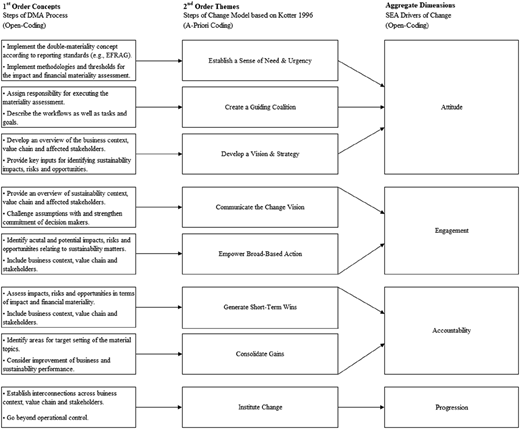
The data analysis was based on a thorough examination of the transcripts, field notes and source files. The steps of the DMA process were analyzed in several rounds of reading. In line with the above-described research aim, the authors specifically sought data on the implementation of the DMA and on how the individual steps lead to changes in strategy, operations and processes. The analytical procedure involved three coding steps based on abductive reasoning (Dubois and Gadde, 2002). At its core, this methodology is designed to allow categories and themes to emerge directly from the data itself combined with imposing preconceived theoretical frameworks (Dubois and Gadde, 2002). Figure 2 provides a graphical overview of the data structure of this paper.
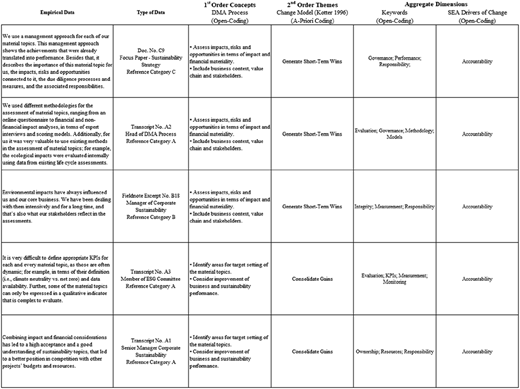
Following the approach of Dubois and Gadde (2002), the authors began with raw data and progressed through a three-step coding process. The first step involved open-coding of the data using interviews, observations, and archival documents, without applying a predetermined theoretical framework. This approach enabled a comprehensive understanding of the individual steps of NatureCo's DMA process and the identification of first-order concepts. In the second step, the authors engaged with the relevant theoretical framework, applying a priori coding to aggregate the first-order concepts into second-order themes using Kotter's (1996) eight-step change model. In the third step, the first-order concepts and second-order themes were distilled into aggregate dimensions through open-coding using keywords. These aggregate dimensions were termed “SEA drivers of change” and can be interpreted as a processual “grammar” foregrounding the socio-economic and political dimensions of DMA and moving beyond technical-rational models. Figure 3 illustrates this abductive reasoning to provide a clearer understanding of the methodology.
The “trustworthiness” of the data (Shenton, 2004) was ensured by addressing the criteria of credibility (internal validity), transferability (external validity), dependability (reliability) and confirmability (objectivity) through various research strategies. These included triangulation of data types and participants, the use of multiple investigators, transparency of the methodological approach and a rich description of the phenomena and context. Alternative explanations were also considered. Three investigators were involved, each taking on specific roles that enabled peer scrutiny. The first lead researcher was most deeply immersed in the empirical field, preparing the transcripts, field notes, and source files. The second lead researcher focused on the iterative process of data analysis and theory building. At major milestones, in-depth discussions between the two lead researchers continued until consensus on the interpretations was reached. A third researcher acted as a “critical friend”, highlighting theoretical inconsistencies and offering new insights.
Findings
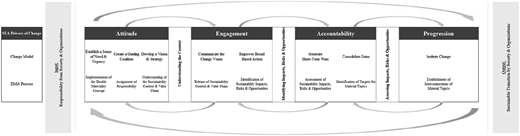
The findings highlight how DMA can act as a structured driver of organizational change. Table 2 introduces an enhanced DMA process model, developed from the empirical data of NatureCo and informed by Kotter's (1996) eight-step change model. Beyond mapping the steps of the DMA process, the table outlines key organizational requirements and challenges that surfaced throughout the empirical analysis. The following sections explore each SEA driver of change in detail, showing how they emerged from the empirical data and how they interact with organizational transformation processes. Each section is structured to reflect the connection between the DMA process, the corresponding change dynamics, and Kotter's (1996) change model.
Attitude
Attitude emerged as the first key driver of change in the enhanced DMA process model. In this context, attitude refers to how people within the organization feel and think about DMA and the broader sustainability topics that inform strategic decisions and transformative efforts.
In the initial stage of DMA, attitude was identified as essential for establishing a sense of purpose and urgency for effective implementation. Here, the authors draw on Kotter's (1996) description of establishing a sense of need and urgency. NatureCo's experience illustrates this. Having first conducted a comprehensive materiality assessment in 2015, the organization expanded the process in 2021 to include the double materiality concept. The motivation was not merely compliance, but rather the belief that aligning sustainability with financial performance improves strategic clarity. According to NatureCo, this alignment provides valuable insights for implementing policies, actions, metrics, and targets that should be included in any future organizational strategy. Furthermore, combining sustainability impacts, risks, and opportunities with areas of the organization that positively impact business value leads to greater agreement among decision-makers. As stated in NatureCo's Sustainability Report:
What distinguishes our sustainability topics is their all-embracing benefit. They maximize value creation from both the environmental, social and governance (ESG) as well as the economic perspective. This universal approach is the future of our industry (Ref. Cat. C, Sustainability Report, Doc. No. C6).
However, translating the abstract double materiality concept into practice posed difficulties. Several interviewees noted the difficulty of establishing scoring criteria and thresholds for impact and financial materiality assessments, for example:
We asked ourselves to what extent the impacts, risks and opportunities can be realistically assessed in terms of scale, scope, irremediability and likelihood, and what the limits of the financial assessments are (Ref. Cat. A, Formal Interview, Transcript No. A1).
As the process evolved, it became clear that assigning responsibility across departments was a critical factor. This step aligns with Kotter's (1996) notion of forming a guiding coalition, which is a team capable of driving the change effort forward. At NatureCo, cross-departmental involvement was essential, as explained by the head of the DMA process:
We observed that the more colleagues were involved in the process, the higher the acceptance and the trust in the results were. In our materiality assessment process of 2021, around 40 colleagues were involved, all of whom are also affected by the outcome of material topics and their operational implementation. Even if such a process is expensive and intensive, it pays off (Ref. Cat. A, Formal Interview, Transcript No. A2).
Yet, sustainability teams at NatureCo often faced challenges regarding internal positioning and legitimacy. Barriers included hierarchical inertia, a limited understanding of sustainability across departments, and workload constraints. Nevertheless, the team remained strongly committed to the process. In an informal conversation, a senior manager in corporate sustainability explained:
Our department and the DMA process itself are often not seen on par with, for example, risk management or other departments. This might be due to the wide range of sustainability concerns that make it difficult for colleagues to classify them or understand their further effects (Ref. Cat. B, Informal Interview, Fieldnote Excerpt No. B1).
The third relevant step in the enhanced DMA process model is understanding the organizational context and value chain. Participants emphasized the importance of viewing materiality as a business opportunity tied to vision, future strategy, and governance rather than as a compliance requirement. The empirical analysis suggests that understanding the sustainability context is particularly aided by clarifying how the future differs from the past in terms of policies, actions, metrics, and targets, as well as how sustainability is linked to the organization's overall culture. This aligns well with Kotter's (1996) third step in his change model: “developing a vision and strategy.” To get a sense of “the big picture,” a member of the ESG committee emphasized the importance of not isolating the DMA process from the rest of the business:
Instead of seeing our DMA process as an exercise that has to be executed due to new regulations, the greatest benefit comes from using it as a strategic business tool (Ref. Cat. A, Formal Interview, Transcript No. A3).
Another key aspect identified in the empirical material is the role of organizational understanding in determining the scope of stakeholder inclusion. Those with a deeper grasp of the organization's sustainability context were better able to define meaningful value chain relationships and identify stakeholders whose perspectives are essential for a robust DMA process. However, the evidence also highlights persistent tensions. Stakeholder engagement is often costly, resource-intensive, and time-consuming. This creates incentives to prioritize easily accessible or institutionally powerful actors, such as shareholders, supervisory boards, and standard-setters. Despite these pressures, the findings also suggest that organizational coalitions dedicated to promoting sustainability can play a pivotal role in expanding the scope of engagement. In several instances, internal advocates insisted on including challenging-to-reach or more marginalized stakeholder groups, such as consumers or suppliers, arguing that their perspectives are vital for capturing the full range of sustainability impacts across the value chain. This dynamic underscore the importance of internal commitment and distributed responsibility in countering the tendency toward minimal or merely symbolic compliance. It also illustrates how, when taken seriously, DMA can serve as arenas of negotiation over which voices are heard, thereby influencing the organization's capacity for substantive rather than superficial change.
In summary, attitude emerges as a foundational driver of the success of a DMA process. Evidence shows that attitudes are not static but evolve as the process unfolds. This evolution is shaped by three interrelated dynamics. First is the recognition of the need for and urgency of change. Second is the creation of a committed coalition that distributes responsibility across the organization. Third is the strategic framing of sustainability as integral to long-term value creation rather than as a compliance exercise. Together, these dynamics underscore the influence of shifting mindsets on the perceived legitimacy of the process and the organization's ability to incorporate sustainability into its broader strategy.
Engagement
The second SEA driver of change that emerged from the analysis is engagement. A strong, organization-wide commitment to the DMA process and identified sustainability topics is essential to fostering meaningful change.
In the enhanced DMA process model, the fourth step is the formal announcement of the sustainability context, value chain, and affected stakeholders by senior decision-makers, which corresponds to Kotter's (1996) “communication of the change vision”. At NatureCo, the Chief Executive Officer and the Managing Board publicly endorsed and released these results. Observational evidence further indicated that this top-level involvement was reinforced by a culture of transparency manifested through multiple communication measures directed both internally and externally. Early and iterative integration of management ensured strong commitment and enhanced authenticity and credibility. However, such involvement introduced complexity as senior leaders often demanded clear connections between sustainability issues and business value. In the course of fieldwork, a sustainability manager reflected:
When communicating with the management, positive and negative effects in the context of sustainability must be possible to explain. That’s why a good database is needed and, above all, the connection to the business value (e.g. what is the financial return of dealing with this topic?) (Ref. Cat. B, Informal Interview, Fieldnote Excerpt No. B2).
The fifth step of the enhanced DMA process model is to identify the actual and potential impacts, risks, and opportunities across the value chain and affected stakeholders. This results in a comprehensive “long list” of sustainability topics. As stated in NatureCo's Focus Paper – Materiality Analysis:
Around 300 internal and external trends and topics in the environment, social and governance (ESG) domain were identified for the present and future; these were considered as well as customer enquiries, questionnaires and topics of conferences, events, specialist journals, internal analyses, and much more. The internal risk assessment was also included (Ref. Cat. C, Focus Paper, Doc. No. C12).
This step reflects what Kotter (1996) describes as “the empowerment of broad-based action”, where individuals are motivated to contribute and aligned around a shared goal. In practice, the analysis showed that this required addressing anxieties and knowledge gaps directly. In particular, a lack of sustainability qualifications among staff created delays and misunderstandings, underscoring the importance of targeted capacity-building. Another challenge was the resource-intensive nature of stakeholder engagement. Yet, documents and observations consistently highlighted that stakeholder dialogues were seen as indispensable, for example:
Engaging in a dialogue means respecting stakeholders, contributing our expertise and knowledge, and taking the opportunity to learn from other perspectives. Each stakeholder dialogue starts with providing transparent information, supporting internal and external stakeholders to form an educated opinion, and to avoid misunderstandings by building trust. Furthermore, stakeholder relationships built on trust and openness help solve existing tensions and avoid potential conflicts (Ref. Cat. C, Focus Paper, Doc. No. C14).
In summary, engagement is a key enabler of organizational change within a DMA process. The findings reveal two interrelated dynamics that shape its effectiveness. First is the visible commitment of decision-makers, which provides authority and legitimacy. This should create transparent communication channels and feedback loops that foster shared understanding across the organization. Second is the cultivation of trust-based relationships with stakeholders when identifying relevant sustainability impacts, risks, and opportunities, which expands perspectives and strengthens the credibility of outcomes. Together, these dynamics demonstrate how engagement can transform the DMA from a procedural requirement into a catalyst for organizational learning and strategic renewal.
Accountability
In the enhanced DMA process model, accountability emerged as the third SEA driver of change. In this context, accountability refers to the responsibility of managing, measuring, and monitoring identified sustainability topics (e.g. policies, actions, metrics, and targets), as well as the ability to provide a clear rationale for these activities.
The sixth step of the model emphasizes the importance of evaluating material sustainability impacts, risks, and opportunities based on impact and financial materiality. This process yields a “short list” of prioritized topics integrating value chain and stakeholder perspectives, forming the basis for structured sustainability management. Kotter (1996) describes this stage as generating short-term wins, which are visible successes that can be communicated to enhance credibility and foster confidence. When assessing impacts, risks, and opportunities, organizations may find it easier to highlight the visible successes they have already achieved in their sustainability transition. However, the findings suggest that real change requires embedding accountability in concrete policies, actions, and performance measures (i.e. metrics and targets), rather than relying on short-term validation. Thus, the DMA process should ensure that identified sustainability topics lead to structured implementation strategies that integrate sustainability into core business practices. As stated in NatureCo's Focus Paper – Sustainability Strategy:
We use a management approach for each of our material topics. This management approach shows the achievements that were already translated into performance. Besides that, it describes the importance of this material topic for us, the impacts, risks and opportunities connected to it, the due diligence processes and measures, and the associated responsibilities (Ref. Cat. C, Focus Paper, Doc No. C9).
Although these steps promoted alignment and transparency, challenges emerged. Data availability and quality were recurring obstacles. Some impacts required estimation, such as sourcing or supply chain effects, while others were constrained by sensitivities, such as cost data. Furthermore, the study revealed that relying on a single methodology, such as scoring models or stakeholder surveys, was insufficient. A combination of approaches, including expert interviews and life cycle assessments, increased acceptance and credibility, especially when aligned with familiar internal departmental practices. The head of the DMA process of NatureCo emphasized in our interview that:
We used different methodologies for the assessment of material topics, ranging from an online questionnaire to financial and non-financial impact analyses, in terms of expert interviews and scoring models. Additionally, for us it was very valuable to use existing methods in the assessment of material topics; for example, ecological impacts were evaluated internally using data from existing life cycle assessments (LCAs) (Ref. Cat. A, Formal Interview, Transcript No. A2).
Interestingly, the analysis underscored that accountability is shaped not only by technical processes, but also by organizational values and reputation. For example, long-standing attention to environmental issues within the firm influenced how stakeholders assessed and perceived sustainability priorities, thereby reinforcing internal commitment and legitimacy. In a reflective moment, a manager explained:
Environmental impacts have always influenced us and our core business. We have been dealing with them intensively and for a long time, and that’s also what our stakeholders reflect in the assessments (Ref. Cat. B, Informal Interview, Fieldnote Excerpt No. B18).
Target-setting is the seventh step in the model and was identified as essential to accountability. Building on Kotter's (1996) idea of consolidating gains and producing further change – “quick wins are only the beginning of what needs to be done to achieve long-term change” – the findings highlight the importance of setting quantitative and qualitative targets at different time intervals. However, challenges arose in defining robust KPIs due to shifting definitions and the limited measurability of certain topics. According to a member of the ESG committee:
It is very difficult to define appropriate KPIs for each and every material topic, as those are often dynamic, for example, in terms of their definition (i.e. climate neutrality vs. net zero) and data availability. Further, some of the material topics can only be expressed in a qualitative indicator that is complex to evaluate (Ref. Cat. A, Formal Interview, Transcript No. A3).
Despite these difficulties, explicitly linking sustainability targets to financial considerations was crucial. Framing sustainability in terms of revenues, costs, and risks facilitated budget allocation and resource mobilization, enhancing internal competition with other projects. In the interview, a senior manager in corporate sustainability commented:
Combining impact and financial considerations has led to a high acceptance and a good understanding of sustainability topics. This led to a better position in competition with other projects budgets and resources(Ref. Cat. A, Formal Interview, Transcript No. A1).
Furthermore, the results imply that accountability in DMA could be enhanced by using planning and monitoring tools (e.g. ESG-cockpits), integrating sustainability into controlling and risk management, and establishing sustainability-specific policies. Although some of these mechanisms were in place, the absence of integration between sustainability and financial targets in shared budgeting and forecasting processes indicates room for improvement.
In summary, accountability is a key driver of the DMA process, ensuring that identified sustainability topics are translated into tangible commitments and measurable actions. Findings show accountability operates through two interrelated mechanisms. First, it grounds assessments in clear methodologies and transparent evaluation practices. This converts quick wins into structured policies, actions, metrics, and targets that sustain momentum. Second, it embeds responsibility for outcomes into organizational routines, such as planning, budgeting, and risk management. Together, these mechanisms demonstrate how accountability transforms DMA from a one-time diagnostic exercise into an ongoing process of managing and monitoring change.
Progression
Progression is the fourth SEA driver of change in the enhanced DMA process model. It refers to the development or gradual advancement toward a more sophisticated state.
The final step emphasizes establishing interconnections among sustainability topics that extend beyond operational control. Empirical analysis indicates that clearly communicating the broader effects of individual sustainability topics, such as the societal impact of a biodiversity policy, is essential to embedding the DMA process within organizational culture and mindset. This aligns with Kotter's (1996) concept of “anchoring new approaches and instituting change”, which involves replacing old habits and ensuring that new behaviors, mindsets, and ways of working are established. The findings illustrate that NatureCo establishes inter-organizational partnerships to improve sustainability standards and transparency. As articulated in NatureCo's Focus Paper – Stakeholder Engagement:
We want to expand our partnerships and all stakeholders. The goal is to further raise sustainability standards and transparency. Close partnership with the value chain is a guiding principle of ours. This is because major challenges such as climate change can only be solved when everyone works together to tackle such challenges (Ref. Cat. C, Focus Paper, Doc. No. C14).
These efforts have influenced the organizational culture and mindset beyond operational measures. Interviewees reported heightened awareness of long-term consequences and commitment to sustainable resource use, reflecting the DMA process's broader impact on daily practices and decision-making. In a casual discussion, employees in sustainability management remarked:
Where I work, we try to make sure that the tree population does not decline. I don’t want people to act without thinking about the consequences (Ref. Cat. B, Informal Interview, Fieldnote Excerpt No. B21).
I work for a company that thinks sustainably and takes great care in using our precious resources (Ref. Cat. B, Informal Interview, Fieldnote Excerpt No. B21).
However, instituting such a change demands a holistic approach that engages multiple departments and requires continuous improvement. At NatureCo, challenges were observed, particularly the difficulty of maintaining a comprehensive view of material topics amid complex and dynamic sustainability considerations. Interviewees noted that the process can be overwhelming, underscoring the need for ongoing validation and refinement to ensure meaningful progress. For example, during the interview, the head of the DMA process highlighted:
Overall, DMA is a complex process, and considering the material topics in their entirety is even more complicated. We often have the feeling that we cannot see the wood for the trees and get lost in the details rather than making major progress. This is why it is essential to continually improve the process itself, and to constantly question the validity, as something changes almost daily in the area of sustainability (Ref. Cat. A, Formal Interview, Transcript No. A2).
These observations underscore that organizations which fully integrate the DMA process – considering both broader contextual and operational factors – are better positioned to respond to evolving environmental and societal conditions, thereby enhancing organizational resilience over time.
In summary, progression is essential for advancing a DMA process. Evidence shows that it is continuous and multidimensional. Progression deliberately expands sustainability considerations beyond operational control, embedding them into daily practices and organizational culture. A DMA process should continually adapt and refine to respond to evolving environmental and societal contexts. Progression underscores how sustained advancement strengthens an organization's ability to drive meaningful improvements in sustainability performance.
Discussion
This paper's central contribution is its theorization of DMA as a dynamic organizational change process rather than a static or technical compliance activity. Based on extensive empirical evidence from NatureCo's iterative DMA implementation and established institutional and organizational change theory (e.g. Argyris and Schön, 1978; DiMaggio and Powell, 1983; Kotter, 1996; Maitlis and Christianson, 2014; Teece et al., 1997; Thornton and Ocasio, 2008), the study presents a processual “grammar” for DMA that moves beyond conventional reporting models. Grounded in the key drivers of change that emerged from the longitudinal analysis – attitude, engagement, accountability, and progression – this grammar is presented here as both an analytical framework and a practical vocabulary for organizational transformation.
Much early literature implicitly expects that materiality could be settled by consensus or technical definition (Carpenter et al., 1994; Eccles, 2020; Lai et al., 2017). However, the findings underscore the force of what Stocker et al. (2020) describe as “calculative struggle”, in which meanings and thresholds remain in flux and are resistant to closure. The pluralism that Giacomini et al. (2025) and Puroila and Mäkelä (2019) highlight in SEA is not an abstract risk but a lived organizational reality. Competing logic, shifting interests, and interpretive ambiguity persist throughout the process. Rather than eliminating this indeterminacy, the proposed grammar formalizes it by structuring but never resolving the tensions that define materiality as a site of organizational conflict and a generator of new possibilities and organizational change.
By proposing said grammar based on the findings of key drivers of change, this paper pursues three interrelated objectives. First, it establishes a robust conceptual foundation for viewing DMA as an organizational change process, emphasizing its generative, negotiated, and recursive qualities rather than treating it as an isolated technical routine. Second, it provides an empirically grounded grammar to clarify and structure future research on how organizations adapt, implement, and institutionalize DMA over time and across contexts. Third, by deploying and developing this grammar, the paper contributes directly to the broader literature on the organizational impacts of SEA, offering new insights into how DMA regimes catalyze, constrain, and shape organizational transformation rather than merely registering external demands.
The analysis that follows draws on the detailed structure of the findings to explain each element of the grammar. The analysis shows how attitude, engagement, accountability, and progression operate as dynamic, interdependent drivers that describe and theorize the DMA as an organizational change process. This advances the understanding of DMA's internal workings and equips researchers and practitioners with a conceptual toolkit for enacting and interrogating the organizational implications of SEA under evolving regulatory regimes.
Establishing DMA as an organizational change process
This paper's empirical analysis foregrounds DMA as an inherently processual and negotiated organizational change activity rather than a technical compliance function. This is evident in the recursive and sequential unfolding of the process at NatureCo. Each phase – beginning with attitude and extending through engagement, accountability, and progression – produces and reflects ongoing changes in strategic priorities, routines, and organizational culture. Attitude, as the entry point, highlights the importance of fostering an internal sense of urgency and strategic alignment regarding sustainability, thereby redefining an organization's role and responsibilities (Adams and McNicholas, 2007). The shift from a compliance-driven to a purpose-driven orientation is visible when NatureCo's leadership reframed DMA as a value-creating instrument rather than a regulatory burden. This is a dynamic that aligns with literature viewing materiality as a site of sensemaking and double-loop learning (Argyris and Schön, 1978; Maitlis and Christianson, 2014). However, the process does not unfold in isolation. Rather, it is embedded in a contested terrain of stakeholder interests, departmental boundaries, and ongoing resource constraints. This confirms the socio-political and negotiated character of materiality (Ardiana, 2021; Jebe, 2019; Reimsbach et al., 2020). Furthermore, engagement emerges not merely as participation but as the activation of distributed agency throughout the organization, foregrounding the importance and politics of inclusion (Brown, 2009; Stubbs and Higgins, 2014). In turn, accountability and progression reflect not only the delivery of measurable outcomes, but also the establishment of new routines and standards in everyday practice and organizational culture. This concept resonates with institutional logic and organizational learning (Bebbington and Fraser, 2014; Contrafatto and Burns, 2013; DiMaggio and Powell, 1983; Teece et al., 1997; Thornton and Ocasio, 2008). In sum, these findings confirm that, when understood through this framework, DMA constitutes a negotiated, recursive organizational change process. This view reorients scholarship and practice away from static compliance logics (see Figure 4).
It is important to acknowledge that any DMA grammar or model, no matter how systematic or theoretically robust, is fundamentally influenced by the ongoing negotiation of stakeholder interests and the contextual and ideological pressures that define organizational life (Boiral, 2021; Clark, 2021; Lehner et al., 2022). The contours of organizational change are not solely determined by process models but are continually shaped and reshaped by the plurality of actors, local contingencies, and broader societal currents in which materiality is embedded. This analysis highlights these dynamics as central and reflects on their limitations and significance when discussing the boundary conditions of conceptualization later in this paper.
Providing a grammar for future research on DMA
The four key drivers of change – attitude, engagement, accountability, and progression – that were distilled from the empirical analysis offer a structured grammar for conceptualizing and investigating the dynamics of DMA in future research. This grammar fills a persistent gap in the literature where processual, situated, and recursive understandings of SEA change are underdeveloped (Jørgensen et al., 2021; Passetti et al., 2018). It also enables comparative analyses across contexts, regulatory regimes, and sectors by providing a common, empirically validated vocabulary for coding, interpreting, and theorizing DMA as a process model.
Attitude serves as the initial point of departure, prompting research on the emergence and evolution of collective purpose, framing, and sensemaking in organizations adopting DMA (Argyris and Schön,1978; Contrafatto and Burns, 2013). Engagement directs scholarly attention toward the politics and practices of stakeholder inclusion, selection bias, and the distributive effects of participation (Brown, 2009; Stubbs and Higgins, 2014). Accountability highlights the various, and sometimes conflicting, methodologies through which DMA is implemented and validated within organizations, raising empirical questions about the interplay of technical tools (e.g. life cycle assessments (LCAs), surveys), data quality, and the stabilization of local standards (Bebbington and Fraser, 2014; Teece et al., 1997). Progression opens up inquiries into the anchoring, institutionalization, and routinization of DMA outcomes. This includes how organizations adapt or backslide over time and how the process catalyzes or constrains wider sustainability transitions (DiMaggio and Powell, 1983; Lozano, 2013). By providing this framework, this paper encourages future research to move beyond outcome-oriented studies and instead trace the contested and recursive work of DMA within and across organizations.
Table 3 further clarifies how the empirically grounded grammar advances the conceptualization of DMA by synthesizing the four key drivers of change – attitude, engagement, accountability, and progression – through analytical lenses of processual, situated, and recursive understandings of SEA. Mapping the grammar across these dimensions demonstrates how each driver structures the temporal sequencing of the DMA process, embeds it within specific institutional and organizational contexts, and enables ongoing adaptation and learning.
Advancing organizational impact research under DMA regimes
Finally, this grammar-based perspective enriches the literature on the organizational impacts of SEA. It illuminates how DMA regimes generate external disclosures and reshape internal organizational dynamics, power relations, and trajectories of change (Bebbington and Fraser, 2014; Contrafatto and Burns, 2013). By embedding DMA within an enhanced DMA process model based on attitude, engagement, accountability, and progression, this paper clarifies how SEA requirements can catalyze, rather than merely represent, organizational transformation.
Attitude and engagement clarify the circumstances in which DMA can stimulate organizational learning and reflexivity (Argyris and Schön, 1978) rather than defensive routines or mere compliance (Meyer and Rowan, 1977; Lozano, 2013). Accountability highlights the potential for meaningful implementation through new policies, actions, metrics, and targets, as well as the limits imposed by data quality, methodological pluralism, and internal contestation (Ferrero-Ferrero et al., 2021; Zharfpeykan, 2021). Progression reveals the difficulty of institutionalizing new sustainability practices and the risks of mere formality or regression (Jebe, 2019; Jørgensen et al., 2021; Reimsbach et al., 2020).
Together, these studies not only theorize but also empirically demonstrate how a DMA process can guide organizations from symbolic compliance to routinized, resilient, and substantive sustainability transformation. This advances the literature by articulating a set of mechanisms linking external reporting mandates to internal organizational change. It provides a conceptual and empirical foundation for future research and practice.
Table 4 presents a comparative analysis of the SEA drivers of change – attitude, engagement, accountability, and progression – against classic frameworks such as Kotter's (1996) eight-step change model and other influential models to clarify how the empirically derived grammar differentiates and extends itself from established models of organizational change. Furthermore, it shows how each driver, while resonating with familiar change management constructs, adds distinctive analytical depth to the context of DMA in SEA. By explicitly contrasting these dimensions, this paper shows how the grammar enables a more nuanced understanding of materiality work by foregrounding issues of iterative transformation, power, local negotiation, and reflexivity. This comparative perspective situates the contribution of this paper within broader institutional and organizational theory and highlights the conceptual advances needed to address the unique challenges of sustainability transitions.
Boundary conditions, limitations, and future research
Although the grammar of attitude, engagement, accountability, and progression redefines DMA as an open-ended organizational change process, it is crucial to define the contingencies and scope of this conceptualization. The existing SEA literature both affirms and provokes such a move but also points to institutional, organizational, and methodological boundary conditions that mediate the enactment and limits of materiality work.
Though the grammar of this paper provides a framework for analyzing the organizational impact of DMA, it does not resolve the inherent contestation and ongoing negotiation that define the concept of materiality (Hicks, 1964; Puroila and Mäkelä, 2019; Stocker et al., 2020). Instead, it provides a processual lens for investigating how ambiguity, contextual pressures, and stakeholder plurality are continually renegotiated within organizations.
Early empirical studies of materiality in SEA (e.g. Adams and McNicholas, 2007; Daub, 2007) primarily interpreted assessment as a procedural or technical undertaking. These studies were often focused on improving compliance with emerging standards, disclosure quality, or stakeholder legitimacy. However, recent scholarship (e.g. Jørgensen et al., 2021; Passetti et al., 2018; Puroila and Mäkelä, 2019) has begun to foreground the social construction, contestation, and political economy of materiality. The processual, recursive, and deeply embedded nature of materiality has only recently begun to be systematically addressed (Ardiana, 2021). The findings of this paper corroborate these early claims and suggest that technical rationality alone is rarely sufficient. Rather, the effectiveness of DMA depends on pre-existing attitudes, the authenticity and inclusivity of engagement practices, an organization's capacity to stabilize accountability measures amid plural rationalities, and its ability to sustain progression in the face of institutional inertia and resource constraints.
Unlike models that posit a linear progression from awareness to institutionalization (e.g. Kotter, 1996; Lewin, 1947), this grammar shows that recursive cycles of adaption, negotiation, and sensemaking, are generative and necessary but vulnerable to ceremonialism, co-optiation, and regression (e.g. DiMaggio and Powell, 1983; Meyer and Rowan, 1977). This follows Ardiana's (2021) call for an approach that “acknowledges and preserves dissent”, which is true to the sociopolitical nature of materiality.
Studies frequently document “tick-box” DMA, selective stakeholder inclusion, and the ritualization of engagement as symbolic compliance (Brown, 2009; Stubbs and Higgins, 2014). This research cautions against assuming that the presence of foundational drivers for change in DMA guarantees such change. Boundary conditions such as organizational hierarchy, powerful counter-ideological actors, missing data infrastructure, external assurance regimes, and prevailing field-level logics can block, distort, or enable the iterative embedding of new materialities in organizational practices (Ferrero-Ferrero et al., 2021; Modell, 2022).
Furthermore, it is important to acknowledge the limitations of the empirical design to capturing organizational change. The findings are based on the retrospective accounts and perceptions of the key individuals involved in the DMA process and are supplemented by a limited but embedded longitudinal tracking of outcomes. Thus, this research documents narratives of desired or perceived change that unfold rather than presenting calculable evidence of structural transformation. This distinction is critical because organizational change is dynamic and iterative, shaped by multiple factors over time.
This paper is based on an in-depth, single-case analysis within a specific organizational and regulatory context. While revelatory, this approach raises questions about the generalizability and transferability of the findings. Although the grammar is empirically and theoretically grounded, it may function differently in different geographies, industries, and institutional settings, especially when cultural, regulatory, or resource conditions differ from those examined here. Methodologically, the focus on processes emphasizes organizational dynamics and routines while macro-structural factors, policy feedback effects, and long-term unintended consequences receive less attention.
These boundary conditions should be viewed not only as limitations, but also as prompts for further research. Future scholarship could explore how the proposed grammar operates across diverse institutional and organizational contexts, identifying enablers and critical thresholds. For example, under what conditions does “attitude” translate into sustained reflexivity rather than rhetorical compliance? How might “engagement” evolve from symbolic inclusion to the redistribution of authority and voice, particularly in multilevel or transnational settings? To what extent do “accountability routines” serve as learning devices versus ossified bureaucratic artifacts? How can “progression” be maintained amid shifting economic and political landscapes? Comparative and longitudinal designs, as well as multi-actor and multi-scalar approaches, are necessary to investigate contingencies, exceptions, and paradoxes.
Future work should also examine how emerging technologies, evolving stakeholder expectations, and regulatory shifts reconfigure the boundaries and effects of DMA. Finally, future research should explore the possibility of co-opted or subversive effects. This includes instances where the grammar itself is resisted or used in a way that diminishes its transformative potential.
In sum, the proposed grammar offers conceptual scaffolding that is sensitive to boundary conditions and adaptable to diverse contexts. Mapping the dynamic interplay between these drivers and the often unruly realities of organizational life can advance critical theory and provide practical insight into the organizational impact of SEA under DMA regimes.
Conclusion
This paper conceptualizes DMA as an organizational change process, moving beyond the prevailing view that materiality is merely a technical or compliance-driven exercise. Through the deployment and development of an empirically grounded grammar, this research demonstrates that DMA is a dynamic, negotiated, and recursive transformation capable of shaping the internal workings and external legitimacy of organizations navigating new sustainability regimes.
This paper's principal theoretical contribution is articulating this grammar as a conceptual and practical framework for understanding and researching the institutional and organizational impact of in-depth, stakeholder-driven DMA as a basis for future sustainability activities. Rather than treating materiality as a static artifact, the enhanced process model emphasizes DMA's processual, situated, and open-ended qualities. It highlights the enactment of organizational routines, the politics of stakeholder engagement, and the importance of recursive accountability and progression. In practice, the grammar provides a structured yet flexible approach to integrating sustainability into core organizational systems and decision-making processes, shifting organizations from symbolic compliance to substantive transformation.
Importantly, the insights presented here are shaped by the boundary conditions and methodological limitations discussed in the previous section. These constraints, including the process-focused methodology, retrospective perspectives, and single-case context, delimit and guide the interpretation of the grammar. This opens opportunities for future research to explore how the grammar operates across diverse institutional and organizational settings.
In conclusion, by theorizing DMA as an organizational change process, this study opens new avenues for impactful SEA research and practice. The advanced grammar invites scholars and practitioners to pay closer attention to the adaptive, political, and processual realities of DMA while remaining attentive to the contingencies and contextual factors that may influence its effectiveness and enactment in the ongoing pursuit of organizational and societal sustainability.
Ethical approval
The Ethics Committee of the Hanken School of Economics in Helsinki waived ethical approval in view of the retrospective nature of the study. The authors followed best practices for data protection and received informed consent from all interviewees.
Notes
Alternatively, “social and environmental accounting (SEA)” can be called “social and environmental accounting and reporting (SEAR)”, “corporate social responsibility (CSR) accounting and reporting”, or, more recently “environmental, social and governance (ESG) accounting and reporting” (Adams, 2020; Burritt and Schaltegger, 2010; Christensen et al., 2021). For consistency purposes, we use “social and environmental accounting (SEA)” throughout this paper.
The original name of the company has been anonymized.