


This study aims to offer a bibliometric and coding analysis of blockchain articles published in the accounting, auditing and accountability fields.
The data were collected using the Scopus database and a bibliometric and qualitative coding analysis with the keywords “blockchain” and “accounting” or “auditing” or “accountability.” Of the 514 initial sources, 93 peer-reviewed papers, book chapters and conference proceedings in the areas of business, management and accounting were finally selected. Nonscientific sources such as nonpeer-reviewed books and white papers were excluded.
This study reveals a promising and multidisciplinary field of research dominated by scholars and less by practitioners. Qualitative research, especially discourse analysis, is the most used method among authors. This study gives some useful insights about blockchain's definition and characteristics, business models, processes involved, connection with other technologies and relationships with accounting theories. Among the most interesting insights, the results confirm that technology as an external force can create an intersection among several research areas: accounting, auditing, accountability, business, management, computer science and engineering fields. Finally, in terms of research themes, although blockchain has a clear effect on auditing accounting, the links with the area of accountability are less clear and validated.
This study highlights the current state of the field, combining methodological approaches and providing valuable future research insights. Additionally, it is also a starting point for professionals to fully understand blockchain's characteristics and potential with a constructive and systemic approach.
1. Introduction
Blockchain is one of the most disruptive digital technologies (Carson et al., 2018; Ruzza et al., 2020), and interest in its applicability and effects has grown both from practitioners and academics. Therefore, research on blockchain has spread widely in recent years. There is increasing interest in studying company results and experiences following the introduction of blockchain-related technologies (Casino et al., 2019; Dal Mas et al., 2020b; Marrone and Hazelton, 2019; Schmitz and Leoni, 2019).
The first relevant paper in this field, Haber and Stornetta (1991), proposes practical calculation procedures for the digital time-stamping of documents. More recently, Nakamoto (2008) applies an archetype based on distributed consensus (i.e. distributed ledger technology) validation compared with a centralization model for a new parallel payment system. While much research investigates cryptocurrencies, further developments for distributed ledgers, its business model's validity and applicability are still being studied in several sectors (Dal Mas et al., 2020b; Saberi et al., 2018).
Considering the literature reviews by Casino et al. (2019), Lombardi et al. (2021) and Xu et al. (2019), most existing studies focus on the possible implementation of this technology because of its technical and managerial specifications in auditing, medicine, supply chain, the energy sector and fintech, above all.
Although there is beneficial interest motivated by the possible reduction of costs in the accounting, auditing and accountability field, many elements still need clarification. For example, according to Kokina et al. (2017), one of the first research problems concerns accounting data ownership and transparency in their decentralization. Besides, blockchain's characteristics and definitions in this area are unclear (Kokina and Davenport, 2017; Schmitz and Leoni, 2019). Still, few studies question which theoretical areas of accounting blockchain are persisting (Bonsón and Bednárová, 2019). These critical issues flourish as we face this new and interdisciplinary research topic driven by exogenous forces inherent in society. Guthrie et al.'s (2019) commentary reflections cite Roos's (2015, p. 49) opinion that, in the next 10–15 years, we will see changes driven by technology, creating opportunities and threats that will require new and curious approaches from researchers.
Starting from these premises, this study aims to offer a bibliometric and open coding analysis of articles published in accounting, auditing and accountability to understand the state of the art, new research trends, future avenues and critique the research dialogue around these issues. It proposes a broader investigation that includes the study of the primary bibliometric data and coding analysis (Dal Mas et al., 2019; Massaro et al., 2016) of peer-reviewed journal articles, book chapters and, because of the novelty of the field, conference proceedings listed on Scopus.
Results show a multidisciplinary field, still mainly dominated by research scholars, using mainly discourse analysis. The study offers some useful insights about the new possible business models and processes involved. Despite significant interest in the accountability field, accounting and auditing procedures are the most involved in the blockchain revolution. However, as Guthrie et al. (2019) discuss, this area shows scarce theoretical propensity. Addressing the topics of the special issue “Accounting, accountability and assurance: Blockchain and new forms of digital currency,” our study is novel for several reasons. First, it demonstrates the need for more accurate and updated investigations in a young research stream with disruptive implications for organizations, accountants and auditors. Second, our results suggest future research avenues for scholars in the field. Finally, as Guthrie et al. (2019) indicate, it enhances the Accounting, Auditing and Accountability Journal's (AAAJ's) discussion of this new interdisciplinary research topic's potential effect on the field's future.
The remainder of the paper is structured as follows. Section 2 describes the current literature and why bibliometric analysis using open coding methods may facilitate our research aims. Section 3 defines the means and standard workflow used. Section 4 presents the results. Moreover, section 5 provides an in-depth data interpretation, comments and critique on the main findings. Finally, section 6 concludes with a summary of the current state of the art and suggestions for future research.
2. Background
Much time has passed since Nakamoto's (2008) white paper on blockchain's first cryptocurrency application. Almost 12 years later, the uses of blockchain are innumerable and involve different business sectors. Its effects and benefits have also been studied by accounting, auditing and accountability literature. Whereas some scholars investigate the effects in the accounting and auditing profession (Demirkan et al., 2020; Kokina et al., 2017; Marrone and Hazelton, 2019; O'Leary, 2017), others focus on models, architectures, security and real-time discussion for transaction information in a blockchain consortium (Dai and Vasarhelyi, 2017; Lemieux et al., 2020; Rooney et al., 2017). The AAAJ has also fostered this research. Guthrie et al. (2019) state that many challenges lie ahead, especially in technology. In this sense, Arnaboldi et al.'s (2017) study also notes that the technology revolution will change organizations, individuals and accounting through increased automation.
Free and Hecimovic (2021) outline the situation of the post-COVID-19 supply chain. Among the research agendas, an interest in new blockchain-related studies emerges. Finally, albeit in a different scope, Kotb et al.'s (2020) structured literature review examines research related to artificial intelligence (AI), paving the way for an open discussion on the effects of technology.
In terms of literature reviews published in other sources, some consider this field using different lenses and focus. For instance, Miau and Yang's (2018) article discusses 801 documents gathered from Scopus using keywords such as “Blockchain,” “Bitcoin,” “Ethereum,” “Hyperledger,” “Cryptocurrency” and “Smart contracts.” They review the literature growth and productivity in blockchain technology using the Scopus database. The study identifies three stages of blockchain research flows. From 2013 to 2018, they highlight the relevance of Bitcoin and cryptocurrencies.
Bitcoin research grew from 2014 to 2015. Finally, after 2016, researchers focus mainly on blockchain techniques and smart contracts. Xu et al.'s (2019) analysis reviews 756 academic research papers on blockchain retrieved from the Web of Science database using bibliometric and cluster analysis. They explore the top-cited papers, most productive countries and most common keywords used. Additionally, authors using clustering analysis focus their investigation on the fintech revolution and sharing economy.
Examining the accounting, auditing and accountability literature, Schmitz and Leoni's (2019) article is one of the first to provide scholars with a structured research plan. They bring together authors who currently appear to support blockchain and others who consider the technology harmful to accounting and auditing work. Starting from reports by professionals and literature, they focus limitedly on governance, transparency and trust, continuous audits, smart contracts and accountants and auditors' roles in the emerging blockchain ecosystem.
Using a quantitative approach, Marrone and Hazelton (2019)'s study explores the link between the terms “technology” and “disruption” in the accounting literature, highlighting the research now dealing with blockchain and the aims of managing it. Consistent with our results, their investigation invites future scholars to identify application cases.
Zemánková (2019)'s analysis reviews the literature on blockchain and AI in accounting, focusing on smart contracts and smart audit procedures, highlighting current applications and tools developed by practitioners.
Additionally, Arnaboldi et al.'s (2017) contribution stimulates the conversation between academics and accountants considering business processes and digital interactions identifying, for example, the role of big data information and decision-making processes.
Furthermore, Fuller and Markelevich (2020) focus on the scalability of blockchain at an acceptable cost in accounting and auditing by fixing business applications to the accounting model. Nofer et al. (2017) identify a disruptive innovation among blockchain's implications that affects existing business models. Finally, Lombardi et al.'s (2021) recent research presents a systematic literature review of the effect of blockchain technology in the auditing field. As suggested by the authors, future research works could deepen the investigation field, leading to additional keywords and results.
Considering all these reviews, our study aims to find bibliometric variables and apply coding analysis to investigate the research methodologies implemented; new business models involved; business processes; blockchain characteristics, types and definitions; connections with other technologies; the leading related accounting theories and implications.
As Zupic and Čater (2015) and Massaro et al. (2016) suggest in their literature and bibliometric analyses, researchers might be interested in representing a static picture by providing answers about the history of the field of research under investigation by considering the bibliographic coupling of authors, keywords and citations. Therefore, our first research question (RQ) is as follows:
What are the main features of the literature lying at the intersection between blockchain and accounting, auditing and accountability?
Furthermore, as Börner et al. (2003) suggest, the analysis of the research topics and the authors' cognitive structure could be studied to understand the research field's development status. Therefore, our second RQ is as follows:
What are the most frequent issues and themes/topics of this literature?
Finally, as Massaro et al. (2016) and Paul and Criado (2020) state, each review should develop an understanding of the literature's future by highlighting possible theoretical and practical implications for researchers. Therefore, our third RQ is as follows:
What seem to be the possible implications for future research in this field?
This analysis is different from previous literature reviews for several reasons. First, we aim to provide an in-depth discussion considering the accounting, auditing and accountability fields. Second, we aim to go beyond the mere bibliometric description of variables such as authors, countries and keywords. For instance, as in Secinaro and Calandra's (2020) and Zaheer et al.'s (2019) studies, our study offers broad perspectives on past research methodologies to address future research challenges. Besides, our analysis focuses on blockchain business processes in the field under study and not just applications (Casino et al., 2019). Still, we analyze the characteristics of blockchain while providing indications of the definitions and technical structures most used in the literature. Furthermore, our analysis looks beyond blockchain and attempts to define, whenever possible, a connection with other technologies paving the way to new future research. Finally, we aim to explain what definitions of accounting theory are most used.
3. Methodology
This study adopts a hybrid methodology, quantitative and qualitative, combining bibliometric and code analysis (Cobo et al., 2011; Massaro et al., 2016). The first step to answering the three RQs was to create a review protocol. According to Hoque (2014) and Tranfield et al. (2003), authors should explain the entire review process to facilitate replication. Therefore, we adopt Massaro et al.'s (2016) model to increase the reliability of the representation of the results. Table 1 shows the protocol and all the steps of the study. The subsequent paragraphs explain the dataset creation, the tools used to implement the analysis and how the open codes were created.
Research protocol
| Review protocol elements | Authors' consideration |
|---|---|
| What is already known? (Step 1) | A lot has been achieved since the first study on practical calculation procedures for the digital time-stamping of documents (Haber and Stornetta, 1991). The discussion on the blockchain is further boosted by the distributed consensus study by Nakamoto (2008) and began to be developed in accounting and budgeting with the studies of Marrone and Hazelton (2019) and Schmitz and Leoni (2019) |
| Motivation (Step 2) | Blockchain is known as one of the most disruptive digital technologies. Numerous studies have been conducted in different research fields. Although literature reviews also exist in accounting and auditing, no analysis currently combines bibliometric information analysis and insight with open coding analysis for the accountability field |
| Research topic (Step 3) | There is the potential for a bibliometric analysis and open coding analysis within the accounting, auditing and accountability field, which aim to address three research questions: RQ1: What are the main features of the literature in accounting, auditing and accountability? RQ2: What are the most frequent issues and themes/topic of this literature? RQ3: What seem to be the possible implications for future research in this field? |
| Journals' research (Step 4) | We have decided not to limit research to individual scientific journals because of the still young scope. We include in the analysis of peer-reviewed journal articles, book chapters and, due to the field's novelty, conference proceedings. Book chapters and white papers as nonpeer-reviewed sources were excluded Additionally, we selected business, management and accounting sources from the Scopus database filter |
| Tools (Step 5) | Bibliometrix R package and Deedose software |
| Open coding framework (Step 6) | Years, documents' information, sources, authors, keywords, citations, countries, blockchain's definition, research methodologies, new business models involved, business processes, focus, blockchain characteristics, type of blockchain and governance, connection with other technologies, accounting theory and implications |
Source(s): Authors' elaboration
3.1 Dataset creation
To garner relevant sources, the next vital step is keyword selection. Our analysis considers Blockchain and accounting, or auditing, or accountability as primary keywords. In a critical study published in the AAAJ, Dumay et al. (2018) state that scientific production in accounting includes and is extended to auditing and accountability. Furthermore, all researchers have benefited from Massaro et al. (2016)'s research strategy. Considering that we are analyzing an emerging and continually evolving field of research, we included all sources in the database, including peer-reviewed articles and conferences as sources of knowledge (Easterby-Smith et al., 2012). We used Scopus, a multidisciplinary database that includes the study of several data-suited information science researchers (Okoli and Schabram, 2010). The articles retrieved from Scopus were compared with the Web of Science database to ensure no significant sources were missed.
Additionally, we did not limit our analysis in terms of the research period, and we updated the scientific references to June 15th, 2020. Applying all these features, we created a working list of 514 sources. However, the final flow benefited from the following inclusion and exclusion criteria:
All articles had to be selected from the business, management and accounting fields because the RQs related strictly to these fields.
We considered peer-reviewed articles, reviews, papers from international conferences and books if they came from scientific sources as suggested by de Villiers and Dumay (2014, 2013) in case of an emerging research field.
We did not consider any nonscientific sources such as non-peer-reviewed books, white papers and popular articles.
Following these criteria, the final sample included 93 documents, which were investigated using the bibliometrics approach of studying the title and abstract.
3.2 Tools of analysis
Bibliometric analysis grew out of the need to consider and measure large amounts of numerous types of information, such as title, number of authors, keywords, number of citations, country and institutions, and collaboration in an unexplored or new research stream (Brookes, 1988; Pritchard, 1981). Therefore, we used it to address the first nodes' category.
Additionally, as Schulz and Nicolai (2014) stated, the bibliometric approach makes it possible to analyze the degree and direction of a particular field and is particularly suitable for the second RQ. Therefore, the goal is to analyze the growing literature evidence in blockchain strictly connected with accounting, auditing and accountability.
At the same time, we combine this approach with the open coding procedure as suggested in Massaro et al. (2016)'s research.
The bibliometrix R package and biblioshiny app, widely used in the literature by several studies (Secundo et al., 2020), are used to analyze the bibliographic data for the first coding group (Aria and Cuccurullo, 2017). Finally, for coding analysis, we use the Deedose web application particularly suitable for ensuring that the inter-rater reliability (IRR) links with the degree of consistency in how the code system is applied (Talanquer, 2014). In the next subsection, we provide an analytical description of the coding framework adopted.
3.3 Open coding creation
To deepen the analysis, we define a reliable framework (Biancone et al., 2019b; Dal Mas et al., 2019; Dumay and Cai, 2014; Guthrie and Abeysekera, 2006; Kotb et al., 2020; Massaro et al., 2016). All the analyses are based on the classification of nodes' group, which aims to guide the readers addressing the aims of this study (Dal Mas et al., 2019). According to Massaro et al.'s (2016) methodological paper, reviews should adopt a coding framework for analyzing articles. Besides, as Stanley (2001) specifies, the reduction in the study sample requires the identification of analysis nodes that aim to synthesize the knowledge flow characteristics.
To ensure the reliability of the coding analysis, we introduced Krippendorff's a (Krippendorff, 2013) calculated on each researcher's results. This verifies the reliability measure obtained from the content analysis, positive for values between a = 0.667 and a = 0.800.
The authors made coding decisions considering three essential sources.
First, implementing bibliometric analysis makes it possible to derive useful information such as time period, documents' information, sources, authors, keywords, citations and countries. Therefore, based on the results obtained and from the theory, we created the first category of nodes similar to Guthrie et al. (2012), Massaro et al. (2015) and Secinaro et al. (2020).
Second, we consider internal validity. Starting with a small sample of papers, we created a few nodes based on an in-depth analysis of the title, abstract, introduction and conclusion (Guthrie and Murthy, 2009).
Third, in line with the literature, we consider external validity. Therefore, all the codes created are tested and verified, considering theory and previous studies (Campra et al., 2020; Serenko and Dumay, 2017).
Based on this framework, it is possible to deepen the analysis and create more detailed coding groups. Additionally, the second and third groups are related to the authors' definition and method in their analysis, similar to Zaheer et al. (2019). The fourth is associated with the business model and process related to blockchain used by Massaro et al. (2020). This node's group comes from Fuller and Markelevich (2020) and Arnaboldi et al. (2017). The fifth node's group is related to the study's focus considering accounting theory as suggested in Dumay et al. (2018)'s milestone paper, which asserts that accounting theory also includes auditing and accountability. The sixth node's group is about blockchain characteristics, types and governance similar to Dal Mas et al. (2019) and considering O'Leary (2017), Xu et al. (2019) and Reijers et al. (2016)'s classifications. The seventh node is related to possible connections with other technologies used by Massaro et al. (2016) and van Helden and Uddin (2016). Finally, the eighth node investigates the link between blockchain and accounting theory considering Wild et al. (2012). Additionally, these nodes will shed light on blockchain's implications considering theory, practice and policy.
To create these research nodes, we coded each source following the framework detailed above. All the authors discussed and confirmed the coding list, as reported in Table 2.
Research framework
| Group | Category | Variables | Specifications | Results (n°, %) |
|---|---|---|---|---|
| 1 | Bibliometric data | Main information | Years | – |
| Document types | – | |||
| Sources | ||||
| Dominance ranking | – | |||
| Keywords | – | |||
| Authors | Collaboration | – | ||
| Mixed | 7 (3%) | |||
| Authors' affiliation | Practitioner | 28 (13%) | ||
| Scholar | 175 (83%) | |||
| Citations | ||||
| 93 (100%) | ||||
| 2 | Blockchain's definition (a = 0.795) | Yes | 36 (39%) | |
| Not specified | 57 (61%) | |||
| 3 | Research methodologies (a = 0.667) | Action research | 5 (5%) | |
| Case study | 5 (5%) | |||
| Discourse analysis | 33 (35%) | |||
| Interviews | 1 (1%) | |||
| Literature review | 11 (12%) | |||
| Mixed method | 2 (2%) | |||
| Modeling | 21 (23%) | |||
| Other qualitative | 13 (14%) | |||
| Thematic | 1 (1%) | |||
| Viewpoint | 1 (1%) | |||
| 93 (100%) | ||||
| 4 | New business models involved (a = 0.795) | Not specified | 90 (97%) | |
| Yes | 3 (3%) | |||
| 93 (100%) | ||||
| Business process (a = 0.667) | Contracts | 4 (4.30%) | ||
| Finance | 9 (9.68%) | |||
| Governance | 5 (5.38%) | |||
| Human resources | 5 (5.38%) | |||
| Legal | 8 (8.60%) | |||
| Management and control | 40 (43.01%) | |||
| Procurement | 2 (2.15%) | |||
| Sales | 6 (6.45%) | |||
| Supply chain | 14 (15.05%) | |||
| 93 (100%) | ||||
| 5 | Focus (a = 0.667) | Accounting | 19 (20.43%) | |
| Auditing | 10 (10.75%) | |||
| Accountability | 4 (4.30%) | |||
| Both | 7 (7.53%) | |||
| Others | 53 (56.99%) | |||
| 93 (100%) | ||||
| 6 | Blockchain characteristics (a = 0.667) | Consensus mechanism | 18 (19%) | |
| Cryptographic hashing | 15 (16%) | |||
| Decentralization | 21 (23%) | |||
| Immutability | 18 (19%) | |||
| Transparency | 24 (26%) | |||
| Verifiability | 21 (23%) | |||
| 93 (100%) | ||||
| Type of blockchain and governance (a = 0.667) | Public | 12 (13%) | ||
| Private | 11 (12%) | |||
| Hybrid | 15 (16%) | |||
| Not specified | 55 (59%) | |||
| 93 (100%) | ||||
| 7 | Connection with other technologies (a = 0.667) | Yes | Artificial intelligence | 2 (2.15%) |
| Big data | 1 (1.08%) | |||
| Machine learning | 1 (1.08%) | |||
| Both | 3 (3.23%) | |||
| Not specified | 86 (92.47%) | |||
| 93 (100%) | ||||
| 8 | Accounting theory (a = 0.667) | Yes | Financial accounting | 2 (2.43%) |
| Managerial accounting | 7 (7.53%) | |||
| Both | 2 (2.43%) | |||
| Not specified | 82 (88.17%) | |||
| 93 (100%) | ||||
| Implications (a = 0.795) | Practical | 38 (40.86%) | ||
| Theoretical | 44 (47.31%) | |||
| Policy | 11 (11.83%) | |||
| 93 (100%) |
Source(s): Authors' elaboration
This framework allows for a more accurate literature analysis by investigating undiscovered approaches that have yet to be scientifically validated. Furthermore, as Paul and Criado (2020) indicate, reviews should aim to launch new ideas, theories, measures, methods and RQs. In this sense, code analysis allows us to discover new variables and better highlight possible future research journeys.
4. Results
This section analyses the raw bibliometric data extracted from Scopus and presents the coding analysis performed. Therefore, this part will answer RQ1, namely
What are the main features of the literature lying at the intersection between blockchain and accounting, auditing and accountability?
4.1 Bibliometric analysis
Table 3 shows essential information on 93 articles published between 2015 (the first year that articles were published in this field) and 2020. Casino et al. (2019)'s study includes grey documents (conferences and proceedings) because the topic is emerging between practitioners and policy-makers. Excluding it would be a significant loss of intellectual production, containing critical, innovative elements essential for analysis. Since Nakamoto (2008) coined the term “Bitcoin,” there has been a revolution in the financial and academic sector. The peer to peer system combined with other technologies has led to creating a digital currency known as Bitcoin and an exchange network. The blockchain revolution is divided into three categories: Blockchain 1.0, 2.0 and 3.0.
Main information
| Main information about data | |
|---|---|
| Timespan | 2015–2020 |
| Sources (Journals, books, etc.) | 59 |
| Documents | 93 |
| Average years from publication | 1.32 |
| Average citations per documents | 7.896 |
| Average citations per year per documents | 2.568 |
| References | 3,342 |
| Document types | |
|---|---|
| Articles | 56 |
| Books | 2 |
| Book chapters | 11 |
| Conference papers | 19 |
| Conference review | 1 |
| Editorial | 1 |
| Reviews | 3 |
| Document contents | |
|---|---|
| Keywords Plus | 244 |
| Author's Keywords | 277 |
| Authors | |
|---|---|
| Authors | 210 |
| Author appearances | 219 |
| Authors of single-authored documents | 23 |
| Authors of multi-authored documents | 187 |
| Authors collaboration | |
|---|---|
| Single-authored documents | 27 |
| Documents per author | 0.443 |
| Authors per document | 2.26 |
| Co-authors per document | 2.35 |
| Collaboration index | 2.83 |
Source(s): Authors' elaboration
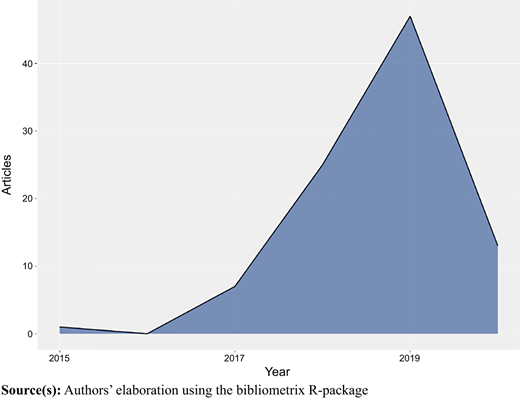
Blockchain 1.0 relates to cryptocurrency and digital payment systems. Blockchain 2.0 includes the economic market and extends to transactions, such as stocks, bonds and smart contracts. Finally, Blockchain 3.0 focuses on applications of Blockchain 1.0 and 2.0, such as digital voting, digital health records and digital art. This analysis covers the third phase, starting in 2015 with an exponential increase from 2016 to date (Figure 1).
The articles average two authors (2.26). The collaboration index, calculated as the total number of authors of multi-authored articles/total number of multi-authored items, is 2.83 (Elango and Rajendran, 2012).
The explosion of contributions starting in 2017 has an annual growth rate of 89.88%; the data justify the in-depth analysis of the literature, which is continually expanding and progressing the stream of knowledge over time (Bonsón and Bednárová, 2019).
The number of keywords used is three times the number of items. At the same time, keywords plus, which are the number of keywords that appears frequently in article titles, were three times the number of items.
4.1.1 Sources' analysis
The distribution of the 93 items of the sample does not show significant concentration. However, Table 4 highlights the journals specializing in improving and facilitating the research, education and practice of advanced information systems, cutting-edge technologies and AI in the accounting, information technology and management advisory system fields. The interdisciplinary conference proceedings focused specifically on technological innovation.
Main sources
| Top ten sources | |
|---|---|
| Journal of Emerging Technologies in Accounting | 8 |
| Proceedings – IEEE 2018 international congress on Cybermatics: 2018 IEEE conferences on the Internet of things green computing and communications cyber-physical and social computing smart data blockchain computer and information technology things/greencom/cpscom/smart data/blockchain | 6 |
| Australian Accounting Review | 4 |
| Lecture Notes in Business Information Processing | 4 |
| Quality – Access to Success | 4 |
| Accounting and Finance | 3 |
| Intelligent Systems in Accounting Finance and Management | 3 |
| International Journal of Digital Accounting Research | 3 |
| Contributions to Management Science | 2 |
| Current Issues in Auditing | 2 |
Source(s): Authors' elaboration
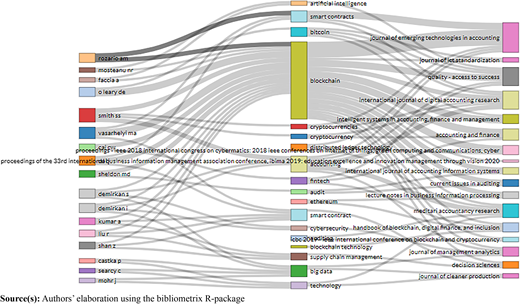
Academic journals play an essential role in developing the discipline; this reflects thematic priorities, academic discussion and knowledge within the scientific community. The Journal of Emerging Technologies in Accounting and Journal of Information Systems has published the most articles on the topic from 2015 to 2020, as shown in Table 5. Journals are considered among the top-ranking journals (A or A* qualified) according to the UK-based Academic Journal Guide 2018 association of business schools (ABS) lists. The ten journals that deal mostly with the topic have many reviews on the ABS list. There is a significant member of the publishing houses in Anglo-Saxon countries except for the latest European one. Journals belonging to the American Accounting Association are also evident. The results show that the subject is more widely discussed in Anglo-Saxon countries. The strands and themes most dealt with within each source are identified through the three-field plot (Figure 2) and highlight the blockchain application and development phases.
Most local cited sources
| Top ten sources | |
|---|---|
| Journal of Emerging Technologies in Accounting | 52 |
| Journal of Information Systems | 50 |
| Accounting | 39 |
| Accounting Horizons | 31 |
| International Journal of Accounting Information Systems | 27 |
| Bitcoin A Peer to Peer Electronic Cash System | 25 |
| Intelligent Systems in Accounting | 22 |
| Harvard Business Review | 19 |
| The Accounting Review | 19 |
| Technological Forecasting and Social Change | 18 |
Source(s): Authors' elaboration
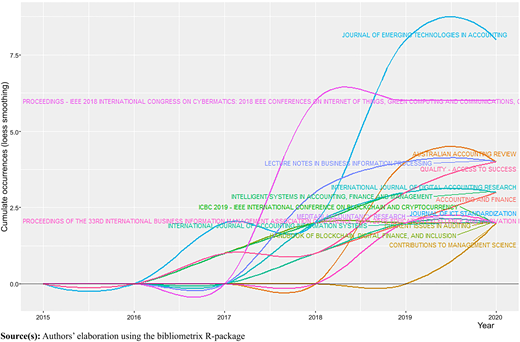
The distribution frequency of the items (Figure 3) indicates the journals dealing with the topic and related issues. The significant growth in the number of publications between 2015 and 2020 is clear. However, the graph shows the result of the Loess regression. It includes the quantity and publication time of the journals under analysis as variables. This allows the function to assume an unlimited distribution; that is, it enables the function to understand values below zero if the data are close to zero, contributing to a better visual result and highlights the discontinuity in the publications' period (Jacoby, 2000).
4.1.2 Authors' analysis
This section identifies the most cited authors for the accounting, auditing, accountability and blockchain fields, analyzing whether they are scholars, practitioners or both. It also identifies the authors' keywords, their dominance factor (DF) ranking and the total number of citations. Table 6 identifies the top ten authors ranked by the number of publications.
Most relevant authors
| Top ten authors on n° of documents | |
|---|---|
| O'Leary DE | 3 |
| Vasarhelyi MA | 3 |
| Cai CW | 2 |
| Dai J | 2 |
| Rozario AM | 2 |
| Sheldon MD | 2 |
| Smith SS | 2 |
| Beckett P | 1 |
| Aerts | 1 |
| Al Omar A | 1 |
Source(s): Authors' elaboration
The table demonstrates an increasing flow of knowledge. Daniel O'Leary (O’Leary, 2017, 2018, 2019) and Miklos Vasarhelyi (Cho et al., 2019; Dai and Vasarhelyi, 2017; Rozario and Vasarhelyi, 2018) are ranked first, having each coauthored three articles. Furthermore, other authors studying this topic present evidence in two publications. Some authors have published as single authors, whereas most have published as coauthors. The research also highlights the authors' dominance ranking. The DF is a ratio measuring the fraction of multi-authored articles in which an author is identified as the first author (Kumar and Kumar, 2008). Bibliometric studies use the DF in their analyses to calculate the author's dominance in producing articles (Elango and Rajendran, 2012; Gatto and Drago, 2020). It is calculated by dividing the number of multi-authored papers where an author is identified as the first author (Nmf) by that author's total number of multi-authored papers (Nmt). This is omitted in the single author case because single-authored articles have a constant value of 1. The mathematical equation for the DF is as follows:
Table 7 lists the top ten DF rankings. Jun Dai, Andrea Rozario and Sean Stein Smith have the highest DFs, having each coauthored three articles where they are identified as the first author. They are followed by other authors who are identified as the first author in one published article.
Author's dominance
| Rank by DF | Author | Dominance factor | Total articles | Single-authored | Multi-authored | First-authored | Rank by articles |
|---|---|---|---|---|---|---|---|
| 1 | Dai J. | 1 | 2 | 0 | 2 | 2 | 8 |
| 1 | Rozario AM. | 1 | 2 | 0 | 2 | 2 | 8 |
| 1 | Smith SS. | 1 | 2 | 1 | 1 | 1 | 8 |
| 1 | Al Htaybat K. | 1 | 1 | 0 | 1 | 1 | 1 |
| 1 | Alsaqa Zh. | 1 | 1 | 0 | 1 | 1 | 1 |
| 1 | Angiulli F. | 1 | 1 | 0 | 1 | 1 | 1 |
| 1 | Annekova EA. | 1 | 1 | 0 | 1 | 1 | 1 |
| 1 | Arumugam SS. | 1 | 1 | 0 | 1 | 1 | 1 |
| 1 | Ashely MJ. | 1 | 1 | 0 | 1 | 1 | 1 |
| 1 | Ashraf AM. | 1 | 1 | 0 | 1 | 1 | 1 |
Source(s): Authors' elaboration
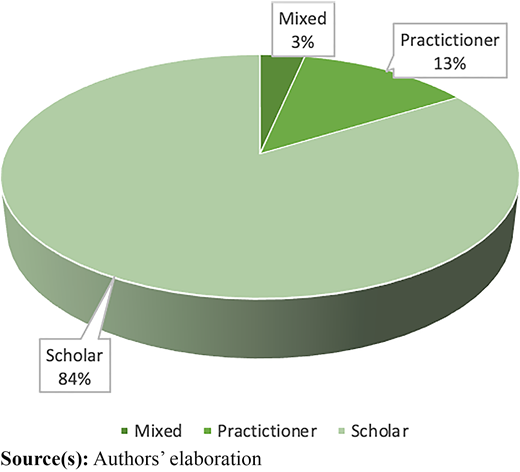
Finally, Figure 4 shows that most authors (84%) come from research centers and university departments. Only 13% are professionals, and, finally, 3% have a mixed scientific-practical affiliation.
4.1.3 Keywords' analysis
This section aims to address RQ2: What are the most frequent issues and themes/topic of this literature?
Table 8 ranks the top ten keywords per author, based on the following elements: Bitcoin(s), smart contract(s) and cryptocurrency. These elements are not predictive and recall the keywords used. However, if we focus on the keywords, we find essential aspects such as distributed ledger technology, AI and smart contract. Even the word “Bitcoin” that might seem distant from a managerial perspective of auditing, accounting and accountability is associated precisely with its accounting and verification of the actual value.
Author's keywords
| Top ten authors on n° of documents | |
|---|---|
| Blockchain | 58 |
| Accounting | 9 |
| Bitcoin | 8 |
| Smart contracts | 7 |
| Auditing | 6 |
| Cryptocurrency | 6 |
| Blockchain technology | 5 |
| Distributed ledger technology | 5 |
| Artificial intelligence | 4 |
| Smart contract | 4 |
Source(s): Authors' elaboration
The TreeMap below (Figure 5) highlights the combination of possible keywords representing the investigation.
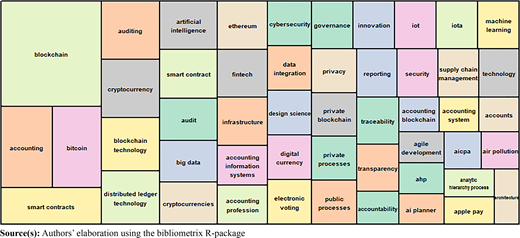
Figure 6 presents a topic dendrogram which, according to Silva et al. (2016), allows the visualization of a search flow in a single image, creating clusters with keywords and providing interest insights. In addition, the structure of the graph allows for hierarchical clustering analysis by considering the height of the nodes. Particularly, the lower the node height, the more similar the clusters will be to each other. Therefore, the node analysis was performed on the lowest level of observation equal to 1 (Marcacini and Rezende, 2010).
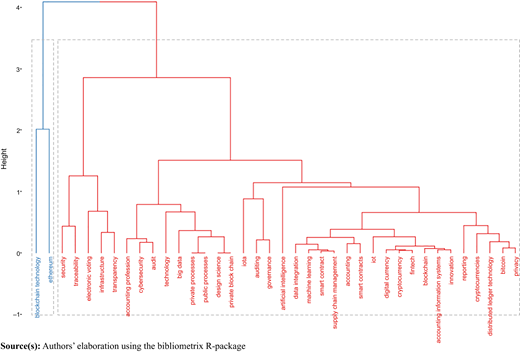
As shown, two main research strands are discussed. The first focuses on blockchain and its technological features strictly related to decentralized platforms, such as Ethereum, used to share peer-to-peer smart contracts. Therefore, we can define it as a technical literature strand.
Additionally, if we consider the second research strand, which is correlated to the first, we can analyze real implications in accounting, auditing and accountability. Mainly, the first node with height 1 refers to the traceability and transparency of corporate voting. The decision to vote at the shareholders' meeting based on blockchain technology leads to numerous challenges, especially accounting and auditing. The second strand of research is based on verification and possible processes based on public or private blockchain, which companies could use to share audit firms' audit processes. A distinct research strand looks at intelligent contracts and accounting operations. Besides, the research flow also shows interest in the accounting implications of cryptocurrency. Finally, the last strand looks at companies' reporting capabilities and new tools that can be used for financial and nonfinancial communication.
4.1.4 Authors' collaboration
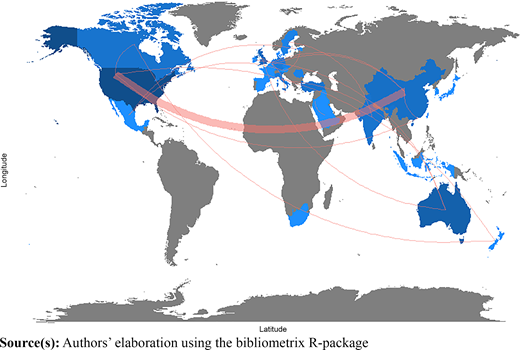
Figure 7 depicts the global collaborations among authors. The blue shaded areas on the map represent research cooperation among nations. Additionally, the pink lines linking countries indicate the extent of collaboration among the authors. It is interesting to see which countries have the most publications on accounting, auditing, accountability and blockchain. The USA has the most collaboration with other countries. The absence of papers and scientific reports in Russia, South America and Africa reflects both their scarce application of technologies to increase fiscal and accounting transparency (Transparency International, 2020) and the lower incidence of journals indexed on the Scopus database from these regions. The results in Table 4 of de Moya-Anegón et al. (2007) confirm this.
4.1.5 Citations' analysis
Table 9 shows the top ten rankings of the number of citations from other articles. Some articles were only worth citing in specific years. Several authors combine blockchain with auditing and control systems, applying it to different business functions. Dai and Vasarhelyi (2017) is the most-cited article. In total, four articles—two from 2019 (Chang et al., 2019; O'Leary, 2019), one from 2018 (Wang and Kogan, 2018) and one from 2017 (Kokina et al., 2017)—are remarkably significant in terms of the number of citations received over several years and the ranking obtained. This indicates that the papers provide high-quality information on accounting, auditing and accountability and blockchain. The publications do not present a relevant grouping in a single journal. The leading journals deal with the topic of technologies and information applied to accounting, auditing and accountability.
Most cited documents
| Ranking no | Authors and their sources (Top 20) | Total citations | Total citations per year |
|---|---|---|---|
| 1 | Dai, J., 2017 | 78 | 19.500 |
| 2 | O Leary, de., 2017. Intell Syst Accoun Finance Manag | 36 | 9.000 |
| 3 | Kokina, J., 2017. J Emerg Technol Account | 25 | 6.250 |
| 4 | Wang, Y., 2018. Int J Accoun Inf Syst | 23 | 7.667 |
| 5 | Coyne, JG., 2017. J Emerg Technol Account | 22 | 5.500 |
| 6 | Holub, M., 2018. Inf Soc | 19 | 6.333 |
| 7 | Noizat, P., 2015. Handbook of digit curr: Bitcoin, Innov, Financ Instruments, and Big Data | 19 | 3.167 |
| 8 | Chang, Se., 2019. Technol Forecast Soc Change | 17 | 8.500 |
| 9 | Cai, CW., 2018. Account Financ | 17 | 5.667 |
| 10 | Rozario AM., 2018. Int J Digit Account Res | 10 | 3.333 |
Source(s): Authors' elaboration
Figure 8 traces the citations and studies during the sample period. The analysis allows us to reconstruct the main lines of research and development. Kokina's 2017 contribution enables academics to identify blockchain's application and future development in accounting applications. McCallig, Moll, Schmitz and Kwilinski (Kwilinski, 2019; McCallig et al., 2019; Moll and Yigitbasioglu, 2019; Schmitz and Leoni, 2019) are the main authors that take up these proposed trends. McCalling et al. (2019) investigate how blockchain technology is applied to give security to the transmission of data related to reporting and audit processes, and the public key identified is the cryptography and network analysis. Moll and Yigitbasioglu (2019) deal with future decision-making based on cloud, big data, blockchain and AI technologies capable of legitimizing the work of professionals affecting the work of accountants. Through a literature review, Schmitz and Leoni (2019) identify the taxonomy and the main application strands of blockchain to accounting and auditing that affect governance, transparency and trust issues in the blockchain ecosystem, blockchain-enabled continuous audits, smart contract applications and the paradigm shift in accountants' and auditors' roles. O'Leary (2017) focuses on the transfer of peer-to-peer data by analyzing the public accessibility of data transmitted through blockchain technology as a market mechanism between organizations.
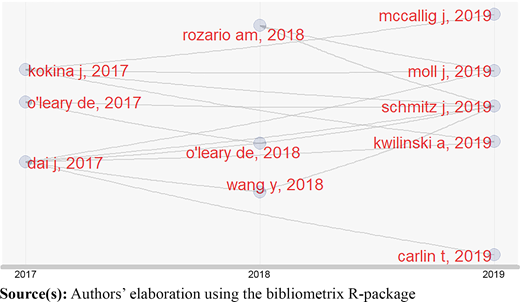
O'Leary (2017) also suggests applications, including accounting, auditing, supply chain and other transaction information types. The author influences and lays the foundations for Schmitz's studies (Schmitz and Leoni, 2019) and subsequent developments that the same author in 2018 will identify in the use of blockchain open on the markets to control the operations that took place with cryptocurrency and the possible effect on supply-chain processes. Dai and Casarhelyi (2017) are among those who provide the best ideas related to the use of blockchain technology as a verifiable, transparent, real-time tool aimed at defining an accounting system useful for supporting accounting and assurance (Dai and Vasarhelyi, 2017). Dai and Casarhelyi's (2017) influence, with that of Moll (Moll and Yigitbasioglu, 2019), Schmitz (Schmitz and Leoni, 2019), Kwilinski (Kwilinski (2019), lay the foundations for Wang and Kogan (2018) and (Carlin, 2019). Furthermore, Wang et al. (2018) demonstrate how blockchain-based transaction processing systems (TPSs) can in real-time accounting, monitor fraud prevention continuously. Finally, Wang et al.’s (2018) studies are the basis for Schmitz and Leoni's (2019) analyses. Finally, the study of Carlin (2019), influenced by Dai et al. (2019), is the most advanced for blockchain and accounting studies focusing on double entry.
5. Coding analysis
5.1 Blockchain definition
This subsection aims to investigate how authors have defined blockchain.
In the original definition, blockchain is defined as a dispersed ledger of chained and consecutive cryptographic blocks, and each block is registered on peer to peer networks (McAliney and Ang, 2019). The nodes also work in the same direction and are validated by the network's other components (Rien Agustin and Susilowati, 2019).
From Nakamoto's original definition, three different periods have been identified, which also correspond to the blockchain definitions provided (ALSaqa et al., 2019). The analysis conducted focuses more on the third period of blockchain implementation and research. Technology can interrogate all blockchain components in real-time and find practical implications considering it as a global brain (Al-Htaybat et al., 2019). From the definition of mere technology aimed at eliminating the search for comparison during monetary transactions (Strugar et al., 2018), we move on to the meaning of technology capable of managing databases in general without a central verification authority (Tan and Low, 2019). The current definition identifies blockchain as the spinal column of a new type of Internet on which to find a series of immutable data not owned by all the actors of the network (Zhao et al., 2019). This definition is associated with managed services, such as accounting and auditing, and with nonfinancial controls, such as the possibility of verifying environmental parameters linked to production (Tan and Low, 2019; Tiberius and Hirth, 2019; Zhao et al., 2019).
5.2 Research methodologies
This subsection analyses the research method used by authors in the selected pools of papers. The results shown in Table 1 provide some interesting elements. First, most studies to date do not use quantitative methodologies. Therefore, indirectly, qualitative methods are widely applied. As DiCicco-Bloom and Crabtree (2006), Miller and Crabtree (1994), Polkinghorne (1995) and Qu and Dumay (2011) indicate, this trend is confirmed by increasing pressure on the quality sphere implying further ramifications. For example, 35% of studies are discursive analyses; 23% establish a blockchain-based model for accounting and budgeting actors; 14% belong to the residual category of other qualitative studies and 12% are literature reviews. Finally, 5% are action research and case studies.
5.3 New business models involved
Starting from Massaro et al. (2020)'s analysis exploring the crypto economy, we wanted to examine whether the authors' discussion focuses on the analysis of new business models based on blockchain. This yielded exciting results. In fact, of the 93 contributions, only three (3%) analyze the role of blockchain in the operations of rental platforms analytically, especially for accountability of information that can be disclosed on products, analyzing the critical threshold of information required by customers (Choi et al., 2020; Qingliang and Tang, 2019). Others, such as Demirkan et al. (2020), initiate an in-depth reflection on the role of business model change, especially for accountants and auditors.
5.4 Business processes
This subsection aims to investigate corporate business applications. The opportunity of distributed technology and possible applications are applied in different contexts. Particularly, the area of management and strategic business control, including accounting and financial statements, have a higher value (43%). There is also an interest in the supply chain sector that seems to benefit from the technology's properties. Indeed, as reflected in the contributions of Choi et al. (2020), Kumar et al. (2020) and O'Leary (2019), the industry sees numerous opportunities for cost reduction, especially concerning transport records, food conservation (Scuderi et al., 2019) and environmental sustainability through coal accounting (Castka et al., 2020).
5.5 Focus
The subsection aims to specify how blockchain affects companies, considering the classification of accounting, auditing and accountability (Dumay et al., 2018). Specifically, accounting studies cover normative, advance or critique studies investigating the role in society. Audit studies include general audits and audit committees. Finally, accountability refers to an inclusive discussion on corporate disclosure for both the private and public sectors.
The analysis shows that in 20% of the cases, the in-depth analyses concern accounting. Among the relevant aspects, the use of the triple match emerges. Thus, according to Alarcon and Ng (2018), Alboaie et al. (2018), Dai and Vasarhelyi (2017), Karajovic et al. (2017) and Sarkar (2018), using triple entry makes it possible to entrust data to an external party, that is, blockchain technology that uses cryptography to seal the data in a ledger that is distributed among those authorized to access it, applying third-party technology guarantees higher reliability (Dai and Vasarhelyi, 2017). This is because, in addition to the two counterparties, there is a third-party intermediary who creates and records what happens. The required criteria call for independence and reliability, which can be solved by technology (Alarcon and Ng, 2018).
Based on Dai and Vasarhelyi's (2017) idea, this system can act as an intermediary. Furthermore, they assert that a complete automated data storage process that prevents the occasional use of accounting items can only be made possible using third-party software (Coyne and McMickle, 2017).
Furthermore, 11% of the articles are related to auditing. Thus, using detailed syntax programming, auditors could automatically verify corporate information directly, ensuring truthfulness. Blockchain application in this context creates a mechanical method of data transmission and, subsequently, approval by all users in case of information modification. As Tiberius and Hirth (2019) and Turker and Bicer (2020) state, the information immutability ensures that several stakeholders, such as banks, courts, tax institutions, regulators, accountants and auditors, could verify the consistency of records every time, supporting corporate decision-making processes.
Finally, 4% of articles focus on accountability, and Marrone and Hazelton (2019)'s and Dai et al. (2019)'s contributions consider accountability as a fundamental and essential approach to combating air pollution that can warn citizens and companies at an early stage when values become too high.
5.6 Blockchain characteristics
This subsection aims to investigate the blockchain characteristics identified.
Blockchain has several characteristics that repeat and configure elements validated by theory. The main features coded refer to consensus, cryptographic hashing, decentralization, transparency and verifiability. Consensus is the agreement between all the network subjects who have access to the data exchanged through blockchain and allows all the actors to validate new blocks and nodes (Brown-Liburd et al., 2019; McCallig et al., 2019; Smith, 2018). Through the agreement between all the network components, consensus allows real-time data updating with copies of the changes (Benedict, 2019; Mühlberger et al., 2019). The process increases the actors' attention to the quality of the data provided (Lemieux et al., 2020; Rien Agustin and Susilowati, 2019). Consensus falls automatically on the trustless, allowing verification by third parties, the characteristics affect the more exceptional ability to provide good governance with a reduction of the verification costs and a more excellent attractiveness of the investments (Chang et al., 2019; Secinaro et al., 2021). Accountants can verify company financial data by including multiple vendors and clients in the exchange of accounting records. In the case of auditors, blockchain makes it possible to validate and request clarifications immediately by resolving errors or identifying potential attempts at corruption and fraud (Birch and Parulava, 2017; Horner and Ryan, 2019).
Through a horizontal consensus between actors, blockchain leads to overcoming the previous hierarchical information exchange paradigm created by the traditional information technology (IT) system (Cai, 2018). Consensus and longitudinal exchange facilitate applying audit and governance systems and smart contracts (Dal Mas et al., 2020a; Joseph, 2019; Rozario and Vasarhelyi, 2018). Consent requires a common language among all components of the network. The information is tracked with different hashes without the possibility of changes in each block (Kokina et al., 2017). Cryptographic hashes remove the ability to change information and facilitate the protection of data even after archiving (White and Daniels, 2019). At the accounting level, this allows companies to demonstrate historical data trends and provide transparent financial data to multiple stakeholders, such as investors and banking systems (Kokina et al., 2017).
The blockchain ecosystem is made up of cryptographic hashes that represent information input (Cai, 2018; McAliney and Ang, 2019). Data encryption, a vital blockchain element, helps protect individuals' privacy (Brown-Liburd et al., 2019). Therefore, the cryptographic hash protects data integrity (Joseph, 2019), the validity and accuracy of information and provides the basis for the accounting system based on blockchain technology (Smith, 2018). The traditional double-entry accounting system with blockchain offers the possibility of triple entries that involve cryptography and hashing systems, where the insertion of credit and debit data is transcribed in the system and made accessible to all third parties with specific bookkeeping systems (Wang and Kogan, 2018). Auditors can map the history of information by providing greater authoritativeness to their analyses (Bonsón and Bednárová, 2019). The information encoded is transmitted directly between all stakeholders with the elimination of intermediaries; the decentralization of information creates a system resilient to destruction and antitampering (Birch and Parulava, 2017; Gökalp et al., 2018; Kokina et al., 2017; White and Daniels, 2019). Decentralization is defined as a real model of cooperation between all subjects (Angiulli et al., 2018). Blockchain shares, records and transmits information by storing it in real-time and continuously in different locations throughout the network, confirming the verification of the data (Smith, 2018; Tiberius and Hirth, 2019). The decentralization of data through increasing transparency and accountability finds application in auditing systems with the confirmation of the elimination or reduction of corruption (Horner and Ryan, 2019), in the supply-chain process (Lemieux et al., 2020) with the possibility of the customer having transparency and less bureaucracy and in the registration and sharing of smart contracts (Mühlberger et al., 2019). There is a particular challenge of continuity of action for professionals at the audit level. The decentralized system also allows the creation of management alerts that can intercept possible liquidity crises much more quickly using AI applications (Gomaa et al., 2019; Kokina and Davenport, 2017).
The previous variables' relationship with some of the characteristics only partially mentioned is also observed from the cooccurrence analysis of the identified codes. Verifiability of data and transparency are closely related and are recalled by the decentralization of consent in the network (Lemieux et al., 2020). Blockchain combines transparency and verifiability in validating the authenticity of each subject's information without the possibility of manipulating the data (Horner and Ryan, 2019), and total transparency is synonymous with the truthfulness of the information (Demirkan et al., 2020). The traceability and ability to access data increases trust and is guaranteed through the presence of scalability, security and system privacy (Chang et al., 2019). Transparency and verifiability lead to increased productivity with greater economic sustainability of the economic system for financial reporting (Dai and Vasarhelyi, 2017). The immutability of the architecture supports the previously identified characteristics and protects information from cyber-attacks (Demirkan et al., 2020), reducing the level of risk (Lemieux et al., 2020). The absence of a central authority and the distribution of copies allows an improvement of the accounting system, the audit systems (Cho et al., 2019) and a more exceptional ability to detect fraud (Bonsón and Bednárová, 2019). The analysis highlighted some additional features associated with the use of blockchain, such as the high availability of information that affects the continued use of electricity and network computers always on, confidentiality (Brown-Liburd et al., 2019; Horner and Ryan, 2019; Lemieux et al., 2020), the stability of information with a reduction of errors (ALSaqa et al., 2019), the accessibility to all investors and scalability (Chang et al., 2019; Smith, 2018). All features guarantee a list of benefits and are closely associated with similar applications. The presence of all the features reinforces the adoption of blockchain technology in these processes.
5.7 Type of blockchain and governance
This subsection aims to analyze the technical types of blockchain, according to O'Leary (2017). We find that 59% of the documents do not focus on technical structure. For the accounting, auditing and accountability sector, 16% consider blockchain creation with hybrid structures. For instance, Rozario and Vasarhelyi (2018) identify hybrid models as holistic models capable of including both internal and external centralized audit procedures. Besides, starting from the need to respect corporate data privacy, Schaefer and Edman (2019) propose a hybrid architecture governance without public or private authorization. Therefore, the authors' most significant interest derives from the possibility of maintaining blockchain's inherent characteristics while also maintaining the confidentiality of data resolving a challenging governance issue regarding data privacy.
Additionally, 13% of the authors focus on public blockchain, among which Shahriar Rahman et al. (2020)'s contribution is interesting. For authors, a public mechanism based on the global data cloud may exist if there are mechanisms for reporting misconduct by users that undermine other users' trust.
Finally, private blockchain structures are investigated in 11% of documents, primarily involving supply chain cases. According to Chang et al. (2019), private blockchains are more suitable for business-to-business applications to solve privacy and commercial competition problems. In the accounting professions, these elements are overcome through the method identified by Rozario and Vasarhelyi (2018).
5.8 Connection with other technologies
Starting from Moll and Yigitbasioglu (2019)'s and Wang and Kogan (2018)'s research agendas, this subsection aims to investigate the possible connections between blockchain and other technologies in the field of accounting, auditing and accountability. Most (93%) of the extracted documents do not consider further relationships with other technologies, and 2% also identify AI as the technology of interest, with 1% focusing on big data and machine learning. Finally, 3% investigate the opportunities of multiple technologies. AI is one of the interesting technologies for accounting and auditing. For instance, Moll and Yigitbasioglu (2019) and Zemánková (2019) state the use of algorithms could provide efficiency by reducing repetitive action for accountants and auditors. In this sense, Tan and Low (2019) suggest that accountants obtain new skills to manage and understand technology needs.
5.9 Link with accounting theories
This subsection aims to investigate whether the authors have referred to the distinction between accounting theories according to Malmi and Granlund (2009)'s and Manzon and Plesko (2001)'s subdivisions. The results show a low level of theoretical research on blockchain. Table 1 shows that 89% of the sources do not consider the theoretical aspects of accounting. Management accounting theory is analyzed in 7% of the cases and the theoretical aspects of auditing in 2%. Finally, 2% of the articles consider both theoretical approaches. This result suggests a valuable insight. Although academic authors are more numerous than practitioner authors, the theoretical aspects of blockchain in this research area are currently unexplored. The result is in line with Guthrie et al. (2019)'s contribution, who arguably saw a change in the theoretical expression of accounting toward new technologies. Table 10 compares blockchain characteristics with an accounting, accountability and auditing focus related to the AAAJ's most cited articles (Dumay et al., 2018).
Blockchain characteristics among accounting focus
| Blockchain characteristics | Accounting focus | ||
|---|---|---|---|
| Accounting | Auditing | Accountability | |
| Consensus mechanism | X | X | |
| Cryptographic | X | X | |
| Hashing | X | X | |
| Decentralization | X | X | X |
| Immutability | X | ||
| Transparency | X | ||
| Verifiability | X | X | |
Source(s): Authors' elaboration
The consensus mechanism is the first feature of blockchain that allows all network actors to exchange data (Brown-Liburd et al., 2019; McCallig et al., 2019). This element, although mediated by technology, has had positive evidence in both accounting and auditing theory. For example, the consensus mechanism appears to underpin the establishment of the global International Financial Reporting Standards (IFRS) framework (Sunder, 2009). Besides, there is evidence that consensus in accounting has a positive correlation with the accuracy of decisions (Ashton, 1985). The blockchain features show that both cryptography and the hashing process are two elements of protection and assurance concerning the consensus mechanism.
A common feature to accounting, auditing and accountability is decentralization. This feature revolutionizes how accounting data are accessed as it allows all actors in the chain to obtain history, real-time updating and final reporting. This element recalls the three moments of the theory of rational administration, which sees in the financial statements the representation of decision-making choices and is based on information flows such as planning, accounting execution and control (Biancone et al., 2019a; Buchi et al., 2011) and which relies on Dumay et al. (2018)'s theory.
Moreover, immutability and transparency present favorable theoretical evidence, especially for accountability, in providing interdisciplinary responses and accountability in organizations and society (Guthrie and Parker, 2004).
Finally, verifiability is reconciled with the theoretical component of auditing, which requires audit committees to check corporate effectiveness measures frequently (Bédard and Gendron, 2010).
6. Implications and future research questions
This section aims to examine which implications are most relevant to the area of research under consideration, answering RQ3: What seem to be the possible implications for future research in this field?
The sources studied indicate theoretical implications for 47% of the cases, mainly in future research. This is in line with the poor theoretical analysis of blockchain in this research area. Besides, 41% of the sources point to practical implications for the research carried out. Finally, 12% the authors analyze the possible policy implications. For instance, among the recurring theoretical implications in Bonsón and Bednárová (2019)'s and Moll and Yigitbasioglu (2019)'s papers, there is an urgent need for the study of new forms of accounting; an updated analysis of the applications of blockchain in the field of accounting, auditing and accountability; and studies on the accounting ecosystem to be implemented in response to the new technology. Moreover, on the practical implications, several results show that blockchain can increase financial visibility by enabling timely action in corporate accounting (Moll and Yigitbasioglu, 2019), questioning the existence of the figures of accountants and auditors (Tiberius and Hirth, 2019). Finally, on policy implications, the authors dwell on the public nature of corporate accounting transactions, aimed at the correct payment of each country's taxation. Therefore, blockchain projects for accounting and auditing need clarity in regulatory terms (Cai, 2018, 2021; Carlin, 2019; Tan and Low, 2019).
As outlined, multiple implications are uncovered for both theory and practice, opening up interesting future research lines. In the following Table 11, we open up three research areas where we believe there may be room for further exploration of the logic in increasing the understanding of blockchain in accounting, auditing and accountability significantly.
Future research avenues
| Topic | Research area |
|---|---|
| Accounting |
|
| Auditing |
|
| Accountability |
|
Source(s): Authors' elaboration
From a theoretical point of view, our study faces researchers with critical future challenges. First, researchers could study new theoretical approaches to management accounting based on blockchain in the accounting field. To date, research has focused on the practical applications of the technology (Smith, 2018). There should therefore be more discussion in the future among researchers about theoretical evolution. Moreover, more theoretical investigations should be undertaken to ascertain how the triple-entry model can replace the double-entry (Cai, 2021; Secinaro, 2020). As demonstrated, blockchain can be an aggregator of stakeholders and few theoretical studies to date investigate this area, for example, through the lens of actor–network theory. Finally, starting from Dal Mas et al. (2020a, b), the accounting field could benefit from further studies that aim to investigate how blockchain will change accountants' business model activity and assess whether this technology is sustainable for them.
Second, in the field of auditing, starting from Dai et al.'s (2019) and Rozario and Vasarhelyi's (2018) premises, more research efforts should be made to define how to audit activities integrated into a blockchain system. Such research will be even more impressive when comparing different accounting systems. Besides, interesting RQs will investigate how auditors will manage all stakeholders and how audit activities will evolve.
Finally, in the field of accountability, numerous research ideas could be validated, as the subject is currently not well investigated. For example, researchers could focus on the applications and evolution of accountability and transparency, considering financial reporting. Finally, new research can be addressed to assess immutability toward stakeholders, such as tax authorities, banks and shareholders.
Our results confirm that new empirical research will be essential. Therefore, future research should avoid descriptive analysis and focus on interviews and case studies to create a fruitful collaboration between academics and practitioners.
7. Conclusion
In concluding our study, we want to return to the premises that inspired it. This study explores how blockchain technology can potentially influence the accounting, auditing and accountability fields. Based on a bibliometric and open coding analysis, we identify the main drivers of blockchain as emerging technologies.
The exponential increase in publications confirms the growing interest in this research stream; however, despite Marrone and Hazelton (2019)'s, Pimentel and Boulianne (2020)'s; Schmitz and Leoni (2019)'s and Zemánková (2019)'s literature reviews, no previous studies have investigated the entire research fields of accounting, auditing and accountability as defined by Dumay et al. (2018). Additionally, no past papers offer a bibliometric with in-depth coding analysis based on the evidence, aims and future research ideas of the previous literature.
Therefore, our study suggests the following main results.
In terms of bibliometric variables, the Journal of Emerging Technologies in Accounting is one of the most interesting journals on this topic and the most cited following the Journal of Information Systems and Australian Accounting Review. Moreover, considering keywords and thematic analysis in this field, as shown by Casino et al. (2019) and Xu et al. (2019), our study demonstrates that multidisciplinary research among accounting, business, management, computer science and engineering fields is required.
Thus, the analysis of the sources reveals a high number of conference proceedings in computer science and engineering and a higher number of relevant publications in scientific journals in the area of business and management.
Second, in terms of authors, O'Leary DE, Vasarhelyi MA and Cai CW are the leading authors. They promptly launch this research stream with in-depth analysis focusing on applications such as triple-entry systems and automated auditing networks. Finally, considering countries' interest and collaboration, the USA has the highest level of collaboration globally, followed by Australia.
This study's coding analysis indicates primary results.
First, in this research area, the articles are primary qualitative and use, especially, discursive analysis. Therefore, it opens the possibility of significant challenges for future researchers in testing new methods.
Second, the focus on the sustainability of blockchain-related business models in accounting and auditing is not yet developed. Therefore, researchers may consider this gap in the future.
Third, in terms of concepts analyzed, we find that the focus in management and control of the sources mainly involved accounting and auditing. Therefore, accountability remains uncovered. More specifically, accounting and auditing reveal the different views of authors such as Coyne and McMickle (2017) and Dai and Vasarhelyi (2017), who are pioneering authors in this area. By contrast, accountability and blockchain are even younger than the entire research stream. Thus, few authors have demonstrated the role of blockchain in sharing both financial and environmental data. Therefore, this research confirms the broadening of research interests in this field to the transformation of the accounting and auditing professions and environmental issues. Thus, the issue of accountability based on blockchain represents a strong push for future research.
Fourth, in terms of the desired characteristics of blockchain, we can consider that
The consensus mechanism is valid for accounting for data entry and validation by the active stakeholders, auditing for controls and accountability to allow data to be continuously updated.
The use of accounting with blockchain technology requires that all actors are adequately informed about encryption and hashing systems.
Decentralization provides companies with a continuous flow of information, auditors with accurate analysis and legislators, if necessary, with fraud control in accounting and budgeting. Therefore, it increases the level of transparency and trust among stakeholders.
Fifth, in terms of blockchain definitions, the coding analysis confronts the standardized definition of McAliney and Ang (2019). Blockchain is a dispersed ledger of chained consecutive cryptographic blocks. Each block is recorded on peer-to-peer networks. Moreover, the analysis shows that all the sources analyzed agree that in accounting, auditing and accountability, we can refer to the Blockchain 3.0 stage of development.
Finally, in terms of blockchain structure, this research stream requires the application of hybrid blockchain because of the need for confidentiality related to firms' information. The structure could help accountants and auditors to handle customer information confidentially and, at the same time, guarantee innovation in the accounting and auditing professions.
To the best of our knowledge, this study is the first to examine the current state of blockchain's diffusion within accounting, auditing and accountability using a bibliometric and coding approach. Therefore, our contribution joins two methodological approaches in this field, starting from the research of Dal Mas et al. (2019), Dumay and Cai (2014), Massaro et al. (2016) and Secinaro et al. (2020). Our work contributes to a solid foundation for researchers who want to start future analysis in this research field.
This study also has critical implications.
The bibliometric variable analysis allows future researchers to study this challenging research stream considering sources, citations, relevant keywords, authors and collaboration between countries. Additionally, this study's findings could help practitioners, as accountants and auditors, understand the effect and opportunities of blockchain technology for their profession. Thus, this work aims to help professionals understand blockchain characteristics and find points of comparison rather than criticism or fear of change. As does all research, this study has limitations. The current work does not consider technical issues, such as security mechanisms and privacy in the accounting field. For this very reason, future work targeted for this area will help build thorough knowledge and determine the subsequent application of blockchain in the fields of accounting in terms of the scalability solutions proposed by the cited authors.
Declaration of interest: None
Funding: This research did not receive any specific grant from funding agencies in the public, commercial or not-for-profit sectors.

