Coastal destinations increasingly implement green attributes, yet evidence remains limited on which attributes activate tourists' cognitive, emotional, and moral mechanisms that lead to eco-friendly participation, and whether any of these mechanisms are indispensable for high participation levels. This study tests a cognitive–affective–normative model linking green coastal destination attributes to tourists' participation in eco-friendly coastal activities.
Survey data were collected from 600 tourists visiting coastal destinations in Thailand's Eastern Economic Corridor. The proposed model was assessed using partial least squares structural equation modeling to test sufficiency-based relationships, complemented by necessary condition analysis to identify non-substitutable prerequisites for high levels of eco-friendly participation.
Green attributes showed heterogeneous effects. Awareness of consequences was mainly driven by energy-efficient facilities, eco-friendly accommodation, sustainable sourcing, and heritage preservation, while conservation efforts and green labeling had a limited impact. Environmental empathy was primarily influenced by eco-friendly accommodation, followed by conservation efforts, energy-efficient facilities, and green labeling, with other attributes showing no significant effects. Awareness of consequences strongly increased ascribed responsibility, which in turn was the key driver of personal norms; environmental empathy contributed only marginally. Personal norms were the strongest predictor of eco-friendly participation. Necessary condition analysis further revealed that ascribed responsibility and personal norms are indispensable for high participation, whereas green attributes and empathy are not.
This study extends coastal sustainability research by combining partial least squares structural equation modeling and a necessary condition analysis to distinguish between factors that enhance eco-friendly participation and those that are indispensable for achieving high participation levels.
1. Introduction
Sustainable tourism has become an imperative in the face of escalating environmental degradation and resource depletion. As tourism development continues to expand in coastal regions worldwide, understanding how to promote eco-friendly tourist behavior has become a central concern for scholars and practitioners alike (Fakfare et al., 2025). Despite extensive discourse on sustainability, the mechanisms through which tourists transform pro-environmental perceptions into active participation in eco-friendly practices remain insufficiently understood (Lee, Fakfare, Han, & Lee, 2026). This calls for a more integrated theoretical and analytical approach capable of capturing both the psychological and moral determinants of sustainable behavior.
This issue is particularly critical in Thailand, where coastal tourism constitutes a major pillar of national economic development and blue-economy strategy (Koondee, Sharafuddin, & Madhavan, 2022). Thailand's coastal destinations, especially those within the Eastern Economic Corridor, are characterized by rapid infrastructure expansion, mass-tourism flows, marine ecosystem fragility, and strong community-based cultural heritage. Unlike small island states or highly regulated Western coastal destinations, Thailand's coastal tourism operates within a hybrid governance environment where green infrastructure development, community livelihoods, and large-scale tourism growth coexist and sometimes conflict (Fakfare, Lee, & Han, 2022). These contextual conditions create a distinctive sustainability challenge: visible environmental initiatives may be present, yet high-intensity tourist participation in eco-friendly behaviors is not guaranteed. Understanding how green coastal attributes translate into internalized responsibility among tourists is therefore not only theoretically relevant but strategically urgent for Thailand's sustainable tourism transformation.
The formation of pro-environmental behavior is inherently psychological, encompassing cognitive, affective, and moral-normative dimensions (Wattanacharoensil et al., 2024). Drawing on the Cognitive–Affective–Behavioral (CAB) framework (Chou, Horng, Liu, & Lin, 2020), individuals' pro-environmental actions stem from cognitive evaluations, affective responses, and behavioral intentions that operate sequentially. When tourists encounter green destination attributes, such as eco-friendly facilities, sustainable sourcing, conservation efforts, or heritage preservation, these features serve as external triggers that shape their cognitive appraisals of environmental consequences and elicit emotional, such as environmental empathy (Han, 2014). These internal responses, in turn, influence their sense of moral duty and behavioral tendencies toward eco-friendly participation (Kim & Hwang, 2020).
However, cognitive and affective mechanisms alone do not fully explain the moral motivation underlying sustainable behavior. The Norm Activation Model (NAM) (Schwartz, 1977) extends this understanding by introducing moral and normative determinants that drive responsible action. According to Han (2014), individuals' awareness of consequences and ascribed responsibility activate personal norms, internalized moral obligations that compel them to behave in an environmentally conscious manner. Integrating CAB and NAM perspectives therefore provides a comprehensive theoretical foundation for understanding how cognitive and affective empathy responses, and moral norms jointly shape tourists' sustainable behavioral participation. Although prior studies in different tourism domains have provided valuable insights into sustainable behavior (e.g. Wattanacharoensil et al., 2024), they often adopt a fragmented perspective that isolates specific psychological or moral mechanisms rather than examining their integrated effects. Research has tended to emphasize cognitive determinants, such as environmental knowledge or perceived benefits, or affective elements like emotional attachment and environmental concern (Han, 2014), while neglecting the complex interconnections between cognition, affect, and moral obligation. As a result, the current understanding of how green destination attributes stimulate internal psychological and normative processes that lead to sustainable behavioral engagement remains incomplete.
More importantly, existing integrations of cognitive–affective–normative models in tourism have largely treated predictors as additive drivers, assuming that stronger cognitive awareness or stronger empathy will proportionally increase sustainable behavior (Tan et al., 2025). What remains underexplored is whether certain moral mechanisms operate as boundary conditions rather than mere enhancers. In fragile coastal ecosystems such as those in Thailand, sustainable engagement may not simply increase linearly with green exposure; instead, it may require a threshold level of internalized responsibility before high participation becomes possible. This study therefore moves beyond incremental integration by explicitly examining whether moral constructs function as structural bottlenecks in coastal sustainability behavior.
Furthermore, most previous studies rely on traditional symmetric analytical approaches, such as regression or structural equation modeling, which primarily identify sufficient causal relationships (Meeprom & Fakfare, 2021). While these techniques are valuable for examining directional influence, they overlook necessary antecedents, that is, the minimum conditions that must be present for a sustainable behavioral outcome to occur (Dul, 2016). In the context of sustainability, understanding these necessary conditions is crucial because certain psychological or normative factors may be indispensable even when other predictors vary. This limitation highlights the need for a complementary analytical perspective that can identify both the sufficiency and necessity of causal factors underlying eco-friendly participation. By introducing necessity logic into a coastal tourism framework, this study reconceptualizes sustainable behavior not only as a product of influential drivers but also as a phenomenon constrained by moral thresholds. This distinction is theoretically significant because it differentiates between attributes that enhance eco-friendly participation and those that are indispensable for achieving high participation levels. Empirically demonstrating such boundary conditions contributes to a more refined causal understanding of sustainable tourism behavior and addresses recent calls for methodological pluralism in hospitality and tourism research.
To address these theoretical and methodological gaps, this study employs an integrated Cognitive–Affective–Behavioral (CAB) framework and Norm Activation Model (NAM) to explain how green destination attributes shape tourists' sustainable engagement. The model posits that green coastal attributes act as external triggers that enhance awareness of consequences (cognitive), evoke environmental empathy (affective), and strengthen ascribed responsibility, which together activate personal norms, leading ultimately to participation in eco-friendly coastal activities. This comprehensive framework thus captures the psychological and moral processes through which sustainable destinations can cultivate environmentally responsible tourists.
Methodologically, the study adopts a multi-analytic approach that combines Structural Equation Modeling (SEM) and Necessary Condition Analysis (NCA) to test the hypothesized model. SEM is used to evaluate the sufficiency-based causal pathways among green destination attributes, cognitive–affective–normative mechanisms, and eco-friendly participation. In contrast, NCA identifies the indispensable psychological and normative conditions that must exist for sustainable behavioral engagement to occur (Dul, 2016). The integration of SEM and NCA offers a richer and more robust analytical perspective, addressing both the linear and boundary conditions of sustainable tourist behavior in coastal destinations. Practically, this study provides actionable insight for Thailand's coastal policymakers and destination management organizations. Rather than assuming that expanding green infrastructure automatically generates responsible tourist behavior, the findings aim to identify whether internalized responsibility and moral obligation must reach minimum thresholds before large-scale eco-friendly participation can be realized. Such evidence is particularly relevant for Thailand's Eastern Economic Corridor, where infrastructure-led growth strategies must be complemented by norm-driven sustainability interventions to achieve long-term environmental resilience. Accordingly, this study pursues three main objectives:
To identify how green destination attributes function as triggers influencing tourists' cognitive, affective, and normative responses toward eco-friendly coastal activities.
To examine how awareness of consequences, ascribed responsibility (cognitive), and environmental empathy (affective) jointly activate personal norms.
To determine the necessary conditions leading to tourists' participation in eco-friendly coastal activities.
2. Literature review
2.1 Green coastal destination attributes
Green destination attributes generally constitute the environmental, infrastructural, cultural, and regulatory elements (Wang & Lin, 2024). Embedded within coastal tourism settings, these attributes collectively foster sustainable visitor behavior. These attributes operate as foundational triggers shaping tourists' cognitive awareness, affective responses, and moral–normative commitments (Tang, Yang, Gan, He, & Wang, 2025). Although diverse in form, green coastal destination attributes can be meaningfully grouped into three detailed clusters, including (1) green infrastructure, (2) environmental conservation and cultural–heritage protection, and (3) institutional sustainability mechanisms, each of which contributes uniquely to the psychological processes leading to eco-friendly coastal participation.
The first cluster, green infrastructure and resource-efficient facilities, captures the physical and operational systems designed to reduce ecological impacts in coastal environments (Fakfare et al., 2025). Eco-friendly facilities and infrastructure, such as low-impact accommodations, environmentally sensitive architectural design, and sustainable mobility systems, form the backbone of a destination's green identity (Merli, Preziosi, Acampora, Lucchetti, & Ali, 2019). Energy-efficient facilities further reinforce this identity by integrating renewable energy, smart resource-monitoring technologies, and energy-saving devices that minimize carbon emissions and resource depletion. Waste reduction initiatives, including recycling stations, plastic-free policies, food waste minimization, and beach waste-management programs play an equally critical role, particularly along coastlines where pollution directly threatens marine ecosystems (Fakfare et al., 2024). These infrastructural attributes are often the most visible markers of sustainability, shaping tourists' cognitive appraisals by increasing their awareness of environmental vulnerability and highlighting the tangible consequences of unsustainable behavior. Nevertheless, some studies argue that highly technical or operational sustainability features may remain cognitively recognized but behaviorally passive, as tourists may perceive them as the responsibility of destination management organizations rather than their own (Merli et al., 2019), thereby limiting their influence on personal behavioral engagement.
The second cluster, environmental conservation and cultural–heritage protection, reflects deeper ecological and sociocultural commitments that extend beyond physical infrastructure (Lacher, Oh, Jodice, & Norman, 2013). Conservation and environmental efforts, such as marine habitat protection, coral restoration, biodiversity monitoring, and coastal habitat rehabilitation address the urgent need to safeguard ecosystems increasingly threatened by climate change, pollution, and overuse (Singh, Bhat, Shah, & Pala, 2021). These initiatives communicate the destination's dedication to ecological preservation and often evoke emotional responses that heighten tourists' environmental empathy (Han, 2014). Sustainable sourcing and consumption practices, such as the promotion of local food systems, eco-friendly supply chains, and support for community-based tourism enterprises, reduce environmental footprints while strengthening the local economy (Sathatip et al., 2024). Heritage preservation, which includes safeguarding coastal cultural landscapes, traditional maritime knowledge, and local identity, enhances authenticity and deepens tourists' emotional connection to place (Moon & Han, 2019). This combination of ecological stewardship and cultural protection fosters affective engagement by helping visitors recognize their relational ties to coastal environments and communities. However, empirical findings remain inconsistent, as some studies report that emotional engagement derived from heritage and conservation does not always translate into sustained pro-environmental actions, suggesting that affective responses alone may be insufficient to drive behavioral commitment (Wang, Qin, & Zhou, 2020).
The third cluster, institutional sustainability mechanisms, encompasses the regulatory and certification structures that formalize and govern sustainable practices within coastal destinations. Green labeling schemes, including eco-certifications for hotels, restaurants, and tour operators, function as trusted indicators of environmental performance and help visitors confidently identify responsible tourism providers (Chi, 2021). Policy support and regulation, such as coastal zoning rules, carrying-capacity limits, pollution-control measures, and incentives for sustainable tourism businesses create an enabling environment that protects fragile coastal ecosystems from degradation. These institutional frameworks reinforce societal expectations around responsible behavior and help assign moral responsibility to tourists (Jarratt & Davies, 2020). When visitors perceive strong regulatory commitment and consistent sustainability messaging, they are more likely to internalize this responsibility, leading to stronger personal norms that motivate eco-friendly behavioral participation.
While green coastal attributes may appear universally desirable, sustainable behavior is not culturally uniform. Cross-national research demonstrates that tourists from different cultural and socio-economic backgrounds vary in environmental concern, norm activation, and responsibility attribution (Thuy, Thao, Thuy, Hoa, & Nga, 2025). For example, tourists from collectivist societies may exhibit stronger responsiveness to shared responsibility cues, whereas those from individualist cultures may prioritize personal choice and autonomy in environmental action. Domestic and international tourists may also differ in their familiarity with local environmental issues, emotional attachment to coastal heritage, and trust in regulatory systems. Similarly, tourists from emerging economies may interpret green labels or conservation messaging differently from visitors originating from highly institutionalized environmental regimes. These variations suggest that destination attributes do not operate in isolation but are filtered through culturally embedded value systems and prior environmental socialization. This heterogeneity has led to ongoing debate in the literature regarding whether destination-level sustainability attributes exert universal effects or context-dependent influences on tourist behavior.
In the Thai coastal context, such cultural filtering is particularly relevant. Thailand receives visitors from diverse regions, including East Asia, Europe, North America, and emerging markets, while also serving a substantial domestic tourism base (Muthuta & Laoswatchaikul, 2023). Perceptions of green infrastructure, conservation visibility, and institutional credibility may therefore differ across tourist segments. Rather than assuming homogeneous behavioral responses, this study positions green coastal attributes as contextual stimuli whose effects are mediated by cognitive and moral mechanisms that may operate differently across cultural backgrounds. Together, these clusters of green coastal destination attributes instantiate the environmental, emotional, and normative conditions that drive tourists' sustainable engagement. By strategically integrating green infrastructure, conservation practices, cultural–heritage protection, and institutional governance, coastal destinations not only enhance environmental quality but also strengthen the psychological mechanisms (cognition and affect) that underpin pro-environmental participation in coastal activities.
2.2 Cognitive–Affective–Behavioral (CAB) framework and hypothesis development
The Cognitive–Affective–Behavioral (CAB) framework offers a structured lens for understanding how tourists process external environmental stimuli and translate them into sustainable behavioral intentions. Rooted in foundational behavioral theories, the CAB model posits that individuals' decisions emerge from a sequential progression beginning with cognitive evaluations, followed by affective responses, and culminating in behavioral tendencies (Chou et al., 2020). While widely adopted in tourism research, this sequential assumption has been increasingly questioned, as empirical studies report that cognitive and affective processes do not always operate linearly and may vary in their relative influence depending on context (Lin & Tsao, 2023). In the context of coastal tourism, green destination attributes act as the initial triggers that activate tourists' internal processing. When tourists encounter eco-friendly accommodations, sustainable resource practices, conservation efforts, or heritage preservation, they engage in cognitive appraisals that heighten awareness of environmental consequences and enable them to recognize the broader ecological implications of tourism activities (Han, 2014). This cognitive dimension is central because it forms the knowledge base that structures tourists' understanding of environmental vulnerability and the importance of responsible behavior.
Following cognitive appraisal, the affective dimension captures the emotional responses that arise from interactions with natural and cultural environments (Wattanacharoensil et al., 2024). Coastal destinations often evoke feelings of concern, empathy, and connectedness, especially when tourists observe active conservation initiatives or engage with cultural heritage tied to coastal livelihoods (Fakfare et al., 2025). Environmental empathy, defined as the capacity to emotionally resonate with ecological conditions emerges as a key affective mechanism that deepens tourists' sense of connection to coastal ecosystems (Han et al., 2019). This emotional engagement plays a crucial bridging role, strengthening the pathway from cognitive understanding to moral and behavioral commitment. Prior studies across tourism contexts affirm that emotional responses such as empathy, place attachment, or environmental concern significantly reinforce pro-environmental tendencies by promoting a sense of care and relational responsibility toward the destination (Han, 2014; Wattanacharoensil et al., 2024).
The final component of the CAB sequence, behavioral response, is reflected in tourists' participation in eco-friendly coastal activities. However, in sustainable tourism contexts, behavior is not solely a function of cognition and affect; rather, it is intertwined with moral–normative determinants explained by the Norm Activation Model (NAM). Integrating CAB with NAM therefore provides a more comprehensive framework. Within this broader model, cognitive awareness of consequences and affective empathy responses set the stage for activating ascribed responsibility and personal norms, which directly shape eco-friendly behavioral engagement (Han, 2014). This integrated approach aligns with recent advances in sustainability research emphasizing the interplay between cognitive appraisals, emotional processes, and moral obligation in predicting environmentally responsible tourism behavior (Wattanacharoensil et al., 2024; Kim & Hwang, 2020). However, existing studies largely treat these components as additive drivers, with limited attention to their relative dominance or potential asymmetry in influencing behavior.
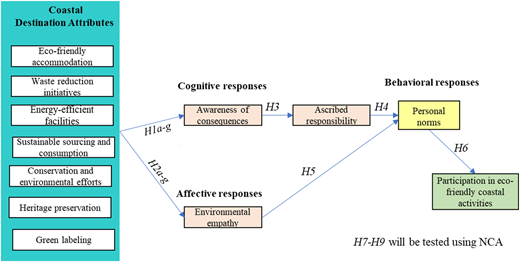
Accordingly, the hypothesized relationships in this research model follow the sequential logic of the CAB framework, complemented by NAM's normative pathway. Green coastal destination attributes are proposed to influence tourists' awareness of consequences, environmental empathy, and ascribed responsibility, which collectively activate personal norms. These personal norms become the immediate driver of participation in eco-friendly coastal activities. In contrast to prior studies that assume uniform effects (e.g. Han, 2014; Han et al., 2019), this research acknowledges the possibility of context-dependent relationships among cognitive, affective, and normative mechanisms, thereby offering a better insight of sustainable tourist behavior. Based on this theoretical integration, the following hypotheses are proposed:
Green coastal destination attributes (i.e. eco-friendly accommodation (H1a), waste reduction initiatives (H1b), energy-efficient facilities (H1c), sustainable sourcing and consumption (H1d), conservation and environmental efforts (H1e), heritage preservation (H1f), and green labeling (H1g)) positively influence tourists' awareness of consequences.
Green coastal destination attributes (i.e. eco-friendly accommodation (H2a), waste reduction initiatives (H2b), energy-efficient facilities (H2c), sustainable sourcing and consumption (H2d), conservation and environmental efforts (H2e), heritage preservation (H2f), and green labeling (H2g)) positively influence tourists' environmental empathy.
Awareness of consequences positively influences ascribed responsibility.
Environmental empathy positively influences personal norms.
Ascribed responsibility positively influences personal norms.
Personal norms positively influence participation in eco-friendly coastal activities.
2.3 Application of necessity logic
This study adopts a necessity-oriented perspective to capture those conditions that are indispensable for sustainable tourist behavior (Dul, 2016). Traditional path-analytic approaches assume that an increase in a predictor enhances the likelihood or magnitude of an outcome (e.g. greater environmental empathy increases eco-friendly participation), but they do not indicate whether a predictor must reach a minimum level for high levels of the outcome to be possible at all (Dul, 2016). Necessity logic addresses this limitation by asking whether certain conditions constitute non-substitutable prerequisites, so-called “must-have” factors, without which a desired outcome cannot occur, even if other predictors are favorable (Hauff, Guerci, Dul, & van Rhee, 2021). Recent applications in sustainable consumption and tourism show that combining sufficiency and necessity perspectives yields a more complete understanding of behavioral determinants and helps distinguish between “important-to-have” versus “essential-to-have” conditions for sustainability outcomes (Pinthong et al., 2026). Necessary Condition Analysis (NCA) operationalizes this logic by estimating ceiling lines that indicate the maximum attainable level of an outcome given a particular level of a condition (Dul, 2016). If the empirical data reveal that high values of an outcome never occur when a condition is low, that condition can be interpreted as necessary within the observed range. This approach is particularly pertinent in coastal sustainability contexts, where certain psychological or contextual factors may function as bottlenecks. For instance, high participation in eco-friendly coastal activities may be impossible without at least a moderate level of personal moral obligation, regardless of how attractive the destination attributes are. Extending insights from recent work integrating NCA with normative models in surplus-food and sustainable purchasing behavior (Agmapisarn, Seetha, & Fakfare, 2025), this study applies necessity logic to CAB–NAM mechanisms in coastal tourism, treating green coastal attributes and key cognitive–affective–normative constructs as potential necessary conditions for eco-friendly participation.
Building on this reasoning, this research investigates the necessary conditions that enable the ultimate outcome of participation in eco-friendly coastal activities. Given that the causal chains linking destination attributes, internalized cognitive mechanisms, and affective orientations are neither linear nor uniformly deterministic, it is essential to examine whether specific antecedent conditions must be present at a minimum threshold for high levels of pro-environmental participation to occur. Considering this, the following necessity hypotheses are proposed. Figure 1 illustrates the research framework.
A minimum level of green coastal destination attributes is necessary for tourists to reach high levels of participation in eco-friendly coastal activities.
A minimum level of cognitive variables (NAM constructs) is necessary for tourists to reach high levels of participation in eco-friendly coastal activities.
A minimum level of affective variable (environmental empathy) is necessary for tourists to reach high levels of participation in eco-friendly coastal activities.
3. Methods
3.1 Measurement development
All latent constructs in the proposed CAB–NAM model were operationalized using multi-item scales adapted from established tourism and environmental psychology literature and tailored to the coastal tourism context (e.g. Fakfare et al., 2025; Han, 2014). The questionnaire was developed in English and Thai, following a translation–back translation procedure to ensure semantic equivalence of items across languages. A panel of three tourism and sustainability scholars and two coastal destination practitioners assessed the initial item pool for content relevance, clarity, and cultural appropriateness. Based on their feedback, wording was refined to align with local coastal tourism practices, and redundant or overlapping items were removed. It is important to clarify that green coastal destination attributes in this study are conceptualized at the destination level rather than as expressions of individual environmental preference. Specifically, they refer to tourists' perceptions of observable and communicated sustainability features embedded within the coastal setting, such as infrastructure, conservation programs, and regulatory frameworks (Foronda-Robles, Galindo-Pérez-de-Azpillaga, & Fernández-Tabales, 2023). While survey items capture tourists' evaluations of these attributes, the underlying construct represents perceived destination-level characteristics rather than personal pro-environmental orientation. This distinction is critical for maintaining conceptual alignment between external environmental stimuli (destination attributes) and internal psychological responses (cognition, affect, and norms).
In this research, green coastal destination attributes were not treated as a single undifferentiated first-order construct. Green coastal destination attributes were measured as a first-order construct comprising seven dimensions. These dimensions are eco-friendly accommodation, waste reduction initiatives, energy-efficient facilities, sustainable sourcing and consumption, conservation and environmental efforts, heritage preservation, and green labeling. They were extracted from prior research, such as Dimitrovski, Lemmetyinen, Nieminen, and Pohjola (2021), Fakfare et al. (2024, 2025), Marasinghe, Perera, Simpson, and Newsome (2021), and Merli et al. (2019). Each dimension was captured through three items. They were modified to reflect tourists' perceptions of and preferences for specific green practices in the Eastern Economic Corridor (EEC) destinations (i.e. Chonburi, Rayong, Chachoengsao). Similarly, items for participation in eco-friendly activities were extracted and modified from Fakfare et al. (2024). Cognitive and normative constructs were adapted from prior applications of the Norm Activation Model (Han, 2014; Schwartz, 1977). Affective factor (i.e. empathy) was extracted and modified from Yin, Ma, Gong, Chen, and Zhang (2021). Screening items were assessed through tourists' recent or intended visits to EEC coastal destinations. Respondents were also asked to identify the recent coastal EEC destinations they visited to recall their memories. All latent constructs were measured using six-point Likert-type scales to reduce central tendency bias. Items for green destination attributes, CAB–NAM variables, and behavioral outcome were anchored from 1 = “strongly disagree” to 6 = “strongly agree”. They were modified to fit the study context relating to coastal tourism.
3.2 Data gathering process
Data were collected through an on-site questionnaire survey administered in major coastal destinations within Thailand's Eastern Economic Corridor (EEC), specifically Chonburi, Rayong, and Chachoengsao in 2026. The selection of the Eastern Economic Corridor (located along the Gulf of Thailand) was theoretically and strategically motivated. First, this region represents one of Thailand's most intensively developed coastal tourism corridors, integrating mass tourism (e.g. Pattaya in Chonburi), emerging eco-coastal zones (Rayong), and heritage-oriented riverine–coastal interfaces (Chachoengsao). Second, the Eastern Economic Corridor is central to Thailand's blue-economy and sustainable infrastructure development policies, making it a critical testbed for examining how green destination attributes translate into behavioral outcomes (Fakfare et al., 2022). Third, compared with the Andaman coast along the Indian Ocean (e.g. Phuket, Krabi), which is more internationally oriented and often characterized by resort-dominated tourism structures, the Eastern Economic Corridor presents a hybrid tourism system combining domestic mass tourism, industrial proximity, community-based heritage, and sustainability transition policies. This diversity allows for examination of sustainability mechanisms across varied coastal typologies within a single regional system while controlling for national regulatory context.
A systematic sampling strategy was implemented to reduce selection bias and ensure broad representation across different tourist groups. Research assistants were hired to conduct field surveys. Field researchers were stationed at high-traffic coastal sites, such as beach entry points, recreational zones, and marine activity centers. Prior to the main data collection, all field researchers underwent training to ensure standardized implementation of the sampling protocol and consistent handling of participant queries.
Using a systematic interval approach, every fourth adult tourist passing a predefined point was approached and briefly screened for eligibility based on two criteria: (1) having visited an EEC coastal destination within the past 12 months, or (2) having concrete plans to visit an EEC coastal destination in the near future. Eligible participants were then invited to complete the questionnaire in either its paper-based form or via a QR code linking to the online survey. The bilingual format (Thai and English) ensured accessibility for both domestic tourists and international visitors commonly found in the EEC region. Respondents were informed that participation was voluntary, responses would remain confidential, and the survey would take approximately 10–15 minutes to complete. Completed questionnaires were checked for completeness, consistency, and potential response quality issues. Responses exhibiting substantial missing data and straight-lining were excluded from the final dataset. After data cleaning, a total of 600 valid responses were retained for subsequent analyses.
The demographic profile of the final sample reflected the general tourist composition in EEC coastal destinations. Approximately 45% were male and 55% were female (n = 330). In terms of education, 62% held a bachelor's degree, followed by 20% with high school education, 10% with postgraduate qualifications, and 8% with below–high school education. Regarding age distribution, the largest group was between 31–40 years old (60%), followed by 21–30 years old (23%), 41–50 years old (10%), and 51 years or older (7%). Regarding nationality composition, 64.2% of respondents were domestic Thai tourists (n = 385), while 35.8% were international tourists (n = 215). International tourists are mostly from Asian countries (76%). This demographic spread reflects a strong representation of working-age adults who frequently visit the EEC for leisure, short-haul trips, and coastal recreational activities.
3.3 Analytical techniques
A multi-step analytical strategy was adopted to examine both the sufficiency-based and necessity-based relationships among the study constructs. First, Partial Least Squares Structural Equation Modeling (PLS-SEM) was employed to assess the measurement and structural components of the proposed CAB–NAM model. PLS-SEM is appropriate for prediction-oriented research, theory extension, and complex models incorporating multiple latent variables and paths, and it performs well with relatively large samples such as the 600 usable cases in this study (Hair, Howard, & Nitzl, 2020). Given the multidimensional specification of green coastal destination attributes, each attribute dimension was modeled as a separate exogenous construct rather than collapsing them into a higher-order aggregate. This approach allows detection of differentiated effects and avoids artificial inflation of explanatory power. The measurement model was then evaluated for all reflective constructs. Indicator reliability was assessed through standardized loadings, internal consistency through composite reliability, and convergent validity through average variance extracted (AVE). Discriminant validity was examined using the heterotrait–monotrait ratio of correlations (HTMT). Once the adequacy of the measurement model was established, the structural model was assessed to test the sufficiency-based hypotheses (H1–H6). Path coefficients, their significance, and the explanatory power of the model were evaluated using a nonparametric bootstrapping procedure with 5,000 resamples. The coefficient of determination (R2) for key endogenous constructs (awareness of consequences, environmental empathy, ascribed responsibility, personal norms, and eco-friendly coastal participation) was used to gauge explanatory power.
To complement the sufficiency-based PLS-SEM results, Necessary Condition Analysis (NCA) was conducted to identify indispensable psychological and contextual conditions for high levels of eco-friendly coastal participation. Following Dul's (2022) guidelines, latent variable scores obtained from the PLS-SEM estimation were used as inputs for NCA. Green coastal destination attributes, awareness of consequences, environmental empathy, ascribed responsibility, and personal norms were treated as potential necessary conditions, while participation in eco-friendly coastal activities was specified as the outcome. Using the CE–FDH (ceiling envelopment–free disposal hull) technique, ceiling lines were estimated to determine whether high values of the outcome could occur in the absence of sufficiently high levels of each condition. Effect sizes (d) and their statistical significance were computed via permutation tests. Bottleneck analysis was then performed to identify the minimum levels of each necessary condition required to achieve specific target levels of eco-friendly coastal participation, thereby distinguishing “essential-to-have” constraints from “important-to-have” drivers and empirically testing the necessity-based hypotheses (H7–H12).
4. Results
4.1 Measurement and structural model assessment
The results presented in Table 1 provide comprehensive evidence supporting the adequacy of the reflective measurement model. Convergent validity was established for all constructs, as the Average Variance Extracted (AVE) values exceeded the recommended threshold of 0.50, ranging from 0.831 to 0.918. In addition, construct reliability was confirmed through Dijkstra–Henseler's rho coefficients, which all surpassed the minimum criterion of 0.70, indicating strong internal consistency across the reflective measures. The standardized loadings for all indicators were high (above 0.7) demonstrating that the observed variables adequately captured the variance of their respective latent constructs. Furthermore, the estimated weights were all positive and statistically significant. This pattern affirms that each indicator contributes meaningfully to its construct in the model. Taken together, these results confirm that the reflective constructs, including eco-friendly accommodation, waste reduction initiatives, energy-efficient facilities, sustainable sourcing and consumption, conservation and environmental efforts, heritage preservation, green labeling, cognitive and normative factors, empathy, and participation in eco-friendly coastal activities demonstrate sound convergent validity and composite reliability within the coastal tourism context.
The structural model was assessed using SmartPLS 4. Multicollinearity diagnostics indicated no concern, with Variance Inflation Factor (VIF) values ranging from 1.00 to 1.284, which fall within acceptable limits. Global model fit indices also supported the adequacy of the model, with SRMR = 0.022 and NFI = 0.909, reflecting a well-fitting PLS model. Bootstrapping with 5,000 subsamples was used to estimate the relevance of the path coefficients. The results are summarized in Table 2. For awareness of consequences (AC), five green coastal destination attributes emerged as meaningful predictors. Eco-friendly accommodation (β = 0.130), waste reduction initiatives (β = 0.122), energy-efficient facilities (β = 0.605), sustainable sourcing and consumption (β = 0.103), and heritage preservation (β = 0.112) all demonstrated positive effects on AC. Among these, energy-efficient facilities exhibited a markedly stronger coefficient relative to the other attributes, suggesting that highly visible and technology-oriented sustainability cues may be particularly salient in shaping tourists' cognitive recognition of environmental consequences. The results are consistent with Han et al.’s (2021) study. In contrast, conservation and environmental efforts (β = 0.018) and green labeling (β = 0.034) did not exhibit meaningful relationships with AC. This non-significant pattern is theoretically informative, as it indicates that institutional or policy-oriented sustainability signals may not automatically translate into heightened personal awareness of consequences, possibly because such initiatives are perceived as background governance measures rather than as cues requiring individual cognitive engagement. Altogether, these predictors accounted for 63.4% of the variance in AC (R2 = 0.634).
In the case of environmental empathy (EE), eco-friendly accommodation exerted the strongest influence (β = 0.645), followed by conservation and environmental efforts (β = 0.153), energy-efficient facilities (β = 0.149), and green labeling (β = 0.101). Waste reduction initiatives (β = −0.046), sustainable sourcing and consumption (β = 0.037), and heritage preservation (β = 0.032) showed minimal and non-significant influence on EE. These weak or non-significant relationships suggest that not all green attributes evoke emotional resonance to the same extent. Attributes embedded in immediate experiential contexts (e.g. accommodation environments or visible conservation programs) may stimulate affective responses more strongly than operational backstage practices such as sourcing systems or waste logistics, which may remain cognitively acknowledged but emotionally distant. The model explained 61.4% of the variance in EE (R2 = 0.614).
Regarding NAM relationships, awareness of consequences had a substantial influence on ascribed responsibility (β = 0.462), explaining 21.4% of its variance (R2 = 0.214). Ascribed responsibility exhibited a strong effect on personal norms (β = 0.777), whereas environmental empathy contributed only marginally to personal norms (β = 0.045). The results verified the norm activation process (Han, 2014). Although empathy is frequently theorized as a bridging mechanism in pro-environmental behavior, its limited coefficient in this model suggests that emotional resonance alone may be insufficient to activate internalized moral obligation in coastal tourism settings. Instead, cognitive appraisal of consequences and responsibility attribution appear to represent the more stable activation route toward personal norms. Together, these variables explained 62.2% of the variance in personal norms (R2 = 0.622). Finally, personal norms strongly shaped participation in eco-friendly coastal activities (β = 0.779), which served as the ultimate outcome of the model. It is important to interpret this dominance cautiously. Because personal norms were specified as the sole direct predictor of participation in the structural model, their strong association reflects the theoretical architecture of the model rather than an unexpected empirical concentration. Accordingly, the results indicate a norm-centered pathway consistent with the proposed framework, rather than establishing that alternative pathways are empirically irrelevant. This relationship accounted for 60.7% of the variance in PECA (R2 = 0.607), highlighting the central role of personal moral obligation in driving eco-friendly engagement.
4.2 Necessary condition analysis results
Following Dul's (2022) guidelines, the Necessary Condition Analysis (NCA) was conducted using the CE-FDH ceiling technique to identify which antecedent conditions are indispensable for achieving high levels of Participation in Eco-friendly Coastal Activities (PECA). In line with Hauff et al. (2021), a construct is considered a meaningful necessary condition when its effect size (d) exceeds 0.10 and is statistically significant at the 95% confidence level. As presented in Table 3, only Ascribed responsibility (AR) and personal norms (PN) satisfied these criteria, with effect sizes of 0.218 and 0.285, respectively. These findings indicate that, within the observed empirical range, high levels of PECA did not occur when AR or PN were low. Given that personal norms were specified as the sole direct predictor of participation in the structural equation model, their emergence as a necessary condition is theoretically coherent and partially implied by the model structure. Thus, the necessity result reinforces the central role of moral obligation within the framework rather than constituting an entirely independent empirical surprise.
All other constructs, including green coastal destination attributes (e.g. EFA, EEF, SSC, CEE, HP, GL) and Environmental Empathy (EE), failed to demonstrate meaningful necessity despite some being statistically significant. This asymmetry between sufficiency (SEM) and necessity (NCA) is conceptually meaningful. Several green attributes contribute to participation indirectly by enhancing cognitive awareness or affective engagement, yet none of them operate as boundary constraints on the maximum attainable level of participation. In other words, destination-level sustainability signals may enhance engagement, but they do not structurally cap participation in the way moral responsibility constructs appear to do.
Further insights are provided by the bottleneck analysis (Table 4), which specifies the minimum levels of necessary conditions required to reach different performance thresholds of PECA. For instance, to achieve a 70% level of PECA, AR and PN must reach at least 13.333% and 24.833%, respectively, while environmental empathy emerges as marginally necessary only at this higher outcome level. When the desired outcome increases to 90% and above, the minimum required levels rise substantially, with PN reaching 53.833% and AR 32.833%, highlighting their escalating importance as participation intensity increases. In contrast, most green coastal destination attributes consistently remained labelled as not necessary, confirming their non-essential status within a necessity logic framework.
5. Discussion and implications
5.1 Research implications
This study advances contemporary sustainability and tourism scholarship by offering an integrated theoretical and methodological understanding of eco-friendly participation within coastal destinations. Conceptually, it extends the Cognitive–Affective–Behavioral (CAB) framework (Chou et al., 2020) by embedding the Norm Activation Model (NAM) (Schwartz, 1977) as a core psychological mechanism. Therefore, it demonstrates that sustainable tourist behavior is not merely attitudinal or emotional but fundamentally norm-driven. The findings empirically validate that cognitive drivers, such as personal norms and ascribed responsibility are not only influential predictors but also indispensable prerequisites for high levels of eco-friendly participation, as revealed through Necessary Condition Analysis (NCA). This distinction is critical, as it shifts scholarly attention from viewing moral constructs as supplementary drivers toward recognizing them as structural foundations of sustainable behavior in tourism contexts (Han, 2014). Theoretically, the results contribute to the growing discourse on necessity logic in hospitality and tourism by illustrating how sufficiency-based explanations alone are insufficient for capturing the full causal chain of sustainable behavior (Agmapisarn et al., 2025). While green coastal attributes and empathy demonstrated sufficiency effects through SEM, only moral–normative constructs exhibited true necessity. This reinforces the value of combining SEM and NCA in behavioral research, offering a more comprehensive interpretation that differentiates between “enhancing” and “indispensable” factors (Wattanacharoensil et al., 2024). Such an approach contributes methodological rigor to sustainability research, echoing recent calls for hybrid analytical models that integrate linear and boundary-condition perspectives.
Moreover, this research enriches existing pro-environmental behavior theory by situating it within the unique socio-ecological dynamics of coastal tourism (Fakfare et al., 2024). Unlike urban or generic destination contexts (Koh, Jarumaneerat, Saikaew, & Fakfare, 2023), coastal environments present heightened ecological fragility, making moral accountability particularly salient (Fakfare et al., 2025). The confirmation that personal norms represent the primary gateway to eco-friendly participation suggests that sustainable engagement in coastal areas is deeply rooted in ethical self-regulation rather than merely environmental awareness or emotional attachment. From a theoretical standpoint, the study also highlights the conditional role of environmental empathy (Yin et al., 2021). While empathy enhances participation under a sufficiency logic, it does not constitute a non-substitutable prerequisite. This positions empathy as a supportive but not foundational mechanism in moral activation processes. Collectively, these findings contribute to sustainable tourism literature by offering a refined behavioral model that integrates cognitive evaluation, emotional resonance, and moral obligation while clarifying their relative structural significance. The study therefore provides a theoretically robust platform for future research exploring sustainable behavior not only in coastal tourism but also in other environmentally sensitive tourism ecosystems.
5.2 Practical implications
The findings offer critical insights for coastal destination managers, policymakers, and tourism operators seeking to foster higher levels of eco-friendly tourist participation. While investments in green infrastructure, eco-certification, and sustainable facilities remain important, this study suggests that such physical attributes alone may not be sufficient to ensure high levels of eco-friendly engagement. Instead, similar to other environmental studies (e.g. Han, 2014), the results indicate that tourists' internal moral responsibility and personal norms may represent important mechanisms influencing behavioral change. Importantly, the necessity logic results indicate that high levels of eco-friendly participation may be constrained when tourists' ascribed responsibility and personal norms remain below minimum thresholds. Thus, destination strategies may benefit from not only “adding more green features” (sufficiency logic) but also considering approaches that encourage the activation of moral obligation and responsibility attribution on-site (necessity logic).
Destination management organizations (DMOs) should therefore move beyond purely informational or aesthetic sustainability messaging and incorporate strategies that actively stimulate moral reflection and accountability. For instance, interpretive signage, storytelling initiatives, and conservation communication should emphasize tourists' personal responsibility for protecting marine ecosystems, including messages that directly link individual actions to environmental consequences. Campaigns that frame sustainability as a shared moral duty rather than a voluntary option may effectively strengthen ascribed responsibility and personal norms, which are confirmed as structurally necessary for behavior change.
Tourism operators may also explore participatory experiences that reinforce ethical engagement, such as guided beach clean-ups, coral restoration programs, or community-based conservation initiatives. These activities have the potential to elevate environmental empathy and may contribute to translating cognitive awareness into an internalized sense of obligation, thereby reinforcing the normative pathway identified in this research. To maximize norm activation, operators could consider incorporating a short “responsibility framing” briefing before the activity begins (e.g. a two-minute explanation linking tourist actions to measurable impacts such as marine debris counts, coral stress, or wildlife disturbance), followed by an immediate behavioral request (e.g. reusable bottle use, reef-safe sunscreen, no-touch coral protocols). However, the effectiveness of such sequencing remains indicative rather than conclusive within the scope of this study.
Policymakers may also consider embedding moral and responsibility-based messaging into sustainability certification schemes and regulatory frameworks. Green labels, for example, may be more effective when accompanied by clear explanations of their environmental significance, encouraging tourists to internalize responsibility rather than merely perceive sustainability as a passive service feature (Worrachananun, 2025). At the policy level, destination authorities could strengthen norm activation through standardized “behavioral codes” used across beaches, marine parks, and licensed operators. When communicated consistently (same symbols, same core behavioral requests, same consequence framing), these codes may function as normative cues that increase perceived expectations, although their impact may vary across contexts. Such standardization is particularly relevant in the Eastern Economic Corridor, where tourists move across multiple coastal zones and operators.
Moreover, the bottleneck findings provide actionable insights (Issariyakulkarn, Pansukkum, & Nunthapirat, 2024; Sathatip, 2024). Since high levels of participation are unattainable without adequate levels of ascribed responsibility and personal norms, destination stakeholders should monitor and measure these psychological constructs through visitor surveys and feedback systems. This is to ensure that sustainability strategies effectively elevate moral engagement rather than focusing solely on infrastructural improvements. In practical terms, this study advises a paradigm shift from infrastructure-driven sustainability toward norm-driven sustainability. Coastal destinations that strategically shape tourists' moral consciousness are more likely to achieve enduring sustainable engagement, thereby reinforcing both environmental protection and destination resilience. Because personal norms and ascribed responsibility are not only influential but necessary conditions, interventions that directly target these constructs are expected to yield disproportionately higher returns than interventions focused only on adding green attributes.
6. Limitations and future research
This study is subject to several limitations that offer opportunities for further investigation. First, the empirical analysis is based on tourists visiting coastal destinations within Thailand's Eastern Economic Corridor. Although this region represents a dynamic coastal tourism cluster, the findings may not be fully generalizable to other national or international coastal settings that differ in environmental regulation, cultural norms, or stages of tourism development. Future studies could replicate and extend the model across diverse coastal and marine destinations, such as small island contexts, temperate coasts, or polar region to assess the stability of the CAB–NAM mechanisms and necessity patterns across socio-ecological environments. Second, the present model focuses on a specific set of cognitive, affective, and normative constructs derived from CAB and NAM. While this enhances theoretical parsimony, it does not capture other potentially important antecedents, such as environmental values, place attachment, perceived behavioral control, social norms, or spillover effects from everyday green practices. Integrating complementary frameworks, such as the Value–Belief–Norm theory, or habit-based approaches could provide a more comprehensive account of how stable values and situational constraints interact with CAB–NAM mechanisms in coastal contexts. Finally, although combining PLS-SEM and NCA offers a richer understanding of sufficiency and necessity, additional analytical approaches could further illuminate the complexity of sustainable behavior. Configurational methods such as fuzzy-set Qualitative Comparative Analysis (fsQCA) may reveal distinct combinations of green attributes, psychological states, and socio-demographic factors that lead to high eco-friendly participation.
The study was approved by the Research Ethics Committee of Burapha University (Reference no: IRB2-012/2026). The authors would also like to acknowledge the support from the Fundamental Fund (FF) for the fiscal year 2026, allocated from the National Science, Research and Innovation Promotion Fund through Burapha University.