
New salt contamination meter
Article Type: New materials and equipment From: Anti-Corrosion Methods and Materials, Volume 61, Issue 1
Measuring soluble salts is now more accurate, easier and faster than ever before thanks to the new Elcometer 130 Salt Contamination Meter, launched by the experts at Elcometer.
Designed for use on-site or in the laboratory, the portable, hand-held gauge can accurately and reliably carry out 24 tests per hour – nearly five times faster than other Bresle equivalent test methods under ISO 8502-6.
Key features include:
* Automatic temperature compensation ensures repeatable and accurate results.
* Calibration offset function allows less than pure water to be used for testing, automatically adjusting the reading to take into consideration the conductivity of the water used.
* Memory capacity up to 150,000 readings in 2,500 alpha numeric batches with individual readings stored with date and time stamp, temperature and size of test paper.
* Measures salt contamination of up to 50 μg/cm2 (3,000 ppm) on flat or curved surfaces.
* The data can be transferred using Bluetooth® to ElcoMasterTM 2.0 Data Management Software to enable professional inspection reports to be sent anywhere in the world instantly.
* Heavy duty, impact resistant, dust and waterproof design equivalent to IP64, the Elcometer 130 is designed for use in the harshest environments.
Performing the Bresle method as per ISO 8502-6 each test can take up to 12 minutes to perform (10 minutes sampling, 2 minutes to prepare the patch, test the conductivity and remove the patch and residue).
The Elcometer 130 is much faster (2 minutes sampling and 2 minutes to prepare test and make good). In addition, as the test samples can be set up concurrently, two tests can be undertaken within 5 minutes.
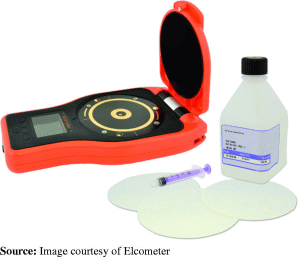
Figure 3 Elcometer 130 Salt Contamination Meter
So whilst the Bresle method restricts users to five tests per hour the Elcometer 130 can accurately and reliably achieve 24 tests per hour – nearly five times faster than other Bresle equivalent test methods (Figure 3).
More information is available from: www.elcometer.com


