The purpose of this paper is to propose a Clarke-Groves Tax (CGT) type as a remedy to the criticism that the implementation of Eurobonds has raised regarding the risk of undermining fiscal discipline. In this model, a government minimizes its sovereign debt-to-GDP ratio in a given period and decides whether to join a common sovereign debt club. In doing so, it exposes itself to a positive or negative tax burden while benefiting from the liquidity premium involved in creating a secure asset. The authors found that the introduction of this tax may prevent free riding behaviours if Eurobonds were to be implemented. To illustrate this, the authors provide some numerical simulations for the Eurozone.
In the model presented, a government which optimizes a social utility function decides whether to join the common debt club.
The adoption of the proposed tax could prevent free-riding behaviours and, therefore, encourages participation by those countries with lower debt levels that would have not otherwise taken part in this common debt mechanism. Under certain circumstances, we can expect the utility of all members of this club to improve. The bias in the distribution of gains might be mitigated by regulating the tax rule determining the magnitude of payment/reward. The proportion of the liquidity premium, arising from the implementation of a sovereign safe asset, has a decisive impact on the degree of the governments’ utility enhancement.
The adoption of a CGT would require Eurobonds club members to reach an agreement on “the” theoretical model for determining the sovereign debt yield. One of the limitations of this model is considering the debt-to-GDP ratio as the sole determinant of public debt yields. Moreover, the authors assumed the relationship between the debt-to-GDP ratio and funding costs to be identical for all countries. Any progress in the implementation of the proposed transfer scheme would require a more realistic and in-depth analysis.
A new fiscal rule based on compensating countries with lower public debt levels could be a way to mitigate free-riding problems if a Eurobond mechanism is to be established.
This fiscal rule has not been proposed or analysed before in a context such as that considered by this paper.
1. Introduction
The European Central Bank’s balance sheet has not stopped growing since the implementation of the first asset purchase programmes in May 2009. This trend has been intensively strengthened with the Pandemic Emergency Purchase Programme (PEPP) since March 2020. Sometime in the future, the European Central Bank (ECB) will have to stop buying new bonds and refinancing the assets in its portfolio. Against this background, the fear of a new sovereign debt crisis in the Eurozone and the drawbacks of flight-to-quality movements, which generate negative snowball effects, have led to proposals aimed at the mutualization of fiscal risks among EU Member States. Recently, on the back of the COVID-19 crisis, nine European Member States raised the question of the desirability of issuing Corona-bonds (a form of EU mutualized debt). Furthermore, the distribution of purchase flows under the PEPP can be conducted by the ECB in a flexible manner, allowing a deviation from the benchmark allocation across jurisdictions that, in principle, are based on the capital key of national central banks. This opens the door to a certain degree of fiscal risk mutualization within the Monetary Union (MU). In addition, in July 2020, the European Council agreed the EUR 750bn Recovery Plan (Next Generation EU), including EUR 390bn in grants and EUR 360bn in loans. The European Commission plans to issue large amounts of common EU bonds to finance this Fund. For instance, on 21 October 2020, the European Commission issued a EUR 17bn inaugural social bond under the European instrument support to mitigate unemployment risk in emergency (SURE). A tool to help protect jobs and keep people in work. The money borrowed as part of the Recovery Fund must be reimbursed by 2058. This Plan brings the Eurozone one step closer to a fiscal union.
However, the implementation of Eurobonds has been also strongly questioned because of the risk of free-riding behaviours by the more fiscally stressed members. In the long term, the only way to avoid future sovereign debt crises in the Eurozone is through a credible commitment by member states to implement economic reforms aimed at achieving sound fiscal discipline. The mutualization of debt may create a misalignment of the incentives of policymakers with respect to public finance sustainability targets, as it would contribute to weaken their will to apply unpopular austerity measures. Countries with weak fiscal structures may be encouraged to maintain wrong public spending policies, if they consider that in an extreme case other governments will bear at least part of the burden arising from such policies. This would be a case of moral hazard. The issuance of a common debt instrument is seen by some economists as a first step on a path to financial bailouts. From this perspective, the Eurobond mechanism would not only be costly for the most solid countries, but its creation would also imply a cost for all Eurozone countries, as it would contribute to undermine the credibility of the Eurozone as an area of stability and fiscal soundness.
In this paper, we propose a reduced-form model to analyse the incentives for a country to join an organization that issues mutualized sovereign debt. In particular, we examine whether the introduction of a Clarke-Groves tax (CGT) type into a Eurobond mechanism could prevent free-riding behaviours. In particular, we consider a common sovereign debt (CSD) instrument or a joint and several guarantee bond, whose yield reflects the average fiscal strength of the countries that are part of this club. The tax can be seen as a transfer system to offset increased borrowing costs incurred by the more creditworthy members if they join the club. To carry out this analysis, we build a model in which a government optimizes a utility function that is negatively dependent on the growth rate of the sovereign debt-to-GDP ratio over a given period. Each government decides whether to join the CSD mechanism knowing ex ante:
the common bond yield, according to the average debt rate of the countries that are part of the club;
the benefit from a liquidity premium linked to the fact that this common debt instrument exhibits features of a safe asset; and
the tax/subsidy it will pay/receive, depending on its relative public debt ratio. The first two factors affect the GDP growth rate, which in our model depend on interest rates.
The present paper aims to contribute to the existing research body with a study focussed on the use of a new fiscal rule in the design of Eurobonds. The proposed CGT type could help to achieve a political consensus to mutualize sovereign debt in the euro area. The original CGT is applied to get a disclosure of true preferences on the budget size of public goods, which have the characteristic of being non-excludable in consumption. Note that we characterize our transfer scheme as a CGT albeit its application does not imply that truth-telling becomes the dominant strategy. Furthermore, in our model, enjoying a scenario of low financing costs is not formally characterized as a public good either. In the original CGT, voters on the size of the budget have to pay according to the marginal cost derived from altering the social outcome. In this case, each country joining the club which shares a CSD is taxed according to its impact on the financing cost of the rest of the members. To the best of our knowledge, there is no literature that proposes this approach. This topic is relevant, as European Union members share a single currency while maintaining very different public debt-to-GDP ratios. We find that all countries (large and small, highly indebted and lowly indebted) could benefit from the implementation of a common debt if it is accompanied by the introduction of a CG-type tax. The enhancement of social utility depends very significantly on the magnitude of a convenience yield, which arises from the implementation of a safe asset with a higher level of liquidity.
The remainder of the paper is organized as follows. In Section 2, we position this work within the literature. In Section 3, we present the model. In Section 4, we derive some theoretical results. In Section 5, we provide some numerical simulations to illustrate the merits of the proposed model. Section 6 concludes the paper by summarizing the findings and identifying open research questions.
2. Related literature
This paper combines two different strands of the literature that have traditionally been separated.
Firstly, it relates to the analysis of the implementation of a sovereign-debt-pooling mechanism in the European Union. Designs of Eurobonds greatly differ in their scope, goals, level of intergovernmental commitment and extent of solidarity. In its most radical variant, a newly created European Fiscal Authority or a European Debt Management Agency would issue a Eurobond, and all Member States would jointly guarantee it. This “joint and several” guarantee is considered by some scholars as a factor that would provide stability and liquidity to sovereign debt markets. It could also insulate more fiscally responsible States against the effect of contagion (Favero and Missale, 2010). In addition, the implementation of a Eurobond mechanism could contribute to mitigate the flight-to-quality, a market movement consisting of investors selling riskier bonds to purchase sovereign bonds with better credit quality and greater liquidity. This strategy turns into a widening of credit spreads that goes beyond those levels that would be theoretically justified by differences in sovereign credit solvency. As a result, a vicious cycle is created, as more fiscally stressed governments face higher yields in the primary market, what reinforce their public deficit problems (Bühler and Trapp, 2009 and Dajcman, 2012). Other policymakers and scholars, however, believe that the establishment of a Eurobond mechanism might entail some drawbacks, including free-rider behaviours by the more indebted members; the undermining of the credibility of no bail-out clauses; and, in presence of moral hazard, a weakening of fiscal discipline inside of the EU (Issing, 2009; Kösters, 2009; Favero and Missale, 2010; IFO, 2011). Alternative mechanisms have been proposed to deal with these drawbacks (Table 1).
As in most Eurobond proposals, we consider that a supranational body would be responsible for the issuance of a common debt. On the contrary, our scheme moves away from a proposal requiring an exchange of sovereign bonds for a joint bond, as is the case with Trichet Bonds (Economides and Smith, 2011). In our Eurobond model there is no explicit quantitative limits, as is the case with Blue Bonds. And, furthermore, it is not based on subordination schemes, as proposed by Delpla and von Weizsäcker, 2010; nor on securitization and insurance wrapping mechanisms as is the case of ESBies (Brunnermeier et al., 2012), Synthetic Eurobonds (Beck et al., 2011), Structured Bonds (Hild et al., 2012) or Sovereign Bond-Backed Securities (European Commission, 2018a, 2018b). Our proposal is closer to the design proposed by Mayer, 2009, where countries pay different coupons according to their level of credit risk, although in our case this adjustment occurs through the establishment of a tax.
Secondly, this paper relates to the theory of preference revelation in public goods provision in the tradition of Clarke, 1971; Groves, 1973; Tideman and Tullock, 1976, and Groves and Ledyard, 1977. This literature includes the analysis of procedures to reach outcomes with desirable properties in systems with self-interested agents that have private information about their preferences and capabilities. The CG tax is a way to ensure that agents are always better off declaring their true preferences. The introduction of a demand-revealing process motivates individuals to reveal their true preferences for public goods. The essence of the process is that each individual is offered a chance to change the outcome that would occur without his vote by paying a special charge equal to the net cost to others that results from including his vote in the decision (Green and Laffont, 1977a, 1977b, D’Aspremont and Gerard-Varet, 1979; Mailath and Postlewaite, 1990; Hellwig, 2003 or Neeman, 2004). In the context of our paper, the stability in sovereign debt markets and the absence of contagion risk are not formally characterized as public goods. However, as in the original CGT, in our model each country is offered the chance to change the average sovereign debt-to-GDP ratio that would result in a CSD club without its participation. However in our model there is no asymmetric information, as we assume that data on debt-to-GDP ratios for each country are always available for a supranational fiscal authority. Therefore, it is not a preference disclosure problem that the tax is trying to fix. We consider a fiscal rule according to which members of a Eurobond mechanism are taxed/rewarded for their negative/positive impact on the funding cost of the other members. Unlike the original CGT, in our model the tax becomes negative when the participation in the CSD mechanism by a given country benefits other members’ fiscal position. In addition, the design of our tax rate ensures that there is no deficit or surplus at a supranational level.
3. Model
In our model, a supranational planner has the task of drawing up a contract to maximize the utility of countries in a MU with m members. To this end, this international body is responsible for issuing jointly guaranteed debt and managing a transfer mechanism that encourages the participation of union members.
It is assumed that the government’s objective of country j is to maximize the social utility function Uj in a period of n years. A different issue that is not discussed in this paper is why governments (who may like debt too much) would not deviate from optimizing the true social welfare function. The utility function is defined herein as:
where dj,0 and dj,n are the respective public debt-to-GDP ratios for periods 0 and n. So, dj,0 = Dj,0/Yj,0 and dj,n = Dj,n/Yj,n being Dj,0 and Dj,n the gross debt amount in periods t = 0 and t = n, and Yj,0 and Yj,n are the GDP levels for country j in periods t = 0 and t = n, respectively. We assume that the annual growth rate of GDP for any country c (including j) in year, defined by , is a function of the relevant interest rate such that:
where β0, β1 and β2 are positive parameters and ic,t is the yield in year t of the country c sovereign bond, which is assumed to provide a benchmark for the funding cost of private companies based in that country. Note that for simplicity’s sake, in the government utility function the variable i is not lagged, while in practice, the effect would typically occur with some delay. In addition, we assume that inflation is nil (πc,t = 0) for all {c, t}. Moreover, the relationship between the GDP growth rate and the funding cost is assumed to be the same for all countries belonging to the MU, which in practice does not necessarily have to hold.
In the scenario out, where the government of country j chooses not to join the CSD mechanism, the funding cost depends on the government’s own debt-to-GDP ratio, such that:
where α0 , α1 and α2 are non-negative parameters, α0 is the funding cost rate for a debt ratio equal to zero, α1 is such that α0 + α1 is the public debt yield when the debt to GDP ratio is 1, and α2 is a measure of the elasticity of the yield respect to the debt-to-GDP ratio dj,t. For simplicity’s sake, the public debt-to-GDP ratio is the sole determinant of public debt yields in our model, and this relationship is assumed to be identical for all members of the MU. In practice, however, aspects such as per capita income, GDP growth rate and the country’s degree of economic development are also of relevance. In addition, other factors such as the risk appetite of international investors and the overall level of liquidity play a role in determining credit spreads over time.
On the other hand, we assume that for a common bond issued in a scenario where country j participates, investors demand a yield that is given by:
Such that:
where γk,t is a parameter indicating a negative risk premium owing to the higher liquidity of this common financial instrument (liquidity premium), k represents the set of m-1 countries, which does not include the country j and k ∪ j is the set of m countries including country j.
We assumed that this mutualized debt exhibits characteristics often attributed to safe assets. As these assets are not only safer but also very liquid, investors are willing to accept them as collateral and earn a lower yield over alternative investments that provide similar cash flows. In other words, safe assets provide nonpecuniary returns and investors attach a liquidity premium or convenience yield to holding them. There is extensive recent literature on this subject, including Longstaff, 2003; Beber et al., 2006; Krishnamurthy and Vissing-Jorgensen, 2012; Nagel, 2016; Du et al., 2018; Liu et al., 2019, among others.
Any government with a debt-to-GDP ratio that exceeds the club’s weighted average ratio would be financed at a lower cost by joining it. This reduction rests on both, the insurance-effect and the liquidity-effect of the common deb instrument. For the sake of simplicity, we work with a zero-coupon bond, and it is assumed that:
all governmental financial liabilities mature just before the moment when the decision to join (or not) the CSD mechanism is made; and
the term of the newly issued debt coincides with the optimization period n.
Moreover, by assuming that fiscal budgets are balanced during the n years of the optimization period, we can ignore potential impacts arising from fiscal deficits.
The outstanding public debt of country j when it has decided to remain outside of the CSD mechanism can be expressed as:
A key ingredient in our model is the tax rate, which encourages the participation of less indebted countries. In the terminology of contract theory, this tax ensures that the incentive compatibility constraint is met. Members of the MU may or may not join this club. A country with a high rate of public indebtedness will be able to finance its debt at a lower cost if it joins the club, but it will have to pay a tax to reward the rest of the members that face an increased financing cost. Similarly, a negative tax (i.e. subsidy) will be applied to a country with a debt-to-GDP ratio below the average, as its participation in the club results into a benefit for the rest.
The outstanding public debt of country j when it has decided to participate in the CSD mechanism will be given by:
where Tj,in,t refers to the tax levied on government j in the period t. This tax is defined as:
where Ω is a positive parameter that indicates how severe is the penalty or the reward; Ik∪j,in,t refers to interest payments during the relevant period paid by all members of the CSD club; Ik,out,t measures interests paid by the rest of the club’s members if country j does not join the club, and Ij,n,t measures interests paid by country j when it becomes a member of the club. Note that in all cases, interests are calculated including the positive effect of the liquidity premium γk,t such that:
Therefore, alternatively to equation (10), we can express:
The magnitude of Tj,in,t depends positively on Ω and decreases:
the more similar the public debt ratio of country j is to the average ratio of the other participating countries;
when the size k of the club increases; and
the smaller the size of country j is compared to the other participating countries.
Assuming that debt ratios remain constant, it is possible to rewrite (13) as:
The tax size as expressed in equation (14) could be interpreted as the transfer system necessary for the participation constraint to hold.
4. Theoretical results
In Section 4, we analyse the relative impact of several determinants in the decision of whether to join the common debt club or not. In particular, we consider how Uj,in − Uj,out is affected by α0, α1, α2, β0, β1, β2, γ and Ω.
Under the assumption that the magnitude of Tj,in,t is small enough in relation to Dj,in, 0, we can obtain a simplified final expression for Uj,in − Uj,out that uses equation (14) such that:
As typically , we are faced with an allocation problem, whose different solutions depend on the fulfilment of some required properties. In this context, the authors suggest a valid solution based on the principle of proportionality, such that the tax size is redefined as :
in which the parameter λ* is such that . It can be obtained:
On the basis that Uj,in − Uj,out > 0, the relevant sensitivities are as follows: ; ; ; ; ; ; ;
5. Numerical simulations
In Section 5, we first present an illustrative case to show how the model proposed in Section 3 operates. Our quantitative analysis is based on model simulations. In the first part of this section, we consider four hypothetical countries: two large and two small, such that two of them show high debt-to-GDP ratios and the other two low debt-to-GDP ratios (Table 2).
The parameters used in the base case scenario are shown in Table 3.
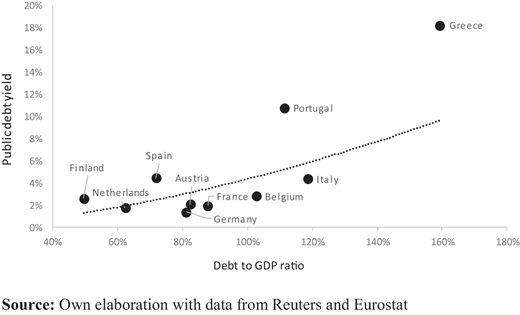
Coefficients indicating the relationship between the government debt yield and the government debt-to-GDP ratio are based on the data of ten countries of the Union with sufficiently liquid bonds (Austria, Belgium, Finland, France, Germany, Greece, Italy, Netherlands, Portugal and Spain). For this estimation, we have chosen a sample period which goes from the beginning of turbulences that took place in public debt markets of peripheral countries of the euro (August 2010) to the declaration by Mario Draghi announcing strong measures from the European Central Bank to defend the euro (July 2012). We believe that it was during this period that the market most accurately reflected the relevance of fundamental credit factors (maybe even exaggerated). Since then, the market has been heavily influenced by the ECB’s intervention and credit spreads do not fully reflect differences in sovereign creditworthiness levels (Figure A1).
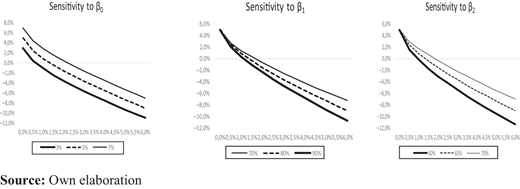
Regarding the relationship between GDP growth rates and government bond yields, we perform simulations under several scenarios. The changes in the behaviour of this curve in response to variations in the parameters used are exhibited in Figure A2.
Finally, in relation to the liquidity premium, the empirical literature has largely focussed on estimating the differences between the yield of US Treasury bonds and yields of US public agencies, supranational agencies and sovereign bonds issued by other developed countries with the same credit rating. This parameter is a key ingredient of our model and the value we use in the base case scenario (30 basis points) is at the lower end of the estimates, whose values range from 26 to 61 basis points, Du et al. (2018).
We start by evaluating sovereign debt yields of countries with different profiles according to their decision to participate in the CSD mechanism. The results, shown in Table 4, are obtained using the base case data.
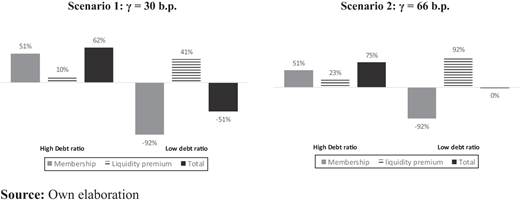
Based on these results, we assess the changes in social utility at the end of the optimization period for countries with high and low debt ratios in a scenario without the CG tax. The total effect is broken down into two components: the impact arising from the participation in the common debt mechanism and the effect of the liquidity premium (Figure 1). As expected, countries with higher levels of public debt improve their social utility at the expense of frugal countries: a situation of free-riding occurs. In the absence of a CGT, less indebted countries are interested in being part of a common debt mechanism only if the liquidity premium reaches a certain magnitude. Applying the values indicated in the base case on the rest of relevant parameters, the liquidity premium should exceed 66 b.p.
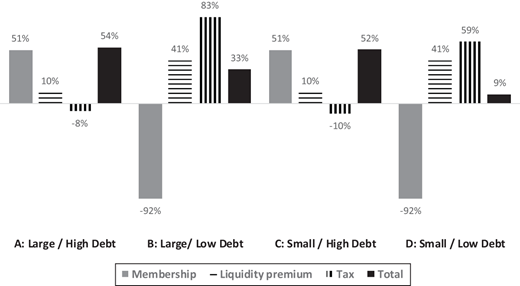
Next, we evaluate the impact of introducing a CGT type that compensates less indebted countries for the increase in their funding cost. The results are now calculated for the four country profiles, as the magnitude of the tax depends not only on the debt ratio, but also on the size of the country. The total effect is now broken down into three components, as the effect of the tax is also incorporated. Our results indicate that, for the base case values, all countries benefit from sharing a common debt instrument. Furthermore, countries that benefit the most are those with the highest debt ratios, especially if they are large-sized countries (Figure 2). Note that our model allows a better distribution of the gains by modifying the value of Ω.
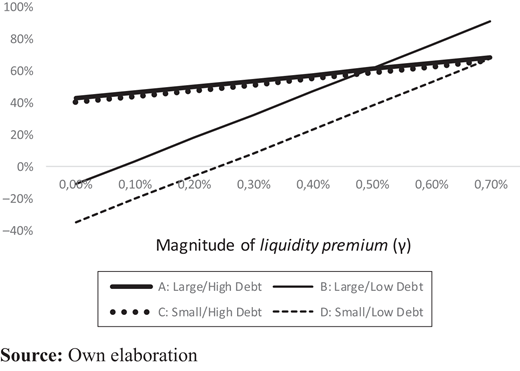
We now discuss the role of the liquidity premium in the variation of social utility according to the type of country under consideration. For this purpose, we have carried out a simulation with several values for γ. The results reported in Figure 3 indicate that in the presence of the tax, for a value of Ω equal to 1, the value of the liquidity premium required for less indebted countries to join the club drops considerably. In particular, the liquidity premium should reach 10 and 20 basis points respectively depending on whether the country is large or small. If the liquidity premium exceeds 50 basis points, large countries with the lowest debt ratios benefit the most from sharing a common debt instrument.
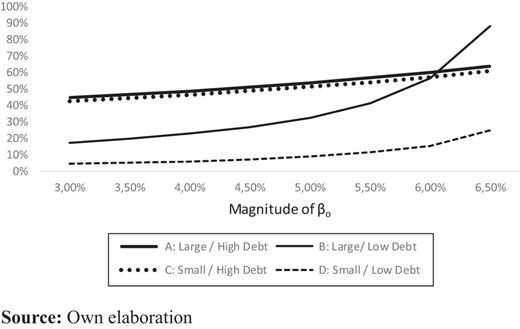
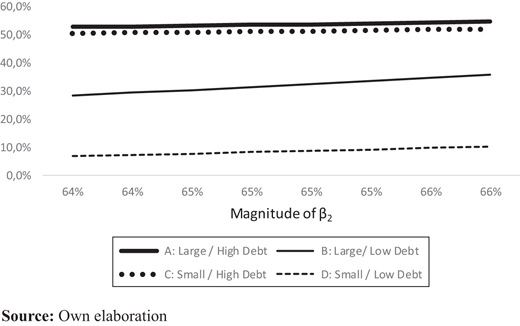
Next, we analyse the role of the sensitivity of GDP growth rates to yield rates. In particular, Figures 4 and 5 report the simulation results for several scenarios of parameters β0 and β2.
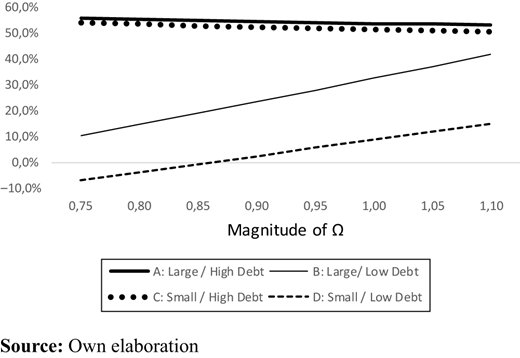
Finally, we assess how the social utility of countries sharing a common debt instrument is impacted by changes in the penalty/reward rates of the tax, Ω. Our results indicate that gains from the introduction of a common debt instrument converge as the value of this parameter increases. In addition, in the case of small countries with a low debt ratio, Ω has to exceed 0.85 for these countries to be interested in joining the common debt club (Figure 6).
In the second part of this section, we apply the same base case scenario to Eurozone countries. The very first feature we highlight is that European countries widely differ in size and in government debt ratios. The weights of GDP (2019) range from 0.1% (Malta) to 28.9% (Germany). The average debt-to-GDP ratios for the period 2017–2019 range from 8.5% (Estonia) to 178% (Greece) (Table A1).
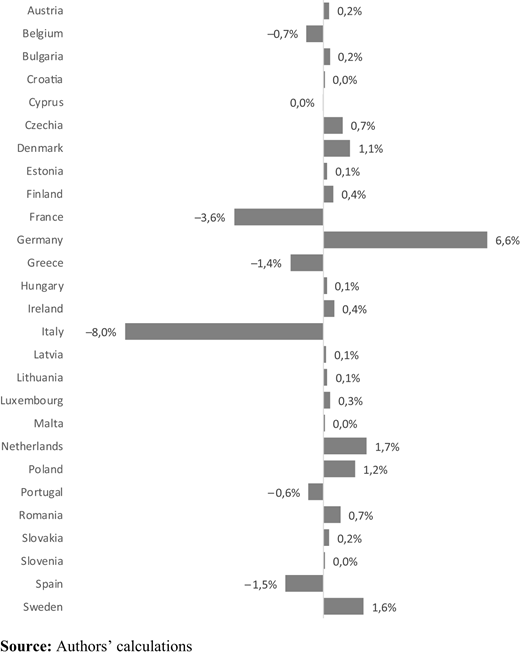
As a result of the high dispersion of values, the exclusion of certain countries from the sample significantly changes the club’s weighted average gross public debt-to-GDP ratio. As reported in Figure 7, the cases of Italy, Germany and France are the most prominent, but the exclusion of Netherlands, Sweden, Spain, Greece and Poland also significantly alters the weighted average of public debt rate.
Based on the assumptions used above, we estimate how each country’s utility changes as a result of the implementation of a Eurobond mechanism with a CGT type. Table 5 reports both the total effect and the contribution of the different relevant factors.
6. Final comments
Proposals for mutualizing fiscal risks among EU Member States have gained strength to prevent future sovereign debt crises and to avoid flight-to-quality strategies that create snowball effects. However, most of these proposals have been questioned because of the potential induction of free-riding behaviours by the more fiscally stressed members. Our paper adds to the existing literature by analysing the effectiveness of the use of a CGT type. A model is proposed such that a country decides whether to join a club in which participating countries share a common sovereign bond. In doing so, each country pays or receives a tax quota according to its impact on the cost of financing of the other partners. In addition, all members benefit from a liquidity premium derived from the fact that common debt shows features of a safe asset. The main findings of the paper are as follows. The adoption of this tax could prevent free-riding behaviours and, therefore, encourages participation by those countries with lower debt levels that would have not otherwise taken part in this common debt mechanism. Under certain circumstances, we can expect the utility of all members of this club to improve. Large, small, highly indebted and lowly indebted countries would benefit from the implementation of a Eurobond mechanism accompanied by the introduction of a CGT type. The bias in the distribution of gains arising from the adoption of a common debt instrument in the presence of this tax might be mitigated by regulating the tax rule determining the magnitude of payment/reward. We also find that the proportion of the liquidity premium, arising from the implementation of a sovereign safe asset, has a decisive impact on the degree of the governments' utility enhancement. According to the available empirical estimates for liquidity premia of safe assets, the improvement in the social utility, as defined in this paper, is expected to be significant.
In the design of this new tax, further research is required. Its adoption would require Eurobonds club members to reach an agreement on “the” theoretical model for determining the sovereign debt yield. One of the limitations of our model is considering the debt-to-GDP ratio as the sole determinant of public debt yields. Moreover, we assume the relationship between the debt-to-GDP ratio and funding costs to be identical for all countries, when in practice this relationship is specific for each country. In addition, it should be noted that countries currently benefiting from fly-to-quality strategies may be reluctant to support the implementation of the proposed tax rule. Finally, the model ignores some relevant features that may have an impact in the real world, such as the role of debt restructuring. In principle, the authors consider that these simplifying assumptions do not fundamentally alter the results of the paper. However, any progress in the implementation of the proposed transfer scheme would require a more realistic and in-depth analysis.