


This paper aims to explore the existence of convergence in non-monetary working conditions in Europe resorting to widely used definitions of this phenomenon and composite indexes of job quality.
The analysis relies on composite indexes, widely used in previous literature, for 207 regions in six different areas of job quality drawing on the microdata of the European Working Conditions Survey from 1995 to 2015. This study assesses the occurrence of convergence both in terms of dispersion of job quality outcomes (sigma-convergence) and, especially, regarding the existence of a catch-up process (beta-convergence).
This study finds evidence of both types of convergences in all the domains, with the exception of skills and discretion and prospects dimensions according to the sigma-convergence approach. The results do not suggest substantial differences between the 15 European Union countries before the 2004 enlargement and the new Member States and are robust to a wide range of changes in the sample and different econometric specifications.
Tot he best of the authors’ knowledge, this paper represents the first rigorous and systematic attempt of addressing the existence of convergence in non-monetary working conditions, applying formal and widely accepted definitions of this phenomenon. It contributes to our knowledge on this topic providing strong evidence of convergence in job quality. Those results can be of interest for scholars in Economics and other Social Sciences.
1. Introduction
Contemporaneous economic research clearly indicates that workers’ well-being goes beyond earnings. They value non-pecuniary job amenities and are willing to exchange income for improvements in other domains (Clark, 2005, 2015; Fernández and Nordman, 2009; Maestas et al., 2018; Nikolova and Cnossen, 2020). Non-monetary working conditions have also attracted the attention of international institutions. Since more than a decade, quality of jobs has become a central concern for organisms such as the International Labour Organization (ILO) (Director-General of the ILO, 1999), the European Union (EU) (European Council, 2000) or the Organisation for the Economic Co-operation and Development (OECD) (OECD, 2014).
At the same time, the evolution of global inequalities ranks high among the priorities listed in the research and political agenda (Milanovic, 2016), an interest fostered by the deepening of international trade (Autor et al., 2016; Bardhan, 2006; Ghose, 2004) and the rise of automation technologies in the workplace (Ivanov et al., 2020). The study of convergence constitutes one of the lenses through which society can look at the evolution of global inequalities (Milanovic, 2005). It continues representing a hot topic in Economics nowadays (Johnson and Papageorgiou, 2020), fostering passionate debates (Kremer et al., 2021; Pande and Enevoldsen, 2021) [1].
Unlike convergence in income, productivity or wages, we know very little about whether – and to which extent – this process applies to non-pecuniary dimensions of job quality. As long as these attributes clearly shape workers’ well-being, economists should care more about the eventual convergence of those features than they do (Nikolova and Cnossen, 2020). This topic is also relevant in the light of the recent debate about the decoupling between productivity and wages in OECD countries (Compagnucci et al., 2021; Schwellnus et al., 2017), which leaves non-monetary working conditions aside, particularly, keeping in mind that most of job amenities workers actually value are often costly for firms (Clark, 2015). Therefore, a sound assessment of the relationship between the evolution of output per unit of labour and worker’s well-being should comprise other features of jobs part of the remuneration package.
This paper explores whether there is convergence in non-monetary working conditions using data from European regions from 1995 to 2015. It aims to provide the first rigorous attempt to analyse the existence of this phenomenon in non-pecuniary job amenities. Particularly, we use the formal concepts of σ- and β-convergence, related to the existence of a catch-up process in and a reduction in the dispersion job quality, respectively. There is some previous related literature on this topic from other traditions, like Management and Social Psychology. Such works adopt a narrower perspective than the one followed here, as they deal with many other topics, only cover either a few countries or a limited set of working conditions, do not rely on formal and clearly defined concepts of convergence and do not make use of any tools of statistical inference for assessing whether their results are statistically significant.
The first noteworthy work in this line (Olsen et al., 2010) explores the evolution of five dimensions of job quality (extrinsic rewards, intrinsic rewards, work intensity, working conditions and interpersonal relationships) in Norway, Germany, the USA and the Great Britain. Using data from International Social Survey Programme, they look at the differences between liberal (the USA and Great Britain) and coordinated market economies (Norway and Germany). They conclude that the sum of the differences in job security, work intensity and working conditions and social relations (after controlling for workers’ characteristics) diminish during the analysed period, although they do not perform any test of statistical significance.
The second relevant research on this topic is Eurofound (2015). This report makes use of the European Working Conditions Survey (EWCS) to assess the evolution of several dimensions of job quality (skills and discretion, work risks, work intensity and working time quality) across the EU between 1995 and 2010. They explore graphically the relationship between the change in each dimension over such a period and the mean in 2010, without any formal statistical test. Such analysis does not fit any widely known concept of convergence, neither β nor σ one [2]. The research of Holman and Rafferty (2018), based on the previous report, examines the evolution of job discretion in four institutional regimes comprising the European Union-15 (EU15) countries (social democratic, continental, liberal and Southern European). They find that the average absolute change in social democratic regimes exceeds the one observed in the rest of institutional context, which they interpret as a sign of partial divergence (even though if that measure does not fit any technical definition of convergence).
Our work does not only draw on the formal, transparent and testable concepts of convergence widely used in Economics but also considerably extend previous studies in terms of the countries and time periods covered. Specifically, we calculate indexes of job quality in six domains of common use in the specialised literature using data from the EWCS 1995, 2000/2001, 2005, 2010 and 2015. After carrying out an extensive work of harmonization over time, we are able to analyse indicators of working conditions over 20 years and across more than 200 European regions, even though not all of them are available over the whole period, which provides our analysis with a sizable statistical power. Our findings suggest the existence of both σ- and, particularly, β-convergence in all the areas considered, with the exception of the skills and discretion and prospects dimensions according to the former approach. We also show the absence of substantial differences in terms of convergence within the EU15 (those countries that were part of the EU before the 2004 enlargement) and the new Member States. These results hold under a large battery of robustness checks.
The rest of the paper unfolds in four sections as follows. Section 2 discusses the theoretical arguments for expecting convergence in working conditions. Section 3 describes the databases and methodological tools used in the analysis. We present and debate the results of convergence in Section 4. Section 5 summarises the main conclusions of the research.
2. Rationale for convergence in working conditions
Expectations of convergence in productivity naturally arises from the neoclassical growth model and the existence of diminishing returns to capital (Barro and Sala-i-Martin, 1991, 1992). In contrast, the case for convergence in working conditions is apparently not so straightforward, as labour market productivity might not necessarily translate into improvements in non-monetary dimensions in the short term. Nevertheless, given that workers does not only value the money and non-pecuniary job amenities are usually costly to provide for employers (Clark, 2015), increases in labour productivity should translate not only into wage improvements but also into upgrades of other kinds of working conditions [3]. In this fashion, recent studies highlight that innovation activities, resulting in higher productivity levels, might raise job quality at the firm level, although with heterogeneous effect across workers (Duhatuois et al., 2018; Duhautois et al., 2022; Mofakhami, 2021) [4]. It is worth highlighting the lack of a consensus about the prevalence and scope of this phenomenon in the recent academic literature. While some works support the existence of convergence in productivity levels, particularly, over last decades (Kinfemichael, 2019; Kinfemichael and Morshed, 2019; Kremer et al., 2021; Madsen and Timol, 2011; Monfort, 2008; Nell, 2020), a relevant number of studies are quite sceptical about it or limit its scope to certain industries or groups of countries (Inklaar and Diewert, 2016; Martino, 2015; Monfort, 2020; Ram, 2017; Rodrik, 2013; Sondermann, 2013). The likely existence of diminishing returns to investment in some areas of job quality, discussed below, strengthens the role of this channel.
An argument related to the previous one has to do with the process of structural change. Ceteris paribus, under the absence of large differences in the ordering of industries by job quality across regions, the increasingly similar sectoral employment shares in the continent (Palan and Schmiedeberg, 2010) might represent a driving force of convergence in productivity levels and working conditions. Nevertheless, the different developments of high-tech industries across the continent (Goos et al., 2018; Ridao-Cano and Bodewig, 2019) might hamper the potentiality of this force for fuelling convergence in job quality.
A third argument for anticipating convergence lies on the existence of a process of harmonization of institutional frameworks in the age of globalisation. State-of-art research tends to support the hypothesis that labour market regulation becomes more and more similar across countries (Davies and Vadlamannati, 2013; Duanmu, 2014; Gahan et al., 2012; Hefeker and Neugart, 2010; Mehmet, 2006; Obadić et al., 2021). With a lower degree of agreement, the same reasoning applies to welfare state arrangements (Arts and Gelissen, 2010; Bouget, 2006; Obinger and Starke, 2014), which contribute to shape work outcomes. The growing involvement of the EU in the social arena might reinforce this trend (Vaughan-Whitehead and Vázquez, 2019) [5].
In the fourth place, experimental evidence suggests that workers’ preferences over job amenities are subject to the law of diminishing marginal utility (Maestas et al., 2018). Convexity of workers’ preferences implies that, other things being equal, they are more inclined to opt for balanced bundles of job characteristics than for extremely uneven ones, which makes more likely that we observe convergence in a certain attribute. For instance, it is reasonable to argue that the cost required for reaching a certain level of achievement in certain dimensions is likely to be increasing (e.g. health and safety measures), but this might not be true for other amenities (e.g. work breaks). This mechanism could favour the translation of productivity raises into better working conditions, thus reinforcing the first argument provided above.
Finally, in contrast with income, some indicators of job quality face natural upper bounds, as in the case of life expectancy and educational variables considered in the assessment of convergence in multidimensional indicators of well-being (Jordá and Sarabia, 2015; Mayer-Foulkes, 2012; Mazumdar, 2002; Noorbakhsh, 2007; Ortega et al., 2015). For instance, it is perfectly feasible the existence of working environments totally free of biological and chemical risks or with full job discretion. Regulations and social customs are very likely to reinforce this effect: overall, the number of regulations affecting non-monetary working conditions exceed by a large extent the ones that apply to earnings. Actually, the dispersion of non-pecuniary job amenities is significantly lower than in the case of wages (e.g. working hours) (Green et al., 2013; Muñoz de Bustillo et al., 2011a). Although they favour the existence of convergence, these reasons are methodologically legitimate. Nevertheless, these superior limits might also appear because of a reduced number of available variables or measurement issues. We further discuss this potential problem in the next section. Moreover, we propose several robustness checks whose results reinforce our confidence on our main results.
3. Data and methods
3.1 Data
Our source of information on job quality is the EWCS, carried out on a five-year basis by the European Foundation for the Improvement of Living Conditions (Eurofound, 2020). Particularly, we make use of the last five waves of this survey, corresponding to the years 1995, 2000/2001, 2005, 2010 and 2015. The sample sizes and the number of variables available in each wave increase over time, with a minimum of 1,000 workers interviewed in each country (with the exception of Malta, Luxembourg and Estonia, single-region countries in our data set, with only 500 observations). Our database covers the EU plus the UK and, irregularly, Albania, Montenegro, Norway, Republic of North Macedonia and Turkey [6]. We display the countries included in each period in Table S1 of the supplementary online appendix, together with some additional details of the survey and the sample selection.
To ensure the highest possible statistical power in our exercise and given that the EWCS is still representative at such a level, regions, the level of stratification of the survey, represent our unit of analysis. They roughly correspond to the Nomenclature of Territorial Units for Statistics at the second level (NUTS 2), although in some cases, because of the existence of administrative changes in the boundaries of NUTS we cannot trace over time, we make use of larger geographical units. As a result, we are able to include in our analysis 207 regions that comprise 184,974 workers. Not all of them are available over the whole period of interest. For instance, we can only continuously trace 111 and 163 regions from 1995 to 2015 and from 2000 to 2015, respectively [7]. We make use of 36 variables on six domains (physical environment, work intensity, working time quality, social environment, skills and discretion and prospects) to construct several composite indicators of job quality following the previous literature on this topic. We summarise the process of construction of these measures in subsection 3.2.
3.2 Measurement of working conditions
Aiming to measure the quality of working conditions and reduce the dimensionality of the problem to manageable levels, we rely on the set of indicators developed by the Eurofound and their collaborators (see, e.g. Muñoz de Bustillo et al., 2011a; Eurofound, 2012, 2015, 2019; Fernández-Macías et al., 2015, and Green et al., 2013) based on the EWCS. The quality and the number of variables available in the EWCS significantly increases over time, so, when considering the developments in the areas mentioned above, one needs to modify the construction of the indexes bearing in mind which variables we can consistently track over time in each dimension. Following this literature and carrying out the necessary adaptations, we organise the 36 available variables into 14 sub-dimensions and the six dimensions mentioned above (Table S2). We define all the domains in such a way that a higher value of the indicator implies a better job. The score (from 0 to 100) in each dimension comes from the arithmetic mean of the different sub-dimensions, which in turn averages the variables included in it [8].
Workers’ ability to adapt to changes and cognitive dissonance might reduce the meaningfulness of subjective assessments of job quality (Bhave and Glomb, 2013; Bowling et al., 2005; Pugh et al., 2011). Therefore, we privilege the use of objective measures over subjective valuations of job features whenever possible. In any case, given the undeniable correlation between objective and subjective measures of well-being (Clark, 2015; Oswald and Wu, 2010), we also look at the behaviour of job satisfaction (a 0–100 variable in our database) to check the robustness of our results. If the evolution of the latter variable were not at odds with our indicators, this would foster our confidence on our approach. With the same spirit, we compute an extended version of our indexes with 49 variables for the period 2005–2015 (see Table S3 in the supplementary online appendix) [9].
3.3 Convergence
Firstly, we look at the convergence issue from the perspective of β-convergence. This concept refers to the degree to which the change in regional average value of a dimension over a certain period of time is negatively related to its initial level (Barro and Sala-i-Martin, 1991, 1992). In other words, it assesses the existence of a catch-up process. We explore the existence of this type of convergence by means of the following equation:
where yrct denotes the average job quality in the dimension y in the region r in country c at time t, yrct− 5, the outcome in the initial period (five years earlier), α is an intercept, Dt and Dc represent fixed time and country effects, respectively and ϵrct is a disturbance (which we assume does not correlate with the regressors). In this framework, β < 0 indicates the existence of convergence [10]. To maximise the statistical power of our analysis, we pool region-level five-year changes. In the spirit of Rodrik (2013), we consider that the specification that includes country fixed effects allows exploring conditional convergence, while the removal of these dummies from the equation implies a focus on unconditional convergence.
In principle, we expect that conditional convergence is faster than unconditional one, as we control for country-specific time-invariant conditions. For instance, while it might not exist convergence across countries or regions, one can well find that the growth in a certain outcome is negatively correlated with its initial level for a fixed set of long-term institutions. This is actually a very common finding in these kinds of studies (i.e. countries move to their own steady state) (Barro and Sala-i-Martin, 1997). Note that, in the context of this literature, the interest here is by no means controlling for as many variables as possible. On the contrary, the larger the set of covariates one needs to condition on, the weaker is the evidence for convergence, as one imposes an increasing number of conditions across units to be same [11]. As customary in this type of analysis (Barro, 2015; Rodrik, 2013), and keeping in mind that our aim is to shed light on the existence of convergence in the most general possible terms, we use all the available regional observations, even if they are not present in all waves10. We cluster standard errors at the regional level in all our specifications to deal with heteroskedasticity and serial correlation.
We also assess the existence and the extent of σ-convergence during the period 1995–2015, which translates into determining whether the dispersion of job quality decreases over time. One can explore this perspective by making use of almost any dispersion statistic. Specifically, we resort to the standard deviation and the coefficient of variation of the log of each job quality index [12]. We should also bear in mind that β-convergence is necessary but not sufficient for σ-convergence (Quah, 1993; Young et al., 2008).
We do not explore in detail here the eventual existence of convergence clubs (Baumol, 1986; Durlauf and Johnson, 1995; Galor, 1996), that is, within specific groups of countries, for two reasons [13]. First, this topic, often related to the study of β-convergence, deserves particular attention when we do not find global convergence (Islam, 2003), i.e. using the total sample as a whole. This is not the case here. Secondly, considering the number of dimensions (and the limitations of space) and the pioneering nature of this work in the formal study of convergence, we think that this issue deserves separate further research works. Nevertheless, to give the reader a first taste on this issue, we compare the performance in terms of convergence between the EU15 and the new 12 Member States joining between 2004 and 2007 (Croatia is only available since 2005) over the period 2000–2015.
4. Results
Figure S1 and S2 in the supplementary online appendix, which plots the five-year change in each dimension against its initial level controlling and not controlling for country-fixed effects, suggest the existence of clear negative relationship between both variables, i.e. a pattern of unconditional and conditional β-convergence, respectively, in the six dimensions considered in our analysis when we look at the whole sample. Table 1 shows the econometric results of the β-convergence analyses, focusing on the estimated speed of convergence. The main results of our regression-based exercise clearly indicate the existence of both types of β-convergences in all the domains of working conditions. Furthermore, while the speed of unconditional convergence seems higher in the case of social environment, work intensity and physical environment, once we account for country-fixed effects, as expected, the coefficients become larger (in absolute value) and differences essentially vanish [14].
β-convergence in working conditions in Europe (baseline specification, five-year changes)
| (I) Physical environment | (II) Work intensity | (III) Working time quality | (IV) Social environment | (V) Skills and discretion | (VI) Prospects | |
|---|---|---|---|---|---|---|
| Panel A. Unconditional convergence | ||||||
| Log initial job quality | −0.111*** (0.009) | −0.134*** (0.009) | −0.078*** (0.006) | −0.167*** (0.007) | −0.098*** (0.008) | −0.078*** (0.010) |
| No. of countries | 33 | 33 | 33 | 33 | 33 | 33 |
| No. of regions | 207 | 207 | 207 | 207 | 207 | 207 |
| No. of observations | 664 | 664 | 664 | 664 | 664 | 664 |
| Time-fixed effects | ✓ | ✓ | ✓ | ✓ | ✓ | ✓ |
| Country-fixed effects | ||||||
| Panel B. Conditional convergence | ||||||
| Log initial job quality | −0.173*** (0.011) | −0.176*** (0.008) | −0.170*** (0.012) | −0.185*** (0.008) | −0.189*** (0.008) | −0.162*** (0.012) |
| No. of countries | 33 | 33 | 33 | 33 | 33 | 33 |
| No. of regions | 207 | 207 | 207 | 207 | 207 | 207 |
| No. of observations | 664 | 664 | 664 | 664 | 664 | 664 |
| Time-fixed effects | ✓ | ✓ | ✓ | ✓ | ✓ | ✓ |
| Country-fixed effects | ✓ | ✓ | ✓ | ✓ | ✓ | ✓ |
Notes:
***Significant at 1% level; **significant at 5% level; *significant at 10% level. Standard errors clustered at the regional level in parentheses
As mentioned above, the inclusion of all available observations means that some countries are only present during the last periods (particularly, those that joined the EU after 2004 or became accession candidates). Although this approach is common in the assessment of this type of convergence, this could introduce some bias in our estimates, so we re-estimate all our regressions considering two balanced samples. The first one, from 1995 to 2015, comprises the Member States of the EU before the Eastern enlargement (Table S6), whereas the second one corresponds to 27 countries, the current members plus the UK and minus Croatia, and covers the period 2000–2015 (Table S7). The results are essentially the same in both qualitative and quantitative terms.
Our analysis of σ-convergence draws on the two balanced panel of regions mentioned above. Figure 1 presents the evolution of the standard deviation and the coefficient of variation of all the dimensions over the period 1995–2015 for the countries forming the EU before the Eastern enlargement. The graph indicates that the dispersion of job quality in the six dimensions slightly decreases from 1995 to 2015, although this pattern is non-monotonic. Tests of equality of variances and coefficients of variation between the values in the initial and the final year (1995 and 2015, respectively) indicate that such a change is statistically different from zero at least at the 5% level in all areas but skills and discretion and prospects.
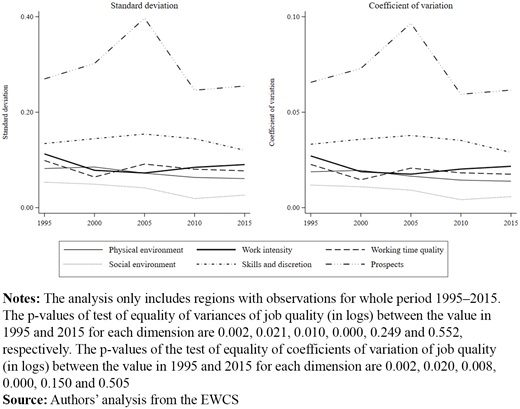
σ-convergence in working conditions by dimension (standard deviation and coefficient of variation of log of job quality index, 1995–2015)
σ-convergence in working conditions by dimension (standard deviation and coefficient of variation of log of job quality index, 1995–2015)
In Figure 2, at the expense of losing a wave and using the same indicators, we extend the country coverage of our analysis. We observe a very similar pattern, which indicates that the selection of the countries does not drive the outcome of the analysis. The main exception is the small increase in the standard deviation of job quality due to work intensity from 2000 to 2015 (statistically significant at the 5% level). Nevertheless, we should bear in mind that we cannot observe the value for year 1995 in this setup and the objective is to check how if the pattern yielded by the main sample holds.
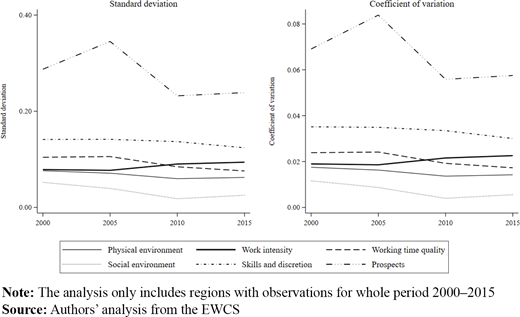
σ-convergence in working conditions by dimension (standard deviation and coefficient of variation of log of job quality index, 2000–2015)
σ-convergence in working conditions by dimension (standard deviation and coefficient of variation of log of job quality index, 2000–2015)
Noteworthy, this evolution does not reflect a race to the bottom, but, if any, an average increase of job quality across European regions. Table S8 shows the average value of job quality in each dimension and shows that working conditions significantly improve in all cases apart from work intensity and prospects (where the increase in job quality is not statistically different from zero).
To further check the stability of our results, we perform several additional analyses. In the first place, we weight the observations by the employment volume at the beginning of each period. This could mean a potential source of discrepancy, as the number of workers in each region greatly varies [15]. We present the results of these estimations in the supplementary online appendix. The results for both β- (Table S9, S10 and S11) and σ-convergence (Figure S3 and S4) are remarkably similar to those based on unweighted regional observations.
Secondly, we look at the evolution of job satisfaction over the periods of interest (1995–2015 and 2000–2015) (Figure S5 and Table S12), even if such an exercise requires several assumptions and is not exempt from problems [16]. The clear pattern of β-convergence and the evolution of the dispersion of this variable are in line with our prior findings, which stresses our confidence that the results of our analysis are not the artefact resulting from an imperfect database.
Our last robustness exercise consists in using a considerably enriched set of job quality indexes that includes 13 additional variables, mostly affecting the third and sixth dimensions of working conditions. These results are available as a supplementary online appendix (Figures S6, S7 and S8 and Table S13). Reassuringly, these results agree with the ones shown above. This is particularly comforting in the case of Dimensions No. 3 (working time) and 6 (prospects), where considering additional job features does not seem to alter the main message conveyed by and trends found in the main analysis.
The study of club convergence is a natural step to follow in the absence of convergence. Although the results presented suggest this is not the case of working conditions in Europe, it is relevant to determine whether this pattern applies to the same extent within the EU15 countries and the 12 new Member States for which we have information from 2000 to 2015. We show the analysis of both unconditional and conditional β-convergence for both sets of countries of countries in Table S14. According to our results, unconditional convergence occurs within both groups and a very similar pace in all dimensions, apart from work intensity. In this area, our statistical tests based on seemingly unrelated regressions indicate that the catch-up process is significantly faster within the EU15 than within the new Member States. As in our main results, conditional convergence is stronger than unconditional one in both sets of states, without differences in any dimension between both groups. Figure S9 displays σ-convergence within the regions of the 11 Member States joining the EU between 2004 and 2007. The evolution of dispersion is pretty similar to the one shown above for the EU15.
5. Conclusions
Despite the extensive literature on the evolution of differences in living standards, welfare state regimes or labour market regulations, there has been a lack of rigorous studies addressing convergence in working conditions. This article has aimed to fill this gap. Using comparable survey-based information for more than 200 European regions over two decades, it has documented the existence of a strong process of unconditional β-convergence during the period 1995–2015. Our findings have also suggested a slight reduction in the dispersion during the same time window in all domains but two (skills and discretion and prospects, where the change in dispersion is not statistically different from zero), providing evidence for σ-convergence. We have also shown that these results are remarkably robust to a rich battery of robustness checks, such as changes in the sample of countries or the enrichment of the job quality indexes.
Jointly with the recent evidence emphasising workers’ valuation of non-monetary job amenities and the persistent controversies about economic convergence and the decoupling of productivity from wages, it seems advisable to support a larger role for the analysis of working conditions in both academic research and policymaking. This issue might be particularly relevant for addressing the impact of globalisation and technology on labour markets, where, apart from noticeable exceptions (Antón et al., 2022; Menon et al., 2019), non-monetary job features have received relatively little attention.
The authors thank two anonymous referees for helpful comments that contributed to improve the manuscript.
Funding: The authots gratefully acknowledge funding from the European Foundation for the Improvement of Living and Working Conditions (reference No. 181001/4707) and the European Commission (Horizon 2020 EuroSociety-2014 project “Quality of Jobs and Innovation Generated Employment Outcomes” [QuInnE]). Antón also thanks the financial support of the Ramón Areces Foundation Grants for Research Projects in Social Sciences 2018 (17th edition).
Notes
Furthermore, the last two decades have attended to the emergence of a large literature exploring the patterns of convergence in different types of indicators of living standards apart from income (Jordá and Sarabia, 2015; Martínez, 2012; Mayer-Foulkes, 2003, 2012; Mazumdar, 2002, 2003; Neumayer, 2003; Noorbakhsh, 2007; Ortega et al., 2015; Sab and Smith, 2002).
Actually, instead of assessing the joint movement of all the Member States, the authors conclude that some countries go closer to the EU average, but not others.
The literature also provides examples of a positive impact of better non-monetary amenities – like health and safety conditions – on productivity (Buhai et al., 2017).
There is a remarkable correlation between innovation and job quality at the firm level, but the causal nexus is hard to disentangle (Grande et al., 2020).
Although not explored formally in the literature, the EU authorities might have played a very relevant role in this area. Milestones like the European Employment Strategy (1997) and the Europe 2020 Strategy (2010), which emphasise the importance of quality of work, and the launch of the European Semester, a coordination mechanism, might have been of substantial importance. Particularly, it is worth mentioning that, during the period of analysis, the EU enacted numerous regulations to set minimum standards in terms of health and safety (nearly 40 directives related to workplace and equipment issues, chemical products, carcinogens and mutagens, biological agents, physical hazards, ergonomics, etc.), working time (e.g. Directive 2003/88/EC), work–life balance (Directive 2019/1158) or fixed-term work (e.g. Directive 1999/70/EC).
Specifically, wave 1995 includes the number of member countries in the EU before the accession of ten candidate countries on 1 May 2004. Wave 2000/2001 adds the new 11 member states that entered the EU between 2004 and 2007. The survey includes Norway, Croatia, North Macedonia, Albania and Montenegro since 2010. There are also two non-consecutive waves for Switzerland and two single waves for Serbia and Kosovo, which we logically exclude from the analysis.
As explained below, exploring σ-convergence only makes sense using a balanced panel and we experience with two different time intervals mentioned in the text. In the case of the (regression-based) β-convergence, in principle, we exploit all the possible five-year changes our database allows. Then, we provide several robustness checks circumscribing our analysis to balanced panels for 1995–2015 and 2000–2015.
Discussing and disagreeing on the convenience of these specific indicators is naturally legitimate. Nevertheless, it is out of the scope of this paper, which relies on them because they are the most solidly grounded in previous literature. Muñoz de Bustillo et al. (2011b) perform a detailed discussion of the dimensions affecting job quality according to the literature in Social Sciences and Medicine. "Muñoz de Bustillo et al. (2011a) and Eurofound (2012, 2019) thoroughly describe the computation of these measures, widely used in the literature, so there is little added value in detailing all these procedures here. In short, we transform each variable so that it reflects a positive feature; then, we convert them into a 0–100 scale using a min-max normalisation (e.g. if a variable runs from 1 [best value] to 5 [worst value], we compute 100·[5 − value of the variable]/[5 – 1]; if the variable runs from 1 [worst value] to 5 [best value], we compute 100·[value of the variable – 1]/[5 – 1]); we calculate the average of the variables within each sub-dimension, and, last, we average the scores of the sub-dimensions within a certain dimension. As in most of the recent works using these sorts of indexes (see, e.g. Green et al., 2013; Menon et al., 2019 and Antón et al., 2022), each variable receives the same weight within each sub-dimension and we assign the same importance to each sub-dimension when computing the average value for each dimension. Sensitivity analyses in Muñoz de Bustillo et al. (2011a) suggest that the composite measures of these dimensions are quite robust to the use of different weighting schemes, because there is a high positive correlation between the outcomes in different domains.
Table S4 shows the detailed definition of all the questions due to the variables used for the construction of our indexes.
We do not estimate any model with regional fixed effects. Unit fixed-effects – in this case, regions – are pretty uncommon in this literature, mainly because of the issue of short frequency. Such an approach throws away much variation (Barro, 2015; Islam, 2003). For instance, Barro (2015) only considers reasonable the use of fixed effects in the analysis of convergence of per capita income when the data span over more than a century. Here, we can look at most at two decades and one should bear in mind that non-monetary working conditions tend to vary over time less than wages (Fernández-Macías et al., 2015).
Therefore, in principle, the main interest lies on the existence of convergence under as few conditions as possible. Exploring this phenomenon for certain profiles of workers should be of a secondary concern or, at most, corresponds to a research question that is different from the one representing the main focus of this work.
Naturally, when one addresses σ-convergence, the analysis should consider only those regions for which there are available observations over the whole period of interest. When we explore β-convergence, considering all the available information is less problematic. In the case of the former, the value of the statistics of dispersion naturally varies when the sample changes. In the latter, as one uses regressions to the mean, the inclusion of different units over time does not alter the assessment of the convergence unless a negative correlation between the change in the outcome and its initial level would vanish if one were able to analyse the whole set of countries (including those for which there is no information for a certain period). Therefore, we carry out several robustness checks using balanced panels for the periods 1995–2015 and 2000–2015.
The main difference between conditional convergence and club convergence is that the former concept means that each economy has its own particular equilibrium, whereas the latter implies that each economy might have different equilibria (Islam, 2003). A group of countries (club) that share an initial attribute might approach a specific equilibrium.
Table S5 shows the relevant formal statistical tests of equality of coefficients across regressions relying on seeming unrelated estimation techniques that supports this statement. These findings are consistent with the idea of conditional convergence, i.e. regions converge to their own steady state faster than to a common and unique one. The existence of distinct institutional arrangements across countries might drive part of the differences in speeds of convergence. Possibly, the importance of the conditioning factors is not the same across dimensions. The narrowing of the differences in speed of convergence across dimensions might obey to the distinct relevance of institutional features (e.g., regulations) for each dimension.
The configuration of NUTS 2 largely reflects the desire of defining territories of a similar size in terms of population. However, there are still large differences across countries, which the need of merging some units because of changes in in the nomenclature exacerbates.
Unfortunately, the EWCS does not contain any other variable that can somehow summarise job quality and not considered in our indicators. Nevertheless, the interpretation of the results of our robustness exercise must be cautious. The value of this variable as an indicator of the quality of work is subject to discussion (Muñoz de Bustillo and Fernández-Macías, 2005; Oswald and Wu, 2010), as workers adapt and suffer from cognitive dissonance. Furthermore, to proceed in a similar way as with our job quality measures, we need to construct a cardinal variable from the ordinal one available in the survey (we translate the four possible responses into a 0–100 scale; “not at all satisfied” [0], “not very satisfied” [33], “satisfied” [67] and “very satisfied” [100]). Even in the presence of the limitations mentioned above, not observing a trend in job satisfaction that is not at odds with those of working conditions is reassuring for our analysis.
References
Further reading
Supplementary material
The supplementary material for this article can be found online.

