

A380 wing production investment
A380 wing production investment
Keywords: UK, Aerospace industry, Wings, Assembly
A £350 million aerospace factory built for plane maker Airbus, was recently opened by the UK's Prime Minister, Tony Blair. The 83,500 m2(over 900,000 ft2) facility, reckoned to be the largest factory built in the UK in recent years, has been constructed alongside the existing Airbus factory in Broughton, North Wales. To be known as the "West Factory", it has been built to house wing assembly for the double-deck, 555 seater A380 airliner as well as other aircraft manufacturing activity (Plate 1).
 Plate 1Aerial view of the West Factory
Tony Blair said: "I am delighted to be asked to officially open the new West Factory and to see for myself the excellent work being done here at Airbus. The order book shows the commercial attraction of the world class product being made here. And is a powerful tribute to the dedication and commitment of the highly skilled workforce. I am delighted that the Government has been able to invest in that effort."
"This impressive new factory is creating 1,200 new jobs, in addition to the 5,000 already here, making a strong contribution to the local and national economy. I would like to welcome the long-term commitment Airbus is making to UK manufacturing."
Noel Forgeard, Airbus President and CEO said: "The opening of the West Factory at Broughton and the acceleration of A380 wing production is yet another step towards the A380's first flight in 2005. The double-decker is extremely important, not just for the continued success of the Airbus company, but also for the benefits it brings to the economy of the United Kingdom. The A380 programme secures and generates over 100,000 long-term jobs in the UK, and around 400 UK companies have already been awarded £7.5 billion worth of work on the programme. This is set to double to £15 billion over the life of the programme. As A380 begins to enter service with the airlines, the Airbus contribution to the UK's balance of payments will rise to more than £1.5 billion a year."
At more than 400 m (1,310 ft) long, 200 m (656 ft) wide and with a peak height of 35 m (115 ft), the floor area of the West Factory is equivalent to 12 full size football pitches. At peak production, 1,200 people will work there,using leading edge manufacturing techniques to assemble, equip and paint the wings. Once assembled, the wings will be delivered via specially commissioned barges and ships to the A380 final assembly line in Toulouse. At more than 36 m long, the wings for A380 are the largest ever designed and built for a commercial aircraft (Plate 2).
 Plate 2Wing assembly stage 01 in West in West Factory – stringers in LV
Airbus is investing nearly £2 billion in the design, manufacture and assembly of the high tech wings and the testing of the landing gear for the A380 programme. Of this, almost £500 million has already been invested at the company's wing production operation in Broughton. As well as building the West Factory, Airbus has made developments to the existing factory known as the East Factory.
A380 wings
In terms of area, an A380 wing is 845 m2 almost twice as big in terms of area than a wing for the A340-600 at 437 m2. At 36.3 m long,the wings are the largest ever designed and built for a commercial aircraft. The wings comprise approximately 25,500 different components from 52 major first-tier suppliers of whom over half are from the UK. Components are also supplied by Broughton's sister site at Filton, where metallic ribs are manufactured and the fixed trailing edge assembled (Plate 3).
 Plate 3First A380 wing skin with stringers attached
A "wing-set" or pair of wings comprises the following.
Twenty aluminium alloy panels or "skins".
One hundred and twenty six ribs, 80 of which are metallic, 46 are made of carbon composite materials.
Six aluminium alloy spars.
Three hundred and fourteen wing stringers or stiffeners, 124 for the top wing skins, 190 for the bottom skins.
Trailing and leading "edges".
About 360,000 m (23.6 miles) of wiring, piping and dueling which control the hydraulics and in turn the flaps and slats.
Around 750,000 fasteners (nuts and bolts).
In March 2003, the first skins for each A380 wing were delivered to the West Factory from the new skin manufacturing centre in Broughton's East Factory. Currently "stringers" or longitudinal stiffeners are being attached to the wing skins in the four low voltage electromagnetic riveting (LVER) machines. Altogether the four LVERs can accommodate up to 16 wing skins.
The wing skins with the stringers attached will then be loaded into the four storey high assembly jigs together with the other wing components; the leading and trailing edges, the ribs and the spars. All the components are then bolted together in the jigs before being rotated by two 35 tonne cranes prior to unloading.
The next stage in the wing assembly process is equipping, when the wings are fitted with wiring and hydraulics in preparation for the moving surfaces which are put on at the final assembly lines in Toulouse. Finally, the wings are painted before moving back to a dispatch area on cranes where they are prepared for transportation to Toulouse via the specially commissioned river barges,ships and road trailers.
Developments to the East Factory
Developments to the East Factory comprise three new facilities constructed within the original site. These represent a £73 million investment,providing additional floor area in the factory equivalent to five football pitches.
A new 12,000 m2 A380 Skin Manufacturing Centre which comprises two extensions to the existing Treatments Facility, is producing 18 of the 20 different aluminium alloy panels which form the external surfaces or "skins" of the wings for the new A380. Furthermore, a new 22,000 m2 building,the Stringer Manufacturing Centre has been constructed to produce bottom skin stringers for wing panels on both the A380 and current Airbus models. The stringers are attached to the wing panels in the new West Factory on LVER machines.
Skin Manufacturing Centre
Within the A380 Skin Manufacturing Centre, the new extension for skin machining houses state-of-the-art floor-level 40 m "Henri Line" milling machines with advanced swarf extraction; providing both a safe and efficient working environment and ensuring efficient recycling of swarf.
The second new extension is used for A380 wing panel "creep forming", a specialist heating or "baking" process which adds curvature to the top panels and subsequently to the wing surface. A forming fixture lifts the wing panel from its rack using a vacuum system. The panel is then wrapped before it is inserted into the autoclave (pressurised oven) which at 42 m long, nearly 6 m in diameter and weighing 300 tonnes is believed to be one of the largest of its type in the world. Panels spend nearly 24 h in the autoclave which heats the material at a uniform temperature of 150°C under 7.5 bar pressure, using eight different heating sections.
After leaving the autoclave, the panel is unwrapped and springs back some 80 per cent whilst retaining the correct amount of curvature. The accuracy of the form is checked and the panel returned to the treatment facility for anodising and painting (Plate 4).
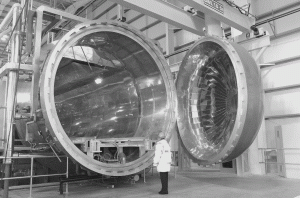
Plate 4 Autoclave used in creep forming process in East Factory
The Skin Manufacturing Centre also houses the treatment facility which has been slightly modified to treat A380 wing panels, a separate inspection area, a billet store for raw materials and a "shuttle car" system to transport the wing panels between processes.
Stringer Manufacturing Centre
The dedicated Stringer Manufacturing Centre – which was unveiled by the First Minister of Wales, Rhodri Morgan, on 31 January 2003, has the benefits of close-coupled manufacturing. As well as ultimately reducing cycle times for the process; less inventory is needed resulting in associated cost savings, and a new collation area will increase efficiency by allowing complex sets of stringers to be collated in webbing straps and delivered for assembly pre-prepared for attaching straight to the milled wing skins.
There are 95 different bottom stringers on an A380 wing (190 per aircraft)and some stringers are up to 22 m long. The facility will produce up to 200 km of stringers every year, and when fully operational from autumn 2003,approximately 250 people will work there. Currently around 200 people are working in the facility.
The Stringer Manufacturing Centre consists of five main areas.
- 1.
Machining – producing the A380 bottom stringers from billets of raw material.
- 2.
Forming – three lines (one each for A380, long-range and single aisle aircraft) where the stringers are formed to the shape or contour of the wing panel and then checked on one of the three contour checking machines.
- 3.
Thirteen surface treatment tanks to wash and anodise the stringers and a paint facility.
- 4.
Shot peening – housing staff from Metal Improvement Company (MIC) the local supplier which carries out the specialist saturation shot peening process on the stringers using two sound-proofed machines incorporated within the new facility.
- 5.
A collation area where the stingers are collated into complete "panel sets"suspended in webbing, ready for attaching straight to the wing skins elsewhere.
Forming of stringers for current model stringers began in the facility in November 2002, and the first A380 production stringers were formed there in January of this year.
A380: Technology
Airbus believes that the A380 will not only be the most spacious civil aircraft ever built, but also the most advanced – representing a technology platform from which all future commercial aircraft programmes will evolve (Plate 5).
 Plate 5Artists impression of A380 in flight
An array of new technologies for materials, processes, systems, and engines have been developed, tested and adopted. According to Airbus all technology considered for the A380 is carefully studied to determine its effects over the lifetime of the aircraft, and is selected for its proven maturity and long-term benefits. The company believes that each selection therefore contributes to attaining or bettering the programme targets, in keeping with the basic design tenets of reliability, low seat-mile cost, passenger comfort and environmental friendliness.
Moreover, while offering all the advantages of a completely new design, the A380 will extend the benefits of Airbus family commonality to the very large aircraft sector. Due to the same cockpit layout, procedures and handling characteristics, pilots will be able to transition to the A380 from other Airbus fly-by-wire aircraft with only minor additional training
Materials
A number of innovations introduced on the A380 will ensure considerable weight savings despite the aircraft's prodigious spaciousness, and tests reportedly show that aerodynamic performance of the aircraft will also be significantly enhanced. Better aerodynamics and lower airframe weight reduce the demands placed on engines and translate into lower fuel burn, reduced emissions into the atmosphere, and lower operating costs.
For instance, based on the in-service experience gained on its existing products, Airbus is extending the use of carbon fibre reinforced plastics (CFRP)to the A380. The A380 will be the first Airbus aircraft ever to boast a carbon fibre central wingbox – representing a weight-saving of up to one and a half tonnes compared to most advanced aluminium alloys. A monolithic CFRP design has also been adopted for the fin box and rudder, as well as the horizontal stabiliser and elevators. Furthermore, the upper deck floor beams and rear pressure bulkhead will be made of CFRP, while the wing covers will be constructed from advanced aluminium alloys. The fixed wing leading edge will be manufactured from thermoplastics, and secondary bracketry in the fuselage(serving, for example, to hold the interior trim) is also likely to be made of thermoplastics. Further applications of thermoplastics are under investigation,such as for the ribs in the fixed leading edges of the vertical and horizontal stabilisers.
An estimated 40 per cent of the aircraft's structure and components will thus be manufactured from the latest generation of carbon composites and advanced metallic materials, which, besides being lighter than traditional materials,offer significant advantages in terms of operational reliability,maintainability and ease of repair.
A new lighter and even more resistant material will also be used for the first time on a civil airliner after intensive trials. The upper fuselage shell of the A380 will be fashioned from GLARE, a laminate alternating layers of aluminium and glass-fibre reinforced adhesive. In addition to being some 10 per cent less dense than aluminium – for a weight- saving of around 800 kg– GLARE is said to have proven superior in terms of fatigue as well as fire and damage resistance. Indeed, it is reported that testing has demonstrated that an artificial crack subjected to thousands of flight cycles barely increases in size. It is also reported that the new material also resists exceptionally well to corrosion with the first glass-fibre layer preventing any penetration beyond the superficial aluminium coating. GLARE uses a hot bonded manufacturing process but is repaired in the same way as standard aluminium.
Following an in-depth study, two test flight campaigns and numerous laboratory and simulator tests, A380 engineers have also succeeded in moving the aircraft's centre of gravity aft by around 6 per cent. This change in centre of gravity, coupled with an enhanced fly-by-wire system, has led to a reduction of approximately 40 m2 in the area of the vertical stabiliser and a consequent saving in weight, while preserving the stability of the aircraft in-flight.
The net weight-savings resulting from these and other innovations discussed below, allow the A380 to weigh in at around 240 tonnes – a full 10-15 tonnes lighter than a similar sized aircraft using 747 technology.
Systems
Another weight saving feature is the use of an increased pressure for the A380's hydraulic systems. It is believed that for the first time ever in civil aviation, the A380's hydraulic systems will have an increased pressure of 5,000 pounds per square inch (psi), as opposed to the traditional 3,000 psi. This increase in pressure allows the necessary power to be transmitted with smaller piping and hydraulic components. The reduction in the size of components, unions and piping not only lowers the weight of the aircraft by around 1 tonne, but also improves its maintainability. Military aircraft have already been using these high pressure systems for many years and the change is an evolutionary move which has stood up well to qualification testing. Trials with existing hydraulic fluids and components have shown that the fluid does not degrade under the higher pressures and no evidence of erosion has been found.
In addition to the increased hydraulic pressure, a dual architecture for the flight control system has been implemented, featuring four independent primary flight control systems with two different configurations. Two of these systems use a conventional hydraulic actuation system whereas the other two feature local electro- hydraulic actuators for the control surfaces. The aircraft can be controlled using any one of these four systems. According to Airbus this brings system separation and redundancy in flight controls to a level never achieved before on an aircraft, whether civil or military.
The A380 will moreover benefit from a completely re-designed double spool air generation system which is more efficient in terms of thermodynamic cycles,provides more flexibility between different air generation requirements on the ground and at cruise, takes up less space and offers more redundancy and damage-resistance. Airliners are generally equipped with two air-conditioning packs, each of which converts high temperature, high pressure bleed air (from the compressor stage of the engines) into pressured cabin air at room temperature. Instead of using four such packs to generate the necessary air, the A380 will be equipped with two innovative double-packs, in which each unit performs separate functions of the overall cycle. This more robust approach provides valuable systems redundancy as well as greater overall efficiency.
Processes
Several innovative manufacturing techniques have been selected for use on the A380 programme, some of which have proved so advantageous that they have gone into series production earlier on other aircraft programmes. One example is laser beam welding which is used to attach the "stringers" (longitudinal reinforcements) of the lower fuselage shell instead of traditional riveting. This technique not only engenders a potential weight reduction, it is also much faster than conventional riveting – 8 m of stringers can be laser beam welded per minute.
The method includes a built-in automated inspection unit and tests run on the resulting structures to determine damage and fatigue tolerance have demonstrated that they behave as well or better than conventional alloy construction. A further major advantage claimed of this technique is that it eliminates fasteners, and thereby the major source of corrosion and fatigue cracks. Laser beam welding went into series production in 2001, for the manufacture of the rear fuselage lower skin on the single-aisle A318.
Environmental friendliness
The A380 will help cope with growing passengers numbers without negatively impacting the environment, due to significantly reduced noise and emissions levels. In spite of its higher weight and thrust requirements, Airbus believes that the A380 will make less noise than its closest competitor while carrying 30-50 per cent more people. Current noise certification rules (ICAO "chapter 3")will be reportedly met by significant margins and the A380 will be compliant with the strictest local noise regulations, classified QC2 for departure from London's busy airports and QC1 for arrival.
For ground operations, the A380 can taxi with only two engines if required,will use only two thrust reversers and will employ a low-noise auxiliary power unit to help eliminate any noise concern.
The A380's new generation engines will reportedly surpass the requirements of the latest regulations for the landing and take-off cycle. Because of its larger capacity, the A380 will make better use of available take-off and landing slots,thus reducing fuel wasted in airborne delays and holding patterns.
The economic fuel consumption claimed of the A380, will also help reduce the impact of exhaust gases on the atmosphere. Indeed, the A380 will be the first long-haul aircraft to consume less than 3l of fuel per passenger over 100 km– a fuel burn comparable with that of a mid-sized automobile.
Airport compatibility
The A380 has been designed in close collaboration with major airlines,airports and airworthiness authorities. For the past 6 years, Airbus has been working with representatives of more than 60 international airports to ensure the most cost-effective integration of the aircraft commercial operations. As a result, all the A380's major destinations are working to a master plan enabling them to accept the aircraft when it enters into service (Plate 6).
The A380 is stated to be in many ways compatible with the facilities used nowadays by the existing large aircraft. The A380's large wings and new engines will reportedly provide better take-off and landing field performance than that of current large aircraft and therefore require a shorter runway. In addition,due to the 20-wheel main landing gear, the A380's pavement loading will remain within the parameters of in-service aircraft. The footprint of the A380 landing gear is said to be comparable with that of the existing aircraft and does not require new runways.
The A380 cockpit is midway between the two decks, which means that the pilot sits near the aircraft centre-line with a much better view. This, alongside cameras located in the tail fin and on the belly, allow accurate placement of the aircraft. At the gate, the A380's two decks and wide forward stairs will allow turnaround times comparable to those of today's largest airliner, even if single deck access only is possible.

