

Sustainable Aviation unveils path to future lower air travel CO2 emissions
Sustainable Aviation unveils path to future lower air travel CO2 emissions
Article Type: Features From: Aircraft Engineering and Aerospace Technology: An International Journal, Volume 81, Issue 2
Sustainable Aviation (SA) recently published the following report mapping the industry’s carbon dioxide (CO2) emissions to 2050. The report concludes that CO2 from all UK civil aviation can return to 2000 levels by 2050, after having reached a peak around 2020, against a background of threefold growth in passenger numbers.
The assessment takes into account the UK air transport market maturity and efficiencies that are expected from new airframe and engine technology, cutting edge air traffic management (ATM) and operations, as well as the development of sustainable fuels. In making this assessment, no allowance is made for the additional contribution to CO2 reductions that will be achieved through airlines’ participation in international emissions cap and trade schemes, the details of which have yet to be fully defined.
Sustainable Aviation CO2 roadmap
Executive summary
This document presents the SA assessment of CO2 emissions from UK aviation over the period 2000-2050. It takes into account reductions that can be achieved through improvements in operations, technology and introduction of sustainable fuels.
Our assessment, which we call in short the “SA CO2 Roadmap”,is based on the knowledge and expertise of our members, spanning both the technology supply and demand sides, as well as operational infrastructure development. We present our current best estimate of the future potential for aviation to mitigate the growth of its CO2 emissions.
The SA CO2 roadmap shows that emissions of CO2 from UK aviation can be reduced to 2000 levels by 2050. This can be achieved through a combination of new technologies, operational efficiency gains and sustainable fuels, against a background where passenger numbers are projected to grow by a factor of three.
Our roadmap does not assess the impact of aviation’s inclusion in emissions trading. SAs UK airlines and operators support the inclusion of aviation in the European Emissions Trading Scheme, as an interim step towards a global scheme. Emissions trading is an economically efficient and environmentally effective market mechanism. Trading can deliver the most cost effective carbon cuts across the economy as a whole, and will allow aviation to purchase carbon reductions from sectors where they can be achieved more economically. This will enable aviation to contribute to overall carbon reductions beyond those outlined in this paper.
SA recognises that there are uncertainties in this assessment, as with any projections into the future. We therefore commit to review this assessment on a regular basis and, where there are material changes, to update and publish our findings.
1 The aviation emissions challenge
CO2 is the emission from aircraft that is considered to have the greatest long-term effect on the climate (Intergovernmental Panel on Climate Change, 2007). The quantity of CO2 emitted is directly related to fuel burn and the understanding of its environmental effect is good. There is a clear need for further research to advance our scientific understanding of other aviation climate effects and we have reviewed the present state of knowledge of these non-CO2 impacts, and the rationale for focusing on CO2at this time, in a separate paper that is published on the SA web site: www.sustainableaviation.co.uk
Aviation is a growing industry with a strong track record in fuel efficiency improvements. For example, the fuel efficiency of jet aircraft has improved by over 70 per cent since the introduction of civil jet airliners. Nonetheless, the success of civil aviation has resulted in growth in overall fuel consumption and in emissions of CO2 outpacing these improvements.
Looking forward, the challenge is to allow society to continue to benefit from the social and economic aspects of aviation whilst ensuring that aviation plays its part in meeting global CO2 targets. Demonstrating growth in traffic without a corresponding growth in long-term emissions is an important step towards sustainability.
Globally, aviation contributes around 2 per cent of man-made CO2emissions (Intergovernmental Panel on Climate Change, 2007) (Figure 1). The UK Government (Defra/NAEI/AEA Energy & Environment, 2008) estimates that UK aviation[1] accounts for around 6 per cent of UK CO2 emissions(2005). SA fully acknowledges that although aviation makes a relatively small contribution to overall global emissions, every industry must play its part in tackling the challenge of climate change.
The SA strategy (SA, 2006, 2005) has identified that a combination of measures is needed to address the challenge of growing emissions from aviation and that, in addition to further improvements in fuel efficiency, market-based measures will play an essential role in securing a sustainable pathway for the sector.

This paper represents the SA view of CO2 emissions from UK aviation over the period 2000 to 2050, taking into account reductions that can be achieved through improvements in operations, technology and fuel substitution. Reductions that may be achieved through emissions trading have not been considered.
We note that emissions trading should deliver the most cost effective carbon cuts across the economy as a whole, and will allow aviation to purchase carbon reductions from sectors where they can be achieved most economically.
In plotting the SA CO2 Roadmap, we have drawn on the expertise of our members, who represent both the supply and demand sides of the industry as well as operational infrastructure.
2 Approach and assessment
In this section, we present the overall approach to developing the SA CO2Roadmap, as well as the key conclusions we reach on the contributions from technologies, operational efficiencies and sustainable fuels to deliver CO2reductions.
2.1 Approach
Our assessment has been made in three steps:
- 1.
Produce a baseline of the growth in future UK CO2 emissions assuming no operational or technological improvements. This represents the reference against which the impact of anticipated abatement efforts can be assessed.
- 2.
Assess the potential for nearer-term improvements to deliver efficiency gains. This draws largely on the work underpinning achievement of the Advisory Council for Aeronautics Research in Europe (ACARE) 2020 goals (“European Aeronautics, a Vision for 2020”, www.acare4europe.com/) to which the European aviation industry has committed.
- 3.
Assess the potential for longer-term developments to deliver efficiency improvements post 2020.
Each of these steps is described fully below.
2.2 Step 1 – Baseline assessment
The baseline is calculated by assuming no technological or operational improvements, relative to the initial fleet, and therefore tracks the growth in demand for UK aviation. In this assessment we have assumed the following annual growth rates for UK aviation, based on CAA data and UK Government projections in passenger numbers:
4.3 per cent per annum from 2001 to 2007;
3.4 per cent per annum from 2008 to 2020;
2.3 per cent per annum from 2021 to 2030;
1.2 per cent per annum from 2031 to 2040; and
0.7 per cent per annum from 2041 to 2050[2].
The reductions in growth rate over time reflect an assumption of market maturity and capacity constraints. It is worth noting that anticipated growth rates for UK aviation are somewhat lower than the corresponding figures for aviation globally, due to the relative maturity of the UK market. Growth rates in CO2 emissions from UK aviation will therefore be lower than the global average.
As revised forecasts become available we shall incorporate them in our analysis.
2.3 Step 2 – Impacts driven by ACARE targets
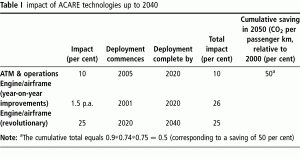
ACARE has established a challenging goal of a 50 per cent reduction in CO2emissions per passenger km for new aircraft entering into service in 2020,compared with equivalent new aircraft entering service in 2000. Our assessment of the nearer term technology and operational improvements centre around the assumptions underpinning the ACARE targets for 2020. This will be achieved through a combination of measures including engine and airframe technologies,ATM and operational improvements.
We believe that these improvements are technically possible: indeed, the industry has committed to their achievement. However, delivery will require continuing research and development by the industry, supported by sustained government funding.
We describe below in more detail our view on the breakdown of this 50 per cent efficiency improvement and the scope and timescales for rolling these out into the industry.
2.3.1 Air traffic management and operations
Improvement in the operation of aircraft to achieve greater fuel efficiency and thus reduce emissions has long been a feature of aviation in the UK and significant improvements continue to be made. These efficiencies fall into two basic categories.
The first of these relates to operating efficiencies being made by operators themselves, and the second is more structural and relates to efficiencies driven by ATM. Each is described below.
Using the most efficient aircraft for the designated route makes a big difference. A 70-seat turboprop will burn 35 per cent less fuel than a regional jet on a 500 nm sector (Bombardier).
Reducing weight from the interior of the aircraft – in terms of products, fixtures and fittings – can make a significant difference to fuel burn. For example, across Virgin Atlantic’s fleet of 38 wide-bodied long-haul aircraft, removing just 1 kg of weight per aircraft can reduce CO2emissions by over 16 tonnes per year (Virgin Atlantic).
Aircraft speed significantly affects fuel burn. For example, a Bombardier Q400 aircraft, which can hold 74 passengers, must burn 24 per cent more fuel to complete a 300 nm journey in 68 min compared to 81 min. Fuel bum for both journeys includes a 10 min taxi (Bombardier).
Air traffic management
Improved air traffic control (ATC) resulting in more direct routes and reduced delays could reduce overall fuel burn by 6-12 per cent(Intergovernmental Panel on Climate Change, 1999).
NATS has, independently, set a stretching target to cut the CO2emissions of aircraft under its control by an average of 10 per cent per flight by 2020 against a 2006 baseline, which is currently being established.
NATS is also evaluating a range of potential measures to determine which will be the most effective in helping to achieve the target. This includes possible efficiency improvements through new technology in airspace design, the route network and ATC operations.
Improving the environmental focus within airspace design and route network management will deliver more direct routes and optimum flight profiles, enable flexible use of airspace alongside military users, and facilitate development of functional airspace blocks to help eliminate inefficiencies that can arise at ATC boundaries.
Other measures to deliver emissions improvements are likely to include the facilitation of continuous descent approaches (CDA) and tailored arrivals,increasing holding heights, introducing speed controls and increasing controller and pilot awareness of the opportunities they have available to influence fuel and emissions performance.
Technology may hold some of the biggest opportunities for ATM. Airport collaborative decision making and air traffic arrivals and departure managing tools will come into operation over the next decade. These tools offer the opportunity to reduce reliance on airborne holding without necessarily impacting airport capacity declarations.
The longer term vision will see technology deliver “4D Trajectories”enabling more direct and efficient route profiles with aircraft self-separation and minimum controller intervention. Single European Sky, the project to harmonise European air traffic, also aspires to deliver a 10 per cent improvement by 2020.
Overall we have conservatively assumed a total reduction in CO2emissions of 10 per cent due to the combined contribution of operations and ATM. We anticipate that this 10 per cent improvement will gradually apply in the period to 2020 and will be relevant to all flights beyond that date. We have made no allowance for further improvements in ATM and operations beyond 2020.
232 Engine and airframe technology
Considerable scope exists for improving fuel efficiency through new technology. The implications of adopting the ACARE targets means that by 2020,engine and airframe technologies must be available to allow a fuel-efficiency improvement of around 45 per cent on those aircraft where they have been implemented.
We have assumed an ongoing improvement rate in fleet-average fuel efficiency of 1.5 per cent per annum (reflecting recent trends) up to 2020, followed by the deployment across the fleet of radically new technologies which will have been developed in the intervening period and which offer a further 25 per centfuel-efficiency improvement where deployed[3]. We have further assumed that these technologies will have permeated the vast majority of the UK fleet within 20 years of their initial availability.
Airbus estimates that for a 1 per cent structural weight saving,approximately 0.5-1.5 per cent benefit in fuel consumption will occur. The exact benefit depends on many factors, particularly configuration and range (with more benefit being available for medium-range aircraft than long-range), and on whether the whole aircraft design can be re-optimised following the weight change.
Airbus predicts that airframe aerodynamic improvements like natural or hybrid laminar flow control, advanced riblets, low-drag technology and innovative aircraft configurations can together offer a fuel burn reduction of around 10 per cent (Airbus Holistic Road Map to the Future).
Ongoing year-on-year improvements result from the gradual introduction of technologies such as lighter materials and structures (Air Travel –Greener by Design, 2002), improvements in turbomachinery, and replacement of hydraulics with electrical systems.
More radical technologies, as indicated above, which might be ready for deployment around 2020, include open-rotor engines (potentially offering 15 per cent improvements over equivalent technology turbofans (Rolls-Royce, 2007)) and alternative thermodynamic cycles using for example intercooling and recuperation(potentially offering 5-10 per cent efficiency improvements). More details on open-rotor development under the SAGE programme detailed as follows.
The Clean Sky Joint Technology Initiative (JTI) which was launched in Brussels on the 5 February 2008 is a major EU-wide research programme designed to integrate results of earlier research programmes into large-scale demonstrators. The €1.6 billion, seven year project will develop and validate technologies and operating practices to focus and drive EU research effort towards the ACARE 2020 targets.
Sustainable and green engines (SAGE) is one of the six integration technology demonstrators (ITDs) that make up the Clean Sky JTI. The €425 million validation programme will involve the design and build of five engine demonstrators, including an open rotor engine demonstrator. The open rotor engine demonstrator is planned to run around 2011-2012, enabling a product to enter into service in the latter half of the next decade. For further information please visit the web site: www.cleansky.eu
Another of the ITDs is the Smart Fixed Wing Aircraft (SFWA). SFWA aims for a 10-20 per cent reduction in fuel burn and CO2 emissions and a 5-10 dB noise reduction for medium to long range aircraft relative to 2000 levels. This will be achieved through the development of an all new, innovative “smart wing” design and the integration of the novel engine concepts from the SAGE ITD.
The “smart wing” design will develop flow control systems, load control systems and integrated flow and load control systems. Flow control technologies designed to reduce the drag of the wing in cruise will include laminar flow control, turbulent skin friction reduction and flow control for low-speed and high-lift.
Further information: Phillips, P. and J Koenig, J. (2008). “Clean Sky:The Joint Technology Initiative for Aeronautics and Air Transport, SFWA Brief Status Presentation”, ET-EU Meeting 27 February 2008.
Although at this stage it is not realistic to determine is derived directly from the industry’s commitment with certainty which of these technologies will be to the 2020 ACARE CO2 target, coupled with our adopted by 2020, our assumption of a 25 per cent assumed rate of year-on-year improvement to improvement arising from radically new technologies 2020[3].
Comparing the assumptions with products currently being designed.The long range A350XWB which will enter into service in 2013 is forecast to burn around 30 per cent less fuel than existing aircraft (1980s/1990s technology) on a 4,000 nm sector mission (Airbus Technical Press Briefing (May 2008) based on a load factor of 80 per cent).
The short range Bombardier C Series which will also enter into service in 2013 will produce IT-19 per cent less CO2 emissions per seat compared to existing aircraft (late 1990s/early 2000s technology) operating in the same market (Bombardier).
233 Summary – ACARE driven technology and operational improvements
Table I summarises the assessment for the near term ACARE-driven technology and operational improvements.
24 Step 3 – Longer term improvements
Technology development is expected to continue post-2020, driven by both fuel-prices and carbon prices. In addition to further airframe and engine technology developments, we anticipate the introduction of sustainable alternative fuel blends which offer a life-cycle CO2 saving relative to kerosene.
241 Sustainable fuels
Lower carbon fuels produced from sustainable, second and third generation feedstocks such as jatropha, algae or biomass waste could make a significant contribution to reducing CO2 emissions from aviation in the longer term.
Alternative fuels must be sustainable – for a candidate fuel to represent a viable alternative to kerosene:
it must be suitable for use in existing aircraft, engines and fuel systems,meeting or; exceeding current fuel specifications;
it must be derived from sustainable sources without adversely impacting food-production, land-use or water-scarcity, and must show a reduction in CO2emissions over its lifecycle, relative to kerosene; and
industrial-scale production must be economically feasible.
In order to have any significant impact by 2050, sustainable fuels will need to be compatible with existing engine, airframe and fuel supply systems and infrastructure. The performance characteristics should also be equivalent to or better than those of current aviation fuel.
Although, we would not expect the UK to be among the early adopter regions of bio-derived fuels for aviation, we would nevertheless envisage lower carbon fuels making a significant contribution within the 2050 timeframe.
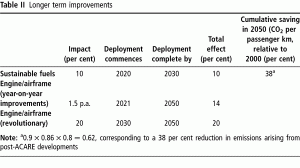
For the purposes of this study we have taken a conservative view and assumed that lower carbon sustainable fuel blends will be deployed from 2020, reaching full market penetration by 2030, at which time a 10 per cent reduction in life cycle CO2 emissions will be achieved, relative to 100 per cent kerosene[4], [5], [6]. This 10 per cent reduction in CO2 will apply on a fleet-wide basis beyond 2030.
242 Engine and airframe technology development
In parallel with the gradual rolling-out of ACARE-compliant technologies across the fleet during the 20-year period post 2020, we anticipate that further opportunities for year-on-year improvement to fleet-average fuel-efficiency will arise from technology insertion and further developments in lightweight materials and turbomachinery efficiencies, amounting to some 0.5 per cent per annum from 2021 onwards.
During this period, we also anticipate that development work will progress on the next generation of radically new technologies, potentially including such items as blended-wing-body aircraft configurations.
We note that, despite the more speculative nature of these assumptions,strong economic drivers will continue to provide incentives for radical new developments.
We assume that these technologies will be ready for deployment around 2030,and will offer an additional 20 per cent fuel-efficiency benefit. We anticipate that the deployment of such technologies into the active fleet will be largely complete by 2050.
243 Summary – long-term improvements
Table II, summarises the longer term advancements and their potential to mitigate CO2.
25 Overall reduction
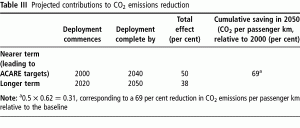
In this section we bring together our analysis, shown in Tables I and II,into a single table, Table III.
When the abatement elements are combined, they are estimated to deliver an overall reduction in CO2 emissions per passenger kilometre in 2050(relative to a 2000 baseline) of around 69 per cent. When this is combined with the anticipated growth in demand for UK aviation, we project that CO2emissions from UK aviation in 2050 will be broadly similar to those in 2000.
3 SA CO2 Roadmap – projected future emissions of CO2 from UK aviation
In this section we bring together the analysis presented previously by plotting the technological, operational and sustainable fuel potential to reduce emissions in the future.
We have distinguished those items that are underpinned in the shorter term,through the industry’s commitments to ACARE and from the longer term technologies that we envisage being implemented through to 2050.
This graph does not include the possible contribution of as-yet-undiscovered technologies which might become available towards 2050.
We present these effects in Figure 2, which draws on the analysis summarised in Tables I-III.

4 Conclusion
Our analysis indicates that emissions of CO2 from UK civil aviation can return to 2000 levels by 2050 after reaching a peak around 2020. These estimates exclude any contribution from emissions trading to reducing the net emissions from UK aviation.
This “SA CO2 Roadmap” will be reviewed and updated regularly by SA, taking into account all new relevant developments.
SA is an initiative from a coalition of industry partners:
- 1.
The Airports Operators Association.
- 2.
The British Air Transport Association.
- 3.
NATS.
- 4.
The Society of British Aerospace Companies.
These four bodies and some of their constituent companies developed the SA strategy in 2004-2005, with input from a range of stakeholders including representatives of Government, Academia, non-governmental organisations and the industry. The strategy contains eight over-arching goals and 34 commitments to drive towards these goals. SA is committed to ongoing consultation with key stakeholders and publishes regular biannual progress reports with the second such report due in early 2009. For further information please visit the web site: www.sustainableaviation.co.uk
An internationally accepted methodology for associating emissions of international aviation with individual territories has yet to be agreed. We have taken UK aviation to include all flights departing from UK airports.
Past data for 2001-2007 are derived from CAA statistics for terminal passenger numbers, averaged over 2000-2007 (www.caa.co.uk/airportstatistics). Future projections in the baseline are derived from UK Department for Transport(DfT) projections [Intergovernmental Panel on Climate Change, 1999, Table 2.16],which themselves are based on assumptions of airport capacity consistent with the Air Transport White Paper. This assumes another (second) runway at Stansted(2011-2012) and another (third) runway at Heathrow (2015-2020). CAA statistics indicate that freight represents less than 10 per cent of the loads (tonnes)from UK airports. Around two thirds of this is carried in the holds of passenger aircraft and no growth was shown from the figures from 2000-2007. Hence, the focus on passenger traffic in this paper. Based on these projections, by 2050 the overall baseline growth in CO2 emissions {in the absence of any improvement initiatives) would be 1.0437×1.034″×1.02310×1.01210×1,00710=3.15 times the emissions in 2000.
20 years at 1.5 per cent p.a., followed by 25 per cent yields 0.98520×0.75= 0.554, corresponding to a 45 per cent improvement.
0.98520=0.739 or 26 per cent improvement.
We would anticipate that sustain produced biofuels would offer a lifecycle CO2footprint half that of conventional kerosene, and thus assume that 20 per cent of total jet fuel uplift would come from biofuels by 2030. As the development of biofuels for aviation is still in its infancy, it is difficult to predict with any degree of certainty the exact contribution this will make to the CO2emissions roadmap. SA will review this projection regularly to take into account this fast moving area.
30 years at 0.5 per cent p.a. yields 0.995.30, corresponding to a 14 per cent improvement.

