

Editorial
Article Type: Editorial From: Aircraft Engineering and Aerospace Technology: An International Journal, Volume 82, Issue 1
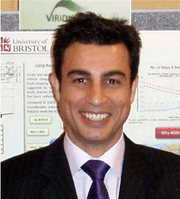
Greetings colleagues. It is with great honour and enthusiasm that I assume the role as Editor of the venerable Aircraft Engineering and Aerospace Technology (AEAT) Journal. My career hitherto spans almost two decades and comprises a broad range of specialisations in both industrial and academic environments. My portfolio includes participation in 39 aerospace design projects, aerospace research and development, and, teaching of small and large-scale integration and optimisation of general engineering systems. I have had the fortune of working for respected companies like Bombardier Aerospace,American Airlines, SAAB AB (now Saab Aerosystems), Williams International, and Hawker de Havilland (now Boeing Aerostructures Australia), amongst others.
Although I knew of the rich technical publication history of AEAT,thumbing through the archived papers I discovered something quite interesting. The publication, originally launched as Aircraft Engineering in March 1929, was endorsed by The Rt Hon. Sir Samuel Hoare, CMG, DL, who serving at the time as the UK Secretary of State for Air recognised the dire need of “[…]a new aeronautical journal devoted exclusively to the all-important scientific and technical aspects of aviation”. It was the intent of the first Editor, Lieut-Col. W. Lockwood Marsh, to “[…] provide a medium for the exchange of knowledge and experience amongst members of the aircraft industry themselves, and between them and the scientist on the one hand and the general engineering world on the other”. In other words, it was the express wish of the first editorial team to have the journal cover both specialist and generalist topics. Aeronautical engineering, after all, is truly a multi-disciplinary field – in retrospect, it should not have been so dramatic a discovery.
The mature industry we know as aerospace engineering today works off the maxim that no methods or technologies will make their way to the final engineered product unless there is a clear global (synergistic) benefit to the aircraft system. In line with this tenet I would like to offer a new vision for the publication. Basically, I urge all authors to continue using AEATas a platform for disseminating innovative scientific methods, research and technology ideas. The only difference now being a proviso that some thought and discussion is given as to how said ideas benefit the design, development,project management, manufacture and operation of current or future aerospace vehicle systems. To ensure perpetuity of high standards with the coming generations of aerospace engineering academics and professionals I also call on those working with aerospace vehicle design and analysis pedagogy to consider submitting articles that cover topics related to novel educational initiatives.
Something that will become a permanent feature for AEAT is the reprinting of seminal technical articles from the past. In order to herald the hand-off of the next generation of editorial management from my most capable predecessor, Mr Terry Savage, Volume 82 Issue 1 contains an interesting archived paper entitled “Design philosophy of the A-300B”, Volume 41 Issue 3, March 1969. The A-300B not only marks a watershed moment for the Airbus company, but also, this highly innovative aircraft was the progenitor of all extended twin operations for transport aviation. Furthermore, it served as an inspiration for Boeing Airplane Company to design and develop the highly successful B757 and B767 equipment types in the early 1980s. This technical article is certainly important from the perspective of presenting a new, “paper”aircraft design concept for the fledgling consortium of European aviation firms known at that time as European Airbus. For me, in addition, it amplifies my vision that AEAT should be a publication that establishes a discernable link between aerospace systems analysis and aerospace systems architecture.
In closing, on behalf of the Editorial Advisory Board and Editorial Team it is our express wish that AEAT will continue to provide a forum for the dissemination and advancement of forward-thinking, high-calibre,multi-disciplinary work at the forefront of the aerospace engineering field. We look forward to receiving your submissions.
Askin T. Isikveren

