Skip to article sections
Purpose

Although the global financial technology (FinTech) market continues to grow, its potential role in agriculture remains underdeveloped, especially in developing countries. This study aims to examine the agricultural FinTech (Agri-FinTech) ecosystem, identify actors, drivers, and impacts of FinTech adoption in the agricultural sector and conceptualise a development framework.

Design/methodology/approach

A systematic literature review (SLR) was conducted following the Preferred Reporting Items for Systematic reviews and Meta-Analyses framework, analysing 107 studies published between 2013 and October 2023.

Findings

Synergy among actors in the Agri-FinTech ecosystem is key to driving inclusive innovation in the agricultural finance sector. Meanwhile, drivers of the use of Agri-FinTech are ease of use, perceived benefits, job relevance, habits and hedonic motivation. Agri-FinTech is associated with a wide range of positive impacts, including increased crop yields, improved farmer household income, enhanced village economic resilience, greater adoption of sustainable agricultural practices, digital transformation of the agribusiness sector and reduced carbon emissions. This study recommends further research to explore Agri-FinTech designs tailored to smallholder preferences, gender-responsive strategies, eco-friendly financing models and context-appropriate regulatory structures.

Originality/value

This study provides an important contribution to the development of Agri-FinTech by proposing a smallholder-inclusive Agri-FinTech development framework. The framework offers a conceptual roadmap for designing inclusive, sustainable and responsive technology-based financial services tailored to smallholder farmers' needs.

Financial technology, or FinTech, is revolutionising the finance industry. In 2023, there were 26,393 FinTech startups in the world with USD 186.87 billion in total revenue (Statista, 2025). The promise of FinTech lies in enabling customers to access financial services more safely, quickly, and cheaply than via conventional banks (Stulz, 2019; Taherdoost, 2023). In addition, FinTech has the potential to improve efficiency (Hua et al., 2019; Ng et al., 2017), accessibility (Im and Yoon, 2021; Nour, 2022), and ease of use (Ng et al., 2017). More broadly, FinTech also offers opportunities to stimulate economic growth (Song and Appiah-Otoo, 2022), reduce carbon emissions (Wang et al., 2024), and boost household consumption (Saraswati et al., 2022).

FinTech's applications are expanding rapidly, including in the agriculture sector. Agri-FinTech, the convergence of financial technology and agriculture, directly addresses critical gaps in the agricultural financial system by providing inclusive digital financial services (Pothula, 2023). Agri-FinTech's positive impacts extend throughout agri-food supply chains. Empirical evidence suggests Agri-FinTech's potential to alleviate rural poverty (Kilombele et al., 2023), enhance agricultural productivity (Wang and Fu, 2022), boost farm household income (Wang et al., 2023), mitigate agricultural non-point source (NPS) pollution (Jiang et al., 2019), reduce consumption inequality among farmers (Wang et al., 2022b), accelerate the adoption of modern agricultural technologies (Batista and Vicente, 2020), and stimulate farmer investment (Xu et al., 2022).

While many studies have highlighted the contribution of FinTech to agriculture, its global utilisation remains limited. In a rapidly growing FinTech ecosystem with 126,488 firms recorded globally in 2023, only 219 FinTech firms/platforms were dedicated to the agriculture sector (Tracxn, 2024). Although other general-purpose FinTech firms may also extend services to agricultural users, the small share of dedicated platforms still signals a substantial gap in tailored agri-financial services. This shortfall in dedicated platforms is compounded by a broader financing gap in agriculture: in 2019 alone, global agricultural financing needs reached USD 240 billion, yet conventional financial institutions could meet only about USD 70 billion of that demand (Shakhovskoy et al., 2019). Taken together, the scarcity of dedicated Agri-FinTech providers and the substantial unmet demand in conventional agricultural finance reveal both untapped potential and underdeveloped infrastructure for FinTech-led solutions in this sector. A systematic synthesis of the existing literature is therefore warranted to clarify what Agri-FinTech has so far contributed, where its capabilities fall short, and how its role can be expanded.

A substantial body of literature sheds light on these challenges, including access to agricultural finance, such as mobile payment applications (Ong et al., 2023) and crowdfunding (Fang, 2022). Other studies have adopted country-specific lenses, examining how Agri-FinTech development unfolds within particular national contexts, such as in China (Liu and Ren, 2023; Wang et al., 2023), Indonesia (Pratiwi, 2023), and Kenya (Gichuki and Kamau, 2022; Omwansa et al., 2013). However, a comprehensive and systematic synthesis of global Agri-FinTech research, particularly those studies focusing on the role of various stakeholders in the FinTech ecosystem, remains absent. Addressing this gap is crucial given the complex and evolving nature of FinTech, influenced by factors at multiple levels—from individual farmers to communities and the broader agriculture sector. Therefore, a systematic literature review is critical to understanding the determinants and impacts of Agri-FinTech development and to informing effective strategies for relevant chain actors.

This study offers three main contributions to the body of knowledge, specifically on the development of FinTech in agriculture. First, this study complements previous SLRs that are limited in scope, either to specific regions or countries or to particular actors, such as studies on the use of FinTech among smallholder farmers in Sub-Saharan Africa by Mapanje et al. (2023), FinTech applications in Indonesian agriculture (Rufaidah et al., 2023), and FinTech adoption among smallholder farmers (Rayhan et al., 2024). Second, this study explores the roles of and interactions among key stakeholders in the ecosystem, identifying approaches to support Agri-FinTech development, and broadening the geographical and thematic scope of the review through global studies. Third, this study develops a conceptual framework linking the dynamics of the Agri-FinTech ecosystem, technological innovations, adoption drivers, and multi-level impacts. The study's novel conceptual framework will steer the effective implementation and scaling of Agri-FinTech development. The following research questions guided the review:

  1. Who are the actors involved in the Agri-FinTech ecosystem?

  2. What are the drivers of Agri-FinTech development?

  3. What are the impacts of Agri-FinTech development at the farm, community and sectoral levels?

This chapter is organised as follows. Section 2 revisits the definitions of Agri-FinTech. Section 3 reviews the research methodology. Results are presented in Section 4, followed by a discussion of potential areas for future research in Section 5. Section 6 concludes the chapter.

The application of technology to financial services (FinTech) has a long history. Early examples include the telephone, and the automated teller machine (ATM), each of which significantly improved the efficiency of financial transactions (Arner et al., 2016). FinTech's evolution can be broadly categorised into three stages, as shown in Figure 1.

FinTech 1.0 utilised the telegraph for financial transactions, enabled by the invention of transcontinental cable transmission. FinTech 2.0 was defined by the digitisation of financial services through electronic technology. FinTech 3.0, beginning around 2008, is marked by the rise of startups offering direct-to-consumer services, significantly expanding the accessibility and scope of financial services.

Given the rapid development of FinTech, it is crucial to understand what it is. While definitions extend from “financial technology combining bank services with computer science and management” (Bettinger, 1972) to encompass a wide array of activities such as contactless payments and digital processes (Walport, 2015), the common thread is the use of technology in the finance industry (Arner et al., 2016). Following the definition of FinTech by Arner et al. (2016), this study adopts a definition of Agri-FinTech as “the use of FinTech in the agricultural sector” (Pothula, 2023), focusing specifically on FinTech 2.0 (digital finance offered by traditional institutions) and FinTech 3.0 (innovative services from non-traditional providers). This study focuses on technologies such as mobile banking, crowdfunding, and peer-to-peer lending within the agricultural context.

Agri-FinTech, encompassing FinTech 2.0 and 3.0, has the potential to increase financial inclusion for farmers by facilitating efficient credit disbursement (Pandey et al., 2025). Additionally, the credit mechanisms and product market facilitation of Agri-FinTech platforms play an important role in promoting agricultural sustainability in developing countries by financing production (Rayhan et al., 2024). Globally, Agri-FinTech startups that provide financial solutions continue to emerge year after year (Tracxn, 2025). One example, from Nigeria, is Thrive Agric, which connects farmers with lenders to provide agricultural inputs and digital loans. In Indonesia, Crowde has emerged as an alternative financing option for smallholder farmers using a crowdfunding model. Overall, these startups have the potential to increase access to capital and strengthen the resilience of the agricultural value chain (Gao and Gao, 2024; Lyu et al., 2025).

Considering the accumulation of studies related to the use of FinTech in agriculture around the world, this study applied a systematic approach to reviewing the literature, which involved comprehensively identifying all relevant studies to answer the research questions (Petticrew and Roberts, 2008). The Preferred Reporting Items for Systematic Reviews and Meta-Analysis (PRISMA) framework is used to guide the rigorous and transparent selection of literature relevant to Agri-FinTech developments in agricultural finance (Koutsos et al., 2019; Page et al., 2021). The PRISMA framework is comprised of five stages: (1) formulation of the research problem; (2) literature search; (3) evaluation of relevant literature; (4) data analysis, synthesis, and interpretation; and (5) reporting of the review results, each of which are discussed below.

This research addresses a critical gap in understanding of Agri-FinTech's impacts by systematically synthesising the main actors, development drivers, and multi-level impacts (farm, community, and sector) based on existing research. While the introduction established FinTech's potential and challenges in the agriculture sector, a comprehensive analysis of these aspects remains absent. Therefore, this study seeks to provide a nuanced understanding of Agri-FinTech's role in transforming agricultural finance.

The literature search began by identifying bibliographic databases, keywords and article search strategies. The search used multidisciplinary databases including EBSCOhost, ProQuest, Science Direct, Scopus, Web of Science, and Google Scholar, which collectively cover agriculture, finance, and technology. The selected studies were drawn from grey literature and peer-reviewed journals. “Grey literature” refers to articles that are not easily identified by database indexes, such as conference proceedings and working papers (Rothstein and Hopewell, 2009). Peer-reviewed studies are included to ensure the quality of the literature in this systematic review (Denyer and Tranfield, 2009). During the literature search, the primary keywords (“financial technology”) were paired with secondary keywords (“agriculture”) to confine the scope to studies on Agri-FinTech. The set of keywords was searched on all chosen databases. The searches were finalised in October 2023.  Appendix 1 details the Boolean operators used in this study.

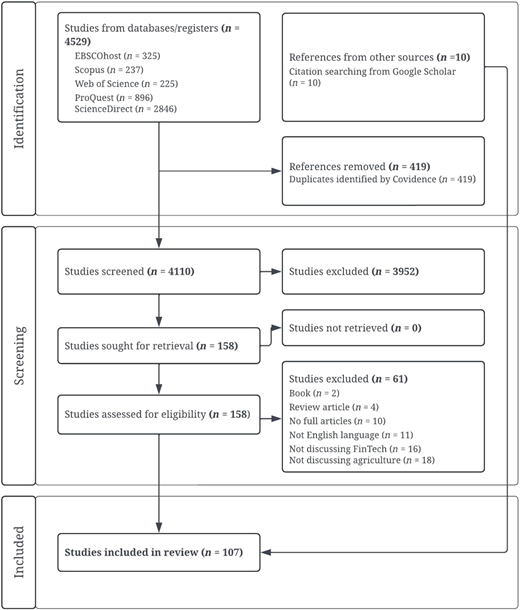
Before retrieving the articles, the inclusion and exclusion criteria were applied (see Table 1). These criteria were designed to ensure the inclusion of high-quality peer-reviewed evidence relevant to FinTech in agriculture. Furthermore, they filtered out ineligible papers (Koutsos et al., 2019) and reduced bias and inconsistency in selecting relevant documents (Frampton et al., 2017). After the screening process, a total of 107 articles relevant to FinTech in the agriculture sector were identified (see Figure 2).

The analysis of the 107 relevant studies was divided into two parts. The first part presented the descriptive statistics, including the publication year, publication type, publisher, Agri-FinTech type, and region. The second part focused on synthesising the reviewed literature, including the actors involved in the Agri-FinTech ecosystem, drivers, and the impacts of Agri-FinTech development.

This section presents the results of the systematic literature review in two main parts. The first part offers a descriptive analysis of the 107 reviewed studies, summarising their distribution by year of publication, type of publication, geographical focus, and Agri-FinTech type. The second part synthesises the substantive findings of the review along three lines of inquiry: the actors in the Agri-FinTech ecosystem, the drivers of Agri-FinTech development, and the impacts of Agri-FinTech at the farm, community, and sector levels. Building on these findings, the section concludes with the proposed smallholder-inclusive Agri-FinTech development framework.

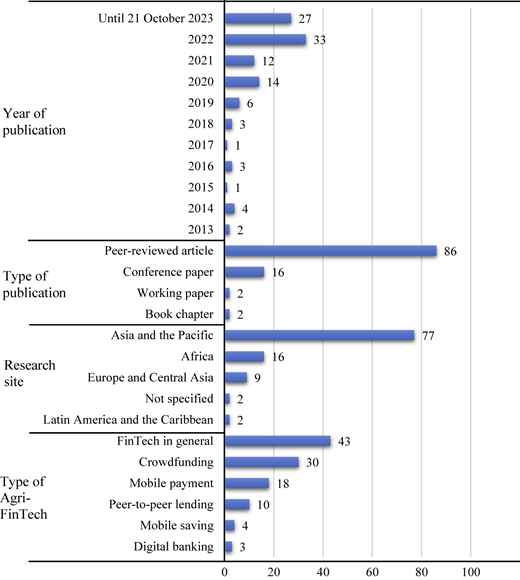
Figure 3 presents the distribution of the selected documents based on the year of publication, the type of publication, the location of the research (i.e. by continent), and the type of Agri-FinTech analysed. The reviewed studies are published between 2013 and 2023, with the majority (approximately 80%) published between 2020 and 2023, reflecting a recent surge in academic interest in Agri-FinTech.

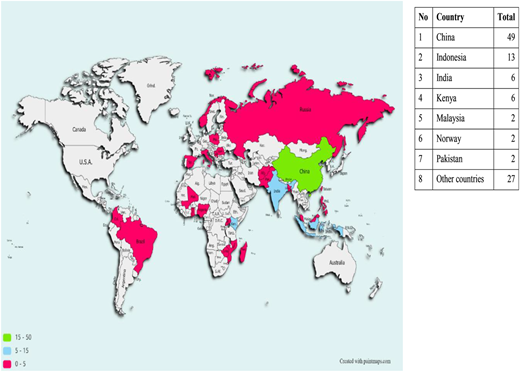
By publication type, 87 articles were published in peer-reviewed journals, while 16 were conference papers. By geographical distribution, 93 articles (88%) described studies in developing countries, particularly in Asia and Africa. This concentration highlights a strong interest in Agri-FinTech in the context of the agriculture sector, where there is limited access to formal financial services and high participation among smallholder farmers. China was the focus of nearly half of the reviewed studies (49 articles), followed by Indonesia (13 articles), India (6 articles), and other countries (see  Appendix 3). In Africa, Kenya (6 articles) was the leading focus of research related to Agri-FinTech.

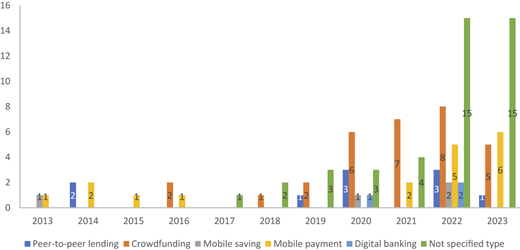
Regarding the Agri-FinTech type, more than a quarter of the selected papers discussed crowdfunding (28%), followed by mobile payments (18%). Figure 4 shows the distribution of Agri-FinTech type studies by year. Because many studies examined FinTech in general rather than specific types, the only clear trends are an increase in research on crowdfunding since 2018, and a growing interest in mobile payments since 2021.

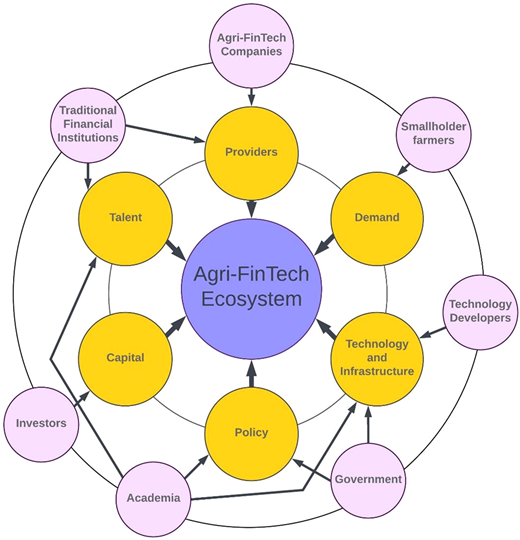
This review identified the roles of various actors in the development of Agri-FinTech. To visualise the linkages between actors and elements of the FinTech ecosystem that stimulate innovation in financial services for smallholder farmers, this study examines the Agri-FinTech ecosystem based on previous studies. In Figure 5, the yellow circles show the six elements of the ecosystem, while the pink circles are the actors. The actors in the “providers” element are Agri-FinTech companies, which act as providers of technology-based financial services; smallholder farmers are the users of FinTech. The government has several roles, including as policy maker and provider of FinTech infrastructure. Furthermore, investors provide capital that enables farmers to fund production.

The remaining actors operate across multiple elements of the ecosystem rather than within a single category. Traditional financial institutions function as both “providers” and “talent”, directly delivering FinTech services while also contributing financial services expertise, for instance, in innovative credit scoring. Technology developers contribute primarily to the “technology and infrastructure” element by designing and deploying the underlying enabling technologies (e.g. blockchain). Academia also operates across three elements of the ecosystem. Academia's contribution to the “technology and infrastructure” element lies in producing the scholarly and applied research that underpins these enabling technologies. Its role in the “talent” element, in turn, is to train the skilled human capital who staff Agri-FinTech firms and supporting institutions. Within the “policy” element, academia supports evidence-based policymaking by generating the empirical evidence on which effective Agri-FinTech regulation and public programmes can be designed. The synthesis described in the following sub-sections is organised around these identified actors.

4.2.1 Agri-FinTech companies

Agri-FinTech companies are key financial intermediaries in the agricultural financial landscape, particularly in providing technology-enabled innovative financing models, including crowdfunding and peer-to-peer lending (Afandi et al., 2021; Azganin et al., 2021a, b; Jaenudin and Hendratmi, 2023; Omwansa et al., 2013; Saiti et al., 2018; Sylla, 2023; Thaker et al., 2020; Yuzaria et al., 2020). These models are designed to bridge the credit gap in agriculture by offering alternative sources of capital outside traditional banking. These include those based on Islamic principles, such as waqf crowdfunding (WCM) (Azganin et al., 2021a), Islamic peer-to-peer crowdfunding (IP2PC) in Malaysia (Azganin et al., 2021b), muzara'ah-based crowdfunding in Mali (Sylla, 2023), and salam-based crowdfunding in Afghanistan (Saiti et al., 2018). These Islamic crowdfunding models aim to expand Agri-FinTech adoption—particularly crowdfunding—in predominantly Muslim countries. Another crowdfunding model is the Integrated Agricultural Land Fundraising Model (IALCM) in Indonesia (Thaker et al., 2020), in which the government participates through the selection and shortlisting of farmers' work plans to obtain funding from crowdfunders.

Studies on Agri-FinTech companies have also adopted a case study approach, including of TernAkses (Afandi et al., 2021), i-Ternak (Yuzaria et al., 2020), and Ternaknesia (Jaenudin and Hendratmi, 2023) in Indonesia, and M-Pesa in Kenya (Omwansa et al., 2013). The TernAkses platform offers two investment options: livestock capital investment and livestock-raising services. Investors share in the profits from livestock sales based on the type of investment. During the investment period, investors can monitor the progress and prospects of the livestock farm via the web and email. Overall, the relationship between the two parties creates an ecosystem in which investors provide capital while farmers gain access to funding. Meanwhile, i-Ternak and Ternakesia only provide funding investment options and do not offer livestock-raising services. However, the three platforms share similar business characteristics. In contrast, the M-Pesa case study concluded that sustainable mobile money savings products are essential to improve farmers' welfare.

4.2.2 Smallholder farmers

The selected studies address smallholder farmers' demand for Agri-FinTech services. A study in Madagascar found that female farmers differed from male farmers in terms of instalment payments, distance travelled to service providers' offices, and FinTech service transaction costs (Wahbi et al., 2023). Meanwhile, a case in Southern Nigeria found that female smallholder farmers who accessed FinTech earned higher incomes and had more savings than those without access to FinTech (Chinelo and Ayodeji, 2023). In Ghana, mobile phone-based saving appeared to benefit female farmers in particular, in contrast to male farmers (Possner et al., 2022).

Based on the findings of the systematic literature review, there are challenges in developing Agri-FinTech for smallholder farmers. Parlasca et al. (2022) found limited usage of FinTech for agricultural purposes among farmers, such as mobile payments and mobile banking loans. This pattern of limited usage reflects farmers' unfamiliarity with FinTech and their sense of insecurity when using digital financial platforms (Jaiswal et al., 2022; Suasih et al., 2022). Low financial and digital literacy is another contributing factor, partly because information about FinTech, especially through the internet, reaches farmers unevenly due to the rural–urban digital divide (Suasih et al., 2022). Farmers' uptake of FinTech is also constrained by their access to ICT infrastructure, including the internet (Filimonova et al., 2019).

4.2.3 Government

The systematic review found very limited existing research on Agri-FinTech policy. One of these studies discussed the impact of FinTech policy support on the development of agricultural industrialisation (Wang et al., 2021). The authors highlighted the need for policies to increase support for e-commerce financing, expand the scope of mobile financing, and supervise the agriculture industrialisation system (Wang et al., 2021). Another study discussed the need for policies to expand the role of non-bank financial intermediaries to foster ICT-based financial innovation, especially FinTech for farmers (Nkala, 2023). Therefore, regulators should focus on creating an enabling environment for digital financing of agriculture while closely supervising the delivery of financial services.

4.2.4 Traditional financial institutions

Traditional financial institutions (e.g. banks) play a part in the Agri-FinTech ecosystem. Since individuals with access to bank services are more likely to use financial technology, farmers, who often lack such access, remain the least likely group to adopt FinTech (Song et al., 2023). To improve financial service accessibility for borrowers with limited credit documentation, several studies have considered linking FinTech to alternative banking services. One study argued that a potential solution is FinTech-based Islamic banking to provide interest-free loans (Maryam and Ahamad, 2021). However, others positioned FinTech as an alternative to conventional banking services. For instance, farmers without bank accounts can use a simple P2P mobile payment for money transfers (Szopinski and Staniewski, 2014).

4.2.5 Investors

Investors play an integral part in the Agri-FinTech ecosystem by providing capital. Studies have found that investors prefer low-risk projects (Du, 2022; Mardhiyyah et al., 2020), short-term loans (Du, 2022; Mardhiyyah et al., 2020; Tong and Xiao, 2019), low interest rates (Tong and Xiao, 2019), and small investment amounts (Du, 2022). Further, a study found that investors tend to prefer female farmers over male farmers as women are perceived to be more competent in managing finances (Tong and Xiao, 2019). Furthermore, early-stage crowdfunding supporters are positively influenced by people, product, and convenience dimensions, whereas cost discourages contribution (Du, 2023). Investors' decision speed in crowdfunding is shortened by good product reputation, publicity, reasonable returns, low investment threshold, and additional benefits (Li et al., 2020). The crowdfunding platform's website interface and responsiveness also influence investor satisfaction (Portus and Flores, 2017).

4.2.6 Technology developers

Existing research on technology developers has discussed blockchain, Internet of Things (IoT), and near-field communication (NFC) technologies. Blockchain-based crowdfunding has the potential to increase investor trust and to help identify which project investments are most beneficial (Rashmitha et al., 2022). Blockchain technology can also strengthen credit systems, reduce information asymmetry, smooth information channels, improve transaction reliability and efficiency, and lower financing costs (Zhang, 2020). For IoT, a FinTech-based approach to designing and assessing IoT systems (FINDEAS) has been developed to identify IoT-based smart agricultural systems that are efficient, safe, affordable, and responsive to farmers' needs (Polymeni et al., 2022). Improving transaction security through blockchain technology and IoT is expected to increase farmers' trust in using FinTech. NFC has been developed to overcome poor internet connectivity and the absence of conventional banks in rural areas, supporting applications such as online payment (Imbachi et al., 2015). Integrating technologies is expected to improve the efficiency and accessibility of FinTech.

4.2.7 Academia

Most of the studies selected in this systematic review were conducted by university researchers from various academic disciplines. Many articles were written by researchers affiliated with economics schools (Fang, 2022; Jaiswal et al., 2022; Lian et al., 2023; Song et al., 2023), business schools (Amin and Li, 2014; Septiani et al., 2020; Thaker et al., 2020), finance schools (Aisaiti et al., 2019; Liu et al., 2022), and management schools (He and He, 2022; Li et al., 2020; Xue and Li, 2022). Others were from agriculture schools (Filimonova et al., 2019; Lin et al., 2022; Wang et al., 2022a). In addition, researchers from information technology schools have also conducted studies (Desabathina et al., 2022; Omwansa et al., 2013; Ong et al., 2023). This indicates that Agri-FinTech as a research field has drawn scholars from various backgrounds.

The systematic literature review found three studies that used the Technology Acceptance Model (TAM) (Davis, 1989) to determine the drivers of Agri-FinTech adoption. In Bangladesh, job relevance was a determinant of perceived benefits, and self-efficacy served as a determinant of ease of use, which influenced the intention to adopt Agri-FinTech (Amin and Li, 2014). In China, job relevance was also found to be a determinant of perceived benefits, while product innovation and self-efficacy were determinants of relative advantage and Agri-FinTech's ease of use, respectively (Amin and Li, 2014). In a Brazilian context, Malaquias and Silva (2020) found that ease of use, perceived benefits and trust were each significantly and positively associated with FinTech adoption among farmers. Social influence, in contrast, exhibited a negative association with FinTech use, diverging from the positive relationship reported by Amin et al. (2014).

Other studies on Agri-FinTech adoption factors used the Unified Theory of Technology and Acceptance (UTAUT) (Venkatesh et al., 2003, 2012). Maryam et al. (2023) concluded that benefit expectations, effort expectations, perceived credibility, anxiety, and consumer innovation influenced the adoption of FinTech in the agriculture sector. Another study revealed that social influence, facilitating conditions, habits, effort expectations, and epistemic value affected farmers' intention to use FinTech (Ong et al., 2023). Septiani et al. (2020) concluded that effort expectation, social influence, hedonic motivation, price value, habit, perceived risk, basic values, and trust influenced farmers' willingness to adopt Agri-FinTech.

Agri-FinTech development can also be influenced by project characteristics. For crowdfunding, its success is shaped by the funding rationale (Du, 2022), fund usage plan (Du, 2022), funding target (Chang, 2018; Du, 2022; Ljumović et al., 2021), the product qualification certificate (Du, 2023) and the number of investors (Chang, 2018). Collaboration, organisational leadership capabilities, and assurance of quantity and quality of agricultural products also influence the success of Agri-FinTech projects (Xue and Li, 2022). Knowledge management capabilities have also been identified as critical (Cillo et al., 2019). Shared responsibility through self-selected farmer groups can therefore help mitigate the risk of project failure (Pratiwi, 2023). Equally important to increasing the uptake of Agri-FinTech is ensuring access to an internet connection (Filimonova et al., 2019).

Innovation in credit scoring is another potential driver of Agri-FinTech development. The review found two studies on designing online credit risk evaluation for farmers (Rao et al., 2020a, b). The credit scoring models proposed in the two studies used an indexing approach related to smallholder farmers' financial history, such as their annual income, annual expenditure, land contract, and planting scale.

The review identified that Agri-FinTech produces effects related to smallholder farmers at multiple levels, including at the farming household level, the community level and the general agriculture sector level (see  Appendix 2). At the household level, Agri-FinTech has proven to have the potential to increase income, consumption, economic resilience, and women's access to financial services. For example, research in China by Wang et al. (2023) shows that P2P lending platforms significantly increased farmers' income. At the community level, FinTech contributes to poverty alleviation and the reduction of income inequality, as demonstrated by research in Tanzania (Kilombele et al., 2023) and China (Wang et al., 2022b; Wang and Fu, 2022). At the agriculture sector level, the impacts have been more widespread, including improvements in agricultural productivity (Musa et al., 2023; Shen et al., 2023), agribusiness digitalisation (Liu et al., 2023), and decarbonisation (Liu and Ren, 2023). Some studies also indicate the potential of FinTech to reduce dependence on conventional financial institutions (Azcárate et al., 2023) and to promote agricultural export growth (Kere and Zongo, 2023). Through this categorisation, it is evident that Agri-FinTech provides economic, social, and environmental benefits.

Furthermore, a growing body of research has examined FinTech adoption's environmental benefits. FinTech can help reduce carbon emissions by enabling entrepreneurship and agricultural technology innovation (Chang, 2022; Liu and Ren, 2023). A more nuanced finding emerges from Jiang et al. (2019), who posited an inverted “U”-shaped relationship between FinTech use and agricultural pollution, meaning that FinTech development after crossing a particular “threshold value” would curb pollution in underdeveloped areas. However, the authors also argued that this is not the case in countries where agriculture is already developed (Jiang et al., 2019). Lin et al. (2022), in contrast, contended instead that pollution reduction increases alongside Agri-FinTech development. Regarding sustainable agricultural practices (SAP), empirical research has concluded that the use of Agri-FinTech significantly increased SAP adoption by reducing credit constraints. This encouraged investment in SAP implementation, provided production and marketing information, reduced information search costs, and promoted social interaction among farmers, thereby facilitating the dissemination of production information (Zhao et al., 2022b).

Regarding the gender dimension, Gichuki and Kamau (2022) concluded that female farmers produce smaller harvests because limited land ownership restricts their access to credit, and identified FinTech as one potential solution. Wahbi et al. (2023) confirmed the lack of financial inclusion of women and stated that FinTech could improve this situation, given its ease of use and affordability. Further, Chinelo and Ayodeji (2023) found that female farmers who accessed FinTech products had higher incomes and savings than those who did not. These studies suggest that female smallholder farmers' access to credit differed from that of males, resulting in lower production and income levels.

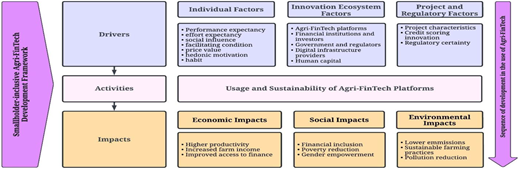
Having synthesising the current research on Agri-FinTech, a conceptual framework is proposed, as shown in Figure 6. This framework is specifically developed to explain the adoption and sustainable use of digital financial technology in the agricultural sector (Agri-FinTech), particularly among smallholder farmers.

The Agri-FinTech framework in Figure 6 illustrates a systemic approach to the development of financial technology in the agriculture sector. This framework emphasises the importance of multi-dimensional integration to create sustainable agricultural system transformation (High Level Panel of Experts on Food Security and Nutrition of the Committee on World Food Security (HLPE), 2017). In this framework, Agri-FinTech serves as an instrument that can enhance farmers' access to finance and contribute to the transformation of the food system towards greater agricultural productivity and sustainability.

The framework structure uses causal pathway logic and emphasises that change occurs through a series of measurable and traceable outcomes following the theory of change (TOC) (Connell and Kubisch, 1998; Fullbright-Anderson et al., 1998; Taplin et al., 2013). Individual factors, innovation ecosystems, and regulatory project factors are “drivers” that serve as preconditions for initiating change and determining the success of Agri-FinTech implementation. Beyond individual-level factors, project characteristics, credit-scoring innovation, and adequate regulatory certainty also significantly shape technology adoption (Chang, 2018; Du, 2022; Rao et al., 2020a). The project-related factors are considered important because they influence investors' and farmers' decisions to use Agri-FinTech platforms, particularly in crowdfunding and peer-to-peer lending, both of which are rapidly growing in various countries.

The innovation ecosystem—comprising farmer platforms, Agri-FinTech companies, academia, technology developers, traditional financial institutions, investors, and the government—consists of actors that collaborate to implement FinTech in the agricultural sector in line with the High Level Panel of Experts on Food Security and Nutrition of the Committee on World Food Security (High Level Panel of Experts on Food Security and Nutrition of the Committee on World Food Security (HLPE), 2017) framework. These elements create conditions that support the use of financial technology in agriculture. Furthermore, “activities” that focus on the use and sustainability of Agri-FinTech platforms represent the implementation stage of the TOC.

The impacts of this framework, spanning economic, social, and environmental dimensions, demonstrate a commitment to multi-dimensional results (High Level Panel of Experts on Food Security and Nutrition of the Committee on World Food Security (HLPE), 2017). In addition, the implementation of activities based on drivers is expected to encourage the use of FinTech technologies not only at the outset but also sustainably. This sustainable adoption will generate various positive impacts in three main sustainability dimensions, namely economic impacts (increased agricultural productivity, increased farmer income, and easier access to capital), social impacts (increased financial inclusion especially for women, reduced poverty, and reduced socio-economic inequality), and environmental impacts (reduced carbon emissions, increased adoption of sustainable agricultural practices, and decreased pollution due to agricultural activities) (Jiang et al., 2019; Kilombele et al., 2023; Liu and Ren, 2023; Wang et al., 2023). Assumptions across these various levels of impact must be continuously monitored to ensure that the use of Agri-FinTech achieves the expected results (Taplin et al., 2013). Thus, this Agri-FinTech framework offers an operational roadmap for achieving sustainable agriculture through financial technology innovation, mapping how initial conditions (drivers) are translated into actions (activities) that ultimately deliver financial access, agricultural productivity, and environmental sustainability.

The results of the systematic review suggest five priority topics for further research. First, only six of the reviewed studies addressed Agri-FinTech adoption factors, indicating a notable research gap. Therefore, future studies should more comprehensively examine the factors influencing smallholder farmers to utilise FinTech, drawing on other theories or methodologies. A gender focus is also critical, given the differences in access to assets, technology, and training opportunities between male and female farmers, which contribute to gendered differences in FinTech adoption.

Second, a topic not addressed in any of the reviewed articles is how to introduce FinTech to smallholder farmers for the first time. Many developing countries' farmers are older and less educated, and unfamiliar technologies pose a particular challenge for these farmers. Future research must therefore critically examine effective strategies for communicating FinTech benefits to this group.

Third, farmers' perceptions of the reasons for using, not using or discontinuing use of FinTech have not been thoroughly scrutinised. Such research is critical to ensuring inclusive, demand-led FinTech development in agriculture. Farmers' willingness to use FinTech, and their views on FinTech product attributes that influence their adoption decision, their understanding of the investments required to acquire FinTech technology, and the expected benefits they will gain from FinTech use compared to alternative financing services remain understudied. Accordingly, future studies should explore approaches such as discrete choice experiments to identify FinTech attributes that matter most to smallholder farmers. Research on the costs involved in using FinTech is also important. Therefore, ex-ante cost-benefit analyses (CBA) are relevant to determining the net benefits of FinTech to farmers.

Fourth, none of the 107 primary studies reviewed provided details on FinTech regulations in the agriculture sector. To ensure inclusivity, future studies should evaluate whether there is a rational basis for public policy intervention in FinTech development. To inform appropriate policy design, ex-ante CBA can complement this work by identifying unintended consequences and the distribution of benefits and costs.

Fifth, there is limited research on green Agri-FinTech articles among the articles selected for this review. Some of these articles concluded that FinTech has the potential to reduce carbon emissions and increase the adoption of SAP. No study, however, included findings about the latest technologies (such as IoT, NFC, and blockchain), Agri-FinTech services, and environmental considerations (e.g. the impact of agricultural waste). Future research is also needed on how Agri-FinTech companies can offer services oriented toward environmental projects for investors.

This study makes an important contribution to the literature on Agri-FinTech development. Using the PRISMA framework, the study systematically reviewed the international literature on Agri-FinTech and analysed 107 articles published between 2013 and October 2023. The findings reveal that although FinTech has revolutionised the global financial sector, its application in the agriculture sector is not yet mature, especially in developing countries. In addition, this study proposes a new framework that provides an operational roadmap for achieving sustainable agriculture through financial technology innovation.

The synthesis of the systematic literature review highlighted the following key findings. First, nearly a third of the studies discuss crowdfunding, and nearly half of these were conducted in China. Second, collaboration among actors in the Agri-FinTech ecosystem is key to driving inclusive innovation in the agricultural finance sector. Third, important drivers influencing the use of Agri-FinTech include the characteristics of funded projects, adequate infrastructure, technologies, and innovations in credit scoring. Fourth, the results demonstrate the positive impact of FinTech on farmer households, communities, and the agricultural sector. Fifth, this study proposes a smallholder-inclusive Agri-FinTech development framework to explain the adoption and sustainable use of Agri-FinTech. This framework describes a collaborative ecosystem among farmers, Agri-FinTech companies, traditional financial institutions, technology developers, academia, investors, and governments to achieve financial inclusivity. The framework also outlines strategic steps to scale up Agri-FinTech adoption. Overall, this framework encompasses the provision of digital financial services, the promotion of sustainable use, and improved financial access for smallholder farmers.

This systematic review research identifies several avenues for future research. Research on the adoption of FinTech by smallholder farmers remains limited, necessitating the expansion of theoretical and methodological approaches, including the integration of gender perspectives. Future work should also formulate effective strategies for introducing FinTech to older or less educated farmers and examine smallholder preferences for Agri-FinTech characteristics that may encourage adoption, using methods such as discrete choice experiments (DCE) and cost-benefit analysis (CBA). At the regulatory level, contextual Agri-FinTech policy studies are important to ensuring inclusiveness. The research agenda also needs to integrate the latest technological findings, Agri-FinTech services, and environmental considerations.

Several caveats apply when interpreting these results. First, the literature search was conducted in October 2023, excluding more recent research. Given the rapidly evolving nature of the FinTech industry, the relevance of this study's findings to the latest FinTech context must be considered. Second, most of the documents reviewed were peer-reviewed articles while many privately published paid consultancy reports were not accessible. Therefore, insights from the private sector are limited. Nevertheless, this study contributes to the limited body of literature reviewing FinTech development in the agricultural sector. This contribution is timely, given the growing global interest in FinTech and digital transformation across the agriculture sector.

In writing this article, the authors used Grammarly to improve the readability and linguistic quality. After using this tool, the authors reviewed and edited the content as necessary and take full responsibility for the content of the published article.

Afandi
,
M.
,
Khusaini
,
M.
,
Nuphanudin
,
N.
,
Purwanto
,
H.
and
Prakoso
,
K.
(
2021
), “
TernAkses: livestock investment based on crowdfunding through custodial services and millennial farms planning
”,
IOP Conference Series: Materials Science and Engineering
.
Aisaiti
,
G.
,
Liu
,
L.
,
Xie
,
J.
and
Yang
,
J.
(
2019
), “
An empirical analysis of rural farmers' financing intention of inclusive finance in China: the moderating role of digital finance and social enterprise embeddedness
”,
Industrial Management and Data Systems
, Vol. 
119
No. 
7
, pp. 
1535
-
1563
, doi: .
Amin
,
M.
and
Li
,
J.
(
2014
), “
Applying farmer technology acceptance model to understand farmer's behavior intention to use ICT based microfinance platform: a comparative analysis between Bangladesh and China
”,
The Thirteenth Wuhan International Conference on E-Business
.
Amin
,
M.
,
Li
,
J.
and
Huang
,
Q.
(
2014
), “
An analysis of the technology acceptance model in understanding Chinese farmers' behavioral intention to use P2P microfinance platform
”,
International Conference on Economics and Management
.
Anjani
,
H.
and
Waluyati
,
L.
(
2022
), “
Partnership of melon farmers in Yogyakarta with startup-agritech P2P lending company, is it beneficial?
”,
Jurnal Agribest
, Vol. 
6
No. 
1
, pp. 
37
-
46
.
Arner
,
D.
,
Barberis
,
J.
and
Buckley
,
R.
(
2016
), “
The evolution of fintech: a new post-crisis paradigm?
”,
Georgetown Journal of International Law
, Vol. 
47
No. 
4
, p.
1271
,
available at:
 Link to the website
Azcárate
,
M.
,
Cruz-Maceín
,
J.
and
Bardají
,
I.
(
2023
), “
Crowdfarming. A public-private crowdfunding campaign to finance sustainable local food systems: a case study of short food supply chains in Madrid
”,
New Medit
, Vol. 
22
No. 
3
, pp.
107
-
126
,
available at:
 Link to the website
Azganin
,
H.
,
Kassim
,
S.
and
Sa'ad
,
A.
(
2021a
), “
Proposed waqf crowdfunding models for small farmers and the required parameters for their application
”,
Islamic Economic Studies
, Vol. 
29
No. 
1
, pp. 
2
-
17
, doi: .
Azganin
,
H.
,
Kassim
,
S.
and
Saad
,
A.
(
2021b
), “
Islamic P2P crowdfunding (IP2PC) platform for the development of paddy industry in Malaysia: an operational perspective
”,
Journal of Islamic Finance
, Vol. 
10
No. 
1
, pp. 
65
-
75
, doi: .
Batista
,
C.
and
Vicente
,
P.
(
2020
), “
Improving access to savings through mobile money: experimental evidence from African smallholder farmers
”,
World Development
, Vol. 
129
, 104905, doi: .
Bettinger
,
A.
(
1972
), “
FINTECH: a series of 40 time shared models used at manufacturers Hanover trust company
”,
Interfaces (Providence)
, Vol. 
2
No. 
4
, pp. 
62
-
63
.
Chang
,
W.-I.
(
2018
), “
Exploring crowdfunding performance of agricultural ventures: evidence from flyingv in Taiwan
”,
E-Infrastructure and E-Services for Developing Countries: 8th International Conference, AFRICOMM 2016, Ouagadougou, Burkina Faso, December 6-7, 2016, Proceedings 8
.
Chang
,
J.
(
2022
), “
The role of digital finance in reducing agricultural carbon emissions: evidence from China's provincial panel data
”,
Environmental Science and Pollution Research
, Vol. 
29
No. 
58
, pp. 
87730
-
87745
, doi: .
Chen
,
B.
and
Ren
,
J.
(
2022
), “
Does the adoption of digital payment improve the financial availability of farmer households? Evidence from China
”,
Agriculture
, Vol. 
12
No. 
9
, 1468, doi: .
Chinelo
,
U.
and
Ayodeji
,
E.
(
2023
), “
Leveraging on digital technology for financial inclusion of women agripreneurs in Southern Nigeria
”,
F1000Research
, Vol. 
11
, p.
704
, doi: .
Cillo
,
V.
,
Rialti
,
R.
,
Bertoldi
,
B.
and
Ciampi
,
F.
(
2019
), “
Knowledge management and open innovation in agri-food crowdfunding
”,
British Food Journal
, Vol. 
121
No. 
2
, pp. 
242
-
258
, doi: .
Connell
,
J.
and
Kubisch
,
A.
(
1998
), “
Applying a theory of change approach to the evaluation of comprehensive community initiatives: progress, prospects, and problems
”,
New approaches to evaluating community initiatives
, Vol. 
2
Nos
15-44
, pp. 
1
-
16
.
Dannenberg
,
P.
and
Lakes
,
T.
(
2014
), “
The use of mobile phones by Kenyan export-orientated small-scale farmers: insights from fruit and vegetable farming in the Mt. Kenya region
”,
Economia Agro-Alimentare
, No. 
3
, pp.
55
-
75
, doi: .
Davis
,
F.
(
1989
), “
Perceived usefulness, perceived ease of use, and user acceptance of information technology
”,
MIS Quarterly
, Vol. 
13
No. 
3
, pp. 
319
-
340
, doi: .
Denyer
,
D.
and
Tranfield
,
D.
(
2009
), “Producing a systematic review”, in
The Sage Handbook of Organizational Research Methods
, pp.
671
-
689
.
Desabathina
,
N.
,
Merugu
,
S.
,
Gunjan
,
V.
and
Kumar
,
B.
(
2022
), “
Agricultural crowdfunding through blockchain
”,
ICDSMLA 2020: Proceedings of the 2nd International Conference on Data Science, Machine Learning and Applications
.
Diemers
,
D.
,
Lamaa
,
A.
,
Salamat
,
J.
and
Steffens
,
T.
(
2015
), “
Developing a FinTech ecosystem in the GCC
”,
Strategy
, pp.
1
-
16
.
Du
,
J.
(
2022
), “
Project attribute information and initiator's commitment in crowdfunding message strategy: an empirical investigation of financing performance in agri-food crowdfunding
”,
Sustainability
, Vol. 
14
No. 
19
, 12702, doi: .
Du
,
J.
(
2023
), “
Rational or impulsive? Early backers' investment behavior in agri-food crowdfunding from 4P–4C perspectives
”,
Sage Open
, Vol. 
13
No. 
3
, 21582440231193353, doi: .
Fang
,
X.
(
2022
), “
Why we hide good deeds? The selfless and anonymous donation behavior in crowdfunding
”,
Technology in Society
, Vol. 
71
, 102144, doi: .
Farstad
,
M.
and
Hårstad
,
R.
(
2022
), “
Crowdfunding of GHG mitigation measures in agriculture: a feasible contribution to the climate challenges? Sociocultural constraints and enablers in Norway
”,
Geografisk Tidsskrift-Danish Journal of Geography
, Vol. 
122
No. 
2
, pp. 
117
-
128
, doi: .
Filimonova
,
N.
,
Ozerova
,
M.
,
Ermakova
,
I.
and
Miheeva
,
N.
(
2019
), “
Crowdfunding as the way of projects financing in agribusiness
”,
IOP Conference Series: Earth and Environmental Science
.
Frampton
,
G.
,
Livoreil
,
B.
and
Petrokofsky
,
G.
(
2017
), “
Eligibility screening in evidence synthesis of environmental management topics
”,
Environmental Evidence
, Vol. 
6
No. 
1
, pp. 
1
-
13
, doi: .
Fullbright-Anderson
,
K.
,
Kubisch
,
A.
and
Connell
,
J.
(
1998
),
New Approaches to Evaluating Community Initiatives: Theory
,
Measurement, and Analysis
, Vol. 
2
,
Aspen Institute
,
Queenstown
.
Gao
,
X.
and
Gao
,
R.
(
2024
), “
A study of the impact of digital financial inclusion on the resilience of the agricultural chain
”,
Frontiers in Sustainable Food Systems
, Vol. 
8
, 1448550, doi: .
Gichuki
,
C.
and
Kamau
,
C.
(
2022
), “
Financing agribusiness: potential determinants of financial inclusion for smallholder rural farming communities in Kenya
”,
International Journal of Rural Management
, Vol. 
18
No. 
3
, pp. 
376
-
393
, doi: .
Guo
,
X.
,
Wang
,
L.
,
Meng
,
X.
,
Dong
,
X.
and
Gu
,
L.
(
2023
), “
The impact of digital inclusive finance on farmers' income level: evidence from China's major grain production regions
”,
Finance Research Letters
, Vol. 
58
, 104531, doi: .
He
,
Q.
and
He
,
J.
(
2022
), “
Analysis of the path to solve the rural financing problem based on ‘agricultural big Data+ Financial Technology’
”,
Optik
, 170340, doi: .
High Level Panel of Experts on Food Security and Nutrition of the Committee on World Food Security (HLPE)
(
2017
),
Nutrition and food systems
,
A report by the high level panel of experts on food security and nutrition of the committee on world food security
.
Hua
,
X.
,
Huang
,
Y.
and
Zheng
,
Y.
(
2019
), “
Current practices, new insights, and emerging trends of financial technologies
”,
Industrial Management and Data Systems
, Vol. 
119
No. 
7
, pp. 
1401
-
1410
, doi: .
Hudaefi
,
F.A.
,
Hassan
,
M.K.
and
Abduh
,
M.
(
2023
), “
Exploring the development of Islamic fintech ecosystem in Indonesia: a text analytics
”,
Qualitative Research in Financial Markets
, Vol. 
15
No. 
3
, pp.
514
-
533
, doi: .
Im
,
H.
and
Yoon
,
T.
(
2021
), “Improving financial accessibility of small and medium-sized enterprises through fintech”, in
Investment in Startups and Small Business Financing
,
World Scientific Publishing
, pp. 
331
-
365
, doi: .
Imbachi
,
J.
,
Jacome
,
D.
and
González
,
G.
(
2015
), “
Mobile payments system employing NFC technology under the Android operating system
”,
Sistemas and Telemática
, Vol. 
13
No. 
33
, pp. 
77
-
87
.
Jaenudin
,
M.
and
Hendratmi
,
A.
(
2023
), “
Risk management of Islamic crowdfunding livestock-based in Indonesia: the case study at Ternaknesia farm innovation
”,
4th International Conference on Islamic Economics, Business, Philanthropy, and PhD Colloqium (ICIEBP 2022)
.
Jaiswal
,
R.
,
Seth
,
V.
and
Kasera
,
M.
(
2022
), “
Digital banking innovations improving financial access for agribusiness sector in emerging economies
”,
ECS Transactions
, Vol. 
107
No. 
1
, pp. 
11755
-
11764
, doi: .
Jiang
,
S.
,
Qiu
,
S.
,
Zhou
,
H.
and
Chen
,
M.
(
2019
), “
Can fintech development curb agricultural nonpoint source pollution?
”,
International Journal of Environmental Research and Public Health
, Vol. 
16
No. 
22
, 4340, doi: .
Kanagavalli
,
G.
,
Manida
,
M.
,
Kumar
,
R.
and
Arulmozhi
,
S.
(
2021
), “
Fin-tech in Indian agricultural sector
”,
Empirical Economics Letters
, Vol. 
20
, pp.
118
-
125
.
Kere
,
S.
and
Zongo
,
A.
(
2023
), “
Digital technologies and intra-African trade
”,
International Economics
, Vol. 
173
, pp. 
359
-
383
, doi: .
Kikulwe
,
E.
,
Fischer
,
E.
and
Qaim
,
M.
(
2013
),
Mobile Money, Market Transactions, and Household Income in Rural Kenya
,
GlobalFood Discussion Papers
.
Kilombele
,
H.
,
Feleke
,
S.
,
Abdoulaye
,
T.
,
Cole
,
S.
,
Sekabira
,
H.
and
Manyong
,
V.
(
2023
), “
Maize productivity and household welfare impacts of mobile money usage in Tanzania
”,
International Journal of Financial Studies
, Vol. 
11
No. 
1
, p.
27
, doi: .
Koutsos
,
T.
,
Menexes
,
G.
and
Dordas
,
C.
(
2019
), “
An efficient framework for conducting systematic literature reviews in agricultural sciences
”,
Science of The Total Environment
, Vol. 
682
, pp. 
106
-
117
, doi: .
Lee
,
I.
and
Shin
,
Y.
(
2018
), “
Fintech: ecosystem, business models, investment decisions, and challenges
”,
Business Horizons
, Vol. 
61
No. 
1
, pp.
35
-
46
, doi: .
Lei
,
H.
and
Su
,
Q.
(
2023
), “
Does the use of digital finance affect household farmland transfer-out?
”,
Sustainability
, Vol. 
15
No. 
16
, 12103, doi: .
Li
,
Y.
and
Fang
,
Y.
(
2025
), “
Effect of digital finance on inclusive green growth through technological innovation
”,
Innovation and development
, Vol. 
15
No. 
1
, pp. 
133
-
152
, doi: .
Li
,
Y.
,
Du
,
J.
and
Fu
,
W.
(
2020
), “
Thirty days are enough: what determines the crowd's cash time in agri-food crowdfunding?
”,
China Agricultural Economic Review
, Vol. 
12
No. 
3
, pp. 
553
-
575
, doi: .
Li
,
F.
,
Zang
,
D.
,
Chandio
,
A.
,
Yang
,
D.
and
Jiang
,
Y.
(
2023a
), “
Farmers' adoption of digital technology and agricultural entrepreneurial willingness: evidence from China
”,
Technology in Society
, Vol. 
73
, 102253, doi: .
Li
,
H.
,
Lin
,
Q.
,
Wang
,
Y.
and
Mao
,
S.
(
2023b
), “
Can digital finance improve China's agricultural green total factor productivity?
”,
Agriculture
, Vol. 
13
No. 
7
, 1429, doi: .
Lian
,
X.
,
Mu
,
Y.
and
Zhang
,
W.
(
2023
), “
Digital inclusive financial services and rural income: evidence from China's major grain-producing regions
”,
Finance Research Letters
, Vol. 
53
, 103622, doi: .
Lin
,
Q.
,
Cheng
,
Q.
,
Zhong
,
J.
and
Lin
,
W.
(
2022
), “
Can digital financial inclusion help reduce agricultural non-point source pollution?—an empirical analysis from China
”,
Frontiers in environmental science
, Vol. 
10
, 2473, doi: .
Liu
,
J.
and
Ren
,
Y.
(
2023
), “
Can digital inclusive finance ensure food security while achieving low-carbon transformation in agricultural development? Evidence from China
”,
Journal of Cleaner Production
, Vol. 
418
, 138016, doi: .
Liu
,
Y.
,
Zhang
,
Y.
,
Zhang
,
Y.
and
Xiao
,
H.
(
2022
), “
Small business owners' Fintech credit in crises: theory and evidence from farmers under the COVID-19
”,
Pacific-Basin Finance Journal
, Vol. 
71
, 101692, doi: .
Liu
,
X.
,
Wang
,
X.
and
Yu
,
W.
(
2023
), “
Opportunity or challenge? Research on the influence of digital finance on digital transformation of agribusiness
”,
Sustainability
, Vol. 
15
No. 
2
, 1072, doi: .
Ljumović
,
I.
,
Pavlović
,
V.
and
Knežević
,
G.
(
2021
), “
Financing agri-food business in the Mediterranean area through crowdfunding: do environmental issues matter?
”,
New Medit
, No. 
3
, pp. 
101
-
117
.
Lyu
,
Z.
,
Jing
,
Z.
and
Yang
,
X.
(
2025
), “
Bridging the digital divide for sustainable agriculture: how digital adoption strengthens farmer livelihood resilience [Original Research]
”,
Frontiers in Sustainable Food Systems
, Vol. 
9
, 1628588, doi: .
Malaquias
,
R.
and
Silva
,
A.
(
2020
), “
Understanding the use of mobile banking in rural areas of Brazil
”,
Technology in Society
, Vol. 
62
, 101260, doi: .
Manta
,
O.
(
2018
), “
Financial technologies (FinTech), instruments, mechanisms and financial products
”,
Internal Auditing and Risk Management
, Vol. 
52
No. 
4
, pp. 
78
-
102
.
Mapanje
,
O.
,
Karuaihe
,
S.
,
Machethe
,
C.
and
Amis
,
M.
(
2023
), “
Financing sustainable agriculture in Sub-Saharan Africa: a review of the role of financial technologies
”,
Sustainability
, Vol. 
15
No. 
5
, 4587, doi: .
Mardhiyyah
,
Y.
,
Rasyidi
,
M.
and
Hidayah
,
L.
(
2020
), “
Factors affecting crowdfunding investor number in agricultural projects: the dummy regression model
”,
Jurnal Manajemen and Agribisnis
, Vol. 
17
No. 
1
, p.
14
.
Maryam
,
S.
and
Ahamad
,
A.
(
2021
), “
Use of financial technology for agricultural financing through Islamic financial institutions
”,
International Journal of Business and Economic Affairs
, Vol. 
6
No. 
6
, pp. 
1
-
10
, doi: .
Maryam
,
S.
,
Ahmed
,
A.
,
Haider
,
S.
and
Akhter
,
T.
(
2023
), “
Explicating the adoption of an innovation fintech value chain financing from Aarti (middlemen) perspective in Pakistan
”,
African Journal of Science, Technology, Innovation and Development
, Vol. 
15
No. 
4
, pp. 
429
-
439
, doi: .
Mei
,
B.
,
Khan
,
A.
,
Khan
,
S.
,
Ali
,
M.
and
Luo
,
J.
(
2022
), “
Complementarity or substitution: a study of the impacts of internet finance and rural financial development on agricultural economic growth
”,
Agriculture
, Vol. 
12
No. 
11
, 1786, doi: .
Musa
,
S.
,
Besar
,
M.
and
Anshari
,
M.
(
2023
), “
COVID-19, local food system and digitalisation of the agri-food sector
”,
Journal of Indian Business Research
, Vol. 
15
No. 
1
, pp. 
125
-
140
, doi: .
Ng
,
Y.
,
Muthukannan
,
P.
,
Tan
,
B.
and
Leong
,
C.
(
2017
), “
Fintech platform development: a revelatory case study of a Chinese microloan startup
”,
International Conference on Information Systems
.
Ningrat
,
R.
and
Nurzaman
,
M.
(
2019
), “
Developing fintech and Islamic finance products in agricultural value chain
”,
Journal of Islamic Monetary Economics and Finance
, Vol. 
5
No. 
3
, pp. 
491
-
516
, doi: .
Nkala
,
P.
(
2023
), “Exploring innovative and sustainable financing of agriculture in Zimbabwe's second republic”, in
Making Politics in Zimbabwe's Second Republic: The Formative Project by Emmerson Mnangagwa
,
Springer Nature Switzerland
,
Cham
, pp. 
239
-
262
.
Nour
,
R.
(
2022
), “
An assessment of accessibility and usability of Saudi online FinTech services for people with disabilities
”,
Computational and Mathematical Methods in Medicine
, Vol. 
2022
, 8610844, pp. 
1
-
9
, doi: .
Omwansa
,
T.
,
Waema
,
T.
,
Chen
,
C.
and
Sullivan
,
N.
(
2013
), “
The mobile phone as the tool to redefine savings for the poor: evidence from Kenya
”,
African Journal of Science, Technology, Innovation and Development
, Vol. 
5
No. 
5
, pp. 
355
-
361
, doi: .
Ong
,
M.
,
Yusri
,
M.
and
Ibrahim
,
N.
(
2023
), “
Use and behavioural intention using digital payment systems among rural residents: extending the UTAUT-2 model
”,
Technology in Society
, Vol. 
74
, pp.
1
-
11
.
Page
,
M.
,
McKenzie
,
J.
,
Bossuyt
,
P.
,
Boutron
,
I.
,
Hoffmann
,
T.
,
Mulrow
,
C.
,
Shamseer
,
L.
,
Tetzlaff
,
J.
,
Akl
,
E.
and
Brennan
,
S.
(
2021
), “
The PRISMA 2020 statement: an updated guideline for reporting systematic reviews
”,
International Journal of Surgery
, Vol. 
88
, 105906.
Pandey
,
S.
,
Kumar
,
P.
and
Gogia
,
J.
(
2025
), “
The role of financial technology in transforming agriculture
”,
International Journal of Research and Review
, Vol. 
12
No. 
9
, pp. 
378
-
385
, doi: .
Parlasca
,
M.
,
Johnen
,
C.
and
Qaim
,
M.
(
2022
), “
Use of mobile financial services among farmers in Africa: insights from Kenya
”,
Global Food Security
, Vol. 
32
, 100590, doi: .
Petticrew
,
M.
and
Roberts
,
H.
(
2008
),
Systematic Reviews in the Social Sciences: A Practical Guide
,
John Wiley & Sons
.
Polymeni
,
S.
,
Skoutas
,
D.
,
Kormentzas
,
G.
and
Skianis
,
C.
(
2022
), “
Findeas: a fintech-based approach on designing and assessing iot systems
”,
IEEE Internet of Things Journal
, Vol. 
9
No. 
24
, pp. 
25196
-
25206
, doi: .
Portus
,
A.J.A.
and
Flores
,
P.J.C.
(
2017
), “
Usability testing of an online farming investment website
”,
Advances in Ergonomics Modeling, Usability & Special Populations: Proceedings of the AHFE 2016 International Conference on Ergonomics Modeling, Usability and Special Populations
,
Walt Disney World®, Florida, USA
,
July 27-31, 2016
.
Possner
,
A.
,
Rosero
,
G.
and
Musshoff
,
O.
(
2022
), “
Saving on the phone-evidence from Ghanaian cocoa farmers
”,
The 96th Annual Conference of the Agricultural Economics Society
.
Pothula
,
S.R.
(
2023
),
The Role of Finance in Navigating Agriculture through Agri-FinTech
,
Authorea Preprints
.
Pratiwi
,
P.Y.
(
2023
), “
The impact of joint liability group lending on lowering the risk of farmer and agriculture crowdfunding in Indonesia
”,
International Journal of Rural Management
, Vol. 
19
No. 
1
, pp. 
130
-
148
, doi: .
Rao
,
C.
,
Lin
,
H.
and
Liu
,
M.
(
2020a
), “
Design of comprehensive evaluation index system for P2P credit risk of ‘three rural’ borrowers
”,
Soft Computing
, Vol. 
24
No. 
15
, pp. 
11493
-
11509
, doi: .
Rao
,
C.
,
Liu
,
M.
,
Goh
,
M.
and
Wen
,
J.
(
2020b
), “
2-stage modified random forest model for credit risk assessment of P2P network lending to ‘Three Rurals’ borrowers
”,
Applied Soft Computing
, Vol. 
95
, 106570, doi: .
Rashmitha
,
S.
,
Sanjay
,
H.
,
Shastry
,
K.A.
and
Laxmi
,
K.J.S.
(
2022
), “
FarmFund-a blockchain based crowdfunding app for farmers
”,
2022 7th International Conference on Communication and Electronics Systems (ICCES)
.
Rayhan
,
M.J.
,
Rahman
,
S.M.
,
Mamun
,
A.A.
,
Saif
,
A.N.M.
,
Islam
,
K.A.
,
Alom
,
M.M.
and
Hafiz
,
N.
(
2024
), “
FinTech solutions for sustainable agricultural value chains: a perspective from smallholder farmers
”,
Business Strategy and Development
, Vol. 
7
No. 
2
, e358, doi: .
Rothstein
,
H.R.
and
Hopewell
,
S.
(
2009
), “
Grey literature
”,
The handbook of research synthesis and meta-analysis
, Vol. 
2
, pp. 
103
-
125
.
Rufaidah
,
F.
,
Karyani
,
T.
,
Wulandari
,
E.
and
Setiawan
,
I.
(
2023
), “
A review of the implementation of financial technology (fintech) in the Indonesian agricultural sector: issues, access, and challenges
”,
International Journal of Financial Studies
, Vol. 
11
No. 
3
, p.
108
, doi: .
Saiti
,
B.
,
Afghan
,
M.
and
Noordin
,
N.H.
(
2018
), “
Financing agricultural activities in Afghanistan: a proposed salam-based crowdfunding structure
”,
ISRA International Journal of Islamic Finance
, Vol. 
10
No. 
1
, pp. 
52
-
61
, doi: .
Saraswati
,
B.D.
,
Maski
,
G.
,
Kaluge
,
D.
and
Sakti
,
R.K.
(
2022
), “
The impact of financial technology on consumption function of the theory of absolute income hypothesis: a partial adjustment model approach (the Indonesian evidence)
”,
Business: Theory and Practice
, Vol. 
23
No. 
1
, pp. 
109
-
116
, doi: .
Senyo
,
P.K.
,
Karanasios
,
S.
,
Gozman
,
D.
and
Baba
,
M.
(
2022
), “
FinTech ecosystem practices shaping financial inclusion: the case of mobile money in Ghana
”,
European Journal of Information Systems
, Vol. 
31
No. 
1
, pp.
112
-
127
, doi: .
Septiani
,
H.L.D.
,
Sumarwan
,
U.
,
Yuliati
,
L.N.
and
Kirbrandoko
,
K.
(
2020
), “
Understanding the factors driving farmers to adopt peer-to-peer lending sharing economy
”,
International Review of Management and Marketing
, Vol. 
10
No. 
6
, pp.
13
-
21
, doi: ,
available at:
 Link to the website
Shakhovskoy
,
M.
,
Colina
,
C.
and
Höök
,
M.C.
(
2019
),
Pathways to Prosperity: Rural and Agricultural Finance State of the Sector Report
,
ISF, Mastercard Foundation, Rural & Agricultural Finance Learning Lab
,
available at:
 Link to the website
Shen
,
Z.
,
Hong
,
T.
,
Blancard
,
S.
and
Bai
,
K.
(
2023
), “
Digital financial inclusion and green growth: analysis of Chinese agriculture
”,
Applied Economics
, Vol. 
56
No. 
46
, pp. 
1
-
19
, doi: .
Siddiqui
,
Z.
and
Rivera
,
C.A.
(
2022
), “
FinTech and FinTech ecosystem: a review of literature
”,
Risk Governance and Control: Financial Markets and Institutions
, Vol. 
12
No. 
1
, pp.
63
-
73
, doi: .
Song
,
N.
and
Appiah-Otoo
,
I.
(
2022
), “
The impact of fintech on economic growth: evidence from China
”,
Sustainability
, Vol. 
14
No. 
10
, 6211, doi: .
Song
,
K.
,
Tang
,
Y.
,
Zang
,
D.
,
Guo
,
H.
and
Kong
,
W.
(
2022
), “
Does digital finance increase relatively large-scale farmers' agricultural income through the allocation of production factors? Evidence from China
”,
Agriculture
, Vol. 
12
No. 
11
, 1915, doi: .
Song
,
K.
,
Wu
,
P.
and
Zou
,
S.
(
2023
), “
The adoption and use of mobile payment: determinants and relationship with bank access
”,
China Economic Review
, Vol. 
77
, 101907, doi: .
Statista
(
2025
), “
Number of fintechs worldwide from 2018 to 2024, by region
”,
available at:
 Link to the website
Stulz
,
R.M.
(
2019
), “
Fintech, bigtech, and the future of banks
”,
Journal of Applied Corporate Finance
, Vol. 
31
No. 
4
, pp. 
86
-
97
.
Suasih
,
N.
,
Budhi
,
M.
and
Wijaya
,
P.
(
2022
), “
Inclusive crowdfunding scheme as capital source alternative for rural agriculture in Indonesia
”,
IOP Conference Series: Earth and Environmental Science
.
Sylla
,
M.
(
2023
), “
Muzara’ah-Based crowdfunding for financing small farmers in Mali
”,
Journal of Islamic Economics
, Vol. 
3
No. 
1
, pp. 
31
-
45
, doi: .
Szopinski
,
T.
and
Staniewski
,
M. W.
(
2014
), “
Trends in the use of cyclical payment channels by Polish households: implications for e-banking
”,
Transformations in Business and Economics
, Vol. 
13
No. 
3
, pp.
235
-
250
.
Taherdoost
,
H.
(
2023
), “
Fintech: emerging trends and the future of finance
”,
Financial Technologies and DeFi: A Revisit to the Digital Finance Revolution
, pp. 
29
-
39
.
Taplin
,
D.H.
,
Clark
,
H.
,
Collins
,
E.
and
Colby
,
D.C.
(
2013
),
Theory of Change. Technical Papers: A Series of Papers to Support Development of Theories of Change Based on Practice in the Field
,
ActKnowledge
,
New York, NY
.
Thaker
,
H.M.T.
,
Khaliq
,
A.
,
Sakaran
,
K.C.
and
Thaker
,
M.A.M.T.
(
2020
), “
A discourse on the potential of crowdfunding and Islamic finance in the agricultural sector of East Java, Indonesia
”,
Jurnal Ekonomi and Keuangan Islam
, Vol. 
6
No. 
1
, pp.
10
-
23
, doi: .
Tong
,
Z.
and
Xiao
,
Y.
(
2019
), “
Research on factors influencing loan efficiency in rural internet financial market
”,
2019 International Conference on Economic Management and Model Engineering (ICEMME)
.
Tracxn
(
2024
),
Agri FinTech - Tracxn Feed Report
,
T. T., available at:
 Link to the website
Tracxn
(
2025
),
Agri FinTech - Tracxn Feed Report
,
T. T.
,
available at:
 Link to the website
Troise
,
C.
,
Tani
,
M.
,
Dinsmore
,
J.
 Jr
and
Schiuma
,
G.
(
2021
), “
Understanding the implications of equity crowdfunding on sustainability-oriented innovation and changes in agri-food systems: insights into an open innovation approach
”,
Technological Forecasting and Social Change
, Vol. 
171
, 120959, doi: .
Turyatemba
,
C.
,
Turyasingura
,
B.
,
Hamed
,
H.A.
,
Gweyi-Onyango
,
J.
and
Ayiga
,
N.
(
2023
), “
Reflections on promotion of digital payments among smallholder tea farmers in Kanungu district
”,
SVU-International Journal of Agricultural Sciences
, Vol. 
5
No. 
3
, pp. 
68
-
80
, doi: .
Venkatesh
,
V.
,
Morris
,
M.G.
,
Davis
,
G.B.
and
Davis
,
F.D.
(
2003
), “
User acceptance of information technology: toward a unified view
”,
MIS Quarterly
, Vol. 
27
No. 
3
, pp. 
425
-
478
, doi: .
Venkatesh
,
V.
,
Thong
,
J.Y.
and
Xu
,
X.
(
2012
), “
Consumer acceptance and use of information technology: extending the unified theory of acceptance and use of technology
”,
MIS Quarterly
, Vol. 
36
No. 
1
, pp. 
157
-
178
, doi: .
Wahbi
,
A.
,
Sarfo
,
Y.
and
Musshoff
,
O.
(
2023
), “
Female smallholder farmers’ preferences for digital and conventional credit attributes: evidence from Madagascar
”,
Agricultural Finance Review
, Vol. 
83
No. 
4-5
, pp.
549
-
571
, doi: .
Walport
,
M.
(
2015
),
FinTech Futures: The UK as a World Leader in Financial Technologies
,
Report to UK Government Office for Science
.
Wang
,
X.
and
Fu
,
Y.
(
2022
), “
Digital financial inclusion and vulnerability to poverty: evidence from Chinese rural households
”,
China Agricultural Economic Review
, Vol. 
14
No. 
1
, pp. 
64
-
83
, doi: .
Wang
,
Y.
,
Wang
,
X.
,
Zhang
,
W.
,
Zheng
,
K.
and
Fu
,
X.
(
2021
), “
Comprehensive analysis of risk factors in Internet agricultural finance based on neural network model
”,
Journal of Intelligent and Fuzzy Systems
, Vol. 
40
No. 
4
, pp. 
6593
-
6604
, doi: .
Wang
,
J.
,
Yu
,
X.
,
Lyu
,
K.
and
Feil
,
J.-H.
(
2022a
), “
The impact of mobile finance use on livelihoods of farmers in Rural China
”,
Emerging Markets Finance and Trade
, Vol. 
58
No. 
10
, pp. 
2867
-
2879
, doi: .
Wang
,
L.
,
Chen
,
Y.
and
Ding
,
S.
(
2022b
), “
Examining the Impact of digital finance on farmer consumption inequality in China
”,
Sustainability
, Vol. 
14
No. 
20
, 13575, doi: .
Wang
,
Y.
,
Weng
,
F.
and
Huo
,
X.
(
2023
), “
Can digital finance promote professional farmers' income growth in China?—an examination based on the perspective of income structure
”,
Agriculture
, Vol. 
13
No. 
5
, 1103, doi: .
Wang
,
C.a.
,
Wang
,
L.
,
Zhao
,
S.
,
Yang
,
C.
and
Albitar
,
K.
(
2024
), “
The impact of Fintech on corporate carbon emissions: towards green and sustainable development
”,
Business Strategy and the Environment
, Vol. 
33
No. 
6
, pp. 
5776
-
5796
, doi: .
Wu
,
X.
,
Tu
,
J.
,
Liu
,
B.
,
Zhou
,
X.
and
Wu
,
Y.
(
2022
), “
Credit risk evaluation of forest farmers under internet crowdfunding mode: the case of China's collective forest regions
”,
Sustainability
, Vol. 
14
No. 
10
, 5832, doi: .
Wu
,
B.
,
Wang
,
L.
and
Yao
,
L.
(
2023
), “
A mechanistic study of the impact of digital payments on rural household development resilience
”,
Sustainability
, Vol. 
15
No. 
14
, 11203, doi: .
Xu
,
Y.
,
Peng
,
Z.
,
Sun
,
Z.
,
Zhan
,
H.
and
Li
,
S.
(
2022
), “
Does digital finance lessen credit rationing?—evidence from Chinese farmers
”,
Research in International Business and Finance
, Vol. 
62
, 101712, doi: .
Xue
,
Y.
and
Li
,
Y.
(
2022
), “
Cohesion of agricultural crowdfunding risk prevention under sustainable development based on gray–rough set and FAHP-TOPSIS
”,
Sustainability
, Vol. 
14
No. 
19
, 12709, doi: .
Yao
,
B.H.
,
Shanoyan
,
A.
,
Schwab
,
B.
and
Amanor-Boadu
,
V.
(
2022
), “
Mobile money, transaction costs, and market participation: evidence from Côte d'Ivoire and Tanzania
”,
Food Policy
, Vol. 
112
, 102370, doi: .
Yi
,
F.
,
Yao
,
L.
,
Sun
,
Y.
and
Cai
,
Y.
(
2023
), “
E-commerce participation, digital finance and farmers' income
”,
China Agricultural Economic Review
, Vol. 
15
No. 
4
, pp. 
833
-
852
, doi: .
Yu
,
L.
,
Zhao
,
D.
,
Xue
,
Z.
and
Gao
,
Y.
(
2020
), “
Research on the use of digital finance and the adoption of green control techniques by family farms in China
”,
Technology in Society
, Vol. 
62
, 101323, doi: .
Yuzaria
,
D.
,
Basyar
,
B.
and
Khairati
,
R.
(
2020
), “
The analysis of value chain of beef cattle partnership business based on financial technology
”,
American Journal of Animal and Veterinary Sciences
, Vol. 
15
No. 
1
, pp. 
48
-
58
, doi: .
Zhang
,
D.
(
2020
), “
The innovation research of contract farming financing mode under the block chain technology
”,
Journal of Cleaner Production
, Vol. 
270
, 122194, doi: .
Zhang
,
X.
,
Luo
,
R.
,
Shi
,
Y.
and
Shangguan
,
Y.
(
2021
), “
How digital economy helps rural poverty alleviation and rural revitalization in China
”,
E3S Web of Conferences
.
Zhang
,
J.
,
Zhang
,
H.
and
Gong
,
X.
(
2022
), “
Mobile payment and rural household consumption: evidence from China
”,
Telecommunications Policy
, Vol. 
46
No. 
3
, 102276, doi: .
Zhao
,
C.
,
Wu
,
Y.
and
Guo
,
J.
(
2022a
), “
Mobile payment and Chinese rural household consumption
”,
China Economic Review
, Vol. 
71
, 101719, doi: .
Zhao
,
P.
,
Zhang
,
W.
,
Cai
,
W.
and
Liu
,
T.
(
2022b
), “
The impact of digital finance use on sustainable agricultural practices adoption among smallholder farmers: an evidence from rural China
”,
Environmental Science and Pollution Research
, Vol. 
29
No. 
26
, pp. 
39281
-
39294
, doi: .
Published by Emerald Publishing Limited. This article is published under the Creative Commons Attribution (CC BY 4.0) licence. Anyone may reproduce, distribute, translate and create derivative works of this article (for both commercial and non-commercial purposes), subject to full attribution to the original publication and authors. The full terms of this licence may be seen at Link to the terms of the CC BY 4.0 licence.

Data & Figures

Figure 1
A timeline of the three stages of FinTech development from 1866 to the present.The timeline illustrates the evolution of FinTech through three distinct stages: FinTech 1.0, FinTech 2.0, and FinTech 3.0. FinTech 1.0 spans from 1866 to 1987 and is characterised by the analogue-to-digital shift, the use of transatlantic transmission cables, and the introduction of telegraph and telephone for financial services. FinTech 2.0 covers the period from 1987 to 2008 and focuses on digitalising traditional financial services, enabling electronic transactions, and the advent of e-banking and ATMs. FinTech 3.0, which began in 2008 and continues to the present, emphasises democratising digital financial services, a focus on financial services providers, and the rise of FinTech start-up companies.

The three stages of FinTech (Arner et al., 2016)

Figure 1
A timeline of the three stages of FinTech development from 1866 to the present.The timeline illustrates the evolution of FinTech through three distinct stages: FinTech 1.0, FinTech 2.0, and FinTech 3.0. FinTech 1.0 spans from 1866 to 1987 and is characterised by the analogue-to-digital shift, the use of transatlantic transmission cables, and the introduction of telegraph and telephone for financial services. FinTech 2.0 covers the period from 1987 to 2008 and focuses on digitalising traditional financial services, enabling electronic transactions, and the advent of e-banking and ATMs. FinTech 3.0, which began in 2008 and continues to the present, emphasises democratising digital financial services, a focus on financial services providers, and the rise of FinTech start-up companies.

The three stages of FinTech (Arner et al., 2016)

Close Figure 1
Figure 2
Flowchart of literature selection results following the PRISMA approach.The flowchart begins with the identification phase, where studies are sourced from databases and registers, including EBSCOhost, Scopus, Web of Science, ProQuest, and ScienceDirect, totaling 4529 studies. Additionally, 10 references are obtained from citation searching on Google Scholar. 419 duplicates are removed, leaving 4110 studies for screening. In the screening phase, 3952 studies are excluded, and 158 studies are sought for retrieval. No studies are not retrieved. 61 studies are excluded for various reasons, including being books, review articles, lacking full articles, not being in English, not discussing FinTech, or not discussing agriculture. This leaves 158 studies assessed for eligibility. Finally, 107 studies are included in the review.

Flowchart of literature selection results following the PRISMA approach

Figure 2
Flowchart of literature selection results following the PRISMA approach.The flowchart begins with the identification phase, where studies are sourced from databases and registers, including EBSCOhost, Scopus, Web of Science, ProQuest, and ScienceDirect, totaling 4529 studies. Additionally, 10 references are obtained from citation searching on Google Scholar. 419 duplicates are removed, leaving 4110 studies for screening. In the screening phase, 3952 studies are excluded, and 158 studies are sought for retrieval. No studies are not retrieved. 61 studies are excluded for various reasons, including being books, review articles, lacking full articles, not being in English, not discussing FinTech, or not discussing agriculture. This leaves 158 studies assessed for eligibility. Finally, 107 studies are included in the review.

Flowchart of literature selection results following the PRISMA approach

Close Figure 2
Figure 3
A bar graph showing the distribution of documents based on year of publication, type of publication, research site, and type of Agri-FinTech.A horizontal bar graph compares the number of documents published from 2013 until 21 October 2023, categorized by year of publication, type of publication, research site, and type of Agri-FinTech. The graph has four sections, each with its own set of horizontal bars. The first section shows the number of documents published each year, with the highest number published in 2022 (33 documents) and the lowest in 2013 (2 documents). The second section categorizes documents by type of publication, with peer-reviewed articles being the most common (86 documents) and book chapters the least (2 documents). The third section categorizes documents by research site, with the majority focusing on Asia and the Pacific (77 documents) and the fewest on Latin America and the Caribbean (2 documents). The fourth section categorizes documents by type of Agri-FinTech, with FinTech in general being the most common (43 documents) and digital banking the least (3 documents).

Selected document distribution based on four categories (n = 107)

Figure 3
A bar graph showing the distribution of documents based on year of publication, type of publication, research site, and type of Agri-FinTech.A horizontal bar graph compares the number of documents published from 2013 until 21 October 2023, categorized by year of publication, type of publication, research site, and type of Agri-FinTech. The graph has four sections, each with its own set of horizontal bars. The first section shows the number of documents published each year, with the highest number published in 2022 (33 documents) and the lowest in 2013 (2 documents). The second section categorizes documents by type of publication, with peer-reviewed articles being the most common (86 documents) and book chapters the least (2 documents). The third section categorizes documents by research site, with the majority focusing on Asia and the Pacific (77 documents) and the fewest on Latin America and the Caribbean (2 documents). The fourth section categorizes documents by type of Agri-FinTech, with FinTech in general being the most common (43 documents) and digital banking the least (3 documents).

Selected document distribution based on four categories (n = 107)

Close Figure 3
Figure 4
A bar graph showing the distribution of Agri-FinTech types over time from 2013 to 2023.The bar graph compares the distribution of various Agri-FinTech types over time from 2013 to 2023. The x-axis represents the years from 2013 to 2023, and the y-axis represents the number of instances. The graph features vertical bars grouped by year, with each group containing multiple bars representing different Agri-FinTech types. The colors in the graph represent different types of Agri-FinTech: Peer-to-peer lending in blue, Crowdfunding in orange, Mobile saving in gray, Mobile payment in yellow, Digital banking in light blue, and Not specified type in green. Notable trends include a significant increase in the number of instances from 2020 onwards, particularly in the Not specified type category, which peaks in 2022 and 2023. Other categories such as Crowdfunding and Mobile payment also show notable increases over the years. The graph indicates a growing diversity and adoption of Agri-FinTech types over time. All values are approximated.

Distribution of Agri-FinTech types over time

Figure 4
A bar graph showing the distribution of Agri-FinTech types over time from 2013 to 2023.The bar graph compares the distribution of various Agri-FinTech types over time from 2013 to 2023. The x-axis represents the years from 2013 to 2023, and the y-axis represents the number of instances. The graph features vertical bars grouped by year, with each group containing multiple bars representing different Agri-FinTech types. The colors in the graph represent different types of Agri-FinTech: Peer-to-peer lending in blue, Crowdfunding in orange, Mobile saving in gray, Mobile payment in yellow, Digital banking in light blue, and Not specified type in green. Notable trends include a significant increase in the number of instances from 2020 onwards, particularly in the Not specified type category, which peaks in 2022 and 2023. Other categories such as Crowdfunding and Mobile payment also show notable increases over the years. The graph indicates a growing diversity and adoption of Agri-FinTech types over time. All values are approximated.

Distribution of Agri-FinTech types over time

Close Figure 4
Figure 5
A diagram of the Agri-FinTech ecosystem showing various components and their interactions.A diagram of the Agri-FinTech ecosystem illustrating the interactions between different components. The central part of the diagram is labeled Agri-FinTech Ecosystem, surrounded by several interconnected components. These components include Agri-FinTech Companies, Traditional Financial Institutions, Smallholder Farmers, Technology Developers, Government, Academia, Investors, Providers, Demand, Technology and Infrastructure, Policy, Capital, and Talent. Agri-FinTech Companies are connected to Providers, which in turn are linked to Demand. Smallholder Farmers are connected to Demand. Technology Developers are linked to Technology and Infrastructure. Government is connected to Policy, Technology and Infrastructure, and Demand. Academia is linked to Policy and Capital. Investors are connected to Capital and Talent. Traditional Financial Institutions are connected to Talent and Capital.

Agri-FinTech ecosystem. Source: Authors' illustration adapted from Diemers et al. (2015), Hudaefi et al. (2023), Lee and Shin (2018), Senyo et al. (2022) and Siddiqui and Rivera (2022) 

Figure 5
A diagram of the Agri-FinTech ecosystem showing various components and their interactions.A diagram of the Agri-FinTech ecosystem illustrating the interactions between different components. The central part of the diagram is labeled Agri-FinTech Ecosystem, surrounded by several interconnected components. These components include Agri-FinTech Companies, Traditional Financial Institutions, Smallholder Farmers, Technology Developers, Government, Academia, Investors, Providers, Demand, Technology and Infrastructure, Policy, Capital, and Talent. Agri-FinTech Companies are connected to Providers, which in turn are linked to Demand. Smallholder Farmers are connected to Demand. Technology Developers are linked to Technology and Infrastructure. Government is connected to Policy, Technology and Infrastructure, and Demand. Academia is linked to Policy and Capital. Investors are connected to Capital and Talent. Traditional Financial Institutions are connected to Talent and Capital.

Agri-FinTech ecosystem. Source: Authors' illustration adapted from Diemers et al. (2015), Hudaefi et al. (2023), Lee and Shin (2018), Senyo et al. (2022) and Siddiqui and Rivera (2022) 

Close Figure 5
Figure 6
A diagram of the smallholder-inclusive Agri-FinTech development framework.The diagram illustrates the smallholder-inclusive Agri-FinTech development framework. It is structured into three main sections: Drivers, Activities, and Impacts. The Drivers section is divided into three categories: Individual Factors, Innovation Ecosystem Factors, and Project and Regulatory Factors. Individual Factors include performance expectancy, effort expectancy, social influence, facilitating condition, price value, hedonic motivation, and habit. Innovation Ecosystem Factors include Agri-FinTech platforms, financial institutions and investors, government and regulators, digital infrastructure, providers, and human capital. Project and Regulatory Factors include project characteristics, credit scoring innovation, and regulatory certainty. The Activities section leads to the Usage and Sustainability of Agri-FinTech Platforms, which then results in Impacts. The Impacts section is divided into three categories: Economic Impacts, Social Impacts, and Environmental Impacts.

Smallholder-inclusive Agri-FinTech development framework

Figure 6
A diagram of the smallholder-inclusive Agri-FinTech development framework.The diagram illustrates the smallholder-inclusive Agri-FinTech development framework. It is structured into three main sections: Drivers, Activities, and Impacts. The Drivers section is divided into three categories: Individual Factors, Innovation Ecosystem Factors, and Project and Regulatory Factors. Individual Factors include performance expectancy, effort expectancy, social influence, facilitating condition, price value, hedonic motivation, and habit. Innovation Ecosystem Factors include Agri-FinTech platforms, financial institutions and investors, government and regulators, digital infrastructure, providers, and human capital. Project and Regulatory Factors include project characteristics, credit scoring innovation, and regulatory certainty. The Activities section leads to the Usage and Sustainability of Agri-FinTech Platforms, which then results in Impacts. The Impacts section is divided into three categories: Economic Impacts, Social Impacts, and Environmental Impacts.

Smallholder-inclusive Agri-FinTech development framework

Close Figure 6
Figure A1
A world map highlighting countries studied with color-coded data points.A world map highlighting countries studied with color-coded data points. The map uses different colors to represent the number of studies conducted in each country. Countries with 15 to 50 studies are highlighted in green, those with 5 to 15 studies in blue, and those with 0 to 5 studies in pink. China is highlighted in green, indicating 49 studies. Indonesia is highlighted in pink, indicating 13 studies. India and Kenya are both highlighted in pink, each indicating 6 studies. Malaysia, Norway, and Pakistan are highlighted in pink, each indicating 2 studies. Other countries collectively have 27 studies. The map provides a visual representation of the geographic distribution of studies across various countries.

Geography of countries studied

Figure A1
A world map highlighting countries studied with color-coded data points.A world map highlighting countries studied with color-coded data points. The map uses different colors to represent the number of studies conducted in each country. Countries with 15 to 50 studies are highlighted in green, those with 5 to 15 studies in blue, and those with 0 to 5 studies in pink. China is highlighted in green, indicating 49 studies. Indonesia is highlighted in pink, indicating 13 studies. India and Kenya are both highlighted in pink, each indicating 6 studies. Malaysia, Norway, and Pakistan are highlighted in pink, each indicating 2 studies. Other countries collectively have 27 studies. The map provides a visual representation of the geographic distribution of studies across various countries.

Geography of countries studied

Close Figure A1
Table 1

Inclusion and exclusion criteria

Inclusion criteriaExclusion criteria
The document discusses and focuses on the use of financial technology in agricultureThe document discusses factors and aspects other than the use of financial technology in agriculture
Peer-reviewed journal articles, conference papers, industry reports, book chaptersBooks, commentaries, and projection studies
Full text availablePublication date before 2010 and after 21 October 2023
Written in English 
Published between 2010–October 2023 
Table A1

Search terms and number of studies found

Enquiry dateDatabaseTermsResults
21 October 2023EBSCOhostAB (“financial technology” OR “digital finance” OR “fintech” OR “mobile payment” OR “digital payment” OR “crowdfunding” OR “p2p lending” OR “peer to peer lending” OR “online lending” OR “digital lending” OR “smart financ*”) AND AB (“farm*” OR “agri*” OR “e-agri*”)325
21 October 2023ProQuestnoft (“financial technology” OR “digital finance” OR “fintech” OR “mobile payment” OR “digital payment” OR “crowdfunding” OR “p2p lending” OR “peer to peer lending” OR “online lending” OR “digital lending” OR “smart financ*”) AND noft(“farm*” OR “agri*” OR “e-agri*”)896
21 October 2023Science Direct(“financial technology” OR “digital finance” OR “fintech”) AND (“farm” OR “farmer” OR “farming” OR “agriculture” OR “agricultural”)1,192
(“mobile payment” OR “digital payment” OR “crowdfunding” OR “p2p lending”) AND (“farm” OR “farmer” OR “farming” OR “agriculture” OR “agricultural”)1,451
(“peer to peer lending” OR “online lending” OR “digital lending” OR “smart finance”) AND (“farm” OR “farmer” OR “farming” OR “agriculture” OR “agricultural”)203
21 October 2023Scopus(TITLE-ABS-KEY (“financial technology” OR “digital finance” OR “fintech” OR “mobile payment” OR “digital payment” OR “crowdfunding” OR “p2p lending” OR “peer to peer lending” OR “online lending” OR “digital lending” OR “smart financ*”) AND TITLE-ABS-KEY (“farm*” OR “agri*” OR “e-agri*”))237
21 October 2023Web of Science“financial technology” OR “digital finance” OR “fintech” OR “mobile payment” OR “digital payment” OR “crowdfunding” OR “p2p lending” OR “peer to peer lending” OR “online lending” OR “digital lending” OR “smart financ*” (Topic) AND “farm*” OR “agri*” OR “e-agri*” (Topic)225
Table A2

The impacts of Agri-FinTech

No.Impacts of Agri-FinTech at each levelAuthor(s), year
1The farming household level
a. Household income growthGuo et al. (2023), Kikulwe et al. (2013), Lian et al. (2023), Song et al. (2022), Wang et al. (2022a), Wang et al. (2023), Yi et al. (2023) 
b. Increased household consumptionZhang et al. (2022), Zhao et al. (2022a) 
c. Household resilienceWu et al. (2023) 
d. Increased farmer investmentXu et al. (2022) 
2The community's level
a. Carbon emission reductionChang (2022), Farstad and Hårstad (2022), Jiang et al. (2019), Li and Fang (2025), Lin et al. (2022), Liu and Ren (2023), Yu et al. (2020) 
b. Poverty reductionKilombele et al. (2023), Wang and Fu (2022), Zhang et al. (2021) 
c. Income inequality reductionWang et al. (2022b) 
d. Reducing reliance on financial intermediariesDesabathina et al. (2022) 
e. Credit risk controlWu et al. (2022) 
f. Rural economic growthMei et al. (2022) 
3The agriculture sector level
a. Increased financial resourcesAisaiti et al. (2019), Anjani and Waluyati (2022), Azcárate et al. (2023), Chen and Ren (2022), He and He (2022), Li et al. (2023a), Manta (2018), Ningrat and Nurzaman (2019), Szopinski and Staniewski (2014), Yao et al. (2022) 
b. Increased agricultural productionDannenberg and Lakes (2014), Kanagavalli et al. (2021), Kilombele et al. (2023), Liu and Ren (2023), Musa et al. (2023), Shen et al. (2023) 
c. Adoption of agricultural technologyBatista and Vicente (2020), Li et al. (2023a, b) 
d. Increased proportion of agricultural landLei and Su (2023) 
e. Adoption of sustainable agricultural practices (SAP)Zhao et al. (2022b) 
f. Stimulating exportsKere and Zongo (2023) 
g. Digital transformation of agribusinessLiu et al. (2023) 
h. Financial deepeningTuryatemba et al. (2023) 
i. Sustainability-oriented innovationTroise et al. (2021) 
j. Alternative financing during the Covid pandemicLiu et al. (2022) 

Supplements

References

Afandi
,
M.
,
Khusaini
,
M.
,
Nuphanudin
,
N.
,
Purwanto
,
H.
and
Prakoso
,
K.
(
2021
), “
TernAkses: livestock investment based on crowdfunding through custodial services and millennial farms planning
”,
IOP Conference Series: Materials Science and Engineering
.
Aisaiti
,
G.
,
Liu
,
L.
,
Xie
,
J.
and
Yang
,
J.
(
2019
), “
An empirical analysis of rural farmers' financing intention of inclusive finance in China: the moderating role of digital finance and social enterprise embeddedness
”,
Industrial Management and Data Systems
, Vol. 
119
No. 
7
, pp. 
1535
-
1563
, doi: .
Amin
,
M.
and
Li
,
J.
(
2014
), “
Applying farmer technology acceptance model to understand farmer's behavior intention to use ICT based microfinance platform: a comparative analysis between Bangladesh and China
”,
The Thirteenth Wuhan International Conference on E-Business
.
Amin
,
M.
,
Li
,
J.
and
Huang
,
Q.
(
2014
), “
An analysis of the technology acceptance model in understanding Chinese farmers' behavioral intention to use P2P microfinance platform
”,
International Conference on Economics and Management
.
Anjani
,
H.
and
Waluyati
,
L.
(
2022
), “
Partnership of melon farmers in Yogyakarta with startup-agritech P2P lending company, is it beneficial?
”,
Jurnal Agribest
, Vol. 
6
No. 
1
, pp. 
37
-
46
.
Arner
,
D.
,
Barberis
,
J.
and
Buckley
,
R.
(
2016
), “
The evolution of fintech: a new post-crisis paradigm?
”,
Georgetown Journal of International Law
, Vol. 
47
No. 
4
, p.
1271
,
available at:
 Link to the website
Azcárate
,
M.
,
Cruz-Maceín
,
J.
and
Bardají
,
I.
(
2023
), “
Crowdfarming. A public-private crowdfunding campaign to finance sustainable local food systems: a case study of short food supply chains in Madrid
”,
New Medit
, Vol. 
22
No. 
3
, pp.
107
-
126
,
available at:
 Link to the website
Azganin
,
H.
,
Kassim
,
S.
and
Sa'ad
,
A.
(
2021a
), “
Proposed waqf crowdfunding models for small farmers and the required parameters for their application
”,
Islamic Economic Studies
, Vol. 
29
No. 
1
, pp. 
2
-
17
, doi: .
Azganin
,
H.
,
Kassim
,
S.
and
Saad
,
A.
(
2021b
), “
Islamic P2P crowdfunding (IP2PC) platform for the development of paddy industry in Malaysia: an operational perspective
”,
Journal of Islamic Finance
, Vol. 
10
No. 
1
, pp. 
65
-
75
, doi: .
Batista
,
C.
and
Vicente
,
P.
(
2020
), “
Improving access to savings through mobile money: experimental evidence from African smallholder farmers
”,
World Development
, Vol. 
129
, 104905, doi: .
Bettinger
,
A.
(
1972
), “
FINTECH: a series of 40 time shared models used at manufacturers Hanover trust company
”,
Interfaces (Providence)
, Vol. 
2
No. 
4
, pp. 
62
-
63
.
Chang
,
W.-I.
(
2018
), “
Exploring crowdfunding performance of agricultural ventures: evidence from flyingv in Taiwan
”,
E-Infrastructure and E-Services for Developing Countries: 8th International Conference, AFRICOMM 2016, Ouagadougou, Burkina Faso, December 6-7, 2016, Proceedings 8
.
Chang
,
J.
(
2022
), “
The role of digital finance in reducing agricultural carbon emissions: evidence from China's provincial panel data
”,
Environmental Science and Pollution Research
, Vol. 
29
No. 
58
, pp. 
87730
-
87745
, doi: .
Chen
,
B.
and
Ren
,
J.
(
2022
), “
Does the adoption of digital payment improve the financial availability of farmer households? Evidence from China
”,
Agriculture
, Vol. 
12
No. 
9
, 1468, doi: .
Chinelo
,
U.
and
Ayodeji
,
E.
(
2023
), “
Leveraging on digital technology for financial inclusion of women agripreneurs in Southern Nigeria
”,
F1000Research
, Vol. 
11
, p.
704
, doi: .
Cillo
,
V.
,
Rialti
,
R.
,
Bertoldi
,
B.
and
Ciampi
,
F.
(
2019
), “
Knowledge management and open innovation in agri-food crowdfunding
”,
British Food Journal
, Vol. 
121
No. 
2
, pp. 
242
-
258
, doi: .
Connell
,
J.
and
Kubisch
,
A.
(
1998
), “
Applying a theory of change approach to the evaluation of comprehensive community initiatives: progress, prospects, and problems
”,
New approaches to evaluating community initiatives
, Vol. 
2
Nos
15-44
, pp. 
1
-
16
.
Dannenberg
,
P.
and
Lakes
,
T.
(
2014
), “
The use of mobile phones by Kenyan export-orientated small-scale farmers: insights from fruit and vegetable farming in the Mt. Kenya region
”,
Economia Agro-Alimentare
, No. 
3
, pp.
55
-
75
, doi: .
Davis
,
F.
(
1989
), “
Perceived usefulness, perceived ease of use, and user acceptance of information technology
”,
MIS Quarterly
, Vol. 
13
No. 
3
, pp. 
319
-
340
, doi: .
Denyer
,
D.
and
Tranfield
,
D.
(
2009
), “Producing a systematic review”, in
The Sage Handbook of Organizational Research Methods
, pp.
671
-
689
.
Desabathina
,
N.
,
Merugu
,
S.
,
Gunjan
,
V.
and
Kumar
,
B.
(
2022
), “
Agricultural crowdfunding through blockchain
”,
ICDSMLA 2020: Proceedings of the 2nd International Conference on Data Science, Machine Learning and Applications
.
Diemers
,
D.
,
Lamaa
,
A.
,
Salamat
,
J.
and
Steffens
,
T.
(
2015
), “
Developing a FinTech ecosystem in the GCC
”,
Strategy
, pp.
1
-
16
.
Du
,
J.
(
2022
), “
Project attribute information and initiator's commitment in crowdfunding message strategy: an empirical investigation of financing performance in agri-food crowdfunding
”,
Sustainability
, Vol. 
14
No. 
19
, 12702, doi: .
Du
,
J.
(
2023
), “
Rational or impulsive? Early backers' investment behavior in agri-food crowdfunding from 4P–4C perspectives
”,
Sage Open
, Vol. 
13
No. 
3
, 21582440231193353, doi: .
Fang
,
X.
(
2022
), “
Why we hide good deeds? The selfless and anonymous donation behavior in crowdfunding
”,
Technology in Society
, Vol. 
71
, 102144, doi: .
Farstad
,
M.
and
Hårstad
,
R.
(
2022
), “
Crowdfunding of GHG mitigation measures in agriculture: a feasible contribution to the climate challenges? Sociocultural constraints and enablers in Norway
”,
Geografisk Tidsskrift-Danish Journal of Geography
, Vol. 
122
No. 
2
, pp. 
117
-
128
, doi: .
Filimonova
,
N.
,
Ozerova
,
M.
,
Ermakova
,
I.
and
Miheeva
,
N.
(
2019
), “
Crowdfunding as the way of projects financing in agribusiness
”,
IOP Conference Series: Earth and Environmental Science
.
Frampton
,
G.
,
Livoreil
,
B.
and
Petrokofsky
,
G.
(
2017
), “
Eligibility screening in evidence synthesis of environmental management topics
”,
Environmental Evidence
, Vol. 
6
No. 
1
, pp. 
1
-
13
, doi: .
Fullbright-Anderson
,
K.
,
Kubisch
,
A.
and
Connell
,
J.
(
1998
),
New Approaches to Evaluating Community Initiatives: Theory
,
Measurement, and Analysis
, Vol. 
2
,
Aspen Institute
,
Queenstown
.
Gao
,
X.
and
Gao
,
R.
(
2024
), “
A study of the impact of digital financial inclusion on the resilience of the agricultural chain
”,
Frontiers in Sustainable Food Systems
, Vol. 
8
, 1448550, doi: .
Gichuki
,
C.
and
Kamau
,
C.
(
2022
), “
Financing agribusiness: potential determinants of financial inclusion for smallholder rural farming communities in Kenya
”,
International Journal of Rural Management
, Vol. 
18
No. 
3
, pp. 
376
-
393
, doi: .
Guo
,
X.
,
Wang
,
L.
,
Meng
,
X.
,
Dong
,
X.
and
Gu
,
L.
(
2023
), “
The impact of digital inclusive finance on farmers' income level: evidence from China's major grain production regions
”,
Finance Research Letters
, Vol. 
58
, 104531, doi: .
He
,
Q.
and
He
,
J.
(
2022
), “
Analysis of the path to solve the rural financing problem based on ‘agricultural big Data+ Financial Technology’
”,
Optik
, 170340, doi: .
High Level Panel of Experts on Food Security and Nutrition of the Committee on World Food Security (HLPE)
(
2017
),
Nutrition and food systems
,
A report by the high level panel of experts on food security and nutrition of the committee on world food security
.
Hua
,
X.
,
Huang
,
Y.
and
Zheng
,
Y.
(
2019
), “
Current practices, new insights, and emerging trends of financial technologies
”,
Industrial Management and Data Systems
, Vol. 
119
No. 
7
, pp. 
1401
-
1410
, doi: .
Hudaefi
,
F.A.
,
Hassan
,
M.K.
and
Abduh
,
M.
(
2023
), “
Exploring the development of Islamic fintech ecosystem in Indonesia: a text analytics
”,
Qualitative Research in Financial Markets
, Vol. 
15
No. 
3
, pp.
514
-
533
, doi: .
Im
,
H.
and
Yoon
,
T.
(
2021
), “Improving financial accessibility of small and medium-sized enterprises through fintech”, in
Investment in Startups and Small Business Financing
,
World Scientific Publishing
, pp. 
331
-
365
, doi: .
Imbachi
,
J.
,
Jacome
,
D.
and
González
,
G.
(
2015
), “
Mobile payments system employing NFC technology under the Android operating system
”,
Sistemas and Telemática
, Vol. 
13
No. 
33
, pp. 
77
-
87
.
Jaenudin
,
M.
and
Hendratmi
,
A.
(
2023
), “
Risk management of Islamic crowdfunding livestock-based in Indonesia: the case study at Ternaknesia farm innovation
”,
4th International Conference on Islamic Economics, Business, Philanthropy, and PhD Colloqium (ICIEBP 2022)
.
Jaiswal
,
R.
,
Seth
,
V.
and
Kasera
,
M.
(
2022
), “
Digital banking innovations improving financial access for agribusiness sector in emerging economies
”,
ECS Transactions
, Vol. 
107
No. 
1
, pp. 
11755
-
11764
, doi: .
Jiang
,
S.
,
Qiu
,
S.
,
Zhou
,
H.
and
Chen
,
M.
(
2019
), “
Can fintech development curb agricultural nonpoint source pollution?
”,
International Journal of Environmental Research and Public Health
, Vol. 
16
No. 
22
, 4340, doi: .
Kanagavalli
,
G.
,
Manida
,
M.
,
Kumar
,
R.
and
Arulmozhi
,
S.
(
2021
), “
Fin-tech in Indian agricultural sector
”,
Empirical Economics Letters
, Vol. 
20
, pp.
118
-
125
.
Kere
,
S.
and
Zongo
,
A.
(
2023
), “
Digital technologies and intra-African trade
”,
International Economics
, Vol. 
173
, pp. 
359
-
383
, doi: .
Kikulwe
,
E.
,
Fischer
,
E.
and
Qaim
,
M.
(
2013
),
Mobile Money, Market Transactions, and Household Income in Rural Kenya
,
GlobalFood Discussion Papers
.
Kilombele
,
H.
,
Feleke
,
S.
,
Abdoulaye
,
T.
,
Cole
,
S.
,
Sekabira
,
H.
and
Manyong
,
V.
(
2023
), “
Maize productivity and household welfare impacts of mobile money usage in Tanzania
”,
International Journal of Financial Studies
, Vol. 
11
No. 
1
, p.
27
, doi: .
Koutsos
,
T.
,
Menexes
,
G.
and
Dordas
,
C.
(
2019
), “
An efficient framework for conducting systematic literature reviews in agricultural sciences
”,
Science of The Total Environment
, Vol. 
682
, pp. 
106
-
117
, doi: .
Lee
,
I.
and
Shin
,
Y.
(
2018
), “
Fintech: ecosystem, business models, investment decisions, and challenges
”,
Business Horizons
, Vol. 
61
No. 
1
, pp.
35
-
46
, doi: .
Lei
,
H.
and
Su
,
Q.
(
2023
), “
Does the use of digital finance affect household farmland transfer-out?
”,
Sustainability
, Vol. 
15
No. 
16
, 12103, doi: .
Li
,
Y.
and
Fang
,
Y.
(
2025
), “
Effect of digital finance on inclusive green growth through technological innovation
”,
Innovation and development
, Vol. 
15
No. 
1
, pp. 
133
-
152
, doi: .
Li
,
Y.
,
Du
,
J.
and
Fu
,
W.
(
2020
), “
Thirty days are enough: what determines the crowd's cash time in agri-food crowdfunding?
”,
China Agricultural Economic Review
, Vol. 
12
No. 
3
, pp. 
553
-
575
, doi: .
Li
,
F.
,
Zang
,
D.
,
Chandio
,
A.
,
Yang
,
D.
and
Jiang
,
Y.
(
2023a
), “
Farmers' adoption of digital technology and agricultural entrepreneurial willingness: evidence from China
”,
Technology in Society
, Vol. 
73
, 102253, doi: .
Li
,
H.
,
Lin
,
Q.
,
Wang
,
Y.
and
Mao
,
S.
(
2023b
), “
Can digital finance improve China's agricultural green total factor productivity?
”,
Agriculture
, Vol. 
13
No. 
7
, 1429, doi: .
Lian
,
X.
,
Mu
,
Y.
and
Zhang
,
W.
(
2023
), “
Digital inclusive financial services and rural income: evidence from China's major grain-producing regions
”,
Finance Research Letters
, Vol. 
53
, 103622, doi: .
Lin
,
Q.
,
Cheng
,
Q.
,
Zhong
,
J.
and
Lin
,
W.
(
2022
), “
Can digital financial inclusion help reduce agricultural non-point source pollution?—an empirical analysis from China
”,
Frontiers in environmental science
, Vol. 
10
, 2473, doi: .
Liu
,
J.
and
Ren
,
Y.
(
2023
), “
Can digital inclusive finance ensure food security while achieving low-carbon transformation in agricultural development? Evidence from China
”,
Journal of Cleaner Production
, Vol. 
418
, 138016, doi: .
Liu
,
Y.
,
Zhang
,
Y.
,
Zhang
,
Y.
and
Xiao
,
H.
(
2022
), “
Small business owners' Fintech credit in crises: theory and evidence from farmers under the COVID-19
”,
Pacific-Basin Finance Journal
, Vol. 
71
, 101692, doi: .
Liu
,
X.
,
Wang
,
X.
and
Yu
,
W.
(
2023
), “
Opportunity or challenge? Research on the influence of digital finance on digital transformation of agribusiness
”,
Sustainability
, Vol. 
15
No. 
2
, 1072, doi: .
Ljumović
,
I.
,
Pavlović
,
V.
and
Knežević
,
G.
(
2021
), “
Financing agri-food business in the Mediterranean area through crowdfunding: do environmental issues matter?
”,
New Medit
, No. 
3
, pp. 
101
-
117
.
Lyu
,
Z.
,
Jing
,
Z.
and
Yang
,
X.
(
2025
), “
Bridging the digital divide for sustainable agriculture: how digital adoption strengthens farmer livelihood resilience [Original Research]
”,
Frontiers in Sustainable Food Systems
, Vol. 
9
, 1628588, doi: .
Malaquias
,
R.
and
Silva
,
A.
(
2020
), “
Understanding the use of mobile banking in rural areas of Brazil
”,
Technology in Society
, Vol. 
62
, 101260, doi: .
Manta
,
O.
(
2018
), “
Financial technologies (FinTech), instruments, mechanisms and financial products
”,
Internal Auditing and Risk Management
, Vol. 
52
No. 
4
, pp. 
78
-
102
.
Mapanje
,
O.
,
Karuaihe
,
S.
,
Machethe
,
C.
and
Amis
,
M.
(
2023
), “
Financing sustainable agriculture in Sub-Saharan Africa: a review of the role of financial technologies
”,
Sustainability
, Vol. 
15
No. 
5
, 4587, doi: .
Mardhiyyah
,
Y.
,
Rasyidi
,
M.
and
Hidayah
,
L.
(
2020
), “
Factors affecting crowdfunding investor number in agricultural projects: the dummy regression model
”,
Jurnal Manajemen and Agribisnis
, Vol. 
17
No. 
1
, p.
14
.
Maryam
,
S.
and
Ahamad
,
A.
(
2021
), “
Use of financial technology for agricultural financing through Islamic financial institutions
”,
International Journal of Business and Economic Affairs
, Vol. 
6
No. 
6
, pp. 
1
-
10
, doi: .
Maryam
,
S.
,
Ahmed
,
A.
,
Haider
,
S.
and
Akhter
,
T.
(
2023
), “
Explicating the adoption of an innovation fintech value chain financing from Aarti (middlemen) perspective in Pakistan
”,
African Journal of Science, Technology, Innovation and Development
, Vol. 
15
No. 
4
, pp. 
429
-
439
, doi: .
Mei
,
B.
,
Khan
,
A.
,
Khan
,
S.
,
Ali
,
M.
and
Luo
,
J.
(
2022
), “
Complementarity or substitution: a study of the impacts of internet finance and rural financial development on agricultural economic growth
”,
Agriculture
, Vol. 
12
No. 
11
, 1786, doi: .
Musa
,
S.
,
Besar
,
M.
and
Anshari
,
M.
(
2023
), “
COVID-19, local food system and digitalisation of the agri-food sector
”,
Journal of Indian Business Research
, Vol. 
15
No. 
1
, pp. 
125
-
140
, doi: .
Ng
,
Y.
,
Muthukannan
,
P.
,
Tan
,
B.
and
Leong
,
C.
(
2017
), “
Fintech platform development: a revelatory case study of a Chinese microloan startup
”,
International Conference on Information Systems
.
Ningrat
,
R.
and
Nurzaman
,
M.
(
2019
), “
Developing fintech and Islamic finance products in agricultural value chain
”,
Journal of Islamic Monetary Economics and Finance
, Vol. 
5
No. 
3
, pp. 
491
-
516
, doi: .
Nkala
,
P.
(
2023
), “Exploring innovative and sustainable financing of agriculture in Zimbabwe's second republic”, in
Making Politics in Zimbabwe's Second Republic: The Formative Project by Emmerson Mnangagwa
,
Springer Nature Switzerland
,
Cham
, pp. 
239
-
262
.
Nour
,
R.
(
2022
), “
An assessment of accessibility and usability of Saudi online FinTech services for people with disabilities
”,
Computational and Mathematical Methods in Medicine
, Vol. 
2022
, 8610844, pp. 
1
-
9
, doi: .
Omwansa
,
T.
,
Waema
,
T.
,
Chen
,
C.
and
Sullivan
,
N.
(
2013
), “
The mobile phone as the tool to redefine savings for the poor: evidence from Kenya
”,
African Journal of Science, Technology, Innovation and Development
, Vol. 
5
No. 
5
, pp. 
355
-
361
, doi: .
Ong
,
M.
,
Yusri
,
M.
and
Ibrahim
,
N.
(
2023
), “
Use and behavioural intention using digital payment systems among rural residents: extending the UTAUT-2 model
”,
Technology in Society
, Vol. 
74
, pp.
1
-
11
.
Page
,
M.
,
McKenzie
,
J.
,
Bossuyt
,
P.
,
Boutron
,
I.
,
Hoffmann
,
T.
,
Mulrow
,
C.
,
Shamseer
,
L.
,
Tetzlaff
,
J.
,
Akl
,
E.
and
Brennan
,
S.
(
2021
), “
The PRISMA 2020 statement: an updated guideline for reporting systematic reviews
”,
International Journal of Surgery
, Vol. 
88
, 105906.
Pandey
,
S.
,
Kumar
,
P.
and
Gogia
,
J.
(
2025
), “
The role of financial technology in transforming agriculture
”,
International Journal of Research and Review
, Vol. 
12
No. 
9
, pp. 
378
-
385
, doi: .
Parlasca
,
M.
,
Johnen
,
C.
and
Qaim
,
M.
(
2022
), “
Use of mobile financial services among farmers in Africa: insights from Kenya
”,
Global Food Security
, Vol. 
32
, 100590, doi: .
Petticrew
,
M.
and
Roberts
,
H.
(
2008
),
Systematic Reviews in the Social Sciences: A Practical Guide
,
John Wiley & Sons
.
Polymeni
,
S.
,
Skoutas
,
D.
,
Kormentzas
,
G.
and
Skianis
,
C.
(
2022
), “
Findeas: a fintech-based approach on designing and assessing iot systems
”,
IEEE Internet of Things Journal
, Vol. 
9
No. 
24
, pp. 
25196
-
25206
, doi: .
Portus
,
A.J.A.
and
Flores
,
P.J.C.
(
2017
), “
Usability testing of an online farming investment website
”,
Advances in Ergonomics Modeling, Usability & Special Populations: Proceedings of the AHFE 2016 International Conference on Ergonomics Modeling, Usability and Special Populations
,
Walt Disney World®, Florida, USA
,
July 27-31, 2016
.
Possner
,
A.
,
Rosero
,
G.
and
Musshoff
,
O.
(
2022
), “
Saving on the phone-evidence from Ghanaian cocoa farmers
”,
The 96th Annual Conference of the Agricultural Economics Society
.
Pothula
,
S.R.
(
2023
),
The Role of Finance in Navigating Agriculture through Agri-FinTech
,
Authorea Preprints
.
Pratiwi
,
P.Y.
(
2023
), “
The impact of joint liability group lending on lowering the risk of farmer and agriculture crowdfunding in Indonesia
”,
International Journal of Rural Management
, Vol. 
19
No. 
1
, pp. 
130
-
148
, doi: .
Rao
,
C.
,
Lin
,
H.
and
Liu
,
M.
(
2020a
), “
Design of comprehensive evaluation index system for P2P credit risk of ‘three rural’ borrowers
”,
Soft Computing
, Vol. 
24
No. 
15
, pp. 
11493
-
11509
, doi: .
Rao
,
C.
,
Liu
,
M.
,
Goh
,
M.
and
Wen
,
J.
(
2020b
), “
2-stage modified random forest model for credit risk assessment of P2P network lending to ‘Three Rurals’ borrowers
”,
Applied Soft Computing
, Vol. 
95
, 106570, doi: .
Rashmitha
,
S.
,
Sanjay
,
H.
,
Shastry
,
K.A.
and
Laxmi
,
K.J.S.
(
2022
), “
FarmFund-a blockchain based crowdfunding app for farmers
”,
2022 7th International Conference on Communication and Electronics Systems (ICCES)
.
Rayhan
,
M.J.
,
Rahman
,
S.M.
,
Mamun
,
A.A.
,
Saif
,
A.N.M.
,
Islam
,
K.A.
,
Alom
,
M.M.
and
Hafiz
,
N.
(
2024
), “
FinTech solutions for sustainable agricultural value chains: a perspective from smallholder farmers
”,
Business Strategy and Development
, Vol. 
7
No. 
2
, e358, doi: .
Rothstein
,
H.R.
and
Hopewell
,
S.
(
2009
), “
Grey literature
”,
The handbook of research synthesis and meta-analysis
, Vol. 
2
, pp. 
103
-
125
.
Rufaidah
,
F.
,
Karyani
,
T.
,
Wulandari
,
E.
and
Setiawan
,
I.
(
2023
), “
A review of the implementation of financial technology (fintech) in the Indonesian agricultural sector: issues, access, and challenges
”,
International Journal of Financial Studies
, Vol. 
11
No. 
3
, p.
108
, doi: .
Saiti
,
B.
,
Afghan
,
M.
and
Noordin
,
N.H.
(
2018
), “
Financing agricultural activities in Afghanistan: a proposed salam-based crowdfunding structure
”,
ISRA International Journal of Islamic Finance
, Vol. 
10
No. 
1
, pp. 
52
-
61
, doi: .
Saraswati
,
B.D.
,
Maski
,
G.
,
Kaluge
,
D.
and
Sakti
,
R.K.
(
2022
), “
The impact of financial technology on consumption function of the theory of absolute income hypothesis: a partial adjustment model approach (the Indonesian evidence)
”,
Business: Theory and Practice
, Vol. 
23
No. 
1
, pp. 
109
-
116
, doi: .
Senyo
,
P.K.
,
Karanasios
,
S.
,
Gozman
,
D.
and
Baba
,
M.
(
2022
), “
FinTech ecosystem practices shaping financial inclusion: the case of mobile money in Ghana
”,
European Journal of Information Systems
, Vol. 
31
No. 
1
, pp.
112
-
127
, doi: .
Septiani
,
H.L.D.
,
Sumarwan
,
U.
,
Yuliati
,
L.N.
and
Kirbrandoko
,
K.
(
2020
), “
Understanding the factors driving farmers to adopt peer-to-peer lending sharing economy
”,
International Review of Management and Marketing
, Vol. 
10
No. 
6
, pp.
13
-
21
, doi: ,
available at:
 Link to the website
Shakhovskoy
,
M.
,
Colina
,
C.
and
Höök
,
M.C.
(
2019
),
Pathways to Prosperity: Rural and Agricultural Finance State of the Sector Report
,
ISF, Mastercard Foundation, Rural & Agricultural Finance Learning Lab
,
available at:
 Link to the website
Shen
,
Z.
,
Hong
,
T.
,
Blancard
,
S.
and
Bai
,
K.
(
2023
), “
Digital financial inclusion and green growth: analysis of Chinese agriculture
”,
Applied Economics
, Vol. 
56
No. 
46
, pp. 
1
-
19
, doi: .
Siddiqui
,
Z.
and
Rivera
,
C.A.
(
2022
), “
FinTech and FinTech ecosystem: a review of literature
”,
Risk Governance and Control: Financial Markets and Institutions
, Vol. 
12
No. 
1
, pp.
63
-
73
, doi: .
Song
,
N.
and
Appiah-Otoo
,
I.
(
2022
), “
The impact of fintech on economic growth: evidence from China
”,
Sustainability
, Vol. 
14
No. 
10
, 6211, doi: .
Song
,
K.
,
Tang
,
Y.
,
Zang
,
D.
,
Guo
,
H.
and
Kong
,
W.
(
2022
), “
Does digital finance increase relatively large-scale farmers' agricultural income through the allocation of production factors? Evidence from China
”,
Agriculture
, Vol. 
12
No. 
11
, 1915, doi: .
Song
,
K.
,
Wu
,
P.
and
Zou
,
S.
(
2023
), “
The adoption and use of mobile payment: determinants and relationship with bank access
”,
China Economic Review
, Vol. 
77
, 101907, doi: .
Statista
(
2025
), “
Number of fintechs worldwide from 2018 to 2024, by region
”,
available at:
 Link to the website
Stulz
,
R.M.
(
2019
), “
Fintech, bigtech, and the future of banks
”,
Journal of Applied Corporate Finance
, Vol. 
31
No. 
4
, pp. 
86
-
97
.
Suasih
,
N.
,
Budhi
,
M.
and
Wijaya
,
P.
(
2022
), “
Inclusive crowdfunding scheme as capital source alternative for rural agriculture in Indonesia
”,
IOP Conference Series: Earth and Environmental Science
.
Sylla
,
M.
(
2023
), “
Muzara’ah-Based crowdfunding for financing small farmers in Mali
”,
Journal of Islamic Economics
, Vol. 
3
No. 
1
, pp. 
31
-
45
, doi: .
Szopinski
,
T.
and
Staniewski
,
M. W.
(
2014
), “
Trends in the use of cyclical payment channels by Polish households: implications for e-banking
”,
Transformations in Business and Economics
, Vol. 
13
No. 
3
, pp.
235
-
250
.
Taherdoost
,
H.
(
2023
), “
Fintech: emerging trends and the future of finance
”,
Financial Technologies and DeFi: A Revisit to the Digital Finance Revolution
, pp. 
29
-
39
.
Taplin
,
D.H.
,
Clark
,
H.
,
Collins
,
E.
and
Colby
,
D.C.
(
2013
),
Theory of Change. Technical Papers: A Series of Papers to Support Development of Theories of Change Based on Practice in the Field
,
ActKnowledge
,
New York, NY
.
Thaker
,
H.M.T.
,
Khaliq
,
A.
,
Sakaran
,
K.C.
and
Thaker
,
M.A.M.T.
(
2020
), “
A discourse on the potential of crowdfunding and Islamic finance in the agricultural sector of East Java, Indonesia
”,
Jurnal Ekonomi and Keuangan Islam
, Vol. 
6
No. 
1
, pp.
10
-
23
, doi: .
Tong
,
Z.
and
Xiao
,
Y.
(
2019
), “
Research on factors influencing loan efficiency in rural internet financial market
”,
2019 International Conference on Economic Management and Model Engineering (ICEMME)
.
Tracxn
(
2024
),
Agri FinTech - Tracxn Feed Report
,
T. T., available at:
 Link to the website
Tracxn
(
2025
),
Agri FinTech - Tracxn Feed Report
,
T. T.
,
available at:
 Link to the website
Troise
,
C.
,
Tani
,
M.
,
Dinsmore
,
J.
 Jr
and
Schiuma
,
G.
(
2021
), “
Understanding the implications of equity crowdfunding on sustainability-oriented innovation and changes in agri-food systems: insights into an open innovation approach
”,
Technological Forecasting and Social Change
, Vol. 
171
, 120959, doi: .
Turyatemba
,
C.
,
Turyasingura
,
B.
,
Hamed
,
H.A.
,
Gweyi-Onyango
,
J.
and
Ayiga
,
N.
(
2023
), “
Reflections on promotion of digital payments among smallholder tea farmers in Kanungu district
”,
SVU-International Journal of Agricultural Sciences
, Vol. 
5
No. 
3
, pp. 
68
-
80
, doi: .
Venkatesh
,
V.
,
Morris
,
M.G.
,
Davis
,
G.B.
and
Davis
,
F.D.
(
2003
), “
User acceptance of information technology: toward a unified view
”,
MIS Quarterly
, Vol. 
27
No. 
3
, pp. 
425
-
478
, doi: .
Venkatesh
,
V.
,
Thong
,
J.Y.
and
Xu
,
X.
(
2012
), “
Consumer acceptance and use of information technology: extending the unified theory of acceptance and use of technology
”,
MIS Quarterly
, Vol. 
36
No. 
1
, pp. 
157
-
178
, doi: .
Wahbi
,
A.
,
Sarfo
,
Y.
and
Musshoff
,
O.
(
2023
), “
Female smallholder farmers’ preferences for digital and conventional credit attributes: evidence from Madagascar
”,
Agricultural Finance Review
, Vol. 
83
No. 
4-5
, pp.
549
-
571
, doi: .
Walport
,
M.
(
2015
),
FinTech Futures: The UK as a World Leader in Financial Technologies
,
Report to UK Government Office for Science
.
Wang
,
X.
and
Fu
,
Y.
(
2022
), “
Digital financial inclusion and vulnerability to poverty: evidence from Chinese rural households
”,
China Agricultural Economic Review
, Vol. 
14
No. 
1
, pp. 
64
-
83
, doi: .
Wang
,
Y.
,
Wang
,
X.
,
Zhang
,
W.
,
Zheng
,
K.
and
Fu
,
X.
(
2021
), “
Comprehensive analysis of risk factors in Internet agricultural finance based on neural network model
”,
Journal of Intelligent and Fuzzy Systems
, Vol. 
40
No. 
4
, pp. 
6593
-
6604
, doi: .
Wang
,
J.
,
Yu
,
X.
,
Lyu
,
K.
and
Feil
,
J.-H.
(
2022a
), “
The impact of mobile finance use on livelihoods of farmers in Rural China
”,
Emerging Markets Finance and Trade
, Vol. 
58
No. 
10
, pp. 
2867
-
2879
, doi: .
Wang
,
L.
,
Chen
,
Y.
and
Ding
,
S.
(
2022b
), “
Examining the Impact of digital finance on farmer consumption inequality in China
”,
Sustainability
, Vol. 
14
No. 
20
, 13575, doi: .
Wang
,
Y.
,
Weng
,
F.
and
Huo
,
X.
(
2023
), “
Can digital finance promote professional farmers' income growth in China?—an examination based on the perspective of income structure
”,
Agriculture
, Vol. 
13
No. 
5
, 1103, doi: .
Wang
,
C.a.
,
Wang
,
L.
,
Zhao
,
S.
,
Yang
,
C.
and
Albitar
,
K.
(
2024
), “
The impact of Fintech on corporate carbon emissions: towards green and sustainable development
”,
Business Strategy and the Environment
, Vol. 
33
No. 
6
, pp. 
5776
-
5796
, doi: .
Wu
,
X.
,
Tu
,
J.
,
Liu
,
B.
,
Zhou
,
X.
and
Wu
,
Y.
(
2022
), “
Credit risk evaluation of forest farmers under internet crowdfunding mode: the case of China's collective forest regions
”,
Sustainability
, Vol. 
14
No. 
10
, 5832, doi: .
Wu
,
B.
,
Wang
,
L.
and
Yao
,
L.
(
2023
), “
A mechanistic study of the impact of digital payments on rural household development resilience
”,
Sustainability
, Vol. 
15
No. 
14
, 11203, doi: .
Xu
,
Y.
,
Peng
,
Z.
,
Sun
,
Z.
,
Zhan
,
H.
and
Li
,
S.
(
2022
), “
Does digital finance lessen credit rationing?—evidence from Chinese farmers
”,
Research in International Business and Finance
, Vol. 
62
, 101712, doi: .
Xue
,
Y.
and
Li
,
Y.
(
2022
), “
Cohesion of agricultural crowdfunding risk prevention under sustainable development based on gray–rough set and FAHP-TOPSIS
”,
Sustainability
, Vol. 
14
No. 
19
, 12709, doi: .
Yao
,
B.H.
,
Shanoyan
,
A.
,
Schwab
,
B.
and
Amanor-Boadu
,
V.
(
2022
), “
Mobile money, transaction costs, and market participation: evidence from Côte d'Ivoire and Tanzania
”,
Food Policy
, Vol. 
112
, 102370, doi: .
Yi
,
F.
,
Yao
,
L.
,
Sun
,
Y.
and
Cai
,
Y.
(
2023
), “
E-commerce participation, digital finance and farmers' income
”,
China Agricultural Economic Review
, Vol. 
15
No. 
4
, pp. 
833
-
852
, doi: .
Yu
,
L.
,
Zhao
,
D.
,
Xue
,
Z.
and
Gao
,
Y.
(
2020
), “
Research on the use of digital finance and the adoption of green control techniques by family farms in China
”,
Technology in Society
, Vol. 
62
, 101323, doi: .
Yuzaria
,
D.
,
Basyar
,
B.
and
Khairati
,
R.
(
2020
), “
The analysis of value chain of beef cattle partnership business based on financial technology
”,
American Journal of Animal and Veterinary Sciences
, Vol. 
15
No. 
1
, pp. 
48
-
58
, doi: .
Zhang
,
D.
(
2020
), “
The innovation research of contract farming financing mode under the block chain technology
”,
Journal of Cleaner Production
, Vol. 
270
, 122194, doi: .
Zhang
,
X.
,
Luo
,
R.
,
Shi
,
Y.
and
Shangguan
,
Y.
(
2021
), “
How digital economy helps rural poverty alleviation and rural revitalization in China
”,
E3S Web of Conferences
.
Zhang
,
J.
,
Zhang
,
H.
and
Gong
,
X.
(
2022
), “
Mobile payment and rural household consumption: evidence from China
”,
Telecommunications Policy
, Vol. 
46
No. 
3
, 102276, doi: .
Zhao
,
C.
,
Wu
,
Y.
and
Guo
,
J.
(
2022a
), “
Mobile payment and Chinese rural household consumption
”,
China Economic Review
, Vol. 
71
, 101719, doi: .
Zhao
,
P.
,
Zhang
,
W.
,
Cai
,
W.
and
Liu
,
T.
(
2022b
), “
The impact of digital finance use on sustainable agricultural practices adoption among smallholder farmers: an evidence from rural China
”,
Environmental Science and Pollution Research
, Vol. 
29
No. 
26
, pp. 
39281
-
39294
, doi: .

Languages

or Create an Account

Close subscription notice
Close access options