The study aims to assess how corporate branding affects firm performance in the context of the Oman hotel industry, listed on the Muscat Stock Exchange (MSX).
This study approach was made by way of a mixed method. First, it examines qualitative and exploratory information collected from companies’ internet sites, audited annual reports (the financial year 2019) published in MSX, web searches and websites of companies and travel agencies from all the eight listed hotel companies in the MSX to examine the impact of corporate branding on firm performance proxied by return of assets (ROA) and return of equity (ROE) and secondly, it assesses the measurement and structural models by applying partial least squares structural equation modeling (PLS-SEM).
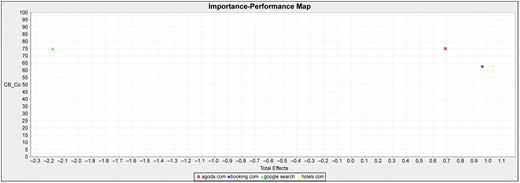
The findings recommend that well-thought-out web marketing on corporate branding by hotel companies leads to firm performance. The findings indicate that corporate branding on travel agency websites and a company’s own website can help businesses become more profitable. In addition, there is a synergistic connection on corporate branding of the hotel industry, including the presentation of a novel hotel narrative, the conception of a cornerstone loyalty program, the demonstration of excellence in hospitality and service, information on timely amenities like Covid-19 safety measures and the use of technology and experiential elements through platforms like the company website or the website of the travel agent all essential to achieve firm financial performance. As per the importance–performance matrix map, websites of travel agents (agoda.com, booking.com and hotels.com) had the importance (agoda.com 0.616, booking.com 0.959 and hotels.com 1.036) to impact companies’ corporate branding and firm performance, whereas Google search shows a value of −1.954, which has no impact on companies’ corporate branding.
The study considered only one hotel/tourism industry to know the effect of corporate branding on firm performance. Further studies may be chosen on other industries needed to allow for generalization.
This study aims to provide insights into how the hotel industry can make use of corporate branding through the company website, Google sites and websites of companies’ travel agency by providing timely updated promotion, facilities, quality services and hygiene matters to enhance firm performance.
This study provides empirical evidence to find various factors of corporate branding of the hotel industry’s firm performance. In addition, the study offers valuable insight into the nonmonetary measures of achievements.
1. Introduction
Corporate branding includes two crucial elements: what a firm stands for and how it is represented to the public. Each company has a distinct identity, which is often reflected in its brand. Marketing experts frequently develop corporate brands to express how they want the public to perceive the organization. For businesses to stand out in the marketplace and establish a distinctive identity from the competition, corporate branding is crucial (Piha, Papadas, & Davvetas, 2021; Thottoli & Thomas, 2021). Customers are on a quest to gain knowledge through the Internet in this digital age. Corporate branding is essential for an organization not only to define standards for their amenities or other services but also to separate themselves from competitors in the world market. Branding adds value to any industry including the hotel industry. It increases the chances of mere survival in the competitive marketplace, unlocks profitability and encourages consumer choice, added services and related awareness. Corporate brand has been identified as a significant key indicator of customer satisfaction and loyalty. Positive corporate brands facilitate companies to achieve higher levels of performance, such as sales and profit, which will aid in exploratory research. Branding exists to provide more value to customers while also establishing a long-term and mutually profitable relationship with them (Khan, Salamzadeh, Iqbal, & Yang, 2022; Tu & Chang, 2012).
Moreover, return of assets (ROA) and return of equity (ROE) are some of the generally used measures of firm performance. ROA and ROE help investors with their investment decision. To increase profit, one should reduce costs and increase revenue. To increase revenue, the business should know what kind of customers to target (Nunna, 2020). Attracting customers by providing information about current promotions (Mishra & Sanghvi, 2020) and advanced services even is a great way to identify their pain points. Prospective customers are on the digital journey. Customers should first land on the company’s web page while booking hotel rooms, and it should act as their tour guide. They want to see the amenities, promotions and other services initially by seeing review summaries done by past customers through the company’s websites, Google site, websites of travel agency and e-tourism channels. They should feel that their stay will be comfortable and hygienic, especially during the Covid-19 pandemic situation. Hence, corporate branding through web advertisement relating to timely updated promotion, facilities, quality services and hygiene matters are important to influence firm performance (Bayer, Srinivasan, Riedl, & Skiera, 2020). During the period of Covid-19, the entire hotel industry was getting through fanatical momentum where such a heavy impact has not been seen before (Hao, Xiao, & Chon, 2020). Thus, the hotel industry should ensure guests’ trust, and confidence should be developed by establishing and advertising strict hygiene measures introduced through an innovative strategic practice applied to monitor the hotel environment. The hotel industry should try to involve activities in continuous brand image among the public (El-Said, 2020). Marketing department managers should ensure that the company provides continuous brand awareness through website advertisement among customers. E-marketing helps to maintain relationships with past and repeat customers. If there is no advanced marketing strategy that inspires customer loyalty, it may adversely affect the success of the hotel industry. In hospitality marketing, if the hotel industry has not involved in web advertising both tangible products (such as food, accommodation and tickets) and intangible products (such as fun activities, luxurious services and creating a relaxing atmosphere), it may affect the firm performance. Less trust in the website of travel agencies among aspirant tourists was another major constraint (Baki, 2020). Customers generally believe the company’s website but at the same time studies found that there is a lack of updates on the company website (Suau Jiménez, 2019). Tourism in Oman grew considerably, and in 2019, Oman recorded about 3.5 m tourists from across the world. Oman has been trying to diversify their income from the oil industry to the nonoil industry as one of the country’s wealth maximization (Oukil & Al-Zidi, 2018). Present clients have greater expectations than in the earlier period and have the likelihood to compare one hotel with other hotel amenities than ever before (Deloitte, 2018). Potential clients will look into the review results from comments or ratings of hotel users, including Oman (Apriliani, Abidin, Sutanta, Hamzah, & Somantri, 2021). Handling customer expectations and satisfaction is a crucial factor that adds credibility and guarantee the existence of the hotel industry (Said & Muqrashi, 2020). There has been little research on corporate branding through advertising using the company’s website. Hence, the study aims to assess how corporate branding affects firm performance in the context of the Oman hotel industry, listed on the Muscat Stock Exchange (MSX).
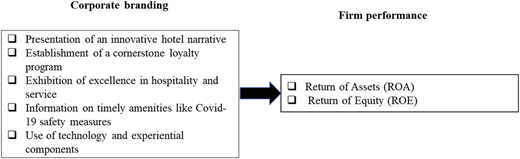
As per the literature, the key concept of the study focused on corporate branding (presentation of an innovative hotel narrative, establishment of cornerstone loyalty program, exhibition of excellence in hospitality and service, information on timely amenities like Covid-19 safety measures and use of technology and experiential components) through platforms such as Google, website of the company or website of the travel agent with firm performance (ROA and ROE). Hence, the main aim of this study is to assess how corporate branding affects firm performance in the context of the Oman hotel industry, listed on the MSX.
As part of the practical contribution, this study looks into how the board of directors of the hotel industry can significantly improve firm performance by systematically building their brand image. This study aims to provide insights into how the hotel industry can make use of corporate branding through the company website, Google site and the websites of companies’ travel agencies by providing timely updated promotion, facilities, quality services and hygiene matters to enhance firm performance. As part of the theoretical contribution,the importance of corporate branding through the website of the company, Google and travel agents on firm performance in the context of the hotel industry is underlined. This research validates the value of corporate branding in the hotel, which has even not been previously examined in detail. Therefore, this research provides an addition to information by exploring the importance of web marketing aspects in connection with the hotel industry.
2. Review of literature
Corporate branding is the process where a company builds its own unique identity and brand image by incorporating manifold touchpoints in the minds of consumers. The touchpoints include customer service, e-advertising and service quality of any company. Successful execution of corporate branding helps to communicate the operational and strategic vision to its stakeholders including prospective customers. Ryu, Lehto, Gordon, and Fu (2019) aimed to study the impact of a narrative transportation method on star hotel customers’ perceptions of company brand image, using a variety of ads on the brand story. Xie and So (2018) examined the impacts of past customer (reviewer) expertise on hotels’ website reputation and firm financial performance. Casidy, Wymer, and O’Cass (2018) examined proposed consumers’ perceived relationship preferences of corporate brands of the hotel industries, with a likely influence on customers’ passions concerning hotel brands and their intention to revisit. Foroudi (2019) described brand signatures such as endorsement of constant client attitude about the dissemination of a corporate brand, logo, the appearance and company’s unique slogan, the operational service quality of the hotel, constant communication with customers and the maintenance of corporate brand using the company’s website. Tseng, Chang, Wang, Wang, and Lin (2021) studied the special effects of consumer reviews on the website of the company (hotel) and travel agent websites on accommodation performance from an e-business perspective. Electronic word-of-mouth and online consumer satisfaction were considered two basic types of online consumer reviews. Lei and Law (2019) empirically studied the hotel’s mobile app of its official websites during the e-business period. These apps of hotel websites are used as virtual promotion and interaction means for tourists worldwide. Given mobile website app was distinct from their desktop complements, a different set of assessment standards must be devised in reply to the advanced technologies in e-browsing. Client-based brand equity builds trust and satisfaction among customers. Hofer (2022) found that a variety of antecedents help to improve firm performance. Thus, for businesses that operate internationally, a consistent strategy of internal branding measures is possible. The hotel industry is one of the key tourism industries, where the tourism sector has been steadily increasing. Hence, the evaluation of hospitality performance is crucial. The financial performance of 570 hotel chains that operated in Portugal has examined by Martins, Vaz, and Alves (2021) and investigated the issue of brand loyalty, hotel chains with comparable star ratings and market orientation were examined. O’Connor (2021) examined the relationship between program size and online branding through websites because loyalty programs are being employed as a competitive strategy by hotel brands for their firm performance. Amin, Ryu, Cobanoglu, and Nizam (2021) revealed how the effectiveness of hotel websites plays a key role in fostering e-trust, affective organizational commitment and online hotel booking intentions. Travelers are more likely to reserve a room at a hotel if they love the social aspects of the hotel’s online platform. They also give evidence of the significance of the holistic model in comprehending travelers’ decision-making processes, particularly when reserving a hotel stay, and confirm the critical function of social presence in improving e-trust and online hotel booking intents.
Hotels should ensure customer trust and satisfaction to build customer loyalty through their website (Sürücü, Öztürk, Okumus, & Bilgihan, 2019). The present awareness of corporate brand knowledge in the hotel business provides a discussion among the board of directors related to the importance of corporate brand and brand loyalty after considering guests’ brand experience (Liu, Hultman, Eisingerich, & Wei, 2020). It was found that there is a considerable impact on a hotel’s direct sales or performance of hotel advertisement by hotels’ performance (Masa’deh, Alananzeh, Tarhini, & Algudah, 2018). Tajvidi and Karami (2021) concluded that a strong and significant link between the use of social media and firm performance. The results did also show that corporate branding and innovation significantly mediate the relationship between the use of social media and firm performance. Brand awareness is a factor that is thought to drive service enhancement, and Sop (2021)’s study result supported the direct impact hypotheses and demonstrated that customer orientation influences brand loyalty and service enhancement significantly. The quality of the hotel website positively impacts utilitarian, telepresence and hedonic performance, as well as hedonic performance, which will in turn affect the client’s behavioral intentions (Ongsakul et al., 2021). Booking rooms using a website has become an essential means in the promotion of hotel customer services. The factors influencing customer trust in online website booking have been examined and have found that the perception of customer trust has a significant direct relationship with customer loyalty (Baki, 2020). It has been found that the size of the firm with versatile programs performed improved in terms of both engagement and traffic. This means the efforts taken by hotels on their brand image through membership are appropriate. Likewise, hotel program satisfaction affects both engagement and traffic levels. Thus, hotel brands should similarly focus on members’ happiness with versatile program benefits. Corporate branding is able to firm performance by leveraging loyalty programs (O’Connor, 2021). Online website hotel marketing approaches affect both online customer review and firm performance.
As per the literature review about corporate branding and firm performance in the context of the Oman hotel industry, listed in the MSX, the present research has developed the below framework (Figure 1) to show corporate branding and firms’ performance proxied by ROA and ROE.
3. Methodology
This study’s approach is made by way of a mixed method. First, it examines qualitative and exploratory information collected from companies’ internet sites, audited annual reports (the financial year 2019) published in MSX, web searches and websites of companies travel agencies from all the eight listed hotel companies in the MSX to examine the impact of corporate branding on firm performance proxied by ROA and ROE, and second, it assesses the measurement and structural models by applying partial least squares structural equation modeling (PLS-SEM).
This study examined eight of the hotel companies that were registered in MSX as of the 2019 financial year, which represents the complete population of hotel companies listed as hotels/tourism/hospitality (the hospitality industry) on the Muscat stock exchange. The hotel industry was chosen as the study context because it is fairly consistent among different hospitality services in Oman, allowing for the evaluation of flexible services between company websites, Google searches and websites of travel agents. This industry has been chosen because of its number of hotel properties situated in a various geographical provinces with a wide range of service kinds (such as business vs. leisure) and service quality such as luxury and budget.
3.1 Qualitative approach
As its first step under methodology, the researchers have initially browsed the website of all eight registered (in MSX) hotel companies to realize their advertisement on corporate branding. We also browsed through Google search followed by searching the websites of travel agents, such as hotels.com, agoda.com, booking.com and expedia.com as it considered intermediaries of the selected hotels in the current study. The study has employed word clouds to know clusters of words. This cloud novelty gives a visual representation of the text data used by the hotel industry in their website, Google search or travel agents’ websites to depict their extended facilities/amenities. This has been used by Heo, Kim and Drapé-Frisch (2019). Qualitative meta-analysis was used to study the website message of hotel management. The main reason to use qualitative study was the client involvements were unique and multidimensional to each situation, and their suggestions were distinctive. Hence, quantitative methodology might not be universally generalizable (Walls, Okumus, Wang, & Kwun, 2011). On the other hand, Alnawas and Hemsley-Brown (2019) were studied used quantitative data to measure market orientation and firm performance by examining the role of high-level promotional capabilities.
3.2 Quantitative approach
Second, the study provided structural equation modeling using SEM-PLS (Lohmöller, 1989). SEM-PLS is a powerful tool in the management and strategy research fields (Hair, Ringle, & Sarstedt, 2013). The use of SEM-PLS for nonnormal data and small sample sizes are the central areas of question, including in tourism and hospitality research studies (Ali, Rasoolimanesh, Sarstedt, Ringle, & Ryu, 2018).
The research considered published financial information from audited annual reports (the FY, 2019) of the entire hotel, tourism or hospitality companies registered in MSX to find out the ROA and ROE to assess the effect of financial performance. Earlier research used various indicators to assess the firm financial performance. Recent literature shows that the studies used financial information to find out financial ratios, such as ROA and ROE, of selected companies (Din, ArshadKhan, Khan, & Khan, 2021; Buallay, 2019; Sichigea, Siminica, Cristea, Noja, & Circiumaru, 2021).
The variables and measurements used in the current study related to corporate branding with firm performance are described in Table 1.
4. Discussion
4.1 Corporate branding and firm performance
Recent studies on corporate branding on firm performance were carried out by Robson and Farquhar (2021), Muthoni and Kinyua (2020), Sharma, Patro, and Chaudhry (2022), Shetty and Fitzsimmons (2022) to substantiate the results of the existing research study, corporate branding and firm performance.
Table 2, the summary of corporate branding, shows that five (63%) companies marketed their hotel details on the company’s websites, whereas three (38%) companies did not market their hotel details on the company’s websites; six (75%) companies marketed their hotel details on the Google site, whereas two (25%) companies did market their hotel details on the Google site. A total of five (63%) companies marketed their hotel details on the website of a travel agent (hotels.com), whereas three (38%) companies did not their hotel details on the website of hotels.com; six (75%) companies marketed their hotel details on the website of a travel agent (agoda.com), whereas 2 (25%) companies did not market their hotel details on the website of agoda.com; five (63%) companies marketed their hotel details on the website of a travel agent (booking.com), whereas three (38%) companies did not market their hotel details on the website of booking.com; six (75%) companies marketed their hotel details on the website of a travel agent (expedia.com), whereas two (25%) companies did not market their hotel details on the website of expedia.com.
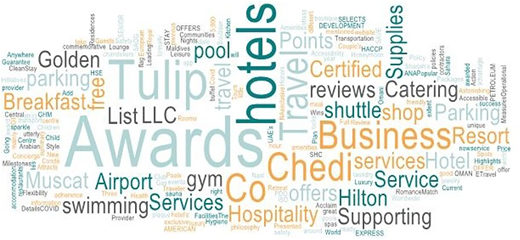
Table 3 and Figure 2 provide the details of marketing on corporate branding (CB) under companies’ website.
From the above discussion and details from Table 2 and Table 3, it is evident that the majority of companies were not strictly engaged in establishing corporate branding through their website. Thus, the main rationale behind corporate branding strategy was ignored and consequently, that might not be able to identify the best one in the hotel industry between travelers or tourists. It was revealed that constituents of corporate branding, such as corporate identity, corporate culture, product identity, brand relationships and personality, were considered the key factors in the business to business (B2B) context. Corporate branding ultimately generates brand value benefits for customers (Ozdemir, Gupta, Foroudi, Wright, & Eng, 2020). Celebrity faith had an increasing influence on brand credibility and marketing credibility (Hussain, Melewar, Priporas, Foroudi, & Dennis, 2020). Moreover, service quality, brand loyalty, brand association and brand relevance had been considered positive factors of firm performance (Narteh, 2018).
Due to vast text data on the company’s website, the researchers have included only limited information under the head “details of CB” in Table 3 to generate a word cloud. Accordingly, Figure 2 shows that the important aspect of corporate branding is awards or achievements made by the company. Hotels may get certification for their achievements as awards with consent use the unique logo and allows them to advertise such logo on hotels websites. This was considered one of the promotional advertisements and allowed tourists to be familiar with hotel facilities. E-booking of hotels focuses particularly on promoting organic and accredited hotels (Spenceley, 2019).
From the above discussion and details from Table 2 and Table 4, it is evident that the majority of companies have not established their corporate branding strategy through Google search. Thus, the main rationale behind corporate branding strategy was ignored and consequently, that might not be able to access or identify the best one in the hotel industry between travelers or tourists. The aspirant travelers or tourists might not be able to choose the best hotels using their brand quality, brand logo or images. Google search and hotel ratings or reviews in the Google search on characteristics such as staff services, location of the hotel and hotel facilities were found to have a significant influence on customers’ e-booking decisions (Le, 2021).
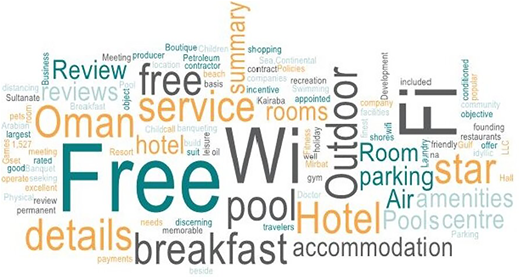
Due to vast text data on the Google site, the researchers have included only limited information under the head “details of CB” in Table 4 to generate a word cloud. Accordingly, Figure 3 shows that the important messages were related to services such as wi-fi, room services, complimentary breakfast, pool and other amenities made by the company. Google reviews and ratings are crucial for increased hotel booking by customers. In hotel industries, advertising a price discount on promoted hotel services had shown a significant influence on Google search (Zhao, Fang, Li, & Ye, 2018).
Table 5 shows marketing on CB under travel agents’ websites “hotels.com,” Table 6 shows marketing on CB under “agoda.com,” Table 7 shows marketing on CB under “booking.com” and Table 8 shows marketing on CB under “expedia.com.”
From the above discussion and details from Table 5 to Table 8, it is evident that the majority of companies have not established their corporate branding strategy through websites of travel agents (hotels.com, agoda.com, booking.com, and expedia.com). Thus, the main rationale behind corporate branding strategy was ignored and consequently, that might not be able to access or identify the best one in the hotel industry between travelers or tourists. The aspirant travelers or tourists might not be able to choose the best hotels using their brand quality, brand logo or images. Information communication technology is considered crucial in the firm performance (Thottoli, 2021a, b; Muneerali, 2020) of hotel or tourism which may include advertising on competitive pricing, latest promotion and extended efficiency in providing customer services to tourists at any time through travel agents website (Madhukar & Sharma, 2019).
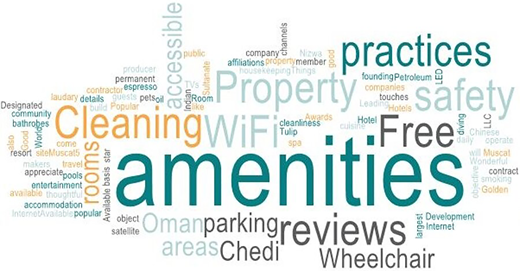
Due to vast text data on the website of travel agents (hotels.com, agoda.com, booking.com, and expedia.com), the researchers have included only limited information under the head “details of CB” in Table 5 to Table 8 to generate a word cloud. Accordingly, below Figure 4 shows the important messages related to hotel amenities provided by the company. Travel agencies need to select the proper marketing approach that fits the services they deal with to carry on their active participation in the hotel or tourism market (Singh & Ranjan, 2019).
4.2 Firms financial performance proxied by ROA and ROE
The research has been extended to assess the eight selected companies’ financial performance proxied by the ROA and ROE. Table 9 provided a summary of the firm’s financial performance (proxied by ROA and ROE) and details of corporate branding on the website of the company, Google site as well as websites of travel agents (hotels.com, agoda.com, booking.com, and expedia.com). Value “1” was given if “yes” and “0” was given if “no” corporate branding. The financial data were collected from all the eight listed companies published or audited annual reports on MSX for the year 2019 for calculating ROA and ROE.
4.2.1 Confirmatory tetrad analysis
The confirmatory tetrad analysis (CTA)-PLS approach allows recognizing whether the study is a formative indicator or a reflective indicator specification (Gudergan, Ringle, Wende, & Will, 2008). It is evident that the study model is reflective as the results shown in Table 10.
4.2.2 Construct validity and reliability
Both Cronbach’s alpha and composite reliability values are examined to test the reliability of the measurement model, which are shown in Table 11 and both values of Cronbach’s alpha and composite reliability are more than 0.7, which is acceptable (Cronbach, 1951). While running the PLS algorithm, the software was shown a single matrix problem. Hence, the item, expedia.com was deleted to process further analysis.
4.2.3 Discriminant validity
Discriminant validity, Table 12, shows the criteria according to Fornell–Larcker, and Table 13 shows the criteria according to the heterotrait–monotrait ratio.
In Table 12, all the items’ off-diagonal values are the correlation among latent constructs. Under the notion of discriminant validity, the AVE is compared with the square root of the correlations of the other constructs (Fornell & Larcker, 1981).
The critical value for heterotrait–monotrait ratio shows lower than 0.9 (Teo, Srivastava, & Jiang, 2008) except for ROA.
4.2.4 Importance–performance map analysis (IPMA)
The study also employed importance–performance map analysis (IPMA) to assess advertising in Google search, and websites of travel agents have the highest importance in a company’s corporate branding as an outcome variable. As per Hair et al. (2016), IPMA facilitates PLS to estimate the relationship of the structural equation model and consists of added dimension to the evaluation of latent constructs. Figure 5 depicts an importance–performance matrix map, which tells that websites of travel agents (agoda.com, booking.com and hotels.com) had the importance (agoda.com 0.616, booking.com 0.959 and hotels.com 1.036) to impact the company’s corporate branding and firm performance, whereas Google search shows a value of −1.954, which has no impact on companies’ corporate branding.
Hence, the study findings indicated the result which has a significant impact on corporate branding and firm performance in hotel or tourism industries companies listed on the MSX, Oman. The website of travel agents (agoda.com, booking.com and hotels.com) had the importance to impact companies’ corporate branding and firm performance, whereas Google search has no impact on companies’ corporate branding. The present research study findings are in line with Alnawas and Hemsley-Brown (2019) and Iyer, Davari, Srivastava, and Paswan (2021) that suggested that proactive systematic marketing on the corporate brand impacts a firm’s financial performance.
Overall, the study’s findings highlight the need of creating strong corporate brands as well as properly planned website marketing initiatives targeted at various hotel industry stakeholders. In other words, when corporate branding and firm performance work together, it brings about greater financial gain than just advertising alone.
Given the contradictory results of past studies on the relationship between web marketing and firm financial performance, this study found that the relationship between corporate branding and firm performance is particularly intriguing. According to the literature, corporate branding does not necessarily have a positive impact on a company’s performance. In other words, some companies can gain from brand loyalty initiatives while others do not. However, it is unknown what industries profit more from corporate branding initiatives (Baum & Überschaer, 2018).
The findings of this research have been able to describe the contradictory results of previous research to some extent. The findings of this study indicated that corporate branding through the website of travel agents and the company’s website would assist firms to enhance their firm financial performance. In another way, there has been a synergistic interaction in corporate branding of hotel industries such as presentation of an innovative hotel narrative, establishment of a cornerstone loyalty program, an exhibition of excellence in hospitality and service, information on timely amenities like Covid-19 safety measures and use of technology and experiential components through platforms such website of the company or website of the travel agent to achieve firm financial performance.
5. Conclusion
This study provides interesting insights into hotel branding in today’s hotel or tourism industry. The findings recommend that a well-thought-out web marketing on corporate branding by hotel companies leads to firm performance. Also, the findings indicate that attracting customers through web advertisement on timely updated promotion, facilities, quality services and hygiene matters impact corporate self-branding reaching a good brand image in the market, which has a greater impact on firm performance. The economy hotels’ timely hygiene measures, situational offers and amenities through publicizing via websites will attract and create a better image in the minds of travelers or tourists. Typically, advertising a company’s (hotel) awards and recognition will help to enhance the hotel’s image.
Corporate branding significantly affects firms’ financial performance. Corporate branding improves a firm’s financial performance proxied by ROA and ROE. Thus, the current study has suggested that the company should engage in active, timely and “uniform” corporate branding strategies using companies own website and websites of travel agents to create a better brand image among the public. As per the importance-performance matrix map, websites of travel agents (agoda.com, booking.com and hotels.com) had the importance (agoda.com 0.616, booking.com 0.959 and hotels.com 1.036) to impact companies’ corporate branding and firm performance, whereas Google search shows a value of −1.954, which has no impact on companies corporate branding. Also, this study’s qualitative findings indicate that corporate branding on travel agency websites and a company’s own website can help businesses become more profitable. In addition, there is a synergistic connection on corporate branding of the hotel industry, including the presentation of a novel hotel narrative, the conception of a cornerstone loyalty program, the demonstration of excellence in hospitality and service, information on timely amenities like Covid-19 safety measures and the use of technology and experiential elements through platforms like the company website or the website of the travel agent all essential to achieve firm financial performance.
Innovative strategies for corporate branding should be employed by hotel industries by applying the latest information communication technology tools in connection with marketing on corporate branding, compliance with internal regulations on corporate branding, accounting on corporate branding and auditing on corporate branding to enhance the firm’s financial performance (Thottoli, 2021c, d; Thottoli, Thomas, & Ahmed, 2019a, b, c; Thottoli & Thomas, 2020).
6. Limitations and directions for future studies
The study has collected data only from selected companies’ (hotel) websites, Google searches and websites of four travel agents. Future studies can be extended to collect data from websites of other travel agents. The study could collect only limited information on corporate branding because of the vast information on websites. The results of this research might lack generalizability because it included hotels only from a particular country, Oman. A potential research method can be applied to investigate how corporate branding can be achieved through companies’ brand advertising or brand marketing. The study considered only one hotel/tourism industry to know the effect of corporate branding on firm performance. Further studies may be chosen in other industries needed to allow for generalization. Further, this study’s results were obtained from data collected during the Covid-19 pandemic period that might be affected ROA or ROE.
The current study provided theory and practice at different levels. As per the extended literature and study results, the model’s validity is supported, adding to the body of knowledge about corporate branding and firm performance. This study offers suggestions to help the hospitality industry’s owners and managers make well-informed judgments about branding, such as presentation of an innovative hotel narrative, establishment of a cornerstone loyalty program, exhibition of excellence in hospitality and service, information on timely amenities like Covid-19 safety measures and use of technology and experiential components through the website of travel agents and the company’s website in light of their firm’s strategy. As part of the practical contribution, this study investigates the significant contribution of the board of directors of hotel businesses to systematically build their brand image for better firm performance. This study aims to provide insights into how the hotel industry can make use of corporate branding through the company website, Google site and the websites of the company’s travel agency by providing timely updated promotion, facilities, quality services and hygiene matters to enhance firm performance. As part of the theoretical contribution, the importance of corporate branding through the website of the company, Google and travel agents on firm performance in the context of the hotel industry is underlined. Mainly, it was noticed that web marketing significantly influences the hotel industry’s financial performance. This research validates the value of corporate branding in the hotel, which has even not been examined in detail. Therefore, this research provides an addition to information by exploring the importance of web marketing aspects in connection with the hotel industry. Further, this research also well highlighted the importance of travel agents in the hotel industry. The study findings put up the significance of both corporate branding and firm performance of the hotel industry.
6.1 Managerial implications
First, hotels should conduct accurate demand forecasting to improve revenue management. Innovative corporate branding is proposed in this paper to forecast future demands through marketing websites of travel agency websites and a company’s website. Effective service marketing highlights sustainability issues in the hospitality business, wherein brand equity and market performance are entirely mediated by sustainable competitive advantage (Hussain et al., 2020). Additionally, based on earlier observations collected from websites of travel agents’ reservation system, hotels’ marketing management should follow up by ensuring that all necessary required information for brand images has been put on their website. The management should make sure that the travel agencies are encouraged to re-intermediate themselves by offering value-added services to the customers’ demand. Despite the fact that hotels appreciate the services of travel agents for enhancing their service visibility and online sales, the large payments made to them have a considerable increase in cost. However, corporate branding is still important to boost company profitability. In a recent study, Nguyen and Feng (2021), it has been found that corporate branding does have a long-term impact on firm performance profitability and increased market value. This research suggests to management that if customers were not able to find affordable and attractive hotel rooms from the website of travel agents, they can search the hotel companies’ websites to make preferred reservations. This fact will encourage clickthrough to hotels’ brand websites.