This study presents a comprehensive bibliometric and literature-based assessment of global research on microplastic (MP) and nanoplastic (NP) bioaccumulation and toxicity in marine organisms from 2015 to 2025, with particular emphasis on ecological risks, human health implications and emerging mechanistic insights into pollutant transfer across marine food webs.
A dataset comprising 1,623 peer-reviewed publications indexed in Scopus was analyzed using VOSviewer to generate collaboration networks, co-citation maps and keyword clusters. Bibliometric findings were complemented by qualitative interpretations of highly cited studies to contextualize major advances in toxicological mechanisms, exposure pathways, model organisms and ecological risk frameworks.
Scientific output increased markedly after 2018, driven by advancements in analytical detection techniques and growing regulatory concern. China leads global research output, followed by Italy, India, Spain and the UK, whereas environmentally vulnerable regions such as the Arabian Gulf remain underrepresented. The research focus has evolved from descriptive occurrence studies to mechanistic and molecular-level toxicology, identifying oxidative stress, immunomodulation, gene expression changes, neurotoxicity and NP-specific risks such as tissue penetration and potential blood–brain barrier translocation. Recent literature further reinforces ecological risk assessment frameworks, seafood safety concerns and the need for harmonized monitoring strategies. Methodological limitations, including reliance on English-language Scopus-indexed publications, are acknowledged.
This study is among the first to integrate systematic bibliometric mapping with qualitative synthesis to identify the principal scientific drivers shaping a decade of MP/NP ecotoxicological research. The findings provide strategic directions for future investigations, including multi-omics approaches, standardized toxicity endpoints, enhanced regional surveillance and policy initiatives aimed at marine ecosystem protection and public health safeguarding.
1. Introduction
Microplastics (MPs; <5 mm) are pervasive pollutants in marine ecosystems, originating from fragmented plastics, textile fibers and microbeads used in personal care products (Andrady, 2011; Delpeche-Ellmann & Soomere, 2013; Jambeck et al., 2015). Their persistence, wide dispersion and interactions with biological systems pose significant risks to aquatic organisms. Reported effects include reduced growth, metabolic impairment, reproductive disruption, immunological stress and increased mortality across species from zooplankton and copepods to commercially important fish and bivalves (Agamuthu, Mehran, Norkhairah, & Norkhairiyah, 2019; Miller, Hamann, & Kroon, 2020; Akbari & Jaafari, 2025; Umaña, Paniagua, Brenes, & Baudrit, 2025). Additionally, MPs act as vectors for toxic substances, including hydrophobic pollutants, pesticides, heavy metals and microbial pathogens, facilitating bioaccumulation and trophic transfer with implications for seafood safety (Wright, Thompson, & Galloway, 2013).
Nanoplastics (NPs; <100 nm), formed through further degradation of MPs, pose additional risks due to their nanoscale size and high surface reactivity. Unlike larger MPs, NPs can penetrate biological membranes, enter systemic circulation and accumulate in vital organs (Singh et al., 2025). Studies indicate their ability to cross blood–brain, placental and intestinal barriers, inducing oxidative stress, inflammation, mitochondrial dysfunction, neurotoxicity and developmental abnormalities. Chronic exposure may also disrupt neurotransmitter metabolism and immune signaling, raising concerns for long-term human and ecological health (PMID: 40144163). Their high surface area further enhances sorption and transport of persistent pollutants and heavy metals, amplifying environmental risks (Pal et al., 2024).
Driven by global sustainability priorities, including the United Nations (UN) Sustainable Development Goals (SDGs), research on MP and NP toxicity has expanded rapidly since 2015 (Walker, 2021). However, few studies have systematically synthesized this growing body of work using quantitative approaches. Bibliometric tools such as VOSviewer enable mapping of publication trends, collaboration networks, keyword evolution and citation patterns, offering insights beyond traditional reviews (Van Eck & Waltman, 2010). Such analyses help identify knowledge gaps, regional disparities, key contributors and thematic shifts from descriptive occurrence studies toward mechanistic toxicology and risk-based ecological assessment.
Accordingly, this study aims to.
Quantify global research output (2015–2025) on micro and nanoplastic bioaccumulation and toxicity in marine organisms.
Identify leading contributors, including countries, institutions, journals and authors.
Apply keyword and co-citation clustering to map thematic evolution in areas such as oxidative stress, trophic transfer and molecular toxicology.
Provide policy and research-relevant interpretation of emerging trends to inform future monitoring, mitigation and marine protection strategies.
By integrating bibliometric evidence with current knowledge, this review offers a structured and quantitative overview of how understanding of micro and nanoplastic impacts has evolved over the past decade, while highlighting emerging research priorities and implications for ecological and public health management.
2. Methodology
2.1 Data source and search strategy
This bibliometric review was designed to assess the evolution, structure and thematic development of global research on microplastics (MPs) and their toxicological implications in marine organisms. Bibliographic data were retrieved from the Elsevier Scopus database on 30 May 2025, covering the publication period from 2015 to 2025. The search string applied was:
TITLE-ABS-KEY (microplastic*) AND TITLE-ABS-KEY (bioaccumulation OR toxicity OR “toxic effect*”) AND TITLE-ABS-KEY (marine OR ocean* OR sea*) AND TITLE-ABS-KEY (organism* OR fish OR mollusc* OR crustacean*) AND PUBYEAR >2014 AND PUBYEAR <2026.
To ensure academic rigor and thematic relevance, only peer-reviewed journal articles and review papers were included. Editorials, conference proceedings, book chapters and non-English publications were excluded to maintain consistency in quality and accessibility. Following application of the inclusion criteria and screening process, 1,623 documents were retained for analysis, collectively comprising 93,064 cited references (Table S1).
2.2 Bibliometric indicators
The study employed standard bibliometric performance and science mapping indicators to analyze.
Annual publication output
Leading countries and institutions (geographical distribution)
Source journals (publication outlets and impact)
Citation and co-citation networks (influential authors, articles and journals)
Keyword co-occurrence networks (thematic clusters and research evolution)
2.3 Bibliometric mapping using VOSviewer
All mapping and visualization were performed using VOSviewer version 1.6.20 (Van Eck & Waltman, 2010).
Citation matrices and co-occurrence maps were generated for.
Author co-citation
Journal co-citation
Reference co-citation
Author keywords
Author keyword mapping was used to delineate major research clusters, including.
Core microplastic occurrence and distribution
Marine ecological impacts
Human and environmental health risks
Toxicological and biochemical responses
Contaminant interactions and pollution sources
Thresholds (e.g. minimum occurrences or co-citation frequency) were defined automatically or adjusted manually depending on dataset size to ensure meaningful visualization.
2.4 Normalization of citation data and bias management
To reduce the temporal citation bias where older publications naturally accrue more citations, citation counts were normalized by publication year using:
This adjustment ensured comparable interpretation of research impact across different years, allowing both early foundational studies and recent high-influence publications to be evaluated objectively.
2.5 Data limitations and qualitative synthesis
Although the Scopus database offers broad international coverage of peer-reviewed literature, reliance on a single indexing source and the exclusion of non-English and grey literature may result in partial underrepresentation of research outputs from certain regions. This limitation is acknowledged, particularly given the rapid growth of microplastic research in developing coastal and marine-dependent nations.
To complement quantitative indicators, a qualitative literature synthesis was performed within each major cluster. Highly cited and cluster-defining publications were examined to contextualize thematic developments and to interpret.
The drivers underlying the emergence of specific research directions;
The evolution of experimental and analytical methodologies;
The connections between scientific findings and regulatory, ecological and human health concerns.
3. Results and discussion
3.1 Publication trends
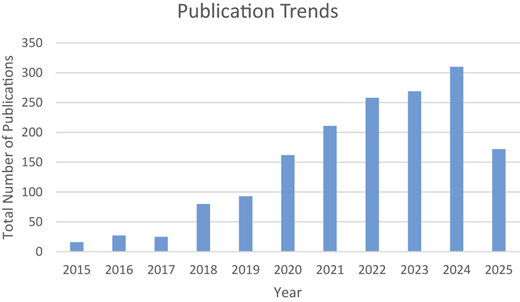
Research on microplastic bioaccumulation and toxicity of microplastics in marine organisms increased markedly over the past decade. Bibliometric analysis of Scopus-indexed publications (2015–2025) indicates a consistent upward trajectory, with minor year-to-year fluctuations. As of May 30, 2025, a total of 172 articles have been recorded, suggesting sustained research momentum.
The evolution of this field can be categorized into three distinct stages.
Modest Beginnings (2015–2017):
Early research activity was limited, with 16 publications in 2015, rising to 27 in 2016 and slightly decreasing to 25 in 2017. This phase primarily comprised exploratory studies on occurrence, exposure pathways and initial toxicological observations.
Exponential Growth (2018–2024):
From 2018 onward, publication output increased sharply: 80 (2018), 93 (2019), 162 (2020), 211 (2021) and peaking at 310 in 2024. This growth coincides with heightened awareness of marine plastic pollution, advances in analytical detection techniques, increased funding and alignment with global environmental priorities, including the UN Sustainable Development Goal 14 (Life Below Water).
Apparent Decline in 2025:
The lower count in 2025 (172 publications) likely reflects incomplete database indexing rather than a genuine decline in research productivity.
Overall, the sustained acceleration since 2018 indicates rapid maturation of this interdisciplinary research domain, spanning marine biology, environmental chemistry and ecotoxicology. Annual publication trends are presented in Figure 1.
3.2 Collaboration network
3.2.1 International collaboration in microplastic research
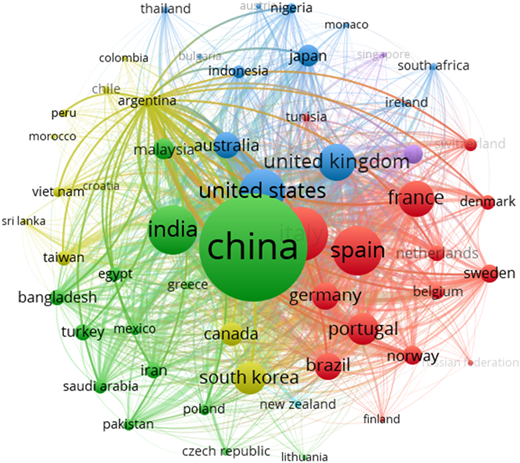
Global research on microplastic bioaccumulation and toxicity in marine organisms demonstrates extensive international collaboration. Between 2015 and 2025, 95 countries contributed at least one publication, with 55 producing three or more, reflecting a well-connected global research network. Bibliographic coupling reveals strong linkages through shared citations and co-authorships as illustrated in the VOSviewer map (Figure 2), where node size reflects publication output, link thickness denotes citation strength and colors represent clusters.
China leads with 457 publications, 31,399 citations and the highest total link strength (TLS) (1,077,919), underscoring its central role (Yang, Chen, & Xue, 2021). Strong collaborations with the United States, Italy, India and Spain have advanced studies on bioaccumulation in fish and shellfish. Other major contributors include Italy (175 publications), India (155), Spain (154) and the United Kingdom (102), each providing region-specific expertise.
The blue cluster comprises the United States, the United Kingdom, Australia and Japan, and focuses on molecular and toxicological responses, including oxidative stress and gene-expression pathways (Galloway, Cole, & Lewis, 2017). These collaborations are supported by joint funding (e.g. US NSF and UK NERC), with Japan providing key North Pacific data (Jambeck et al., 2015). Recent studies highlight nanoplastic-induced neurotoxicity and endocrine disruption (Zhu et al., 2024; PubMed ID: 40,144,163).
The red cluster represents strong European collaboration led by Italy, Spain, France, Portugal and Germany, with participation from Brazil. Research emphasizes mussel-based toxicology and biomarker studies in Mediterranean and Atlantic regions (Curpan, Impellitteri, Plavan, Ciobica, & Faggio, 2022; Jambeck et al., 2015), supported by European Union (EU) frameworks such as the Plastics Strategy and Horizon Europe (Matthews, Moran, & Jaiswal, 2021).
The green cluster, anchored by India (155 publications; 7,579 citations; link strength: 471,114), highlights South and East Asian collaborations addressing riverine inputs and coastal discharge into the Indian Ocean, including the Ganges system (Jambeck et al., 2015). Partnerships with China, the United States, South Korea and Malaysia further reinforce Asia's research influence, with recent studies emphasizing oxidative stress, neurotoxicity and inflammatory responses (Gabisa & Gheewala, 2022; Kumar et al., 2022; Sly, Nabhani, Sripada, & Kayama, 2024).
The yellow cluster, led by South Korea and Canada, focuses on ecological impacts in polar and temperate marine systems, including the Arctic, Yellow Sea and Bay of Bengal (Pitt et al., 2018). Contributions from Southeast Asia and South America represent emerging hubs with growing global connectivity.
Overall, the collaboration patterns reflect a geographically diverse yet thematically integrated research landscape, shifting from descriptive pollution studies to mechanistic toxicology and risk-based assessment. The normalized pairwise collaboration matrix of the top 13 publishing countries (2015–2025), based on TLS, is provided in Table S2 (scaled 0–1).
3.2.2 Prominent institutions
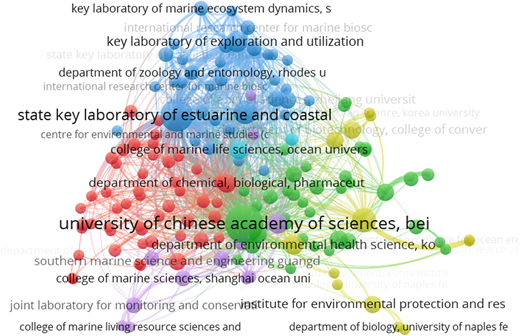
Bibliographic coupling of 4,684 organizations (≥3 publications; 148 included) identified six major thematic clusters (Figure 3). The University of Chinese Academy of Sciences and the State Key Laboratory of Estuarine and Coastal Research act as central hubs, supported by East China Normal University and the Ocean University of China, underscoring China's leading role. Prominent international collaborators include the National University of Singapore, University of Messina (Italy) and KonKuk University (South Korea).
The green cluster, focusing on environmental sciences and marine pollution, is anchored by the Yellow Sea Fisheries Research Institute, Chinese Academy of Fishery Sciences and the Institute of Eco-Environmental Research (Guangxi Academy of Sciences), alongside Konkuk University (Korea) and Foundation for Industrial and Technical Research (SINTEF) Ocean (Norway). This network reflects strong cooperation in ecosystem monitoring, aquaculture and marine risk assessment.
The red cluster, led by the University of Chinese Academy of Sciences (Beijing) and the Southern Marine Science and Engineering Guangdong Laboratory, connects institutions including AcSIR (India), Spanish Institute of Oceanography – Spanish National Research Council (IEO-CSIC) and CIBEROBN (Spain) and Centre for Advanced Studies in Arid Zones (CEAZA), Chile. Their collaborative focus encompasses marine ecology, coastal management and pollution dynamics, integrating both applied and fundamental research perspectives (Jambeck et al., 2015; Matthews et al., 2021).
The blue cluster comprises China's Key Laboratory of Marine Ecosystem Dynamics, the Second Institute of Oceanography and the Ministry of Agriculture's genetic resource laboratories, collaborating with the International Research Centre for Marine Biosciences and Rhodes University (South Africa). It focuses on oceanography, biogeochemistry and aquatic genetics, integrating molecular and ecological approaches in marine plastic research (Cole, Lindeque, Halsband, & Galloway, 2011).
The yellow cluster bridges European and Asian institutions, led by Institute for Environmental Protection and Research (ISPRA) and the University of Naples Federico II (Italy) collaborating with the Guangdong Laboratory (China), Incheon National University, Konkuk University, Sungkyunkwan University (South Korea) and National Taiwan University. Research focuses on micro and nanoplastic detection, ecosystem impact assessment and policy-oriented mitigation frameworks (Walker, 2021).
Overall, Chinese institutions remain at the forefront of global microplastic research. Nevertheless, the strong international and interdisciplinary linkages across collaboration clusters highlight the collective global effort to address microplastic contamination in marine environments. The top 10 contributing organizations are presented in Table S3, illustrating both geographic diversity and network strength among leading institutions.
3.2.3 Prominent authors
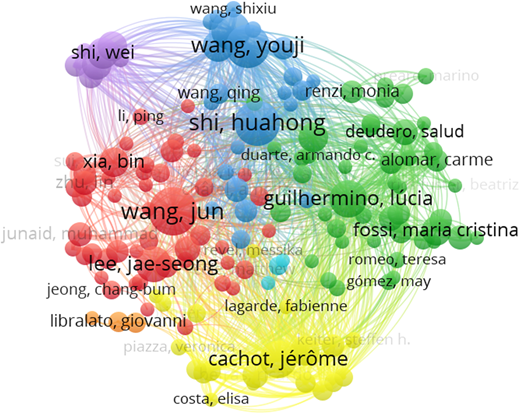
Bibliographic coupling of 7,401 researchers (150 with ≥5 publications) revealed seven major thematic clusters (Figure 4). Node size represents publication output, while TLS reflects shared citations and collaboration. High-impact pairs such as Shi Huahong – Cachot Jérôme (51,004; 46,241) and Wang Youji – Wang Jun (40,435; 40,813), demonstrate strong institutional and intellectual connectivity.
The Red Cluster (East Asia–Western Europe) includes Lee Jae-Seong, Jeong Chang-Bum, Tamara S. Galloway and Matthew Cole, focusing on micro and nanoplastic (MP/NP) bioaccumulation, trophic transfer, molecular toxicology, co-contaminant interactions, organ-level stress, microbiome disruption and climate-linked effects (Ali, Jeong, Lee, Zinck, & Souissi, 2024; Jeong, Ali, Zinck, Souissi, & Lee, 2024).
The Green cluster (Southern/western Europe) comprises Lucia Guilhermino, Maria Cristina Fossi, Salud Deudero and Damia Barcelo, concentrating on pollutant occurrence in water, sediment and organisms, ecotoxicological biomarkers, immune and reproductive impacts and risks to seafood and human exposure pathways. Regional studies in the Mediterranean and North-East Atlantic emphasize ecosystem protection and contamination mitigation strategies (Compa, Capó, Alomar, Deudero, & Sureda, 2024; Lourenco et al., 2025; Le et al., 2024; Giani et al., 2025).
The Blue Cluster, led by Wang Youji and Shi Huahong, focuses on MP interactions in estuarine and coastal systems through field investigations, laboratory toxicity assays and modeling approaches (Xu et al., 2023). These studies consistently demonstrate synergistic effects when MPs/NPs co-occur with pollutants such as phthalates, PCBs, phenanthrene, pharmaceuticals and heavy metals (Walker, 2021; Zhong et al., 2024).
The Yellow Cluster (primarily European groups), featuring Cachot Jérôme, Costa Elisa, Lagarde Fabienne and Beiras Ricardo, emphasizes controlled experiments on larvae and early life stages, highlighting developmental, behavioral and metabolic disruptions while promoting harmonized experimental protocols.
Smaller clusters, including cluster 5 (emerging Chinese researchers), cluster 6 (South American focus) and cluster 7 (Mediterranean ecotoxicology) highlight regional collaboration, shared methodologies and cross-continental connections addressing microplastic bioaccumulation and toxicity.
Overall, the author-level coupling network indicates a mature and globally integrated research landscape in which leading scholars contribute to mechanistic insights, ecological risk assessment and region-specific mitigation strategies. The collaboration patterns and thematic distributions of prominent authors are detailed in Supplementary Table S4.
3.2.4 Citation analysis of documents
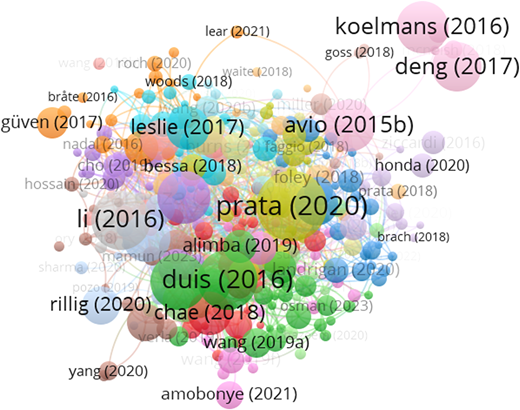
The citation network (Figure 5) identifies 296 highly influential publications on microplastics (≥100 citations) from 321 articles. Node size reflects citation count, while colors indicate thematic areas. Three core studies – Prata, Da Costa, Lopes, Duarte, and Rocha-Santos (2020; 1,689 citations), Duis and Coors (2016; 1,385) and Li, Tse, and Fok (2016; 1,368) – form the structural backbone, showing strong cross-cluster connectivity across environmental toxicology, exposure pathways and ecological risk assessment.
Avio et al. (2015; 1,155 citations) exhibit the widest interdisciplinary reach, linking 78 co-citation pathways related to pollutant interactions, physiological responses and seafood safety. In contrast, other highly cited papers such as Koelmans, Bakir, Burton, and Janssen (2016) and Deng, Zhang, Lemos, and Ren (2017) display more specialized influence, primarily in pollutant-transport modeling and mammalian toxicology, respectively.
Among all documents, Prata et al. (2020) remains the most central node, synthesizing evidence on human exposure routes (ingestion, inhalation, dermal uptake) and mechanistic toxicity pathways such as oxidative stress, inflammation and co-transport of persistent pollutants. Its centrality underscores its continued importance in shaping research directions and guiding risk assessment frameworks.
To minimize temporal citation bias, citation counts were normalized relative to publication year using:
Normalized citation metrics are presented in Table S5.
3.3 Co-citation network
3.3.1 Reference Co-citation
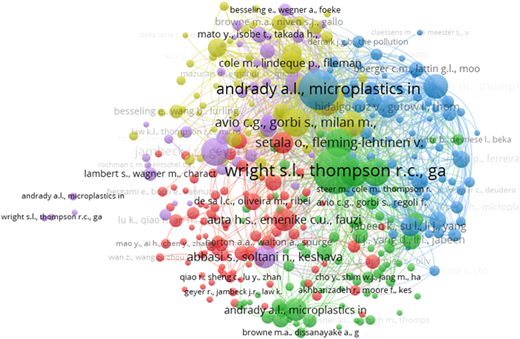
The reference co-citation network, based on 93,064 references from 1,623 source articles, identified 335 key publications using a minimum threshold of 20 co-citations (Figure 6). Five major clusters emerged: (1) toxicological impacts of MPs; (2) pollutant–MP interactions; (3) ecological risk assessment; (4) human health implications; and (5) interdisciplinary frameworks.
Together, these clusters define the conceptual structure of microplastic (MP) research, spanning toxicology, pollutant behavior, ecological monitoring and socio-environmental assessment. Supplementary Tables S6–S7(In Supplementary information) summarize cluster themes and representative studies.
Seminal studies anchor the network, including Wright et al. (2013) on the physical impacts of MPs in marine systems and reviews by Andrady (2011) and Cole et al. (2011) on global distribution and ecotoxicology. Studies on trophic transfer (Farrell & Nelson, 2013; Setälä, Fleming-Lehtinen, & Lehtiniemi, 2014), bioindicators (Van Cauwenberghe, Claessens, Vandegehuchte, & Janssen, 2015a, Van Cauwenberghe, Devriese, Galgani, Robbens, & Janssen, 2015b; Avio et al., 2015) and global flux modeling (Jambeck et al., 2015; Auta, Emenike, & Fauziah, 2017; Abbasi et al., 2018) provide insight into transport pathways. Advances in detection and polymer identification (Browne, Dissanayake, Galloway, Lowe, & Thompson, 2008; Lusher, McHugh, & Thompson, 2013) improved comparability and reliability, while recent work increasingly addresses pollutant interactions and ecological–human health effects (Lu et al., 2016).
Cluster 1 (84 documents) centers on ecotoxicological effects of MPs particularly polyethylene and High-Density Polyethylene (HDPE) on bivalves, copepods, molluscs and fish larvae. Research evaluates oxidative stress responses, survival, growth, reproductive performance and molecular biomarkers, with growing attention to co-exposure to metals, pharmaceuticals and persistent organic pollutants (POPs). Microcosm experiments link laboratory findings with trophic transfer and behavioral responses.
Cluster 2 investigates the combined toxicity of MPs and co-occurring pollutants, including heavy metals, herbicides, polycyclic aromatic hydrocarbons and pharmaceuticals. These studies demonstrate enhanced contaminant bioavailability, oxidative stress, developmental impairment and food-web transfer in copepods, mussels, oysters and fish (Botterell et al., 2025; García-Pimentel et al., 2025; Fernández et al., 2024).
Cluster 3 addresses chronic and sub-lethal risks across aquatic and terrestrial systems, including bioaccumulation, spatial distribution, interactions with co-stressors (temperature, microcystins), impacts on microbial communities, dietary exposure and management frameworks.
Cluster 4 focuses on monitoring strategies and analytical standardization. Advances in sampling design, detection techniques and polymer characterization facilitate cross-regional comparisons. Bioindicator species including seahorses, sea cucumbers, mussels, oysters, Antarctic krill and myctophid fish support long-term environmental assessments and trend analysis (Van Cauwenberghe et al., 2015a, b; Bhuyan et al., 2024; Boisen, Sidlauskas, Heppell, & Brander, 2024; Liu et al., 2025).
Cluster 5 reflects emerging interdisciplinary perspectives integrating socio-economic analysis, environmental policy, risk communication and predictive modeling. This cluster highlights the growing recognition that effective microplastic management requires coordinated scientific, regulatory and societal frameworks.
3.3.2 Author Co-citation
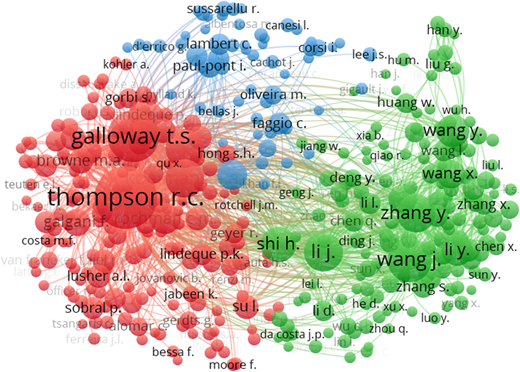
The author co-citation analysis examined 124,776 cited authors, of whom 378 met the minimum threshold of 200 co-citations. The resulting network (Figure 7) comprises three major clusters. Node size represents co-citation frequency, while link thickness reflects intellectual proximity and thematic overlap. Key contributors such as Thompson R.C. (3,845 co-citations) and Galloway T.S. (2,842) function as central hubs, underscoring their foundational and sustained impact on microplastic research.
Cluster 1 Foundational Marine Microplastic Research (Red): This cluster includes pioneering authors such as Thompson R.C., Galloway T.S., Browne M.A., Lusher A.L. and Lindeque P.K. Their work established core methodologies for microplastic detection, characterization and monitoring. Standardized sampling, polymer identification and quantification approaches developed here reinforce later ecological assessments and global monitoring frameworks.
Cluster 2 – Environmental Distribution and Multi-Pollutant Interactions (Green): Led by researchers such as Wang J., Zhang Y., Li J., Shi H. and Liu G., this cluster focuses on environmental fate, transport pathways and interactions between microplastics and co-contaminants (e.g. antibiotics, metals, pesticides, POPs). Using geographic information system (GIS), modeling and field data, these studies explain dispersal mechanisms and the role of microplastics as pollutant vectors, linking environmental chemistry with exposure dynamics.
Cluster 3 – Molecular and Physiological Mechanisms of Toxicity (Blue): Centered on authors including Paul-Pont I., Lambert C., Cachot J., Oliveira M. and Faggio C., this cluster examines sub-lethal and chronic effects using biochemical, histological and molecular endpoints. Key findings include oxidative stress, inflammation, reproductive and metabolic disruption and gene-expression changes, supporting mechanistic risk assessment.
A comparative synthesis of clusters, leading authors and thematic contributions is provided in Table S8.
3.3.3 Co-citation analysis of journals
Journal co-citation analysis of 19,187 Scopus-indexed articles identified 316 journals meeting a ≥30 co-citation threshold, representing the core microplastic (MP) literature (Figure S1). The network reveals five major clusters defining the intellectual structure of global MP research.
Cluster 1 (red), led by Marine Pollution Bulletin and linked with Environmental Pollution, Aquatic Toxicology, and Estuarine, Coastal and Shelf Science, represents the marine environmental science core. These journals emphasize field and laboratory assessments of MPs in water, sediment and biota, integrating toxicological endpoints such as oxidative stress, metabolic disruption and immune responses within marine risk frameworks.
Cluster 2 (green), dominated by Science of the Total Environment, Journal of Hazardous Materials and Chemical Engineering Journal, integrates environmental chemistry with pollutant transport modeling. Research addresses MP behavior, interactions with co-contaminants (e.g. heavy metals and antibiotics) and remediation strategies, reflecting the convergence of chemical engineering and environmental risk analysis.
Cluster 3 (blue), including Environmental Science and Pollution Research, Scientific Reports and Frontiers in Environmental Science, centers on ecological processes in marine and estuarine systems. Themes include monitoring, trophic transfer, species interactions and pathway modeling, providing ecological baselines for impact assessment.
Cluster 4 (yellow) comprises Marine Drugs, Ecotoxicology and Harmful Algae, highlighting marine biotoxins, chemical ecology and organismal responses. Research explores interactions between MPs and natural toxins, including effects on metabolite production and harmful algal bloom toxicity, marking an emerging interdisciplinary area.
Cluster 5 (purple) is anchored by Environmental Science & Technology, supported by ES&T Letters, Analytical Methods and Integrated Environmental Assessment and Management. This cluster emphasizes analytical innovation, detection methodologies and regulatory development for micro and nanoplastics.
Across clusters, Marine Pollution Bulletin shows the highest co-citation frequency, while Environmental Pollution demonstrates the strongest bridging role (TLS: 763,676), linking toxicology, ecology and environmental chemistry. Although limited by Scopus coverage and English-language indexing, the analysis provides a coherent overview of the disciplinary streams shaping MP research. Cluster summaries are presented in Table S9.
3.4 Emerging trends and keyword analysis
The keyword co-occurrence network generated using VOSviewer (Figure S2) illustrates the major thematic structures, intellectual trajectories and emerging priorities within the microplastic (MP) and nanoplastic (NP research. Author-provided keywords from Scopus were filtered using a minimum occurrence threshold of five. Of 3,461 unique terms, 258 met this criterion, ensuring analytical robustness while minimizing network noise.
Microplastics remain the central node (occurrence: 694; TLS: 1,415), strongly associated to nanoplastics, toxicity, bioaccumulation, oxidative stress, ingestion and marine pollution. These linkages underscore sustained global concern regarding exposure pathways, contaminant interactions and organism-level physiological and biochemical effects.
Temporal overlay visualization reveals a clear thematic transition between 2021 and 2023. Earlier research (blue nodes) primarily emphasized pollution assessment and spatial distributional mapping. In contrast, recent studies (yellow–green nodes) increasingly focus on mechanistic and molecular endpoints. Emerging keywords including gene expression, neurotoxicity, metabolomics, DNA damage, inflammation and ecological risk indicate a shift toward cellular stress mechanisms, immune and endocrine disruption and biomarker based risk evaluation development. Model organisms such as Mytilus coruscus, Mytilus galloprovincialis, Daphnia magna and zebrafish have become central to mechanistic ecotoxicological investigations.
For clarity, high-frequency keywords were organized into 11 thematic clusters, encompassing pollutant characterization, environmental distribution, trophic transfer, organismal physiology and health implications. A summary of high-frequency author keywords and representative studies is provided in Table S10.
4. Conclusion
This bibliometric and literature-based assessment (2015–2025) summarizes the evolution of research on microplastic (MP) and nanoplastic (NP) bioaccumulation and toxicity in marine ecosystems. Early investigations (2015–2017) primarily documented MP occurrence in water, sediments and biota. Since 2018, advances in analytical methodologies, growing policy attention and concern over human exposure have shifted toward mechanistic toxicology, molecular biomarkers, trophic dynamics and structured ecological risk assessment frameworks.
Two major research directions dominate: (1) mechanistic toxicology, including oxidative stress, immune responses, neurotoxicity, gene expression and cellular uptake; and (2) ecological and human health risk assessment, focusing on bioaccumulation, biomagnification and seafood safety. Research output is led by China, Italy, India, Spain and the UK, while regions such as the Arabian Gulf and Indian Ocean remain underrepresented. Normalized citation metrics (Table S1) reduced temporal bias and distinguished key studies, though reliance on Scopus and English-language sources may limit global coverage.
Collectively, the findings underscore the urgent need for standardized protocols for MP/NP sampling, particle-size classification, polymer identification and toxicity endpoints to enhance cross-study comparability. Increasing evidence of nanoplastic specific risks including tissue translocation, immune disruption and potential neurotoxicity highlights their growing relevance within marine ecological and food-safety risk frameworks. Strengthening cross-regional collaboration, particularly in data-deficient yet environmentally sensitive regions, will be critical to advancing integrated monitoring, mechanistic understanding and evidence-based policy development.
4.1 Future prospects and research directions
The curated dataset and cluster based analyses identify several priority directions for advancing MP/NP research.
Integrated multi-omics approaches to elucidate long-term, low-dose and transgenerational toxicity.
Global standardization of methodologies, including harmonized measurement units, particle-size classifications, polymer identification protocols and biological endpoints, to enhance cross-study comparability and facilitate regulatory alignment.
Predictive modeling of MP/NP transport and risk hotspots, integrating hydrodynamic models, climate variables and contaminant interactions to improve exposure forecasting and management strategies.
Region-specific risk assessments, particularly in environmentally vulnerable yet data-scarce areas such as the Arabian Gulf and Indian Ocean, where ecological sensitivity and socio-economic dependence on marine resources necessitate targeted evaluation.
Policy-oriented applications, including seafood advisories, wastewater treatment optimization and circular-economy–aligned plastic management frameworks.
Collectively, these efforts will support effective marine protection and contribute to achieving SDG 14.
Data availability
Data will be available on reasonable request.
The supplementary material for this article can be found online.