


Bahrain has set a national target of achieving carbon neutrality by 2060, with an interim goal of a 30% reduction in CO2e emissions by 2035. The aim of this policy brief is to provide insights on how carbon neutrality in Bahrain can be achieved.
A review of literature related to climate change mitigation in general, and that related to Bahrain in particular, was carried out.
Given that the carbon intensity of Bahrain's economy is relatively high, achieving carbon neutrality requires not only technologies for reducing CO2e emissions at the source and enhanced carbon sinks, but it also requires the introduction of a circular economy culture and efforts to foster pro-environmental behavior within the population. The involvement of different stakeholders in the journey toward carbon neutrality is critical, along with the formulation of requisite policies regulating the roles of technology, behavior and research.
Pathways to achieve carbon neutrality in Bahrain were explored, and areas for policy focus were recommended.
Background
Bahrain is a petroleum-producing country, with fossil fuel comprising the country's main energy source, resulting in an economy with relatively high carbon intensity (IEA, 2021). Although Bahrain's carbon intensity [1] decreased from 0.5 kgCO2/2015 USD (purchasing power parity-PPP) [2] in 1990 to 0.4 kgCO2/2015 USD (PPP) in 2019, it is still higher than the carbon intensities of some Gulf Cooperation Council (GCC) countries, including Saudi Arabia (0.3 kgCO2/2015 USD (PPP) in 2019) and the United Arab Emirates (UAE) (0.2 kgCO2/2015 USD (PPP) in 2019) (IEA, 2021). Carbon intensity of Bahrain is also higher than that of the United States of America (0.2 kgCO2/2015 USD (PPP) in 2019), Australia (0.3 kgCO2/2015 USD (PPP) in 2019) and China (0.4 kgCO2/2015 USD (PPP) in 2019) (IEA, 2021) (Figure 1).
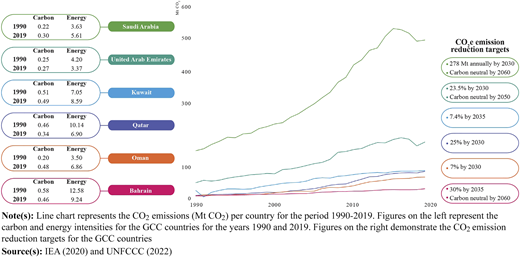
Energy and carbon indicators and targets for the Gulf Cooperation Council countries
Energy and carbon indicators and targets for the Gulf Cooperation Council countries
Up to the 26th United Nations Climate Change Conference of the Parties (COP 26), Bahrain had not set an explicit CO2e emissions reduction target, as CO2e emissions were addressed implicitly within existing energy targets. These targets include achieving a 6% improvement in energy efficiency by 2025 through the adoption of the National Energy Efficiency Action Plan (NEEAP) and increasing the share of renewable energy by 5% in 2025 and 10% in 2035 through the adoption of the National Renewable Energy Action Plan (NREAP). CO2e emissions reduction resulting from the implementation of the NEEAP and the NREAP is projected to amount to 1.9 million tons in 2030, which is less than 5% [3] of Bahrain's total CO2e emissions (Supreme Council for Environment, 2020). While the government has implemented major initiatives, a few initiatives within the private sector are also evident, including installing 880 solar panels in a shopping mall and the planned establishment of a 5-MW solar farm for Aluminium Bahrain (Akhbar Alkhaleej, 2019; Al Watan, 2021).
One week before COP 26 took place, Bahrain announced on the 24th of October 2021 its commitment to achieving carbon neutrality by 2060, with an interim goal of a 30% reduction in CO2e emissions by 2035 (BNA, 2021). This is Bahrain's first explicit CO2e emission reduction target. Bahrain has almost achieved its renewable energy target for 2025 and is planning to double the penetration of renewables by 2025, thus accomplishing this target 10 years earlier than planned (Alshakhoori, 2021). In the case of the NEEAP, 21 out of 22 energy efficiency initiatives have been achieved in line with the energy efficiency target set for 2025 (Alshakhoori, 2021).
The UAE and Saudi Arabia announced carbon neutrality targets for the years 2050 and 2060, respectively. As for the remaining GCC countries, their CO2e emission targets was communicated in their updated Nationally Determined Contributions (NDCs) submitted in accordance with Article 4, paragraph 12 of the Paris Agreement (UNFCCC, 2022) (Figure 1).
Policy options
None of the few studies exploring Bahrain's CO2e emission reduction potential have tackled zero-carbon pathways. These studies examined the potential for climate change mitigation within transportation (Alsabbagh, 2020b; Alsabbagh, 2017a; Alsabbagh, Siu, Guehnemann, & Barrett, 2017a, b), residential (Alsabbagh, 2018), waste (Alsabbagh, 2019a) and water (Alsabbagh, Al-Zubari, Marzooq, & Hasan, 2021) sectors. One study explored the potential for achieving emission reductions within the water-energy nexus (Alsabbagh, 2020a). The adoption of renewable energy technologies, solar and wind energies in specific was extensively explored on the GCC level (Alharbi & Csala, 2021; Alnaser, Albuflasa, & Alnaser, 2022).
There is a high potential for solar power generation in Bahrain (33 TWh/year (Bachellerie, 2012)), where the mean annual solar radiation is 2,180 kWh/m2 (Alnaser & Alnaser, 2019). Bahrain has targeted installing 200 and 400 MW of solar energy by 2025 and 2035, respectively (SEU, 2017). From a social perspective, social learning effectively changed public views, preferences and acceptance levels relating to mitigation options in the transportation sector in Bahrain (Alsabbagh, 2017b). Given the provision of adequate information and financial support, the Bahraini public was also reported to be willing to install residential solar photovoltaics (Alsabbagh, 2019b). A further study (Alsabbagh & Al-Jayyousi, 2018) recommended adopting a collective approach that draws on the experiences of the European Union at the GCC level for the penetration of renewable energy.
Bahrain's Third National Communication on Climate Change provided recommendations for policymakers, practitioners and researchers (Supreme Council for Environment, 2020). Recommendations to policymakers emphasized the need to set a CO2e emission reduction target, a climate change strategy, carbon emissions credits and a monitoring and evaluation system (Supreme Council for Environment, 2020). Bahrain announced that the interim goal of a 30% CO2e emission reduction would be achieved by doubling the renewable energy penetration target, improving energy efficiency and increasing carbon sinks by doubling and quadrupling the areas covered by trees and mangrove, respectively, and by investing in carbon capture, use and storage (CCUS) technologies (BNA, 2021).
Two main options for reducing CO2e emissions are evident in the literature: reduction at source and enhancement of sinks. Options from the first group are regulatory, economic and information-based, whereas those in the second group include nature-based and technology-based solutions (Figure 2) (Edenhofer et al., 2014; Fawzy, Osman, Doran, & Rooney, 2020; Fekete et al., 2021; IEA, 2020). Effective mitigation policies have been implemented in countries with high CO2e emissions, focusing specifically on renewable energy penetration, improved energy efficiency, changing individuals' consumption patterns, energy recovery from waste, design of sustainable cities and buildings and electrification of the transportation sector (Fawzy et al., 2020; Fekete et al., 2021; Chen et al., 2022). Less evidence is available for other sectors, such as the industrial and agricultural sectors (Fekete et al., 2021).
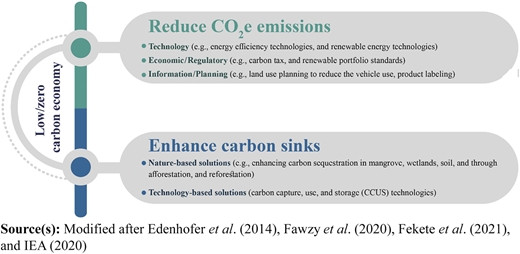
Options for achieving a low/zero-carbon economy
Options for achieving a low/zero-carbon economy
Reducing carbon emissions cannot be achieved using technologies alone. The social aspect needs to be prioritized as well, where knowledge, equity and behavioral change can contribute to achieving carbon neutrality (Blohm, 2021; Zhang, Pan, & Liao, 2021). The public can participate in community renewable energy initiatives. However, the public participation depends on their motivation, capacity and ownership of projects (Mees, 2022).
Carbon sink enhancement is recommended as a complementary option for reducing residual CO2e emissions after implementing options in the first group (Fawzy et al., 2020). Carbon sinks can be grouped into nature and technology-based sinks (Figure 2). Based on the carbon capture systems, carbon capture approaches can be classified into pre-combustion, post-combustion, and oxyfuel combustion (Osman, Hefny, Abdel Maksoud, Elgarahy, & Rooney, 2021; Chen et al., 2022). Examples of carbon sinks include carbon sequestration in plantations, blue carbon sequestration and adopting carbon dioxide removal (CDR) or CCUS technologies for power generation and the industrial sector (Fawzy et al., 2020). Literature suggests that the integration between bioenergy and carbon capture and storage technologies can be effective in reducing CO2e emissions associated with oxyfuel combustion (Osman et al., 2021).
There are some concerns about adopting different technologies, including the environmental impacts of onshore and offshore renewable energy technologies, especially on wildlife (Jager, Efroymson, & McManamay, 2021; Kulkarni & Edwards, 2021; Sayed et al., 2021). There are also some concerns relating to the installation of photovoltaic and whether these induce a heat island effect and cause increase in ambient temperatures (Barron-Gafford et al., 2016). However, most of the impacts associated with the adoption of renewable energies technologies are considered negligible or short-term (Kulkarni & Edwards, 2021; Sayed et al., 2021). Additionally, many of the CCUS technologies relating to carbon sinks are still under development, and entail uncertainties regarding pricing and environmental implications, in addition to risks such as leakage and public nonacceptance along with fire and diseases for nature-based carbon sinks (Fawzy et al., 2020; Chen et al., 2022). There are also concerns relating to the end-of-life waste produced by these technologies, such as solar panel waste (Daniela-Abigail et al., 2021; Mathur, Gregory, & Hogan, 2021). Therefore, it is recommended that all decarbonization technologies undergo a lifecycle assessment (Chen et al., 2022). Additional concerns are also evident in literature in relation to generating a green paradox, where direct and indirect rebound effects are created. On one hand, saving energy by adopting energy efficiency measures can create more demand on energy, and this is the direct rebound effect. On the other hand, costs of saved energy may be used in carbon-intensive activities, and this is the indirect rebound effect (Elavarasan et al., 2022).
In recent years, the concept of a circular carbon economy has attracted increasing attention. Although this approach focuses on the carbon lifecycle of products and services, changes in consumer behavior are also required (Parajuly, Fitzpatrick, Muldoon, & Kuehr, 2020). Behavioral changes are an essential component of climate change mitigation strategies (Attari, 2021; Masson & Fritsche, 2021; Whitmarsh, Poortinga, & Capstick, 2021). Whereas different technological options can reduce CO2e emissions, achieving a circular carbon economy requires creating a social system that promotes pro-environmental behaviors.
Policy recommendations
Future pathways to achieve carbon neutrality in Bahrain include targeting large-scale penetration of renewable energies, improving energy efficiency, and adopting sustainable lifestyle where gradual reduction in CO2e emissions can be achieved. The use of CDR technologies can contribute to a large overshoot in emissions reduction (Pathak et al., 2022). To achieve carbon neutrality in Bahrain, it is recommended that the general policy focus should be on technology, behavior and research (Figure 3). Investing in research and development along with capacity building is highly recommended, especially in relation to solar inverters, solar air conditioning, water desalination, electric cars, carbon emission monitoring devices and green hydrogen. More specific recommendations are provided below.
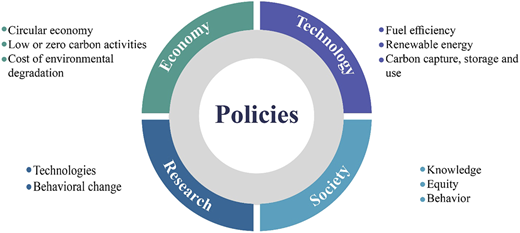
Recommended areas of policy focus for achieving carbon neutrality in Bahrain
Recommended areas of policy focus for achieving carbon neutrality in Bahrain
Wider involvement of industries is needed
Large industries in Bahrain account for nearly one-third of the national capacity for electricity generation and currently do not feature in the national renewable energy target (SEU, 2017). Mandating progressively stricter renewable portfolio standards ensures the involvement of industries in achieving carbon neutrality. A mandatory but gradual shift to green energy procurement can also foster a transition toward a carbon-neutral economy. Promoting sustainable finance mechanisms, environmentally-oriented corporate social responsibility and environment-related certification can be beneficial. Special attention needs to be paid to cement and aluminum industries being carbon intensive industries. Literature suggests several decarbonization options including redesigning and use of low carbon constitutes for the cement industry and using renewable energy as a source of energy for the aluminum industry (Elavarasan et al., 2022).
Technology alone cannot achieve the target
Efforts to foster a behavioral shift toward pro-environmental practices and the adoption of sustainable lifestyles, with policymakers serving as role models for the public, are highly recommended. An environmentally-based incentives system that rewards pro-environmental behavior and acknowledges the interlinkages between lifestyles and the environment can reduce carbon emissions. An example is offering grants to those who purchase electric cars to purchase and install residential photovoltaic systems.
Data, research and innovation are needed
Climate change mitigation solutions are data-intensive, necessitating detailed data gathering for exploring mitigation opportunities. Although much of the required data are publicly available in Bahrain, detailed bottom-up data on, for example, residential electricity consumption by nationality, income group and built area are also needed. Additionally, energy balances are needed to understand the energy flow at the national level and within major industries. Collaborations between the public and private sectors, on the one hand, and researchers, on the other hand, are essential to provide an evidence base that informs the policy-making process. The provision of funds for low- and zero-carbon research is also recommended.
Because the transition to a low- or zero-carbon economy generates new types of waste, planned management of renewable energy waste, specifically solar panels, is highly recommended. This can be achieved by investing in recycling companies and building the necessary capacities. End-of-life waste generated through renewable energy technologies will require regulation.
To ensure the embedding of a carbon-neutral culture within Bahraini society, public and private entities need to incorporate carbon emissions within their strategies. For example, Fikra (an Arabic word that means idea), a government-initiated innovation competition, can include a dedicated track for novel ideas to reduce CO2e.
Building on existing experience
During the COVID-19 pandemic, e-learning and e-working schemes were successfully introduced and applied in Bahrain. Expanding their scale could reduce the demand for cars and consequent fuel use and air emissions. However, innovative solutions need to be explored to avoid increasing the electricity demand within the residential sector. At the level of the GCC countries, unified regulations relating to climate change could conserve time and resources and facilitate shared policies among them.
A circular economy culture is needed
Progress toward carbon neutrality entails a transition in Bahrain's energy system and its economic, social and technological systems. New material will be used, and new waste will be generated. Therefore, new processes, policies and capacities need to be developed. The current linear economy will need to become circular in terms of carbon flows and flows of energy, water and resources. Thus, in addition to a circular economy, a “circular economy culture” will be needed to achieve carbon neutrality in Bahrain.
Limitations and future research
One of the main limitations of this paper is the limited number of publications that examine climate change mitigation and low- or zero-carbon pathways in Bahrain. Although a substantial body of literature exists at the international level, adopting mitigation technologies and measures necessitates exploring its effectiveness in reducing CO2e emissions prior to the implementation. Future research can focus on exploring the feasibility and sustainability (from social, economic and environmental perspectives) of pathways to achieve carbon neutrality in Bahrain, with a particular focus on areas identified in Figure 3.
Notes
Carbon intensity refers here to the amount of CO2e produced per unit of Gross Domestic Product (GDP).
PPP refers to Purchasing Power Parity.
This figure is based on the assumption of a constant level of CO2e emissions by 2030 similar to that in 2015 (i.e. 39.9 million tons) (Supreme Council for Environment, 2020).

