


Halal integrity assurance is the primary objective of Halal supply chain management. Several halal-related risks are present that have the potential to breach halal integrity. Therefore, this study aims to develop the framework for the assessment of halal-related risk from a supply chain perspective.
Risk related to halal is identified through the combined approach of the systematic literature review and experts’ input. Further, these risks are assessed using the integrated approach of intuitionistic fuzzy number (IFN) and D-number based on their severity score. This integrated approach can handle fuzziness, inconsistency and incomplete information that are present in the expert’s input.
Eighteen significant risks related to halal are identified and grouped into four categories. These risks are further prioritised based on their severity score and classified as “high priority risk” or “low priority risks”. The findings of the study suggests that raw material status, processing methods, the wholesomeness of raw materials and common facilities for halal and non-halal products are more severe risks.
This study only focusses on halal-related risks and does not capture the other types of risks occurring in the supply chain. Risks related to halal supply chain management are not considered in this study. Prioritisation of the risks is based on the expert’s input which can be biased to the experts' background.
The proposed risk assessment framework is beneficial for risk managers to assess the halal related risks and develop their mitigation strategies accordingly. Furthermore, the prioritisation of the risks also assists managers in the optimal utilisation of resources to mitigate high-priority risks.
This study provides significant risks related to halal integrity, therefore helping in a better understanding of the halal supply chain. To the best of the authors' knowledge, this is the first comprehensive study for developing a risk assessment model for the halal supply chain.
1. Introduction
The assurance of the integrity of halal products (i.e. product compliance with Halal standards) which is associated with people’s health, consumer confidence and performance of the organisation is a significant issue for the global halal business. Credence quality-attributed products (such as halal, kosher, organic and GMO-free), is one that cannot be evaluated by the consumers directly because the characteristics of the product cannot be determined by the consumers directly (Tieman, 2021). Due to this, halal risk management has become an important part of ensuring trust in halal-certified brands through maintaining halal integrity. Several halal integrity-related scandals reported in recent years such as the detection of pork DNA traces in chicken sausages in Italy (Pinto et al., 2015), DNA of animal species traced in candy products (Muñoz-Colmenero, Martínez, Roca, & Garcia-Vazquez, 2016) and adulteration of pork in halal-labelled chocolates in Malaysia (Tan, Ali, Makhbul, & Ismail, 2017). These incidents not only affect the consumer’s health and beliefs but also alter the image of the halal industries (Ali & Suleiman, 2018). Therefore, a higher degree of halal integrity in the halal product is needed to restore consumer confidence. In order to meet the expectation of the consumers and reduce the occurrence of the scandal, it is necessary to develop an appropriate strategy to deal with halal-related risks.
There are various reasons behind the occurrence of these incidents such as outsourcing practices, and the elongated and complex network structure of the supply chain. Many firms have outsourced raw materials/ingredients from offshore companies, and it becomes more challenging to assure the halal integrity and quality of their halal products with such an elongated and complex supply chain (Khan, Haleem, & Khan, 2018). Although assurance of the integrity of the products is the primary goal of all halal supply chain partners, halal integrity of the product is vulnerable to various stages such as raw material/ingredient, processing and transportation (Tieman, 2017). For example, there is no mechanism that disseminates the halal status of goods on freight documents, cargo labels and in IT systems throughout the supply chain, which results in the mixing of halal and non-halal goods during the transportation and storage process (Tieman, 2021). These types of risks need to be identified to maintain the halal integrity of the product for the enhancement of consumer satisfaction.
Several types of risks are associated with the halal supply chain that needs to be addressed for developing a resilient halal supply chain. However, halal supply chain risk-related studies are not sufficiently available in the literature (Maman, Mahbubi, & Jie, 2018). There are very few studies that are available in the literature on halal with a focus on risk management (Tieman, 2017). For instance, Sumarliah, Li, Wang, and Indriya (2021) identified and ranked the risks in the halal fashion supply chain; Khan, Haleem, and Khan (2021) focus on halal integrity along with supply chain risks. Therefore, there is a need to conduct a study that focussed on halal-related risks to fill the gap in the existing literature. In order to fill this knowledge gap, this study is conducted to develop a comprehensive understanding of the risk associated with halal integrity. The prime objective of this study is to propose a risk management model for the halal supply chain. Specifically, this study aims to accomplish the following research objectives:
Identify the major risks in the halal supply chain related to halal integrity
Propose a risk assessment model for prioritising these identified risks
Recommend the possible solutions to overcome these halal integrity risks
In order to fulfil the above objectives, a comprehensive literature review is conducted for the identification of halal integrity-related risks. Furthermore, an intuitionistic fuzzy number (IFN) and D number-based model is proposed for the assessment of the halal integrity-related risks.
The remaining article is organised in the following order. Section 2 develops the background for this study. Section 3 provides the preliminaries for this study. Section 4 illustrates the adopted research methodology. Section 5 provides a ranking of the identified risks. Section 6 discusses the results. Section 7 provides the implications of this research and finally, Section 8 gives the conclusion.
2. Background of the study
In this section, we provide an overview of risk management studies in the context of halal and risk assessment models for the supply chain.
2.1 Risk management in the halal supply chain
Risk management has emerged as one of the primary research areas of supply chain management (Ge, Nolan, Gray, Goetz, & Han, 2016; Haleem, Khan & Khan, 2021). In the last several years, risk management in the supply chain has received more attention from academia and industries towards the reduction in the vulnerability along the supply chain (Govindan, Fattahi, & Keyvanshokooh, 2017; Khan, Haleem, & Khan, 2020; Prayudanti & Sucipto, 2021). Despite the growing interest in risk management in supply chains, the field of Halal supply chain risk management is still in its infancy. In addition to usual risks, the Halal supply chain faces an additional risk related to halal integrity (Ali & Suleiman, 2018; Khan, Khan, Haleem & Jami, 2019b). Specifically, halal supply chain-related risks are unexpected events that might disrupt the halalness (the state of being halal) of the product, from its origin to the consumption point. In the halal supply chain, the primary focus is on ensuring halal integrity, especially when materials/ingredients are increasingly procured from all over the world. Halal-related risks occur in the various stages of the supply chain such as procurement, production and logistics (Tieman, 2017). These risks might cause the production of non-halal, low-quality and unhygienic consumables that damage the brand image, and somehow affect operational efficiency. Therefore, it is significantly important to understand and manage the halal-related risks in the supply chain to accomplish the desired objective.
However, the literature on Halal provides evidence that mere research has been done regarding risk management in the halal supply chain. The majority of the research regarding the risk in the halal supply chain is focussed on the production process, contamination and ethical issues of animals. For example, Tieman (2019) also emphasised the role of Halal authenticity and the trustworthiness of the halal certification body on the halal brand. Furthermore, corporate halal reputation index is proposed to measure the corporate halal reputation. In addition, this study also considers the halal issue that is present in the halal production/supply chain including contamination and non-compliance with halal standards. Ali, Tan, Pawar, and Makhbul (2014) identified the six types of halal integrity risks namely “production risk”, “raw material risk”, “food security risk”, “outsourcing practices risk”, “service, risk” and “logistics risk”. Furthermore, they suggest mitigating these risks through supply chain integration. Maman et al. (2018) identified the risk event, and risk agent in the halal red meat supply chain and provided the mitigation strategies for all stages in the beef supply. They suggested mitigation strategies to develop an operation manual by the factory and formulate policies for the logistics companies/retailers to avoid contaminations. A study carried out by Fujiwara (2017), identified the risk drivers, risk sources and their consequences and developed the risk mitigating strategies for supplier management in halal food supply chains. Further, they contracted the risk management framework for supplier management using the case study.
Khan, Khan, & Halim (2019a) investigates the significant risks associated with halal food supply chains and focusses on the risks associated with halal food supply chains. Several risks associated with halal supply chain were considered, including supply, demand outsourcing and logistics risks. Mansur, Farida, and Albab (2017) studied operational risk in the meat supply chain and had a specific focus on the contamination risk during transportation. They suggested that the effective packaging of halal products could reduce the risk of contamination. In addition, Khan et al. (2020) also conduct a comprehensive study examining the risks in the halal supply chain and found that contamination is a serious concern for maintaining halal integrity. The study is further extended by assessing the halal supply chain-related risks, which shows that halal logistics represents a significant risk within the halal supply chain (Khan et al., 2021). Ermis (2017) reviewed the role of the enzymes with a focus on fermentation processes in halal products, the halal status of enzymes and the risk associated with these enzymes in the halal assurance. Tieman (2017) proposed a risk prevention cycle for the halal supply chain through the reduction of halal integrity-related risks. The proposed risk prevention cycle consists of four components: (1) assessment of risk vulnerability, (2) (re)design supply chain, (3) horizontal and vertical collaboration and (4) monitoring.
Sumarliah et al. (2021) analysed the halal fashion supply chain risks using the fuzzy Best Worst Method (BWM) method and considered seven dimensions of risk. Fuseini, Knowles, Hadley and Wotton (2016) review the literature on the criteria for Halal meat and investigate the criteria used by Halal Certification Bodies (HCBs) to identify halal meat. A study by Yener (2015) indicated that the consumer purchase intention is affected by the news about the physical risk (cross-contamination) of halal food with the non-halal product. Further, this study found that consumer purchase intention will be diminished through the news of physical risks about the halal products. These studies show that risk management in the context of the halal supply chain is in the initial stage. Some studies have been done to identify the different types of risks in the different stages of the supply chain and the role of these risks in the management of the halal supply chain. Therefore, there is a need to conduct a study which has holistic focus on the supply chain from the risk point of view and this research tries to fill this gap.
2.2 Risk assessment model/framework
Several models/frameworks/approaches have been applied for risk evaluation in different areas such as supply chain management, system management and operational management area. Some popular approaches are the FEMA (Giannakis & Papadopoulos, 2016; Fattahi & Khalilzadeh, 2018), interpretive structural modelling (Venkatesh, Rathi, & Patwa, 2015), multicriteria decision-making methods such as ANP (Vishwakarma, Prakash, & Barua, 2016), AHP (Wang, Chan, Yee, & Diaz-Rainey, 2012), VIKOR (Rostamzadeh, Govindan, Esmaeili, & Sabaghi, 2015) and DEMATEL (Lin, Li, Xu, Liu, & Liu, 2018). These approaches are integrated with the fuzzy set theory such as fuzzy AHP (Radivojević & Gajović, 2013; Li & Wang, 2016), grey theory such as grey DEMATEL (Su et al., 2016), intuitionistic fuzzy set theory such as IFN based MULTIMOORA (Zhao, You, & Liu, 2016), Z number such as Z-BWM (Li, Guo, Yazdi, Nedjati, & Adesina, 2021) and Bayesian theory such as B-TOPSIS (Li & Yazdi, 2022a, b) to enhance the effectiveness of the evaluation.
Risk assessment has many complexities due to the involvement of several presumptions (Samvedi, Jain, & Chan, 2013; Li & Yazdi, 2022a, b). In the supply chain environment, risks are qualitative and can be analysed using expert input. These experts’ input is subjective and many times imprecise in nature which lowers the accuracy of the assessment (Shankar, Choudhary, & Jharkharia, 2018; Li & Yazdi, 2022a, b; Agarwal et al., 2022). The three major complications involved with the expert’s input as the vagueness of the linguistic scale (Yazdi, 2022), inconsistent information (Gholamizadeh, Zarei, Omidvar & Yazdi, 2022) and uncertainty in the expert’s opinion (Zhou, Shi, Deng, & Deng, 2017; Asim, Jalil, Javaid, & Muneeb, 2021; Hashmi, AqibJalil, & Javaid, 2022). These three issues are not handled simultaneously by the conventional risk assessment technique. In this study, we implement an integrated risk assessment technique by combining the IFN and the D-number theory. This integrated method can deal with the vagueness of linguistic data, incomplete information and subjectivity in expert evaluations simultaneously. IFNs are utilised to transform the linguistic assessment of the experts and D number combines transformed expert’s inputs to obtain the result instead of taking average scores. IFNs have more capabilities than fuzzy numbers as they consist of three membership elements: membership, indeterminacy and non-membership (Cevik Onar, Oztaysi, Otay, & Kahraman, 2015; Kahraman, ÇevikOnar, & Öztayşi, 2015; Gupta, Rathore, Srivastava, & Biswas, 2022). Hence, they can handle the fuzziness, inconsistent information and incomplete information in the expert’s input better than fuzzy and crisp numbers. Moreover, D-number theory is the advancement of the evidence theory because it is considered incomplete and non-exclusive information in the framework (Deng, 2012). Hence, the D number is used to combine the judgement of multiple experts which might be subjective.
3. Preliminaries
A brief introduction of the essential preliminaries is presented in this section.
3.1 An integrated approach based on IFS and D number theory
The integrated approach is the combination of two or more approaches to take advantage or/and reduce the limitation of the individual methodologies. Mostly, individual approaches are not efficient and reliable to solve complex decision problems. The integration of the IFN and D number are adopted as an integrated approach for risk assessment in this study. In this section, the conceptual and analytical foundations of the IFN and D number and the adopted integrated approach are explained.
3.2 Intuitionistic fuzzy set (IFS) theory
IFS theory is proposed by Atanassov (1986), which is an extension of the original fuzzy set theory. In Fuzzy set theory, the fuzzification of input data is characterised by the membership function; while the IFS theory not only considered the membership (degree of agreement) but non-membership (degree of disagreement) and hesitancy degree (unknown information). Consequently, IFS has more competence to characterise vague/imprecise and uncertain information in practical applications than the fuzzy set theory. Some basic concepts and definitions related to the IFS theory are discussed below (Atanassov, 1999):
An IFS “A” in the universe of discourse is defined as follows (Atanassov, 1986):
The third parameter of the IFS is , known as hesitation margin or intuitionistic fuzzy index, and can be utilised to explain the hesitancy degree of z to IFS A, where and
According to the IFS theory, an IFN can be characterised as an ordered pair () fulfilling the given conditions:
Consider two IFNs numbers as, and , the multiplication of ‘a’ and ‘b’ are expressed as equation (3):
3.3 D-number theory
The D-number theory was first introduced by Deng (2012), which is the generalisation of Dempster–Shafer (D-S) evidence theory. The D-S theory has some strong hypotheses that constraints its applicability for a practical problem. The first undesirable assumption is “all the elements of the frame of discernment should be mutually exclusive” for the application of this theory, which is not appropriate for linguistic assessments. Another constraint of evidence theory is that the sum of all elements of the basic probability assignment (BPA) should be equal to 1, which is referred to as the completeness constraint of BPAs. In the real-world problem, the experts/decision-maker does not have complete knowledge and they provide their judgement based on partial/incomplete information, which makes it impossible to satisfy the completeness constraint (Deng, Hu, Deng, & Mahadevan, 2014; Zhou et al., 2017). D numbers overcome these limitations of the evidence theory as they can effectively characterise the non-exclusive linguistic assessments as well as incomplete information (Zhou et al., 2017). Hence, D-number theory can be more suitable for the practical problem, which has mostly incomplete information. For completeness of the explanation, some basic concepts of the D-number theory are described as follows (Deng, 2012):
Assume Ω be a finite non-empty set, D numbers is a mapping formulated by:
Suppose a problem domain is where and if , a specific form of D numbers can be expressed by
(D number’s rule of combination) Suppose two D numbers, D1 and D2, denoted by
The combination of D1 and D2, indicated by , is defined by
where,
(D number’s integration) Let , be a D number, then the integration representation of D is defined as
4. Research methodology
Initially halal related risks are identified through the literature review. In order to identify the risks related to the halal related risks systematic literature review is conducted using the Scopus database. After the initial identification of risks, these risks are categorised into four categories based on their similarities. Further, three experts panel is formed to evaluate the identified risks. The first expert panel (Expert panel A) consists of four members of management level from the Halal producing companies. The second panel (Expert panel-B) comprises the three members of the halal certification bodies. Three academic experts working in the area of the halal supply chain are a member of the third expert panel (Expert panel-C). In this manner, we have taken the three major stakeholders of the halal supply chain as a panel. Further, these identified risks are evaluated through the integration of IFNs and D number-based method. In this integrated method IFNs are utilised to evaluate the severity of the risk using the expert’s judgement. The experts provide their responses by membership, non-membership and hesitancy value for the probability and impact of the risk. These multiple expert’s inputs are fused using the D-number theory, which can better handle the incompleteness and/or biasness of the experts. The integration of IFN and D numbers is used in some studies for prioritisation such as Shankar et al. (2018), Mo (2021) and Mo (2020). Hence, the adopted methodology is more efficient and realistic for the evaluation of the risk in comparison to other conventional methods such as AHP, fuzzy AHP, ANP and BWM, etc. The adopted research methodology is provided in Figure 1 and the steps of the adopted methodology are as follows:
Step 1: Risks identification: This step deals with the identification of the several risks related to the adopted problem (in this case halal related risks) through various techniques such as systematic literature review, Delphi, Prisma and expert’s input, etc.
Step 2: Risk assessment through the expert’s input using IFNs: The probability (P) of occurrence and corresponding impact (I) of the identified risk are assigned by the experts using the linguistic scale. These linguistic variables are converted into equivalent IFNs as per Table 1 (Boran, Genç, Kurt, & Akay, 2009).
Linguistic variables and their corresponding intuitionistic fuzzy number (IFN)
| S No | Linguistic scale | Corresponding IFNs |
|---|---|---|
| 1 | Extremely Low (EL) | [0.10, 0.90] |
| 2 | Very Low (VL) | [0.15, 0.75] |
| 3 | Low (L) | [0.25, 0.60] |
| 4 | Moderately Low (ML) | [0.40, 0.50] |
| 5 | Medium (M) | [0.50, 0.40] |
| 6 | Moderately High (MH) | [0.60, 0.30] |
| 7 | High (H) | [0.70, 0.20] |
| 8 | Very High (VH) | [0.85, 0.10] |
| 9 | Extremely High (EH) | [1.00, 0.00] |
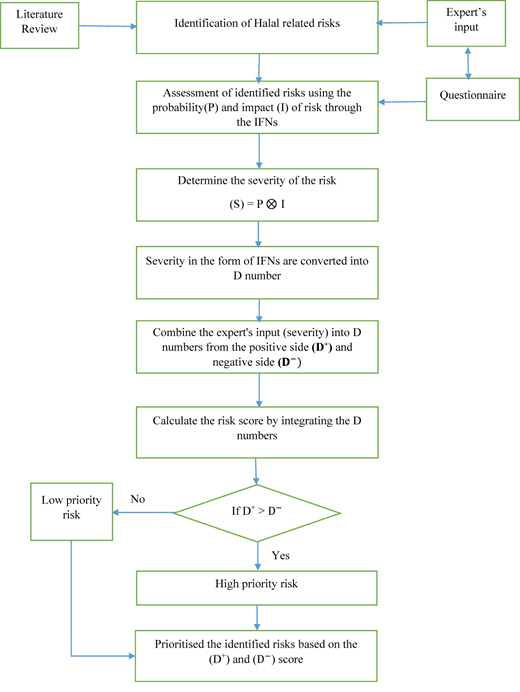
The obtained IFNs characterise the assessment of risk from the positive side (i.e. membership degree) and the negative side (i.e. non-membership degree). The severity (S) of identified risk is calculated as equation (11):
Step 3: Fusion of the experts’ risk assessments using D number: The “severity” of the identified risks is transformed into corresponding D numbers as explained below.
Assume , is the severity of a risk R then, the corresponding positive D number (i.e. ) and negative D numbers () can be determined using the following relations:
where p and q are the probability associated with the membership and non-membership degree respectively. In this study, we take the equal probability associated with membership and non-membership degrees, which means p = q = 0.50. In the D-number, the criteria should be positive or negative simultaneously. Therefore, the membership degree () is considered positive criterion and the non-membership degree () as the negative criteria in this study. Hence, when D-number is represented from the positive side, the value of the membership degree () remains the same, and the value of the non-membership degree ) is replaced by the (). On the other hand, when D-number is represented from the negative side, and the membership degree ( is replaced by (1) and non-membership degree and remain the same. Furthermore, the obtained D numbers (from positive and negative sides) are fused from each side (positive and negative) separately for identified risk using equations (6)-(10). In combination, a series of () values are obtained corresponding to the positive and negative D numbers, respectively. These values are integrated to obtain the crisp value of risk scores from the positive side ( and negative side ( of all the identified halal risks using the D-number integration rule.
Step 4: Prioritisation of risks: The severity of the risk is represented through the value of D+ risk score. The higher value of the positive risk score (D+) for the particular risk represents the higher severity of the corresponding risk. On the other hand, the risk score from the negative side signifies the non-membership degree, which is interpreted as a higher value D− represent the lower severity. Therefore, the decreasing order of D+ risk score gives the descending order of the risk and vice versa. While increasing the order of D− the risk score gives the increasing order of the risks and vice versa. Hence, the identified risk is prioritised based on the descending order of D+ and ascending order of the D− score.
5. Risk management framework for halal-related risks
The objective of this paper is to develop a framework for risk management related to the halal supply chain. To fulfil this objective, this study proposed a framework for risk management for halal-related risk as shown in Figure 2.
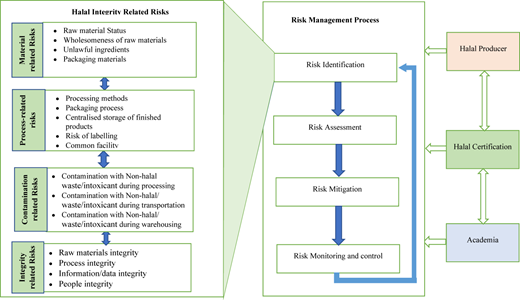
As per the proposed framework, initially, the halal-related risks are identified through the integrated approach of literature review and experts’ input. Eighteen halal-related risks are identified and shown in Table 2. These identified risks are categorised into four dimensions namely “material-related risks”, “process-related risks” “contamination-related risks” and “integrity-related risks.” After the identification of these risks, determine the priority of these risks based on the severity of these risks.
Selection of halal related risk and their references
These identified risks are categorised into four dimensions namely “material-related risks”, “process-related risks”, “contamination-related risks” and “integrity-related risks.” After identification of these risks, determine the priority of these risks based on their severity.
Three expert panels are formed as suggested in the methodology section. After the formation of the expert panel, a questionnaire is circulated to each expert panel and asked to evaluate the identified risks based on their probability and impact using the linguistic scale (please see Table 1). Here, to avoid biases and mathematical complexities, different experts were asked to provide a single linguistic assessment. This assessment is based on the consensus of all members of the expert panel. In this manner, the expert panel’s input is collected and summarised in Table 3.
Linguistic assessment of the halal-related risks
| Risks | Expert panel A | Expert panel B | Expert panel C | |||
|---|---|---|---|---|---|---|
| P | I | P | I | P | I | |
| R01 | H | VH | H | EH | H | EH |
| R02 | H | H | H | VH | VH | H |
| R03 | M | VH | M | VH | VH | H |
| R04 | ML | ML | M | VH | ML | MH |
| R05 | MH | EH | H | EH | MH | EH |
| R06 | L | L | ML | L | ML | M |
| R07 | MH | VH | MH | H | MH | VH |
| R08 | L | MH | VL | H | L | VH |
| R09 | ML | VH | MH | VH | MH | VH |
| R10 | M | VH | MH | VH | H | VH |
| R11 | L | EH | ML | EH | H | EH |
| R12 | ML | H | ML | MH | ML | H |
| R13 | VH | MH | MH | H | M | VH |
| R14 | L | VH | ML | VH | M | H |
| R15 | ML | EH | H | EH | MH | VH |
| R16 | ML | VH | ML | EH | M | VH |
| R17 | VH | M | VH | MH | ML | MH |
| R18 | ML | L | M | ML | L | ML |
These subjective assessments of the halal-related risks provided by the expert panel are converted into corresponding IFN (as per Table 2) and shown in Table 4.
Transformation of the linguistic assessment into IFNs
| Risks | Expert panel A | Expert panel B | Expert panel C | |||
|---|---|---|---|---|---|---|
| P | I | P | I | P | I | |
| R01 | [0.70,0.20] | [0.85,0.10] | [0.70,0.20] | [1.00,0.00] | [0.70,0.20] | [1.00,0.00] |
| R02 | [0.70,0.20] | [0.70,0.20] | [0.70,0.20] | [0.85,0.10] | [0.85,0.10] | [0.70,0.20] |
| R03 | [0.50,0.40] | [0.85,0.10] | [0.50,0.40] | [0.85,0.10] | [0.85,0.10] | [0.70,0.20] |
| R04 | [0.40,0.50] | [0.40,0.50] | [0.50,0.40] | [0.85,0.10] | [0.40,0.50] | [0.60,0.30] |
| R05 | [0.60,0.30] | [1.00,0.00] | [0.70,0.20] | [1.00,0.00] | [0.60,0.30] | [1.00,0.00] |
| R06 | [0.25,0.60] | [0.25,0.60] | [0.40,0.50] | [0.25,0.60] | [0.40,0.50] | [0.50,0.40] |
| R07 | [0.60,0.30] | [0.85,0.10] | [0.60,0.30] | [0.70,0.20] | [0.60,0.30] | [0.85,0.10] |
| R08 | [0.25,0.60] | [0.60,0.30] | [0.15,0.75] | [0.70,0.20] | [0.25,0.60] | [0.85,0.10] |
| R09 | [0.40,0.50] | [0.85,0.10] | [0.60,0.30] | [0.85,0.10] | [0.60,0.30] | [0.85,0.10] |
| R10 | [0.50,0.40] | [0.85,0.10] | [0.60,0.30] | [0.85,0.10] | [0.70,0.20] | [0.85,0.10] |
| R11 | [0.25,0.60] | [1.00,0.00] | [0.40,0.50] | [1.00,0.00] | [0.70,0.20] | [1.00,0.00] |
| R12 | [0.40,0.50] | [0.70,0.20] | [0.40,0.50] | [0.60,0.30] | [0.40,0.50] | [0.70,0.20] |
| R13 | [0.85,0.10] | [0.60,0.30] | [0.60,0.30] | [0.70,0.20] | [0.50,0.40] | [0.85,0.10] |
| R14 | [0.25,0.60] | [0.85,0.10] | [0.40,0.50] | [0.85,0.10] | [0.50,0.40] | [0.70,0.20] |
| R15 | [0.40,0.50] | [1.00,0.00] | [0.70,0.20] | [1.00,0.00] | [0.60,0.30] | [0.85,0.10] |
| R16 | [0.40,0.50] | [0.85,0.10] | [0.40,0.50] | [1.00,0.00] | [0.50,0.40] | [0.85,0.10] |
| R17 | [0.85,0.10] | [0.50,0.40] | [0.85,0.10] | [0.60,0.30] | [0.40,0.50] | [0.60,0.30] |
| R18 | [0.40,0.50] | [0.25,0.60] | [0.50,0.40] | [0.40,0.50] | [0.25,0.60] | [0.40,0.50] |
The severity of each risk is calculated using equation (11) and depicted in Table 5.
Severity of the halal-related risks
| Risks | Severity | ||
|---|---|---|---|
| Expert panel A | Expert panel B | Expert panel C | |
| R01 | [0.595,0.28] | [0.7,0.2] | [0.7,0.2] |
| R02 | [0.49,0.36] | [0.595,0.28] | [0.595,0.28] |
| R03 | [0.425,0.46] | [0.425,0.46] | [0.595,0.28] |
| R04 | [0.16,0.75] | [0.425,0.46] | [0.24,0.65] |
| R05 | [0.6,0.3] | [0.7,0.2] | [0.6,0.3] |
| R06 | [0.0625,0.84] | [0.1,0.8] | [0.2,0.7] |
| R07 | [0.51,0.37] | [0.42,0.44] | [0.51,0.37] |
| R08 | [0.15,0.72] | [0.105,0.8] | [0.2125,0.64] |
| R09 | [0.34,0.55] | [0.51,0.37] | [0.51,0.37] |
| R10 | [0.425,0.46] | [0.51,0.37] | [0.595,0.28] |
| R11 | [0.25,0.6] | [0.4,0.5] | [0.7,0.2] |
| R12 | [0.28,0.6] | [0.24,0.65] | [0.28,0.6] |
| R13 | [0.51,0.37] | [0.42,0.44] | [0.425,0.46] |
| R14 | [0.213,0.64] | [0.34,0.55] | [0.35,0.52] |
| R15 | [0.4,0.5] | [0.7,0.2] | [0.51,0.37] |
| R16 | [0.34,0.55] | [0.4,0.5] | [0.425,0.46] |
| R17 | [0.425,0.46] | [0.51,0.37] | [0.24,0.65] |
| R18 | [0.1,0.8] | [0.2,0.7] | [0.1,0.8] |
The severity of each risk obtained from the expert’s panel is aggregated using the D-number theory. It is synthesised from both sides (i.e. positive and negative) for each identified halal integrity-related risk. The aggregation of the risk assessment process is elaborated in detail for R04 as represented in Tables 6-8.
Severity of the risk R4
| Severity | Expert panel A | Expert panel B | Expert panel C | |||
|---|---|---|---|---|---|---|
| R04 | 0.425 | 0.46 | 0.425 | 0.46 | 0.595 | 0.28 |
Result of
| From positive side | From negative side | ||
|---|---|---|---|
| B | B | ||
| 0.51 | 0.15 | 0.49 | 0.15 |
| 0.53875 | 0.2 | 0.46125 | 0.2 |
| 0.5675 | 0.15 | 0.4325 | 0.15 |
| 0.5725 | 0.15 | 0.4275 | 0.15 |
| 0.60125 | 0.2 | 0.39875 | 0.2 |
| 0.63 | 0.15 | 0.37 | 0.15 |
The severity of the risk R04 based on the assessment of the expert panels (i.e. expert panels A, B and C) is presented in Table 6. Membership degree is the positive criteria (D+) that indicates the probability of occurrence and impact of risk whereas non-membership degree (D−) is considered as the negative criteria, which represents the probability of non-occurrence of the risk and has no impact on the halal supply chain. Further, the severity of the R04 (which is shown in Table 6) is converted into D numbers from the positive and negative sides using equations (12) and (13) and shown in Table 7. After transformation, D numbers are aggregated using Equations (6)-(9) from positive and negative sides respectively. As a result of , series of (b, v) are obtained from both sides as given in Table 8.
Finally, these obtained D numbers from the positive and negative sides are converted into a crisp number (risk score) through the D-number integration rule using an equation (10). The risk scores obtained for the R04 are D+ = 0.57 and = 0.43. In this manner, the risk score for the remaining risks is calculated from a positive side (D+) and a negative side () and shown in Table 9. These risks are prioritised based on the decreasing order of D+ risk scores and increasing order of risk scores. The priority rank of each identified halal integrity-related risk is shown in Table 9.
Risk score and their priority rank
| Risk | Risk score based on D+ | Ranking based on D+ | Risk score | Ranking based on D− | Overall ranking |
|---|---|---|---|---|---|
| R01 | 0.726875 | 1 | 0.273125 | 1 | 1 |
| R02 | 0.634375 | 3 | 0.365625 | 3 | 3 |
| R03 | 0.57 | 6 | 0.43 | 6 | 6 |
| R04 | 0.38875 | 16 | 0.61125 | 16 | 16 |
| R05 | 0.675 | 2 | 0.325 | 2 | 2 |
| R06 | 0.475 | 12 | 0.525 | 12 | 12 |
| R07 | 0.55 | 8 | 0.45 | 8 | 8 |
| R08 | 0.235 | 19 | 0.765 | 19 | 19 |
| R09 | 0.52625 | 9 | 0.47375 | 9 | 9 |
| R10 | 0.591875 | 4 | 0.408125 | 4 | 4 |
| R11 | 0.56875 | 7 | 0.43125 | 7 | 7 |
| R12 | 0.32875 | 18 | 0.67125 | 18 | 18 |
| R13 | 0.50625 | 11 | 0.49375 | 11 | 11 |
| R14 | 0.3778125 | 17 | 0.6221875 | 17 | 17 |
| R15 | 0.585 | 5 | 0.415 | 5 | 5 |
| R16 | 0.4525 | 14 | 0.5475 | 14 | 14 |
| R17 | 0.410625 | 15 | 0.589375 | 15 | 15 |
| R18 | 0.175 | 20 | 0.825 | 20 | 20 |
6. Discussion
The primary objective of the halal supply chain is to maintain and assure halal integrity up to the consumption point. In order to do so, it is essential to control the halal integrity-related risk inherent in the Halal supply chain. This study identified the significant risk which can affect the halalness of the product and support control risks. After that, the integrated IFN and D number techniques are employed to prioritise the identified risks as shown in Table 9. Based on the risk score from a positive side (D+) and negative side (), a graph is plotted and shown in Figure 3.
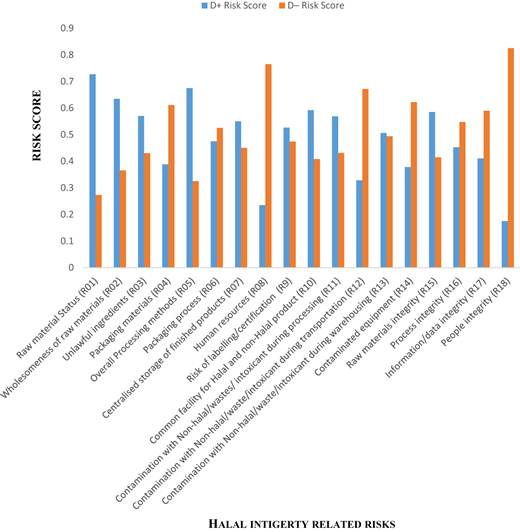
It is clear from Figure 3, that all identified risks are categorised into two groups based on the D+ and D− risk scores. If the D+ risk score risk score represents the degree of severity (membership degree) of the risk is dominates the degree of non-severity of the risk (non-membership degree) and is named as “high priority risks”. While risk score D+ risk score signifies the degree of non-severity risk (non-membership degree) dominating the degree of severity (membership degree) and termed as “low priority risks”. Based on this discussion, the identified risks are categorised as “high priority risks” and “low priority risks.” Amongst the high-priority risks the ranking order as raw material status, overall processing methods wholesomeness of raw materials common facility for halal and non-halal products raw materials integrity unlawful ingredients contamination with non-halal/waste/intoxicant during processing centralised storage of finished products risk of labelling/certification contamination with non-halal/waste/intoxicant during warehousing. These high-priority risks need the instant attention of the supply chain partners to control and mitigate. On the other hand, the order of the low priority risks is: people integrity human resources contamination with non-halal/waste/intoxicant during transportation contaminated equipment packaging materials information/data integrity process integrity packaging process.
The highest rank amongst the higher priority risks is “raw material status” with a D+ risk score of 0.727. The halal status of the product is affected by the status of the raw material in terms of halal and non-halal. Thus, there is a need to assure the raw material status of all the used ingredients. The second highest priority rank is “overall processing method” with a risk score of 0.675. Processing methods-related risks fall under the firm’s control, and they can be mitigated through process improvement and innovation. The next higher priority of the risk is “wholesomeness of raw materials” having D+ risk score is 0.635. The “wholesomeness of the raw material risk” is related to the raw materials, and it can be maintained through the proper selection of suppliers and processing methods. In this row, the next risk is “common facility for halal and non-halal products” with a risk score of 0.592. This risk can be mitigated through the proper ritual cleaning before the production of the halal products. “Raw material integrity” related risk is the next significant risk for the halal supply chain with a risk score of 0.585. The integrity of the raw material can be maintained through the credible supplier and SC partner selection. Next in the hierarchy are unlawful ingredients which are the result of the unavailability of a halal substitute for the corresponding ingredient. This risk can be reduced by developing and/or providing the halal ingredient.
Contamination with non-halal/waste/intoxicant during processing is also related to the product which has a risk score of 0.569. This risk can be mitigated using a separate facility and support system for halal and non-halal products. The next risk is “centralised storage of finished products” with a risk score of 0.550. This risk can be controlled by placing the halal products in the warehouse with appropriate packaging. The “risk of labelling/certification” risk is also one of the major risks in the halal supply chain which should be minimised/eliminated by doing ethical practices and developing standardised processes for labelling. The next higher priority risk is “contamination with non-halal/waste/intoxicant during warehousing” is related to the outsourcing of related risks and has 0.507, which can be controlled by selecting a credible halal-certified warehouse.
Amongst the low-priority risks, packaging material and process integrity have the highest priority with the lowest risk score of 0.525 and 0.5475, respectively. These risks can be mitigated using halal packaging materials for the packaging of the product. The process integrity can be maintained through designing and operating the process as per the standard of the credible certification system. In this hierarchy, the next low-priority risks are information/data integrity, packaging process and contaminated equipment with the D-risk scores of 0.589, 0.611 and 0.622, respectively. The information integrity can be maintained using an efficient and effective traceability system throughout the halal supply chain. The production equipment (knife) and internal transportation facility (trollies) and storage facility (rakes, containers) should be separated or adequately cleaned before use. A standardised process for packaging can reduce the event of contaminated equipment and packaging process. The lowest rank amongst the low priority risks is contamination with non-halal/waste/intoxicant during transportation, human resources and people integrity with the highest D-risk score of 0.671, 0.765 and 0.825, respectively. Contamination during transportation can be reduced by proper packaging of the product and by using halal-certified transportation. Human resource-related risks and people integrity can be reduced by providing the proper training.
7. Implications of this research
The academic and managerial implications of this study are provided as follows:
7.1 Academic implications
This study contributes to the literature on halal from the risk management perspective. It explores and investigates the halal related risk from the supply chain perspective which can help in developing the understanding of risk in the context of halal. The proposed risk management framework guides the academicians to understand risks in other relevant fields. The finding of this study suggests that the major risks are related to the raw materials and processing methods which can be used for developing the hypothesis and robust halal management model. The adopted methodology is different from the contemporary assessment methodologies in terms of handling the expert’s imprecise and incomplete information. This hybrid methodology can efficiently handle imprecise, incomplete and subjective information.
7.2 Managerial implications
This study provides useful insight for the firms to manage the halal supply chain which can efficiently maintain halal integrity. This research explores the major risk element related to the halal supply chain which can help in developing an understanding of the risk from halal perspective. The proposed framework is beneficial for the halal supply chain risk managers to assess halal-related risks and develop their mitigation strategies accordingly. The categorisation of the risks into “low priority risks” and “high priority risks can help in pro-active strategy formulation for the treatment of the risks.” The “high priority risks” such as material-related risks need the immediate attention of the supply chain partner to minimise the breach of halal integrity. The finding suggests that raw material status, overall processing methods and wholesomeness of raw materials are high-priority risks. The raw materials-related risks are minimised through the training of raw material suppliers. The training about halal gives them a clear understanding of the concept of halal and halal integrity assurance. Further, the processing method needs to improve such as the implementation of a blockchain-based traceability system that helps in the reduction of contamination and compliance with the halal standard. The priority of the risks also assists managers in taking better decisions by controlling the high-priority risk in the first place by optimal utilisation of their resources. This study will support halal firms to not only improve profitability but also contribute to tackling major halal-related risks currently faced by firms as well as consumers.
8. Conclusion, limitation and future scope
The primary objective of this study is to manage the risks of the halal supply chain from the perspective of halal. To accomplish the research objective, a research framework for the management of the halal supply chain was proposed. As per the proposed research framework, initially, the eighteen major risks of the halal supply chain have been identified through the extensive literature review and supported by the expert’s opinion. These identified risks are quantified and assessed based on the severity of the risk using a hybrid IFN and D-number technique. Further, these risks are categorised into “high priority risk” and “low priority risk” based on the risk score. Ten risks belong to the “high priority risk” which needs the instant attention of the halal supply partner and the remaining eight risk falls under “low priority risks.” Amongst the high priority, risks such as “raw material status”, “processing methods” and “wholesomeness of raw material” are three major risks while “people integrity”, “human resources” and “contamination with non-halal/waste/intoxicant during transportation” are placed at the bottom of the list. The prioritisation of the risks is helpful to develop strategies to mitigate these halal-related risks.
In terms of research limitations, this study also has some limitations which leave room for future research in the fertile areas of risk management. Although a systematic literature review was conducted to identify the risk, some risks may not have been captured due to limited access to relevant publications. Therefore, more risks could be captured to broaden the scope of systematic literature review in future studies. This study only focusses on the halal integrity-related risk which is another limitation of this study. In future studies, other risks such as production, social and economic sustainability-related risks are also considered for the analysis. In addition to this, the proposed framework is focussed on the risk identification and risk assessment phase but does not include risk mitigation and control. This study could be extended by proposing risk mitigation strategies to control high priority risks. From the methodological perspective, this study utilised expert input which can be biased. Therefore, the expert’s input should be carefully collected and analysed to get a robust result. In this study, the purposed framework is utilised for the evaluation of the halal-related risk. Further, the proposed framework can be utilised to assess the other different risks such as food safety and quality-related risks. The identified risk can be evaluated using another multi-criteria decision-making (MCDM) technique such as type-2 fuzzy integrated AHP, D-number-based TOPSIS and IFN-based ANP. Apart from the prioritisation, the interrelation amongst the risk can be investigated through the ISM, fuzzy-ISM, TISM and DEMATEL methods. The findings of this research can be well validated through multiple case studies.

