The issue that revolves around corporate governance and corporate environmental reporting (CER) has always been an essential element deliberated upon globally. A good corporate governance mechanism instills an investor’s confidence and ensures a transparent process that facilitates more disclosures and quality reporting. Precisely, the purpose of this paper is to investigate the relationship between corporate governance variables, namely, board size, board independence, board meeting (BM), risk management committee composition and CER in Nigeria. This study utilized the data obtained from the annual reports of 24 non-financial public listed companies in the Nigeria Stock Exchange comprising three sectors, namely, industrial goods, natural resources and oil & gas for the period of 2011–2015. The model of this study is theoretically based on agency theory. In analyzing data, this study utilized panel data analysis. Based on the Hausman test, the random effect model was used to examine the effect of predictors on CER. The result indicates a positive significant relationship between board independence and CER. Similarly, a positive significant relationship between BM and CER is revealed in the study. However, there is no significant relationship between other hypothesis variables and CER. Finally, the study provides suggestions for future research and several recommendations for regulators, government and accounting professional bodies.
The data was analysed using statistics.
The result indicates a positive significant relationship between board independence and CER. Similarly, a positive significant relationship between BM and CER is revealed in the study. However, there is no significant relationship between other hypothesis variables and CER.
There are no prior studies linking risk management committee with CER.
Introduction
Historically, the primary aim of traditional corporate reporting is to communicate economic information and measurements about the resources and performance of the company’s financial and non-financial indicators for informed decision making (ASSC, 1975). There are basically two types of corporate reporting, namely, mandatory and voluntary. While mandatory disclosure refers to the disclosure required by laws from regulatory organizations or accounting standards, the voluntary disclosure refers to the information that the company willingly chooses to disclose for different reasons.
In recent years, economic growth and development are perceived to have an adverse effect on the environment, thus it has become a matter of public concern both locally and internationally. The corporate world is increasingly being pressurized to provide more information about the effect of their operation activities on the environment (Uwalomwa, 2011). Thus, corporate environmental reporting (CER) has become an important topic of national and international discourse.
The public demand for more CER has greatly improved, as stakeholders have become more conscious. Pramanik et al. (2008) perceived CER as a “universal issue” with a persistent demand for harmonization of environmental costs and liabilities of accounting reporting.
The corporate environmental report is established to provide environmental information, such as corporate activities in protecting and preserving the natural environment (Shearer, 2002). This report shows the organizations stride toward the environment and strategists adapted to source for alternative measures that are less harmful to the environment. The companies are expected to voluntarily establish a report of their non-financial activities that improved the well-being of human, community, workplace, market and environment.
However, Rouf (2011) argues that CER more at times does not serve the need of external users because top management of the organization are more likely to pursue their personal interests when taken managerial decisions, and the resultant effect is more disclosure gap such as the variance between actual and expected disclosure.
The choice to disclose or not to disclose more information largely depends on several factors like corporate and board characteristics (Sheila et al., 2012). Therefore, the code on corporate governance 2011 was introduced in Nigeria to facilitate quality information presented by corporate entities in Nigeria.
Universally, committee of nations, supranational organization and government have also established their concern over the environment through initiating policies and rules, such as the International Financial Reporting Standard Board (IFRSB), Global Reporting Initiative (GRI)and the Association of Chartered Certified Accountants (ACCA).
For instance, the IFRSB has introduced Financial Reporting Standard (FRS) 101 – Presentation of Financial Statements which require firms to declare their environmental information on human activities that could have an effect on the environment. Conversely, GRI is an organization established not to make a profit but to promote social, economic, environmental and sustainability through developing a framework of sustainability reporting that is widely used globally for all types of businesses, large or small.
It has launched its latest framework in 2013 which is called the G4. This newly improved framework includes a harmonization with other vital global frameworks, including the Organization for Economic Cooperation and Development Guidelines for Multinational Companies, the United Nation Global Compact Principles and the United Nations Guiding Principles of Business and Human Rights.
Previously, there were several studies on CER practices in public listed companies globally with a limited number of studies conducted in Africa, especially in Nigeria. Most of the studies found that CER was done on a voluntary basis (see Ku-Ismail and Ibrahim, 2009; Joshi et al., 2011; Suttipun and Stanton, 2012).
CER among companies has increased such that studies have encouraged future prospect for mandatory disclosure of environmental information (Galani et al., 2011; Suttipun and Stanton, 2012). Recently, some countries for instance China, Denmark, The Netherlands and Norway have made CER as one of the compulsory disclosures in the company’s annual reports.
Environmental reporting issues are considered a vital component of corporate governance. This is in accordance with the new provision of code on corporate governance best practices. To the best of the researcher’s knowledge, there is no comprehensive prior study conducted in Nigeria in the context of examining risk management committee attributes relationship with CER in the three environmentally sensitive industries (Industrial goods, natural resources and Oil & gas).
Therefore, there is a need to have convergence between CER and corporate governance to ensure more environmental reporting disclosures. Irrespective of the importance of corporate governance and its possible impact on organizations to disclose more CER, there are limited studies conducted in this area (Buniamin et al., 2008). Therefore, the study intends to ascertain whether there is any relationship between the board of directors, risk management committee and CER.
Research questions
This study seeks to find answers to the following research questions:
Does board size (BS) influence CER in Nigeria?
Does board independence influence CER in Nigeria?
Does board meeting (BM) influence CER in Nigeria?
Does risk management committee composition influence CER in Nigeria?
Research objectives
The research objectives of this study are as follows:
to examine the BS influence on CER in Nigeria;
to examine the board independence influence on CER in Nigeria;
to examine the BM influence on CER in Nigeria; and
to examine the risk management committee composition influence on CER in Nigeria.
To achieve the research objectives, four board characteristics, namely, BS, board independence, BM and risk management committee composition were chosen.
Theoretical framework
According to Deegan (2002), there is a need to explore into different theoretical perspective to understand the CER and disclosures. Different theories are complementary rather than competing to support the hypotheses (Carpenter and Feroz, 2001). Therefore, this study used agency theory to support the development of hypotheses. Agency theory posits that where there is a separation of ownership and control of a company, agency cost exists. This is due to the conflicts of interest between principal and agent (Jensen and Meclcling, 1976). According to Jensen and Meclcling (1976), agency costs that are being borne by managers may motivate them to voluntarily disclose corporate environmental information to reduce agency costs. Larger information asymmetry would also exist between managers and shareholders if managers do not reveal more information that would benefit the stakeholders (Gantyowati and Nugraheni, 2014).
The objective of the agency theory is to reduce “agency cost” by establishing internal controls systems. This is done in two ways: by forming a financial incentive scheme that aims at aligning principal’s and agent’s interests and governance structure where the board of directors perform audits; and performance evaluations on the managers (Alange and Steiber, 2009). From the corporate governance view, adequate monitoring mechanisms need to be established to protect shareholders from management’s conflict of interests which is called “agency cost” (Fama and Jensen, 1983). According to Peter and Romi (2015) agency theory also suggests that the board’s membership should be independent to better monitor management when disclosing sustainability information especially on the environment.
Determinant variables
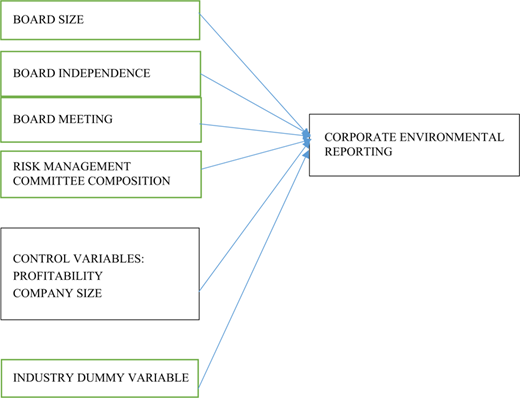
This study examines board characteristics and CER disclosures. The determinant variables include four board characteristics which are: BS, board independence, BM and risk management committee composition. The study used two control variables: profitability and company size.
Based on past literature, the study developed a research framework on board of directors, risk management committee and CER using the board characteristics as presented in Figure 1.
Hypothesis development
Referring to the selected hypotheses variables in the latter section, the study develops four hypotheses to support the research objectives. The detail of each hypothesis is explained in the subsequent section.
Board size
According to Florackis (2008), the board of directors with more than seven or eight members is unlikely to be effective. This is because a larger number of people would tend to disrupt the effectiveness of communication, coordination and decision making. Thus, the end decision would be controlled by top management. However, it is not in tandem with recent studies (Janggu et al., 2014; Zubaidah et al., 2009; Buniamin et al., 2011).
Janggu et al. (2014) found a positive relationship between BS and sustainability reporting. Similarly, a study by Buniamin et al. (2011) found that BS has a positive significant influence on CER disclosure.
It is argued that BS would have a significant influence on CER. This is due to the findings of Buniamin et al. (2011) and Janggu et al. (2014) as to the influence of BS on environmental reporting, this study hypothesizes that there is a positive significant relationship between BS and the existence of environmental reporting:
Companies with more board members are more likely to have a positive influence on environmental reporting disclosures.
Board independence
The quality of personalities who serve on the board is a pointer for effective monitoring. Board independence is perceived to be more efficient if it has more members of independent non-executive directors, they have the incentive to develop their reputation as experts (Fama and Jensen, 1983). The oversight functions performed by such members adhere more to the related approved standards, laws and regulations. This is in tandem with the agency theory view where independent board members would be able to monitor any self-interested actions by managers and lower agency cost (Peter and Romi, 2015).
Several studies (see Htay et al., 2012 and Salehuddin and Fadzil, 2013) found that the board of directors’ independence is very important in the determining the level of CER disclosures. Thus, it is argued that independent directors would influence other directors to voluntary disclose more information about the company to the stakeholders. As such, this study hypothesized that there is a positive relationship between board independence and the existence of environmental reporting disclosure:
Companies with more independent board members are more likely to have a positive influence on CER.
Board meeting
BM is one of the initiatives by the board to perform its oversight function on the management (agent); this is in tandem with the agency theory in which the board members act as the principal. BM serves as a platform to share knowledge and information among experts. This is a crucial and critical resource for the organization.
Prior studies suggest that frequency of the BMs is credited to the number of meetings held annually by the board of directors. As indicated by Chen et al. (2006) BM recurrence reflects sound checking systems. Thus, implies that board practices if carried out by the recurrence of meetings influence the capacity of the board to scrutinize reports to reduce agency problems and improve more quality disclosures (Xie et al., 2003; Knechel et al., 2007). Increase scrutiny and monitoring by board decrease agency cost and information asymmetry and invariably improve quality disclosures (Chou et al., 2013). According to Conger et al. (1998) BM has a significant relationship with CER disclosures. Thus, frequent BMs would improve the quality of corporate disclosures:
There is a positive relationship between the frequency of BM and CER.
Risk management committee composition
Section (10) of the Code on Corporate Governance 2011 in Nigeria provides that the board may establish risk management committee to assist the board in its oversight of risk profile, risk management and risk-reward strategy for the organization. It is a voluntary recommendation not binding on the companies. Risk is a concept used to describe future uncertainty.
Risk management has now become an integral part of corporate governance and is a link to the internal control systems. This awareness has resulted to improve board oversight functions which in turn can enhance the board governance structure, quality reporting disclosures and drastically reduce the scope of the audit committee work (Yatim, 2010).
De Lacy recommended for a separation between the audit committee and risk management committee especially for complex business industries. The complexities associated with the industries expose them to failure (Jarvis, 2005). The quality of individuals who are members of the risk management committee is an important indicator of the effective monitoring of risk matters. The risk management committee seems to be more efficient when there is quite a number of independent non-executive directors (Fama and Jensen, 1983).
Successful companies frequently exhibit a reliable emphasis on risk management. One way to successful risk management is no doubt including the majority of non-executive directors to be part of the committee. Prevention action is the best cure, and non-executive directors perceive and acknowledge how management is taking care of risks (Barde, 2009).
The non-executive directors’ risk management is essentially a problem of acting expressly ahead of time to keep a risk occasion from happening or to reduce its results when it does. The shareholders’ wealth increase if non-executive directors establish a good risk management system and effective business decisions. Methodology and business choices convey risk and a risk-reward system. The outside directors’ role in risk management issues is reflected in the guidelines and rules in numerous districts (Hassan, 2007):
There is a positive relationship between risk management committee composition and CER.
Model of the study
To answer the objective of the study:
where β0 is constant for all entities over the period, CERit = environmental reporting index score for the period, BSit =total number of the board members, BIit = the proportion of independent non-executive directors on board, BMit = frequency of BM held in the company financial year, RCit = the proportion of the independent non-executive directors on the risk management committee, ROAit= net income divided by total asset for the period, TA(log)it= log of total Asset for the period, Dit= industrial dummy variable coded 1 to oil & gas companies and 0 for others, εit = error term for all companies over the period (Tables I and II).
Disclosure score for the environmental reporting index:
Score description of table format.
0 items that are not disclosed.
1 items that are disclosed in qualitative.
1 items that are disclosed in diagram or picture.
2 items that are disclosed in quantitative or financial.
Source: Adapted from Sulaiman et al. (2014)
Linear regression analysis
In the current study, the analysis of linear regression is being utilized as a statistical technique to investigate the relationships that arise amongst the dependent variable and four independent variables comprising BS, board independence, BM, risk management committee composition and the two control variables which are profitability and total asset for 24 listed firms in Nigerian oil & gas, natural resources and industrial goods. Table III reveals the analysis of result for random effects model in the study.
Discussions
As shown by the outcomes in Table III, the rate of R2 in the model is 0.5117. This implies that the model describes 51.17 percent of the difference in CER and is considered as an acceptable outcome.
In an additional finding, the outcomes, Table III displays the three variables in the study that are discovered to be significant with CER predictors (as being measured by CERS). The variables are board independence (BI) (β=0.3530959, p<0.05), BM (β=0.035602, p<0.05) and finally total asset (TA) (β=0.0712573, p<0.1).
Nevertheless, other variables such as BS (β=0.0115358, p>0.1) risk management committee composition (RC) (β=0.0002878, p>0.1) and profitability (ROA) (β=0.0010162, p>0.1) failed to make a significant contribution as CER predictor (CER as being measured using ERI); thus, the significance values higher than 0.1 were revealed to be statistically insignificantly related to CERS.
This suggests that board independence does influence CER based on both normal and additional analyses done on this studies. Another relationship was found between risk management committee composition and the CER (CER) which found that the variable relationship is statistically negatively insignificant as evidence by the p-value of 0.528 (52.8 percent). This suggests that risk management committee composition does not influence CER on companies in the oil & gas, natural resources and industrial goods sectors.
Table III shows that the BS on this regression has a clear positive effect on CER, and the outcome is insignificant. This finding did not support the first H1 that there is a positive significant relationship between board size and CER.
As such, the first hypothesis that mentioned there is a positive significant relationship between the board size and CER is not supported. This result shows that an increase in board size would not increase CER. This outcome is like that found in previous studies that board size has no significant association with environmental disclosures (e.g. Wan Abdullah et al., 2012; Abdul Razak and Mustapha, 2013). This insignificant relationship agrees with most studies that find smaller board size can effectively perform better in CER (Zubaidah et al., 2009).
In addition, the study found a positive significant relationship between the board independent and CER. The findings accept H2 which states that there is a positive significant relationship between the board independence and CER. Therefore, H2 which reveals that there is a positive significant relationship between the board independence and CER is supported. The result discloses that if there is an increase in the number of independent non-executive directors on board, board size, more CER is reported and vice versa.
This result is like that found in several studies (e.g. Htay et al., 2012; Salehuddin and Fadzil, 2013) that board of directors’ independence is very important in the determining the level of CER disclosures. Thus, it is argued that independent directors would influence other directors to voluntary disclose more information about the company to the stakeholders.
For BM variable, this variable has a positive significant relationship on CER. The findings support H3 which revealed that there is a positive significant relationship between the BM and CER. The positive value indicates that when there is an increase in the number of BMs held, more CER is reported and reverse is the case. The outcome is in tandem with previous studies (see Xie et al., 2003; Knechel et al., 2007). Thus, it implies that board practices if carried out by recurrence of meetings influence the capacity of the board to scrutinize reports to reduce agency problems and improve more quality disclosures.
Furthermore, the findings which revealed the relationship between risk management committee compositions and CER are insignificant. The findings failed to support H4 which revealed that there is a positive significant relationship between the risk management committee composition and CER. The positive value indicates that when there is a decrease in the number of independent non-executive directors, more CER are reported and reverse is the case. The outcome is not in tandem with a previous study (Yatim, 2010) that a well-established risk management committee improves board oversight functions which in turn can enhance the board governance structure, quality reporting disclosures and drastically reduce the scope of the audit committee work.
Also, the study adopted two control variables which are profitability and company size. The use of profitability as a control variable is being justified by the findings of companies with various distinct characteristics. Profitability usually would be referred to as one of the indicators to measure a company’s performance. Prior studies would use profitability as their control variables to examine the relationship between financial attributes against CER (Lang and Lundolhm, 1993; Alarussi, 2009; Suttipun and Stanton, 2012). Mix results were found on profitability.
Lang and Lundolhm (1993) view companies with less profit would provide more disclosure on environmental information. Companies might use the condition of having lesser profit as a mechanism of defense toward its stakeholders that less profit means more expenses were made especially for the CER. The result in Table III shows a positive relationship, but statistically insignificant (β=0.0010162, p<0.1) between profitability (ROA) and CER. This was consistent with the study by Makori as mentioned earlier.
The second control variable considered was the company size. Previous studies found a positive relationship between company size and environmental disclosure such as Deegan and Gordon (1996) and Joshi et al. (2011). While size is known for being a representative for company visibility, it also represents the company capability in a financial manner to have social responsibility and environmental activities (Joshi et al., 2011). A recent study by Barbu et al. (2014) examines the mandatory reporting of environmental information in compliance with IASAFRS on three potential countries which are Germany, France and the UK. They found that company size is a relevant proxy for the influential factor against CER on a mandatory basis.
Romlah et al. (2002) and Cornier and Magnan found that large firms lean toward more disclosure of information voluntarily. Sharifah posits that a company that is visible in public has a better possibility to disclose more information to enhance its legitimacy and corporate image. Big companies are more expected to be worried about their corporate environmental performance since they are more visible to external interested parties who always demand for an improved environmental disclosure (Uwalomwa, 2011). As illustrated in Table III, the result displays a positively significant relationship between the company size (TA) and CER (β=0.0712573, p<0.1). This result is consistent with the ones found in previous studies (Table IV).
Implications of the study
This research examined the relationship between corporate governance mechanisms (board size, board independence, BM and risk management committee composition) and CER in Nigeria. The findings of the study would provide invaluable insight to the government, stock market, audit firms, accounting regulators and professional bodies, as to the extent which codes on corporate governance rules and resolutions are implemented by non-financial listed companies especially oil & gas, natural resources and industrial goods sectors. Furthermore, the study provides invaluable information to the government and regulators when making new policies or deliberating on issues regarding corporate governance in relation to CER in Nigeria.
Moreover, the importance of having a good corporate governance practice should be emphasized to achieve credibility and quality disclosures. Hence, the result of the study could improve corporate governance practices by management, and corporate environmental disclosures and reporting in organizations most especially in the oil & gas, natural resources and industrial goods sectors. Finally, the result of this study expedites the need for integrating environmental issues to the investment decision of shareholders.
Limitations of the study
There are very few studies conducted on corporate governance mechanisms (board size, board independence, BM and risk management committee composition) and CER in Nigeria. However, due to the differences in environment and culture between these countries and Nigeria, the results of these studies might not be too suitable to apply in the Nigerian setting. The outcome of the study might not be applicable to all listed companies due to the focus of the research on listed companies perceive to be environmentally sensitive such as the oil & gas, natural resources and industrial goods sectors.
Recommendations for future studies
The limitations of this study have urged the following recommendations for future research:
To enhance the model of this study, future research ought to incorporate other corporate governance variables like risk management committee diligence and knowledge, audit committee size and accounting background, and management ownership. Furthermore, the data for this research cover only listed companies in three sectors (oil & gas, natural resources and industrial goods). Further studies can consider all non-financial listed companies on the Nigerian stock exchange market.
The data utilized for the study are originated from 24 non-financial listed companies in Nigeria with the level of their environmental disclosures. A large data set relating financial and non-financial organizations might convey a substitute model of the relationship that exists between the CER and corporate governance. The introduction of new corporate governance mechanisms might also convey extra edge-worth mixtures of the internal control mechanism.
This research has added impetus to explore corporate governance with CER in a broader context. Further research could explore the relationship in more specific categories, for example, in nonprofit making organizations, government-owned companies and in family business. Since this study focused on three sectors. It would be beneficial to have a clearer understanding of corporate governance roles in other types of organizations. Such research could address the similarities and differences of the roles in different organizations and also consider the legal requirements for different organizations.
Advance studies are also essential on the behavioral features of the boards. Studies in developed countries have recently started examining board processes by attending actual BMs. However, this also needs to be expanded by studies in developing economies. There is therefore the need to go beyond the quantitative research, which yields a mixture of results, to perhaps a more qualitative approach as to how boards work. Expanding this current research into a wider study of board dynamics and decision making would be a start in developing a better understanding of corporate governance.
Future study could also explore the perception of stakeholders on corporate social reporting, as it is evidenced that there is no standard template in Nigeria that serves as a guide for the preparation of corporate social reporting. The study could have harmonized views of stakeholders on what are their expectations and areas they felt is below standard benchmark peculiar to Nigerian setting.
Conclusions
The study examines the relationship between some corporate governance variables (board size, board independence, BM and risk management committee composition) and CER has been accomplished. Based on the outcome of the panel data analysis, two variables namely board independence and BM are found to have a positive significant relationship with the CER and the other hypothesis variables are insignificant.