We investigate the relation between political connections and the level of financial distress based on Indonesian listed companies from 2010 to 2022 in two different regimes.
The final sample is 3,505 firm-year observations. To estimate the associations, we apply Ordinary Least Squares (OLS) regression, Logistic Regression, Stratified Analysis, and several additional tests, including endogeneity tests using the generalized method of moments (GMM).
The results show that firms with politically connected board of commissioners experience higher levels of financial distress. Additionally, we find that politically connected firms face greater financial distress during leadership transitions due to political instability and policy changes.
We limit our investigation on SBY (Susilo Bambang Yudhoyono) and JKW (Joko Widodo) regimes. Another limitation is political connection information which relies on information published in the annual report. Also, we only use the Altman Z-score model to estimate financial distress.
We extend the literature by highlighting the interplay among political connections, political regimes, and financial distress. Additionally, our study has implications for policymakers to improve corporate governance regulations by considering political factors.
We first address the impact of political connections via board of commissioner members on financial distress in two different regimes in an emerging economy.
1. Introduction
The purpose of our paper is to examine the relationship between political connections and the level of financial distress in two regimes in Indonesia from 2010 to 2022. Globally, political connections are a crucial factor in the business world, particularly in developing countries (Aney and Banerji, 2022; Joni et al., 2020a). Generally, political connections are established through top management who has affiliation with politicians or other political entities. In our study, a politically connected firm is defined as a company with at least one of board of commissioner members who are current or former ministers, member of parliament, military, or other types of local and national government officers (Faccio, 2006; Joni et al., 2020a) [1]. Indonesian context is applied due to the nature of corporate governance landscape affected by political connections. The economic uncertainty and political volatility in Indonesia are relatively high, leading many companies to seek protection by establishing political connections (Basri and Hill, 2020). In general, political connections are established through political people who are appointed as supervisory board members within the dual-board system (Joni et al., 2020a).
Several studies have investigated the costs and benefits of having political connections across countries, including their effects on financial distress (e.g. Candra and Joni, 2025). Financial distress refers to a situation in which a company faces doubts about its financial concerns. While several studies show that politically connected supervisory boards improve performance through their monitoring function by focusing on the risk of financial distress, other studies have reported opposite results (e.g. Candra and Joni (2025). Politically connected firms may prioritize political objectives over company value, leading to higher labor costs and lower profitability (EL Ammari, 2023). Consequently, firms with a more politically connected supervisory board are associated with a higher likelihood of financial distress. This study differs from previous research in Indonesian (e.g. Candra and Joni, 2025) and international (e.g. Nguyen et al., 2023) contexts for several reasons. First, we highlight the impact of political connections on financial distress levels in two different regimes in Indonesia, while prior studies (e.g. Candra and Joni, 2025; Nguyen et al., 2023) did not address the issue of regime changes. The time frame of our study is from 2010 to 2022, which includes the second period of Susilo Bambang Yudhoyono [SBY] (2010–2013), the two terms of Joko Widodo’s presidency [JKW] (2014–2022). During the second term of SBY and the two terms of Joko Widodo, there were significant differences in the targets of the State Budget (APBN). The APBN targets during Joko Widodo's era were larger than those during SBY's regime, focusing on infrastructure, education, and health sectors (Davidson, 2021). These policies have an impact on companies during both presidencies, potentially influencing corporate operations and increasing operational costs, leading to financial distress or even bankruptcy. Empirical research indicates that leadership transitions can result in many different regulatory changes in a democratic country, affecting a company’s going concerns (Setiawan and Tomsa, 2022).
Second, we focus on the role of the politically connected board of commissioners in the dual-board system context. Unlike the one-tier board system in Western countries, a two-tier board system consists of directors who conduct the operations of the company and a board of commissioners who supervise and monitor management (Joni et al., 2020a). Separating the roles of board of director and board of commissioners can improve transparency and monitoring function. It is an interesting issue to identify the effective of political board of commissioners within the dual board system context. Third, the timeframe of our study was 2010–2022. We apply long panel data to explore how politically connected companies can withstand economic instability caused by different presidential periods and avoid financial distress.
Following the introduction section, we proceed with Section 2, which covers hypothesis development. Section 3 discusses the research methods, and Section 4 presents and discusses the empirical test results. Section 5 discusses and presents additional analytical results, and Section 6 concludes the paper.
2. Hypothesis development
2.1 Politically connected board of commissioners and financial distress
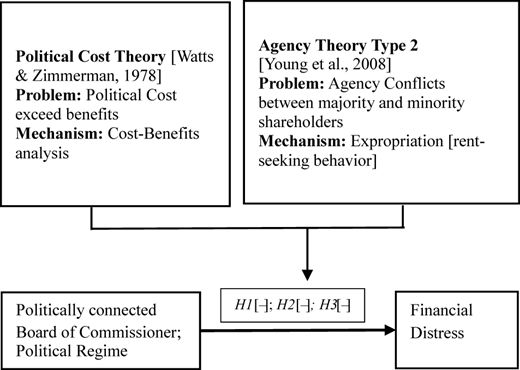
Several theories explain the relationship between political connections through the supervisory board and the level of financial distress, such as the Agency Theory (ATE), Rent Seeking Theory (RST), and Political Cost Theory (PCT). ATE type 1 posits that an agency conflict arises between the owner (principal) and the manager (agent) to run business operations due to asymmetrical information (Jensen and Meckling, 2019). However, in emerging countries, such as Indonesia, ownership structures are concentrated. This creates potential conflicts between the majority and minority shareholders, known as Agency Theory Type 2 (Joni et al., 2020a). In view of ATE type 2, the presence of a politically connected board of commissioners in Indonesia can be harmful because of rent-seeking behavior. It is possible that the controlling owners appointed the political board of commissioners as a vehicle to expropriate minority shareholders. This argument is in line with RST. Next, PCT explains the cost of political connections (Watts and Zimmerman, 1978). Firms need to incur political costs to build political connections, which can be higher than the benefits that companies can have. Therefore, the presence of politically connected commissioners in developing countries can increase the level of financial distress because of rent-seeking behavior and unmanageable political costs.
Prior studies also (e.g. Yousaf et al., 2024) argue that firms with political connections experience higher financial distress risk. This is because political connections can intervene in company operations to prioritize political objectives over corporate value. Aney and Banerji (2022) find that politically connected executive boards can worsen inefficiency and hinder the development of private securities markets during economic crises. Candra and Joni (2025) also argue that companies with political connections in top management positions may engage in rent-seeking, thereby increasing company costs in the form of political expenses, including labor costs and other expenses for political purposes. EL Ammari (2023) reported that political connections in companies lead to decreased company performance. This aligns with PCT, where top management with political connections increases the political costs to maintain political relationships within a company. Therefore, the greater the number of politically connected supervisors, the higher the likelihood of a company experiencing financial distress. Based on theoretical development and prior empirical studies, the following hypothesis is proposed (see Figure 1):
Firms with politically connected board of commissioners experience higher risk of financial distress
2.2 Politically connected board of commissioner, political regimes and financial distress
While prior research has examined the relationship between political connections and financial distress (e.g. Aney and Banerji, 2022; Candra and Joni, 2025), few studies have addressed how political regimes affect this association. In Indonesia, the transition of political regimes is an important issue, especially when regimes are changing. In 2014, leadership transitioned from Susilo Bambang Yudhoyono (SBY) to Joko Widodo (JKW). SBY's leadership spanned two decades, from 2004–2010 and to 2010–2014. During SBY's first decade (2004–2010), there was political and policy uncertainty. However, SBY's leadership also saw increased trade, which provided Indonesia with economic stability (Basri and Hill, 2020). Indonesia experienced a global crisis in 2008 that led to economic instability until 2009. Therefore, in SBY's second decade (2010–2014), he was responsible for restoring Indonesia's economic stability, which was affected by the global crisis (Joni et al., 2020b). To address the global crisis and enhance Indonesia's economic stability, the SBY implemented new policies to attract investors with more appealing offers compared to other countries (Law No. 25 of 2007). Additionally, the government began to establish laws for limited liability companies and social and environmental responsibilities as part of corporate accountability for operational activities to increase investor appeal (Law No. 40 of 2007). This was further developed with Law No. 32 of 2009 on environmental protection.
After SBY's regime ended in 2014, the leadership transitioned to JKW. Regime transition can cause political instability and policy uncertainty. During the JKW regime, Indonesia implemented deregulation packages to increase private sector investments by developing public infrastructure (Basri and Hill, 2020). However, the government promoted policies that raised restrictions on foreign investment in certain industries. Consequently, it increases the level of financial distress. In JKW’s regime, market competition has increased, which lead to financial difficulties (Basri and Hill, 2020). Also, new regulations can affect company performance negatively. For instance, changes in import regulations influence company operation negatively and increase the risk of financial distress due to difficulties in importing and exporting certain items.
Political regime is directly associated with corporate outcomes (Siaroff, 2022; Ullah and Kamal, 2022). Nurfalah and Rusydiana (2021) find that regime shifting in Indonesia increases financial instability. This is due to political and policy uncertainty. EL Ammari (2023) argues that firms with politically connected boards fall into rent-seeking behavior, leading to higher operating costs and lower firm performance. This is also consistent with PCT which argues that politically connected firm through board of commissioners can increase political costs, including expenses for political purposes such as campaigns. Next, the change of political regimes can cause more political costs. As a result, they experience higher likelihood of financial distress. Based on the above explanation, the author proposes the following hypothesis (see Figure 1):
Presidential transitions from SBY to JKW regimes increase companies’ risk of financial distress.
Firms with politically connected commissioners experience a higher risk of financial distress under both the SBY and JKW regimes.
3. Research design
3.1 Data and sample
We use secondary data consisting of financial and non-financial data. Financial data were obtained by extracting information from Refinitiv Eikon databases. Non-financial data were manually obtained through company annual reports, websites, and Google searches. For instance, political connection data were collected in several steps. First, we checked the annual reports of the company. Specifically, in the background of Board of Commissioners section, we explore whether they have political status or political careers. Then, we applied the Google search engine and website searching to investigate the BOD or BOC background. If a company has a BOD/BOC with a political background, we define them as politically connected firms. Our sample consists of Indonesian listed companies from 2010–2022, excluding the financial industry, due to its different regulations compared to other sectors. This includes the transition from SBY's leadership to Joko Widodo's (JKW) leadership. The details of the sample distributions are presented in Table 1.
3.2 Variable definitions
3.2.1 Dependent variable
To measure the level of financial distress, we used the Altman Z-Score (ZSCR). ZSCR is a robust model which has been applied in many different industries (Rashid et al., 2023). The higher the Altman Z-score, the lower the likelihood of financial distress (Altman et al., 2019). The formula is as follows:
A detailed description of each variable is presented as follows:
X1 = working capital/total assets; X2 = retained earnings/total assets; X3 = earnings before income and tax/total assets; X4 = market value of equity/book value of debt; X5 = sales/total assets
3.2.2 Independent variables
Our independent variable is politically connected board of commissioners (PC-SB). Political connection is measured by the percentage of board of commissioners with political connections, including former or current officials, such as ministers, military members, parliament members, and other bureaucrats at the local or central government levels. The second independent variable is regime (RGYM), measured as a dummy variable, where 0 represents SBY's leadership period (2010–2013) and 1 represents Jokowi's leadership period (2014–2022).
3.2.3 Control variables
This study used several control variables that can influence a company's financial distress, as indicated by prior studies (Guizani and Abdalkrim, 2023; Wan et al., 2023; Elsayed and Hassanein, 2024; Hassanein et al., 2024; Yousef et al., 2025; Hassanein and Albitar, 2025; Xing et al., 2025. The control variables included in the models are the size of board members (BCZE), company age (FAGE), company size (FSIZ), leverage (LVRG), state-owned enterprises (SOE), industry (INDY) and year (YIR) fixed effects. While state-owned enterprises and firms with higher leverage increase business risks, it is expected that firms with larger board members and size, and older, can reduce the likelihood of financial distress.
3.3 Regression model
We investigate the relationship between politically connected commissioners and the level of financial distress in two different regimes, based on Indonesian listed companies from 2010–2022 using ordinary least squares regression. Next, our study tests our main model using a sub-sample analysis model (stratified analysis) to explore the association between politically connected commissioners and financial distress during SBY's leadership period compared to Jokowi's leadership period. The main research model is as follows:
The definition of all variables is presented in Table 2.
3.4 Additional tests
Several additional tests are applied to check the robustness of our models. First, we categorize our sample into three sub-samples: SBY’s regime in the period of 2010–2013; JKW’s first regime from 2014–2018; and JKW’s second regime from 2019–2022. Second, we measure financial distress using dummy variables, where 1 is for firms with a lower likelihood of financial distress (Z-Score >1.81) and 0 is for firms suffering from financial distress (Z-Score ≤1.81). We then ran the model using logistic regression. Third, the endogeneity problem was addressed using a Generalized Method of Moments. It is possible that firms with a higher likelihood of suffering from financial distress tend to have more connections with the government to provide more protection. Fourth, other additional tests are used to enhance the quality of our estimations, including the interaction effect between industry and year [INDY*YIR], etc.
4. Empirical results
4.1 Descriptive statistics
Table 3 presents the summary of descriptive statistics based on 3,505 firm-year observations. Table 3 shows that the average ZSCR is 1.385, with a minimum value of −1.320, a maximum value of 3.845, and a standard deviation of 1.289. This means that the average company listed on the IDX from 2010–2022 experienced financial difficulties. This value is consistent and within a reasonable range compared to previous studies Guizani and Abdalkrim (2023). Furthermore, the average PC-SB value is 0.131, with a minimum value of 0, maximum value of 1, and standard deviation of 0.228. These values are within a reasonable range compared with previous studies, such as Joni et al. (2020a), and Dharmawan et al. (2024). Table 4 reports the results of Pearson’s correlation test among key variables. The highest correlation is between RGYM and FSIZ (0.618). Also, we conducted the Variance Inflation Factor (VIF) method to check for multicollinearity, as shown in Table 4. The results indicate that all models are free from multicollinearity issues, with VIF values < 10.
4.2 Politically connected board of commissioners and financial distress
Table 5 shows the results of the ordinary least squares regression to examine the effect of politically affiliated board of commissioners (PC-SB) and political regimes (RGYM) on company financial distress (ZSCR) in model 1. Table 5, Model 1, shows that PC-SB has a significant negative impact on ZSCR at the 1% level, with a coefficient of −0.682 and a t-value of −7.24. A coefficient of −0.682 implies that a one standard deviation increase in politically affiliated commissioners leads to an increase in financial distress by 155 basis points (−0.682 [Coefficient]*0.228 [SD]). Similarly, RGYM has a significant negative impact at the 1% level, with a coefficient of 0.400 and a t-value of −2.28. In addition, it is economically significant that financial distress will increase by 150 basis points (−0.400 [Coefficient]*0.377 [SD]). Therefore, it can be concluded that the overall results support H1 and H2.
Our findings are consistent with previous research on the impact of political connections on company financial distress, such as Candra and Joni (2025), Aney and Banerji (2022), and EL Ammari (2023) which found that companies with political connections in top management, particularly the board of commissioners, are associated with higher levels of financial distress. Thus, the stronger the political connections within a company's governance system, the higher the risk of financial distress due to rent-seeking behavior, which increases political costs without providing commensurate returns. This is in line with PCT, RST and ATE, which state that the larger the company and the stronger the political connections, the higher the political costs incurred to maintain these relationships and cause rent-seeking behavior (Watts and Zimmerman, 1978).
Table 5 also shows that presidential leadership transitions are associated with companies’ level of financial distress. This is in line with previous research (Nurfalah and Rusydiana, 2021; EL Ammari, 2023). It is argued that the risk of financial distress increased during the JKW's presidency transition due to political and policy uncertainty resulting from the presidential transition. This is evidenced by the emergence of new policies during JKW's period, which could hinder company operations, such as changes in import regulations that restrict company activities due to difficulties in importing raw materials, especially manufacturing companies (Minister of Trade Regulation No.3 of 2024), changes in regulations on export foreign exchange requiring 30% of export foreign exchange to be placed in the Indonesian financial system for three months (Bank Indonesia Regulation No.7 of 2023), and the omnibus law, which introduces the online single submission (OSS) system for licensing, but still faces many implementation challenges (Law No.11 of 2020).
4.3 Politically connected board of commissioners and financial distress in two different regimes
We also examine the association between politically connected board of commissioners and financial distress in two different regimes: SBY and JKW. Table 5 Model 2 is the result of the OLS test between the PC-SB variable and the ZSCR variable during the SBY's leadership period from 2010–2013 to, with 601 company observations. Table 5 Model 2 reports that during SBY’s leadership period, politically affiliated company commissioners had a significant negative impact at the 1% level, with a coefficient value of −0.943 and a t-value of −3.24. Table 5 model 3 is the result of the OLS test between the PC-SB variable and the ZSCR variable during JKW's leadership period from 2014–2022, with 2,904 company observations. Table 5 model 3 finds that during JKW's leadership period, politically affiliated company commissioners had a significant negative impact at the 1% level, with a coefficient value of −0.610 and a t-value of −6.03. Thus, it can be concluded that the overall statistical test results support hypothesis 3.
Our findings are in line with Incerti and Incerti (2024) stated that presidential transitions impact corporate governance due to political and policy uncertainty. Policy uncertainty can arise from policy changes from SBY's regime to JKW's regime. For example, during SBY's leadership, several new policies impacted on companies, such as policies on corporate environmental responsibility, including environmental management, and the management of hazardous waste and contaminated material resulting from company operations (Government Regulation No.101 of 2014). After companies adjusted to the new policies created during SBY's leadership, the leadership transitioned to JKW. Similarly, JKW introduced several new policies that impacted companies. For example, the Omnibus Law introduced an online single-submission system to simplify licensing (Law No.11 of 2020). JKW also updated import regulations (Minister of Trade Regulation No.3 of 2024), which affected the operational activities of companies that require imported raw materials. As a result, many companies have built political connections to minimize the impact of policy instability during presidential transitions. However, establishing political connections requires costs as described by PCT. In line with PCT, it is argued that companies with strong political connections tend to have high political costs that can increase the likelihood of financial distress.
5. Additional tests
We conducted an additional analysis test by dividing the sub-sample into three parts: SBY's leadership period from 2010–2013, JKW's leadership period from 2014–2018, and JKW's leadership period from 2019–2022. Also, we run an additional analysis using logistic regression. Next, our study addressed endogeneity issue using the generalized method of moments (GMM) analysis. Additionally, several additional tests were performed in the present study. First, to ensure the robustness of our study, we winsorized the continuous variables at the 2nd and 98th percentiles. Second, we estimate our main model by considering the interaction between industry and year [INDY*YIR]. Third, we added the interaction between political connection [PC-SB] and regime [RGYM]. Fourth, we separated our sample into state-owned enterprises (SOE) and non-SOEs. Overall, the results of all the robustness tests are consistent with the results in Table 5 [2] (See Tables 6–9).
6. Conclusion
We show that politically affiliated commissioners and presidential leadership transitions are associated with financial distress in Indonesian companies. Further analysis reveals that companies with politically affiliated commissioners were associated with higher financial distress during presidential transitions in Indonesia. This indicates that politically affiliated commissioners have not yet performed their monitoring functions and optimized their social networks for the company but have instead prioritized political objectives. Additionally, politically connected companies tend to have higher political costs to gain certain advantages. However, the benefits obtained, such as government aid funds and easier access to loans, do not match the costs incurred by the company, thus failing to help minimize the risk of financial distress.
Several implications are defined in our study. First, we extend the literature by showing the interplay among political connections, political regimes, and financial distress. Second, our study also has implications for policymakers. It offers a guideline to enhance the effectiveness of Indonesia's dual board mechanism. Specifically, firms can be required to have the mandatory disclosure of political connection information to improve transparency. Additionally, to prevent excessive influence, regulators can limit the number of politically connected board members. Third, investors can consider the presidential transition as a critical factor when making investment decisions. However, our findings should be interpreted by considering several limitations. First, we rely on information about political connections disclosed in companies' annual reports which cannot capture the undisclosed political relationships. Second, our study only explores the Susilo Bambang Yudhoyono and Joko Widodo regimes. Third, we limited our measure of financial distress using the Altman Z-score model. Future research can address these limitations. For example, qualitative studies can provide deeper insights into the nature and substance of corporate political connections, beyond what is disclosed in annual reports. Additionally, expanding the timeframe to include other political regimes can provide a more comprehensive understanding of how different regimes affect the relationship between political connections and financial distress. Lastly, to ensure consistent interpretation of the Altman Z-score direction, future studies can add a robustness test with the Ohlson O-score and Zmijewski.
Notes
Board of Commissioners (BOC) in Indonesia is similar to Supervisory Board in the context of dual board system. In our paper, we use the terms board of commissioners and Supervisory Board interchangeably.
The results of additional tests are provided in Tables 6–9.