The purpose of this paper is to gain insights into the gap between management accounting professional’s role and the societal expectations of the management accounting professionals in Sri Lanka.
A quantitative research approach was adopted to identify the statistical gap of the management accountant’s role and society’s expectations. Four business sectors were selected from Colombo Stock Exchange as of 31 December 2018. Sample consisted of 160 entities; 480 questionnaires were distributed among three stakeholders (financial accountant/manager, management accountant and human resource manager). Out of the 228 responses received, only 171 responses were usable. Exhibiting an overall response rate of 35.6 per cent.
The role expectation of management accountants varies significantly across the selected business sectors in Sri Lanka. There is an increasing demand for contemporary management accounting skills in Sri Lanka.
The insights of this study would be of use to policy makers and policy implementers to examine and develop remedial measures to enhance the creditability and transparency of the management accounting profession in Sri Lanka. Academic and professional educational providers can identify future trends and necessary skills of management accounting to improve management accounting curriculum.
The evidence from this study contributes to the literature of societal importance of management accounting from a Sri Lankan perspective.
1. Introduction
Over the past decades, there have been drastic changes in the field of management accounting (Gaffikin, 2009; Shotter, 2001). Contemporary management accounting practices have emerged, such as balance scorecard, activity-based costing (ABC) and life cycle costing (Adler et al., 2000; Tempone et al., 2012). In the beginning of the twentieth century, management accounting was considered as a mere information tool to communicate the relevant details of business valuation in the short term and the extent of the value created in the short term (Friedman, 1970). In the latter part of the twentieth century, corporates began to address the issues of the macro-factors affecting the business (Berry et al., 2009; Cordery, 2013; Scapens, 2006) and management accountants considered themselves as business advisors, and this encouraged management accountants to make better decisions that will benefit the overall society (Sharma et al., 2014). Several practicing accountants have focused on providing service of information on sustainable business practices, stakeholder management and integrated reporting (Scapens, 2006; Sharma et al., 2010; Tan et al., 2004). Remarkable developments in management accounting have encouraged researchers to advance the understanding on how and when management accounting practices should be applied and further study the implications of such practices on organisations (Ratnatunga et al., 2015). Such developments do not lead to the equivalent level of interests in examining the management accounting profession, most of the academic literature focus on understanding the management accounting profession itself (Messner, 2016; Siegel and Sorensen, 1999).
The objective of this study is to provide empirical evidence on the skills and knowledge that a management accountant should possess across different market segments of Sri Lanka. Findings of this study can assist in identifying the management skills in demand for a particular sector and develop educational programs to cover emerging areas and skills of management accounting.
Numerous academic literature on examining the relationship between management accounting profession and the societal expectations are available; however, these are mostly examining the business context of developed nations. This research would advance the understanding of the relevance of management accounting as a profession through examining the perspectives of different stakeholders of different Sri Lankan organisations in different business sectors. Understanding the perspectives of management accountant’s role and skill set requirement of different stakeholders is important to determine the future direction of management accounting profession in Sri Lanka. Insights from this study can assist in identifying the demand for unique management accounting skills required by particular industry. Furthermore, there is dearth of studies in this in area, focusing on the Asian business environment, particularly focusing on Sri Lankan context. In order to fill the gap in the literature, this paper presents a study on Sri Lankan management accountant’s role and the societal expectations. This paper mainly examines the necessary skills and knowledge which management accounting professionals are expected to possess. The findings of this study would help management accounting professionals to understand future skill requirements of the profession, and management accounting educators can extend and include the skills into the education programs. This study also examines the demand for selected skill set in demand for management accounting professionals.
2. Review of literature
2.1 The history of management accounting
CIMA (2005, p. V) defines “Management accounting is the application of the principles of accounting and financial management to create, protect, preserve and increase value for the stakeholders of for-profit and not-for-profit enterprises in public and private sectors”.
The birth of management accounting can be traced to the Industrial Revolution, which originated in the West in the eighteenth century. During that era, textile mills, railroads, steel mills of the yesteryear developed measures such as cost per yard of fabric, cost per pound of spun cotton, cost per gross ton-mile and cost per passenger mile to assess the internal efficiency. During the mid-nineteenth century, a group of engineers led by F.W. Taylor developed standard costing mechanism. In the twentieth century diversified DuPont Corporation, developed a practice of examining components of the cost ratios to identify the root cause of the adverse cost variations, this form of analysis is still in practice in the modern corporations. During the latter part of the twentieth century, the development of accounting and auditing standards, preparation of formal financial statements and emergence of stock market and regulatory requirements took precedence over management accounting. The development of management accounting was hindered due to the after effects of oil shock and stagflation of the 1970s. However, the birth of neo-liberalism breathed new life into management accounting development. Neo-liberalism forced organisations to offer diversified high-quality products and services at low prices in order to stay competitive. Complexity, diversity and rapidity of the business environment made the existing management accounting practices inadequate to meet the needs and challenges of the modern business era. Modernised business world paved a path to modern management accounting practices such as ABC, cost of quality computations, target costing, balanced scorecard, life cycle costing, Kaizen costing, value chain analysis and product life cycle analysis. In an emerging era of customer orientation and digitalisation, organisations are forced to adopt such modern management accounting practices in order to stay competitive and survive in the modern business environment (Chandler, 2005).
2.2 Management accounting in Sri Lanka
Moore (1997) stated that in the late 1980s, large inflow of foreign direct investments came into Sri Lanka, encouraged the development of commercial markets, which, in turn, led to the steady growth of public and private sectors. Large-scale privatisation programmes were developed in the industrial, plantation and service sector organisations. This caused extensive competition in many industries and service sectors. In order for the organisations to provide high-quality products at competitive prices, the adoption of modern technology and new management accounting principles and practices were inevitable (Fonseka, 2017).
Currently, the General Certificate in Education Advance Level accounting curriculum contains 20 per cent of cost and management accounting. During the period of 1977–2017, Sri Lanka experienced momentous changes in the area of Commerce and Accounting education and training. The state universities presently provides nine Accounting and Finance degree programmes. Global and local professional accounting bodies have strengthened their presence by increasing their academic and professional activities in Sri Lanka (Fonseka, 2017).
Chartered Institute of Management Accountants of UK (CIMA-UK)
CIMA was founded in 1919. It is the largest professional body of management accountants in the world. Operating in 177 countries with a student population of 175,372 and member population of 106,095 worldwide as of 2016. CIMA-UK is a member of International Federation of Accountants (IFAC) (The Chartered Institute of Management Accountants, 2016).
Institute of Certified Management Accountants of Sri Lanka (ICMASL)
Initially, Society of Management Accountants was inaugurated on 3rd June 2000, as per the guidelines of Society of Management Accountants of Canada, the Institute of Management Accountants of USA (IMA) and the IFAC. Later, it was established by Act of Parliament No. 23 of 2009 as Institute of Certified Management Accountants of Sri Lanka. ICAMSL is a member of IFAC, Confederation of Asia and Pacific Accountants (CAPA) and South Asian Federation of Accountants (SAFA). ICMASL has a student base of 15,000 and a member base of 2,064 island wide as of 2017 (ICMASL History, n.d; Institute of Certified Management Accountants of Sri Lanka, 2017).
Chartered Accountants of Sri Lanka (CASL)
The Institute of Chartered Accountants of Sri Lanka (CASL) was incorporated by the Act of Parliament No. 23 of 1959. CASL has the sole authority for adopting accounting and auditing standards in Sri Lanka. CASL has 5,526 members and 39,456 students as of 2017. CASL is a member of IFAC (Chartered Accountants of Sri Lanka, 2017).
CASL is considered as the National body of accountants in Sri Lanka and ICMASL is the only and prominent national body for management accountants.
2.3 Management accounting as a profession
Defining profession is a controversial matter and defining management accounting as a profession is a tedious task. There is no universally accepted list of attributes that should be included in defining a profession. However, a unique body of knowledge is one of the main attributes of a profession as well as the power by the professional bodies to control the practice and the persons who are involved in the practice (Adams, 2010; Birkett and Evans, 2005). Furthermore, Greenwood (1957) identified five key attributes that construct a profession, and these can be listed as follows: a systematic body of theory, professional culture, professional authority, sanction of the community, a regulative code of ethics and professional culture. Passage of time created more attributes that defined a profession such as sense of duty (Greenwood, 1957), a fiduciary relationship with clients (Lewis and Maude, 1973), loyalty to colleagues (Drinker, 1954) and rewards based on work achievement (Barber, 1963). Goode (1957) stated that the absence of characteristics such as prolonged special training, a formal body of abstract knowledge, a collective orientation to public service and collective self-control cannot constitute to a profession.
In UK, in terms of acquiring a body of knowledge, professionals who fulfil the rules and regulations of particular professional bodies are admitted as members of that bodies. As a sanction to the community, professional designations and post-nominals are attached to the membership (Parker, 2005). CIMA-UK grants membership to individuals who fulfil their educational and practical requirements. Two post-nominal membership grades are attached to a common professional designation (Chartered Management Accountant), depending on the practical experience of the professionals. The membership grades are as follows: Associate Chartered Management Accountant and Fellow Chartered Management Accountant (Ratnatunga et al., 2015). Sri Lanka was a British colonial country, and even after attaining independence, certain British influences over the governmental, legal and regulatory practices can be witnessed. Similarly, ICMASL adopts and follows the structure and requirements of CIMA-UK. However, ICMASL does not have “Charter” membership; therefore, the common professional designation will be “Certified Management Accountant”. The two post-nominal membership grades will be similar to that of CIMA-UK. Both ICMASL and CIMA-UK have a stringent code of ethics and best practices that all members should strictly adhere, and any deviations or malpractices can lead to permanent termination of membership privileges. In order to maintain the body of knowledge, annually all members are required to partake in “Continuous Professional Development Programs”. It is evident that members of both management accounting bodies, depict traits of profession supported by the literature.
However, the legal and power status of management accountants is a debatable matter. Even though numerous management accounting bodies exist in different countries, the level of government recognition and support given to management accounting bodies varies. Institute of Management Accountants of USA (IMA-US) does not receive any formal recognition from government. Management bodies in Canada, Sri Lanka and UK are incorporated by legislations. Even though such entities are governed by legislations, the legislations does not forbid individuals who are not members of the above management accounting bodies from engaging in management accounting practices. However, India, Pakistan, Bangladesh and Papua New Guinea only members of the respective management accounting bodies can engage in regulated management accounting practices (Ratnatunga et al., 2015).
Neoinstitutional theorists suggest that institutions of similar nature tend to adopt similar template of institutions over time as they conform to their societal expectations. Legitimacy theory suggests that institutions conforming to societal expectations is to achieve societal legitimacy (Greenwood et al., 2008). Similarly, members of IFAC have to follow the rules, regulations and procedures laid down by IFAC.
Wilensky (1964) claimed that if the boundaries between professionals and non-professionals could not be clearly established, then everyone might be considered as a professional. Professionals are expected as institutional actors embedded in a complex environment of related institutions (Suddaby and Viale, 2011). It was observed that Sri Lankan organisations are given a free hand to adopt and implement management accounting practices that most suit their needs. However, when recruiting individuals for management accounting or accounting vacancies, organisations depending on the dexterity of the job role, require individuals to be either partly or fully complete the requirements of the professional accounting bodies. Some multinational and national corporates in Sri Lanka only recruit individuals who have obtained full membership in the required accounting bodies. Such requirements by Sri Lankan corporations imply that management accountant is a formal profession in Sri Lanka.
2.4 Role of management accountants and development of the hypotheses
There are numerous literature debating the stance and the roles of management accountant (Byrne and Pierce, 2007; Ten Rouwelaar and Bots, 2008). Prior literature also indicate that the role of management accountant has evolved from “bean counters” to “business advocates”, supporting the senior management (Burns and Baldvinsdottir, 2005; Caglio, 2003; Jablonsky and Barsky, 2000). Contradicting the above view, there is evidence that support the view that “bean counting” is an important function of management accountants employed in small-sized enterprises (Albu et al., 2008; Verstegen et al., 2007; Zoni and Merchant, 2007). Multinational organisations customarily recruit professionals with special expertise to manage organisational management control systems. These professionals are referred to as “controllers”, “financial managers”, and “management accountants” and such expert professionals play a significant roles within an organisation when exercising their power (Ezzamel and Burns, 2005; Granlund and Lukka, 1998; Lambert and Sponem, 2005). In various circumstances, it can be observed that management accountants attempt to change their roles in a particular direction, to obtain a new set of responsibilities (Morales and Lambert, 2013). Hilton and Platt (2011) stated that management accountants are considered as strategic business partners in local and international business teams within the organisations. The primary purpose of management accounting in the organisation is to assist management to enhance their process by collecting, processing and communicating the processed information. The term “accounting” in management accounting does not merely indicate recording of financial transactions.
Prior literature indicate that the role of management accountant is influenced by various macro-factors. Introducing modern techniques (Emsley, 2005; Friedman and Lyne, 2001) and information technology (Caglio, 2003; Dechow and Mouritsen, 2005; Jack and Kholeif, 2008; Scapens and Jazayeri, 2003) have drastically affected the functions and the role of the management accountant. It is pertinent to note that uncertain and volatile business environment has caused the demand and expectations of stakeholders to vary from time-to-time (Pierce and Odea, 2003), thus, increasing the work responsibility of management accountants from collecting and reporting information to interpreting and advising managers (Granlund and Lukka, 1998). Management accountants to facilitate decision-making (Johnston et al., 2002) and contribute to strategy formulating (Tillmann and Goddard, 2008; Yi and Tayles, 2009).
It is vital to understand the macro-economic factors influencing the role of management accountants but it is also necessary to comprehend why a role change occur within the organisation on a micro-level. Furthermore, it is important to establish the linkage between the micro- and macro-level factors. First, the role of a particular individual in an organisation is determined by the purposive actions/institutional work of that individual. For instance, the goals, interests and expectations of a particular organisation or business sector can determine management accountant’s role. Second, in order to institutionalise a new role within an organisation, the institutional work of the role should be supported by legitimacy and identity construction. For instance, institutionalisation of “business partner” role of management accountants should be supported by the activities gaining legitimacy and identity construction. Third, when institutionalising a new role within an organisation incorporate various intra-organisational dynamics to enhance the legitimacy of the role (Goretzki et al., 2013).
Financial accounting can be considered as recording of transactions and events and summarizing financial information to satisfy the information needs of the external parties. Management accounting can be considered as a procedure of aligning the lower level manager’s action with the company’s objectives (decision influencing function) and enabling senior management to make economic decisions (decision facilitating function). Based on the organisation and its primary and secondary objectives, differences in management accounting most probably depend on how organisations strike the balance between these two functions (Schmidt, 2017). Crawford et al. (2012) stated that the differences in management accounting and financial accounting stem from the use of different accounting standards, policies and practices. Based on the evidence from the literature, it is clear that there is a separation in the output provided by financial and management accounting. Thereby indicating that there is a separation in management accounting and financial accounting functions. Following hypothesis is formulated:
There is a significant gap between the role of management accountant and the role of financial accountant as perceived by the stakeholders.
Besides the competitive forces, culture and customs of the organisation have an impact on the role and the position of the management accountant (Ahrens and Chapman, 2000). Lambert and Sponem (2012) stated that the role of management accountants is largely determined by the positioning of their functions within the organisation.
The current business environment is highly volatile, complex and uncertain. Organisations that deploy traditional generic strategies such as lowest cost strategy or customer differentiation strategy would be vulnerable against agile competitors who can swiftly match their strategies. Business analysis can support the management accounting function well beyond simple ratio analyses. Business analytic competence and skills can provide competitive edge for the management accounting function. It can help to identify new trends and strategies to defend agile competitors (Cokins, 2016). In this study, business analytic skill is considered as a core skill of management accounting thereby following hypothesis is formulated:
There is a significant gap between the expected increase in demand for of management accountant with business analysis skills and the demand perceived by stakeholders among different business sectors.
Loo et al. (2011) stated that in the current business environment, it is common to witness management accountants performing risk management activities in the organisation. Further stated that internal analysis and risk management have become fundamental aspects of daily management accounting function. Risk management and internal analysis reporting are considered as core skills for an organisation to define their management accounting function (Verstegen et al., 2007). In this study, risk management skill is considered as a core skill of management accounting thereby following hypothesis is formulated:
There is a significant gap between the expected increase in demand for of management accountant with risk management skills and the demand perceived by stakeholders among different business sectors.
The stewardship theory (Donaldson and Davis, 1991) and resource dependency theory (Pfeffer and Salancik, 1977) explain the prominent role played by management accounting in corporate governance. These theories suggest that management accounting enhances business governance by a means of using budgeting and balance scorecard techniques to control and safeguard organisation’s resource generation and utilisation. Furthermore, strategic management accounting techniques can be a useful tool in formulating and executing organisation’s strategy, which will, in turn, enhance the corporate governance of the organisation (Arunruangsirilert and Chonglerttham, 2017). Management accounting can be considered as a policy-management interface between corporate governance and operations of the organisation because the board of directors cannot handle and oversee all the operations of an organisation. The board is contingent upon management and other stakeholders of the organisation to work together in building a strong governance structure within the organisation (Ratnatunga and Alam, 2011). In this study, corporate governance skill is considered as a core skill of management accounting thereby following hypothesis is formulated:
There is a significant gap between the expected increase in demand for of management accountant with corporate governance skills and the demand perceived by stakeholders among different business sectors.
Management accounting information is utilised for internal alignment and to improve organisation performance. These performance measures are mainly used to develop sustainability performance (Maas et al., 2016). The demand for non-monetary information has increased in recent years with the demand for economic, environmental and social reporting practices. Reporting on economic, environmental and social reporting practices would help to understand (IIRC, 2011) and can facilitate management in decision-making (Eccles et al., 2015; García-Sánchez et al., 2013). Modern trends such as “Integrated Thinking and Integrated Reporting” aim to encourage managers to incorporate integrated guidelines within the organisation’s vision, strategy, risk management, conventional management accounting, control and reporting systems (Adams, 2015; Eccles et al., 2015). In this study, integrated reporting skill is considered as a core skill of management accounting thereby following hypothesis is formulated:
There is a significant gap between the expected increase in demand for of management accountant with integrated reporting skills and the demand perceived by stakeholders among different business sectors.
Costing skill is another significant aspect of management accounting function. The gap between the information provided by the management accounts and the information required by the users is widening. As the costing reports prepared by the management accountants provide information on product costs (historical information) whereby the users require further detailed information such as future trend of the cost behaviour and reasons for such behaviour. Cost planning, analysis and reporting should facilitate senior management in formulating strategies (Cokins, 2016). In this study, cost-management skill is considered as a core skill of management accounting thereby following hypothesis is formulated:
There is a significant gap between the expected increase in demand for of management accountant with cost management skills and the demand perceived by stakeholders among different business sectors.
International Financial Reporting Standard 13 prescribes three levels of input to compute the fair value of financial assets and liabilities (Admin, 2012). Cokins (2016) stated that one of the main components of management accounting is cost accounting that provides cost-related information for external regulated reporting. These inputs are derived from both monetary and non-monetary data (Burritt et al., 2002; Schaltegger and Burritt, 2000). In this study, IFRS and fair asset valuation skill is considered as a core skill of management accounting thereby following hypothesis is formulated:
There is a significant gap between the expected increase in demand for of management accountant with IFRS and fair asset valuation skills and the demand perceived by stakeholders among different business sectors.
Apart from the six hypotheses (H2–H7) formulated based on core skills of management accountant (business analysis, risk management, corporate governance, integrated reporting, cost management and IFRS and fair asset valuations). Based on Ratnatunga et al. (2015) study, this study further analyses the demand of selected sub-skills related to the six core skills of management accountant.
2.5 Theoretical development of society’s expectations of management accounting professionals
Over the years, management accounting has evolved from simple cost sheets to more complexed contemporary management practices (Chandler, 2005). The role and the expectations of the management accountant have also evolved over time. Kaplan (1984) suggested that in the past, management accounting was designed to fulfil the needs of the accountant but not to cater the needs of the operational management. The financial outputs were historical and backward-looking (Siegel and Sorensen, 1999). Such information was neither understood in an operational context nor used in decision-making process and problem-solving process by management accountants (Burns and Baldvinsdottir, 2005). Globalisation led to changes such as increased market competition, and increased customer demand. These changes influenced the role expectations of management accountant (Burns and Baldvinsdottir, 2005; Byrne and Pierce, 2007). Due to unregulated management accounting practices, significant variations can be observed across Sri Lankan organisations in terms of the work patterns and management practices adopted. Understanding the current and future role of management accountant would ascertain the relevance of the management accounting profession to the society.
In view of this issue and growing demand for management accountants in Sri Lanka, a major change occurred in Sri Lankan management accounting profession in March 2019. ICMASL inaugurated Cost and Management Accounting Standard Board (CMASB) with the aim of regulating and governing management accounting practices. However, it will be effective from latter part of 2020. CMASB will have an impact on future role expectations management accounting professionals in Sri Lanka.
The above literature review shows that various studies have been conducted to examine the societal expectations and management accountant’s role in different context yielding different findings. The findings of the developed nations cannot be adopted and applied to a developing nation such as Sri Lanka. The dearth of studies in Sri Lankan context as well the inauguration of CMASB in Sri Lanka compels this study to examine the management accountant’s role and the expectations of the society.
3. Methodology
3.1 Research approach
This study adopts a quantitative approach to examine the gap between management accountant’s role and the expectations of the society. Prior studies have adopted a similar quantitative approach to measure such expectation gaps (Anis, 2017; Masoud, 2017; Ratnatunga et al., 2015).
3.2 Population and sample
The population is all the listed companies in Colombo Stock Exchange (CSE) as of 31 December 2018. There were 297 listed entities as of 31 December 2018 and the entities are classified into 20 industrial sectors (Colombo Stock Exchange, n.d.). Sample was formed by selecting sectors, which consists of more than 20 entities. Table I illustrates the sample of this research.
Population and sample
| Sector | No. of entities in the sector | No. of Questionnaires circulated | No. of questionnaires received | Usable responses | Response rate (%) |
|---|---|---|---|---|---|
| Banking, finance, insurance | 62 | 186 | 63 | 45 | 24.19 |
| Hotels and travel | 39 | 117 | 57 | 36 | 30.77 |
| Manufacturing | 38 | 114 | 72 | 63 | 55.26 |
| Beverage food tobacco | 21 | 63 | 36 | 27 | 42.86 |
| Total | 160 | 480 | 228 | 171 | 35.63 |
Source: Author’s construction
As per Table I, four sectors satisfy the selection criteria. In total, 480 questionnaires were distributed to three distinctive stakeholders (financial accountant/manager, management accountant and human resource manager) from 160 Sri Lankan listed entities. Out of 228 responses, only 171 responses were usable. The overall response rate was 35.6 per cent. The highest response rate was received from manufacturing sector (55.3 per cent), whereas the lowest response rate of 24.2 per cent was received from banking, finance and insurance sector.
3.3 Questionnaire development
Similar questionnaire adopted by Ratnatunga et al. (2015) was utilised in this study to examine the gap between management accountant’s role and the expectations of the society. The questionnaire was amended to suit the Sri Lankan context. Then, an initial pilot survey was conducted among research colleagues to assess the suitability, relevance and the length of the questionnaire. According to the pilot survey feedback, final alterations were made to the questionnaire and was circulated to the sample entities.
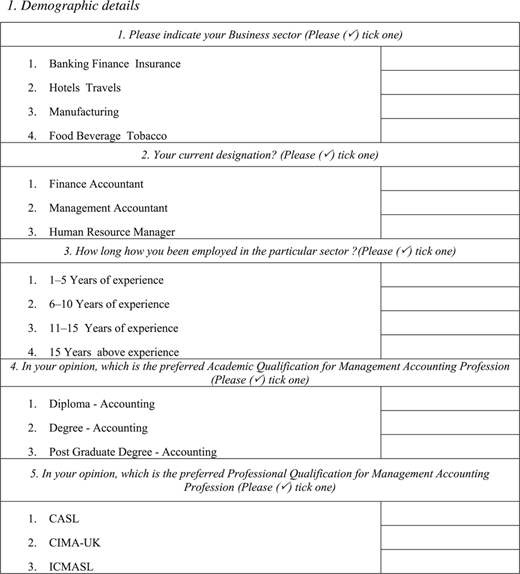
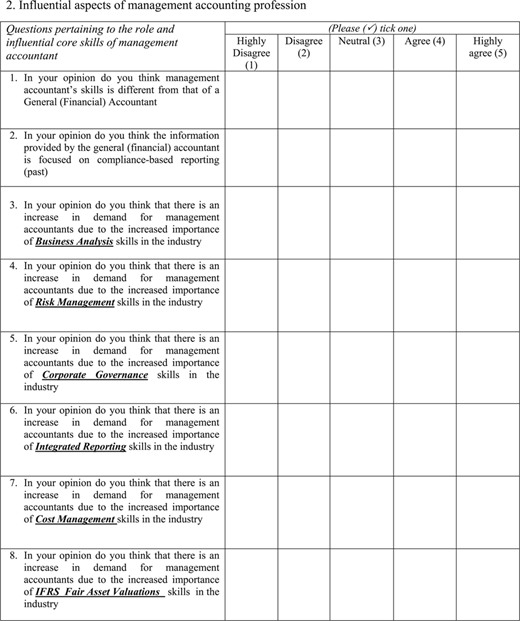
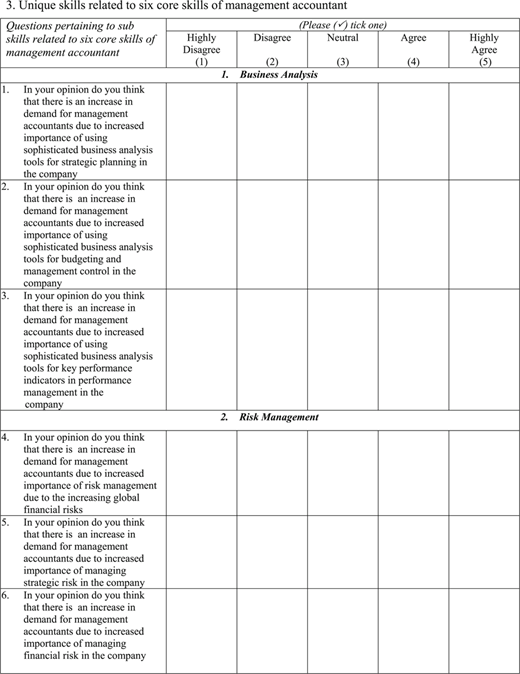
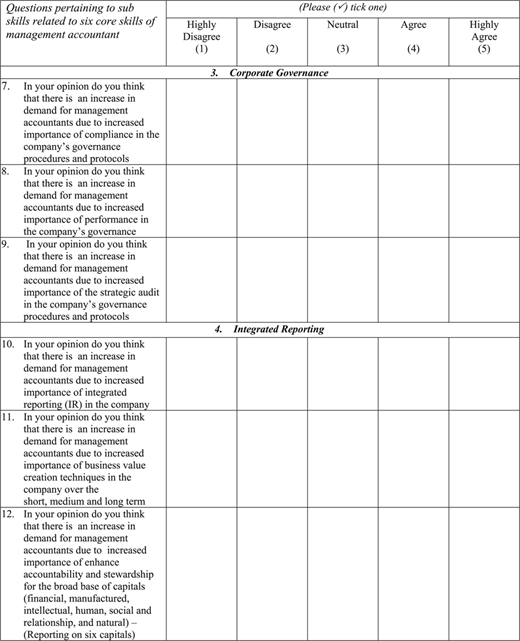
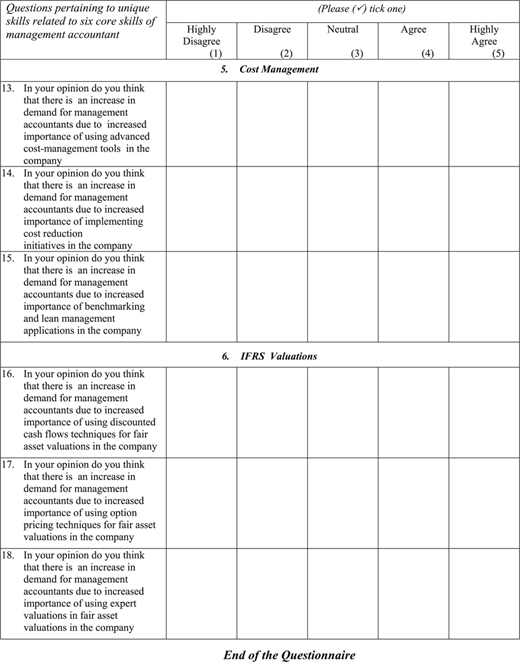
The questionnaire consists of three sections. The first section gathers demographic information regarding the respondents and their organisations. Second section consists of eight questions, two questions relate to the role of management accountants and the rest of the questions relate to the six core skills of management accounting profession; this is measured via five-point Likert scale. The final section consists of selected sub-skills relating to the six core skills of management accountant measured via five-point Likert scale (Questionnaire is provided in the Appendix).
3.4 Analytical strategies
Initially, the data from questionnaires were documented in a spreadsheet application (Microsoft Excel) and transferred to SPSS 23 (Statistical Package for Social Sciences) for statistical analysis. Frequency test was used to analyse the demographic and the skill bases. The mean rank method was used to identify the highest and lowest mean values. The data collected from the sample did not meet the normality assumptions. Therefore, non-parametric Krushkal–Wallis test was performed to analyse whether the group responses are statistically different across the groups (any value less p<0.05 is considered as significant). Next section discusses the results of the analyses.
4. Data analysis and results
4.1 Demographic factors
As per the results presented in Table II, responses were requested from three distinctive stakeholders from each entity in the four business sectors. In terms of the sample, the highest response rate was from manufacturing sector 37 per cent and the lowest response rate was from beverage, food and tobacco sector 16 per cent. As three stakeholders from each entity responded, there is an equal frequency distribution of 33 per cent among three stakeholder groups. In the sample, 44 per cent of the respondents have experience of 11–15 years in their respective industry. In all, 79 per cent of respondents preferred an undergraduate degree to enter management accounting profession and 21 per cent preferred a postgraduate degree to enter management accounting profession. Nil response for diploma qualification. In Sri Lanka, undergraduate degree is considered as the minimum qualification to enter white-collar professions. In terms of preferred professional qualification to enter management accounting profession CASL was selected by 57 per cent of the respondents, 26 per cent of the respondents selected CIMA-UK and only 17 per cent of the respondents had selected ICMASL. It was found that CASL and CIMA-UK has chartered designation, which is well recognised and acknowledged by both national and international employers. CASL also covers significant management accounting modules in its curriculum. Therefore, respondents have selected CASL and CIMA-UK over ICMASL.
Demographic factors
| n | % | |
|---|---|---|
| Business sectors | ||
| Banking finance and insurance | 45 | 26 |
| Hotels and travels | 36 | 21 |
| Manufacturing | 63 | 37 |
| Food beverage and tobacco | 27 | 16 |
| Total | 171 | 100 |
| Stakeholders | ||
| Finance accountant | 57 | 33 |
| Management accountant | 57 | 33 |
| Human resource manager | 57 | 33 |
| Total | 171 | 100 |
| Years of experience | ||
| 1–5 | 17 | 10 |
| 6–10 | 48 | 28 |
| 11–15 | 75 | 44 |
| 15 and above | 31 | 18 |
| Total | 171 | 100 |
| Preferred academic qualification for management accounting | ||
| Diploma – accounting related | 0 | 0 |
| Degree – accounting related | 135 | 79 |
| Post graduate – accounting related | 36 | 21 |
| Total | 171 | 100 |
| Preferred professional qualification for management accounting | ||
| CASL | 97 | 57 |
| CIMA-UK | 45 | 26 |
| ICMASL | 29 | 17 |
| Total | 171 | 100 |
Source: Author’s construction
4.2 Group responses on the differences between management accountant and general financial) accountant
As per the results in Tables III, 91.8 per cent of the respondents agreed (in that 25.7 per cent strongly agree) that the management accountant’s role and the financial accountant’s role differ due to the different skills set. However, there is a disagreement of 8.2 per cent across the three stakeholders. Krushkal–Wallis test revealed that the responses were significant across the stakeholders. In all, 70.1 per cent of the respondents agreed that management accountant’s role and the financial accountant’s role is different because the information provided by the financial accountant is compliance based. In this perspective 21.7 per cent stakeholders disagreed and 11.1 per cent were neutral. Krushkal–Wallis statistic revealed that the responses were significant across the stakeholders. Statistical results supports H1. The disagreement among the stakeholders may be due to management accountants engaging in year-end financial and compliance reporting.
Group responses on the difference between management and financial accountant
| There is a difference between management and financial accounting due to | |||||||||||||||
|---|---|---|---|---|---|---|---|---|---|---|---|---|---|---|---|
| The skill set of an MA is very different to that of a general (financial) accountant | The information provided by the general (financial) accountant is focused on compliance-based reporting (past) | ||||||||||||||
| Stakeholders | Frequencies and percentages | Strongly disagree | Disagree | Neutral | Agree | Strongly agree | Total | Mean rank | Strongly disagree | Disagree | Neutral | Agree | Strongly agree | Total | Mean rank |
| Finance accountant | n | 0 | 4 | 0 | 32 | 21 | 57 | 95.46 | 5 | 9 | 7 | 24 | 12 | 57 | 76.68 |
| % | 0.0 | 7.0 | 0.0 | 56.1 | 36.8 | 100.0 | 8.8 | 15.8 | 12.3 | 42.1 | 21.1 | 100.0 | |||
| Management accountant | n | 0 | 2 | 0 | 39 | 16 | 57 | 90.81 | 1 | 5 | 0 | 28 | 23 | 57 | 104.38 |
| % | 0.0 | 3.5 | 0.0 | 68.4 | 28.1 | 100.0 | 1.8 | 8.8 | 0.0 | 49.1 | 40.4 | 100.0 | |||
| Human resource manager | n | 0 | 8 | 0 | 42 | 7 | 57 | 71.73 | 2 | 10 | 12 | 20 | 13 | 57 | 76.94 |
| % | 0.0 | 14.0 | 0.0 | 73.7 | 12.3 | 100.0 | 3.5 | 17.5 | 21.1 | 35.1 | 22.8 | 100.0 | |||
| Total | n | 0 | 14 | 0 | 113 | 44 | 171 | 8 | 24 | 19 | 72 | 48 | 171 | ||
| % | 0.0 | 8.2 | 0.0 | 66.1 | 25.7 | 100.0 | 4.7 | 14.0 | 11.1 | 42.1 | 28.1 | 100.0 | |||
| Krushkal–Wallis test | χ2 = 1.079, df = 3, p= 0.78 | χ2 = 1.162, df = 3, p=0.76 | |||||||||||||
Source: Author’s construction
4.3 The group responses on expected increase in demand for of management accountant/profession (influential core skills of management accounting)
As per the results in Table IV, there is an increased demand for management accountants due to the increased use of business analysis in the industry, 22.8 per cent of the respondents strongly agreed, whereas 63.7 per cent of the respondents agreed to this statement. Krushkal–Wallis results does not indicate that the responses are significantly different across the business sectors. Based on the statistical results, H2 is supported. In all, 61.4 per cent of the respondents agreed (34.5 per cent agreed and 26.9 per cent strongly agreed) that increased importance of risk management skills caused an expected increase in demand for management accountant. However, the Krushkal–Wallis results show that group responses significantly differ across the business sectors. Based on the statistical results H3 is supported. This may be due to minor percentage of the respondents disagreed (22.8 per cent) and minor percentage of the respondents provided neutral response (15.8 per cent). The disagreement is likely to arise because not all stakeholders engage in risk management process. Banking, insurance and finance and food, beverages tobacco sectors are highly regulated and have strict risk management procedures compared to other sectors. There is an increased demand for management accountants due to increased importance of corporate governance in the industry; respondents show a 76.6 per cent agreement (22.8 per cent strongly agreed and 53.8 per cent agreed) to the statement. This view is consistent with Krushkal–Wallis test, which indicates that group responses do not significantly differ across the business sectors. Based on the statistical results H4 is not supported. In all, 83.6 per cent of the respondents agreed that increase in importance in integrated reporting in the industry caused the increase in expected demand for management accountant. Krushkal–Wallis test indicate that group responses do not significantly differ across the business sectors. Based on the statistical results H5 is not supported. In all, 81.3 per cent respondents are in agreement with the statement that there is an increase in demand for management accountants due to increase importance of cost management in the industry. However, Krushkal–Wallis test indicates that group responses significantly differ across the business sectors. Based on the statistical results H6 is supported. In view of this statement, 10.5 per cent of the respondents selected neutral response, whereas 8.2 per cent of the respondents disagreed. This is because not all management accountants engage in cost management practices. Banking, finance and insurance and hotels and travels sectors are likely to have less cost management practices compared to other sectors. There is an increased demand for management accountants due to importance of IFRS and fair-value asset valuations in the industry, 56.2 per cent agreed with the statement, whereas 1.8 per cent strongly disagreed, 19.9 per cent disagreed and 22.2 per cent provided a neutral response. Furthermore, Krushkal–Wallis test indicates that group responses significantly differ across the business sectors. Based on the statistical results H7 is supported. Highly regulated industries such as banking, manufacturing and food, beverages and tobacco, in some aspects of their management accounting process consist of strict IFRS and fair-value asset valuations. Furthermore, not all stakeholders engage in IFRS reporting and fair asset valuations.
Group responses on expected increase in demand for management accountant
| There is an increase in demand for management accountants due to the increased importance of | |||||||||||||||
| Business analysis in the industry | Risk management in the industry | ||||||||||||||
| Business Sector | Frequencies and percentages | Strongly disagree | Disagree | Neutral | Agree | Strongly agree | Total | Mean rank | Strongly disagree | Disagree | Neutral | Agree | Strongly agree | Total | Mean rank |
| Banking finance and insurance | n | 0 | 5 | 3 | 18 | 19 | 45 | 97.39 | 0 | 2 | 5 | 16 | 22 | 45 | 113.51 |
| % | 0.0 | 11.1 | 6.7 | 40.0 | 42.2 | 100.0 | 0.0 | 4.4 | 11.1 | 35.6 | 48.9 | 100.0 | |||
| Hotels and travels | n | 0 | 1 | 1 | 28 | 6 | 36 | 86.71 | 0 | 22 | 14 | 0 | 0 | 36 | 32.83 |
| % | 0.0 | 2.8 | 2.8 | 77.8 | 16.7 | 100.0 | 0.0 | 61.1 | 38.9 | 0.0 | 0.0 | 100.0 | |||
| Manufacturing | n | 0 | 6 | 4 | 43 | 10 | 63 | 79.21 | 0 | 12 | 3 | 31 | 17 | 63 | 93.64 |
| % | 0.0 | 9.5 | 6.3 | 68.3 | 15.9 | 100.0 | 0.0 | 19.0 | 4.8 | 49.2 | 27.0 | 100.0 | |||
| Food beverage and tobacco | n | 0 | 1 | 2 | 20 | 4 | 27 | 81.93 | 0 | 3 | 5 | 12 | 7 | 27 | 93.20 |
| % | 0.0 | 3.7 | 7.4 | 74.1 | 14.8 | 100.0 | 0.0 | 11.1 | 18.5 | 44.4 | 25.9 | 100.0 | |||
| Total | n | 0 | 13 | 10 | 109 | 39 | 171 | 0 | 39 | 27 | 59 | 46 | 171 | ||
| % | 0.0 | 7.6 | 5.8 | 63.7 | 22.8 | 100.0 | 0.0 | 22.8 | 15.8 | 34.5 | 26.9 | 100.0 | |||
| Krushkal–Wallis test | χ2 = 1.079, df = 3, p=0.78 | χ2 = 1.162, df = 3, p=0.76 | |||||||||||||
| There is an increase in demand for management accountants due to the increased importance of | |||||||||||||||
| Corporate governance in the industry | Integrated reporting (IR) in the industry | ||||||||||||||
| Business sector | Frequencies and percentages | Strongly disagree | Disagree | Neutral | Agree | Strongly agree | Total | Mean rank | Strongly disagree | Disagree | Neutral | Agree | Strongly agree | Total | Mean rank |
| Banking finance and insurance | n | 0 | 8 | 7 | 18 | 12 | 45 | 80.41 | 0 | 3 | 3 | 26 | 13 | 45 | 89.59 |
| % | 0.0 | 17.8 | 15.6 | 40.0 | 26.7 | 100.0 | 0.0 | 6.7 | 6.7 | 57.8 | 28.9 | 100.0 | |||
| Hotels and travels | n | 0 | 1 | 4 | 24 | 7 | 36 | 90.35 | 0 | 1 | 4 | 24 | 7 | 36 | 83.04 |
| % | 0.0 | 2.8 | 11.1 | 66.7 | 19.4 | 100.0 | 0.0 | 2.8 | 11.1 | 66.7 | 19.4 | 100.0 | |||
| Manufacturing | n | 0 | 3 | 13 | 31 | 16 | 63 | 86.94 | 0 | 1 | 12 | 30 | 20 | 63 | 87.89 |
| % | 0.0 | 4.8 | 20.6 | 49.2 | 25.4 | 100.0 | 0.0 | 1.6 | 19.0 | 47.6 | 31.7 | 100.0 | |||
| Food beverage and tobacco | n | 0 | 0 | 4 | 19 | 4 | 27 | 87.31 | 0 | 0 | 4 | 19 | 4 | 27 | 79.56 |
| % | 0.0 | 0.0 | 14.8 | 70.4 | 14.8 | 100.0 | 0.0 | 0.0 | 14.8 | 70.4 | 14.8 | 100.0 | |||
| Total | n | 0 | 12 | 28 | 92 | 39 | 171 | 0 | 5 | 23 | 99 | 44 | 171 | ||
| % | 0.0 | 7.0 | 16.4 | 53.8 | 22.8 | 100.0 | 0.0 | 2.9 | 13.5 | 57.9 | 25.7 | 100.0 | |||
| Krushkal–Wallis test | χ2 = 1.079, df = 3, p=0.78 | χ2 = 1.162, df = 3, p=0.76 | |||||||||||||
| There is an increase in demand for management accountants due to the increased importance of | |||||||||||||||
| Cost management in the industry | IFRS and fair-value asset valuations in the industry | ||||||||||||||
| Business sector | Frequencies and percentages | Strongly disagree | Disagree | Neutral | Agree | Strongly agree | Total | Mean rank | Strongly | Disagree | Neutral | Agree | Strongly agree | Total | Mean rank |
| Banking finance and insurance | n | 0 | 4 | 5 | 26 | 10 | 45 | 81.92 | 3 | 7 | 7 | 17 | 11 | 45 | 90.11 |
| % | 0.0 | 8.9 | 11.1 | 57.8 | 22.2 | 100.0 | 6.7 | 15.6 | 15.6 | 37.8 | 24.4 | 100.0 | |||
| Hotels and travels | n | 0 | 1 | 1 | 28 | 6 | 36 | 87.06 | 0 | 22 | 14 | 0 | 0 | 36 | 34.50 |
| % | 0.0 | 2.8 | 2.8 | 77.8 | 16.7 | 100.0 | 0.0 | 61.1 | 38.9 | 0.0 | 0.0 | 100.0 | |||
| Manufacturing | n | 0 | 9 | 9 | 21 | 24 | 63 | 87.33 | 0 | 5 | 11 | 27 | 20 | 63 | 106.18 |
| % | 0.0 | 14.3 | 14.3 | 33.3 | 38.1 | 100.0 | 0.0 | 7.9 | 17.5 | 42.9 | 31.7 | 100.0 | |||
| Food beverage and tobacco | n | 0 | 0 | 3 | 18 | 6 | 27 | 88.28 | 0 | 0 | 6 | 18 | 3 | 27 | 100.72 |
| % | 0.0 | 0.0 | 11.1 | 66.7 | 22.2 | 100.0 | 0.0 | 0.0 | 22.2 | 66.7 | 11.1 | 100.0 | |||
| Total | n | 0 | 14 | 18 | 93 | 46 | 171 | 3 | 34 | 38 | 62 | 34 | 171 | ||
| % | 0.0 | 8.2 | 10.5 | 54.4 | 26.9 | 100.0 | 1.8 | 19.9 | 22.2 | 36.3 | 19.9 | 100.0 | |||
| Krushkal–Wallis test | χ2 = 0.519, df = 3, p=0.00 | χ2 = 56.310, df = 3, p=0.00 | |||||||||||||
Source: Author’s construction
4.4 The group responses on expected increase in demand for of management accountant/profession (selected sub-skills of management accounting)
Business analysis skills
As per the results in Table V, in terms of selected business analysis skills, 74.2 per cent of the respondents agreed to the statement that sophisticated business analysis tools used strategic planning. In terms of using sophisticated business analysis tools, Krushkal–Wallis test indicates that there is a significant difference between the group responses. In all, 46.7 per cent of the respondents from the banking sector have given a neutral response and 15.9 per cent of the respondents from manufacturing sector have given a neutral response. Furthermore, entities in the sectors will not have the same level of access to sophisticated analysis software and the level of involvement by the stakeholders in strategic planning will differ. In terms of using business analysis tools for budgeting and key performance indicator measurement, Krushkal–Wallis test does not indicate a significant difference among the business sectors and show an overall agreement rate of 88.9 and 85.3 per cent, respectively.
Group responses on expected increase in demand for management accountant/profession (selected business analysis skills)
| Krushkal–Wallis test | Responses to questionnaire survey (n (%)) | ||||||||||
|---|---|---|---|---|---|---|---|---|---|---|---|
| Skills | There is an increase in demand for management accountants due to the increased importance of | Business sector | Mean rank | χ2 | df | p | Strongly disagree | Disagree | Neutral | Agree | Strongly agree |
| Business analysis | Using sophisticated business analysis tools for strategic planning in the company | Banking finance and insurance | 57.11 | 25.414 | 3 | 0.00 | 0 (0.0) | 4 (8.9) | 21 (46.7) | 17 (37.8) | 3 (6.7) |
| Hotels and travels | 95.56 | 0 (0.0) | 1 (2.8) | 1 (2.8) | 28 (77.8) | 6 (16.7) | |||||
| Manufacturing | 99.13 | 0 (0.0) | 4 (6.3) | 10 (15.9) | 24 (38.1) | 25 (39.7) | |||||
| Food beverage and tobacco | 90.76 | 0 (0.0) | 1 (3.7) | 2 (7.4) | 20 (74.1) | 4 (14.8) | |||||
| Total | 0 (0.0) | 10 (5.8) | 34 (19.9) | 89 (52.0) | 38 (22.2) | ||||||
| Using sophisticated business analysis tools for budgeting and management control in the company | Banking finance and insurance | 80.37 | 1.429 | 3 | 0.70 | 0 (0.0) | 5 (11.1) | 7 (15.6) | 22 (48.9) | 11 (24.4) | |
| Hotels and travels | 88.35 | 0 (0.0) | 1 (2.8) | 1 (2.8) | 28 (77.8) | 6 (16.7) | |||||
| Manufacturing | 89.71 | 0 (0.0) | 7 (11.1) | 3 (4.8) | 35 (55.6) | 18 (28.6) | |||||
| Food beverage and tobacco | 83.61 | 0 (0.0) | 1 (3.7) | 2 (7.4) | 20 (74.1) | 4 (14.8) | |||||
| Total | 0 (0.0) | 14 (8.2) | 13 (7.6) | 105 (61.4) | 39 (22.8) | ||||||
| Using sophisticated business analysis tools for key performance indicators in performance management in the company | Banking finance and insurance | 88.29 | 0.629 | 3 | 0.89 | 0 (0.0) | 5 (11.1) | 5 (11.1) | 19 (42.2) | 16 (35.6) | |
| Hotels and travels | 85.13 | 0 (0.0) | 1 (2.8) | 1 (2.8) | 28 (77.8) | 6 (16.7) | |||||
| Manufacturing | 87.24 | 0 (0.0) | 5 (7.9) | 5 (7.9) | 35 (55.6) | 18 (28.6) | |||||
| Food beverage and tobacco | 80.46 | 0 (0.0) | 1 (3.7) | 2 (7.4) | 20 (74.1) | 4 (14.8) | |||||
| Total | 0 (0.0) | 12 (7) | 13 (7.6) | 102 (59.6) | 44 (25.7) | ||||||
Source: Author’s construction
Risk management skills
As per the results in Table VI, in terms of selected risk management skills, increasing importance of managing strategic risk, compliance and regulatory risks and financial risks, according to Krushkal–Wallis statistical results, there is a significant difference among the responses received from the business sectors. The three selected skills of risk management as listed in Table VI indicate an overall agreement rate of 60.2, 57.9 and 59.1 per cent. Because business sectors are not equally affected by the selected risks. Highly regulated sectors such as banking, finance and insurance are more likely to be impacted by these identified risks compared to hotels and travels sector. In terms of managing risks, hotels and travels sector indicate an overall disagreement of 61.1 per cent.
Group responses on expected increase in demand for management accountant/profession (selected risk management skills)
| Krushkal–Wallis test | Responses to questionnaire survey (n (%)) | ||||||||||
|---|---|---|---|---|---|---|---|---|---|---|---|
| Skills | There is an increase in demand for management accountants due to the increased importance of | Business sector | Mean rank | χ2 | df | p | Strongly disagree | Disagree | Neutral | Agree | Strongly agree |
| Risk management | Managing strategic risk in the company | Banking finance and insurance | 93.87 | 63.225 | 3 | 0.00 | 0 (0.0) | 6 (13.3) | 9 (20) | 18 (40) | 12 (26.7) |
| Hotels and travels | 31.22 | 0 (0.0) | 22 (61.1) | 14 (38.9) | 0 (0) | 0 (0) | |||||
| Manufacturing | 107.37 | 0 (0.0) | 4 (6.3) | 5 (7.9) | 35 (55.6) | 19 (30.2) | |||||
| Food beverage and tobacco | 96.06 | 0 (0.0) | 3 (11.1) | 5 (18.5) | 12 (44.4) | 7 (25.9) | |||||
| Total | 0 (0.0) | 35 (20.5) | 33 (19.3) | 65 (38) | 38 (22.2) | ||||||
| Managing compliance and regulatory risk in the company | Banking finance and insurance | 95.72 | 58.753 | 3 | 0.00 | 0 (0.0) | 8 (17.8) | 8 (17.8) | 15 (33.3) | 14 (31.1) | |
| Hotels and travels | 32.50 | 0 (0.0) | 22 (61.1) | 14 (38.9) | 0 (0) | 0 (0) | |||||
| Manufacturing | 104.26 | 0 (0.0) | 3 (4.8) | 9 (14.3) | 37 (58.7) | 14 (22.2) | |||||
| Food beverage and tobacco | 98.52 | 0 (0.0) | 3 (11.1) | 5 (18.5) | 12 (44.4) | 7 (25.9) | |||||
| Total | 0 (0.0) | 36 (21.1) | 36 (21.1) | 64 (37.4) | 35 (20.5) | ||||||
| managing financial risk in the company | Banking finance and insurance | 108.83 | 55.586 | 3 | 0.00 | 0 (0.0) | 8 (17.8) | 3 (6.7) | 11 (24.4) | 23 (51.1) | |
| Hotels and travels | 34.61 | 0 (0.0) | 22 (61.1) | 14 (38.9) | 0 (0) | 0 (0) | |||||
| Manufacturing | 94.70 | 0 (0.0) | 8 (12.7) | 7 (11.1) | 36 (57.1) | 12 (19) | |||||
| Food beverage and tobacco | 96.17 | 0 (0.0) | 3 (11.1) | 5 (18.5) | 12 (44.4) | 7 (25.9) | |||||
| Total | 0 (0.0) | 41 (24) | 29 (17) | 59 (34.5) | 42 (24.6) | ||||||
Source: Author’s construction
Corporate governance skills
As per the results of Table VII, in terms of compliance reporting, reporting on company’s corporate governance procedures and performing strategic audit on company’s corporate governance system, Krushkal–Wallis test reveals that there is no significant differences across the responses received from the business sectors. An overall agreement rate for each skill is as follows: 79, 85.4 and 79.5 per cent.
Group responses on expected increase in demand for management accountant/profession (selected corporate governance skills)
| Krushkal–Wallis test | Responses to questionnaire survey (n (%)) | ||||||||||
|---|---|---|---|---|---|---|---|---|---|---|---|
| Skills | There is an increase in demand for management accountants due to the increased importance of | Business sector | Mean rank | χ2 | df | p | Strongly disagree | Disagree | Neutral | Agree | Strongly agree |
| Corporate governance | Increased compliance reporting in terms of company’s governance procedures and protocols | Banking finance and insurance | 91.48 | 4.091 | 3 | 0.25 | 0 (0) | 2 (4.4) | 6 (13.3) | 27 (60) | 10 (22.2) |
| Hotels and travels | 92.32 | 0 (0) | 1 (2.8) | 4 (11.1) | 24 (66.7) | 7 (19.4) | |||||
| Manufacturing | 77.12 | 2 (3.2) | 10 (15.9) | 7 (11.1) | 36 (57.1) | 8 (12.7) | |||||
| Food beverage and tobacco | 89.17 | 0 (0) | 0 (0) | 4 (14.8) | 19 (70.4) | 4 (14.8) | |||||
| Total | 2 (1.2) | 13 (7.6) | 21 (12.3) | 106 (62.0) | 29 (17.0) | ||||||
| Reporting on the performance of the company’s governance | Banking finance and insurance | 92.46 | 6.100 | 3 | 0.107 | 0 (0) | 2 (4.4) | 6 (13.3) | 27 (60) | 10 (22.2) | |
| Hotels and travels | 93.33 | 0 (0) | 1 (2.8) | 4 (11.1) | 24 (66.7) | 7 (19.4) | |||||
| Manufacturing | 75.44 | 3 (4.8) | 1 (1.6) | 4 (6.3) | 38 (60.3) | 17 (27) | |||||
| Food beverage and tobacco | 90.09 | 0 (0) | 0 (0) | 4 (14.8) | 19 (70.4) | 4 (14.8) | |||||
| Total | 3 (1.8) | 4 (2.3) | 18 (10.5) | 108 (63.2) | 38 (22.2) | ||||||
| Performing strategic audit on the company’s governance procedures and protocols | Banking finance and insurance | 84.03 | 1.166 | 3 | 0.76 | 0 (0) | 0 (0) | 4 (8.9) | 25 (55.6) | 16 (35.6) | |
| Hotels and travels | 84.64 | 0 (0) | 1 (2.8) | 10 (27.8) | 18 (50) | 7 (19.4) | |||||
| Manufacturing | 90.33 | 3 (4.8) | 2 (3.2) | 11 (17.5) | 34 (54) | 13 (20.6) | |||||
| Food beverage and tobacco | 80.98 | 0 (0) | 0 (0) | 4 (14.8) | 19 (70.4) | 4 (14.8) | |||||
| Total | 3 (1.8) | 3 (1.8) | 29 (17) | 96 (56.1) | 40 (23.4) | ||||||
Source: Author’s construction
Integrated reporting skills
As per the results in Table VIII, skills relating to implementing integrated reporting procedures indicate an overall agreement rate of 50.8 per cent across the business sectors, whereas the respondents indicate an overall neutral response rate of 22.8 per cent across the sectors. However, Krushkal–Wallis test results indicate that there is a significant difference across the responses received by the sectors. This may due to a different level of involvement of the identified stakeholders. In terms of implementing business value creation techniques (85.2 per cent agreement rate between the sectors) and reporting on accountability and stewardship of the broad base of capitals (70.8 per cent agreement rate between the sectors), Krushkal–Wallis test does not indicate a significant difference across the groups.
Group responses on expected increase in demand for management accountant/profession (integrated reporting skills)
| Krushkal–Wallis test | Responses to questionnaire survey (n (%)) | ||||||||||
|---|---|---|---|---|---|---|---|---|---|---|---|
| Skills | There is an increase in demand for management accountants due to the increased importance of | Business sector | Mean rank | χ2 | df | p | Strongly disagree | Disagree | Neutral | Agree | Strongly agree |
| Integrated reporting | Implementing integrated reporting (IR) procedures in the company | Banking finance and insurance | 102.12 | 8.439 | 3 | 0.04 | 0 (0) | 5 (11.1) | 14 (31.1) | 15 (33.3) | 11 (24.4) |
| Hotels and travels | 77.18 | 0 (0) | 1 (2.8) | 10 (27.8) | 18 (50) | 7 (19.4) | |||||
| Manufacturing | 80.25 | 3 (4.8) | 2 (3.2) | 11 (17.5) | 34 (54) | 13 (20.6) | |||||
| Food beverage and tobacco | 84.31 | 0 (0) | 0 (0) | 4 (14.8) | 19 (70.4) | 4 (14.8) | |||||
| Total | 3 (1.8) | 8 (4.7) | 39 (22.8) | 86 (50.3) | 35 (20.5) | ||||||
| Implementing business value creation techniques in the company over the short, medium and long term | Banking finance and insurance | 79.29 | 1.764 | 3 | 0.62 | 0 (0) | 5 (11.1) | 14 (31.1) | 15 (33.3) | 11 (24.4) | |
| Hotels and travels | 85.51 | 0 (0) | 1 (2.8) | 10 (27.8) | 18 (50) | 7 (19.4) | |||||
| Manufacturing | 87.98 | 3 (4.8) | 2 (3.2) | 11 (17.5) | 34 (54) | 13 (20.6) | |||||
| Food beverage and tobacco | 93.20 | 0 (0) | 0 (0) | 4 (14.8) | 19 (70.4) | 4 (14.8) | |||||
| Total | 3 (1.8) | 8 (4.7) | 39 (22.8) | 86 (50.3) | 35 (20.5) | ||||||
| Reporting of accountability and stewardship for the broad base of capitals (financial, manufactured, intellectual, human, social and relationship, and natural) and promote understanding of their interdependencies | Banking finance and insurance | 79.29 | 1.764 | 3 | 0.62 | 0 (0) | 5 (11.1) | 14 (31.1) | 15 (33.3) | 11 (24.4) | |
| Hotels and travels | 85.51 | 0 (0) | 1 (2.8) | 10 (27.8) | 18 (50) | 7 (19.4) | |||||
| Manufacturing | 87.98 | 3 (4.8) | 2 (3.2) | 11 (17.5) | 34 (54) | 13 (20.6) | |||||
| Food beverage and tobacco | 93.20 | 0 (0) | 0 (0) | 4 (14.8) | 19 (70.4) | 4 (14.8) | |||||
| Total | 3 (1.8) | 8 (4.7) | 39 (22.8) | 86 (50.3) | 35 (20.5) | ||||||
Source: Author’s construction
Cost management skills
As per the results in Table IX, using advance cost management tools has an overall agreement rate of 88.9 per cent across the business sectors and Krushkal–Wallis test does not indicate a significant difference across the business sectors. In terms of cost management skills, Krushkal–Wallis test indicates that there is a significant difference across the responses received from the business sectors.
Group responses on expected increase in demand for management accountant/profession (cost management skills)
| Krushkal–Wallis test | Responses to questionnaire survey (n (%)) | ||||||||||
|---|---|---|---|---|---|---|---|---|---|---|---|
| Skills | There is an increase in demand for management accountants due to the increased importance of | Business sector | Mean rank | χ2 | df | p | Strongly disagree | Disagree | Neutral | Agree | Strongly agree |
| Cost management | Using advanced cost-management tools in the company | Banking finance and insurance | 86.69 | 2.396 | 3 | 0.49 | 0 (0) | 6 (13.3) | 5 (11.1) | 24 (53.3) | 10 (22.2) |
| Hotels and travels | 81.63 | 0 (0) | 7 (19.4) | 2 (5.6) | 21 (58.3) | 6 (16.7) | |||||
| Manufacturing | 83.34 | 4 (6.3) | 2 (3.2) | 5 (7.9) | 45 (71.4) | 7 (11.1) | |||||
| Food beverage and tobacco | 96.89 | 0 (0) | 0 (0) | 3 (11.1) | 18 (66.7) | 6 (22.2) | |||||
| Total | 4 (2.3) | 15 (8.8) | 15 (8.8) | 108 (63.2) | 29 (17) | ||||||
| Implementing cost reduction initiatives in the company | Banking finance and insurance | 102.17 | 12.211 | 3 | 0.01 | 0 (0) | 0 (0) | 5 (11.1) | 21 (46.7) | 19 (42.2) | |
| Hotels and travels | 86.26 | 0 (0) | 1 (2.8) | 1 (2.8) | 28 (77.8) | 6 (16.7) | |||||
| Manufacturing | 73.80 | 4 (6.3) | 2 (3.2) | 5 (7.9) | 45 (71.4) | 7 (11.1) | |||||
| Food beverage and tobacco | 87.17 | 0 (0) | 0 (0) | 3 (11.1) | 18 (66.7) | 6 (22.2) | |||||
| Total | 4 (2.3) | 3 (1.8) | 14 (8.2) | 112 (65.5) | 38 (22.2) | ||||||
| Benchmarking and lean management applications in the company | Banking finance and insurance | 47.56 | 115.873 | 3 | 0.00 | 0 (0) | 40 (88.9) | 5 (11.1) | 0 (0) | 0 (0) | |
| Hotels and travels | 45.03 | 0 (0) | 34 (94.4) | 2 (5.6) | 0 (0) | 0 (0) | |||||
| Manufacturing | 117.54 | 4 (6.3) | 2 (3.2) | 5 (7.9) | 45 (71.4) | 7 (11.1) | |||||
| Food beverage and tobacco | 131.11 | 0 (0) | 0 (0) | 3 (11.1) | 18 (66.7) | 6 (22.2) | |||||
| Total | 4 (2.3) | 76 (44.4) | 15 (8.8) | 63 (36.8) | 13 (7.6) | ||||||
IFRS and fair-value asset valuations
As per the results in Table X, in terms of using option-pricing techniques and using expert for fair asset valuations, Krushkal–Wallis test indicates that there is a significant difference across the responses received by the business sectors. Only few entities in banking, finance and insurance, manufacturing and food, beverage and tobacco sectors adopt such practices. However, in terms of using discounted cash flows techniques, there is an overall agreement rate of 77.8 per cent. Krushkal–Wallis test does not indicate a significant difference across the responses received from the stakeholders.
Group responses on expected increase in demand for management accountant/profession (IFRS and fair-value asset valuations)
| Krushkal–Wallis test | Responses to questionnaire survey (n (%)) | ||||||||||
|---|---|---|---|---|---|---|---|---|---|---|---|
| Skills | There is an increase in demand for management accountants due to the increased importance of | Business sector | Mean rank | χ2 | df | p | Strongly disagree | Disagree | Neutral | Agree | Strongly agree |
| IFRS and fair valuations | Using discounted cash flows techniques for fair asset valuations in the company | Banking finance and insurance | 78.43 | 4.425 | 3 | 0.22 | 3 (6.7) | 2 (4.4) | 12 (26.7) | 15 (33.3) | 13 (28.9) |
| Hotels and travels | 86.01 | 0 (0) | 5 (13.9) | 2 (5.6) | 20 (55.6) | 9 (25) | |||||
| Manufacturing | 94.85 | 0 (0) | 4 (6.3) | 6 (9.5) | 32 (50.8) | 21 (33.3) | |||||
| Food beverage and tobacco | 77.94 | 0 (0) | 0 (0) | 6 (22.2) | 18 (66.7) | 3 (11.1) | |||||
| Total | 3 (1.8) | 11 (6.4) | 26 (15.2) | 85 (49.7) | 46 (26.9) | ||||||
| Using option-pricing techniques for fair asset valuations in the company | Banking finance and insurance | 68.13 | 64.778 | 3 | 0.00 | 3 (6.7) | 24 (53.3) | 18 (40) | 0 (0) | 0 (0) | |
| Hotels and travels | 70.00 | 0 (0) | 22 (61.1) | 14 (38.9) | 0 (0) | 0 (0) | |||||
| Manufacturing | 80.67 | 0 (0) | 31 (49.2) | 29 (46) | 3 (4.8) | 0 (0) | |||||
| Food beverage and tobacco | 149.56 | 0 (0) | 0 (0) | 6 (22.2) | 18 (66.7) | 3 (11.1) | |||||
| Total | 3 (1.8) | 77 (45) | 67 (39.2) | 21 (12.3) | 3 (1.8) | ||||||
| Using expert valuations in fair asset valuations in the company | Banking finance and insurance | 103.80 | 72.571 | 3 | 0.00 | 0 (0) | 3 (6.7) | 7 (15.6) | 18 (40) | 17 (37.8) | |
| Hotels and travels | 27.06 | 0 (0) | 22 (61.1) | 14 (38.9) | 0 (0) | 0 (0) | |||||
| Manufacturing | 104.68 | 0 (0) | 4 (6.3) | 6 (9.5) | 32 (50.8) | 21 (33.3) | |||||
| Food beverage and tobacco | 91.33 | 0 (0) | 0 (0) | 6 (22.2) | 18 (66.7) | 3 (11.1) | |||||
| Total | 0 (0) | 29 (17) | 33 (19.3) | 68 (39.8) | 41 (24) | ||||||
Source: Author’s construction
This section statistically analysed the management accountant’s role and the expectations of the society in terms of four business sectors as classified by CSE. Statistical results indicate that the role expectations of management accountant varies significantly across the different business sectors as their nature and operations are different. There is an increasing demand for modern management accounting skills in Sri Lanka. The next section provides the conclusion of this study.
Conclusion
The main aim of the study is to provide empirical evidence on the society’s expectations of the skills and knowledge a management accountant should possess. Frequency statistics was performed to describe the respondents and the organisations in the sample. In order to measure the gap between management accountant’s role and society’s expectations, Krushkal–Wallis test was performed and it was identified that role expectations of management accountants varies significantly across the business sectors in the sample. This is because the nature and operations of the entities differ across each business sector and each business sector requires different management accounting skills. It was also noted that there is an increasing demand for contemporary management accounting skills in Sri Lanka. There is a certain level of recognition for the national management accounting body in Sri Lanka. However, unless the management accounting practices are regulated in Sri Lanka, the transparency and creditability of management accounting profession is unlikely to be enhanced.
The findings of the study would be of use to policy makers and implementers to develop remedial measures to enhance the creditability and transparency of the management accounting profession in Sri Lanka. For instance, regulating management accounting practices would enhance the creditability of the management accounting professionals by prohibiting individuals without the required qualifications. Regulating management accounting practices can mitigate the significant variations and increase the transparency in management accounting work patterns and practices across various industries. Furthermore, academic and professional institutions, which provide management accounting education and training programs can identify future trends and necessary skills in Sri Lanka and improve management accounting curriculum and training programs. For example, industry-specific management accounting training modules and training programmes can be developed by such institutions to cater different professionals involved in different industries. Furthermore, academic institutions can identify the emerging management accounting techniques and skills and can modify the curriculum. If modifying the curriculum is not a feasible option, academic institutions can provide such skills and techniques as complimentary training modules to the main curriculum.
Finally, it should be noted that this study is subject to certain limitations and the results should be interpreted upon considering such limitations. This study only considered four market sectors in Sri Lanka and only selected management accounting skills were examined. Future researchers can expand the sample by extending to other sectors and incorporating other management accounting skills.
References
Further reading
Appendix. Questionnaire