The purpose of this paper is to uncover similarities and differences among emphasized information literacy (IL) skills for the disciplines of political- and social sciences, economics, educational sciences, law sciences, mathematics, life sciences, history and German studies, based on an analysis of IL teaching materials.
Eight issues of the German language publication series Erfolgreich recherchieren (Succesful Research Strategies) are compared by using a structuring content analysis. The category system is based on the IL standards and performance indicators of the Association of College and Research Libraries (2000), extended with additional categories.
The results, first, suggest that the biggest similarities and differences among the disciplines are found concerning the determination of the nature and extent of the needed information, especially in the area of identifying potential sources of information. Second, some of the disciplines focus more on international sources, whereas others focus on country- and language-specific sources. Third, the criteria to define the appropriate retrieval system differ among the various disciplines. Fourth, approaches to narrow the search results differ among the various disciplines. Fifth, the critical evaluation of sources is addressed in all disciplines but relates to different contexts.
This approach only addresses one book per discipline out of a German language book series. Further research is needed.
This paper is unique in its approach and one of few papers on disciplinary differences in IL perception.
Introduction
Emerging from its early origins in the user training in libraries (Tiefel, 1995), the concept of information literacy (IL) has seen constant developments. Today, there are several definitions for the term IL, which overlaps with the concepts of media literacy, computer literacy, internet literacy and digital literacy (Ala-Mutka, 2011). A common definition of IL has been published by the American Association of College and Research Libraries, which was last updated in 2016. Accordingly, “Information literacy is the set of integrated abilities encompassing the reflective discovery of information, the understanding of how information is produced and valued, and the use of information in creating new knowledge and participating ethically in communities of learning” (ACRL, 2016). This definition is also the relevant IL definition used for this study. Today, IL can be considered as a necessary skill of the white-collar workforce (Bruce, 1999; Edmunds and Morris, 2000; Klusek and Bornstein, 2006). Nevertheless, several studies have found IL skills of students to be weak. For example, students seem to have trouble using Boolean operators, organizing literature and tend not to know the appropriate sources for finding scientific literature (Skipton and Bail, 2014; Maurer et al., 2016). Additionally, students tend to overestimate their IL skills (Michalak and Rysavy, 2016). Libraries are aware of this issue and make efforts to develop solutions in order to remedy the situation but are not always successful due to a lack of awareness by students and the incompatibility of such programs with their needs (Yevelson-Shorsher and Bronstein, 2018). Web-based approaches through freely accessible massive open online courses (MOOCs) are increasingly discussed as a possible solution to improve student learning (Gore, 2014; Massis, 2013).
Recent literature on developing IL of students suggests that curricula should involve not only generic skills but also knowledge of discipline-specific content and research practices (Grafstein, 2002; Secker and Coonan, 2013). Additionally, IL teaching in a discipline-specific context is considered beneficial to students, as discipline-specific contexts create motivating authentic settings and thus allow students self-reflective learning (Farrell and Badke, 2015; Rubinić et al., 2013). The research process is not identical in different disciplines and thus influences IL facilitation in a discipline-specific context: “the ways in which knowledge is organized in different disciplines determine, among other things, the scope of the research questions that can be asked, the rules of evidence that are recognized within the discipline as valid for supporting claims, the kind of criteria that can be used to evaluate claims critically, the sources researchers consult to find information, and the nature of the statements that must be cited” (Grafstein, 2002). Nevertheless, research on disciplinary differences in IL perception is still rare. While existing studies tend to approach the topic through surveys or interviews of faculty members (Bury, 2011; Pinto, 2016) or students (Pinto and Sales, 2015; Maurer et al., 2016), so far, no study has been performed assessing disciplinary differences in IL perception by a thorough analysis of IL teaching materials. Therefore, the aim of this study is to answer the following research question:
Which similarities and differences among emphasized IL skills exist between various disciplines, based on an analysis of IL teaching materials?
By conducting a structuring content analysis of eight issues of the German language publication series Erfolgreich recherchieren (Succesful Research Strategies) covering the disciplines of political and social sciences, economics, educational sciences, law sciences, mathematics, life sciences, history and German studies, this paper contributes to current literature on discipline-specific IL facilitation. It aims to enhance the understanding of discipline-specific differences and thus to enhance IL instruction targeting students from different disciplines to ultimately improve student learning outcomes. Generic IL trainings proved to be less efficient for students with different disciplinary backgrounds. Williams and Evans (2008) found that, after attending an IL module, students showed uneven IL gains among disciplines, which they explained with different disciplinary information needs. Already Plum (1984) argued that the nature of disciplines should figure heavily the nature of bibliographic instruction. Thus, the ACRL (2000) standards, as well as the ACRL (2016) framework, emphasize heavily discipline-specific instruction. Grafstein (2002) suggested that IL teaching should be shared among an academic institution rather than limited to the library to allow the classroom faculty to provide their discipline-specific background. Nevertheless, this requires an experienced faculty since a novice might not have the specialized knowledge of the discipline to do so. The results of this study can help to adopt generic IL instructions to discipline-specific student needs.
Literature review
Several recent studies compared the perceptions of scholars toward IL among different disciplines. Interviews with academics in the UK showed that their perception of IL is partly similar to but partly also significantly different from librarian-generated frameworks and standards. The research implies significant disciplinary differences in IL perceptions and therefore suggests further research to identify those (Boon et al., 2007). Similar results were shown by a study that conducted interviews at the City University of New York with the aim to examine disciplinary differences in IL perception between instructors and professionals in library and information science (Cope and Sanabria, 2014). Another study conducted semi-structured interviews among 24 faculty members from different disciplines at a public research university in Canada. The findings showed that faculty members perceive IL as a central skill for students. However, they also showed disciplinary differences regarding which skill-sets are perceived as less and which as more important. Academic reading is found to be more important by the faculty in business, social sciences and the humanities, while abilities to search for information sources are found to be less important among the science and business disciplines (Bury, 2016).
A survey among full-time faculty members at York University, Canada, aimed to investigate IL instruction practices, attitudes and knowledge. The results showed disciplinary differences. While IL was found to be important within all disciplines, the highest agreement came from scholars of social science and the humanities. Over 60 percent of the scholars coming from these two disciplines also acknowledged considering IL skills in their own teaching, while for economics, science and law sciences, the rate was between 30 and 40 percent (Bury, 2011). These results are similar to a more recent survey among faculty members of the University of Granada, Spain, which found that more than half of the faculty members had a concept of IL. The results suggest that IL awareness is higher in the disciplines of health sciences, social and legal sciences, arts and the humanities and lower in science and technical disciplines (Pinto, 2016). Another nation-wide survey on the IL perception among US scholars of six disciplines showed disciplinary differences among the faculty. While the lack of students’ IL was a concern across all disciplines, the matter of which sources are preferred, how they are found and how they are evaluated turned out to differ among the various disciplines (Saunders, 2012). A survey among faculty members of Stetson University, FL, aimed to learn what role they believe the Framework for Information Literacy for Higher Education (ACRL, 2016) knowledge practices should play in student learning. The findings suggest that the understanding of discipline-specific conventions was rated less important and as a knowledge practice that should be focused on at a later point in IL instruction programs (Kaletski, 2017).
Other studies looked at differences in students’ IL skills and requirements among various disciplines. A study among faculty members of US universities from different disciplines used questionnaires and interviews to find out disciplinary differences in faculty attitudes toward and approaches to IL. The results showed that the majority of the faculty members found IL competencies important. Differences between the disciplines were found regarding their knowledge of IL standards and opinion of student abilities. For example, the web searching skills of biology students were rated higher than of students in English literature (Badia, 2013). A study among Austrian students using a standardized questionnaire revealed that those students in general only had mediocre IL skills. However, the test results differed among the disciplines with the best results achieved by students of the humanities and the worst results by business students (Maurer et al., 2016). Similarly, another study among students from the University of West Florida found the best results to be achieved by social science and political science majors, while pre-law and education majors achieved the lowest scores (Williams and Evans, 2008). A survey among faculty members at a public research university in Canada showed major concerns regarding undergraduate students’ IL skills. The study further identified disciplinary differences in IL attitudes and adoption as future research (Tewell, 2013). Another study among university students used a self-assessment questionnaire to uncover disciplinary differences in IL. The results showed that attitudes appreciably vary between five branches of knowledge – in reverse relation to interdisciplinary differences (Pinto and Sales, 2015). Similarly, another study also found differences in the information behavior of students regarding the preference for print and digital sources (Dimzov and Stričević, 2014).
While studies compare that IL education among different disciplines are rare, there are several publications that report about discipline-specific IL instruction, suggest discipline-specific IL frameworks and analyze discipline-specific IL content. Hock (2007) defined relevant subject-specific IL skills in German studies, including the ability to make use of print and electronic resources and the difference between the library and the World Wide Web as a source of German studies related information. The skills necessary to study old documents and the ability to critically approach the different kind of historical sources are pointed out as important IL skills of history students (Pinto, 2012). Chen and Doty (2005) published a conceptional framework for digital libraries aiming to support mathematics education. The paper identifies areas relevant for IL training in mathematics, including retrieval schemes, synonyms and the ability to generate and use multimedia sources. An assessment of IL instruction at the University of the West Indies, Jamaica in the science, technology, engineering and mathematics (STEM) discipline outlined that the instruction focused on STEM resources in the library, general use of the library to find STEM resources, use of the library’s portal to find STEM resources, use of subject-specific databases to find STEM resources, general search strategies, evaluating and selecting online resources, plagiarism and referencing (Harris, 2017). An analysis of IL teaching resources for the discipline of economics found that factual databases are the most commonly mentioned resource, followed by literature databases, dictionaries, encyclopedias and journal rankings (Dreisiebner, 2019b). In an IL training for political science students, exercises focused on discovering constitutional issues, aimed to introduce them to political science journals and to help them to understand the differences between scholarly and popular publications and how to build an annotated bibliography (Stevens and Campbell, 2008). A joint project of the American Library Association and the American Sociological Association aimed to outline how to integrate IL standards into assignments for students of social science, particularly sociology majors (Caravello et al., 2008). Seufert et al. (2016) published a model for the conceptualization and measurement of IL in education sciences, focusing on secondary education. The IL training for students at Cardiff Law School aims to develop legal analysis and reasoning skills, legal research skills and legal presentation skills. Students are introduced into the largest legal databases, which they are later intended to transfer to other databases. In later lectures, they are instructed into proper citation and referencing for law (Davies and Jackson, 2005). An IL program for undergraduate law students in Sri Lanka focuses on electronic resources for the law discipline (Wijetunge and Manatunge, 2014).
As can be seen, research on discipline-specific differences in IL perception is still rare. Existing studies tend to approach the topic through surveys or interviews of faculty members or students. Nevertheless, so far, no study has been performed assessing disciplinary differences in emphasized IL skills by an analysis of IL teaching materials.
Methodology
For identifying disciplinary differences and similarities in emphasized IL skills, eight issues of the German language publication series Erfolgreich recherchieren (Succesful Research Strategies) by De Gruyter are compared. This book series aims to provide students at all levels a quick and professional overview of a subject. It describes how to use library resources successfully – whether in the physical or digital realm (De Gruyter, 2019). This book series is the only one of this kind in German language and according to the search engines of the national library networks of Austria, Germany and Switzerland available in the libraries of the major higher education institutions in these countries. Each issue is covering IL in the context of a different discipline. For the purpose of this study, issues for the disciplines of political and social sciences, economics, educational sciences, law, mathematics, life sciences, history and German studies have been selected. All of these books are authored by experts in IL in the respective field and follow a similar structure: they start with a chapter on basic knowledge, followed by a chapter on advanced knowledge and conclude with a chapter on processing information. While the titles of the main chapters are the same for all issues, the sub-chapters and detailed contents vary. The advantage of analyzing one book per discipline out of a single book series edited by authors from one cultural and lingual area is the higher comparability of the results. However, differences between the books might also reflect the individual perceptions of their authors and must not essentially be differences between the disciplines in general. It might also be possible that the authors had to follow guidelines provided by the publisher that lead to similarities between the books that must not essentially reflect similarities between the disciplines in general. Table I gives an overview of the analyzed books which have all been published between 2012 and 2014.
The content of the books is compared by using a structuring content analysis (Mayring, 2000). Thus, text fragments are encoded into categories. Categories are defined either by an inductive or a deductive approach. With the inductive approach, after the formulation of the criterion for a category definition, categories are derived while working through the material. Within a feedback loop, categories are revised and checked for their reliability. With the deductive approach, categories are defined on a theoretical basis and collected in a coding agenda. After this agenda has been completed, it is revised step by step while going through the analysis (Mayring, 2000). The analysis uses the digital editions of the books that are encoded through the software MAXQDA Plus 12. This software supports, but not replaces, the steps of the text interpretation. It allows encoding text elements through drag-and-drop operations and supports the final interpretation with the possibility to generate reports.
The category scheme for this study was developed following a mixed deductive and inductive approach. First, the standards and associated performance indicators according to the ACRL (2000) standards were considered. In contrast to the recent IL Framework (ACRL, 2016), these standards are highly operationalized which allows the direct transfer to the category scheme. Table II shows the resulting coding agenda. This is a translation of the original agenda, which was produced in German. Second, additional sub-categories were defined based on the content found in the analyzed books, especially regarding the identification of potential sources of information. The criterion for the definition of sub-categories was the mentioning of specific information sources or other topics that clearly fall into one category and can be grouped under an umbrella term. An example is reference works that have been defined as a sub-category for the category Performance Indicator 2: the information literate student identifies a variety of types and formats of potential sources for information. The coding was conducted by an experienced master student in close coordination with the authors. After coding had been finished, a summative check of reliability was conducted by the authors through a second run of working through the texts. The number of disagreements between both coders appeared to be very low. Overall, 2,937 text elements have been encoded. These represent all the content of the books, while usually one paragraph represents one text element.
Research results
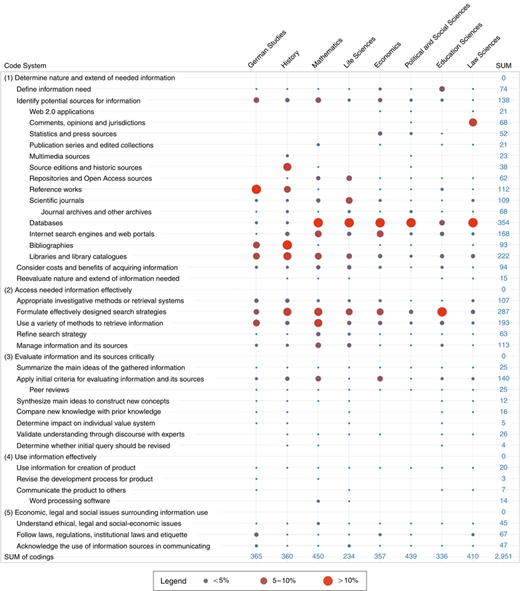
The results reveal that there are several similarities and differences between the various disciplines. Figure 1 gives an overview of the most mentioned categories within each discipline. It shows the number of codings per category and discipline. The percentage of the codings per category in relation to the sum of all codings for each discipline is represented by the size of the red dots. To allow better readability, the performance indicators of the ACRL (2000) standards are summarized in shorter umbrella terms in the first column of the table.
As can be seen, the biggest difference between the disciplines has been identified regarding the determination of the nature and extent of the needed information, especially in the area of identifying potential sources of information. Databases appear to be the most important information sources in most of the disciplines, more precisely in science-related disciplines (mathematics and life science), economics, political and social science, educational sciences and law sciences. In law sciences, comments, opinions and jurisdictions also play an important role. In economics and mathematics, internet search engines and web portals are also covered in more detail. In the humanities (German studies and history), the focus appears to be on completely different sources. In history, source editions and historic sources, reference works, bibliographies and libraries, as well as library catalogues are covered in more detail. In German studies, the focus is also on reference works. These different information sources also require different search strategies, evaluation criteria and citation. Educational sciences constitute the only discipline where the formulation of effectively designed search strategies is covered in more detail than single information sources. Also, in mathematics, the formulation of effectively designed search strategies is discussed in more detail. Only 203 (6.9 percent) of the coded text elements within the books refer to the effective use of information and economic, legal and social issues surrounding the information use. This shows that the books emphasize more skills regarding search and evaluation, rather than information use. The number of coded text elements per ACRL (2000) standard also reflects how often discipline-specific aspects are emphasized within the standards: within Standard 1 (determination of the nature and extent of the needed information) they are named three times, Standard 2 (access needed information effectively) two times and Standard 3 (evaluate information and its sources critically) once.
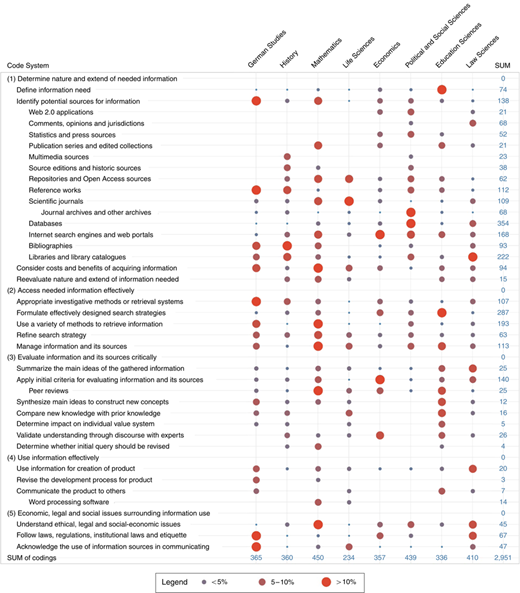
Figure 2 presents the results from another direction than the previous figure by showing to which degree each of the categories is covered within the different disciplines. The percentage of the codings per discipline in relation to the sum of all codings for the category is represented by the size of the red dots. As can be seen, most of the standards have their highest coverage within the humanities (German studies and history) and science-related disciplines (mathematics and life sciences). An exception is the critical evaluation of information and its sources, which had its highest coverage within the field of educational sciences. In the following, the results are discussed in more detail, structured by the five ACRL (2000) standards.
Determination of the nature and extent of the needed information
Personal interest in the topic of research is considered an important prerequisite for a successful literature research. Out of the analyzed books, this is only emphasized in the issues for economics and educational sciences. The book for educational sciences, in general, has a strong focus on the steps before the start of the actual literature research. A special focus is on pedagogical issues and theories. The books on law sciences and economics emphasize practical issues, especially issues of the business world. In history, it is pointed out that the relevant era for the research has to be defined first. In German studies, particular persons are often in the focus of research, which leads to the need to consider other information sources than the ones in other disciplines. The issue for life sciences describes that the literature research in this discipline is usually conducted later than in other disciplines.
Several sources are only discussed in a few disciplines. Web 2.0 applications are emphasized in the issues for economics, political and social science and law sciences. They include social media channels of practitioners and scholars, blogs and RSS feeds. All of these channels are suggested to be a possible source for being kept up to date regarding a particular topic. The issue for economics names special search engines for blogs. In economics, non-scientific sources like product reviews and social media channels of customers also play a role to assess customer behavior and trends. The issue for educational sciences does not include Web 2.0 services despite their growing relevance in research and different contexts of educational sciences (Cervetti et al., 2006).
Comments, opinions and jurisdictions are the most important sources in the discipline of law sciences. Casebooks are also mentioned in this context. Specific databases play an important role when retrieving legal texts and current law-making issues. In this regard, law sciences overlap with the political and social science where these particular sources are also used. The importance of understanding these sources is also emphasized in IL competence standards for the discipline of law sciences (American Association of Law Libraries, 2013) and a common part of IL trainings for law students (Wijetunge and Manatunge, 2014; Davies and Jackson, 2005). Interestingly, these resources are only shortly mentioned in political- and social science, despite IL-related exercises might confront students of this discipline with legal issues (Stevens and Campbell, 2008).
Statistics are especially discussed in economics, political- and social science, and to a smaller extent in educational sciences. This includes statistic databases and statistics provided by various public and private organizations on a local and an international level. Also, the need to be aware of the quality of the statistics is addressed. Statistics can be useful in the discipline of law sciences (American Association of Law Libraries, 2013) as well but are not addressed in the analyzed book. In the disciplines of economics, political- and social science and educational sciences, press databases and various press sources are also mentioned. This is in accordance with previous studies that found factual databases the most commonly named source in IL teaching for economics (Dreisiebner, 2019b).
Publication series and edited collections are mainly discussed in mathematics and educational sciences. To a smaller extent, they are also covered in economics and law sciences. While in educational sciences, economics and law sciences they are only described on different levels of depth, in mathematics, several important publication series and edited collections by mathematical research societies are introduced.
Multimedia sources are discussed in the issues for history and political and social science. The highest relevance appears to be in history, with a focus on historic multimedia content. This includes image databases, especially for historic paintings and images, video and audio archives. In political and social science, the focus is mainly on multimedia sources related to current events. In a more work-related context, multimedia sources also play a role in economics, especially in the area of marketing (Steinbach et al., 2015). The abilities to generate and use multimedia sources are further considered as relevant in mathematics (Chen and Doty, 2005). Nevertheless, they are not discussed in the analyzed book.
Source editions and historic sources are only included in the issues for history and political and social science, with the most mentioned sources in history. Relevant historic sources include personal belongings of deceased persons, autographs and databases for handwritten texts. Most of these sources are not available in electronic format. This is in accordance with the general tradition in the humanities where printed sources play a more important role than in other disciplines (East, 2005). Also, the literature on IL education for history students points out the relevance of historical sources (Pinto, 2012).
Repositories and open access sources are addressed in all analyzed disciplines with the exception of German studies. They appear to have the highest relevance for science disciplines (mathematics and life sciences). While the latter focus on preprints, in economics, the focus is on working papers. Most of the mentioned sources and search engines are discipline-specific.
Reference works are mentioned in all disciplines with the exception of life sciences. In addition to generic encyclopedias, discipline-specific encyclopedias are mentioned. Reference works appear to have their highest relevance in the humanities (German studies and history). While bibliographies and historic encyclopedia play a role in both disciplines, in German studies, especially dictionaries and bibliographical dictionaries are emphasized. This is in accordance with IL teaching guidelines for German studies (Hock, 2007).
Bibliographies are mentioned in all disciplines with the exception of life sciences and educational sciences. The content analysis reveals that they are of highest relevance in the humanities (German studies and history). This includes especially national and regional bibliographies. In German studies, there are several important bibliographies of the literature. There are also bibliographies about other bibliographies, which show their importance for this particular discipline. In history, there are several bibliographies of historic periods.
In addition to the previous sources, which were only relevant for some of the analyzed disciplines, several sources appeared in all disciplines. Scientific journals seem to be of highest relevance for science-related disciplines (mathematics and life sciences). In addition, journal archives and other archives are named. For both scientific journals and journal archives, among generic sources, discipline-specific sources are also included. In contrast to scientific journals, journal archives are most extensively covered in the political and social sciences. This might be due to the vast amount of also scientifically relevant political and educational journals for practitioners that cover recent political decisions and developments – many of them are accessible through journal archives. Besides journal archives, other archives also appear to be relevant in some of the disciplines. These are, for example, parliamentary archives in political and social science, newspaper archives in connection with educational discussions in educational sciences, data archives in economics and historical archives in history.
Libraries and library catalogs appear to play a role in all disciplines. Among local library catalogs, this also includes international catalogs. Special collections are mentioned in all disciplines, as well as the global catalog WorldCat. According to the content analysis, libraries and library catalogs appear to be of highest relevance in law sciences and history, followed by German studies, mathematics and political and social sciences.
Internet search engines and web portals occur in all disciplines but are most intensively covered in economics. All analyzed books point out two aspects: first, only parts of relevant scientific literature can be found through internet search engines. Second, the quality of the results depends on the search strategy. All analyzed books mention Google but focus mainly on scientific internet search engines like Google Scholar or the Bielefeld Academic Search Engine. While the search engines mentioned predominantly are on a generic level, web portals like EconBiz for economics, which were also mentioned, are to be seen in a discipline-specific context.
Finally, databases also seem to play a role in all disciplines. First, several generic databases like Web of Science are mentioned. This list is mostly identical in comparison with all disciplines. Second, multidisciplinary and discipline-specific databases are mentioned as well, with most databases being mentioned the most in political and social science and law sciences. With some of the disciplines, particular databases are marked to be of high relevance. Additionally, the analysis shows that some disciplines have a greater focus on international databases, while other disciplines prefer regional databases. In law sciences, most of the databases mentioned are in German and related to German-speaking countries. This also shows the country and culture-specific dimension of the analyzed sources.
All analyzed books suggest considering the costs and benefits of acquiring information. This suggestion includes conducting an online search before using interlibrary loans, document delivery services and e-book on-demand services, for which several examples are presented. In mathematics, the possibility of searching directly at the publishers is also emphasized. To re-evaluate, the nature and extent of the needed information is only roughly mentioned in some of the disciplines.
Access the needed information effectively
Not only should students know the possible information sources, but they also need to be able to use them in the next step to access the needed information. These skills are addressed in all analyzed disciplines. Regarding appropriate investigation methods, the content analysis shows two groups: first, disciplines where experimental research plays an important role; this applies primarily to the science disciplines. Second, disciplines where literature-based research plays an important role. Regarding appropriate retrieval systems, all issues suggest internet search engines for a basic search. The suggested criteria to define the appropriate retrieval system differ among the various disciplines. In humanities-related disciplines (German studies and history), the focus is on criteria for selecting appropriate reference works and bibliographic databases, while in law sciences, the focus is on appropriate databases for each legal field. In economics, it is also emphasized that the level of the planned scientific work (e.g. seminar paper or PhD thesis) influences the selection of the appropriate retrieval systems.
For all disciplines, the formulation of effectively designed search strategies is discussed, most intensely in German studies and history. This includes the proper formulation of keywords, which can be supported by thesauri. Thesauri are explicitly described in economics, political and social science and educational sciences. In the latter, thesauri from other disciplines like psychology and sociology are also described. In political and social science as well as law sciences, European thesauri predominate. Also, classifications are described, where either the Dewey Decimal Classification, the Regensburg Library Network Classification or the basic classification is mentioned. Additionally, several discipline-specific classifications are introduced, e.g., JEL in economics. In mathematics and life science, classifications are described in most detail. All issues describe the differences between simple search, advanced search, fuzzy search and phrase search. This includes the use of Boolean operators and truncations. Only in science-related disciplines (mathematics and life science), scientific classifications are mentioned. The analysis also shows that different indexes play a role in each of the disciplines.
In a next step, the search strategy has to be applied to various sources. All analyzed sources mention local university libraries. In the humanities, especially archives are mentioned. In this connection, several additional resources that provide further help for working in archives are recommended in history. For example, students of this particular discipline need to know how to work with register numbers in archives. Alert services are described in most of the disciplines. Link resolvers are named in all disciplines with the exception of law sciences. The possibilities of how to narrow the search results differ between the chosen databases and catalogs. The content analysis shows significant discipline-specific differences. While in history, eras might be used to narrow the search results, it might be legal fields in law sciences. In economics, time periods and regions might be defined as criteria to filter statistical databases. In law sciences, document numbers that classify specific types of documents (e.g. documents by the general assembly of the United Nations) might also be used.
When it comes to refining the search strategy and managing the information and its sources, the content analysis only shows minor differences between the disciplines. The snowball principle and the citation analysis are mentioned in all disciplines, but the most in mathematics. The possibilities of too little, too many random and too many good search results are discussed as well as possibilities of how to react. Concerning the managing of the information and its sources, the focus in the analyzed books is on documenting the search attempts, organizing the search results and the use of literature management software. In the science-related issues (mathematics and life science), the use of BibTeX in connection with LaTeX is described, which is not mentioned in the other disciplines.
Evaluate information and its sources critically
The content analysis reveals that the critical evaluation of information and its sources is mostly discussed in the books related to applying the initial criteria for evaluating the information and its sources. In addition, the use of social networks to discuss and exchange the results with colleagues is suggested. In economics, conferences are also named as possible opportunities. In history, online discussion platforms like H-German are mentioned, and the participation in the preparation of encyclopedia articles is suggested.
The books suggest several formal criteria like the date and type of publication a student should check after obtaining the search results. In political and social science, several criteria are also suggested to analyze keywords, abstracts, introductions and summaries. In law sciences, different systematic interpretations that influence the evaluation criteria to be applied are possible. When it comes to a more detailed analysis of the retrieved sources, criteria to check the reputation of the authors and publishers are suggested in all disciplines. In law sciences, where usually also organizations appear as authors, students are recommended to consider the aims of the respective organizations. Peer reviews are mentioned in all disciplines. The content analysis shows the strongest focus on peer reviews in mathematics, life science, economics and educational sciences. This is in accordance with the stronger focus on journals in these disciplines, as has been shown earlier in this analysis. In mathematics, downsides of peer reviews are also covered. Along with peer reviews, rankings are mentioned as well. The strongest focus on rankings appears in economics. Also, previous research found rankings to be commonly mentioned in IL teaching resources for economics (Dreisiebner, 2019b).
The content analysis shows a difference between the disciplines concerning the context that should be considered when evaluating sources. In German studies, the cultural background should be considered, e.g., the background of specific terms and their use in specific regions. In history, the life circumstances of when the sources were produced need to be considered. In science-related disciplines, it should be considered who funded the research. A similar situation happens in economics where the background of statistical data sources should be looked at. In law sciences, the hierarchy of norms and how the law was developed also need to be considered. Schemes are suggested to support the decision if the sources are applicable to the case of interest or not.
Use information effectively
Regarding the effective use of information, the content analysis shows a focus on recommendations on how to build well-structured arguments based on the literature. In life science, the relevance of experiments for publications is pointed out, and it is recommended to consider formal criteria by publishers when writing a paper. In educational sciences, the use of statistics is suggested, and students are recommended to also present their knowledge at conferences and in informal discussions. In law sciences, it is common to formulate arguments to solve a practical problem. In the humanities like history and German studies, critical reflections by authors play an important role (Reference and User Services Association, 2013; Hock, 2007). However, this is not addressed in the analyzed books. In mathematics and life science, some recommendations for the use of word processing software are included, which mainly refer to the use of LaTeX.
Economic, legal and social issues surrounding information use
Concerning economic, legal and social issues surrounding information use, the content analysis shows similar results in all disciplines. Citations are discussed in all of them, and plagiarism is described. The content analysis shows differences concerning the suggested citation styles. Also, the common style of the bibliography varies between the disciplines.
Additionally, the content analysis shows that the books mention various critical issues. Ranking algorithms of search engines are named in all disciplines, regarding their possible influence on the search results and lacking transparency. In life sciences, economics and law sciences, expensive licenses for databases and journals are discussed critically. In mathematics, the power of publishers is mentioned critically as well. In political and social science, the challenge to ensure the quality of a growing number of free content is mentioned. These critical issues also reflect the most commonly named sources per discipline, as has been shown earlier in this analysis.
Conclusions, limitations and further research
The aim of this paper is to examine existing teaching materials on IL out of various disciplines to find similarities and differences among emphasized IL skills. It presents a structuring content analysis of eight issues of the German language publication series Erfolgreich recherchieren (Succesful Research Strategies) covering the disciplines of political and social sciences, economics, educational sciences, law sciences, mathematics, life sciences, history and German studies. Thus, this paper makes the following main contributions to current literature on discipline-specific IL facilitation: first, it reveals that the biggest differences among the disciplines are found concerning the determination of the nature and extent of the needed information, especially in the area of identifying potential sources of information. Databases appear to be the most important information sources in most of the disciplines. In law sciences, comments, opinions and jurisdictions also play an important role, while in economics and mathematics, internet search engines and web portals are also covered in more detail. In the humanities, the focus appears to be on completely different sources, including source editions, reference works, bibliographies and library catalogs. Second, it shows that some of the disciplines put a greater focus on international sources, while other disciplines put a greater focus on country- and language-specific ones. Third, the criteria to define the appropriate retrieval systems differ among the disciplines. In the humanities, the focus is on criteria for selecting appropriate reference works and bibliographic databases, while in law sciences, the focus is on appropriate databases for each legal field. Fourth, the analysis shows that the approaches to narrow the search results vary among the disciplines. While in history, eras might be used to narrow the search results, it might be legal fields in law sciences. In economics, time periods and regions might be considered as criteria to filter statistical databases. In law sciences, document numbers that classify specific types of documents might also be used. Fifth, it reveals that the critical evaluation of sources is addressed in all disciplines but relates to different contexts. In German studies, the cultural background should be considered, while history focuses on the life circumstances of when the sources were produced. In science-related disciplines and economics, it should be considered who funded the research, and the background of statistical data sources must be looked at. In law sciences, the hierarchy of norms and how the law was developed should be considered.
By further analyzing which disciplinary differences are visible among discipline-specific teaching material on IL, these results show both disciplinary differences and the status of IL facilitation in a discipline-specific context, although based on a limited sample size. As previous research showed, IL facilitation, which is unfitting to disciplinary contexts, can lead to lower IL gains of students (Williams and Evans, 2008). Thus, these results can enhance IL instruction targeting students from different disciplines and thus ultimately improve student learning outcomes. The results further showed that the analyzed books emphasize more skills regarding search and evaluation, rather than information use. Those more task-oriented skills might need more practical examples and exercises to teach, which are more challenging to deliver through a printed book. Thus, the instruction of the theoretical basics might be followed by practical exercises and assignments. There are already several reports of such approaches to teaching IL in subject-specific contexts (Davies and Jackson, 2005; Wijetunge and Manatunge, 2014; Stevens and Campbell, 2008). Besides regular classes, MOOCs might be a possible solution, which have the advantage to be completely web-based and thus allow the direct integration of practical exercises and examples (Gore, 2014; Massis, 2013). In the meantime, there is a rising number of IL MOOCs available (Dreisiebner, 2019a).
This study has several limitations, which in turn open up paths into further research. First, the sample in this study is limited to German language teaching materials. This makes the generalization of the results difficult. Examining English-language materials would allow us to see if there are country, language and culture-specific differences. Second, the sample only includes teaching materials out of one book series and thus one book per discipline. While this creates a higher comparability due to the similar structure of the books, the contents of the books might also reflect the individual perceptions of their authors. Further research could include teaching materials used by various discipline-specific trainings. Third, as the analyzed books are printed guidelines on successful literature research, they are not able to address skills that are dependent on individual research problems and information needs in depth going beyond formal criteria, especially in the competence fields of critical evaluation of information and its sources, and effective use of information. Further research could include students and scholars of various disciplines, using a mixed methodological approach to look into problem-based issues in more depth. Fourth, the category scheme of the content analysis draws on the standards and associated performance indicators according to the ACRL (2000) standards. This approach was chosen as these standards are highly operationalized, which allowed direct transfer to the category scheme. Nevertheless, future research could extend the analysis, regarding coverage of the IL Framework (ACRL, 2016).
The authors would like to thank the Master student Patrick Harg for encoding of the content analysis within his Master’s thesis “Subject-specific differences and similarities regarding information literacy”. This work is supported by the Erasmus+Program of the European Commission. The European Commission support for the production of this publication does not constitute an endorsement of the contents which reflects the views only of the authors, and the Commission cannot be held responsible for any use which may be made of the information contained therein.