The aim of this paper is to investigate the relationship between the ring structure of the twisted partial skew generalized power series ring and the corresponding structure of its zero-divisor graph .
The authors first introduce the history and motivation of this paper. Secondly, the authors give a brief exposition of twisted partial skew generalized power series ring, in addition to presenting some properties of such structure, for instance, a-rigid ring, a-compatible ring and (G,a)-McCoy ring. Finally, the study’s main results are stated and proved.
The authors establish the relation between the diameter and girth of the zero-divisor graph of twisted partial skew generalized power series ring and the zero-divisor graph of the ground ring R. The authors also provide counterexamples to demonstrate that some conditions of the results are not redundant. As well the authors indicate that some conditions of recent results can be omitted.
The results of the twisted partial skew generalized power series ring embrace a wide range of results of classical ring theoretic extensions, including Laurent (skew Laurent) polynomial ring, Laurent (skew Laurent) power series ring and group (skew group) ring and of course their partial skew versions.
1. Introduction
During the last decades, several papers have studied the relation between the algebraic structure of rings and their related graphs. Perhaps one of the first papers connecting the graphs to rings dates back to 1963 when R. Swan [1] gave an elegant proof to a well-known theorem by Amitsur and Levitzki [2] that “the ring of all n × n matrices over a commutative ring R satisfies the standard polynomial identity .” Swan’s proof is based completely on the use of graph theory. Also this connection was pointed out by C. Chao and M. Schutzenberger (see [3], p. 167]).
Recently, Beck’s results on coloring of a commutative ring attract the interest of many mathematicians to explore the structure of rings through their zero-divisor graph [4]. Beck considered a commutative ring R as a simple graph whose vertices are all elements of R, such that two different vertices x, y ∈ R are adjacent if and only if xy = 0. Beck’s investigation of colorings was then continued by Anderson and Naseer in [5]. Anderson and Livingston redefined Beck’s graph of a commutative ring R by restricting the vertices to be the set that consists of nonzero zero divisors of R and called such graph a zero-divisor graph of R (see [6]). Thereafter, Redmond extended this concept to noncommutative case, and he gave two different ways to define zero-divisor graph of a noncommutative ring R. The first is directed and denoted by such that x → y is an edge between distinct vertices x and y if and only if xy = 0. The second graph is undirected and denoted by such that two different vertices x and y are adjacent if and only if xy = 0 or yx = 0 (see [7, 8]).
Afterward, many authors studied the relationship between zero-divisor graph of a ring R and zero-divisor graph of some of its extensions, for example, polynomial ring , formal power series ring and skew generalized power series ring (see for example [9–11]).
In this paper, we consider the (undirected) zero-divisor graph of a ring R. For two distinct vertices x and y in the distance between x and y, denoted by d(x, y), constitute the length of the shortest path connecting x and y, if such a path exists; otherwise d(x, y)≔∞. The diameter of a graph diam and y are distinct vertices of if has more than one vertex, and it is zero otherwise. A graph is called complete if all of its vertices are adjacent. The girth , denoted by gr, is the length of the shortest cycle in , provided contains a cycle; otherwise gr. Redmond in [8] proved that for any ring R is connected with diam and if contains a cycle then gr or 4.
The proof of many theorems is based on the following result given by Akbari and Mohammadian in [9].
Let R be a ring. Then is a complete graph if and only if either or Z(R)2 = {0}. Moreover, in the latter case, Z(R) is an ideal of R.
Axtell et al. in [10] proved that if R is a commutative ring with identity and not isomorphic to , then having any one of Γ(R), Γ(R[X]) or Γ(R[[X]]) complete is enough to imply all three are complete. Using Theorem 1.1, Akbari and Mohammadian in [9] generalized Axtell’s result for any arbitrary ring R. For skew generalized power series ring R[[S, ω]], Moussavi and Paykan in [11] proved the following theorem.
[11, Theorem 3.3] Let be a ring, S an a.n.u.p. monoid and ω: S → End(R) a monoid homomorphism. Assume that R is S − compatible. Then is complete if and only if is complete.
According to [12], a twisted partial skew generalized power series ring embraces a wide range of classical ring theoretic extensions, including Laurent (skew Laurent) polynomial ring (), Laurent (skew Laurent) power series ring () and group (skew group) ring () and of course their partial skew versions. Our purpose of this paper is to continue study the relationship between zero-divisor graph of a ring R and zero-divisor graph of twisted partial skew generalized power series ring .
In the following section, we give a brief exposition of twisted partial skew generalized power series ring , in addition to presenting some properties of such structure, for instance, α − rigid ring, α − compatible ring and McCoy ring.
In Section 3, our main results are stated and proved. We establish the relation between the diameter and girth of zero-divisor graph of twisted partial skew generalized power series ring and zero-divisor graph of the ground ring R. We also provide counterexamples to demonstrate that some conditions of the results are not redundant. As well we indicate that some conditions of recent results can be omitted.
2. Twisted partial skew generalized power series ring
The action of groups on sets is one of the crucial tools in study theory of representations and the algebraic structures of groups and rings. Partial action of groups on sets has been raised in functional analysis (see for instance [13, 14]), then it was studied from a purely algebraic point of view. In [15], Dokuchaev and Exel defined partial skew group rings and proved that, under some assumptions, it is an associative ring. As a parallel case of partial skew group ring, Cortes and Ferrero defined partial skew polynomial rings and studied its prime and maximal ideals [16]. Thereafter many contemporaneous researchers were interested in studying the transfer of a lot of properties such as right Goldie, Baer, ACC on right annihilators, right p.p. and right zip properties between partial skew polynomial rings, partial skew Laurent polynomial rings and their ground ring (see for instance [17, 18]). Fahmy et al. in [19] studied the transfer of right (left) zip property between the partial skew generalized power series ring and its ground ring R. The twisted partial skew version was defined and studied in [12, 20].
Let us first recall the definition of an idempotent (unital) twisted partial action, which is inspired by [21, Example 2.1], [22, Section 4] and suits Definition 2.1 of [23].
An idempotent twisted partial action of a group G on a ring R is a triple , where , is a ring isomorphism from to Ds, , and τ is a twisted map from G × G to , the group of units of R, satisfying the following postulates, for all u, v and w in G:
is generated by a central idempotent 1u;
and is the identity map of R;
;
;
for each ;
for each .
An ordered group is called a strictly ordered group if it is satisfying the condition, if u, v, w ∈ G and u ≺ v, then uw ≺ vw and wu ≺ wv. A subset X of is said to be Artinian if every strictly decreasing sequence of elements of X is finite and that X is narrow if every subset of pairwise order-incomparable elements of X is finite.
The twisted partial skew generalized power series ring was introduced in [12, Definition 1.2] as follows.
Let R be a ring, a strictly ordered group and Θ an idempotent twisted partial action of G on R. The twisted partial skew generalized power series ring is the ring of all maps f: G → R, where belongs to the corresponding ideal Ds such that is Artinian and narrow subset of G, with pointwise addition, and the product operation is defined by
According to Krempa [24], an endomorphism σ of a ring R is said to be rigid if implies a = 0 for a ∈ R. If there exists a rigid endomorphism σ of R, then R is said to be σ − rigid. In [25], Hashemi and Moussavi generalized σ − rigid rings by introducing σ − compatible rings. A ring R is called σ − compatible if for each a, b ∈ R, ab = 0 if and only if aσ(b) = 0. If R is a ring, (S, ⪯) a strictly ordered monoid and ω: S → End(R) a monoid homomorphism, Marks et al. in [26] extended such concepts to S − compatible and S − rigid rings. A ring R is said to be S − compatible (respectively S − rigid) if ωs is compatible (respectively rigid) for every s ∈ S. The partial version of such concepts can be given as follows:
Let R be a ring, a strictly ordered group and Θ an idempotent twisted partial action of G on R. The ring R is called partial α − compatible if whenever s ∈ G, a ∈ Ds, b ∈ R; ab = 0 if and only if .
According to Cortes [17] we adopt the following definition.
Let R be a ring, a strictly ordered group and Θ an idempotent twisted partial action of G on R. The ring R is called partial α − rigid if a ∈ Ds for s ∈ G such that , then a = 0.
A ring R is called Armendariz if whenever the polynomials and in the polynomial ring , satisfy implies that aibj = 0 for all 0 ≤ i ≤ m and 0 ≤ j ≤ n. In [19], the partial skew version of Armendariz rings was defined as a natural extension of Definition 2 in [17]. In the light of the above definitions, we get the following:
Let R be a ring, a strictly ordered group and Θ an idempotent twisted partial action of G on R. The ring R is called Armendariz if for any such that fg = 0, then for each and .
Similar to [27, Definition 3.11] a ring R is called right (G, α) − McCoy if whenever nonzero elements f, g of satisfy fg = 0, then there exists 0 ≠ r ∈ R such that fr = 0. Left (G, α) − McCoy rings is defined analogously. If R is both left and right (G, α) − McCoy, then we say R is (G, α) − McCoy ring.
Recall that a monoid S (resp. a group G) is called a unique product monoid (u.p., for short) if for any two nonempty finite subsets X, Y ⊆ S (resp. G) there exist x ∈ X and y ∈ Y such that xy ≠ x′y′ for every (x′, y′) ∈ X × Y \{(x, y)}, the element xy is called a u.p. element of XY = {st: s ∈ X, t ∈ Y}. The class of u.p. monoids (resp. groups) includes the right and the left totally ordered monoids (resp. groups), for more details see [28].
[26, Definition 4.11] Let (S, ⪯) be an ordered monoid. Then (S, ⪯) is called an Artinian narrow unique product monoid (or simply an a.n.u.p. monoid) if for every two Artinian and narrow subsets X and Y of S, there exists a u.p. element in the product XY.
3. Main results
In the following lemma, () denote to the set of nonzero left (right) zero divisors of a ring R.
Let R be a ring, a strictly ordered a.n.u.p. group and an idempotent twisted partial action of the group G on the ring R.
If and R is partial α − compatible, then for some .
If , then for some .
Let . Then there exists a nonzero element such that fg = 0. Since G is a.n.u.p., there exist and such that st is u.p. of . Thus . Since R is partial α − compatible, it follows that f(s)g(t) = 0. Hence .
Let . Then there exists a nonzero element such that gf = 0. Since G is a.n.u.p., there exist and such that ts is u.p. of . Therefore, . It follows directly that .□
The following example shows that the partial α − compatibility condition for the ring R in part of the previous lemma is not superfluous.
Let R be the infinite direct product of copies of a ring A and the group of integers with the trivial order. For each positive integer i, consider the isomorphisms αi: D−i → Di, where Di is the ideal of R consists of all elements of R with zero in the first i components, that is, if a ∈ Di then a is of the form
By adding the identity automorphism α0 of the ring R, we get a construction of a twisted partial skew generalized power series ring with trivial twisting, where and . We see that the ring R is not partial α − compatible, since while . Now, consider the element defined by and for all and the element defined by and for all . Therefore, fg = 0, but for all .
Let R be a ring, a strictly ordered a.n.u.p. group and an idempotent twisted partial action of the group G on the ring R. Assume Ds = R whenever , for any s ∈ G. If , then for some .
Let . From Lemma 3.1 , it is sufficient that to study the case fg = 0 for some nonzero element . Since G is a.n.u.p., there exist and such that st is u.p. of . Therefore, . It follows that , that is, . Using our assumption, we have either is an automorphism of R, therefore , or we have 1s ≠ 1R, hence and . □
Let R be a ring, a strictly ordered a.n.u.p. group and an idempotent twisted partial action of the group G on the ring R. If is an ideal of R, then is a domain.
First observe that any nonzero element in can be represented as an element where for all . Now, let be non zero elements in such that . Then . Since G is a.n.u.p., there exist and such that st is u.p. of . Therefore, . Since is an ideal, it follows that R has no nontrivial idempotents and αs is an isomorphism of R for all s ∈ G. Hence , so either or is nonzero zero divisors, a contradiction. □
Let be a ring, a strictly ordered a.n.u.p. group and an idempotent twisted partial action of the group G on the ring R. Then is complete if and only if is complete.
Suppose that , then there exists a nonzero element such that fg = 0 (or gf = 0). Since , is a nonzero element in the domain and . We conclude that . On other hand, consider the set . By Lemma 3.3, H is nonempty; so we can write f as a sum of two maps h and k, where and . Since and , it follows that . Therefore, we have . Since , , by [9, Theorem 5], and α is a global action, it follows that hg = 0. Hence kg = 0, which contradicts Lemma 3.3, where for each . Therefore .
Now, let . Then for each s, t ∈ G. Since α is a global action, for each s, t ∈ G. So, fg = 0 and is complete.
The converse is clear, since is induced subgraph of . □
The following example explains why the case of is excluded in Theorem 3.5.
Let and the group of integers with the trivial order. Let D0 = R, , and for each . Consider the identity automorphism α0 of R and the isomorphism α1: D−1 → D1 defined by . Then with pointwise addition, and the product operation is defined by
We conclude that
and is given by the following planar graph.
Before continuing, it worth mention here that accurate tracking of the proof of Proposition 3.21 in [11] shows that the condition on S to be a.n.u.p. is superfluous. Therefore, we can give the following:
Let R be a ring that is not a domain, S a nontrivial monoid and ω: S → End(R) a monoid homomorphism. Assume that R is S − compatible and the skew generalized power series ring. Then is either 3 or 4 . In particular, if R is not reduced, then .
We have two cases:
Case 1: If . Let ab = 0 for distinct elements . Using the S − compatibility of R, we find that is a 4 − cycle in for any .
Case 2: If . Let a2 = 0 for the nonzero element . Using the S − compatibility of R, we find that is a 3 − cycle in for any . □
Unfortunately, the following example shows that the twisted partial skew version of Proposition 1 is not true.
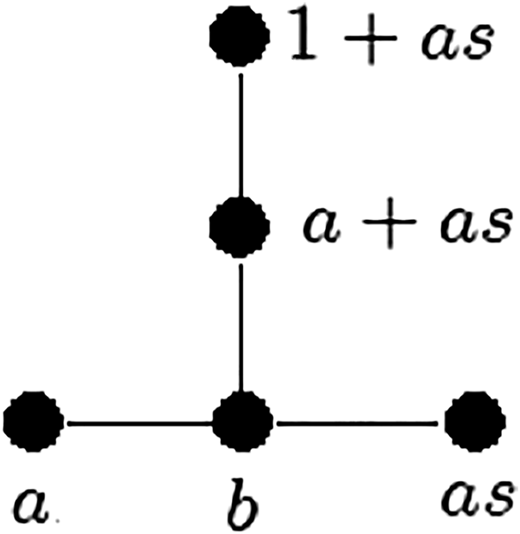
Let , , D1 = R, , and αu be the identity automorphism of Du, u ∈ G. Then the twisted partial skew generalized power series ring with trivial twisting map is isomorphic to , which is a subring of the group ring . Consequently, gr and is the following tree
Let R be a ring, G a nontrivial group, and a twisted partial skew generalized power series ring. If R is partial α − compatible and a ∈ Du, b ∈ Dv are nonzero elements such that ab = 0 where , then contains a cycle. In particular, if a is nilpotent, then gr.
Let a ∈ Du, b ∈ Dv be nonzero distinct elements such that ab = 0, where . Using the partial α − compatibility of R, we find that
is a 4 − cycle in . In particular, if a = b, then is a 3 − cycle in . □
By [8, Theorem 3.3], we note that if R is partial α − compatible, G a nontrivial group and a ∈ Du, b ∈ Dv are nonzero elements such that ab = 0 where then gr is either 3 or 4.
Let R be a ring, G a nontrivial a.n.u.p. group, and a twisted partial skew generalized power series ring. If R is partial α − rigid and contains a cycle, then grgr.
The proof is similar to the proof of Theorem 3.22 in [11]. □
The next example shows that the a.n.u.p. condition in Theorem 3.9 is not superfluous.
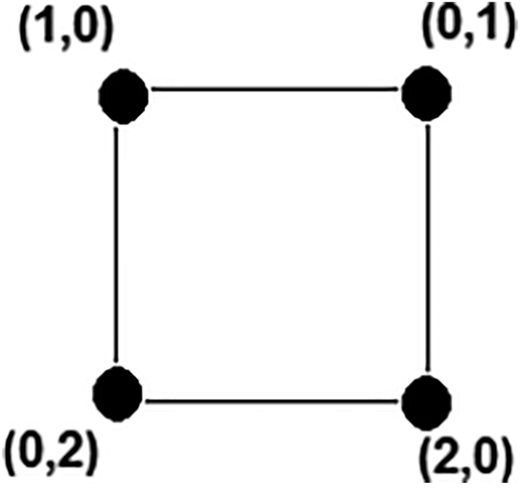
Let , , D1 = R, , and αu be the identity automorphism of Du, u ∈ G. Then the twisted partial skew generalized power series ring with trivial twisting map is isomorphic to , which is a subring of the group ring . Since consist a three-cycle, gr. However gr, since is the following four-cycle