


Let be a connected subgraph of a connected graph The -structure connectivity of the graph , denoted by is the minimum cardinality of a minimal set of subgraphs in , such that every is isomorphic to and removal of from will disconnect . The -substructure connectivity of the graph , denoted by is the minimum cardinality of a minimal set of subgraphs in , such that every is a connected subgraph of and removal of from will disconnect In this paper, we provide the -structure and the -substructure connectivity of the circulant graph Cir where and the hypercube for some connected subgraphs
1. Introduction
A simple graph is a finite nonempty set of objects called vertices together with a (possibly empty) set of unordered pairs of distinct vertices of called edges. Two distinct vertices are said to be adjacent in if and are connected by an edge and it is represented by . A graph is said to be trivial if it contains only one vertex and no edges. The connectivity is an important indicator of the reliability and fault tolerability of a network. The vertex connectivity of a connected graph , denoted by , is the minimum cardinality of a vertex subset , whose removal would disconnect or is the trivial graph. As a generalization of the vertex connectivity , Cheng-Kuan Lin et al. [6] introduced two new kinds of connectivity, called structure connectivity and substructure connectivity. A set of connected subgraphs of a graph is a subgraph-cut of if is a disconnected graph or . Let be a connected subgraph of . Then is an -structure cut if is a subgraph cut, and every element in is isomorphic to . The -structure connectivity of , denoted by , is defined to be the minimum cardinality of all -structure cuts of . is an -substructure cut if is a subgraph-cut, and every element in is isomorphic to a connected subgraph of . The -substructure connectivity of , denoted by , is the minimum cardinality of all -substructure cuts of . Since every -structure cut is an -substructure cut . If then we have .
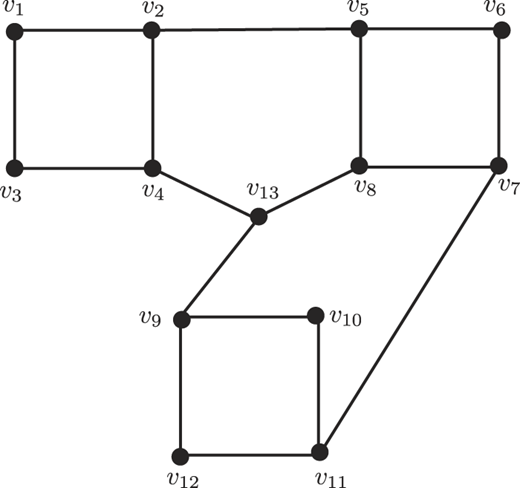
The vertex connectivity for every subgraph of whereas the relation between vertex connectivity and structure connectivity depends on . For the graph , given in Figure 1, , the structure connectivity of with respect to the cycle of length and the structure connectivity of with respect to the cycle of length .
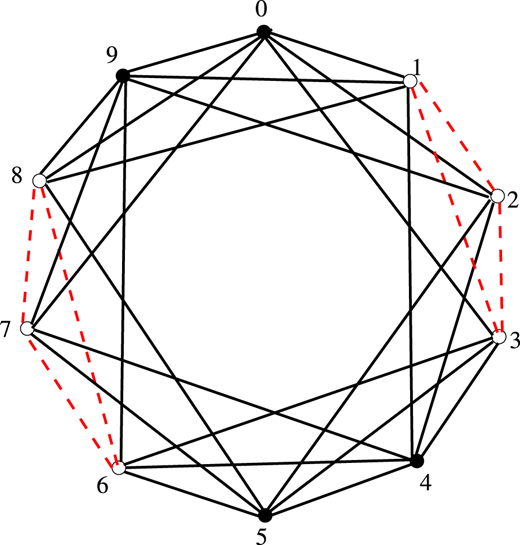
Let be a finite group with as the identity. A generating set of is a subset such that every element of can be expressed as a product of finitely many elements in . Assume that and implies and such a subset is called as a symmetric generating set of . Hereafter, we assume that is a symmetric generating set of a finite group . A Cayley graph is a graph , where and two vertices and are adjacent if and it is denoted by Cay. The inclusion of the inverse in for every element of means that Cay is undirected. Since is a generating set for , Cay is connected and Cay is a regular graph of degree . Cayley graphs are extensively dealt in the literature and various authors including Dejter [3], Lakshmivarahan [4], Lee [5], Tamizh Chelvam [8], and Wang [10] have worked on Cayley graphs. For example, one can refer the survey by Tamizh Chelvam and Sivagami [9] for domination in Cayley graphs. The Cayley graph constructed out of the finite cyclic group along with a symmetric generating set is called a circulant graph and the same is denoted by Cir. The hypercube is the Cayley graph defined on the group with the standard orthonormal basis as the generating set. Cheng-Kuan Lin et al. [6] have obtained and for . Here, we provide an example in Figure 2, to exhibit a structure cut of the circulant graph Cir with respect to . In Figure 2, the structure cut is indicated by the dotted lines and note that .
Throughout this paper, denotes the removal of a set of subgraphs from the graph and denotes the removal of the set from the graph . When , is simply denoted as . For a graph , the open neighborhood of a vertex is the set of all vertices which are adjacent to . The closed neighborhood of is . Let and be two graphs. Then the intersection of and , denoted by , is the graph whose vertex set is and the edge set is . The union of two disjoint vertex sets graphs and , denoted by , is the graph whose vertex set is and the edge set is . For basic definitions and properties related to graph theory, one can refer [2]. For undefined definitions related to algebraic graph theory, one can refer [1].
In Section 2, we obtain the -structure and the -substructure connectivity of the circulant graph Cir where , for with respect to some of its connected subgraphs. For integers and with , Mane [7] proved that , where is a positive even integer with and observed that . In Section 3, for , we obtain the exact value for .
2. Structure and substructure connectivity of circulant graphs
Throughout this section , and are integers such that and . We take the elements of as . The following result due to Wang [10] is useful in the paper.
([10, Wang]). Let and be positive integers such that , and . Then .
By definition and from Theorem 2.1, we have the following corollary.
Let and be positive integers such that , and . Then and .
A star graph is a complete bipartite graph comprised of two partite sets of vertices of sizes and respectively, such that two vertices are adjacent if and only if they are in different partite sets. If is a subgraph of Cir, then . If and , then the circulant graph is the complete graph . Now, we obtain the structure connectivity of , as a circulant graph with respect to . If does not divide , then removal of does not disconnect Cir for any . Hence the structure connectivity of with respect to is meaningful only when divides .
Let and be positive integers such that , and . For a positive integer with , . Also, if divides .
By the assumption on and , Cir. By Theorem 2.1, is - connected. Let be a -substructure cut with minimum cardinality of . Suppose . Then and is disconnected, which is a contradiction to is -connected. Hence .
For , let be the subgraph of with as the central vertex and as the end vertices and hence isomorphic to . Consider the subgraph of with as the central vertex and all remaining vertices of as end vertices. Note that is isomorphic to a subgraph of . Clearly is the trivial graph . Hence . Thus .
Suppose divides . As mentioned above in the proof, is a subgraph of isomorphic to and so . Now . Hence . □
In Lemma 2.3, we have considered in which case is complete. Now, we consider , so that can never be complete. By considering , we determine the structure and substructure connectivity of Cir with respect to where .
Let and be positive integers such that and . Let and . Then the following are equivalent:
(i)
(ii)
(iii) .
Since , .
(i) (ii). Assume that . So that there exists a subgraph of for some such that is disconnected or a trivial graph. Since is vertex transitive, one can have the central vertex of as . Consider the subgraph of induced by 〈〉. The graph is connected and the vertices of other than are adjacent to either or in . Note that is a subgraph of . Suppose , then is connected, which is a contradiction. Hence and . It is easy to observe that the graphs and are equal. It is known that . Suppose , then is connected, which is a contradiction. This implies that . Hence .
(ii) (iii). Assume that . For , deg and hence . Since , is a subgraph of and hence removal of from is same as removing from . Thus .
(iii) (i). Since , . □
Let and be positive integers such that , , and . Even without the condition , one can talk about , whereas it is not so in the case of . For, if , then for any integer with , removal of does not disconnect .
Consider . If , then and hence by Theorem 2.1, is connected after removal of from . On the other hand if , then . This along with yields . Thus .
Now, we attempt to obtain and , for and .
Let and be positive integers such that , and . If is an integer such that and , then and .
Let for , for and for . By division algorithm and for some and with and .
For , let be defined as follows.
and edge set
Further when , let be defined as follows.
and edge set
In , two vertices and are adjacent if and only if has the property that . Since for every and for every , is indeed a subgraph of for every .
Note that, each is isomorphic to . Let be the union of subgraphs given by
Note that , , is disconnected with as one component. Thus, and so . By Theorem 2.1, is -connected. Suppose there exists a set of subgraphs of such that every is isomorphic to a subgraph of , and is disconnected. Let . Clearly and by the assumption is disconnected, which is a contradiction to is -connected.
Thus and so . Hence . □
Now we obtain and , for and .
Let and be positive integers such that , and . If is an integer with and , then
By Theorem 2.6, for . This gives that and so when . By Theorem 2.4, if and only if . Hence for the other cases and . Thus,
3. Structure and substructure connectivity of hypercubes
The -dimensional hypercube is the Cayley graph defined on the group with generating set as the standard orthonormal basis. Note that contains vertices and edges. Actually two distinct vertices and in are adjacent if and only if for exactly one (). For any vertex in , let where for every and . Note that is the neighborhood set of in . For each , we have two -dimensional subgraphs of where and . Obviously, is isomorphic to for each . The path of length is a walk with distinct vertices and distinct edges. The cycle of length is a closed path that contains distinct vertices.
Cheng-Kuan Lin et al. [6] proved the following theorem for the substructure connectivity of hypercube with respect to the cycle .
([6, Theorem 10]). For , .
For integers and with is a positive even integer, and , Mane [7] considered the substructure connectivity of with respect to the cycle . In fact Mane [7] proved that , and . In this section, for , we obtain the exact value for .
First, we obtain the structure connectivity and the substructure connectivity of hypercube with respect to , the path of length 3.
For , .
By Theorem 3.1, . Since all subgraphs of are also subgraphs of , we have .
For , consider the paths of length , where
For odd , let and for even , let . The removal of these paths , for , of length disconnects with as an isolated vertex. Hence .
Thus, we have and so . □
In the following lemma, we obtain an upper bound for the structure connectivity of with respect to .
For , .
By division algorithm, , . For , consider the cycles of length given below:
where
If , let .
If , let .
The removal of cycles disconnects with as an isolated vertex. Hence . □
For each , is a collection of -cles of and the same is taken as . Let be a subset of collection of -cycles of . For , is the subgraph of . Cheng-Kuan Lin et al. [6] obtained the substructure connectivity of hypercube with respect to and the same the stated below to obtain a lower bound for the substructure connectivity of the hypercube with respect to .
([6, Theorem 6]). For , .
If , then is connected.
If , then , hence is connected. Assume that and .
Suppose for all . Since is connected and every vertex of is connected to a vertex in , we get that is connected.
If for all , then by similar arguments as above, is connected.
Assume that and . Without loss of generality one can assume that . Then we have two cases.
Let and . Clearly is connected and every vertex in is adjacent to a vertex in . Hence is connected.
Let and . Note that subgraphs induced by are subgraph isomorphic to in and respectively. Further both and are isomorphic to . By Lemma 3.4, removal of a does not disconnect and . Thus both and are connected. Also there exists a vertex adjacent to . Thus is connected. □
In the following lemma, we obtain a lower bound for the structure connectivity of with respect to .
For an integer , .
By induction on . By Lemma 3.5, the result is true for . Assume as induction hypothesis that the statement holds for , . To complete the proof, one has to prove that if , then is connected.
Assume that either or . Without loss of generality, let us assume that . Note that is connected and every vertex of is connected to a vertex in and hence is connected.
Suppose and .
Assume that, for every 6-cycle of , or . In this case, we have the number of 6-cycles of and is at most and . Note that and so . By the induction hypothesis, and thus is connected for . Since , for , contains more than vertices. Hence there exists a vertex which is adjacent to . Hence is connected.
Assume that and and there is a 6-cycle such that for each .
Let , where each is a 6-cycle. For any , the elements of differ from one another in at most 3 coordinates. Let us name those coordinates as . i.e., if (or 1) is the th coordinate of an element in for , then every element of has (or ) as the th coordinate.
Hence in total we have such coordinates , for (not necessarily distinct) corresponding to all elements in . Further, . Thus there exists such that for each . This means that th coordinate of is same in all the 6 elements of . i.e., the th coordinate of all the elements of are equal.
Let us partition the vertices of into two subsets . By the above arguments, for every , , either or . Note that both the induced subgraphs and of are isomorphic to . Now, if for some , proceeding as in Case 1, is connected. Otherwise, proceeding as in Case 2.1, is connected. Thus, . □
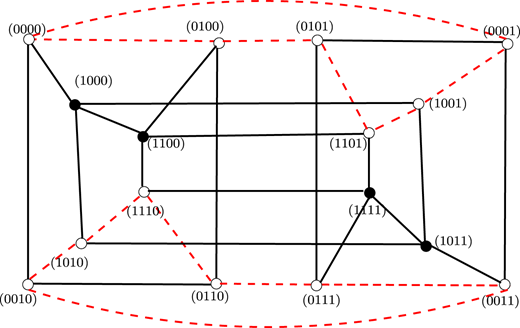
Figure 4 illustrates the -structure connectivity of . In Figure 4, the structure cut is indicated with the dotted lines.
Since is connected and by Lemma 3.3, , . Also, by Lemma 3.3 and 3.6, we have the following result.
For , .
This research work is supported through the INSPIRE, India programme (IF160672) of Department of Science and Technology, Government of India for the second author. Declaration of Competing Interest: The authors declare that they have no known competing financial interests or personal relationships that could have appeared to influence the work reported in this paper. The publisher wishes to inform readers that the article “Structure and substructure connectivity of circulant graphs and hypercubes” was originally published by the previous publisher of the Arab Journal of Mathematical Sciences and the pagination of this article has been subsequently changed. There has been no change to the content of the article. This change was necessary for the journal to transition from the previous publisher to the new one. The publisher sincerely apologises for any inconvenience caused. To access and cite this article, please use Tamizh Chelvam, T., Sivagami, M., “Structure and substructure connectivity of circulant graphs and hypercubes”, Arab Journal of Mathematical Sciences, Vol. 27 No. 1, pp. 94-103. The original publication date for this paper was 24/10/2019.

