The purpose of this paper is to understand the role of entrepreneurial intention in promoting women entrepreneurship in Indian micro, small and medium enterprises (MSMEs). This study seeks to clarify the construct of entrepreneurial intention and then reports the validation of the entrepreneurial intention instrument.
An instrument has been designed and administered on a sample of 103 respondents across India from women entrepreneurs to understand the entrepreneurial intention by using cluster and snowball sampling. The data has been streamlined and then analyzed using descriptive analysis for validity and reliability checks.
This research was aimed to determine the constructs of entrepreneurial intention. Through data analysis, it has been observed that the reliability coefficients reveal the adequacy of the sample. The Cronbach’s alpha values for all the items in the instrument were found to be greater than or equal to 0.6. Strong correlations were also found between direct and indirect measures of entrepreneurial intention and hence confirmed that all the measures in the instrument were well constructed. Analysis has also explained the relationship between various constructs of entrepreneurial intention by using Pearson’s correlation coefficients. Strong and positive values of correlation explain the existence of the convergent and discriminant validity of the instrument.
The research results obtained from the analysis of reliability and validity tests not only provides the establishment of the relationship among the various constructs but also suggests that the model provides a promising potential to measure entrepreneurial intention. This study will contribute to new knowledge of the conditions of women entrepreneurship from different perspectives by developing and validating an analytic model for promoting the women entrepreneurship in MSMEs of India.
From a government perspective, this model will help in designing training programmes for promoting women entrepreneurship in India. The obtained result also brings significant implications for practice as well as raises a broad future direction for other researchers
Extended SCCT model has recently suggested an inclusive framework of factors affecting the entrepreneurial intention, there is not much attempt made in research using this theory as background for predicting intention in the context of women entrepreneurship. This paper attempts to fill this gap by formulating a conceptual model for measuring entrepreneurial intention among women entrepreneurs by integrating and adapting the constructs of extended social cognitive career theory model and entrepreneurial potential model.
Introduction
The Indian economy has been witnessing a drastic change since mid-1991, with the new policies of economic liberalization, globalization and privatization initiated by the Indian Government. The micro, small and medium enterprises (MSMEs) sector in India has a very pivotal role to play in the development of the country’s economy. Gartner in 1988 has defined entrepreneurship as “the creation of new organizations.” Women entrepreneurship is “an act of owning a business which makes women economically independent.” Female entrepreneurs play an important role in the sustained economic development and social progress. The gender gap in entrepreneurship is defined as the difference between men and women in terms of numbers engaged in entrepreneurial activity, motives to start or run a business, industry choice and business performance and growth. Entrepreneurship amongst women in India has been a recent phenomenon. As per Global Entrepreneurship Index Report of 2018, India has ranked 68th among 137 global countries. In addition, it has been reported that the product innovation is the highest strength possessed by entrepreneurial ecosystem in India and a lot of improvement is required in technology absorption. Zoltán et al. (2018, GEI Report). The recent Mastercard Index of Women Entrepreneurs (MIWE) has ranked India on 52th position among 57 nations. The study mentioned that the “underlying conditions” for women entrepreneurs in India are less favorable when compared to countries that got a high index score. The report further indicates that women in India have less inclination toward business ownership because of cultural bias. Not just that, women who actually own businesses are less likely to grow their business and are more prone to shutting down because of lack of financing. In addition to this, it has been suggested that India needs to work on increasing women enrollment in postsecondary education, increasing access to financial loans to women entrepreneurs and single window clearances, tax breaks and other measures to promote women entrepreneurship in the country (Mastercard Index of Women Entrepreneurs [MIWE], 2018, MIWE Report).
MSMEs have been recognized as a fundamental driver for creating, running and growing business and, consequently, the economic growth of a country and this is no different for Indian economy as well. Ministry of MSME report states MSMEs constitutes 95 per cent of all industrial units in India contributing to 8 per cent of National GDP, 50 per cent of country’s total manufactured exports, 45 per cent of India’s total industrial employment (Ravi, 2014). As mentioned in the Sixth Economic Census released by the Ministry of Statistics and Programme Implementation, it is found that women constitute around 14 per cent of the total entrepreneurship, i.e. 8.05 million out of the total 58.5 million entrepreneurs. Out of these, 2.76 million women constituting 13.3 per cent of women entrepreneurs work in agriculture sector, whereas 5.29 million women constituting more than 65 per cent work in nonagriculture sector. MSME’s in India provides largest source of employment which is at par with agriculture sector. Entrepreneurial intention plays a vital role for any decision to take place for starting any firm.
Most entrepreneurship research on individual level analysis has focused on the entrepreneurial activities of male entrepreneurs. It is explicitly found in earlier research findings that there is no significant difference in male and female entrepreneurs (Carter, 2000; Carter and Cannon, 1992). Several other studies were conducted with a focus on studying the gender differences in entrepreneurship. It has been stated in some studies by that women entrepreneurs are different from that of men in terms of characteristics, background, motivation, entrepreneurial skills and the problems faced by them. In addition to this, studies have pointed that men and women use different strategies and organizational structures while managing business enterprises (Hisrich and Brush, 1984; Zapalska, 1997; Bird and Brush, 2002; Klyver and Grant, 2010; Hechavarria et al., 2018; Said et al., 2014). Rapid increase in number of women-owned enterprises across different countries has attracted several researchers’ interest. With this growing phenomenon, the major focuses of study are terms of characteristics, motivations, constraints and consequences. This study intends to understand the role of entrepreneurial intention in promoting women entrepreneurship among women entrepreneurs.
Literature review and hypothesis development
Most entrepreneurship research on individual level analysis has focused on the entrepreneurial activities of male entrepreneurs. There are not much attempts made to conduct a nation-wide comprehensive research study to understand the characteristics, motivation, entrepreneurial intention, issues and challenges of women entrepreneurs. Most of the research studies are cross-sectional or longitudinal studies focusing on specific regions with in India, namely, Tamilnadu, Jammu and Kashmir, Meghalaya, Andhra Pradesh, Karnataka, Uttar Pradesh and Kerala (Marichamy, 2013; Mani, 2011; Thomas and Lavanya, 2012; Zuhaib, 2013; Farooq and Mustafa, 2014; Sairabell, 2013; Nagalakshmi, 2015; Nivedita and Mishra, 2013; Chandrasekar et al., 2008).
Literature review revealed 13 intention-based theories. Extended social cognitive career theory and entrepreneurial potential model are studied most predominantly. These two models holistically cover the major constructs mentioned in other leading entrepreneurial intention theories. This study addresses the above gaps by developing a conceptual model which adapts extended social cognitive career theory and entrepreneurial potential model, followed by pan India data collection.
An attempt is made in this study to fill these literature gaps. Hence, the literature highlights the various antecedents of entrepreneurial intention, and the role of these antecedents in influencing entrepreneurial intention among women. The comprehensive review of literature has been divided into two sections: defining women entrepreneurship and entrepreneurial intention.
Defining women entrepreneurship
Women entrepreneurship is a subset of entrepreneurship; it also faces the difficulty of single or commonly accepted definition for the same. Researchers have defined women entrepreneurship in several ways; Table I summarizes some of these definitions. Definition of MSMEs was given under micro, small and medium enterprises development (MSMED) Act, 2006 is considered for this study. This act defines women entrepreneurship as “a business entity which owned and managed by a woman”(MSME Report,2006). It was in 1970’s that the Government of India began to promote and focus on self-employment among women. As a result of these initiatives, in late 1990’s the concept of women entrepreneurship gained prominence.
Entrepreneurial intention
Entrepreneurial intention is defined as a state of mind that ultimately leads an individual towards forming a new business concept and making a career in entrepreneurship. Entrepreneurial intention plays a vital role for any decision to take place for starting any firm. Intention is a direct antecedent of real behavior; the stronger the intention for behavior, the bigger the success of behavior prediction or actual behavior (Hikkerovaa et al., 2016). Entrepreneurial intention is defined as a state of mind that ultimately leads an individual towards forming a new business concept and making a career in entrepreneurship. It has been highlighted by Krueger and Brazeal (1994) in that entrepreneurial potential plays an important role to have an intention that leads to behavior. They have also mentioned that we want more potential entrepreneurs; we need to identify and establish policies that increase both their perceived feasibility and their perceived desirability. Hence, it is required to study entrepreneurial potential to understand the intention of a person. There is not much source available to measure entrepreneurial potential. Several intentional theories were found in the literature review, the summary of these theories/models is presented in Table II.
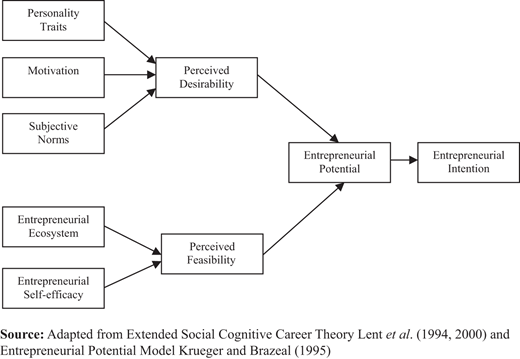
As envisaged in the literature review, we have observed crucial gaps. To overcome those gaps, a conceptual model has been developed which aims to serve the objective of the research study, i.e. how to promote women entrepreneurship in Indian MSMEs. Through literature various intentions-based theories were found. Out of which two theories gained the utmost importance are extended social cognitive career theory model (SCCT) and entrepreneurial potential model (EPM). Extended SCCT theory focuses on testing the interdependence of some narrower and concrete variables such as individuals’ personalities, education, role models, perceived supports and entrepreneurship intention (Zhao et al., 2005; Linan, 2008). Also, the researchers Krueger and Dr Brazeal in 1994 mentioned that “Entrepreneurial potential requires potential entrepreneurs.” This model focuses on entrepreneurial potential of an individual and alsouses the constructs of Theory of Planned Behavior and Shapero’s (1982) model of the entrepreneurial event. The conceptual model used for this study (Figure 1) has been adapted from SCCT and EPM.
The model consists of following constructs defined as below.
Personal characteristics
It is defined as a feature or trait that helps to distinguish an individual. In order to study these characteristics, we will be using BIG 5 Personality model (OCEAN), as this model provides a comprehensive framework that comprises personality constructs instead of varied personalities variables. Personality traits are defined as follows:
Agreeableness – It represents an individual who has the tendency to be compassionate and supportive rather than mistrustful for others. Those individuals who have high agreeableness are considered to be more attracted toward entrepreneurship.
Conscientiousness – It represents an individual who are self-motivated, hardworking and are goal-oriented. Those individuals who have high conscientiousness are considered to be more attracted toward entrepreneurship.
Extraversion – It represents an individual who is empathetic, creative, proactive, dominant and energetic. Individuals scored high on extraversion tend to be more attracted toward entrepreneurship.
Neuroticism – It defines the degree of emotional stability in an individual. People who are high on neuroticism tend to be self-confident, high on self-esteem and are composed. The individuals who scored high on Neuroticism tend to be more attracted toward entrepreneurship.
Openness – It represents an individual who tends to be inquisitive, innovative, inventive and creative. Individuals who scored high on openness tend to be more attracted toward entrepreneurship.
Subjective norms – It is defined as the perception of an important person or group of people about choosing entrepreneurship as a career. An individual who is motivated by fellow people tends to be more attracted toward entrepreneurship.
Motivation – It is defined as the drive or factor that motivates women to become an entrepreneur. The two types of factors are as follows.
Necessity-driven factors (push factors) – Factors that force a women to become an entrepreneur including factors such as unemployment, dissatisfaction from job, family constraints and financial constraints.
Opportunity-driven factors (pull factors) – Factors that act as an opportunity and pull women to choose entrepreneurial activity as a career including factors such as market opportunity, self-recognition, desire to be independent, family support and autonomy.
Entrepreneurial ecosystem – OECD defines institutional framework “as the set of governmental and other institutions responsible for the design and implementation of SME policies” (Erastus et al., 2014).The individuals who tends to have more support from Entrepreneurial ecosystem(focus is made on support from government) are highly motivated and found to have more intention towards entrepreneurship.
Entrepreneurial potential– Potential Entrepreneurs are defined as the individuals who are desirable and feasible to become an entrepreneur but are not willing to act on it. Individuals with high entrepreneurial potential are found to have high intention towards entrepreneurship. As mentioned by Krueger and Brazeal (2015) in entrepreneurial potential is measured through following constructs:-
Optimism – The degree attained or attainable by entrepreneur or a nonentrepreneur under implied or specified conditions. Individuals who are high on optimism tend to have high entrepreneurial potential and hence tend to have intention towards entrepreneurship.
Cognitive flexibility – It is the Ability to adapt the cognitive processing strategies to face new and unexpected conditions in the environment. Individuals who are high on cognitive flexibility tend to have high Entrepreneurial Potential and hence tends to have intention towards entrepreneurship
Entrepreneurial intensity – It measures the focus and commitment of entrepreneurs regarding their entrepreneurial ventures. The individuals who are high on entrepreneurial intensity tend to have high entrepreneurial potential and hence tend to have intention toward entrepreneurship.
Entrepreneurial potential-action control scale – The action control scale consists of three subscales that are action orientation subsequent to failure vs preoccupation (AOF), prospective and decision-related action orientation vs hesitation (AOD) and action orientation during (successful) performance of activities (intrinsic orientation) vs volatility (AOP). The individuals who score high on this scale tend to have high entrepreneurial potential and hence tend to have intention towards entrepreneurship
Role identity – It is defined as how one sees themselves as entrepreneurs. Individuals who are high on role identity tend to have high entrepreneurial potential and hence tend to have intention towards entrepreneurship
Entrepreneurial self-efficacy – It is defined as the belief that individual has on its one of the skills that will help them in performing certain actions in order to achieve something (Bandura, 1993). Individuals who are high on entrepreneurial self-efficacy tend to be more confident in performing any activity and they possess high intentions towards entrepreneurship.
Perceived desirability – It is defined as the personal attractiveness that an individual has toward becoming an Entrepreneur.
Perceived feasibility – It is defined as how one sees themselves capable of becoming an entrepreneur. Individuals who are high on feasibility tend to have more willingness to act as an entrepreneur.
By applying extended SCCT and EPM, we propose the following:
P1. Personality traits will be positively related to perceived desirability.
P2. Motivational factors will be positively related to perceived desirability.
P3. Subjective norms will be positively related to Perceived Desirability.
P4. Entrepreneurial ecosystem will be positively related to Perceived Feasibility.
P5. Entrepreneurial self-efficacy will be positively related to Perceived Feasibility.
P6. Perceived desirability and perceived feasibility together lead to entrepreneurial potential.
Analysis
Descriptive analysis
Descriptive statistics is required to explain the basic features of data in the study through measure of central tendency, measure of variability and measure of dispersion. It forms a major component of quantitative data analysis. This analysis explained in measuring the distributional aspects of data to cluster around central value, symmetry of data and variability within the data. As presented in Table III, the values for central tendency are found to be ranging between 4.7184 and 84.242 for the mean, 5.000 and 83.000 for median. The value for measuring the spread are found to be in the range of 1.149 to 12.198.The value for dispersion are found to be in the range of −1.023 to 0.941 for skewness and 0.102 to 1.942 for kurtosis. The ranges obtained during explained that the data is symmetrical, normally distributed, bell shaped, centered and uni-modal.
Reliability analysis
Reliability measures the degree to which the instrument can yield same results on repeated trials. In order to evaluate a survey instrument, an internal consistency check has been performed using Cronbach’s alpha test. The analysis has been presented in Table IV.
The employed indicators in the instrument have resulted in high reliability with the threshold level of Cronbach alpha greater than or equal to 0.60 on average. As mentioned in Table IV, the composite reliability shows outputs that range from 0.597 to 0.871 which is nearly equivalent and larger than the threshold level 0.6. The inter-item correlation matrix represents a mean value of 0.025-0.531 which signifies that all the items are positively correlated and measures a single uni-dimensional latent construct. The employed indicators for all the mentioned constructs, i.e. personal characteristics, motivational factors, subjective norms, entrepreneurial ecosystem, entrepreneurial self-efficacy, perceived desirability, perceived feasibility, entrepreneurial potential and entrepreneurial intention, are found to be reliable and hence justifying the adequacy of the sample.
Validity test
The content validity is defined as an extent to which a variable represents all facets of a given construct. An attempt has been made for content clarity using Delphi method by performing the check for wordings, statements for the instruments by experts in this field. Construct validity is defined as the degree to which a test measures what it claims to be measuring. It explains the nature of an underlying construct along with its relationship with other constructs in an instrument. In order to understand the association of variables, Pearson product correlation analysis has been conducted as presented in Table V. There are two subsets of construct validity, i.e. convergent and discriminant construct validity. Convergent construct validity tests the relationship between the construct and a similar measure, while discriminant validity tests the relationships between the construct and an unrelated measure. To have good construct validity, one must have a strong relationship with convergent construct validity and no relationship for discriminant construct validity.
As observed in the Table V, it has found that entrepreneurial intensity shows a convergent relationship with cognitive flexibility, i.e. 0.394 at 0.01 significant level. Similar relationships were observed in action control scale with optimism and cognitive flexibility, i.e. 0.508, 0.651, role identity with entrepreneurial intensity and cognitive flexibility, i.e. 0.202, 0.216 at significant levels of 0.05 and 0.01. The resulted values explain that variables are positively correlated and measure the same construct, i.e. entrepreneurial potential. The discriminant relationship has been observed too in case of perceived feasibility and intention, optimism, cognitive flexibility and perceived desirability which explains the fact that these variables are discriminant; hence, it explains that the instrument used for the study is valid. It also confirms that for any behavior to happen among women entrepreneurs, the antecedents like Personality traits, motivational factors, subjective norms, entrepreneurial ecosystem, entrepreneurial self-efficacy, perceived desirability, perceived feasibility and entrepreneurial potential plays a significant role. These findings are in line with the previous literature on how all these antecedents lead to entrepreneurial intentions through entrepreneurial potential. The outcomes of validity are presented in Table V. In this study, we estimated the relationships proposed in our model using Pearson correlation test.
Discussion and conclusion
This study provides new insights into the literature by providing a well-organized conceptual model for measuring entrepreneurial intention among women entrepreneurs. The model addresses the role of personal characteristics, motivation, subjective norms, entrepreneurial ecosystem, and entrepreneurial self-efficacy in influencing perceived desirability, perceived feasibility and entrepreneurial potential towards the entrepreneurial intention. The obtained result also brings the significant implications for practice as well as raises a broad future direction for other researchers.
Theoretical contribution
Although the extended SCCT model has recently suggested in inclusive framework of factors affecting entrepreneurial intention, there is not much attempt made in research using this theory as background for predicting intention in the context of women entrepreneurship. This paper attempts to fills this gap by formulating the conceptual model for measuring entrepreneurial intention among women entrepreneurs by integrating and adapting the constructs of extended SCCT model and EPM. This model illustrates that the antecedent’s personal characteristics, motivation, subjective norms, entrepreneurial ecosystem and entrepreneurial self-efficacy influences the perceived desirability, perceived feasibility and entrepreneurial potential which in turn leads to the entrepreneurial intention. This paper highlights the role of entrepreneurial potential in influencing the influences the entrepreneurial intention. This study attempts to open up a new approach for doing research in this field with these new insights.
The conceptual model presents an important theoretical contribution as well. The results obtained from reliability and validity tests have not only provides the establishment of relationship among the various constructs but also suggested that the model provides a promising potential to measure entrepreneurial intention. These findings are in line with the previous literature on how personal characteristics, motivational factors, subjective norms, entrepreneurial ecosystem, and entrepreneurial self-efficacy lead to perceived desirability and feasibility and in turn influence the entrepreneurial intention through entrepreneurial potential.
Practical implication and future scope
In practice, this framework provides a broad view of factors that could contribute to the success of women entrepreneur. The study will contribute to new knowledge of the conditions of women entrepreneurship from different perspectives by developing and validating an Analytic Model for promoting the Women Entrepreneurship in MSMEs. From Government perspective, this model will help in designing Training and Development programmes for promoting Women Entrepreneurship in India. It will also help the policy makers, educational institutions and incubation centers to look into the lines of promoting Women Entrepreneurship with a systematic approach.
The authors would want to express their earnest and sincere gratitude to Prof. Dr Norris Krueger, Entrepreneurship Northwest for his constructive inputs. In addition to this, the authors would also thank the reviewers for all of their careful, constructive and insightful comments.