This study aims to examine the influence of clan culture on women’s entrepreneurship through the lens of the challenge-based entrepreneurship model and explore how women’s education and social trust moderate this relationship.
Using data from the China Family Panel Studies (CFPS) from 2014 to 2018, this study conducted multilevel mixed-effects logistic regression to test proposed model.
Results indicate that clan culture positively influences women’s entrepreneurship. However, this effect is attenuated for women with higher education level or greater social trust, highlighting the moderating role of cognitive and relational embeddedness within the clan system.
These findings highlight the need for targeted entrepreneurial support services for women navigating traditional sociocultural constraints. Policymakers should adopt a dialectical perspective on the role of clan culture and design differentiated strategies to promote women’s entrepreneurship in diverse cultural contexts.
This research represents an early attempt to empirically examine the relationship between clan culture and women’s entrepreneurship, introducing a relatively novel triggering factor for women entrepreneurs. It also verifies and extends the challenge-based entrepreneurship model by applying it to women’s entrepreneurship, reflecting the role of sociocultural challenges in shaping entrepreneurial activities.
I grew up doing handicrafts with the women elders in my family […] I realize that without those early experiences, I might find it tough to persevere hard work and not be as successful as I am today.
—Wang Laichun, the founder of LUXSHARE-ICT, 2021
1. Introduction
Women’s entrepreneurship has grown rapidly over the past decades, playing an important role in driving economic growth and national development (Brush et al., 2009; Nair, 2020). Recent reports indicate substantial improvements in women’s entrepreneurial intentions and start-up execution, with women’s startup activity rates reaching 10.4% in 2023 (Global Entrepreneurship Monitor, 2024). While several studies have highlighted the positive influence of supportive factors on women’s entrepreneurship, such as education (Piva and Rovelli, 2022), entrepreneurial role models (Byrne et al., 2019), social networks (Maas et al., 2014) and financial support (Cowling and Dvouletý, 2024; Simba et al., 2024), less is known about the role of the cultural environment. This raises a compelling question: Why do many women still choose to start businesses in challenging cultural environments?
China provides an ideal context for studying the relationship between challenging cultural environments and women’s entrepreneurship. Clan culture, which is prevalent in China and other Asian countries, represents a distinctly challenging cultural environment for women. Characterized by patrilineal, patriarchal and patrilocal features (Harrell, 2002), clan culture shows a pronounced son preference (Zhang and Ma, 2017) and the marginalization of women. As one of the most influential and enduring social groups in China, clans have significantly shaped their members’ value and behavior (Greif and Mokyr, 2017; Hsu, 1967). However, women’s entrepreneurship in China has grown rapidly, exerting a significant impact on the global business landscape (Jiang, 2024). Forbes also shows that China has the world’s largest number of self-made female billionaires (Forbes China, 2024). Remarkably, some of successful women entrepreneurs, such as Wang Laichun, founder of LUXSHARE-ICT, were raised in regions where the influence of clan culture is strongest in China. She believes that the experience of being involved in labor with female family member cultivate her diligence essential for entrepreneurship (Shantou Daily, 2021). This suggests that clan culture potentially plays an unexpected and underestimated role in driving women’s entrepreneurship.
Miller and Le Breton-Miller’s (2017) challenge-based entrepreneurship model offers an instrumental theoretical lens to understand how underdogs become entrepreneurs. They posit that “negative personal circumstances of an economic, sociocultural, cognitive and physical/emotional nature may have an equally powerful role to play in getting people to become effective entrepreneurs” (Miller and Le Breton-Miller, 2017, p. 1). Studies based on this model have explored the physical and mental challenges of entrepreneurs, such as financial difficulty (Jiang, 2024; Su et al., 2023), childhood trauma (Nguyen et al., 2024; Yu et al., 2023), negative life events (Churchill et al., 2023) and disability (Bhardwaj et al., 2023). A smaller number of studies have treated migrants or refugees as underdog entrepreneurs (Heilbrunn, 2021). However, the sociocultural challenges remain overlooked in the literature, leaving a significant gap in understanding underdog entrepreneurship within specific cultural contexts, such as women’s entrepreneurship in clan culture.
Drawing on Miller and Le Breton-Miller’s (2017) challenge-based entrepreneurship model, this study explores the influence of clan culture on women’s entrepreneurship. We propose that clan culture exerts a positive effect on women’s entrepreneurship, as challenges in unfavorable environments facilitate the development of coping and adaptive skills conducive to entrepreneurial activities. Furthermore, we examine how this effect is moderated by women’s education level and social trust. We use the CFPS data ranging from 2014 to 2018 to test our conceptual model.
Our study makes three key contributions. First, it advances the understanding of women’s entrepreneurial motivations by examining the influence of clan culture, addressing calls to explore the contextual factors shaping women’s entrepreneurial activities (Henry et al., 2015; Jiang, 2024). Second, it verifies and extends the challenge-based entrepreneurship model by applying it to women’s entrepreneurship, reflecting the role of social and cultural marginalization in shaping entrepreneurial activities. Third, this study contributes to the existing literature of underdog entrepreneurs by introducing social embeddedness as boundary conditions in the relationship between challenges and likelihood of entrepreneurship, addressing an overlooked but critical aspect of the framework proposed by Miller and Le Breton-Miller (2017).
2. Literature review
2.1 Clan culture and its impacts on women
Clan (“ZongZu” in Chinese) is a kinship-based community composed of patrilineal households whose origin can be traced back to a real or fictious common male ancestor (Freedman, 1967; Greif and Mokyr, 2017). Clan culture, rooted in the traditions of tribes and families, revolves around specific values centered on a common ancestor (Tsai, 2007). Although clan culture has experienced significant disruption since the establishment of modern China, its norms, beliefs and values continue to influence contemporary Chinese society (Greif and Mokyr, 2017; Zhang, 2019). Key attributes of clan culture, such as mutual assistance (Cao et al., 2022; Xiong et al., 2021; Zhang, 2020), long-term orientation (Liu et al., 2023) and moral education (Pasricha et al., 2018; Xu and Guo, 2024), have been shown to play a vital role in local economic development and corporate operations. However, the impact of gender norms embedded within clan culture remains underexplored.
Clan culture is a type of “root culture” that stems from both blood and geographical characteristics (Peng, 2004). Its core norm centers on the continuation of lineage and blood relations among its members (Peng, 2010). Because only sons can pass on family names, preside over family rituals and perform ancestor worship activities (Peng, 2010), women are marginalized in the clan culture. This man-centered structure deprives women of a voice in family matters (Peng, 2010) and restrict their access to resources such as property and education (Zhang and Ma, 2017). The clan culture norm of “man outside and women inside” further confines women to domestic roles and family-bound responsibilities (Xu, 1992). Within this context, women are expected to serve as good mothers and caregivers for the interests of the patrilineal family (Hu, 2017).
Clan culture, with its entrenched gender norms, exerts profound influences on women’s survival and development. Under the influence of clan culture, women typically receive less investment in human capital during their formative years (Li et al., 2025; Zhang and Ma, 2017). Upon reaching adulthood, they encounter rigid role expectations, leading to lower labor force participation rates (Cheng, 2021) and limited access to external support (Hussain et al., 2010; Wang et al., 2019). At the psychological level, women may also experience a weakened sense of belonging, as they are often regarded as “outsiders” within patrilineal clan structures (Taylor and Choy, 2005) and may suffer from maternal guilt as they struggle to balance family responsibilities with professional aspirations (Hatoum et al., 2023).
While acknowledging that women embedded in clan culture confront substantial challenges and adverse experiences, this study departs from the dominant constraint-oriented perspective by adopting an adaptive lens. Rather than viewing clan culture solely as a suppressive force, we examine women’s proactive responses to these sociocultural constraints, with a particular focus on women’s entrepreneurship. By doing so, we move beyond an exclusive emphasis on limitation and repression and highlight the possibility that clan culture, as a challenging sociocultural environment, may also induce adaptive behaviors that facilitate women’s entrepreneurial engagement.
2.2 Underdog or challenge-based entrepreneurship
Existing literature categorizes entrepreneurs into two types: opportunity entrepreneurs and necessity entrepreneurs (Carter et al., 2003; Feldman and Bolino, 2000). Opportunity entrepreneurs are “pulled” into entrepreneurship due to external supporting factors, such as access to financial resources (Xavier-Oliveira et al., 2015), entrepreneurial ecosystems (Chhabra et al., 2020) and social networks (Sesen, 2013). While necessity entrepreneurs are “pushed” into entrepreneurship by non-supportive external factors, such as unemployment (Churchill et al., 2023), poverty (Jiang, 2024; Su et al., 2023) and war (Churchill et al., 2021). Underdogs are defined as individuals or groups who are at a disadvantage and are expected to lose (Vandello et al., 2007). They usually lack resources or face more obstacles than competitors (Paharia et al., 2011). Thus, underdog entrepreneurs often fall into the category of necessity-driven entrepreneurship (Bhardwaj et al., 2023; Churchill et al., 2021).
Miller and Le Breton-Miller’s (2017) challenge-based entrepreneurship framework explains how adverse experiences can contribute to entrepreneurial outcomes. This paradigm suggests that challenging circumstances – encompassing economic, sociocultural, cognitive, physical and emotional – expose individuals to unfavorable conditions and experiences. These conditions motivate adaptive responses, fostering traits or outcomes that are conducive to entrepreneurship. Previous studies have used this model to explore the motivation of underdog entrepreneurs, such as individuals with disabilities (Bhardwaj et al., 2023; Pérez-Macías et al., 2024), immigrants (Wen et al., 2024), those facing financial constraints (Jiang, 2024; Sajjad and Talat, 2024; Su et al., 2023) and individuals with traumatic experiences (Cheng, 2021; Churchill et al., 2021; Nguyen and Tran, 2025; Yu et al., 2022). Individuals facing resource constraints, social marginalization or identity-based disadvantages are often compelled to develop adaptive responses, such as heightened persistence, creativity and opportunity recognition (Vandello et al., 2007), which increase their likelihood of engaging in entrepreneurship. In this view, challenges function not merely as barriers but also as catalysts for entrepreneurial motivation and capability development.
However, the adaptive outcomes proposed by this theory are not universal (Miller and Le Breton-Miller, 2017). Not all individuals experiencing challenges will become entrepreneurs. Recent research has emphasized that the effects of challenges depend on individual and contextual contingencies (Churchill et al., 2023). Most existing studies, however, have primarily focused on individual personality traits, such as locus of control (Churchill et al., 2023) and openness to experience (Jiang, 2024), while overlooking the moderating role of individuals’ social embeddedness. Unlike physical, emotional or economic adversities, from which individuals often cannot escape, sociocultural challenges offer the possibility of detachment. In sociocultural contexts, individuals may choose to disengage from oppressive social structures such as clan culture either cognitively or relationally, for example, by questioning traditional norms or establishing connections beyond their immediate social milieu (Brush et al., 2009). Therefore, a critical yet underexplored boundary condition concerns the degree of social embeddedness. Although individuals may take adaptive action in response to sociocultural challenges, the extent to which these adaptive responses translate into entrepreneurship depends on how deeply they remain embedded in, or detached from, the prevailing sociocultural environment.
Therefore, it is necessary to explore how the adaptive outcomes of sociocultural challenges is moderated by social embeddedness. Specifically, social embeddedness determines the intensity and salience of challenges that individuals suffer in their sociocultural context. Those who are more deeply embedded within traditional or constraining social structures are likely to experience stronger pressures and more pronounced obstacles, which may activate the adaptive mechanisms described by the underdog entrepreneurship theory. In contrast, individuals who are more detached from such environments may face weaker contextual pressures, thereby reducing the necessity for adaptive entrepreneurial responses. Furthermore, social embeddedness has two primary dimensions: cognitive embeddedness and relational embeddedness (Wigren-Kristoferson et al., 2022). Cognitive embeddedness encompasses the shared language, interpretive schemes and values that guide individuals’ understanding of their social world. Relational embeddedness refers to the quality of social relationships, including trust, reciprocity and mutual respect among actors (Li and Fei, 2023). From this perspective, both of cognitive embeddedness and relational embeddedness can shape the intensity and salience of challenges, thus delineating an important theoretical boundary for the underdog entrepreneurship framework.
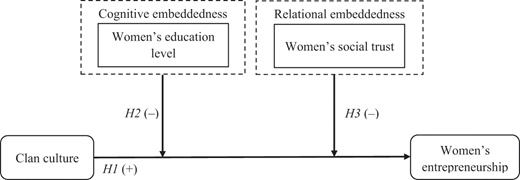
In summary, according to the challenge-based entrepreneurship model, clan culture presents a sociocultural challenge for women. As a marginalized group in clan culture, women face restricted access to resources and opportunities. These constraints often stimulate adaptive responses, ultimately driving some women to pursue entrepreneurship. Furthermore, the degree of social embeddedness can moderate the relationship between clan culture and women’s entrepreneurship. In the context of increasing gender equality and social openness, we consider two forms of embeddedness that reflect women’s connection beyond clan boundaries. Higher education represents cognitive embeddedness, while generalized social trust reflects relational embeddedness. When women possess these broader social linkages, they are more capable of detaching from patriarchal norms, which weakens the perceived sociocultural constraints of clan culture and reduces the adaptive entrepreneurial responses predicted by underdog entrepreneurship theory. Figure 1 presents the theoretical framework.
3. Hypothesis development
3.1 Clan culture and women’s entrepreneurship
The challenge-based entrepreneurship model posits that external challenges can act as critical catalysts for entrepreneurial activity. According to this perspective, clan culture represents a typical sociocultural challenge for women, as it restricts their access to resources and opportunities. Building on insights from underdog entrepreneurship literature, we identify three main reasons to argue that the clan-induced underdog position stimulates women’s propensity for entrepreneurship.
First, challenges stemmed from clan culture motivates women’s entrepreneurship. On one hand, the pressure of balancing family responsibilities and work obligations drives women to pursue entrepreneurship as a viable option (Cooke and Xiao, 2021; Thébaud, 2015). Due to the constraints of clan culture, women face limited career choices and unequal employment opportunities (Cheng, 2021; Zhang and Wang, 2020). Entrepreneurship, with its flexibility and profitability, offers women an effective way to mitigate family-work conflicts (Ng et al., 2016; Tlaiss, 2015). On the other hand, entrepreneurship is perceived as a critical means for women to achieve autonomy and independence (Alkhaled and Berglund, 2018; Murnieks et al., 2020). Furthermore, some women are motivated to “do more” in some male-dominated areas in terms of changing unequal societal situations, such as entrepreneurship (Alkhaled and Berglund, 2018). For many women in resource-constrained environments, entrepreneurship represents a pathway to emancipation (Atarah et al., 2023; Ibáñez and Guerrero, 2022).
Second, women in clan culture often exhibit a heightened willingness to take the risks associated with entrepreneurship. The constraints of deprived environment cultivate a unique form of courage, enabling women to navigate the uncertainties of venturing activities. Previous studies have shown no significant gender differences in risk-taking behaviors (Lago et al., 2018), and unfavorable labor market conditions often increase the likelihood of women pursuing entrepreneurship (Zhu et al., 2019). Moreover, the gender-specific challenges cultivate resilience and optimism in women (Liu, 2013; Tian and Bush, 2020), enabling them to confront the risks inherent of entrepreneurship.
Third, women in clan culture may develop traits and skills suitable for entrepreneurship. As marginalized individuals, women’s social adult identity is frequently denied in clan culture (Sacks, 1974). To prove their capabilities, women have to work harder than men (Liu, 2013). Meanwhile, women usually find themselves isolated in a male-dominated business environment, which limits their access to resources for development (Cooke and Xiao, 2021; Hussain et al., 2010). Consequently, women are compelled to effectively seek support, such as collaborating with feminist networks (Alkhaled and Berglund, 2018), and actively manage their professional networks (Semkunde et al., 2021; Vershinina et al., 2020). These efforts foster the development of unique skills and traits that can help them navigate the challenging environments. They are often characterized as hard working (Liu, 2013), resilient (Rajoana and Saxena, 2022), risk-tolerant (Brush, 1992) and adept at building strong teams in work (Liu, 2013). Overall, we propose the following hypothesis:
Clan culture is positively related to the likelihood of women engaging in entrepreneurship.
3.2 Moderating role of women’s education level
Education represents a form of cognitive embeddedness, which encompasses the common language, interpretive schemes and shared values that shape how individuals perceive and respond to their social environment. Higher education exposes women to more diverse ideas (Gulesci et al., 2020), egalitarian gender norms (Black et al., 2008; Chaijaroen and Panda, 2023; Chen and Guo, 2022) and modern institutional logics (Du et al., 2021; Rivera-Garrido, 2022), enabling them to question and reinterpret the traditional beliefs embedded in clan culture. When women possess higher levels of education, they are more capable of decoupling their cognition and values from the patriarchal control of clans. As a result, the challenges posed by clan culture are perceived as less constraining and less necessary to overcome through entrepreneurship.
First, education mitigates the motivational pressure that drives women in clan societies to engage in entrepreneurship as an adaptive strategy. Less-educated women, who are deeply embedded in the traditional clans, tend to experience more severe conflicts between family obligations and professional opportunities (Ng et al., 2016; Tlaiss, 2015), leading them to view entrepreneurship as a viable way to achieve autonomy and flexibility (Murnieks et al., 2020). In contrast, higher education provides women with alternative job opportunities and expanded career cognition. It enhances their employability in formal labor markets (Bühler et al., 2024; S. Liu et al., 2024) and equips them with professional qualifications that reduce their dependence on self-employment as a compensatory response to exclusion within the clan system. From the underdog entrepreneurship perspective, while less-educated women may view entrepreneurship as an adaptive response to sociocultural challenges, more educated women – having greater access to labor market resources – no longer experience clan culture as a sufficiently strong challenge to trigger entrepreneurial motivation.
Second, education fosters women’s awareness of gender equality and legitimizes their modernized identities (Du et al., 2021; Rivera-Garrido, 2022), which stand in contrast to the traditional value systems upheld by clan culture. Through formal education, women are increasingly exposed to egalitarian ideals emphasizing autonomy, meritocracy and self-realization (Du et al., 2021; Rivera-Garrido, 2022). These beliefs challenge the patriarchal norms of obedience and domestic confinement that underpin clan-based social orders. Furthermore, education grants women symbolic and institutional legitimacy to pursue professional roles and leadership positions traditionally dominated by men (Rivera-Garrido, 2022; Du et al., 2021). As women internalize modern values and gain recognition for their professional aspirations, the normative influence of clan culture becomes diluted. Consequently, the suppressive effect of clan-based expectations weakens, reducing the extent to which women perceive entrepreneurship as a necessary means to assert autonomy or achieve social legitimacy.
Taken together, education enables women to cognitively detach from the normative constraints of clan culture, providing alternative cognitive frameworks and institutional pathways for self-realization. This cognitive disembeddedness diminishes both the motivational and normative channels through which clan culture stimulates women’s entrepreneurship, thereby weakening its overall positive effect. Therefore, we propose the following hypothesis:
Women’s education level weakens the positive relationship between clan culture and the likelihood of women’s entrepreneurship.
3.3 Moderating role of social trust
Social trust reflects a form of relational embeddedness that shapes how individuals connect with others and rely on social relations beyond immediate kinship networks (Qu and Yang, 2015). Clan-based social control relies not only on blood and geographical proximity but also on a particularistic form of trust (Xiong et al., 2021), in which people place confidence exclusively in familiar in-group members and maintain social order through moral evaluations and communal sanctions. Such limited trust confines women within the relational boundaries of the clan, making their external behaviors visible, judged and constrained. By contrast, generalized social trust, particularly trust in strangers, represents an outward-oriented trust structure that allows individuals to build social confidence and relational security beyond the clan (Lu et al., 2018). When women possess higher levels of generalized social trust, they can rely on broader social networks and relationships, thereby escaping the moral and relational control of clan culture.
First, social trust weakens the motivational mechanism through which clan culture stimulates entrepreneurship. In low-trust environments dominated by particularistic ties, women who face gender role restrictions often regard entrepreneurship as one of the few legitimate means to gain autonomy. However, women with higher social trust are more likely to perceive external social systems as reliable and inclusive (Qu and Yang, 2015). They can access support, information and resources through broader social networks rather than clans (Lu et al., 2018). High-trust individuals are more confident in forming cooperative relationships beyond kinship boundaries (Qu and Yang, 2015), reducing their dependence on clan-based ties for emotional and material security. As a result, the social control and reputational constraints of the clan weaken, diminishing the motivational pressure to pursue entrepreneurship as an adaptive response to clan oppression.
Second, social trust enhances women’s confidence in external institutions and market systems, thereby facilitating relational detachment from the clan as the sole trusted social framework. When individuals hold low levels of social trust, they perceive external actors and organizations as unreliable, reinforcing their reliance on clan-based protection and support (Xiong et al., 2021). In contrast, women with high social trust believe that external institutions, such as the state, markets and civic organizations, provide fair and dependable interactions (Lu et al., 2018). This belief fosters a sense of relational and psychological independence from the clan, allowing women to pursue professional and personal goals without seeking legitimacy or safety within traditional clan systems. Consequently, the psychological and moral influence of clan culture on women’s career decisions is reduced, weakening the degree to which sociocultural challenges translate into entrepreneurial action.
Taken together, higher social trust provides women with relational independence and external social confidence, enabling them to disengage from the relational control of clan culture. This relational disembeddedness reduces both the motivational and psychological pathways through which clan culture promotes women’s entrepreneurship, thereby weakening its positive effect. Overall, we propose the following hypothesis:
Women’s social trust weakens the positive relationship between clan culture and the likelihood of women’s entrepreneurship.
4. Research methodology
4.1 Study context
Our study focuses on women’s entrepreneurship in rural China, which offers a rich context to explore this phenomenon in a challenging sociocultural environment – clan culture. First, China has retained a strong tradition of clan culture. Rooted in kinship, hierarchy and collective identity, clan culture continues to shape community governance, moral norms and economic behavior despite rapid modernization (Xiong et al., 2021; Zhang, 2019). This influence is particularly evident in rural areas, where social life still follows the “differential mode of association”, meaning that individuals’ relationships and behaviors are organized around clan-based networks (Fei, 1946). Prior studies have shown that blood-based clans play an important role in coordinating collective production and providing local public goods (Greif and Iyigun, 2013; Tsai, 2007).
In addition, China’s hukou (household registration) system reinforces the persistence of clan-based structures in rural society. Rural residents have limited access to public welfare, medical care, housing subsidies, unemployment insurance and other benefits available in urban areas (Chan and Zhang, 1999; Meng, 2012). Consequently, many rural individuals remain embedded in their local communities, where clan culture exerts strong influence. This institutional constraint also restricts their access to wage employment in non-agricultural sectors. Under these conditions, entrepreneurship or self-employment becomes a vital pathway for disadvantaged groups to escape poverty and achieve upward mobility (Fairlie, 2005).
4.2 Sample and data collection
We test the hypotheses using data from the China Family Panel Studies (CFPS) for the years from 2014 to 2018. CFPS is a nationwide, comprehensive longitudinal social survey designed to address a wide range of social phenomena in contemporary China (Xie and Hu, 2014). The survey is conducted biennially, with subsequent waves occurring at two-year intervals. The CFPS consists of four questionnaire modules that collect detailed information at the village, household and individual level. CFPS adopts a stratified sampling method. The sample is distributed across 25 provinces, representing 94.5% of the total population of mainland China. It provides a unique longitudinal, multilevel data set, which has been widely used in extant studies (Chen et al., 2023; Fang, 2023; Xiao and Wu, 2021).
We choose CFPS of 2014, 2016 and 2018 as the main data resource, as these surveys provide consistent and comparable information about individual employment status, enabling us to identify woman entrepreneurs. Additionally, we extract genealogy data from the 2010 CFPS. Genealogy, as a typical material embodiment of clan culture (Liu et al., 2023; Peng, 2004; Xiong et al., 2021), serves as a rational indicator for the presence of clan culture within a community. The 2010 CFPS provides information on whether families possess a clan genealogy, allowing us to objectively assess the degree of clan culture in each community (Cao et al., 2022; Song and Campbell, 2017) (Parboteeah et al., 2015). The final sample comprises 6,838 observations from 331 villages across 25 provinces in China.
4.3 Measures
Dependent variable. Women’s entrepreneurship is measured using a dummy variable coded as 1 if the respondent engaged in individual/private business or other forms of self-employment, and 0 otherwise. The CFPS questionnaire categorizes occupational status into five groups: family agricultural work, individual/private business/self-employment, other family agricultural work, paid work and non-agricultural casual labor. Consistent with prior studies (Barnett et al., 2019; Li et al., 2022; Xiao and Wu, 2021), we classify individuals engaged in individual/private business or self-employment as entrepreneurs.
Independent variable. Following previous studies, we adopt genealogy as a proxy of the strength of clan culture (Cao et al., 2022; Huang et al., 2022; Xiong et al., 2021; Zhang, 2020). Clan culture is measured as the ratio of households maintaining genealogy books to the total number of households in a community. The existence and operation of clans are manifested by clan genealogies, ancestral halls, clan property and clan norms (Liu and Ran, 2024). Genealogies document kinship ties, reinforce identity, foster cohesion and set moral norms (Bol, 2008). Because genealogies are portable and resilient to political disruptions, they provide a reliable indicator of enduring clan influence. Thus, a higher proportion of genealogical households reflects a stronger clan culture at the community level.
Moderators. Education is a dummy variable coded 1 if the respondent holds a bachelor’s degree or higher and 0 otherwise. Social trust is measured using the question “How much do you trust strangers?” from the CFPS survey, which captures individuals’ generalized trust beyond familial or local networks.
Control variables. We included a long list of control variables. First, we controlled for several individual-level variables that may relate to entrepreneurship (Edelman et al., 2016; Welsh et al., 2016), including age, age squared, health, marital status (1 for married, 0 otherwise). Specially, we controlled Internet use (1 for woman using the Internet, and 0 otherwise) which has been shown to promote women’s entrepreneurship.
Household-level factors also play an important role in individuals’ decision to start a business (Aldrich and Cliff, 2003; Chen and Hu, 2019). In line with previous research (Barnett et al., 2019; Sun et al., 2024; Xie et al., 2023), we controlled for family size, measured as the logarithm of number of individuals in the household; household net assets, measured as the logarithm of total net assets; household income, measured as the logarithm of the total net income in a family; household property, measured as the logarithm of the total market value of household property holdings; household land assets, measured as the logarithm of the total land assets in a family.
At the community level, to account for external environmental influences, we controlled for the distance to the provincial capital (distance to the province), measured by travel time and community output (GCP). Table 1 presents the measures.
4.4 Estimation methods
To test our hypotheses, we conducted multilevel mixed effects logistic regression. Multilevel modeling is superior to traditional regression techniques because the latter provide inefficient estimates and biased standard errors in the presence of nested data (De Clercq et al., 2013; Snijders and Bosker, 2011). In our data set, individuals (Level 1) were nested in communities (Level 2). Ignoring the interdependency between individual and community-level data may thus lead to artificial significant effects. Compared with conventional models, the multilevel mixed-effects approach accounts for fixed and random effects to adequately model effects between variables on the different levels of the research design (Snijders and Bosker, 2011). We also included year fixed effects to control for temporal variation. The basic formula applying the two-level regression models is as follows:
where denotes whether individual i engages in entrepreneurship (1 = entrepreneur, 0 = otherwise) in community j and in year t. represents the strength of clan culture at the community level. represents the random part of the equation, and is a measure of the community-level residuals, while is the individual-specific error item that represents other factors that predict women’s entrepreneurship.
To check the appropriateness of our multilevel modeling approach, we conducted a likelihood ratio test and compared a random intercept-only model (no predictors) with a one-level, logistic regression model. The likelihood ratio statistic of 129.59 (p < 0.001) shows that the estimated variance component was different from 0, so a random intercept model helps explain critical variance in the dependent variable, even in the absence of the independent variables. We also calculated the intraclass correlation coefficient (ICC). The ICC of the null model indicates that approximately 22.3% of the variance in women’s entrepreneurship is attributable to differences across communities. Thus, multilevel specification is reasonable.
5. Results
5.1 Descriptive results
Table 2 presents the means, standard deviations and correlations for all variables. The descriptive statistics indicate that 7.1% of women are entrepreneurs. The correlation coefficients show a positive correlation between clan culture and women’s entrepreneurship.
5.2 Hypothesis testing
Table 3 presents the results of the multilevel logistic regressions of our hypotheses. Model 1 is a null model. Model 2 includes the control variables and Model 3 adds the Clan as the independent variable. Results show that clan culture is positively related to women’s entrepreneurship (β = 0.849, p < 0.05), suggesting that women in higher clan culture are more likely to start a new business, thereby providing support for H1 in our data.
The moderating effect of education is tested in Model 4, which shows that the interaction of the Clan and Education is negative (β = −3.244, p < 0.05), suggesting that the likelihood of women becoming entrepreneurs under the influence of clan culture diminishes as their educational level increases. Therefore, H2 is supported in our data.
The moderating effect of social trust is tested in Model 5, which shows that the interaction of the Clan and Social trust is negative (β = −0.228, p < 0.05), suggesting that that a higher level of social trust mitigates the impact of clan culture on women’s entrepreneurial likelihood. Therefore, H3 is supported in our data.
Model 6 is the full model, in which all variables and interactions are added still consistent with our predictions. The signs and significance levels of the independent variable and interaction terms remain largely unchanged in this full model. Therefore, all of our hypotheses are supported in our data.
5.3 Robustness check
To ensure the robustness of our results, we conduct several additional analyses.
Alternative measures of clan culture. To address potential concerns regarding the left-skewed distribution of our primary independent variable, we construct a dummy variable (Clan_alt) indicating whether the proportion of households with genealogies in the community is above or below the national mean, following Cao et al. (2022). As reported in Table 4, the results remain consistent with the baseline findings.
Alternative measures of education. We replace the original binary measure of education with a five-level categorical variable (Education_alt), distinguishing among illiteracy, primary and junior high school, high school, university and postgraduate or above. As shown in Table 5, the results remain consistent with our hypothesis, confirming the robustness of our conclusions.
Endogeneity issues. We use an instrumental variable (IV) and use the conditional mixed process (CMP) estimation to rule out concerns over endogeneity of potential measurement error of clan culture and the omitted variables.
CMP method fits a set of estimates for a series of multiple equations, hierarchical and conditional regression mixtures, which means it is capable of fitting instrumental variable models (Roodman, 2011). “Mixture process” implies that different equations can respond to different types of dependent variables (Li and Xu, 2023; Mishra and Sam, 2016; Roodman, 2011). Within the CMP framework, OLS is used as the first-stage regression model because the dependent variable Clan is a continuous, enabling instrumental variable regression through the construction of recursive equations. Probit is used as the second-stage regression model because the explanatory variables women’s entrepreneurship is binary (0–1) variables. Following prior studies (Liu et al., 2023; Xiong et al., 2021), we select community-level terrain slope (Slope) as an suitable instrumental variable for clan culture. People in regions with steeper terrain slopes are more likely to form clan culture, as such areas are characterized by harsh natural conditions, historical inflows of northern migrants fleeing warfare since the Song Dynasty and underdeveloped transportation that inhibits outward population mobility. In addition, terrain slope, as a geographically predetermined factor, is uncorrelated with women’s entrepreneurship. We obtain the community terrain slope data from the CFPS 2014.
Table 6 presents the CMP estimation results. The instrumental variable shows a significant positive effect on Clan at the 1% level, satisfying the relevance condition. The coefficient of atanhrho_12, which captures the correlation between the error terms of the first- and second-stage equations, is significant at the 5% level, confirming the endogeneity of clan culture. Meanwhile, the chosen instrumental variables are exogenous, with first-stage F-values of 53.14, exceeding 10. This demonstrates the absence of weak instrumental variable issues. In the second stage, Clan remains positively and significantly associated with Women’s entrepreneurship, consistent with our main results.
5.4 Additional analysis
We argue that clan culture is positively associated with women’s entrepreneurship because it creates a challenging social environment that compels women to develop coping and adaptive skills, which in turn facilitate entrepreneurial activities. To further verify the mechanism of women’s oppression within clan culture, we conducted two additional analyses using data from the 2014 wave of the CFPS.
First, we investigated the relationship between clan culture and individual experiences of gender-based discrimination. Based on the CFPS question “In the past 12 months, have you experienced unfair treatment because of your gender?”, we constructed a dummy variable coded 1 if the respondent reported personally experiencing or witnessing such unfair treatment, and 0 otherwise. We then divided the sample into male and female subgroups and ran separate regressions, as reported in Table 7. The coefficient of Clan in the female subgroup is positive and significant (β = 0.811, p < 0.05), whereas for the male subgroup it is negative and not significant (β = −0.248, p = 0.505). It suggests that women in areas with stronger clan culture are more likely to experience gender-based discrimination, confirming the gendered oppressive nature of clan culture.
Second, we examined the relationship between clan culture and the endorsement of traditional gender norms. We calculated the mean score of five key gender-attitude items in CFPS 2014, which included statements reflecting traditional views on gender roles (“Men should focus on their careers, while women should focus on their families,” “A woman’s success is less important than a good marriage,” “A woman is not complete without children,” “Men should share half of the housework” [reverse coded] and “For family continuity, one should have at least one son”). Given this continuous dependent variable, the analysis was conducted using a Linear Mixed Effects model (mixed). We again estimated separate regressions for male and female samples, as shown in Table 8. The coefficient of Clan is positive and significant in the male subgroup but insignificant in the female subgroup. This finding suggests that stronger clan culture is associated with a greater endorsement of male preference specifically among men.
Taken together, these results provide robust additional evidence supporting the oppression–adaptation mechanism proposed in this study. Clan culture reinforces severe gender inequality and traditional norms that structurally constrain women’s social roles. This finding suggests that stronger clan culture is associated with a greater endorsement of male preference specifically among men. This outcome provides preliminary evidence of the mechanism: clan culture exhibits a preference for males, yet simultaneously generates the social friction that fosters women’s resistance consciousness.
6. Discussion
6.1 Theoretical contributions
Drawing on the challenge-based entrepreneurship model (Miller and Le Breton-Miller, 2017), this study reveals that clan culture has a positive impact on women’s entrepreneurship. This effect is further moderated by women’s education level and social trust. Our study makes three key contributions. First, this research represents an early attempt to empirically examine the relationship between clan culture and women’s entrepreneurship, introducing a relatively novel triggering factor for women entrepreneurs. While previous studies have predominantly focused on the restrictive nature of clan culture regarding women’s roles (e.g. Yang and Chen, 2024; Zhang and Ma, 2017), the present research uses an adaptive lens to explore how such cultural environments may, paradoxically, foster women’s entrepreneurial activity. Furthermore, our study echoes calls to delve deeper into theoretical frameworks rooted in the Chinese context and to explore the influence of cultural values on women’s entrepreneurship (Jiang et al., 2024).
Second, our article extends a growing stream of research that builds on the underdog framework of entrepreneurship. Previous studies have used this framework to explain how individuals with disabilities (Bhardwaj et al., 2023), those living in poverty (Jiang et al., 2024; Su et al., 2023) and those with trauma experience (Cheng, 2021; Churchill et al., 2023; Nguyen and Tran, 2025) become entrepreneurs. However, scholars have given limited attention to cultural circumstances and underdog groups within specific cultural environments. This study addresses this gap by identifying the marginalization of women in clan culture and examining their entrepreneurial motivation in clan culture through the lens of the challenge-based entrepreneurship framework.
Third, this study enriches the growing stream of research on the boundary conditions shaping the impact of sociocultural factors on entrepreneurship. Miller and Le Breton-Miller (2017) highlight the pivotal role of personal and environmental factors in shaping the impact of adverse circumstances on entrepreneurial propensity. As sociocultural challenges are not inescapable, the positive effect of sociocultural environment (i.e., clan culture) on women’s entrepreneurship may vary depending on the degree of individuals’ social embeddedness within the clan system. However, this contingency has not yet been considered in the challenge-based entrepreneurship model. Accordingly, we examine two moderating factors capturing distinct dimensions of social embeddedness, namely women’s education level (cognitive embeddedness) and social trust (relational embeddedness). Our study contributes to the challenge-based entrepreneurship model by identifying social embeddedness as a key boundary condition that influence the relationship between sociocultural challenges and women’s entrepreneurship.
6.2 Practical implications
Our study offers several important practical implications. First, policymakers and practitioners should develop a balanced understanding of the role of traditional clan culture in shaping women’s entrepreneurship. Although clan culture imposes strong gender norms and constraints on women, such challenging environment can paradoxically serve as a catalyst for women’s entrepreneurship. Recognizing this motivating role of clan culture on women’s entrepreneurship can help policymakers design culturally sensitive initiatives that transform sociocultural challenges into women’s entrepreneurial practice.
Second, since the effects of clan culture on women’s entrepreneurship depend on women’s degree of social embeddedness, entrepreneurship support programs provided by governments should be differentiated. Specifically, for women who have low education level and social trust, remaining strongly embedded in traditional clans, policymakers should focus on enhancing entrepreneurial awareness and capabilities, helping them actively engage in adaptive necessity-based entrepreneurship. For example, governments can provide entrepreneurial skill training, access to financial resources and tax incentives (Cooke and Xiao, 2021), particularly in challenging environments. Between 2009 and 2018, a total of 383.77bn yuan in micro-guaranteed loans was issued to women nationwide, enabling millions of women to seek entrepreneurial opportunities (The State Council of China, 2019). For women with higher education or broader social trust, who are relatively disembedded from clan systems, public support should emphasize innovation capacity and professional networking, encouraging them to pursue entrepreneurship by market opportunity rather than by sociocultural challenges.
6.3 Limitations
While this study provides insightful theoretical and practical implications, it still has several limitations. First, this study investigates the impact of clan culture on women’s entrepreneurship by focusing on regional differences within China. However, clan culture is also prevalent in other Asian countries, such as South Korea, Japan and Singapore. The findings are thus limited to China. Second, while we identify three mechanisms through which clan culture fosters women’s entrepreneurship from the perspective of the challenge-based entrepreneurship framework, we have not empirically tested each mechanism. Third, due to data availability constraints, this study only focuses on the probability of women’s entrepreneurship. However, the impact of a challenging cultural environment on women’s subsequent entrepreneurial performance warrants further exploration.
6.4 Future research directions
The limitations of our study also give rise to opportunities for further research. First, our findings could be extended to other countries where clan culture is prevalent, providing a broader understanding of its impact on women’s entrepreneurship. As clan culture is not unique to China but also widespread in other Asian countries (e.g., Singapore, Korea and Japan), future research could explore the generalizability of these results through cross-country analyses. Future studies could also investigate the influence of distinct Chinese cultural values, such as guanxi (interpersonal relationships), mianzi (face-saving) and renqing (reciprocal obligation), on women’s entrepreneurship.
Second, future research could use questionnaires to collect data on psychological and skill-related variables to directly test the mechanisms through which clan culture influences women’s entrepreneurial activities. An interview-based approach could also help identify the psychological processes of women’s entrepreneurship in challenging environments.
Finally, future research could examine the influence of clan culture on women’s business performance, such as profitability, business survival and long-term growth. Such research could deepen understanding of how cultural values shape not only entrepreneurial intentions but also post-entrepreneurship outcomes.