Entrepreneurial ecosystems consist of interactions among diverse actors and key elements, support, culture, finance, policies, human capital and markets, that shape venture development. This research aims to investigate how these elements interrelate and influence the ecosystem’s innovative performance.
This research evaluates the perceptions of 87 actors involved in a Brazilian entrepreneurial ecosystem through a quantitative study, employing multiple correspondence analysis in SPSS 22. Each dimension was analyzed using two categories: high and low.
The analysis revealed four clusters that explain how the core elements sustain innovative performance within the ecosystem. In Clusters 1 and 3, associations were observed between creative performance and the market, policy, finance and human capital, classified as “high” and “low,” respectively. Clusters 2 and 4, in turn, showed links between culture and support, also in the “high” and “low” categories. These findings indicate that sustaining innovative performance depends on specific patterns of association among elements rather than on the isolated presence of each component.
This research contributes to the literature on entrepreneurial ecosystems in three ways: (1) it advances the theoretical understanding of ecosystem dynamics by showing how the orchestration of key elements reduces fragmentation and supports innovative performance in emerging economies; (2) it offers an empirically grounded framework with strategic management practices to guide actors in orchestrating and activating their ecosystems; and (3) it introduces a data-driven multiple correspondence analysi based methodology as a robust tool for diagnosing synergies and gaps in the development of entrepreneurial ecosystems in emerging economies.
1. Introduction
Given the dynamic, unstable and complex environment, organizations are increasingly seeking to adapt their business models to capture, cocreate and coproduce value with various market actors (Piantoni et al., 2023). This trend encourages organizations to adopt an ecosystemic strategy (Autio, 2022) such as participating in entrepreneurial ecosystems (EEs), enabling them to secure a competitive position (Adner, 2017) and develop new capabilities for innovation (Ketonen-Oksi and Valkokari, 2019).
EEs are recognized as environments that foster interactions among agents across various socioeconomic, institutional and informational contexts (Audretsch and Belitski, 2017), encompassing both complementary and substitutive relationships, which are important for explaining the creation of new enterprises, the development of entrepreneurial activities (Cantner et al., 2021) and innovative performance (Granstrand and Holgersson, 2020). However, they differ from other structural arrangements due to the nature of their governance and the challenges associated with their orchestration (Autio, 2022).
Recent research has demonstrated that the coordinated interaction of entrepreneurial actors, educational institutions and diverse cultures facilitates the development of new ventures and productive entrepreneurship (Santos et al., 2023; Chaudhary et al., 2024). Nonetheless, due to the fragmentation and complexity involved in integrating the components that constitute the EE (Malecki, 2018), the diversity of functions performed by ecosystem actors (Tabas et al., 2023), and the challenges of orchestrating different elements (Autio, 2022). Further exploration is required to explain how forms of interaction occur in other contexts – such as cities, regions and countries – as suggested by Stam and Van de Ven (2021) and Gonçalves et al. (2024).
This theoretical fragmentation is problematic, as existing studies still show little consensus on the causal mechanisms that drive EEs and enhance innovative performance (Chaudhary et al., 2024). Although EEs have received significant attention in recent years, the concept has also been criticized for its limited analytical precision. Recent studies argue that the ecosystem perspective often relies on biological metaphors that overlook the intentional role of actors in shaping these environments (Harrison, 2025).
In this regard (Isenberg, 2016) further warns that an uncritical use of the ecosystem metaphor may lead to what he calls the “intentionality fallacy,” in which ecosystem development is assumed to occur naturally or spontaneously. In response to these critiques, this study examines how deliberate agency conceptualized here as orchestration is associated with innovative performance in EEs. Current research, perspectives, remains fragmented, leaving unclear how ket ecosystem dimensions such as politics, finance, culture, support, human capital and market interact in specific patterns to enable actors to consistently sustain their innovative capacity (Isenberg, 2011; Stam and Van de Ven, 2021; Chaudhary et al., 2024).
This gap is particularly significant in emerging economies, where market volatility and resource constraints demand a more precise understanding of how to orchestrate these elements effectively and maximize the return on limited investments (Cao and Shi, 2021; Moerchel, Tietze, and Urmetzer, 2023; Thomas, Faccin and Asheim, 2021; Dávila, Andreeva, and Varvakis, 2019). Furthermore, the challenge of fragmentation, stemming from a lack of coherent alignment and interaction between diverse actors and resources, is a defining characteristic of nascent ecosystems in these contexts (Porras-Paez and Schmutzler, 2019; Bittencourt et al., 2021). Our study addresses this issue, focusing on orchestration as the key mechanism for overcoming fragmentation and driving sustainable innovative performance.
Responding to the call by Wurth, Stam, and Spigel (2022) who integrated different research streams on EEs, reviewed recent advances in the field, and proposed transdisciplinary approaches to advance both theory and practice this study addresses the following research question: What is the association between the dimensions of an EE and innovative performance in an emerging economy? The investigation is grounded in Isenberg’s (2011) widely cited model, which identifies six key elements of an EE: (i) Policy, (ii) Finance/Capital, (iii) Culture, (iv) Support, (v) Human Capital and (vi) Markets. The objective is to examine how these key elements are associated with, and influence, the innovative performance of EEs.
This study also seeks to fill identified gaps, primarily regarding the relationships between ecosystem elements, as described by Stam and Van de Ven (2021), and considering the context of emerging economies see (Harrison, 2025). Thus, it contributes to the literature on EEs in three ways: (1) providing an empirical model that links the orchestration of specific element patterns to sustained innovative performance, offering a differentiated view of how to mitigate ecosystem fragmentation; (2) presenting a robust methodological approach (multiple correspondence analysis [MCA]) applicable to the analysis of synergies and stages of development in emerging economies; and (3) providing practical guidelines for ecosystem actors, including strategic management practices to orchestrate, activate and shape ecosystems, primarily considering the context of emerging economies.
2. Entrepreneurship ecosystems
The theoretical foundation that underpins the understanding of EEs and establishes different analytical models is aligned with the studies of authors such as Isenberg (2010, 2011), Stam (2015), Mack and Mayer (2016), Spigel (2017) and Maroufkhani et al. (2018). These studies have been widely used as references in the formulation of public policies, in understanding the orchestration of ecosystems, and in explaining the advancement of entrepreneurship at urban, regional and national levels. More recent research, such as that by Chaudhary et al. (2024), Audretsch et al. (2022), Cantner et al. (2021) and Stam and Van de Ven (2021), continues to expand this understanding, contributing to the theoretical and practical development of entrepreneurship globally.
These concepts represent different elements that analyze the creation, orchestration and activation of EEs, playing a significant role in the development of entrepreneurship. They not only support the advancement of various theoretical currents but also connect with related literatures, such as the origin and analysis of clusters discussed by Delgado et al. (2010), innovation systems addressed by Cooke et al. (1997) economic geography explored by Feldman (2001), social capital as defined by Westlund and Bolton (2003), and networks as examined by Sorenson and Stuart (2001). These connections across different fields of knowledge reinforce the importance of these elements for a comprehensive understanding of EEs and their implications for economic and social development.
Despite the methodological and conceptual differences among these approaches, they converge on certain attributes, such as the importance of location within a specific geographic region (Audretsch et al., 2022), the search for resources that transcend the boundaries of a single firm, and the orientation toward the creation of new ventures (Stam and Van de Ven, 2021). An EE grounded in supportive policies and culture contributes to the creation of a social and economic system that fosters value generation and innovation (Chaudhary et al., 2024). These intersections demonstrate how different theories can complement each other to offer a more comprehensive understanding of the factors that drive entrepreneurship in various contexts.
It is important to note that although Isenberg’s framework (2011) provides the structural pillars of EEs, the author himself later emphasizes that the mere presence of these elements is insufficient to ensure ecosystem functionality. Isenberg (2016) argued that effective ecosystems require deliberate interventions and policies capable of addressing coordination failures among actors. This view also aligns with recent critiques of the ecosystem literature, which argue that the concept is often applied through biological metaphors that obscure the intentional role of actors in shaping ecosystem dynamics (Harrison, 2025). Therefore, in this study the six dimensions are not treated as isolated components but as an integrated system whose capacity to generate public value depends on governance and coordination mechanisms.
The EE comprises a set of interdependent actors and factors organized to drive productive entrepreneurship and value creation (Stam, 2015). A fundamental characteristic of these ecosystems, according to Brown and Mason (2017), is their nonlinearity, whereby the combination of various social, institutional and relational characteristics (Chaudhary et al., 2024) lends the concept its explanatory power. Moreover, Spigel (2017) emphasized that the pillars of an EE should not operate in isolation; rather, they should be developed in conjunction, fostering collaboration and mutual reinforcement among the system’s different components.
Despite the emergence of new research streams, the six elements outlined by Isenberg (2010, 2011) for an EE, policy, finance, culture, support, human capital and markets, remain a dominant framework in studies on EEs (Chaudhary et al., 2024; Audretsch et al., 2022; Cantner et al., 2021; Stam and Van de Ven, 2021; Mack and Mayer, 2016). This formulation largely reflects the infrastructure components presented by Van de Ven (1993) and the eight pillars proposed by the World Economic Forum (2014) for a successful ecosystem.
These elements highlight the importance of key factors such as human capital, finance and services, as well as the involvement of various actors, including talent, investors, mentors and fellow entrepreneurs. They also underscore the role of formal institutions, such as governmental and regulatory frameworks, and informal institutions, such as cultural support, in strengthening entrepreneurship. Furthermore, they emphasize the need for access to both internal and external markets for the success of an EE. Given the comprehensive nature of the essential elements proposed by Isenberg (2010, 2011), they have been adopted as the theoretical foundation for this study, serving as a model for the development of a strong and self-sustaining EE. Table 1 presents the variables used to measure each of these elements.
Although Isenberg’s model (2011) provides the structural basis, more recent literature has focused on the dynamic processes governing the evolution of emerging ecosystems (Kantis and Federico, 2020). Orchestration has emerged as a central concept, defined as the ability of an actor (or group of actors) to align and coordinate the actions of heterogeneous participants to achieve common goals, without relying on formal hierarchical control (Bittencourt et al., 2021; Santos et al., 2023; Bonomi Santos et al., 2025). In emerging economies, orchestration is vital to overcome ecosystem fragmentation, characterized by resource dispersion, low connectivity between actors, and institutional inconsistency (Porras-Paez and Schmutzler, 2019) . Recent studies, such as those by Santos et al. (2023) and Kanda et al. (2025) emphasize that effective orchestration is a key factor in the transition from embryonic to expanding ecosystems, as it allows for the strategic identification and filling of gaps (synergies and gaps). This research, by identifying patterns of association between the elements, directly contributes to this discussion, offering an empirical diagnosis of fragmentation and suggesting pathways for more coherent and innovation-oriented orchestration.
Although established concepts of EEs encompass various specificities, Brown and Mason (2017) suggested that their effectiveness should be assessed based on the collective components that comprise them. To advance conceptual understanding, the authors propose evaluating the developmental stages of EEs, categorizing them as either “embryonic” or “expanding.”
Embryonic ecosystems are characterized by relatively modest levels of growth-oriented entrepreneurship, with few high-tech startups, low entrepreneurial orientation and limited interactions within the ecosystem. In such contexts, large, rapidly growing companies tend to dominate the local business environment, while connections to external sources of financing, human capital and innovation remain scarce. Furthermore, businesses often rely heavily on public policies for financing and for fostering the creation of new technology-based companies (Brown and Mason, 2017).This “embryonic” state is frequently observed in emerging economies, where institutional voids and market imperfections require a greater reliance on policy interventions and proactive orchestration to catalyze growth (Cao and Shi, 2021; Kantis and Federico, 2020; Porras-Paez and Schmutzler, 2019).
In contrast, expanding ecosystems are characterized by the presence of growth-oriented startups, with unicorns dominating the landscape and driving the emergence of new companies. These ecosystems demonstrate a strong entrepreneurial orientation, vertical interactions among startups, and access to a wide range of private financing sources. Businesses and investors operate internationally, and high-growth-potential startups maintain strong connections at local, national and global levels. Industry-led initiatives focus on building vertical network connectivity, drawing resources from diverse sources and a variety of actors (Brown and Mason, 2017).
To achieve significant results and innovative performance within the EE, Santos et al. (2023) emphasized the importance of orchestration, whereby influential actors assume responsibility for guiding partners and fostering ecosystem-level returns without relying on formal controls or rigid hierarchies. In addition, Souza, Wegner, and Faccin (2023) suggested that such orchestration can facilitate ecosystem planning and design, reducing uncertainties and mitigating operational risks for all participants. Thus, orchestration is essential for the evolution of both embryonic and expanding ecosystems, ensuring cohesion and sustainable growth.
2.1 Innovative performance in entrepreneurial ecosystems
In this study, innovative performance is analyzed based on the outcomes of the innovation activities of organizations within an EE. It is measured through indicators such as the number of new products, the initiation of new projects, and the implementation of new processes or products in the market, as well as increases in sales, market share and the adoption of new business models (Gunday et al., 2011). These outcomes are intrinsically linked to a company’s resources and innovative capabilities (Wang and Chen, 2013), reflecting a synergistic combination of elements that generate such capabilities (Li, Xia, and Zajac, 2018).
This research, supported by authors such as Moore (2006) and Jacobides et al. (2018), posits that the environmental conditions of an ecosystem serve as sources of new entrepreneurial opportunities and can enhance the innovative performance of companies participating in these environments by promoting collaborative actions to share information and knowledge on potential innovations (Granstrand and Holgersson, 2020). Accordingly, “ecosystemic clusters,” characterized by intense interaction and collaboration among participants, are considered environments that foster greater innovation (Pidorycheva et al., 2020).
In this context, Kianto et al. (2017) highlighted that the positive relationship between a company’s external capital and its innovative performance complements the knowledge required to develop innovation capabilities, which extend beyond the company’s internal boundaries. Strengthening external relationships by seeking and sharing information and knowledge with diverse stakeholders, and combining this external knowledge with the organization’s existing internal knowledge, enhances its innovation capabilities (Forés and Camisón, 2016).
Furthermore, as the various actors within the ecosystem – such as innovative companies, universities, research institutions and technology transfer agencies – occupy specific niches analogous to those in a natural ecosystem (Pierrakis and Saridakis, 2019), the formation of new enterprises is influenced by factors related to market development, human capital, governance, finance, culture and support. These elements drive entrepreneurship and foster innovation (Chaudhary et al., 2024; Cao and Shi, 2021; Mack and Mayer, 2016; Isenberg, 2010, 2011). Consequently, business initiatives within ecosystems tend to achieve superior results and a higher likelihood of success (Vedula and Kim, 2019).
Collaborative, cooperative and trust-based relationships, embedded within internal and external network interactions, are positively correlated with innovation performance (Cabrilo et al., 2020). This relational dynamic, linked to the outcomes of innovation activities, equips the EE with the ability to reduce the technological gap among participating agents. Effective collaboration can also enhance the system’s flexibility, leading to optimized costs associated with absorptive capacity, while innovation, in turn, contributes to elevating companies’ innovative performance (Jiang, Yang, and Liu, 2022).
Although many companies in emerging markets demonstrate strong growth momentum and improvements in overall innovation performance and efficiency, the results remain somewhat unsatisfactory (Duan et al., 2021). This underscores the need to refine and expand indicators and metrics for measuring the success of innovation and entrepreneurship ecosystems in Brazil, as highlighted by Rovere et al. (2021).
In an effort to contribute to and expand theoretical discussions on the potential connection between the elements identified by Isenberg (2010, 2011) and innovative performance, this research adopted the analytical dimensions proposed by Inkinen et al. (2015), as outlined in Table 2. These dimensions have been validated in studies conducted in Brazil by Dávila, Durst, and Varvakis (2018) and by Dávila et al. (2019), which evaluated the innovative performance of companies participating in EEs.
Thus, the environment of an EE can provide companies in emerging markets with a favorable context for innovation, enhancing the efficiency of transforming and utilizing their innovative outcomes. However, as Cantner et al. (2021) pointed out, this depends on the synergy among the various elements and actors within EEs for the association to be effective. In summary, Cao and Shi (2021) argued that understanding EEs in emerging economies is an urgent priority for both entrepreneurship scholars and policymakers.
2.2 Orchestration and synergies in entrepreneurial ecosystems
The concept of synergy between elements arises when the coordinated combination of resources and capabilities produces superior results compared to those achieved through the isolated actions of individual components (Moore, 2006). This synergy manifests across multiple dimensions: operational synergies stem from the optimization of shared processes among actors; strategic synergies emerge from the alignment of objectives and visions among stakeholders (Jacobides et al., 2018); and knowledge synergies result from combining complementary expertise to generate disruptive innovations (Kantis and Federico, 2020).
Universities, incubators and accelerators exemplify specialized orchestrating actors that facilitate the transfer of knowledge and resources among different elements of the regional EE (Santos et al., 2023; Thomas, Faccin and Asheim, 2021). These actors function as strategic intermediaries, connecting emerging startups with established institutional resources, enabling two-way knowledge transfer, and bridging traditionally disconnected ecosystem elements (Spigel, 2017). Their ability to simultaneously support existing ventures while identifying new technological opportunities illustrates how effective orchestration can overcome the coordination limitations typical of fragmented ecosystems (Brown and Mason, 2017).
Strategic coordination among multiple actors is particularly relevant for fostering the growth of smaller companies, especially when there is deliberate alignment between policy, finance and entrepreneurial culture (Rossi et al., 2022). Such coordination requires institutional mechanisms that facilitate communication, resource sharing and incentive alignment among heterogeneous actors (Brown and Mason, 2017). The ambidextrous positioning of corporate investors illustrates how different regional approaches to orchestration can create distinct conditions for the emergence of robust ecosystems (Kolte et al., 2023).
2.3 Innovation from an actor’s perspective
The analysis from an actor’s perspective within the EE reveals how environmental elements contribute to differentiated and sustainable results over time (Pierrakis and Saridakis, 2019). This micro-analytic perspective clarifies the mechanisms through which actors – whether startups, established companies or research institutions – capture value from ecosystem synergies and transform it into tangible competitive advantages (Vedula and Kim, 2019).
Innovative outcomes manifest across multiple interrelated dimensions: the development of disruptive products and services, the implementation of innovative organizational processes, the creation of new business models, and the establishment of proprietary technological capabilities (Gunday et al., 2011). Each dimension requires specific combinations of resources and capabilities that often transcend the organizational boundaries of individual actors, making participation in ecosystems a necessary strategy for sustaining innovative performance (Wang and Chen, 2013).
Corporate investments in clean energy in the Asia-Pacific region exemplify how strategic coordination among government policies, private capital and technology markets can generate differentiated, sustainable outcomes for various types of entrepreneurial actors (Kolte et al., 2023). In this context, startups specializing in renewable technologies benefit from government subsidies and regulatory incentives; established companies gain new market opportunities through strategic partnerships; and institutional investors diversify their portfolios while contributing to environmental sustainability goals (Mack and Mayer, 2016).
The ability of actors to sustain superior innovative performance depends on the quality and intensity of their interactions with other elements of the ecosystem (Cabrilo et al., 2020). This quality is shaped by factors such as mutual trust, resource complementarity, strategic alignment and interorganizational coordination capacity (Cantner et al., 2021). When internal organizational culture, external institutional support, and access to qualified markets are effectively aligned, actors can develop dynamic capabilities that enable them to adapt quickly to environmental changes and seize emerging opportunities (Kianto et al., 2017).
3. Procedures and methods
The research question formulated for this study – What is the association between the dimensions of an EE and innovative performance in an emerging economy? – establishes a direct link between the reviewed literature and the methodology used to measure this association. This question arises from a gap identified in the literature, highlighting the need to understand the causal mechanisms and effects of elements within an EE, particularly in emerging economies (Stam and Van de Ven, 2021; Cao and Shi, 2021).
The methodological approach employed in this study examines the interdependencies and associations between the factors proposed by Isenberg (2011) and innovation performance. These elements, presented in the literature review and discussed in Section 2.1, provide the empirical basis for the strategic management practices suggested by Dávila, Durst, and Varvakis (2018), Wurth, Stam, and Spigel (2022) and Souza, Wegner, and Faccin (2023).
3.1 Variables and operationalization
The variables used in this research were derived directly from Isenberg’s model (2010, 2011), which identifies six key elements of an EE: (i) Policy, (ii) Finance/Capital, (iii) Culture, (iv) Support, (v) Human Capital and (vi) Markets. As detailed in Table 1, each dimension was operationalized using specific indicators, enabling a quantitative assessment of stakeholder perceptions. The choice of these variables is justified by their broad acceptance and application in the EE literature (Chaudhary et al., 2024; Audretsch et al., 2022; Cantner et al., 2021; Stam and Van de Ven, 2021; Mack and Mayer, 2016), ensuring the validity and comparability of the findings.
Innovation performance variables, based on Inkinen et al. (2015), were measured using indicators of innovation outcomes, including the number of new products, the implementation of new processes or products in the market, and increases in sales and market share (Gunday et al., 2011; Wang and Chen, 2013). A seven-point Likert scale was employed for this purpose (Rhemtulla et al., 2012; Kriksciuniene et al., 2019). Integrating these variables enables the analysis of the association between ecosystem elements and innovation performance, consistent with the central proposition of this study.
3.2 Research context
The study was conducted within a Brazilian EE, situated in an emerging economy. This context is relevant because, as noted by Cao and Shi (2021) and Moerchel, Tietze, and Urmetzer (2023), examining the ecosystem perspective in emerging countries can offer a more nuanced understanding of how market volatility and behavioral changes impact businesses. The choice of this specific ecosystem was strategic, aiming to capture the nuances and challenges of environments with developing resources and infrastructures, which differ markedly from mature ecosystems in developed economies. The ecosystem under study is recognized for its growing entrepreneurial activity and the efforts of diverse stakeholders to foster innovation, making it fertile ground for the proposed investigation.
3.3 Sampling strategy and data collection
The study sample comprised 87 stakeholders involved in the Brazilian EE, selected through non-probabilistic convenience sampling (Vehovar, Toepoel, and Steinmetz, 2016). The respondents – entrepreneurs, investors, government representatives, academics and members of support institutions – represented the different pillars of the ecosystem. This approach ensured access to individuals with relevant knowledge and experience regarding the ecosystem’s functioning. Data collection took place in October 2023 via online questionnaires. To maximize the response rate, several strategies were employed: direct contact with participants during an ecosystem fair, assistance from fair managers in raising awareness within their contact networks, and the guarantee of anonymity to eliminate the possibility of individual identification. A quantitative approach, employing MCA (Hoffman and De Leeuw, 1992) with the support of SPSS 22 software (Hair et al., 2018), enabled the analysis of stakeholder perceptions and the identification of associations between ecosystem dimensions and innovation performance, integrating the literature review with the methodological framework. These aspects contributed significantly to the discussion of results.
To empirically validate the research model, a non-probabilistic accessibility sample was used (Vehovar, Toepoel, and Steinmetz, 2016). Factor analysis was then performed using IBM SPSS version 22, grouping the assertions with their key elements based on factor loadings ( Appendix 1). The scores for each observation were subsequently saved ( Appendix 2). Interpolation followed, assigning the highest and lowest values as 100 and 0, respectively ( Appendix 3), after which the mean for each element was calculated. In this study, each of the key elements of Isenberg’s model (2010, 2011) was treated as a variable, following the statistical analysis procedure. Observations with values above the mean were classified as high, and those below the mean as low. The number of observations at each level (high/low) was balanced for each variable, as shown in Table 3.
Following the balancing, MCA was conducted to examine the association between innovative performance and the six elements of Isenberg’s (2010, 2011) EE model.
3.4 Data analysis
The choice of MCA is motivated by the need to move beyond purely descriptive approaches in research on EEs, responding to recent critiques that highlight analytical limitations in the field’s literature (Harrison, 2025). As an exploratory multivariate technique for categorical data, MCA enables the simultaneous analysis of multiple variables and represents their associations in a reduced-dimensional space. This allows the identification of configurational patterns and the interdependencies among ecosystem elements.
The collected data were analyzed using MCA in SPSS 22. This multivariate technique is well-suited for exploring relationships among multiple categorical variables, enabling the visualization of associations between EE dimensions and innovation performance. MCA facilitates the identification of underlying patterns and structures in the data, showing how different variable categories (high and low for each dimension) cluster and relate to innovation performance. This methodological choice aligns with the research objective of assessing how the six core elements of EEs combine into specific association patterns that sustain innovative performance among ecosystem actors.
4. Presentation of results
4.1 Analysis of descriptive variables and sample characterization
To characterize the research sample, a frequency analysis was conducted on the variables of education, gender, age range and field of activity (Table 4) and statistics on age and experience in ecosystems (Table 5) were performed. The age ranges were categorized as follows: 21–32.25 years, 32.26–43.51 years, 43.52–54.77 years and 54.78–66 years.
Education emerges as a relevant variable, with 70% of respondents reporting a high level of knowledge: 36 hold a postgraduate qualification, 18 a master’s degree, 15 a completed undergraduate degree, 10 an incomplete undergraduate degree and 7 a doctoral degree. According to Cekule, Cekuls, and Dunska (2023) and Kapri (2023), knowledge significantly contributes to the development of entrepreneurial skills, leading to improved innovative performance. When education is analyzed in relation to gender, male respondents predominantly report having a postgraduate qualification (26), a completed undergraduate degree (14), a master’s degree (11), an incomplete undergraduate degree (8) and a doctoral degree (4). Female respondents mostly hold a postgraduate qualification (10), a master’s degree (7) and a doctoral degree (3).
Regarding business segments, 59.77% of respondents are engaged in business, industry or commercial activities, followed by 31.03% in educational institutions, 5.75% in government and 3.45% in other segments. Cross-analysis with education shows that, among the 52 respondents from the business/industry/commercial segment, 48.08% hold a postgraduate qualification, 26.92% a completed undergraduate degree, 13.46% an incomplete undergraduate degree, 9.62% a master’s degree and 1.92% a high school diploma. Among the 27 respondents from educational institutions, 40.74% hold a master’s degree, 25.93% a doctoral degree and 25.93% a postgraduate qualification.
In the government segment, 80% of the five respondents hold a postgraduate qualification, and 20% a completed undergraduate degree. In the “other” segment, 41.38% have a postgraduate qualification, 20.69% a master’s degree, 17.24% a completed undergraduate degree, 11.49% an incomplete undergraduate degree, 8.05% a doctoral degree, and 1.15% a high school diploma.
These findings align with the literature, as the diverse backgrounds of professionals provide new businesses within an EE with varied experiences, drawing on the expertise of those with a solid foundation to stimulate business growth (Shen, Guo, and Ma, 2023). The various actors in the ecosystem can – and should – contribute their expertise to the ecosystem’s development (Zahra, Petricevic, and Luo, 2022) and support younger participants (Linde et al., 2021).
4.2 Analysis of associations between elements
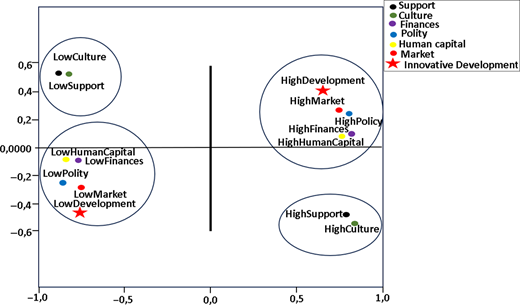
Following the methods proposed by Greve (2018), MCA was applied to generate a proximity map of the study variables, enabling the graphical identification of associations and proximities between the key elements and innovative performance (Figure 1).
In the proximity map, closer positioning indicates interdependence, whereas greater distance signifies a lack of association between elements (Hair et al., 2018). In this study, with variables classified as “high” and “low,” the map reveals four distinct clusters, each representing different characteristics.
The first cluster shows proximity among the “high” category of innovative performance, market, policy, finance and human capital. This indicates that, in this EE, high innovative performance is associated with high levels of these elements. Such a configuration suggests that favorable market conditions, supportive policies, access to finance and qualified human capital are linked to enhanced innovative performance. These findings align with Chaudhary et al. (2024), who emphasized that achieving high levels of innovation requires collaboration among various actors to build competencies. This study therefore reinforces the need for integrating ecosystem actors, given the observed association between high values for these elements and high innovative performance.
The second cluster shows an association between the “high” category of the support and culture elements, indicating a link between them. Although somewhat distant, they are positioned closer to the “high” than the “low” category of innovative performance. This suggests that a supportive environment featuring business incubators, accelerators, mentors and established entrepreneurs within a culture that values entrepreneurship is associated with innovation (Stam and Van de Ven, 2021).
The third cluster mirrors the first, associating the elements of performance, market, policy, finance and human capital, but in the “low” category. This suggests that leadership for orchestrating the ecosystem remains underdeveloped, requiring greater government involvement, increased funding and stronger investment in professional development by educational institutions to enhance innovative performance. These findings are particularly relevant for policymakers and ecosystem managers. According to Spigel (2017), government policies and university participation are critical support mechanisms that help entrepreneurs overcome barriers, train skilled workers, and promote funding for targeted support programs such as networking events.
The fourth cluster is the inverse of the second, grouping the same key elements culture and support but in the “low” category. In this scenario, entrepreneurs face greater obstacles due to limited appreciation and scarce resources. Chaudhary et al. (2024) noted that the interaction of numerous actors can restrict ventures within a geographical area. Conversely, Audretsch and Belitski (2017) argued that achieving innovation requires fostering interaction among various structural, organizational and cultural factors.
Brown and Mason (2017) classified ecosystems with these characteristics as “embryonic.” Similarly, Isenberg (2011) emphasized that a sustainable EE requires the integration of market, human capital, policy, finance, culture and support. The interdependent functioning of these six key elements is essential for entrepreneurial growth and innovation. In this context, the findings of this study indicate that the ecosystem under investigation still needs to integrate – particularly the elements of culture and support – to achieve growth. Moreover, while the ecosystem has established associations among the elements, it does not yet exhibit the characteristics of an expanding ecosystem.
Although culture and support formed separate associations, the “high” category of each element remained on the right side of Figure 1, while the “low” category appeared on the left. If only two clusters were considered, one would encompass the “high” categories and the other the “low” categories. These findings align with the perspectives of Isenberg (2011), Brown and Mason (2017), Rovere et al. (2021), Mack and Mayer (2016) and Cao and Shi (2021).
5. Discussion of results
The findings of this study offer insights into the interaction among the key elements that form an EE and their relationship with innovative performance, particularly through the application of MCA. This methodological approach proved effective in deepening the understanding of these associations, especially in the context of venture creation in ecosystems within emerging economies. Such environments often challenge innovative performance due to global competition, as companies frequently contend with resource scarcity and weak institutional support (Dávila, Andreeva, and Varvakis, 2019).
The results reveal no association between the elements of support and culture and innovative performance, a challenge to the consolidation of the EE under analysis and an indication that it remains in an embryonic stage of development. This finding aligns with Brown and Mason (2017), who emphasized the fundamental role of cultural factors shaped by the nature of business in fostering entrepreneurship. Furthermore, an entrepreneurial culture for innovation is a causal and disruptive element essential for consolidating innovative businesses, as the outcomes of entrepreneurship are rooted in the sociocultural relationships of ecosystems (Autio, 2022).
These effects also inform practical and managerial discussions on the need for actors within the EE to build shared values, beliefs and rules that guide their actions, interactions and decisions. As Santos et al. (2023) noted, coordination and orchestration among actors are essential for creating business value and enhancing the potential of entrepreneurial companies, as orchestration provides a clearer understanding of the specificities and needs related to ecosystem governance.
This study also identifies that the lack of association between the support dimension and innovative performance broadens the discussion on government programs linked to public innovation policies, which may be flawed in their implementation. The complexity and need for integrated approaches to promote entrepreneurial development are often not effectively addressed (Koch et al., 2025). It is possible that the limited role of innovation policy is concentrated on building connectivity within the vertical network, which could hinder efforts to enhance the innovative performance of companies within the ecosystem.
It was also observed that the independent actions of actors within the EE hinder its expansion, corroborating the findings of Souza, Wegner, and Faccin (2023), who highlight the crucial role of the orchestrator in shaping ecosystem guidelines during the orchestration stages. Furthermore, the method of orchestration and the resulting ecosystem performance depend on the ecosystem’s maturity level (Santos et al., 2023). As shown by this study’s findings, EEs in an embryonic stage do not exhibit strong associations among all the elements necessary for their consolidation.
In this context, the diversity among ecosystem members and the quality of their interrelationships are vital for ensuring operational balance and resilience to external disruptions, thereby fostering the creation and mobilization of resources and assets for ecosystem orchestration. Valuing knowledge and ideas within the ecosystem cultivates an environment conducive to developing the support elements needed for effective orchestration. This conclusion aligns with Bojica and Fuentes (2012), Hemmert, Bstieler, and Okamuro (2014) and Cantner et al. (2021), who emphasize the importance of relationships for the effective functioning of EEs.
The contextual view of the EE underscores the importance of historical, spatial and social network dimensions in addressing the challenges faced by expanding ecosystems. These challenges stem from the complex interrelations among social, economic and ecological systems and require interdisciplinary collaboration and knowledge across multiple fields. Significant changes may occur within ecosystems over time, particularly due to shifts in government policies, leading to diverse developmental trajectories. In this context, this research proposes guidelines for strategic actors within an EE to follow for effective orchestration, as outlined in the following section.
This study makes a specific contribution to the literature on EEs by empirically demonstrating that the vitality and innovative performance of actors depend on the coordinated and synergistic activation of multiple elements, rather than their isolated presence. The analysis identified four distinct patterns of association, showing that strong synergies particularly among policy, market, finance and human capital are linked to high levels of innovation, while the lack of integration between culture and support constitutes a critical point of fragility. These findings enrich the literature on EE orchestration by positioning it as a key mechanism for aligning and leveraging dispersed resources to create more resilient and adaptive ecosystem dynamics. Furthermore, the study advances the theoretical understanding of EE dynamics by demonstrating that the stronger the synergies among elements, the greater the ecosystem’s capacity for evolution and renewal, thereby offering a practical framework for orchestrators and policymakers to build more cohesive and sustainable ecosystems.
5.1 Guidelines for the different strategic actors in orchestrating the entrepreneurial ecosystem
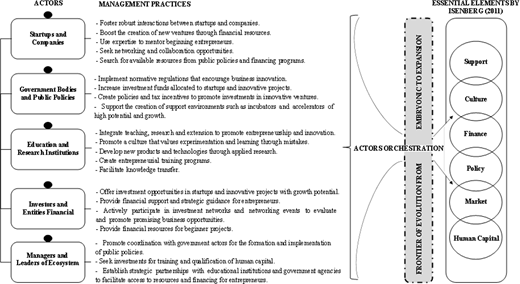
Figure 2, called Guideline, first illustrates the interconnection of actors and then presents management practices for each actor in the ecosystem. These practices can help predict and design actions to overcome the barriers between the embryonic stage and the expansion stage of the ecosystems in which they operate, thereby strengthening the connections among the essential elements identified by Isenberg (2011) and, in turn, enhancing innovative performance.
The results and propositions of this study indicate that, for an EE to reach maturity and expansion, the integration of all elements is essential, as proposed by Isenberg (2011). However, the findings also reveal barriers that hinder the effective implementation of this integration. To mitigate these challenges, this research proposes management practices for the various ecosystem actors, aimed at overcoming the existing obstacles to the development of a mature ecosystem.
These management practices offer guidelines for the various actors in the EE, fostering more collaborative and effective actions to promote innovation and regional economic growth. As the boundaries of EEs expand (Souza, Wegner, and Faccin, 2023), actors and orchestrators face the challenge of working together to create an environment conducive to entrepreneurship and innovation, with an emphasis on long-term sustainable development. Ultimately, the outcomes of these actions shape and define the EE.
Among the key aspects to consider in the context of entrepreneurship alongside the interactions between different actors in the EE and the influence of social, cultural and institutional factors is the importance of labor mobility and the absorption of knowledge and skills by workers (Cantner et al., 2021), which can stimulate the creation of new ventures (Isenberg, 2011). Thus, inadequate orchestration of a support network can pose a challenge for government policies and programs aimed at entrepreneurship, as observed by Spigel (2017), Chaudhary et al. (2024) and Rovere et al. (2021).
In addition to technical knowledge, understanding the entrepreneurial process itself is crucial, with emphasis on the cooperative and sharing relationships established within EEs (Rovere et al., 2021). The contextual view of entrepreneurship, as discussed by Mack and Mayer (2016), suggests that social, spatial, historical and institutional environments influence venture success by facilitating access to capital, factors of production and stakeholder connections.
In line with the observations of Santos et al. (2023), Souza, Wegner, and Faccin (2023) and Thomas and Asheim (2022), the presence of one or more key orchestrators who share responsibilities is essential to fostering the growth of EEs. However, this study highlights that embryonic ecosystems face specific challenges, including shallow connections and limited diversity among entrepreneurial actors, which constrain growth due to insufficient cultural integration, restricted market access and inadequate growth capital.
5.2 Practical implications for the orchestration and evolution of entrepreneurial ecosystems
The practical implications of this research are directed toward the various actors within the EE, suggesting that ecosystems sharing regional characteristics with the case analyzed could adopt management practices, strategies and orchestration mechanisms aimed at fostering the management, expansion and sustainable development of EEs. These actions should align with the guidelines and models proposed by Isenberg (2011), Brown and Mason (2017) and Souza, Wegner, and Faccin (2023), as illustrated in Figure 2. To move from general principles to concrete actions, it is essential to examine how these implications unfold across the diverse actors who shape ecosystem dynamics.
EEs possess the potential to foster organic collaborations among diverse stakeholders, serving as catalysts for the emergence of new ventures, job creation, innovation and economic prosperity. Mechanisms such as business incubators and coworking spaces are essential for promoting interaction between the knowledge infrastructure and the productive sector. Overcoming existing barriers through effective orchestration practices is crucial for the development and consolidation of EEs, as it enables the implementation of more effective policies and practices to stimulate innovation and drive regional economic growth. Building on this understanding, the following implications highlight how coordinated action among stakeholders becomes a central pathway for reducing fragmentation and strengthening systemic alignment.
By directly addressing the practical implications for each stakeholder, it is possible to foster synergies that enable startups and established companies to drive mutual growth, creating connections and partnerships that sustainably strengthen strategic support and, consequently, enhance market competitiveness. For government agencies and public policymakers, this entails collaborating on the implementation of regulatory frameworks that ensure quality standards while removing barriers. Moreover, such efforts can enhance connectivity within the ecosystem and stimulate innovation. This interconnected approach also reinforces the idea that no single stakeholder can independently promote ecosystem evolution; instead, progress emerges from shared responsibility and coordination.
In educational and research institutions, teaching, research and outreach can be synergistically integrated to strengthen the organizational culture, fostering an environment that values learning and new discoveries – important pathways for advancing both industry and society. For investors and financial institutions, this integration creates growth opportunities by generating ideas for financial support combined with strategic guidance, enabling resources to be allocated in a robust and more targeted manner. This approach ensures that investors gain access not only to financial capital but also to the knowledge essential for improving and scaling businesses. Together, these institutional and financial contributions demonstrate how orchestration depends on the alignment of incentives, knowledge flows and resource mobilization.
Finally, the practical implications for ecosystem managers and leaders involve promoting and developing the ecosystem itself, while contributing to the formulation and implementation of public policies that foster entrepreneurship. Such efforts can also facilitate the establishment of strategic partnerships with public and private institutions, thereby enabling sustainable business growth and enhancing regional competitiveness. Thus, the orchestration role becomes both technical and relational, requiring the ability to coordinate actors, reduce fragmentation and sustain long-term development trajectories.
The results of this research reinforce a consistent diagnosis of the orchestration challenges faced by ecosystems located in emerging economies such as Brazil. The configuration observed in Clusters 1 and 3, which contrasts “High” and “Low” associations across structural dimensions such as market, public policy, finance and human capital, reveals a pattern of functioning marked by fragmentation and institutional instability. This aligns with the characterizations offered by Porras-Paez and Schmutzler (2019) and resonates with the evidence presented by Kantis and Federico (2020) regarding Latin American ecosystems in the early stages of evolution. Unlike mature ecosystems, where more stable correlations among elements and more predictable coordination mechanisms tend to emerge, this heterogeneity reflects the absence of governance structures capable of producing sustained alignment, as discussed by Kanda et al. (2025) in the context of ecosystems oriented toward the circular economy. Recognizing these structural vulnerabilities is essential for designing practical interventions that address not only resource scarcity but also systemic misalignment.
Furthermore, the finding that innovative performance does not depend on the uniform presence of all elements at “High” levels, but rather on specific patterns of association among them, underscores the need for orchestration strategies that prioritize coherence, complementarity and efficient allocation of scarce resources. This interpretation aligns with Moerchel, Tietze, and Urmetzer (2023) and is supported by the analyses of Bittencourt et al. (2021), who demonstrate that the articulation of resources, rather than their isolated availability is the primary determinant of an ecosystem’s innovative capacity across different maturity stages . In this regard, the application of MCA proved to be a particularly effective instrument for uncovering structural interdependencies, functioning as a diagnostic map of critical synergies and gaps. This type of analytical tool mirrors the approaches suggested by Leendertse, Schrijvers, and Stam (2022) and reinforces the importance of orchestrators endowed with legitimacy and systemic perspective, as discussed by Thomas, Faccin, and Asheim (2021), to mobilize actors, reduce the dispersion of efforts, and guide the ecosystem toward a more consistent developmental trajectory .
Consequently, the practical implications outlined here are not isolated recommendations but part of a broader strategic framework that connects empirical diagnosis with coordinated action and long-term ecosystem evolution. To deepen this understanding, the following subsections elaborate on these implications by articulating explicit theoretical, methodological and practical contributions, clarifying how the findings reshape current knowledge and inform future ecosystem management.
5.2.1 Theoretical contributions: beyond the ecosystem metaphor toward a theory of orchestrated agency.
Building on the practical insights discussed, this subsection translates the observed empirical patterns into theoretical contributions that refine the conceptualization of EEs. The first contribution of this study is to move the EE literature beyond the passive biological metaphor, frequently criticized for its analytical looseness and limited treatment of human agency (Isenberg, 2016; Harrison, 2025), toward a more precise understanding of orchestrated agency as a causal mechanism underlying innovative performance.
In this study, orchestration is conceptualized as the coordinating mechanism through which ecosystem actors intentionally align resources, institutions and interactions to generate innovative outcomes. Rather than emerging solely from spontaneous interactions, ecosystem dynamics are shaped by the ability of key actors to coordinate complementary resources and reduce systemic fragmentation.
Although much of the current literature emphasizes the evolutionary and self-reinforcing nature of EEs (Stam and Van de Ven, 2021; Wurth, Stam and Spigel, 2022), Autio’s (2022) recent critiques argue that the ecosystem metaphor often obscures the intentional role of actors and the mechanisms through which coordination actually occurs (Harrison, 2025). Our findings contribute to addressing this gap by demonstrating that the transition between ecosystem configurations is not merely the result of an organic evolutionary process but rather the outcome of deliberate coordination among key actors.
The empirical identification of clusters with contrasting configurations (“High” and “Low” associations) illustrates how different combinations of ecosystem elements shape innovative performance. While this heterogeneity is consistent with the diverse development paths identified in Latin American ecosystems (Kantis and Federico, 2020), our results add an important causal dimension: these trajectories are strongly influenced by the extent to which orchestration mitigates the fragmentation and institutional volatility that characterize many emerging economies (Chaudhary et al., 2024; Porras-Paez and Schmutzler, 2019).
Furthermore, our results position orchestration as the central theoretical mechanism explaining why specific ecosystem elements cooccur and generate synergistic outcomes. Echoing the argument of Kanda et al. (2025), orchestration requires dynamic capabilities to sense, seize and reconfigure resources across actors. However, our analysis extends this perspective by showing that orchestration operates as the interstitial mechanism linking the pillars of Isenberg’s (2011) ecosystem framework. As Isenberg (2016) cautioned against the “intention mistake” inherent in the ecosystem metaphor, our findings demonstrate that the strong synergy observed in Cluster 1; particularly among Market, Policy, Finance and Human Capital, is not a spontaneous biological alignment but the outcome of coordinated institutional action that reduces systemic friction and enhances innovative performance.
Thus, this study advances the EE literature through three main theoretical contributions:
5.2.1.1 Redefining the Ecosystem Framework.
Rather than viewing ecosystems as static collections of elements, our findings highlight the importance of analyzing dynamic configurational patterns among ecosystem dimensions. Incorporating Harrison’s (2025) critique, we argue that the value of an EE lies not in its metaphorical resemblance to biological systems but in its institutional capacity to align and govern interdependent actors and resources.
5.2.1.2 Orchestration as a Causal Mechanism.
Our results identify orchestration as the mechanism that enables the transformation of embryonic and fragmented environments into expanding EEs. Consistent with Bittencourt et al. (2021), resource articulation and coordination among actors appear as critical processes enabling ecosystem progression, particularly in contexts characterized by institutional instability and resource scarcity.
5.2.1.3 Place Leadership and Institutional Agency.
Finally, by integrating insights from the literature on place leadership (Thomas, Faccin and Asheim, 2021), this study highlights the active role played by universities and public institutions in shaping ecosystem functionality. Rather than merely participating in ecosystems, these actors often assume orchestrating roles that coordinate resources, align stakeholders and reduce the systemic “entropy” generated by uncoordinated interactions.
By embedding these insights, this study contributes to a governance-oriented perspective of EEs, offering a theoretically grounded explanation of how coordinated agency shapes ecosystem performance in emerging markets.
5.2.2 Methodological contributions: multiple correspondence analysis as a diagnostic tool for ecosystem dynamics.
Building on the theoretical contributions, this subsection explains how the study advances methodological approaches to examining EEs, particularly in emerging economies.
The second contribution is methodological, addressing persistent challenges in measuring EE development, as noted by Stangler and Bell-Masterson (2015), Santos et al. (2024) and Harrison (2025). While previous assessments often relied on metrics such as the number of startups or investment flows, this study introduces and validates MCA as an effective tool for identifying ecosystem synergies, gaps and developmental stages. MCA allows for:
identifying interdependence structures among ecosystem components;
visualizing configurations (clusters) that indicate ecosystem maturity or fragmentation; and
providing actionable insights for strategic decision-making by policymakers and ecosystem orchestrators.
This contribution is significant for emerging economies, where fragmentation and resource dispersion make traditional measurement methods more difficult. MCA provides a more detailed assessment that evaluates relational quality, alignment and coherence – key aspects emphasized in dynamic ecosystem theories (Autio, 2022; Wurth et al., 2022).
5.2.3 Practical contributions: Actionable guidelines tailored to ecosystem stages.
This contribution is practical and directly applicable to ecosystem actors, including policymakers, investors, universities and entrepreneurs. Our guidelines, based on the association patterns revealed by the MCA, are designed to empower these actors to make informed decisions and foster ecosystem growth.
Examples include:
For ecosystems in Cluster 4 (low culture and support): Prioritize orchestration efforts that promote trust, social connectivity and cultural reinforcement, as emphasized by Spigel (2017) and supported by Thomas, Faccin and Asheim (2021) regarding the importance of trust-building in emerging ecosystems.
For ecosystems in Cluster 3 (low performance across Market, Policy, Finance and Human Capital): Focusing on targeted resource allocation and coordinated interventions aimed at systemic gaps, leveraging MCA maps as a planning tool.
These insights align with Bittencourt et al. (2021) regarding the evolving nature of orchestration as ecosystems develop, and with Kanda et al. (2025), who emphasize the importance of continuous system adaptation through dynamic capabilities.
By translating empirical diagnosis into a structured decision-making framework, the study offers a governance-oriented roadmap aligned with nonhierarchical, collaborative ecosystem management.
6. Final considerations
This study examined how the key elements of an EE are associated with innovative performance in an emerging economy. The findings show that performance results not from the isolated presence of ecosystem elements but from specific configurations and complementarities among them. These patterns reveal the challenges posed by fragmentation and institutional instability typical of ecosystems in the early stages of development, while also highlighting the central role of orchestration in aligning actors and resources.
The findings also suggest that the biological metaphor often used in the EE literature is insufficient to explain ecosystem dynamics in emerging economies, reinforcing recent critiques regarding its limited analytical precision (Harrison, 2025). Instead, the evidence indicates that innovative performance emerges from orchestrated agency, in which the coordinated alignment of ecosystem elements shapes outcomes, rather than from a purely natural or evolutionary process.
Methodologically, the study demonstrates that MCA is a valuable tool for identifying ecosystem synergies, gaps and developmental stages. By mapping associations across key dimensions, MCA helps ecosystem managers and policymakers detect coordination failures and prioritize interventions. This helps address a recurring limitation in ecosystem research: the lack of measures of relational quality and systemic alignment.
From a practical standpoint, the results provide actionable insights for governments, universities, investors, intermediaries and entrepreneurs. Strengthening trust, improving coordination and strategically activating complementarities emerge as essential pathways for ecosystem evolution, particularly in contexts marked by resource constraints and institutional volatility.
Although this study provides methodological, theoretical and managerial progress, it also presents limitations. Data were collected from a single Brazilian ecosystem, which limits generalization because cultural, institutional and infrastructural conditions vary across regions and countries. To expand the analytical reach and validate the patterns observed, future research should examine diverse ecosystems in both emerging and developed economies, compare results using MCA or complementary methods, and integrate qualitative approaches to capture perceptions of orchestration, coordination and leadership, as highlighted by Harima et al. (2024) and Autio (2022). Such extensions would deepen understanding of the dynamic processes through which ecosystems evolve, as emphasized by Kantis and Federico (2020) and Autio (2022).
In sum, the study reinforces that ecosystem vitality depends on the dynamic articulation of its elements, and that improving innovative performance requires moving beyond structural inventories toward an understanding centered on interaction patterns, coherence and the orchestration capabilities that sustain long-term development.
This work was carried out with the support of the Santa Catarina State Research and Innovation Support Foudation (FAPESC) and the Coordination for the Improvement of Higher Education Personnel - Brazil (CAPES).