


This paper aims to explore avenue where suppliers and manufacturers are aligned with health-care providers to improve supply chain visibility. Supply chain finance is explored to link suppliers/manufacturers with health-care providers.
Existing literature on supply chain visibility in health care forms a basis to achieve the study purpose. Alignment calls also for financial health where supply chain partners’ working capital is readily available to execute joint supply chain plan.
There is a disjoint in supply chain alliance between suppliers/manufacturers and providers where providers are unable to trace the origin of supplies. Quality care suffers and cost of care rises as providers search for supplies on an emergency basis. This paper provides a framework where solution can be formulated.
Suppliers/manufactures form a direct strategic alliance with providers where product visibility enables health-care providers with a better patient management with lower cost of supplies. Inventory management and logistics cost will be lowered as better planning/forecasting is in place. This paper does not call for testing any hypothesis. Perhaps, next move along this line will be to investigate financial health of supply chain partners based on supplier relationship management practices.
This paper proposes health-care supply chain as an alternative solution to achieve the following twin purposes: controlling the cost while improving quality of care through supply chain finance. As far as we know, this study is the first attempt to achieve the goals.
Introduction
Improving the health-care system to deliver better quality care at affordable cost is important to our nation’s long-term economic and fiscal well-being. The rising cost of health care is one of the key drivers of our growing national debt, which crowds out important investments in future economy, including priority areas like education, research and development and infrastructure. According to one study, 30 per cent of the total health-care spending goes to unnecessary, ineffective, overpriced and wasteful services, equivalent to $765bn (Bui et al., 2017).
In spite of large spending in health-care area, the USA is far behind the health outcomes measured by infant mortality and life expectancy (Kwon et al., 2016).
The health-care industry faces two adversary forces making their profit margin squeezed. Cost of care has been increasing at a rate of twice as much (average over 4 per cent) as consumer price index (Auerbach and Kellermann, 2011). Expensive new technologies in health-care industry add to the total cost for care. Merger and acquisition in health-care industry to take advantage of economies of scale weaken the competition and reduce consumer choices in the market. Aging population creates additional pressure for the health-care industry to deal with complicated and challenging treatment for seniors whose life expectancy has been growing with advent of so-called “miracle” drugs. Consumer’s expectation (consumerization) and the focus on patient-centric care with a reasonable cost add further pressure on providers to create a health-care system that meets the challenging goals. Health-care providers are trying to do more with less in more places.
While managing the cost is the biggest challenge for health-care providers, the revenue stream has been also pressured by regulations and market forces. Government reimbursement to health-care providers have been steadily decreased in relative terms through Medicare and Medicaid programmes. Investment opportunity in health-care areas has been carefully scrutinized by ever-increasing and complicated governmental regulations creating confusion and uncertainties in long-term planning. Health-care spending by providers on new drugs and technologies often deprives funds for other strategic innovative projects which may reduce future health-care cost.
Unlike other industries, health-care providers have been known to be less “open” to innovative ideas commonly prevailing in commercial industries, slow in adopting technologies and reluctant to new ideas. Operating under such “island” environments may eventually lead them to “catching up” syndrome where waste of resources is inevitable.
As Figure 1 shows, two forces working against each other in the health-care industry tend to squeeze profit margin to the point that many small-community health-care providers opt to exit the market leaving many consumers unprotected, especially in the most vulnerable areas such as inner cities and rural areas, further deteriorating health outcomes in this country.
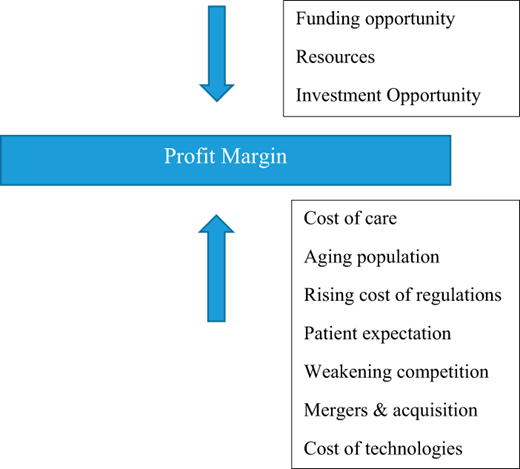
Recently, we witness flurries of suggestions from industries and group of concerned citizens. For example, Amazon, Berkshire Hathaway and JP Morgan Chase announced a formation of alliance to create health-care organization free from profit-making incentives and constraints. They called the skyrocketing costs of health care in the USA the “hungry tapeworm” on the American economy. Salt Lake City based Intermountain Health care will outsource 2,300 non-clinical employees to the revenue-cycle management company R1 RCM, a move that is expected to save the integrated health system $70m over the next three years. To manage the rapid increase cost of drugs, four major US hospital systems (SSM Health, Intermountain Health Care, Accession Health and Trinity Health) are planning to form a nonprofit company to produce generic drugs looking to stabilize a market that has seen soaring prices and shortage of supply of needed drugs. The early-stage deal talks between Walmart and Humana Inc. mark the latest sign of consolidation in distributors, pharmacy operators and benefits managers. The shifting landscape is triggering deepening anxiety in provider sector. Hospitals have been eyeing Walmart nervously for years as it advances into health care, seeking to leverage its enormous purchasing power, physical reach and focus on price. The action by the nonprofit health-care systems is the latest sign of changes in the health-care world that has seen consolidation among hospital systems. This initiative could trigger more changes if more hospitals band together to make their own medical supplies and even bring drug wholesalers and independent distributors into their own networks.
The purpose of this paper is to explore avenue where suppliers/manufacturers are aligned with health-care providers to take advantage of supplier relationship management (SRM) principles. A successful SRM implementation, however, is not feasible without a clear understanding of supply chain finance (SCF). Financial breakdown experienced during the 2008-2010 Great Recessions taught an important financing lesson that SCF is one of the critical components in sustainable supply chain operations.
This paper is organized as follows: brief literature review is given in Section 2 which is followed by framework for health-care supply chain in Section 3. Summary and conclusion is provided in Section 4. Managerial implications is presented in Section 5.
Literature review in health-care supply chain management
Health-care supply chain industry is relatively new compared to commercial supply chain. Kwon et al. (2016) argue that health-care supply chain is in Level 2 (few units in hospital involvement) while the commercial supply chain is in Level 4 (several external partners involvement) in Schneller and Smelter model (Schneller et al., 2006). As long as health-care supply chain remains in Level 2, benefits from supply chain implementations may be limited and health-care industries may be continuously struggling to find resources to improve the quality of care in the midst of financial struggle. Health-care industries face constant regulatory changes that make a long-term planning difficult if not impossible (Vries and Huijsman, 2011). One study even reports that the health-care industry is way “behind in the effective utilization of the benefits that could be derived from effective SCM” (Elmuti et al., 2014, p. 130). Inundated increase in regulatory inspections in medical warehouses the past few years (300 per cent increases) diverts resources from patient care that may hamper any effort to improve quality care and manage financial health (Doone, 2014).
There are several works in health-care supply chain field indicating benefits to be gained from supply chain operations. Nachtmann and Pohl (2009) argue that a properly re-designed health-care supply chain could generate over $1bn annual savings in health care. In addition, recent studies show that a significant portion of the costs associated with supply chain operations in the health-care sector can be reduced by implementing effective supply chain (Burns, 2000; Oliveira and Pinto, 2005). One study even suggests that supply chain implementation tends to reduce cost, improve quality of care and reduce cycle time that leads to high performance (Elmuti et al., 2014). Similar findings were reported elsewhere (e.g. Kwon and Hong, 2011).
One study cites a numerous instances on waste that health-care industries are experiencing because of suboptimum operations of supply chain. For example, in health-care industries, 65 per cent of freight is transported via less than truck load (LTL rate is higher than full truck load rate and LTL invites a higher chance products being damaged with more hands touching the packages), a warehouse utilization rate is 60-70 per cent (inefficient use of working capital) and inventory turn in health-care industry is just 2, whereas it is 44 for consumer electronic, 10 for automotive industry and 6 for consumer packaging goods (investment tied up in non-revenue generating asset) (Doone, 2014).
One of the challenges in health-care supply chain research is a lack of specific tools that may contribute to achieving health-care supply chain surplus. Fragment reports addressing specific tools in industry reports (unscientific studies commissioned by particular industries such as UPS Health-care Study Series) are lacking of vigorous research protocol. Nevertheless, such reports provide a glimpse of industry practices in implementing supply chain in health-care industries. For example, only little over one-thirds health-care supply chain professionals consider that logistics play significant roles in providing accessible health care (O’Malley, 2017). Conspicuous absence in health-care supply chain literature is studies on suppliers and providers relationship. SRM has been known in commercial supply chain as a process strengthening relationship between suppliers and the rest of supply chain community to facilitate information flow, thereby making supply chain operations more efficient and effective (Sander, 2005). In addition, if health-care providers are totally disconnected from suppliers and manufacturers as under group purchasing organization (GPO) model, they are left unprepared in case of supply chain disruption. Kwon et al. (2016) attempted to bridge such gap. They provide selective tools that would address some of the issues that health-care industry has been searching for. The authors provide a framework that implementation of health-care supply chain creates supply chain surplus for all participants (e.g. providers, patients, suppliers and community as a whole). They argue that investment in quality improvement comes from supply chain surplus (similar to consumer surplus) with no additional cost to other sectors of providers, a win-win proposition that only supply chain can provide. The study suggests three specific tools such as SRM, vendor management inventory and collaborative planning and forecasting replenishment. The paper argues that implementation of these tools will create extra value (called supply chain surplus) for all participants (consumers, shareholders and stakeholders). The paper was very careful, however, in pointing out the merit of GPOs and how these two streams of supply chain frameworks supplement each other. There is a room that GPOs can play to improve provider’s financial situation. A study by Kwon and Hong (2011) explored the roles of distributors by directly linking them to manufacturers bypassing GPOs. The purpose of the study, they claim, is to:
see whether logistics cost can be separated from the “total costs” practiced by GPOs; and
search for relationship building process with suppliers.
A similar study is needed to connect providers with manufacturers to make health-care supply chain nimble and more efficient.
Framework for health-care supply chain
The essence of SRM is philosophical issues playing with human judgment and degree of trust. Implementing SRM becomes even more complicated when and if supplier’s financial information is being scrutinized as a part of healthy collaborative relationship between suppliers and providers.
Foundation for providers and suppliers alliance
Health-care experts may argue (correctly for sometimes) that health-care supply chain is fundamentally different from commercial supply chain management. They argue that the core value for health-care providers is to provide quality care for healthier life experiences while commercial supply chain maximizes returns from investment to meet consumers shopping experience (low price), shareholder’s expectation (reasonable return from investment) and stakeholder’s mandate (social responsibilities). Accordingly, fundamental emphasis in both supply chains is different as shown in Table I.
Areas of emphasis between two supply chain operations
| Attributes | Commercial | Health care |
|---|---|---|
| Foundation | Collaboration | Contract management |
| Target area | Products-oriented | Service-oriented |
| Major emphasis | Efficiency | Effectiveness |
| Supply chain model | Pull/push | Mostly pull |
| Quality | Important | Critical |
| Scope | Global | Regional/local |
| Sourcing | Important | Difficult/impossible |
| Payment | Consumers | Third parties |
| Regulations | Less | Heavy |
Notes: Reproduced with permission from authors. Originally published in Kwon and Hong (2011)
While commercial supply chain practices push/pull model, health-care supply chain emphasizes more pull model, as demand for their services is triggered by patients through third-party agents (physicians). While in commercial supply chain, price/cost is very sensitive to the demand for such products and services, in health-care arena, such constraining factors seldom exist, as third party (insurance company) plays a patient’s surrogate for payment. Finally, the scope of commercial supply chain is global, while for health-care supply chain it is regional and even local limiting supplier base and choice of products and services. Although two supply chain models look similar in Table I, one notices a basic difference between these two models in supply chain foundation. While commercial supply chain is built on the concept of collaboration, the health-care supply chain is based on contracts. Supply chain based on collaborative framework looks for a long-term value creating relationship while supply chain based on contract emphasizes a short-term fulfillment of the contents specified in the contract.
Figure 2 outlines the supply chain process from the start to the end in the most simplified framework. Supply chain encompasses three blocks of process goals: foundation, drivers and outcomes. Outcomes from supply chain implementation depend to large extent on how well supply chain drivers are aligned with each other and executed. Each driver requires substantial capital investment to be able to produce intended results. Misalignments of any drivers could weaken potential gains. The critical component at this stage is how well each player in each driver box aligns with the rest of the drivers. For example, misalignment between inventory managers and transportation decision-makers may cause shortage or excess inventory. Similar scenario can be made between manufacturers and health-care providers. If manufacturers provide providers with less than requested and/or items other than what were requested, the quality of care will be compromised.
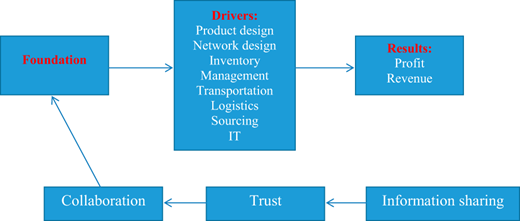
The best way to avoid such mismatch is to build a strong collaborative relationship among supply chain players. Collaboration among players is seeking value proposition and not short-term gains commonly seen in contract negotiations. Collaboration, therefore, is a long-term commitment based on mutual respect from the business prospective. Formation of the collaborative process, therefore, is slow and sometime difficult, as there is no immediate return. Difficulty is compounded, as the collaborative formation process requires information sharing among the players, which is not an easy task (Kwon and Suh, 2004, 2005). However, once players overcome uneasiness and fear for sharing information, trust building process can be initiated or formed without much reservation. Immediate benefit from trust formation is reduction of transaction costs (Kwon et al., 2012; Williamson, 1981). Transaction cost in supply chain ranges from 35 to 40 per cent of supply chain cost. If and when supply chain players become aware of the benefit built on a strong foundation, each party starts to listen to others and tries to accommodate ideas and suggestions beneficial for both parties and even willing to take risks to be a part of winning supply chain partnership. Supply chain partners enter into the maturity stage and become “more listening and less arguing” to explore mutually beneficial strategies. Supply chain benefits increase for both players (last box in Figure 2). Supply chain works well in meeting original targets (efficiency and consumer responsiveness) if and only if every participant has a clear understanding of fundamentals of supply chain.
According to one study, inventory carrying cost for the best collaborator with customer is 4 per cent of the average inventory values, whereas the corresponding cost for the bottom collaborators is recorded as 18 per cent. The demand and supply planning cost for the top collaborators is $0.47 per $1,000 revenue while the bottom collaborator is $2.56 per $1,000 revenue (Partida, 2015). A similar result is reported in other study (Kwon et al., 2017). On the other hand, lack of collaboration and trust may have cost Chrysler $24bn over 12 years period (Henke et al., 2014). Unfortunately health-care supply chain has made very little progress toward adopting commercial supply chain framework (Kwon et al., 2016) since the original study was reported in 2011 (Kwon and Hong, 2011).
Supply chain financing and supplier alliance
Financial difficulties experienced by many retailers such as Sears and Toys “R” Us, especially after the advent of ecommerce, raises a serious concern by suppliers and manufacturers. Many suppliers threaten to cut supplies or shorten payment periods with retailers. In light of this financial meltdown by retailers, it is not unusual by suppliers to review buyer’s financial condition with extra care. In health-care area, situation may be reversed; providers may concern supplier’s financial health more than supplier’s concern with provider’s financial health. Such concern becomes more evident, as there is no clear and visible business relationship between providers and suppliers/manufacturers as discussed in previous section. There are three areas that need a special attention when strategic alliance between providers (buyers) and suppliers enter into serious discussion: financial landscape, organizational strengthens and skills. Each one of these core components plays a significant role making supply chain outcome different. Among three, financial health of suppliers/manufacturers becomes dominant factor for successful consummation of supply chain alliance between providers and suppliers.
Suppler visibility is essential for supply chain operations, as transportation, inventory and production all depend on reliable supplier’s commitments. Production unit cost increases if production schedule is disrupted because of lack of materials. Transportation optimization becomes illusive if and when supplies commitment becomes uncertain and unreliable. Inventory shortage becomes inevitable and entire supply chain optimization will be disrupted. Such possible disruption becomes even more critical, as 80 per cent of the active ingredients in American pharmaceuticals come from other countries – mainly India and China. Medical supplies are even worse; only 5 per cent of the more than 230 million surgical masks and 30 per cent of the more than 20 million respirators purchased by the US health-care industry each year are made in this country. The rest are mostly sourced from Mexico and China (Eshkenazi, 2018).
Nevertheless, there is a clear disconnection between health-care providers and suppliers/manufacturers of the critical products that health-care providers need to perform their functions, saving lives. In commercial supply chain, visibility covers the entire operations; from sourcing to retailers in order to make supply chain more efficient (cost) and effective (customer experience). Visibility becomes even more critical in successful supply chain execution as ecommerce becomes a way of doing business in commercial supply chain. Yet, there is no process in place for health-care providers to trace the origins of their supplies leaving them shortage of critical products in many instances. One study shows that such disconnection stems from a dominant role that GPOs play as a supply chain “surrogate” for hospitals and provided solution to mitigate disconnection (Kwon and Hong, 2011). A reliance on GPOs as sourcing partners deprives of their abilities to establish relationship with suppliers and manufacturers. An absence of supply chain relationship with suppliers presents a difficult choice for providers in case shortages of critical supplies are forecasted. In a worst case, surgeries may be postponed and patients may go without needed medicines for a long period. Quality of care suffers.
Supplier financial strength
The 2008-2010 Great Recessions reveals vulnerability of supplier’s financial conditions especially for small- and medium-size suppliers. Small- and medium-size suppliers were unable to secure needed working capitals to meet the buyer’s requirements. Many suppliers went into bankruptcies leaving buyers in untenable situations. Production lines were halted, shelves at retail stores were empty and supply chain was disrupted. The vicious cycle continued as suppliers were unable to secure working capitals. Many buyers arranged financing using their (buyers) credit for suppliers to keep supply chain moving. Buyers usually maintain reasonably good credit standing with lenders and suppliers would get capitals with lower interest burden than otherwise. When big buyers unilaterally impose new payment terms on their suppliers, they (buyers) are essentially shifting the working capital burden further up the supply chain. Such move adds significant risk to the supply chain (Fernandes and Ellram, 2017).
It has been reported that buyers now routinely use SCF (called supply chain working capital finance, SCWCF) in cooperation with suppliers rather than using high-cost-lending institutions. SCF is defined by the Global Supply Chain Finance Forum (2018) as “the use of financing and risk mitigation practices and techniques to minimize the management of the working capital and liquidity invested in supply chain processes and transactions.” SCF focuses on creating liquidity in the supply chain through various buyers (providers) or sellers (suppliers) – led solution (Kouvelis et al., 2017). A proper use of SCF can build collaboration, improve relationship and enhance trust between supply chain partners as well as financial performance (Templar et al., 2016). This financial tool, augmented by technology such as cloud-based computing platforms, is being provided by new financial technology called fintech specialists set up by traditional financial services companies such as Citi Group and Deutche Bank (Fernandes and Ellram, 2017).
It is prudent for buyers to check supplier’s financial health and if necessary arrange financing tools especially setup for supply chain management. During the 2008-2010 Great Recessions, many buyers and suppliers made special financial arrangement to keep supplies flow into supply chain. For example, a Spring 2009 survey found that 55 per cent of companies extended payment terms with suppliers, 25 per cent worked to accelerate customer payment terms and 44 per cent worked on reducing supply chain-wide inventory together to free working capital for both players (suppliers and buyers) as part of their efforts to manage working capital (Scheffi, 2015).
There are several types of SCFs. Financing through financial institution is the most prevalent method that has been used. The advantage of financial institution’s providing credit stems primarily from their access to capital markets, ability to diversify risk and specialization in financial intermediation. Suppliers on the other hand may have an advantage over banks in assessing borrower’s creditworthiness, enforcing repayment or salvaging repossessed inventory upon a borrower’s default (Frank and Maksimovic, 2004).
Another popular financing method is supplier financing (also called factoring). In this case, the supplier has dual roles; seller and lender. Under this framework, suppliers extend buyer’s payment period, which thereby improves buyer’s liquidity condition. Typical suppliers sell (factoring) on a 30-day note to financial institutions with a discount (a typical discount rate of 5 to 6 per cent of the face value). The financial institution cashes the note in maturity date. Supplier receives funds immediately and augments their working capital while financial institute earns interest at the end of maturity date. According to Burkart and Ellingsen (2004), the advantage of supplier financing over bank financing is that goods are more difficult to divert for private benefits. Fabbri and Menichini (2016) argue that supplier financing can mitigate the borrower’s risk-shifting opportunities. During the 2008-2010 Great Recessions, for example, 25 per cent of large companies extended payment terms to buyers. This financing method is especially attractive when buyers are unable to secure credit with commercial lending institution because of a poor credit standing.
Finally, buyer’s financing (also called reverse factoring) is popular if buyer has a better and strong credit standing than supplier’s credit condition. This is especially attractive financing for small- and medium-size suppliers. Large creditworthy buyers work together with banks to provide innovative financing programs to help small- and medium-size suppliers to gain easier access to a capital market (Lekkakos and Serrano, 2017). Reverse factoring is gaining momentum in the industry, as it requires suppliers consent in extending payment terms (Milne, 2009). During the 2008-2010 Great Recessions period, 55 per cent of companies extended payment terms with suppliers (Scheffi, 2015).
Beside SCF for suppliers, another area that buyers/providers should pay special attention is supplier’s past financial performances. If bulk of supplier’s revenue/profit has been depending on a handful clients, financial stability may be brought into questions as client base is too narrowly limited to a few. Such segmentation in evaluating supplier’s financial health should not limit only to client bases but may also include stock keeping unit (SKU) levels as well. If bulk of revenue/profit is coming from one or two SKUs, financial vulnerability may be greater than large SKU base. Along with this line of thought, it is also prudent for buyers to evaluate supplier’s long-term financial performance to see stability of the supplier’s financial performance in the past few years. With extensive financial/accounting records available, buyers may be able to construct supplier potential “bankruptcy models” (Trent, 2016). This model, properly constructed, would give the buyer a potential warning sign of supplier’s financial condition and may arrange mitigating strategies to avoid unexpected supply chain disruptions.
Summary and conclusion
Existing literature on health-care supply chain has neglected the importance of supplier/manufacturer and the health-care provider alliance. Heavy reliance on GPOs and independent distributor networks (IDNs) left few opportunities for providers to explore a direct strategic alliance with suppliers. Such an absence of alliance has created two “holes” in health-care supply chain operations.
First, supply source is almost exclusively depending on third-party suppliers (usually GPOs) whose strategic objective may be different from those of providers. While providers seek for reliable uninterrupted supplies of critical supplies on time in right place, the main purpose of GPOs is to provide supplies at a reasonable (lower) cost. Under this scenario, suppliers become just “sellers” and providers become just “buyers” through third parties (GPOs). There is no immediate linkage between suppliers and providers. Providers are put in a situation where they do not have knowledge of supplier’s production and engineering capabilities. A long-term SRM becomes almost impossible which weakens opportunities to develop value creating relationship between providers and suppliers.
Second, such an absence of direct linkage/alliance increases supplier’s financial risk, as suppliers seldom work on long-term strategic plan based on a provider’s strategic goals. Supplier’s direct link under traditional model is with GPOs, and they are not financial institutions that support supplier’s financial needs or provide financial assistance in case when suppliers face financial hardship.
This paper provides a framework to establish SRM where both parties benefit from long-term value created by SRM. In addition, this paper attempted to re-define suppliers as more than “sellers” and providers more than “buyers”. They are strategic partners whose long-term goal is to improve quality cares with a reasonable cost using supply chain management tools. Supply chain creates “community surplus” and providers can use this “surplus” by investing in new technologies that reduce costs of care and improve quality of life. To support SRM, this paper reviewed three popular supply chain financing methods: financing working capital thorough traditional financial institutions, supplier financing (factoring) and buyers (providers) financing (reverse factoring). It has been reported that there is a growing need for SCF as advocated by The Global Supply Chain Finance Forum (2018). It became apparent since the 2008-2010 Great Recessions that SCF is an important component for all parties involved in supply chain operations to avoid financial meltdown that affects every player in supply chain. It is, therefore, imperative to consider SCF as one of the critical supply chain drivers in Figure 2.
Managerial implications
One study already suggested that providers should take advantage of a direct link between distributors and providers (Kwon and Hong, 2011). This study extends such linkage further to upstream in supply chain operations. Shortage of critical supplies in hospitals cannot and should not be tolerated. Such disruption reflects ineffective supply chain operations. One way to avoid such disruption is for providers to link directly with suppliers/manufacturers and establish a strong collaborative relationship manifested by SRM principles. This study acknowledges contributions provided by GPOs and IDNs. We claim that providers can and should create twin processes to take advantages of both models (GPO and SRM) to take the most benefit out of supply chain in health care.
This paper forms part of a special section “Global entrepreneurship and social innovation in the fourth industrial revolution”, guest edited by Chang Won Lee.

