This study examines how China’s first and only nation-wide institutional reforms, Open Government Information (OGI) and Open Environment Information (OEI), both effective in 2008, influence the change in corporate climate-related environmental reporting (CER). It explores the role of institutional pressures in moderating the relationship between company characteristics and information disclosure.
The study uses multivariate regression analysis with general estimating equations to analyse 471 annual and CSR reports from 100 Chinese companies. Data were collected for three key years: 2006 (pre-reform), 2008 (immediate post reform-implementation), and 2010 (extended post reform-implementation). The study assesses the impact of regulatory reforms on overall reporting and category-specific reporting on climate-related environmental information in the short and medium term.
The findings reveal a significant increase in environmental reporting post-reform. Coercive institutional pressures from OGI and OEI moderate the relationship between Chinese company characteristics, such as political connections, ownership structure, and international operations, and reporting practices. Distinct drivers were identified for category and overall disclosures, highlighting the role of even voluntary regulatory reforms in shaping reporting behaviour.
The study offers policymakers insights into designing effective regulatory frameworks to enhance corporate transparency.
This study uniquely evaluates the moderating effects of OGI and OEI on the relationship between Chinese company characteristics and CER across overall and six category-specific disclosures. By addressing critical gaps, it captures the nuanced variability of factors influencing disclosure practices. The study also contributes a dynamic empirical model, resolving a long-standing issue of a “stable” functional relationship between company characteristics and CER. These insights deepen understanding of regulatory impacts on the change in corporate behaviour.
1. Introduction
Empirical research on corporate climate-related environmental reporting (CER) in developing countries remains limited, despite the growing significance of these regions over the past decade (Andrew and Baker, 2020; Boubakri et al., 2021). The dominance of Western-centric theories and methodologies in this field often neglects the unique political, institutional, and economic dynamics of non-Western contexts, particularly those of transitional economies such as China (Andrew and Baker, 2020; Lennox and Wu, 2022). This reliance on Western paradigms reflects what Alatas (2003) described as “academic dependency,” where scholars in developing countries depend heavily on Western frameworks, limiting exploration of localized institutional influences. Consequently, prevailing models of corporate reporting tend to lack contextual relevance and overlook institutional complexity in emerging markets (Yang et al., 2015).
China exemplifies this tension. As an emerging market, China’s economic reforms are characterized by experimentation and gradual adjustments, which pose challenges, including weak property rights, inconsistent rule of law, and insufficient corruption control (Qian and Chen, 2021). The relationship between Chinese companies and the state is far more complex than is generally assumed in conventional capital markets research (Conyon et al., 2015; Finamore, 2010; Hilmy, 1999). The Chinese government plays a multifaceted role in corporate affairs, not only as a regulator but also as a key consumer of goods and services, a principal provider of capital, and a dominant force in resource allocation through the ruling Communist Party of China (CPC) (Bryson et al., 2014; Parsa et al., 2020; Shen et al., 2023). Regulatory institutions, such as the China Securities Regulatory Commission (CSRC), enforce stringent oversight through strict listing requirements and approval processes shaped by political priorities (Lennox and Wu, 2022).
In China’s distinct institutional environment, regulatory reforms such as the first nation-wide state-led Open Government Information (OGI) and Open Environment Information (OEI) guidelines (Finamore, 2010) effective since 2008, represent a shift in corporate transparency. These reforms marked a departure from China’s long-standing bureaucratic secrecy and introduced voluntary disclosure mechanisms aimed at enhancing information transparency (Hubbard, 2008; Yang and Farley, 2016). Notably, these remain the only state-led voluntary reforms associated with CER in China; all subsequent initiatives have taken a mandatory form.
Despite recent advances in the CER literature based in China [1], particularly in areas such as stakeholder salience (Qian et al., 2024), media and peer influences (Long et al., 2024), and disclosure outcomes (Wang et al., 2024), limited attention has been given to the effects of these early state-led voluntary reforms. Few studies have assessed how OGI and OEI interacted with uniquely Chinese firm-level characteristics, such as CPC affiliations, ownership structures, and international operations. Existing studies have largely focused on mandatory reporting requirements (e.g. Chen et al., 2018), leaving a gap in understanding the behavioural implications of voluntary policy mechanisms.
This study addresses this gap by empirically examining how the OGI and OEI reforms moderated the relationship between firm-level characteristics and CER. Adopting an institutional theory framework, we explore how coercive pressures, even when applied through voluntary guidelines, can moderate the relationship between company characteristics and disclosure behaviour in an authoritarian context. Specifically, this study investigates the following research questions:
What was the direct impact of OGI and OEI on CER by Chinese listed companies?
How did these regulatory reforms influence the relationship between company characteristics and CER?
This study contributes to the literature by offering a category-specific, multidimensional analysis of CER across three time points (2006, 2008, and 2010), capturing both the overall level of disclosure and variation across six category disclosures. Our empirical model has addressed a long-standing issue in the literature: the assumption of a “stable” functional relationship between company characteristics and CER (Gray et al., 2001). Our model allows for variation in both the intercept and slope of this relationship following regulatory reform, offering a more dynamic and context-sensitive understanding of CER determinants.
The selection of 2006–2010 as the sample period is deliberate, reflecting both the timing of the OGI and OEI reforms and the unique opportunity they provide to isolate the effects of voluntary guidelines without the confounding influence of mandatory regulation. While the reforms occurred more than 17 years ago, their significance endures, not only as a precursor to subsequent mandatory policies but also as a foundational step in China’s evolving sustainability governance. Analysing their impact offers valuable insights for understanding how early-stage regulatory reforms under authoritarian institutions can catalyse longer-term shifts in corporate transparency. These findings have increasing relevance today amid global movements toward corporate sustainability disclosure standards such as IFRS S1 and S2. They highlight how insights from China’s early-stage voluntary reforms may inform current debates on the implementation and efficacy of emerging global standards, particularly in jurisdictions with developing institutional infrastructures.
This study also differs markedly from Chen et al. (2018) in scope, focus, and theoretical framing. While both studies examine regulatory developments introduced in China in 2008, our research centres on the foundational, nationwide voluntary reforms, the OGI and OEI guidelines. These reforms laid the institutional groundwork for subsequent disclosure mandates, including the mandatory CSR policy examined by Chen et al. (2018). However, Chen et al. (2018) focus on the outcomes of a stock exchange-imposed mandatory disclosure requirement targeting a subset of heavy-polluting firms, without accounting for the broader institutional context that preceded it.
In contrast, our study explicitly considers how the state-led voluntary reforms shaped the regulatory environment and influenced corporate behaviour. A key point of differentiation is our application of institutional theory to examine how coercive pressures from OGI and OEI moderated the relationship between firm-level characteristics and climate-related environmental reporting. By adopting a multidimensional approach, we provide a comprehensive, category-specific analysis of CER across three time points, capturing both overall disclosure and six distinct dimensions across industries. This level of granularity enables deeper insight into how voluntary regulatory reforms influence corporate transparency in an authoritarian setting.
The findings reveal that in authoritarian regimes like China, even voluntary regulatory reforms can exert meaningful coercive pressure. The interaction between these regulatory reforms and firm-specific characteristics significantly shapes reporting outcomes, both in terms of overall disclosure and category-specific content. By exploring these moderating effects, the study enhances our understanding of how local institutional contexts influence corporate environmental reporting, contributing to broader insights into cross-national and cross-industry variations in CER. These findings also carry practical implications for policymakers and researchers seeking to improve transparency and accountability in transitional and non-Western regulatory environments (Andrew and Baker, 2020).
2. Conceptual framework and hypothesis development
Institutional theory (DiMaggio and Powell, 1983; Scott, 2002) provides a compelling framework for this study, given the regulatory and political context of CER in China. In authoritarian regimes like China, the state plays a dominant role in shaping corporate behaviour. Prior research consistently finds that Chinese companies with closer political ties or state ownership are more responsive to government signals, often disclosing more substantively in anticipation of regulatory scrutiny (Marquis and Qian, 2014). Yang et al. (2015) and Situ et al. (2018) highlight the Chinese government’s influence in shaping transparency practices.
This study focuses on the state-led, but formally voluntary reforms (OGI and OEI), that marked a turning point in China’s institutional approach to environmental transparency. Although non-mandatory, these guidelines exerted coercive pressure on firms by signalling heightened regulatory expectations and aligning with the broader political agenda of accountability (Marquis and Qian, 2014). The strategic responses observed among firms following these reforms reflect an underlying drive for legitimacy in an evolving institutional environment.
Existing studies further demonstrate that Chinese companies often disclose selectively to align with institutional expectations, whether to satisfy domestic regulatory norms or to gain legitimacy in global markets (Meng et al., 2014; Yang and Farley, 2016). More recent research has expanded this perspective by examining how internal factors, such as leadership turnover, climate governance, and stakeholder engagement, influence disclosure practices (Qian and Chen, 2021; Wang et al., 2024). Collectively, these findings reinforce the consensus that CER in China is shaped more by institutional dynamics than by market mechanisms.
Institutional theory posits that organizations adapt their behaviours to conform to prevailing regulatory, normative, or cultural pressures, not merely to improve efficiency, but to secure legitimacy and survival (DiMaggio and Powell, 1983; Scott, 2002). In the Chinese context, where voluntary guidelines often function as indirect mandates, government’s coercive pressures are particularly salient. The OGI and OEI reforms exemplify this dynamic, functioning as institutional levers that shaped disclosure expectations across the corporate sector.
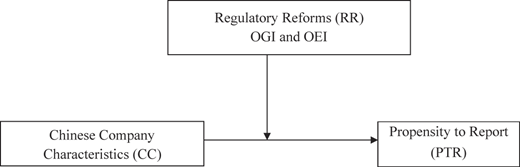
By explicitly modelling the empirical effects of these reforms on CER, this study contributes to institutional theory by illustrating how state-led, voluntary regulatory initiatives can moderate the relationships between company characteristics and disclosure behaviour. This offers new insight into the institutional dynamics of corporate environmental governance in China and deepens our understanding of how voluntary reforms operate within coercive institutional contexts. Figure 1 presents the conceptual framework that demonstrates the direct and indirect effects of regulatory reforms on CER in China.
The regulatory reforms (RR), specifically the Open Government Information (OGI) and Open Environment Information (OEI) guidelines, serve as an external institutional force aiming to increase information transparency.
Chinese company characteristics (CC) refer to the attributes of Chinese companies, such as CPC affiliation, ownership structures, international operations, engagement with Big 4 international accounting firms as auditors, and listing exchange, that influence their CER behaviour.
Propensity to Report (PTR) represents the likelihood of companies to engage in CER, reflecting their responsiveness to both internal attributes (CC) and external pressures (RR).
The framework positions RR as a moderating variable that influences the strength or direction of the relationship between CC and PTR. For instance, companies with strong CPC affiliation may exhibit higher or lower reporting tendencies depending on the regulatory environment.
This framework emphasizes the critical role of regulatory reforms in shaping corporate behaviours, highlighting the interaction between local Chinese company characteristics (CC) and the pressures exerted by regulatory reforms (RR) in influencing the propensity to report (PTR).
2.1 The direct impact of China’s OGI and OEI on CER
In China, public disclosure of corporate environmental information barely existed prior to 2006. However, this has changed since China’s first nationwide OGI was promulgated by the State Council of China on 27 April, 2007 (effective on 1 May 2008) [2]. The Ministry of Environmental Protection (formerly State Environmental Protection Agency) became the first to implement OGI and issued Measures for Environmental Information Disclosure (hereafter OEI, see Finamore, 2010), also effective in May 2008. The OEI encouraged Chinese companies to report environmental information voluntarily.
OGI and OEI, endorsed by the most powerful political actors in China (CPC and the central government), were expected to exert coercive pressures on Chinese companies to report environmental information (He et al., 2019; Yang and Farley, 2016). Research on regulatory reforms in China (Parsa et al., 2020) and other countries (Cho et al., 2013; Tauringana and Chithambo, 2015) has shown that such government-led reforms often lead to significant increases in transparency and compliance in areas like corporate social and environmental reporting.
This suggests that even if there were no change in the level/setting or influence of company characteristics, there would be an expected increase in CER. Therefore, the following hypothesis is formed.
CER in 2008 and 2010 was higher than in 2006 above and beyond that caused by changes in the level/setting or influence of Chinese companies’ characteristics due to a direct positive impact of OGI and OEI.
2.2 The moderating effect of regulatory reforms on the relationship between Chinese company characteristics and CER
According to González‐Benito and González‐Benito (2008), company characteristics relevant to the context of CER are closely linked to the external influences on environmental management and are also shaped by the context of the country in which the company operates. In China, political, social, and economic environments give rise to unique company characteristics, such as senior executives’ CPC affiliations, diverse ownership structures, stock exchange listings, engagement with Big 4 accounting firms, and international operations (Yang et al., 2015). These characteristics are expected to interact with regulatory reforms to influence CER practice.
2.2.1 Senior executives’ CPC affiliation
One distinguishing characteristic of Chinese companies is the affiliation of their CEOs or Chairmen with the Communist Party of China (CPC). The CPC exercises significant control over the recruitment and promotion of senior executives in many listed companies. To maintain its ruling status, the CPC systematically screens the political loyalty of its members, rewards politically loyal members with power and privileges, and penalizes disloyalty (Bian et al., 2001, p. 808). CPC members must consistently demonstrate both political loyalty and professional capability to retain their elite management positions (Bryson et al., 2014; Conyon et al., 2015).
The Chinese government implemented in 2008 regulatory reforms aimed at enhancing information transparency, which were designed to promote accountability and align corporate practices with national priorities. Despite being voluntary these reforms were expected to exert greater influence on companies with CPC-affiliated executives, given their closer alignment with the government’s directives and higher susceptibility to political oversight and compliance incentives. CPC executives are positioned to act as conduits for implementing state-driven reforms, such as those related to CER.
For reporting items supported by Chinese guidelines (OGI and OEI), companies with CPC-affiliated CEOs or Chairmen were more likely to report the item than their non-CPC counterparts, as they are compelled to adhere to government expectations. Given the social objectives of the CPC this may have been true to a lesser degree even before the RR. Consequently, ceteris paribus, the total number of items reported by companies with CPC executives was expected to be greater after the introduction of the RR than it was before their introduction. Therefore, the following hypothesis is proposed.
China’s OGI and OEI increased the level of CER of companies with CPC affiliated executives.
2.2.2 Ownership structure
Ownership structures have been consistently associated with CER in developing countries, for example, India (Bedi and Singh, 2024), China (He et al., 2019), and Vietnam (Nguyen et al., 2024). However, prior studies based in China often treat state ownership as a single variable, overlooking important distinctions between central-state-controlled (CSC) and local-state-controlled (LSC) entities. This study addresses this gap by analysing the moderating effect of China’s regulatory reforms on the relationship between different ownership types and CER.
In China, the ownership structures of listed companies have evolved from economic reforms, resulting in three main types of ownership control: CSC, LSC, and Non-Gov entities. State-controlled companies, particularly those under central state control, are tasked with pursuing social and political objectives alongside economic ones. In contrast, LSC companies, while also subject to social objectives, operate with greater market exposure and autonomy. Non-Gov companies prioritize financial performance over social objectives and are evaluated primarily on their economic outcomes (Lee et al., 2017; Scott, 2002). These objectives and priorities applied even before the RR. Given corporate environmental accountability has been a long term objective of the Chinese government (Situ et al., 2018), it is expected that up to 2006, ceteris paribus, there would be a declining level of CER ranked from CSC to LSC to Non-Gov. Due to the institutional pressure applied on all companies by the introduction of the RR, it is expected that the gap between the ownership types will close. Thus, the following hypothesis is proposed.
The introduction of OGI and OEI closed the gap in CER between CSC, LSC and Non-Gov companies.
2.2.3 Listing exchanges
China’s economic reforms in the early 1990s led to the establishment of two primary mainland stock exchanges: the Shenzhen Stock Exchange (SZSE, 2006) and the Shanghai Stock Exchange (SSE). Prior research often treats these exchanges as a single variable (Ferguson et al., 2002) or focuses exclusively on one exchange (Cheng et al., 2015), overlooking their distinct roles in shaping corporate environmental disclosure practices.
The SZSE pioneered environmental responsibility by introducing the SZSE Guide 2006, which provided voluntary guidelines for corporate social responsibility reporting, including CER. This early adoption likely cultivated a culture of social responsibility information disclosure among SZSE-listed companies, positioning them as early movers in CER. By contrast, the SSE introduced its first CSR reporting guidelines in May 2008 (SSE, 2008), aligning its requirements with the national OEI guidelines. As a result, SSE-listed companies had less time to internalize and adopt CER practices prior to the enforcement of national standards.
For disclosure supported by Chinese guidelines, SZSE-listed companies, benefiting from their early alignment with CER principles, are expected to exhibit higher levels of disclosure compared to SSE-listed companies. However, for items not supported by specific guidelines, both SZSE and SSE-listed companies face similar external pressures, leading to negligible differences in disclosure practices on those items. Thus, prior to the RR, SZSE-listed companies are expected to demonstrate greater overall CER performance. However, there are two alternative scenarios on how the RR may impact the CER gap between the two exchange groups. Firstly, it may be that the RR added to the existing institutional pressure created by the SZSE guide, which they had not properly responded to, and hence place greater total institutional pressure on the SZSE group. This would widen the gap between the two groups. Alternatively, due to SZSE having already responded to the pressure exerted by the SZSE guide there may be less impact on the SZSE group of responding to the institutional pressure of the RR. This would close and existing gap between the two groups. Hence, the following hypothesis is formed.
The introduction of OGI and OEI moderated the gap between the CER of SZSE and SSE listed companies.
2.2.4 Big 4 international accounting firms
The entry of the Big 4 international accounting firms into China in 1992 was driven by a domestic shortage of accounting professionals with international experience. Chinese regulators anticipated that collaboration with the Big 4 would facilitate the adoption of internationally accepted accounting practices and enhance the global legitimacy of Chinese enterprises, particularly state-controlled entities pursuing international operations (Chen et al., 2007).
Engaging a Big 4 auditor offered Chinese companies a pathway to address international perceptions of the country’s traditional socialist accounting model and align with globally accepted financial reporting standards (Street and Gray, 2002). Big 4 accounting firms bring a global culture of training, expertise, and consistency in applying international auditing practices. This global perspective likely influences how these auditors advise Chinese companies on environmental reporting, potentially altering their internal interpretation and prioritization of both Chinese and international environmental guidelines.
In the context of CER, having a Big 4 auditor could have significant implications. On one hand, the global training and culture of the Big 4 might encourage greater alignment with international best practices, enhancing the company’s CER performance. On the other hand, their influence could vary based on their internal position on environmental reporting, potentially leading to inconsistent effects across different reporting items. For example, for disclosure items supported by Chinese guidelines (e.g. OGI and OEI), Big 4 auditors might encourage stricter compliance. This could diminish the level of CER.
For items not explicitly supported by guidelines, the Big 4’s influence could depend on the extent to which their international perspective prioritizes voluntary environmental disclosures.
Given the complexity of the Big 4’s role, the direction and magnitude of their influence on CER before the RR may vary. However, regulatory reforms aimed at enhancing environmental transparency may moderate this relationship by aligning corporate reporting practices with national priorities, potentially moderating the impact of Big 4 auditors in promoting CER. Thus, the following hypothesis is proposed.
The introduction of OGI and OEI moderated the relationship between Chinese company’s engagement with a Big 4 international accounting firm and CER.
2.2.5 International operations
China’s economic reforms have emphasized the adoption of internationally recognized business practices as a pathway to modernization and global competitiveness (Chen et al., 2007). The rapid expansion of Chinese companies into international markets has catalysed significant organizational changes, particularly in CER. Export-oriented Chinese companies, operating in the context of stringent environmental regulations in developed countries, are increasingly motivated to engage in environmental self-regulation to avoid protective trade barriers (Christmann and Taylor, 2001).
Companies with international operations frequently interact with overseas governments, regulators, consumers, trading partners, competitors, and international industry associations. These interactions expose them to global norms, expectations, and pressures that can influence their environmental reporting practices. Organizations such as the World Bank and the International Monetary Fund further reinforce the need for transparent environmental practices as part of global best practices. Therefore, even before the RR companies with international operations were likely to report more on items in the Chinese guidelines that were supported by international guidelines, as these guidelines align with global expectations and provide a framework for compliance.
For items not supported by international guidelines, there is no compelling reason to expect companies with international operations to report differently from those without, as both groups are subject to similar external pressures on such items.
With respect to behaviour after the RR however a similar argument could be mounted about the possible direction of the change in the gap between international and non-international companies following the introduction of OGI and OEI. Thus, the following hypothesis is proposed.
The introduction of OGI and OEI moderated the positive relationship between a company’s international operations and CER so as to change the gap between the two groups.
3. Research design
3.1 Sample selection and study period
This study examines Annual Reports (AR) and Corporate Social Responsibility (CSR) reports of selected companies listed on the CSI 100 as of December 30, 2007. The CSI 100 comprises 100 large companies listed on China’s Shanghai Stock Exchange (SSE) and Shenzhen Stock Exchange (SZSE), representing 60% of the total market value of the mainland Chinese capital market. The sample spans 10 industry sectors. ARs were collected from the SSE and SZSE databases, while CSR reports were obtained from the websites of the sampled companies.
Three reporting years were selected for analysis: 2006, 2008, and 2010, each chosen for its specific significance as follows:
2006: It was the final year without the announcement of national-level corporate voluntary environmental reporting guidelines to be implemented in 2008.
2008: The first year of implementation for the Open Government Information (OGI) and Open Environmental Information (OEI) policies.
2010: Two years after the implementation of OGI and OEI, providing sufficient time for companies to fully integrate these guidelines into their reporting.
The comparison of 2006–2008 allows a test of the immediate impact of introduction of the RR while the comparison of 2008–2010 allows a test of whether there are any delayed responses to the RR. Only these years allow a test of the impact of voluntary information transparency guidelines because all following regulations in later years involved mandated reporting. 2007 would not have been appropriate year to study because the guidelines were announced but not encouraged to be implemented, hence its inclusion would not have clearly differentiated between a time of no institutional pressure and one of the maximum institutional pressures on CER. 2009 was ignored to give a substantial period for the institutional pressures to bring about full change. Years beyond 2010 were not included to minimize the possible impact of other factors (both within China and worldwide) that may have affected CER. Due to the merger of two companies during the 2010 data collection period, the sample size for that year is 99 companies. In total, 471 reports were analysed for this study, as summarized in Table 1.
3.2 Empirical model
The following linear model is postulated (other than for size, which is represented by log of income) to test the hypotheses. Since all variables other than size are 0/1 and hence the relationship with them is not altered by many common non-linear transformations.
3.2.1 Dependent variable
The overall level of disclosure is used as the dependent variable (. This is measured by using a structured research instrument comprising six categories and 38 disclosure items (see Table 2). This instrument was originally developed and published in our earlier work (Yang and Farley, 2016). As the present study extends that research, we have retained the validated instrument to ensure analytical consistency and comparability over time.
The instrument was specifically designed to capture climate-related corporate environmental reporting (CER) in the Chinese context. It was constructed through systematic content analysis of internationally recognized reporting frameworks, such as GRI (G3), the GHG Protocol, the Global Compact, and CDP, and key domestic Chinese guidelines issued between 2005 and 2010, including OEI (2007), SZSE (2006), SSE (2008), and SASAC (2007). Grounded in institutional theory, the instrument recognizes that corporate climate disclosure is shaped by coercive, normative, and mimetic pressures from both global and national institutions. The 38 disclosure items are categorized into six thematic areas: policy; governance and strategy; financial implications and other risks/opportunities; performance and targets; mitigation and adaptation; and credibility. This design supports a nuanced analysis of convergence and divergence in reporting practices, providing a robust framework for evaluating the evolution of climate-related CER in China’s unique institutional and political environment.
Initial coding was done by one of the authors, who speaks and writes Chinese at a professional level and has professional translation experience. The author developed a coding sheet to record the 38 reporting items. If an item was reported in AR, “1” was coded in the relevant cell in the column titled “AR”, or “0” if not reported. If an item was reported in CSR, then “1” was coded in the relevant cell in the column titled “CSR”, or “0” if not reported. If an item was reported in both AR and CSR, the item was recorded “1” in each column, and “1” was coded in the relevant cell in the column titled “Overall”. This coding process avoids double counting the same item. The maximum score for any company was theoretically 38 in any study period. The author did the initial coding on a hardcopy of the reports and then checked the coding by using the PDF search function on an electronic version of the reports.
To ensure consistency of coding across companies, all reports were coded at least three times (following the above coding procedure) by the author at different points in time to ensure inter-temporal coding consistency. In addition, coding for 27 reports was redone by two independent assessors for validation. The similarity of coding by the independent assessors, compared with the coding done by the first author, was 94.1%. This is an acceptable level of inter-coder reliability (Milne and Adler, 1999).
3.2.2 Explanatory variables
This study uses two dummy variables representing 2006 (T2006) and 2010 (T2010) to measure the response to regulatory reforms implemented in 2008 (Gray et al., 2001; Tauringana and Chithambo, 2015). This then tests the direct effect of changes in CER between 2006 (pre-RR) and 2008 (immediately post-RR), and 2008 and 2010 (delayed post-RR) respectively.
Company characteristics are represented by dichotomous variables (except for size) as follows.
The affiliation of a senior executive with the CPC is proxied by whether the Chairman and/or the Managing Director is a member of CPC. This is a composite variable that uses knowledge that this is the case for all central-state controlled companies, combined with self-disclosure from AR to detect non central-state controlled companies for which it is also true.
Ownership is represented by three variables: one for central-state-controlled companies (CSC); one for local-state-controlled (LSC) companies; and the other for non-government-controlled companies (Non-Gov). LSC is omitted from each model to avoid estimation problems. The estimated coefficients then represent the difference between the associated variable group and the LSC group.
There are five variables for listing exchange (denoted by EXCH1 to EXCH5); two for the domestic exchanges, SZSE and SSE, and three for the cross-listing exchanges (control variables), Hong Kong (HK), New York (NY), London (LON). However, the variable representing SSE is omitted from the model. Hence, in each case, the difference between the quoted exchange and SSE is tested.
The variable for Big 4 international accounting firms as auditors (BIG4) is used to distinguish companies audited by any one of the Big 4 Four international accounting firms, that is, KPMG, PricewaterhouseCoopers (PwC), Ernst and Young (EY), and Deloitte from those audited by all other auditors.
The variable for international operation (INT) distinguishes between companies who reported export sales as part of major operating income and/or reported overseas branches, and those who did not. The simplistic use of a yes/no approach to modelling this characteristic rather than using a measure of the size of international operations is due to the disclosure of data. While the extent of export sales can be obtained from annual reports the extent of overseas operations is not always clearly reported.
3.2.3 Control variables
There are consistent findings about the relationship of a company’s size and industry membership with CER. Hence, we include these two factors as control variables in this study.
Measures of size vary in prior literature. Due to the difficulty of measuring assets in the financial industry, size is measured here according to income (INC). The log of income is used as the size measure (Cho and Patten, 2007). To ensure the constant purchasing power of Chinese local currency RMB Yuan, income has been adjusted by using China’s GDP deflator [3].
Industry is represented by ten dichotomous variables, one per industry (denoted by IND1 to IND10). However, only nine industry variables are included in any one model. An industry towards one of the extremes was dropped to allow a test of the greatest industry differences. Additionally, prior literature has found a positive relationship between foreign exchange listings and corporate voluntary disclosures (e.g. Broberg et al., 2009; Xiao et al., 2004). Hence, the variables representing cross-listing exchanges (already defined) are also treated as control variables.
4. Results
4.1 Descriptive statistics
Descriptive statistics for the explanatory variables and overall reporting are shown in Table 3.
Correlations between explanatory variables are shown in Table 4.
4.2 Multivariate analysis
Given this is panel data, a general estimating equations (GEE) approach, either linear or binary logistic as appropriate, is used. The correlation between explanatory variables shown in Table 4 indicated that there could be an issue with multicollinearity in model estimation. However, in the fitting of the initial random effects models this did not prove an issue based upon testing of the relevant statistics.
4.2.1 Overall disclosure
For overall disclosure, the model is statistically significant (see Table 5) and has strong explanatory power.
The results for overall disclosure indicate a significant impact of OGI and OEI on CER between 2006 and 2008 (T2006), and between 2008 and 2010 (T2010). They also support a significant impact of the control variables size (Log(Inc)), industry category (with differing impacts across years), and foreign exchange listing (with differing impacts across years).
Table 5 shows strong support for the moderating effect of China’s regulatory reforms on the relationship between Chinese company characteristics and CER. However, the statistically significant results of cross product variables show this moderating effect is not constant over time.
Table 6 is designed to enhance the interpretability of the results in Table 5. The use of cross-product terms in the regressions allows the coefficients of the associated variables to change over time. The pattern of this change can be informative. Table 6 shows the coefficients for each variable for each year. Since the estimated intercept term corresponds to the average level of reporting when all explanatory variables equal zero, including income, it falls well outside the range of the level of reporting for any real company. To make the intercept term more interpretable it has been adjusted to align with a company of the same size as the smallest company in the reference industry (Energy) in 2006. This company has a log of income equal to 9.6588. The revised intercept therefore corresponds to the estimated average level of reporting of a company with log of income equal to 9.6588 and all other variables equal to zero in 2008, i.e. 11.07251. The revised intercept for 2006 is the value in 2008 plus the estimated coefficient of Y2006. Similarly for 2010 it is the 2008 value plus the coefficient of Y2010.
The remaining entries for each variable in 2008 are the originally estimated coefficients for those variables. The entries in the 2006 column for each other variable are the values in the 2008 column plus the estimated coefficient of the cross-product term between Y2006 and the relevant variable, e.g. the 2006 coefficient for CPC is 1.791 which equals 8.454 (the 2008 value) plus −6.663, which is the estimated coefficient for 2006CPC. Similarly, the remaining entries in the 2010 column are the 2008 values plus the estimated coefficient of the cross-product term between Y2010 and the relevant variable.
The coefficient for LogInc remains constant in each year but the appropriate value to multiply it by for any observation is the difference between the log of income for that company in that year and 9.6588.
4.2.2 Category reporting
The models for disclosure in the six general categories were all statistically significant with good to strong explanatory power. The GEE results of the six models of category reporting are reported in Table 7.
The results for the six categories of reporting give greater understanding of what drove the results for overall reporting. As with overall reporting, the majority of the variables for category reporting are significant. However, what is notable is the variables don’t always have the same directional impact on different categories.
4.2.3 Robustness check
Several robustness checks were undertaken. Firstly, a robustness check was also conducted by using two alternative measures of size. Firstly, log of assets in constant dollars (Adjusted R2 = 0.637). Secondly, income in constant dollars (Adjusted R2 = 0.618). Both rendered a slightly lower explanatory power for overall disclosure than log of income (compared to Adjusted R2 = 0.651). In both cases there was only a slight change in the set of variables that were significant. Alternative measures were not available for most other variables since in general they represent a factual statement about the state of the world.
Secondly, due to the existence of two time-invariant variables (local stock exchange and industry group) in the model a Hausman test for bias due to endogenous variables was conducted. As expected with time-invariant variables the test was found to be significant. To assess the impact of this a fixed effects model (FEM) was also run and the results are shown in Tables 8 and 9. The benefit of the FEM is that it specifically test for the impact of variables only over time. The benefit of the original random effects model (REM) is that it also gives an estimate of the impact of the time-invariant variables across companies. This is useful to assess the assertions that CPC-affiliated executive, SZSE, CSC and international operating companies had a greater level of CER even before the RR.
5. Discussion and conclusion
This study empirically investigates the impact of China’s first nationwide regulatory reforms, OGI and OEI, on corporate climate-related environmental reporting (CER). Specifically, it explores the moderating role of these reforms on the relationship between Chinese company characteristics and CER. The findings of the initial REM model provide robust evidence addressing the research questions.
First, OGI and OEI reforms, despite being voluntary, led to a notable increase in CER by Chinese companies when they were implemented in 2008 (RQ1). The results demonstrate a statistically significant rise in reporting between 2006 and 2008, and a smaller but sustained increase from 2008 to 2010. These findings underscore the immediate and substantial direct influence of even voluntary government-led reforms in China on corporate behaviour. Therefore, Hypothesis 1 is supported.
Second, the study confirms that OGI and OEI moderate the relationship between key company characteristics, such as CPC affiliated executives, ownership structure, listing exchange, Big4 international accounting firms, and international operations, and CER (RQ2). The strength of these moderating effects varied over time, highlighting the dynamic interplay between the regulatory reforms and company attributes. This provides strong support for Hypotheses 2a to 2e. Furthermore, the study corroborates the influence of control variables such as company size, industry membership, and cross-listing exchanges on CER (Tables 5–7). strongly support the hypotheses of the moderating effects of OGI and OEI on the relationship between company characteristics and CER (H2a – H2b). Results also give strong support to an effect of the control variables size, industry membership, and cross-listing exchanges on CER.
The findings regarding senior executives’ CPC affiliation reveal a significant and positive relationship with overall disclosure and most reporting categories, except for credibility (C6). Notably, this influence intensified after the implementation of OGI and OEI. These results validate arguments about the CPC’s political influence on Chinese companies’ operations and underscore its role in promoting compliance with state-driven initiatives. This has practical implications for foreign companies operating in China, which may face lower CPC-driven pressures on environmental reporting compared to domestic firms.
In the REM regression analyses, differences between non-government controlled (Non-Gov), central-state-controlled (CSC), or local state-controlled (LSC) ownership often influences reporting behaviour. In overall reporting in all years CSC companies rank significantly below LSC companies, and Non-Gov companies in turn rank significantly below CSC companies. This overall pattern is strongly driven by the results for Mitigation (C5) and less so by Governance (C2). For Risks (C3), CSC and Non-Gov are both significantly above LSC in 2008 and 2010, although Non-Gov is lower than LSC in 2006. For Policy (C1) Non-Gov is significantly above both CSC and LSC in 2008 and 2010 after being below both in 2006. Notable is the fact that the gap between Non-Gov and both forms of government ownership closed even with voluntary RR. This shows that the CPC, and authoritarian government, can have significant impact on non-government companies even through voluntary guidelines. These findings reveal the differing effect of OGI and OEI on the relationship between Chinese company ownership structures and components of CER.
The findings provide support to the proposition that there was a moderating effect of OGI and OEI on the relationship between companies based on the domestic exchange they are listed on and CER. Prior to the RR companies listed on the Shenzhen Stock Exchange (SZSE) performed similar to those on the Shanghai Stock Exchange (SSE) in overall disclosure and most categories. This lack of difference suggests that SZSE’s earlier adoption of CSR guidelines did not influence CER. However, post OGI and OEI there is support for significantly greater CER companies on SZSE. This is consistent with a converging effect of institutional pressures from the CSR guidelines and the RR.
While the REM analysis suggests companies with Big4 auditors were reporting less before OGI and OEI this gap closed significantly with the introduction of the RR. The category results show that this was strongly driven by Performance (C4) where the Big4 have greater expertise in quantifying CER measures (Pham et al., 2024). The growing internationalization of Chinese companies has also played a significant role in improving CER. Firms with international operations exhibited higher reporting levels, influenced by their exposure to stringent environmental regulations in developed markets. Notable is that the gap increased post RR again suggesting a converging effect of the institutional pressures. It is also notable that international operations is the only variable for which the substantial additional impact seen in 2010. This is consistent with the strongest impact of the RR being immediate (2008), with only limited further delayed improvement (by 2010).
The key differences in the findings of the fixed effects model (FEM) in Tables 8 and 9 compared to the findings of the random effects model (REM) already discussed are:
No direct effects of OGI and OEI are found in the FEM’s which rejects hypothesis 1 whereas the REM’s accepted hypothesis 1.
Very similar estimates are obtained for all the coefficients of the shared variables in the two sets of models.
The standard errors of the coefficient estimates for all variables have increased substantially in the FEM’s and hence the significance of the shared variables have reduced substantially. The cause of this is obvious in that the average Variance Inflation Factor (VIF), used as a measure of multicollinearity in a model, has increased from 8.1 in the REM to 15.2 in the FEM. The REM has only four variables with a VIF exceeding the accepted measure of serious multicollinearity, i.e. a VIF of at least 10, whereas the FEM has 63 such variables, of which 13 are non-fixed effects variables, i.e. equivalent to the variables in REM. What this shows is that using FEM’s to eliminate one form of bias in the estimates, i.e. endogeneity, another form of bias has been introduced, i.e. multicollinearity. This justifies looking at both sets of results. One consequence of the FEM’s is that no cross-product variables for 2010 are significant. Another is that less cross-product variables for 2006 are significant.
The FEM’s still support that the impact of the OGI and OEI introduction led to the following changes in CER between 2006 and 2008:
CER in companies with CCP affiliated executives increased more than the average level, which supported H2a.
CER in non-government companies increased more than the companies with any form of government ownership, which supported H2b.
The gap in CER between SZSE and SSE companies changed between 2006 and 2008, which supported H2c.
There is no support in the FEM’s for any delayed (2010) implementation of OGI and OEI.
This study strongly supports the institutional theory approach to analyse how regulatory reforms moderate the relationship between company characteristics and CER. Results affirm that these reforms drove increased CER in China, even when voluntary. The developed model addresses the “stability” issue in predicting CER and provides a comprehensive analysis of China’s contextual factors influencing disclosures before and after transparency reforms. Findings provide important evidence that factors influencing category reporting can differ from those influencing the overall and that these influences vary over time.
The findings of this study make a significant contribution to the existing literature on the role of government guidance, even when voluntary, in enhancing corporate environmental reporting. They highlight that in countries with authoritarian governments the impact of the introduction of voluntary regulations/guidelines cannot be ignored in research. They have the practical implications for policy development aimed at improving corporate transparency. Specifically, the results demonstrate that strengthening government regulation or implementing detailed voluntary guidelines in the Chinese context can effectively drive corporate environmental disclosures, even in the face of non-compliance. This aligns with evidence from studies conducted in Australia (Frost, 2007), Spain (Criado-Jiménez et al., 2007), and South Korea (Cho et al., 2013), affirming the broader relevance of such measures for diverse regulatory settings.
These findings are particularly relevant in the context of the IFRS Sustainability Disclosure Standard IFRS S1 General Requirements for Disclosure of Sustainability-related Financial Information and IFRS S2 Climate-related Disclosures, which set out global requirements for sustainability and climate-related disclosures. While IFRS S1 and S2 provide a unified framework for corporate transparency, this study highlights how local adaptations, such as China’s Open Government Information (OGI) and Open Environmental Information (OEI) reforms, can complement global standards (Hubbard, 2008). The study’s evidence reinforces the argument that robust government initiatives, whether voluntary or mandatory, can serve as foundational mechanisms to align national practices with international frameworks like IFRS S1 and S2.
Additionally, the findings support Unerman and Bennet’s (2004) argument that, without external regulatory pressures from influential stakeholders (such as the CPC and the central government in the Chinese context), companies are unlikely to voluntarily align their reporting practices with global or national standards. The coercive influence exerted by regulatory reforms such as OGI and OEI emerges as a dominant driver of corporate reporting changes, surpassing other factors. This demonstrates China’s strong administrative capacity to design highly tailored policies that address local conditions while also resonating with the global push toward standardized sustainability reporting (KPMG, 2024). These findings provide a valuable reference for policymakers worldwide who aim to balance local adaptations with adherence to global standards like IFRS S1 and S2.
Finally, the study identifies an important avenue for future research. The quasi-legislative power of government-issued guidelines in emerging economies, which can operate as effectively as formal regulations in developed countries. The findings further reveal significant variations in how regulatory reforms moderate the relationship between company characteristics and CER. These variations underscore the intricate interplay of institutional, economic, and political factors, validating the complexity and context-dependence of CER (Tilt, 2016). This complexity has profound implications for the implementation of international standards such as IFRS S1 and S2, which aim to establish unified sustainability and climate-related reporting standards. For these standards to achieve global adoption, they must account for diverse institutional environments and regulatory capacities across countries. By addressing these variations, IFRS S1 and S2 can strike a balance between global consistency and local adaptability, ensuring they are both actionable and inclusive. Advancing this alignment will be critical for refining the theory and practice of climate-related environmental reporting, fostering a more cohesive and impactful global approach to addressing sustainability challenges.
Notes
See Yang et al. (2015) and Shen et al. (2023) for comprehensive reviews of the literature on corporate environmental reporting (CER) in China.
See Horsley (2007) and Hubbard (2008) for further details.
Data retrieved from World Bank at http://data.worldbank.org