This paper is concerned with materials developed to represent and communicate state-commissioned spatial experiments on social media. Our objective is to reveal what such materials can do, even before – or whether–the projects they represent are built. Such materials can constitute an intervention in the way political territory is created, shared and made sense of.
We use empirical research of The Line, a new city set to be built in the Kingdom of Saudi Arabia (KSA), to explore this contention. Our research data is the publicly available visual, textual and audio-visual materials commissioned by The Line’s delivery company to be disseminated on digital platforms. Our methodological approach to these materials is a qualitative content analysis.
The materials do not provide a clear sense of fundamental elements of what The Line as an architectural project actually is. Rather the materials foreground three main tropes that disrupt existing notions of nature, space and temporality. Such disruptions propagate KSA’s official story of transformation as drafted in its Vision 2030. They lead us to understand The Line as a radical experiment to rework the Saudi territory and therefore reflecting the power of the state.
Exploring critically the ways in which material projects are embedded in predominantly visual digital cultural forms that imply architecture – and are compounded by affordances of social media – can illuminate much about how designed environments can be mobilized vis-a-vis political imaginaries.
1. Introduction
States have shown a considerable appetite for using spectacular architecture as part of their nation-building projects, providing governments with a way to trial the future form of political territories. When commissioned in these conditions, architecture can be understood as an “experimental terrain” (Scott, 1998) upon which political speculations and desires are articulated and explored. Accordingly, state-commissioned projects of spatial futures can provide a distinctive insight into contemporary social realities and the forms of statecraft; these imaginings are not solely futurist, but rather reflect some contemporaneous assumptions about the world as is, and the way it was, is, as well as representing how it could/should be developed (Degen and Rose, 2012; Jones, 2015).
State-commissioned projects of spatial futures are afforded a distinctive momentum by the combined workings of visual, textual and audio-visual materials that digital communication platforms make possible. Social media allow users to connect, share and engage in various ways at accelerated speeds and scopes. Although these affordances of social media (see, for example, Davis and Chouinard, 2016; Fox and McEwan, 2017) should not be considered monolithic (Schroeder, 2018), they nevertheless enable stakeholders to communicate projects, such as The Line, globally, in real-time, and in ever-more “realistic” ways. The possibilities afforded by social media have a significant import for architectural practice as well as for the political communication of spatial imaginings of the future. For analysts such as ourselves, the “deep mediatization” (Couldry and Hepp, 2017, p. 7) normalized on social media makes even defining these state-commissioned projects of spatial futures a difficult task. The slippery, dynamic and disparate nature of the projects that involve lots of things happening at once and that are displayed on a variety of platforms that shift shape and communicate very differently to different audiences. Beyond being multiple and not singular, the types of state-commissioned projects of spatial futures we find on social media contain a bewildering combination of the visible and opaque, of the imagined and the actually existing, and of contestable-but-amplified motivations and subterranean rationales. Overall, these architectural representations reveal the contradictions inherent in symbolic and material reinventions of national territory. Our general starting point here is that theoretically informed and empirically engaged analysis is necessary if we are to understand digital representations of state-commissioned projects of spatial futures in the age of social media.
The case of The Line in the Kingdom of Saudi Arabia (herein KSA) provides an apposite lens through which to view these broader theoretical issues. At the time of writing The Line is a set-to-be-built city in a region that has been newly designated Neom, which is in the northwest of KSA. It is one of many projects developed by the eponymous Neom, an organization owned by that country’s sovereign wealth fund and that exists with the aim of transforming the region as a key part of KSA’s Vision 2030. These developments are occurring in a context of high penetration rate of social media platforms in KSA (Alhussein, 2019) and massive social media consumption with approximately 60% of the Saudi population being under the age of 30 (Uniacke, 2021).
In what follows, we first provide a purposeful description of the project that draws attention to what we consider to be some of its most notable features, before elaborating on the methods we applied to research such. Drawing from across social sciences, humanities, and architecture, mixed methods allow us to interrogate the distinctive and dynamic force added to the project by the artifacts created for and shared on social media. We then provide findings of our analysis of publicly available visual, textual, and audio-visual materials–all released by Neom–identifying three tropes that our analysis has revealed therein. In these stable ways of articulating The Line we find highly temporalized sets of visuals that share much in common with digitized images from the genre of science fiction and video games, fantasy-style imaginings that involve fundamental reworkings of reality. The uncertain status of images of The Line vis-a-vis architectural practice leaves us to reflect on a project whose existence is currently primarily digital, but that involves interventions in reality: spatial futures become malleable to the extent that these digital imaginings imply fundamental interventions into social life. In sum, the visual, textual and audio-visual materials associated with The Line seek to challenge a stable sense of social and spatial reality and play around with ideas of social time (Durkheim, 1915). Any stable understanding of what architecture is and what architects do cannot be taken for granted in this complex and messy context that simultaneously draws on representations of the built environment while undermining the very premises of such.
2. Architecture, nation building and regime maintenance
As a central part of their governance, states involve themselves in the active creation of territory. This construction involves symbolic work associated with cultural narrations and sees language, discourses of history, formal and less formal education, and all manner of artifacts drawn into national narratives. Territory also refers to more material issues associated with land, political boundaries and the exercise of law therein. For its part, architecture is a field that has close links with all these issues. Architecture and the representational practice it becomes entangled with are “political imaginaries” (Brenner and Elden, 2009, p. 359) of our sense of societies and their boundaries. At the same time, the material business of states is grounded in practice and directed to the distribution of power (Mair, 2021). This is a highly dynamic process, and states rework the territory over which they govern; architecture is often centrally implicated in these territorial re-imaginings (On architecture’s close relationship with nation-building projects see for example Minkenberg (2014), Jones (2011), Vale (1992). On architecture and regime maintenance, see Pieri (2008), who discusses King Faisal II’s star architecture spree in Baghdad following the 1955 Baghdad Pact.).
Using architecture for nation-building or regime maintenance has often gone beyond the commissioning of individual buildings and monuments to encompass city building. Vale argues that “City building and nation building are linked, especially when the city is a modern capital.” (Vale in Minkenberg, 2014, p. 35) Islamabad, the capital of post-partition Pakistan, laid out by Doxiadis, Le Corbusier’s Chandigarh in India’s Punjab, or Oscar Niemeyer’s Brasilia, capital of Brazil are examples in which a “regime gains the power to narrate its national story spatially” (Minkenberg, 2014, p. 42). Amravati in India and the new administrative Capital of Egypt are more contemporary examples of such efforts.
Tantalisingly – and as per our hypothesis in this article – social media platforms have affected the relationship between states, architecture and territory with representations of the built environment now gaining significant momentum prior to/independent of spaces being realized. While physical buildings and monuments to symbolize and enact territory take years to make and often reflect uncertain purpose outside of the symbolic narration of the territory, the exposure, interaction and engagement at accelerated scopes, speeds and intensities afforded by digital platforms lend mediated representations distinctive power. This fascinating context is the backdrop to our study.
3. Situating The Line: architecture, nation, future
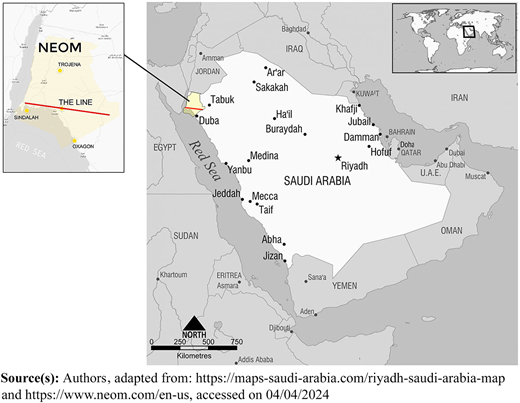
Neom – a territory invented and named by the crown prince of KSA, Mohammed bin Salman bin Abdulaziz (MBS) – can be understood as a series of megaprojects to be developed in a northwest region of that territory. Refer to Figure 1. Neom is financed and led by the Kingdom’s Public Investment Fund (PIF) with an overarching objective to contribute to Saudi Arabia’s economic transformation as per the stated aims of KSA’s Vision 2030, launched by MBS in 2016 “to see the country develop into a pioneering and thriving model of excellence in various and important areas of life”. (Source: https://www.spa.gov.sa/2372273, accessed on 24/02/2023) [1]. To put it simply, The Line is one of the major projects developed under the auspices of Neom and, by extension, MBS.
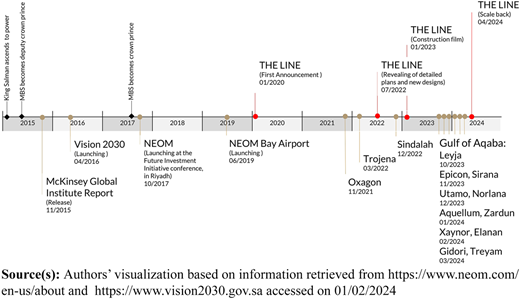
The Line was first presented to the public in January 2021 by the crown prince himself (refer to Figure 2 for milestones of the project and other related events). The first designs for The Line were unveiled in an exhibition in KSA in July 2022. Although satellite photography suggests the construction of some sections is underway, the project is at present primarily made visible through a wide range of publicly available digital visuals, textual documents and videos.
The Line was originally designed to house over nine million people in an enclosed space with a height of 500 m, no wider than 200 m at any point and stretching over 170 km, amounting to a total area of just 34 km2. Its projected population density would have made it the highest in the world by some considerable margin (by way of comparison Dhaka in Bangladesh has a roughly comparable population, but in an urban area of over 300 km2, whereas Port-au-Prince in Haiti has a similar area to The Line but with a population of fewer than one million). As we’ll see, the projected population density of the project is far from its only element of it that stretches credulity past breaking point. But rather than dismiss these features and representations of The Line, out of hand, we aim to draw analytic attention to them as ways that the KSA territory is being reworked. It is key to note that in April 2024 (during the writing of this paper) it was announced that The Line was scaled back to a much shorter stretch of 2.4 km. This massive reduction in the scope and scale of the project has all sorts of major implications some of which will be unpacked in a later section of this paper; for now, it suffices to say that Neom at the time of writing this article still communicates the project via the same material and the original project still features on its website and social media feeds. So, even as most of the to-be-built physical project is scraped, the digital project is still operational (even if significant elements of the project will never exist outside of the online images of such).
The Line is one of 43 key projects contributing to Vision 2030, a governmental document outlining a strategic framework aimed at reducing the country’s dependence on oil (Source: https://www.vision2030.gov.sa/en/projects/, accessed 04/04/2024). More than half of these key projects are architectural in nature, yielding spectacular visuals of future forms of the transformed built environment of KSA. While these projects are supposed to contribute to this “story of transformation”, as Vision 2030 is described by PIF (Source: https://www.vision2030.gov.sa/en/, accessed on 04/04/2024) as involving three pillars of vision: creating a vibrant society, a thriving economy and an ambitious nation (Ibid). It would be an error to understand The Line as just a real estate or economic urban development project. But what is it? We suggest below that this is a contribution that cannot be understood outside of the construction of a new Saudi national identity using social media as a primary site; reimagination of political territory is a key but implicit aim of this project.
The problem of the construction of a culturally meaningful Saudi territory is far from new. Madawi Al-Rasheed (2021) argues that from the onset of the establishment of KSA as a country in 1936, its Saudi rulers struggled to construct a coherent identity that could integrate the fragmented identities of its constituencies into a political cultural community under institutionalized governance. According to Al-Rasheed, Saudi rulers first used religious nationalism, then pan-Islamism in the 1970s, and most recently, since 2015, under the defacto leadership of MBS, populist nationalism. Eman Alhussein (2019, p. 5) notes that “since 2015, the new leadership has promoted a more overt form of nationalism to address its regional worries and to help justify economic measures designed to end the draining rentier social contract system”. She states that media – social media as well as traditional print outlets – have swung forcefully in behind this and concludes that “the new nationalism is about the state … Not about society” (Alhussein 2019, p. 12) its core purpose is to speed the rise of the crown prince, and back his reform agenda [2]. Indeed, available evidence suggests that The Line is the brainchild of the crown prince himself. In a manner reminiscent of Le Corbusier’s famous pointing over a model, the crown prince gestures with his hands holding them parallel to each other to indicate a narrow space and “tells the documentary-makers how one practice (Morphosis) proposed a linear city 2 km wide, and he credits himself with the idea of narrowing it and pushing up its height” (Moore, 2023). Curiously, although a number of famous architects are mentioned as contributors to the project, the specific contributions of the architects to The Line are not publicly declared though. At its announcement event, it is the crown prince himself who presents the project. He is depicted as the committed leader “who will deliver the project on behalf of the nation” (press release, emphasis added). The Line is depicted as demonstrating the closeness of the crown prince to Saudi citizens and his leadership of Saudi society.
Most significantly, The Line might not be so much about architecture, but more about the circulation of material about architecture on social media platforms. The Line and other architectural projects are a rich source of visual, textual and audio-visual materials; the combination of such supports a strategy of inundation with visuals and malleable material, which can remain open to interpretation and evolve as the designs unfold. In his book The Anaesthetics of Architecture, Neil Leach (2000) cautions that inundation with sensationalist and spectacular materials induces “a narcotic effect that diminishes social and political awareness. In the intoxicating world of the image … lowering critical awareness” (Leach, 2000, p. viii).
Our interest in this paper is how architectural production lends itself to such kind of instrumentalization at a particular moment of a country’s potential transformation, heavily influenced by state sponsored social media content. By investigating the case study of The Line our focus is to describe the content of its digital representations that circulate on social media and explain what such materials reflect as a way of unpacking what this project is really about. This has major implications for architectural production; in the words of Kim Dovey, a “critical architect will be critical of thoughtless reproduction of identities and will accept the responsibility of the inevitable production of identities-nations, cities, corporations, communities, families and selves-through architecture” (Dovey, 2010, p. 45) including representations of architecture. In the age of social media, architecture can become fodder for media content that can amplify power structures.
4. Methodology
Identifying the material for analysis with respect to The Line is a deceptively difficult task. Not only is The Line entangled element of a far larger set of imaginings – Vision 2030, which itself contains 43 major projects – the proliferation of visual, textual and audio-visual materials constitutes a disparate and dynamic set of artifacts to consider. Further complicating the object of our inquiry, the status of The Line relative to what is actually built or what will ever be built is also highly ambiguous. When we started discussing this paper, we were confronted by representations of one of the largest, most ambitious schemes the world had ever seen. Now we are left to consider a far more modest proposal in most respects, but one that is still worthy of analysis, as it tells us a great deal about what can happen when states seek to rework territory with architectural representations on social media. Even so, we have very little access to even basic descriptive information concerning the production of these visuals and other resources – who made them? For what? And for whom?
Despite this confused and confusing context, The Line illustrates particularly well how state-commissioned imaginings of spatial futures can be mobilized on social media. While social media platforms compound the elusive character of much of what currently constitutes The Line, social media intensify what is shared with respect to the project and enable it to be widely distributed, paradoxically making what is a slippery object of study all the more difficult to grasp. Formally, though, The Line is presented by Neom on its user accounts on social media platforms such as Instagram and LinkedIn through a combination of visual, textual and audio materials that – when considered together – can be understood as a collective “multimodal text” (Markus and Cameron, 2002, p. 150) shared with social media users of different platforms with distinct but related sets of aims.
Despite our aforementioned uncertainty regarding the nature of the project, we set about capturing some of the material to make sense of the nature of this project. In this regard, Gillian Rose’s definitive work on critical visual methodology is particularly instructive and underpins how we have situated the materials to analyse it. Rose (2023, p. 43) identifies “four sites at which the meanings of an image are made: the site(s) of the production of an image; the site of the image itself; the site(s) of its circulation; and the site(s) where it is seen by various audiences and users” and attributes three different modalities to each of these sites, namely technological, compositional and social. As social constructions, the sites of production, circulation and audience de facto affect the potential meanings of these materials; it is imperative to uncover elements of meaning stably present in the materials (visual, textual, and audio-visual). Using qualitative content analysis (Schreier, 2013), visual analysis (Rose, 2023) and film analysis (Mikos, 2013), we set out to systematically interrogate the materials to this end at the site of the material itself, identifying recurring patterns that emerged across the visual, textual and audio-visual fields.
The focus of our analysis is the content of these materials. Although they would have been interesting lines of inquiry, we are not interested in the lifespan or reception of these materials on social media nor the co-production that unfolds as they circulate on social media. We have not sought to account for or to analyse audience reception, or to interrogate the social contexts into which these materials were pitched; not only did our approach not give us access to related data, but we were particularly keen to see where our analysis–as two scholars from distinct but related traditions of sociology and architecture–of the materials that we decided to analyse would take us. We opted to collect these materials from the website rather than from social media platforms because websites are more “static” and controlled if compared to social media platforms, which are designed precisely for connectivity, dynamism, and engagement with material. In short, it was more practical to use the website rather than social media platforms to collect the materials that circulate on social media.
Hence, we collected all visual, textual and audio-visual materials that were available via the official English language version of the website of Neom, namely https://www.neom.com/en-us, which was hosted at the day of collecting the data for this research to communicate The Line. Neom’s website functions as a kind of archive of all the materials communicated about its constitutive projects – 15 of them at the time of writing – which is in turn disseminated further on social media platforms. Significantly, in this context, the materials published on Neom’s website is the same that is posted on Neom’s social media accounts. As of March 12, 2024, the materials pertaining to The Line that appear on the website have included one press release, 21 visuals alongside their captions and one audiovisual. For a more comprehensive understanding of the context in which The Line was first announced to the public, we added the first press release, which was not in evidence on the website at the time in which we collected the data. All texts are released in seven languages, including Arabic and English. We analysed texts as they were released in the English language. The two press releases that we analysed were released following the announcement of the project on January 10, 2021, and the announcement of the designs on July 25, 2022; they contain 574 words and 674 words, respectively. The 21 visuals that we analysed are accompanied by short text captions, ranging from phrases of 4 words to longer texts with up to 160 words. The visuals and their associated captioned text are placed together on Neom’s website. While they may circulate differently on different platforms, the linkage between this text and visual data is in place on the website (as we will see, this connection is not lost on social media). Indeed, the same pairing of visuals and their associated texts as published on the website often is replicated on various social media platforms. The two-minute audiovisual features a combination of visuals and animated flythroughs of the project. It is narrated by a voiceover that frames the project.
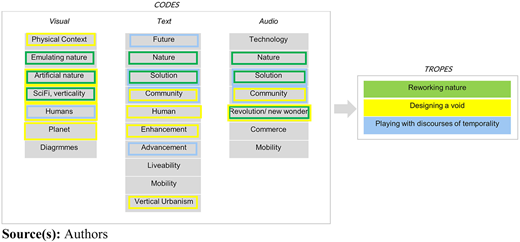
We downloaded the texts, visuals and audiovisual from the website, assembled them and then coded them. The coding was initially undertaken independently for each medium, starting with the text of the press releases, then visuals, then text captions of visuals, and finally, the audiovisual. We broke down the audiovisual into an inventory of components, audio, visual and text; we coded each of these components. We then juxtaposed the codes of the visuals and their associated text captions; often, the combination of these different types of text – the linguistic and the visual – saw complexities emerge, and the overall set of meanings became more internally complex and occasionally contradictory (Markus and Cameron, 2002, p. 149). In a subsequent step, we juxtaposed the codes – of press releases, visuals and associated texts and audiovisuals – through the discussions of our interpretive understandings drawn from across the material, we consolidated our analysis of the data into three tropes. As such, although we isolated the different media of the materials in one step of our analysis, we combined the different media in a subsequent step, as per Figure 3.
This analysis led us to develop three tropes which we describe and operationalize in some detail in the following section. Taken together, these three tropes are indicative of what this assembled collection of materials – considered as a totality rather than as individual components – is capable of conveying. We delved into these materials with a sense that they could – in principle – be ways that social reality is represented and affected.
5. Interpreting The Line: three emerging tropes
From our analysis of the materials, we want to draw attention to three primary ways that The Line was represented: firstly, as a lush and verdant landscape that fundamentally repositions nature vis-a-vis human-designed settlements; secondly, as a space characterized by designed emptiness and a surfeit of air in the form of huge architectural voids; and thirdly, as a space with an uncertain relationship between pasts-presents-futures. In what follows we elaborate on each of these tropes by drawing on exemplary instances from the publicly available materials.
5.1 Reworking nature: “the community will live close to, and in harmony with, nature”
One of the prominent tropes in evidence across the materials we analysed involved a reworking – and a breaching – of a distinction between human-designed architecture and naturally occurring space. More precisely, this binary is represented so it can subsequently be breached. Visualizations of the designed environment inside The Line are almost always accompanied by prominent greenery in the form of trees and hanging plants and other features such as waterfalls. In fact, greenery is in the vast majority of the visuals, some of which depict such features exclusively, emulating natural settings with waterfalls and lagoons but inside the glass walls of The Line. While it is unclear where the water comes from or to where it flows, the key thing to note here is that the materials foreground a reworking of binaries between the urban and nature, disrupting stable distinctions between the “garden and the city” by incorporating living trees and plants and water features as integral features of urban life, situating nature harmoniously within and alongside human-designed buildings and environments.
While the embedding of nature into buildings is far from new in architecture – think for example of Hundertwasser’s social housing in Vienna, which included large trees growing in from the internal centres and through facades of a social housing block, or the more recent example of Bosco Verticale in Milan which features lush vertical forests on two residential towers – it is noteworthy in the case of The Line that such visuals serve to add credence to a set of claims concerning the project’s sustainability. Such claims are highly contestable, of course, but the images superficially provide some degree of momentum to these claims, if only to those who are not paying attention to the aforementioned feasibility of such a merging. Significantly the lush, green spaces inside The Line are at odds with the harsh barren deserts that are suggested in other visuals (e.g. V.13) to be characteristic of the space outside The Line. Inside The Line is the only place for humans to be; it provides the boundary to – and sanctuary from – the harsh, inhospitable desert. The ostensibly inclusionary boundary also serves as a hard exclusionary one; the natural environment outside The Line is unliveable, an austere desert.
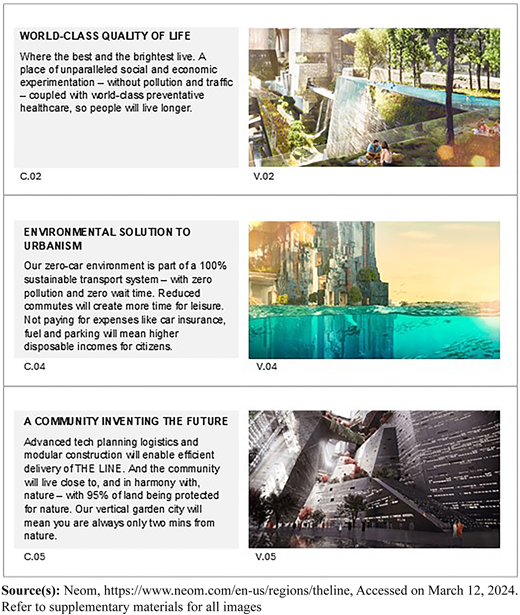
Such claims towards sustainability are not solely visual though. Indeed, in the opening statement in the audiovisual the narrator proclaims that unlike existing cities that “ignore nature” (0:06, audiovisual) The Line is designed “to protect and enhance nature” (0:17 audiovisual), with the whole design intended to “provide a healthier more sustainable quality of Life” (0:28 audiovisual). One of the visuals (V.04) shows divers and fish swimming in clear water surrounded by built artifacts; this is paired with a caption (C.04) declaring The Line as the “environmental solution to urbanism” (see Figure 4). Although there is the temptation to dismiss such assertions as fanciful, considering the role of the materials analytically – so questioning what they are being used to do – we are confronted by headline claims towards ecological sustainability, in contrast to existing settlements’ unsustainability. The visuals and their correlated captions are often complementary rather than matching or reinforcing in this respect. For example, a visual (V.07) illustrates a scene of artificial nature in The Line showing vast voids and enclosed green space, but its caption is about the enhancement of human liveability (C.07).
Crucially, the visuals emphasizing the naturalistic basis of The Line are decoupled from any text that actually explains the architecture or its urban setting; the visuals are mostly atmospheric, they are reminiscent of stylized representations of architectural spaces deployed in video games to enhance the viewer’s experience and develop affective moods. For example, a visualization of the interior showing greyish vertical concrete (V.05) is paired with the caption (C.05) “A community inventing the future”. The extended caption reads, “And the community will live close to, and in harmony with, nature – with 95% of the land being protected for nature. Our vertical garden city will mean you are always only two mins from nature”. Oftentimes, such a reworking of nature involved the creation of merged greenery inside, other times this was the mirrored exterior of The Line amongst a desert. Preservation of nature is a discourse that is predicated on an internal simulacrum – of a version of nature that does not exist here (for instance waterfalls are not naturally occurring in this part of the world). Additionally, visuals that depict the interface with the outside desert focus on the mirror facade, which allows The Line to appear present and absent at the same time, as aesthetically in harmony with the surroundings but distinct from them. Blurring the distinction between the urban and non-urban, between the built and unbuilt, this element of the project suggests a new place for nature in The Line, and a place for The Line in nature.
5.2 Designing a void: “a place of unparalleled social and economic experimentation”
Another prominent motif emerging from our analysis of the materials representing The Line concerns the ways in which designed voids – ostensibly emptiness – are represented in the visuals. Indeed, we want to argue that such expanses of air are crucial to creating the impression of the out-of-the-ordinary scales of designed space that are fundamental to the development [3]. Such “wrapping” or enclosing social activity within large volumes of space – or the visualization of such wrapping – can change the values of the practices and objects therein (Jones, 2024) [4]. Furthermore, these visual representations of emptiness are paired with text that promotes such spaces as enhancing liveability, of reflecting new ways of organizing communities, and of nothing short of a new basis for sustainable and convivial sociality; such claims are added some momentum by the images, which themselves articulate a radically new type of social space for a putative new type of life. For example, a visual (V.07) showing vertical enclosed emptiness is captioned “Enhance human liveability-vertical urbanism” (C.07), the audio-visual shows 3D diagrams of connected functions such as business, residential and health, declaring “The Line’s communities are organized in three dimensions” (0:33, audio-visual); while of course we currently live in three dimensions, the enclosing of volumes of air provides a manifestation and material demarcation of such that is untypical in the majority of contemporary city spaces. As the visuals focus significantly on verticality, fluidity, transparency of structures, then we are presented with a digital spatialisation of the wider discourses at play throughout the development.
Crucially, in spite of the activity being represented, from our reading the materials of the whole project, the space inside The Line is dominated by voided space, which gives the illusion of surplus in a context of massive density (Jones, 2024). The voided space that is prominently represented in the materials associated with The Line is prima facie reflective of a paradox. Despite of the proposed high population density and the emphasis on community in the discourses surrounding the project, and the discourses of sociality notwithstanding, the materials depicting voided spaces do not provide any clues as to how people will socialize in The Line. And we know that human-made territory is characterized by the production of implicit or explicit social boundaries of all kinds, but here there is no sense of exclusion or marginalisation at all, rather everyone is welcome in the spectacle that is being suggested, even if it is imprecisely and generically articulated in the materials. Humans are depicted mostly at a very small scale, dwarfed by the vast volumes of the albeit enclosed built environment. The few visuals that visibly depict details of people interacting in the foreground, show them undertaking leisure activities, for example, a young couple picnicking, the aforementioned diver surrounded by fish, two DJs performing in a public space, or people walking in the distance.
Territory involves bounding space, creating boundaries and here is a particularly evident example. The void emphasizes the space inside The Line, but as per the previous, this is in contradistinction to the outside. The contradictory prominence of inside voids finds parallel in the relationship between The Line and the exterior. The exterior, what is outside of the project’s glass walls, is itself presented as voided, inasmuch as no human life exists there [5]. The suggestion that the project is being constructed upon tabula rasa is not only contestable, it also makes the sustaining of some other discourses more possible. Ostensibly The Line exists within a cultural vacuum; the mission of serving “humanity” allows it nominally to be detached from its immediate social context. This placelessness is reflected in the dress codes of digitally depicted people, that do not reflect Saudi cultural or religious norms and are more akin to global transnational consumption elites. More generally, there is an emphasis on depicting the project as one that contributes to universal needs and aspirations. The Line is positioned as primarily, and perhaps exclusively, focused on benefiting a global community, a place “Where the best and the brightest live” as mentioned in one of the captions (C.02). There is no mention of any specific local context, such as Saudi, Arab, or Muslim culture in any of the material that we analysed. Against this backdrop, it is significant that the project’s shape and name, The Line, lacks any symbolic local cultural references (a line as a reference to a geometric figure lends itself to be understood by any audience; it is worth noting that the English version of the project’s name is used in all other languages, without translating it, even in the Arabic language communication).[6]
5.3 Playing with discourses of temporality: “a community inventing the future”
By discourses of temporality, we are referring to representations of what could be called pasts-presents-futures, reworkings of social time that both seek to forge connections and make breaks across temporal planes. The disseminated materials do not tell a straightforward story of transformation; our analysis suggests that the materials are not solely forward-looking, futurist visions but ways of experimenting with different temporal ideas of KSA territory. Nor are they linear, although projects into the future do something to the present. They are, however, historized, inasmuch as they reflect certain contemporary assumptions about KSA’s current place in time, and its possible trajectories into the future.
Culturally or place-specific notions of past and present, or of that which is being transformed is absent in the materials representing The Line. Rather transformation is presented as an abstract idea or a universal phenomenon, which can happen anywhere. Normative distinctions are drawn between the mistakes of the past in urban planning terms and the more enlightened future. One visual of the interior reminiscent of Sci-Fi movies and video games includes elements with dominant blue colours, dynamic shapes, and seemingly interactive features reminiscent of virtual worlds is captioned as “legacy free urbanism” (V.15). Another visual (V.05) using a greyish colour palette is paired with a caption “A community inventing the future” (C.05) The audio-visual begins and ends in outer space, depicted as black void. The audio-visual commences by putting The Line in the service of humanity, because “for too long humanity has existed within dysfunctional and polluted cities” (0:01, audio-visual), the audio-visual closes by declaring The Line as “A place for commerce and communities to thrive like nothing on earth seen before” (1:45, audio-visual).
This is not to say that representations of the future are absent. The Line is “designed to deliver new wonders” (C.06), it is “A place of unparalleled social and economic experimentation” (C.02), “Next-gen architecture (C.19), and “The future of urban living. The Line [sic] redefines the concept of urban development and what cities of the future will look like (C.01). Visuals depict gravity-defying flyovers and allude to Sci-Fi movies and video games to represent the fantasy-like, glossy futures that are being celebrated. Notably, “MBS is an avowed lover of video games, and the shining, intricate, infinitely receding perspectives of The Line look like works of a gamer’s imagination.” (Moore, 2023). It is worth noting that a number of visuals shown elsewhere (not on the website) have been produced by concept artist and art director Olivier Pron, enabling The Line to make it on top of a list of fantasy film projects that Pron has worked on, such as The Avengers, Guardians of the Galaxy, Harry Potter, and Narnia (Refer to the website of Olivier Pron, https://www.olivierpron.com/projects, accessed May 20, 2024).
Discourses of innovation, scientism and a technocratic utopia are so pervasive as to characterize the materials. This future is now, or at least can be fast-forwarding into the future, cutting-edge technology – including architecture – is the way, and criticism of, questioning or resistance to the project is understood as being anti-KSA (Spocchia, 2024). So impossible is the architecture and concept of The Line that Neom is compelled to release images and drone footage of construction having started. As a way of convincing its audience of the realism of this hyperrealism, The Line is presented as being both impossible and possible at the same time; a failure of political imagination or bravery to realise this Brave New World is all that holds us back.
6. Reworking territory with “architecture”
The three tropes that we found in the materials suggest a radical disruption of existing notions of nature, space and temporality. Such disruptions propagate KSA’s official story of the hoped-for fundamental, rapid and unprecedented social transformation as drafted in its Vision 2030. Using such tropes the state communicates on social media its self-perceived power over its governance of space. The tropes led us to understand the materials analysed and the project that they represent as contributing to the efforts of the state to rework its territory. Reworking territory, as discussed by scholars like Agnew (1994), Brenner and Elden (2009) and Painter (2010), refers to the ways in which states redraw and exercise political control within and through the creation and maintenance – often via violence (or “terror”) – of boundaries.
Although versions of the materials which we analysed above have been exhibited in real estate fairs and exhibitions in KSA and elsewhere in the world, they circulate foremost on social media platforms such as Instagram, X (formerly Twitter) and LinkedIn. As mentioned, social media is an important arena in which the hyper-nationalist narrative in KSA is constructed (Alhussein, 2019). “Just like the traditional bay’a (oath of allegiance) through which citizens affirm their loyalty to the new king, Twitter is now an arena for the encouragement and display of nationalism: “emoji allegiance” has emerged” (Alhussein, 2019, p. 8). The materials we have analysed were most often “digitally generated imagery flashing up at speed” (Smith, 2022, p. 200) on these sites; arguably this context explains the bombastic nature of the materials and the relatively evident and striking character of the tropes we have identified. Designed to capture attention and stir emotions in highly transient and aestheticized spaces, the materials associated with The Line published by Neom are notable for their attention-grabbing, bombastic and sensationalist aesthetics rather than their nuance or technically accurate form. Foregrounding highly visualized consumption over critical engagement, the materials fetishize smart technology and contemporary gamified aesthetics; a subtext is that The Line is a futuristic, technically driven and apolitical project. This could not be further from the case. Rather The Line conforms to what Neil Leach (2000) portrays as “anaesthetic architecture”, an architecture that aestheticizes politics; some elements of made visible while others are opaque or left unsaid.
The materials we analysed led us to explore the practical tactics deployed in attempts to rework the Saudi territory. Always-contestable and often incredible architectural-spatial basis of the social media materials and the claims that they are associated with, we can understand The Line is a radical experiment in this respect. As territory is “a discrete, bounded, and coherent unit in and through which a sustained process of economic [and political] growth is to occur” (Brenner and Elden, 2009, p. 369), then so its productions involve not only material resources such as land and other resources, but also the cultural imagination, sets of culturally meaningful ideas that articulate the social basis of the state and its governance arrangements. In doing so, such materials imagining the future form of elements of Saudi society – in this case a dense, internalized, consumption spectacle – is of analytical interest. However, positioning the social media representations of The Line as statecraft does not automatically make it easier to analyse, but at least draws our attention to the ways in which architectural statecraft moves through representational space, creating bewildering combinations of visibility and invisibilities as it does.
The Line is an illustration of how “[f]ar from refuting or falsifying network theories of spatiality, the current resurgence of territory can be seen as itself a product of relational networks” (Painter, 2010, p. 1090). A prominent element of territory is the articulation and securing boundaries or frontiers, within which control can be exercised. In different ways, the materials we have analysed seek to reimagine such. We are left with a series of audio, visual and textual materials that tell us very little concerning the routine business of everyday life – where are people to work and live, how are food and water going to be produced and distributed, what are the arrangements for burying the dead, etc. – with these banal concerns displaced by spectacular accounts of glamourous leisure settings, of dramatic images of festivalized spaces and of elite consumption in general.
Architecture, as is formally understood as a professional practice and the designed outcomes of that practice (Jones, 2011), has an extremely ambivalent role in this territorial reimagining. While, nominally, the visuals that we analysed are of built settings, they might not be visualizing an architectural design per se, and nor do they conform to the imaginings of spatial organisation that typically emerge from architecture practice (interestingly, hardly any plans or sections are communicated via social media, and we have nothing of the technical or operational basis that such a construction would demand). In other words, despite being adjacent to “architecture” – for instance focusing on the built environment as a topic – many of the materials of the project do not conform to architectural outputs in terms of their form.
As such The Line becomes an impossible project. Its prominent, virtual existence on social media sees the project becoming hostage to the digital medium for which it has been constructed to perform. Whether or not the materials we have assessed have served the function they were designed to is moot; this notwithstanding – and as the three tropes illustrate – The Line is an experiment in the control of space, time and mastery over nature. Key elements of Saudi territory are being reimagined in the virtual space of social media “as the outcome of networked socio-technical practices” (Painter, 2010, p. 1,090). By definition, territories are not universal or homogenous, but rather reflective of particular political imperatives at particular times in particular places (Agnew, 1994). Importantly, this emphasis on the reworking of Saudi territory in social media space is not to negate or minimize the fatal real-world effects, the human rights abuses condemned by the United Nations, the labour law breaches and land dispossessions (Roche, 2024; Spocchia, 2024). This experiment is radical, not just because it stretched 170 km, but rather because it proposes the spatially and socially unrealisable borders and boundaries. The brutal, material reality of the project is that even as it is not constructed “in real life”, virtual ideations are having an effect on life and death in and around The Line.
The need for speed and the urgency to achieve a future-oriented modernity (Fabbri and Jackson, 2021) renders post oil urban transformations in the Gulf region “a testing ground for experimental, risk-imbued architecture and real estate … [with an] ever-present sense of the ‘tabula-rasa approach’ … of being able to ‘start again’, a sense of being in an ever-present ‘now’ [and] an inclination towards audacity, dynamism and thirst for emerging” (Fabbri and Jackson, 2021, p. 5). The political urgency in KSA to convince domestic and international audiences of a “story of transformation” in the context of post-oil economic arrangements; the coincidence of this moment of urgency with the affordances of the current era of digital communication and its receptiveness to the local context of KSA explains both how The Line is being mobilized via social media and its post-material form. Therefore, although The Line seems radical and disjunctive, perhaps even unrealistic in the literal sense of the term, as KSA seeks to naturalize its recent “story of transformation”, it needs to make desirable a set of proposals that could – by definition – be other, and to add momentum to a plan that is not universally supported.
7. Conclusion
The Line as represented in digital visual, textual and audiovisual materials that circulate on social media pushes at the limits of reality and reflects a politicized intent on behalf of KSA to redefine territory. In this paper, we have set out to describe some of the contours of what is in many respects a bewildering set of strategies that underpin and articulate The Line. In spite of – perhaps because of–their oftentimes fantastical character, which disrupts stable assumptions of nature, space and temporality, the materials of The Line can be understood as constitutive interventions in reality, and ones that can have significant and material social implications in the present. The wider project and its constitutive materials are an attempt to transform the future and the present and what is/what we think of as KSA territory. The set of architecturally adjacent materials we reviewed are part of territorial exercises to re-represent temporal and spatial dimensions of KSA territory. Our analysis leads us to conclude that the possibilities afforded by social media allowing communication and engagement at accelerated scopes, speeds and intensities can on occasion shift this practice towards projects whose existence is primarily digital.
We are left to make sense of a project that does not neatly conform to architecture per se. As social media allows for instantaneous sharing of increasingly “realistic” images, it serves to compound this uncertainty. In addition, social media compounds a fast-moving cycling of spatial imaginaries. In providing such a dizzying volume of visuals, each more spectacular and outrageous than the next, the proponents of The Line create a field of materials that is very difficult to capture or fully comprehend. It is hardly possible to catch up with new material or to grasp the full extent of what’s going on (in political rhetoric this strategy is referred to as a “gish-gallop”, namely proposing more claims or arguments than it is feasible to respond to (Satta, 2024)). In sum, we have concluded that this project can only be made sense of as a political intervention as much as it is an architectural one.
We are left with the beguiling possibility that The Line tells us something very significant about the malleability of what would even be considered architecture; part of the reality that is being challenged, reworked and mobilized is architecture itself. The Line emerges from a black box. In the black box visualizers, musicians, screen players, copywriters, politicians, visual artists, PR managers, social media strategists, consultants and perhaps architects operate. Although Neom mentions the involvement of several famous architects in the project, it does not clarify their specific professional contributions. Architects’ very practice is rendered uncertain in this black box. As researchers of highly politicized and often highly shrouded in secrecy projects such as The Line we are unable to access this black box. Perhaps the circulation of visuals, texts, audiovisuals materials of state-commissioned projects of spatial futures lead us to fundamentally question foundational assumptions regarding the nature of architecture (and, for its part, political action drawing upon such). What is most often called architecture – such as the representations of The Line – might more profitably be framed as political marketing, branding or propaganda. Architects’ mediated capital – their words, disposition and professional field status as well as their design skills – can be borrowed and extracted, without any recourse to the core elements or expertise of their practice. An interdisciplinary perspective is needed to tease out how architecture is used and politicized to serve power interests in the age of social media. Analysing the mediatization of such projects and so revealing something concerning the deployments of which they are part and parcel is one way to understand their political dimension.
This research has been supported by the GATES project (Grenoble ATtractiveness and ExcellenceS) which is funded by the French government’s Programme d'Investissement Avenir and implemented by ANR France 2030 (Project ANR-22-EXES-0001). We are also particularly grateful to Joe Greener, Gillian Rose, Ross McGarry, Georgia Lindsay and Mark Sawyer for sharp and constructive inputs into this paper. We would like to thank Paula Löffler, student assistant at TUM, for her support in producing the figures.
Notes
Global consultancy companies such as McKinsey and Company have been instrumental in shaping this vision. See Bogdanich and Forsythe (2022). When McKinsey comes to town: the hidden influence of the world’s most powerful consulting firm. Doubleday: New York.
It is important to take into account that restrictions exist in KSA regarding how freely Saudi users can engage with social media content in KSA. In his book Social Theory after the Internet Ralph Schroeder cautions against considering the affordances of digital media as monolithic by drawing attention to the fact that nation-states place strong boundaries around how media operate, as well as the bounds within which popular political inputs – public opinion and civil society organizations– shape the political agenda via media (Schroeder, 2018, p. 2). As such national differences matter for the implications of digital media and social media. The restricted nature of freedom of speech in KSA means that social media content in KSA can be either censored by authorities or that users engage in self-censoring.
This is a design “trick” used in much religious architecture. Lots of space means bodies feeling small. Ironically in the case of The Line it is precisely the enclosing of these voids that gives a feeling of space, independent of the huge population densities that are planned for there.
The tantalizing possibility here, discussed elsewhere in more detail (Jones, 2024) is that such voids, ostensible emptiness, can actually be mobilized in the context of political and economic projects, creating surplus value from nothing.
This discourse of naturally unpopulated exterior is belied by forced evictions and violence that have reportedly taken place against protestors and those living on the proposed site of The Line (Source: https://www.bbc.com/news/world-middle-east-68945445 accessed May 31, 2024).
In this sense, The Line is reminiscent other projects in the Gulf region, such as The Pearl Island in Doha or The World and The Palm Jumeirah in Dubai, whose formal shapes and names resemble objects, with the latter two projects being advertised as objects that are recognizable from outer space.
References
Supplementary material
The supplementary material for this article can be found online.