This study investigates the commercial resurgence of public spaces in Kuwait through the growing presence of food trucks and their influence on urban life, with a focus on their role in temporary place-making (TPM). Frequently operating in a drive-through capacity, these mobile vendors have introduced new challenges related to spatial organization, urban regulation and public infrastructure.
Employing a mixed-methods approach, the study centers on a detailed case study of food trucks in Qortuba – a residential area hosting 22 trucks – complemented by interviews with food truck owners and a nationwide survey of public perceptions.
The findings reveal several pressing issues, including unauthorized parking, inadequate shading, limited pedestrian accessibility and a lack of essential infrastructure. These challenges point to a critical need for urban design strategies that balance vehicular convenience with pedestrian movement and neighborhood livability. The study highlights the popularity of food trucks, particularly among youth, who are drawn by convenience and food quality, often staying in idling cars during visits, raising questions about sustainability and inclusivity. While food trucks thrive in residential areas, parks, coastal zones, and parking lots – especially in pleasant weather – concerns persist about noise, air pollution and visual disorder.
The paper concludes by proposing policy and design measures that integrate food trucks more thoughtfully into the cityscape, through six TPM principles.
The paper frames food trucks as catalysts of TPM, capable of animating underutilized urban spaces. By examining these mobile units as dynamic, short-term urban interventions, the study contributes a novel perspective to urban discourse.
1. Introduction
Developing livable cities necessitates a dual approach of macro-scale planning and micro-scale place-making. This is a synthesis of temporary actions and processes that are inadequately considered in official urban planning frameworks (Andres et al., 2021). Food is increasingly transforming into a performative experience, increasingly becoming social events that migrate from the dinner table to the urban landscape (Fisker and Olsen, 2008). The food truck concept has garnered widespread acclaim in Kuwait, particularly in a drive-through format due to its expediency and accessibility. Drive-through food trucks exemplify a capitalist, vehicle-oriented urban structure. This convenience incurs a significant environmental cost: prolonged lines of idling vehicles consume gasoline and produce emissions associated with global warming and health issues (Bruwer and Neethling, 2022). This study examines this temporary form of place-making within Kuwait, where vehicle-centric urban design and rapid urbanization are exacerbating the preference for private transportation. The study is accomplished via a mixed-methods approach: the first component employs field observation and semi-structured interviews with food truck proprietors at the case study location, while the second utilizes a nationwide survey to assess public perceptions of drive-through food trucks. This research aims to examine the interrelations between top-down urban planning regulations and temporary place-making (TPM) strategies. Ending in recommendations that emphasize alternate methodologies of place-making and urban interpretation.
2. Literature review
2.1 Temporary urbanism
Cities are intricate systems demonstrating differing levels and forms of connectedness. At the micro level, such as at a food vendor stall, individuals interact with the city according to their own spatial and temporal rhythms. These rhythms illustrate the complexity of urban existence and expose the dynamics that formal design frequently neglects.
Spatial planning, the primary tool employed by local and national governments to influence urban settings, typically emphasizes long-term, organized goals for the future of cities. It fundamentally concerns foresight and predetermined results, allowing less scope for short-term or routine flexibility. Consequently, a significant deficiency exists in spatial planning’s capacity to interact with the transient, variable rhythms of daily life and their related place-making activities. Temporary urbanism addresses this deficiency by facilitating spatial and social adaptation, permitting areas to be utilised in accordance with particular social and economic demands. Madanipour (2017) observes that temporary urbanism is rooted in informal behaviors rather than being associated with formal urban plans. Examining these temporalities within the constructed environment highlights the importance of interventions like food trucks, which operate in a condition of permanent impermanence.
Underscoring the essential role of citizens and communities in influencing urban landscapes, Wolch (2014) also cited the emergence of the concept of the “shadow state” – voluntary organizations that exist outside conventional democratic frameworks while executing numerous roles previously managed by the public sector. These manifestations of people-centered place-making frequently arise in environments where formal institutions are either nonexistent or lack accountability. In these instances, temporary urbanism provides localized, context-specific solutions adapted to the capacities and capabilities of communities. Nevertheless, these initiatives seldom yield a unified, citywide strategy for place-making. TPM constitutes a shadow state process wherein citizen behaviors serve as a type of informal planning. These initiatives entail transient interventions designed to enhance the quality of public space. While individually modest, the cumulative effect of these projects can significantly affect urban living and shape more formal planning methodologies. They function as both replacements for unmet state provisions and as inventive alternatives to hierarchical urban development schemes. This dual dynamic – between regulatory forethought and quotidian informality – underlies the revolutionary potential of temporary urbanization.
Place-making, as articulated by Tuan (1975), denotes the conversion of undefined space into a significant place via human experience and interpretation. In urban architecture and public spaces, this process is not exclusively dictated by physical form but is constantly influenced throughout time by social interactions, cultural practices and everyday usage. Warnaby (2024) contends that a thorough comprehension of place-making must consider its time aspect. Consequently, place-making is intrinsically dynamic and dependent, contesting fixed design frameworks. Public spaces are arenas of intersecting and disputed significances, influenced by various stakeholders and evolving socio-political circumstances. Effective urban design must accept this diversity, facilitating inclusivity and adaptation. Recent research in consumer culture emphasizes the immersive, co-creative, and performative aspects of place-making (Malone et al., 2024). From this perspective, public space is both relationally and experientially received, as well as produced through collective interpretation and communal actions. TPM, therefore, manifests as a continuous negotiation between physical design and socio-cultural significance. In urban planning, this signifies a transition from creating spaces to fostering TPM—cultivating surroundings that promote interaction, diversity and the evolving significance of experiences rather than hierarchical, formal planning processes. It perceives the city as a dynamic entity, continuously transformed by its inhabitants – their habits, interactions and adaptations.
2.2 Drive-through phenomena
Traditionally, drive-throughs are perceived as the opposite of place-making; they prioritize convenience and transit over prolonged engagement or contact. They provide a non-relational, ephemeral experience that diminishes the necessity to interact with the constructed world or other individuals. The drive-through exemplifies an urban structure that reinforces the societal paradigm of the automobile as the sole facilitator of sufficient mobility. Food establishments and their drive-through services are increasingly common in developing countries (Prasetyo et al., 2021), driven by the appeal of food and the contemporary demand for convenience and rapid service. Drive-through establishments allow customers to place take-away food orders from their automobiles, eliminating the need for parking and in-person queuing (Baxter and Stafford, 1985). Individuals with physical disabilities and parents with young children can remain in their vehicles, which is an advantage of drive-through services (Dougherty, 1997). Food drive-through establishments are proliferating in the developing world amid escalating traffic congestion, fueled by an increased preference for private transportation (Krishnan et al., 2023). Drive-throughs often include a unidirectional traffic pattern along the perimeter, incorporating service windows for ordering, payment and food collection, in that sequence. The drive-in is a variation of the driver-through. In drive-throughs, customers typically leave once they receive their orders, but in drive-ins, they typically consume their orders in their vehicles at the dining location. Most food trucks in Kuwait function as roadside drive-through establishments. The parking and access roads adjacent to these trucks frequently restrict walk-in access, hence promoting the usage of private vehicles. A 2006 study in the USA revealed that 57% of individuals prefer utilizing a drive-through facility instead of parking and entering a restaurant (Christina A Roberto et al., 2010). Approximately 60% of restaurant revenues in Houston, TX, are derived from the drive-through (Hill et al., 2016), and the coronavirus disease 2019 (COVID-19) pandemic has significantly impacted this phenomenon. As brick-and-mortar eateries suffered due to lockdowns, food trucks capitalized on the opportunity to expand their operations, resulting in a proliferation of trucks across urban areas (El Ghonaimy and Eldardiry, 2021). These drive-through food trucks offer a diverse array of cuisine and are particularly favored in the extreme heat. Also, social media has greatly enhanced the marketing and awareness of these truck operations, menus and locations (Warakanyaka, 2024).
2.3 Motorized city
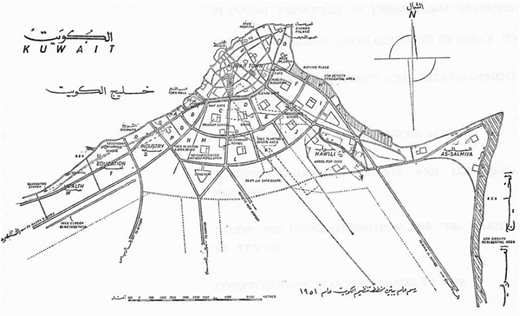
In 1954, two years after the Kuwait master plan initiation, the Gulf town went through an urban transformation centered on the establishment of a motorized city, where the architectural landscapes would be experienced as vistas in a drive-by manner, reflecting the principles of petro-modernity (Sedighi and AlBader, 2019; Hindelang, 2021). The master plan (Figure 1) illustrates that highways served as a significant planning instrument, encircling old Kuwait City concentrically with radially intersecting roadways that defined independent neighborhood units. The late twentieth century saw a swift and deliberate escalation in the speed we see and experience space (Bell and Lyall, 1998), as the automobiles established a socioeconomic urban sphere (Crary, 1984, p. 290). Peca Amaral Gomes et al., 2021 explain that “For the Kuwaiti population, the concept of public space use is also unique in that it is inextricably tied to transportation from one destination to another, often by private cars. The middle process that includes walking through the built environment through streets and parks is almost erased … thus eliminating a stronger sense of engagement or socialization that could take place.” Like other Gulf cities exhibiting comparable urban development patterns, Kuwait City was designed to facilitate automotive traffic.
Regrettably, in Kuwait, roadway networks and urban planning regulations are oriented toward automobile-centric neighborhoods. Expansive vehicle lanes, unapproachable pavements and unwelcoming public areas prevail, rendering walking and cycling challenging and occasionally perilous. These urban planning principles influence social conduct, resulting in individuals who prefer to drive and opt not to walk. Monofunctional zoning and an uncoordinated transport infrastructure are further impediments to realizing a dynamic public space. The examination of the relationship between public space and user behavior indicates that the use of public space is inversely correlated with the use of private motorized vehicles (Peca Amaral Gomes et al., 2021). Kuwaitis rely on private motorized cars to get between destinations, regardless of the distance involved. Non-Kuwaitis, primarily from the lower socio-economic strata, rely on public transportation methods. Car owners in Kuwait regard their vehicles as vital for daily activities, a matter of practicality and sometimes prestige. The view of the automobile as a vital instrument is bolstered by two factors specific to developing nations: first, the absence of alternative public transportation that is both efficient and convenient for the extensive distances commonly traversed in urban areas; and second, urban and transportation policies influenced by capitalist modernization that have fostered an environment favoring private vehicle usage over public transit (Mittal and Biswas, 2019).
In Kuwait, drive-through behavior demonstrates unique socio-cultural adaptations influenced by the nation’s harsh environment and ingrained car-centric urban infrastructure. In contrast to Western contexts, where drive-throughs are primarily linked to fast food convenience, in Kuwait, they fulfil a wider array of purposes – from coffee kiosks to global cuisines – integrating into daily spatial practices that emphasize comfort, efficiency and thermal protection. The widespread use of air-conditioned automobiles reduces physical exposure to outdoor heat, encouraging mobility and consumption behaviors specifically tailored to the Gulf environment. The normalization of remaining in one’s vehicle reconfigures the utilization of public space and contrasts with Western urban trends that prioritize walkability and pedestrian-focused architecture. In Kuwait, drive-throughs function not just as service locations but as socially ingrained reactions to climatic and infrastructural circumstances, rendering them essential for comprehending urban existence in a motorized metropolis.
2.4 Food trucks in Kuwait
Food in all its forms, including restaurants, cafes and home-based enterprises, has become a highly sought-after business endeavor among young Kuwaitis due to significant public demand. The gastronomic culture of Kuwait has experienced remarkable growth in recent years (Al-Haroun, 2019), and food trucks have become integral to Kuwaiti culture, providing numerous small businesses with a cost-effective and flexible option to launch. Food truck licenses were granted post-liberation to a specific demographic: pensioners with moderate income and individuals with disabilities. Later, it was expanded to include retirees, Chapter V (holders of company licenses), Chapter III (workers in the private sector) and the unemployed (not enrolled in social insurance). The phenomenon of food trucks in Kuwait commenced its proliferation in 2013. AJ’s Kitchen was the inaugural food truck, and it functioned without a license, as the regulatory framework for food trucks had yet to be established (Mathew, 2019). In 2017, the Kuwaiti government formally sanctioned food trucks with an initial issuance of 3,000 permits, establishing a formal procedure for acquiring licenses and operating lawfully. This initiative sought to govern the food truck sector, guaranteeing safety, hygiene and systematic operation. Following the attainment of this threshold, no additional permits were sanctioned until 2019. The authorization was suspended again during COVID-19 due to health and safety concerns. Resuming in 2021, 1,021 locations were distributed, 716 of them were in residential zones in development till the establishment and functioning of cooperative organizations, 151 in diverse sorts of parking lots in public parks, along the coastline, parking facilities of sporting clubs, and 154 in remote locations including farms, chalets and desert campgrounds (Mohammad, 2022).
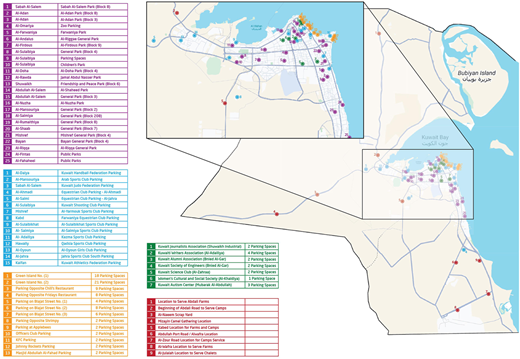
The authorization process for a food truck differs based on its intended use. The functions of the truck encompass restaurants, cafes and markets. Each function is associated with a distinct set of regulatory bodies that owners must engage with to obtain their approval. Proprietors must obtain approval from eleven entities: Social Insurance, the Ministry of Commerce, Kuwait Municipality, the Ministry of Internal Affairs, the Environment, the Fire Department, the Ministry of Justice, the Labor Force, the Ministry of Health, the Chamber of Commerce and an insurance company. The final phase entails securing a spot for operation. Applicants are required to visit the Kuwait Municipality to secure a place for their food truck on the municipal map (Figure 2). All coastline sites are off limits to maintain the city’s aesthetic integrity. The “Place Permit” is priced at 40KD a month (approximately 130$) and is valid for precisely one month, after which it expires, and the space becomes available once more. This compels food truck owners to vacate their spots in pursuit of more favorable options, which presents a significant challenge. In 2023, there were roughly 3,157 licensed food truck proprietors in Kuwait (Mohammad, 2023). These operators are permitted to operate in 400 licensed establishments (Mohammad, 2023). The “Vehicle Regulation Decision,” issued by the Ministry of Commerce and Industry in 2019, Article 10, mandates that the licensee must install a GPS tracking device in the food truck to ascertain its location as designated by regulatory authorities, and to conduct commercial activities in accordance with the licensed location.
3. The case study
Numerous places in Kuwait are currently flourishing with the food truck industry, spanning diverse residential areas. The third Kuwaiti master plan included privately owned lands, and Qortuba was acquired by Sheikh Salim al Ali. Qortuba is one of the most densely populated single-family-zoned neighborhoods in Kuwait, with a population of 34,610. It is characterized by its narrow streets and densely packed houses, which complicate and often jeopardize pedestrian mobility. The area is delineated by the Fourth Ring Road, Damascus Street and Sheikh Zayed Street, facilitating automotive ingress from all directions. Qortuba mostly accommodates Kuwaiti households and their resident expatriate domestic servants in villa-style residences. Characterized by its suburban nature, supported by cooperatives, Qortuba, like Al-Adailiya (Alajmi and Hu, 2021), is predominantly residential, featuring clusters of amenities that cater to the local populace, with more than 10 educational institutions, 5 mosques and 5 commercial centers. These amenities cater to the local community but are segregated from the residential units in designated areas of the district. Qortuba has no bus stops, which explains why over 90% of survey respondents utilized vehicles or taxis to reach the area (Peca Amaral Gomes et al., 2021).
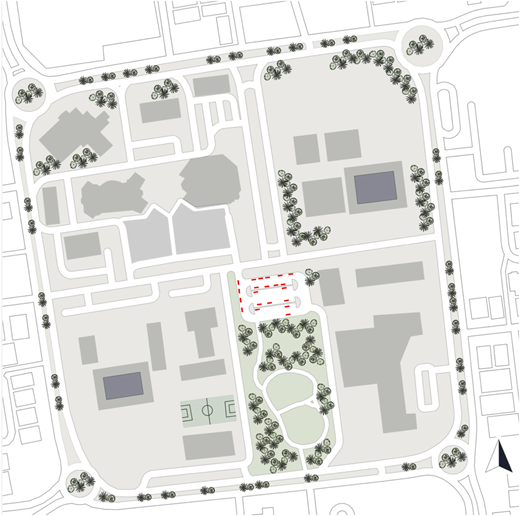
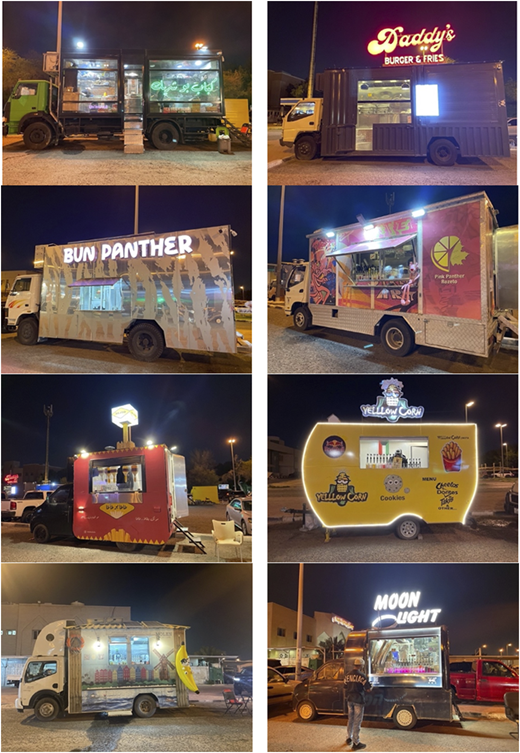
Qortuba is a modestly sized area partitioned into five parcels, and block 5 is regarded as a significant commercial district (Figure 3). Situated in the parking area of Qortuba Public Park are 22 food trucks that operate from 5 p.m. to 1 a.m. on weekdays, and 7 p.m. to 3 a.m. on weekends (Figure 4). Predominantly, consumers arrive in couples or trios, and the age demographic spans from early adolescence to mid-thirties. The site faces significant challenges related to accessibility, visibility, security, inclusion and architectural identity. It is poorly connected to transportation, with inefficient parking and only a single driveway entrance. Visibility is limited by inadequate street lighting, and the surrounding buildings obstruct sightlines. The site lacks proper pavement, seating and shading, contributing to a weak architectural character. While it offers diverse food options, it suffers from poor organization and a decline in business during the summer months. There is a potential for event hosting, themed gatherings, partnerships, and greater environmental and social engagement. From a security standpoint, while the area is safe for vehicles, it poses risks to pedestrians and cyclists due to the lack of defined walkways and bike lanes. Additionally, the site does not meet the needs of people with disabilities, lacking accessible parking and crossing points. There are no regulations specifying the truck’s dimensions or the external appearance; the process is arbitrary, executed by those responsible. This randomness is regarded as one of the most substantial challenges encountered by project owners, as it can lead to public criticism for the presence of these trucks in residential areas. Furniture may not be placed outside the truck, save for personal usage by workers, such as sitting on chairs.
4. Methods and findings
A mixed methods approach was employed, integrating both qualitative and quantitative data collection techniques to provide a comprehensive understanding of the study’s objectives. The qualitative phase involved field observations aimed at probing spatial and environmental issues associated with food truck operations. In addition, twelve semi-structured interviews were conducted with the owners of food trucks located in the Qurtoba area. These interviews provided in-depth insights into the challenges and opportunities faced by food truck owners, including operational constraints, customer interactions and spatial utilization patterns within the urban context.
The findings from the qualitative phase were instrumental in informing the development of the quantitative method. Specifically, they guided the design of a nationwide online survey aimed at collecting data on food truck visitors’ behaviors and perceptions. The survey targeted a broad audience to ensure diverse perspectives, allowing for a more nuanced understanding of consumer preferences, visit frequency, and urban experiences. By triangulating the qualitative insights with quantitative data, this mixed-methods approach enabled a holistic analysis of the urban dynamics surrounding food truck culture. This approach facilitated a deeper exploration of how food trucks contribute to urban vibrancy, spatial interactions, and environmental considerations within the urban fabric.
4.1 Semi-structured interviews
In Qurtoba, 12 semi-structured interviews were conducted with food truck owners, covering topics like business history, challenges, site selection and location decisions. The interviews also aimed to understand seasonal changes, sustainability and eco-friendliness. Owners were asked about their adaptation to customer traffic fluctuations and the need for built amenities. The long-term vision for the business was also explored, including plans for expansion or transitioning to a physical restaurant. The study conducted interviews with 12 of the 22 food truck proprietors at the designated location. This purposeful sample, although not indicative of Kuwait’s total population demographics, encompasses more than half of the vendors on-site, facilitating a concentrated comprehension of location-specific behaviors and viewpoints. The interviews directly informed the development of the second part of the research, which involves a nationwide online survey to understand the urban food truck scene in Kuwait. The insights gained from the interviews helped to identify key themes and concepts, which guided the formulation of the survey items.
4.1.1 Interview findings
Many of the owners we interviewed were inspired to start a food truck business to provide a new type of cuisine to the Kuwaiti food scene. For some, it is a transition period to test their idea before opening a more costly permanent restaurant. Food trucks allow quick mobility and flexibility; however, the discussions with owners highlighted many challenges, which include governmental obstacles and location-specific urban design issues. One specific issue regarding governmental frameworks for the food truck industry is a lack of proper space. One food truck owner describes that, “food trucks as I know are at least 3,000 with only 400 legal spots to use. It is literally impossible for this amount of food trucks to use only 400 locations.” This situation has created a scenario where many food trucks are densely parked in a small area. The food truck owner continues by saying it’s “more than crowded it’s impossible.” Furthermore, it seems that the government is using an unfair lottery system to designate locations, which restricts food truck freedom of selecting their space and, as a result, may affect revenue. This has been highlighted by one food truck owner who argues, “it seems almost as if it’s an arbitrary process, every year there’s a lottery system to see who gets placed where.” They continue by explaining that there are some food truck owners who may have connections or “wasta” in the ministry, which gets them placed in a better location.
Another common thread among interviewed food truck owners were the various urban design constraints. One interviewee argues that the government needs to provide “more facilities and a larger area for food trucks” and “organize the entry and exit to the trucks, and parking for customers’ cars.” One particular food truck owner proposes, “the site should move to a completely new and empty one, and to redesign it just like the food truck parks in Riyadh and the UAE.” The same participant insists if no one creates a project like “the Riyadh Food Truck Park within the next five years, I don’t think I would be operating a food truck anymore. Because food trucks in parking lots aren’t serious, and I don’t think that they’re a permanent phenomenon. I already have a permanent store so I would probably just stick to that.”
Another issue is the lack of amenities on the site such as trash bins, seating, bathrooms and shading devices. Some owners believe “food truck culture is grab and go, no one is going to stay long enough to need these things.” Another reaffirmed this notion due to Kuwait’s harsh summer climate “summers are particularly tough for maintaining the food quality, the truck’s operational efficiency, and the comfort of our staff and customers.” Another also stressed that street furniture may bring with it more customers, but that is not necessarily positive in the long term. Due to the larger youth influx, “young men interacting with girls may annoy them, and some respectable families resent the presence of these types of customers. The greater the number, the greater the problems.”
Finally, another theme that emerged from the interviews was the lack of sustainable approaches from both the government and food truck owners. In reaction to this, no clear strategies have been discussed; instead, ideas of cleanliness and recycling were more prevalent. One participant when asked how they apply sustainable initiatives replied, “through workers and their keenness to protect the environment, and by reminding them of cleanliness and placing garbage in the appropriate place, avoiding the use of plastics as much as possible and replacing them with paper.” Another stressed the importance of recycling, “as there is a place for excess food, a place for plastic, a place for glass, paper, etc. We use paper for bags and try as much as possible to collect the garbage from those who throw it around us without deterrence, which affects us if our name is on it, so we try to clean up around us.” A proposal to have the government to, “at least place recycling bins in the site” would provide minimum passive environmental solutions.
4.2 Nationwide survey
Drawing from the field observations and semi-structured interviews, the survey was designed to investigate a comprehensive range of factors, including demographics, consumer behavior, urban influences, perceptions, ordering methods and vehicle-related behaviors. Specifically, it examines the motivations for visiting food trucks, preferred times of day, ordering methods and the duration of visitors’ stay near food trucks. The survey also explores the urban factors influencing the food truck experience in Kuwait, such as attractive locations, safety, weather conditions, seating options, cleanliness and available amenities. It evaluates the significance of designated pedestrian and cyclist areas and gathers suggestions for improvements, including increasing the number of food trucks, optimizing location distribution and implementing sustainable policies. Additionally, the survey addresses regulatory and environmental concerns, such as pollution, noise and waste management, along with the potential negative impacts of food trucks on urban development. By examining these multifaceted dimensions, the survey provides a nuanced understanding of the urban dynamics surrounding food trucks and their influence on the urban fabric in Kuwait.
Determining the appropriate sample size is a critical question in survey design (Rahman, 2023). Kuwait’s population is 4,913,272 (Central statistical Bureau, 2025), with around 3,100 food trucks serving this population (Mohammad, 2023). For a national survey of this scale, a sufficiently large sample size is essential. We opted for a combination of Simple Random Sampling (SRS) and Convenience Sampling due to their simplicity and effectiveness for large populations. Given the digital distribution method we used (SurveyMonkey), which facilitated a broad reach, we decided to increase the sample size to enhance reliability. Bryman (2016) observed that with a sample size approaching 1,000, the gains in precision are evident. To achieve a 99% confidence level with a 3% margin of error, a sample size of 1,111 was deemed sufficient (Australian Bureau of Statistics, 2024). Accounting for potential non-response or completed surveys, sought at least 1,700 responses. We ultimately received 1878 responses.
The survey examined the preferences, behaviors, and perceptions of Kuwait’s population, highlighting several key trends and areas for potential improvement. It explored the habits of Kuwaitis as a foundation for understanding their engagement with food trucks. To set the stage, it began with three clear and targeted questions: Q6 (How often do you have food and/or drinks delivered to your home?), Q7 (How often do you dine in restaurants and/or cafes?), and Q9 (How often do you visit food trucks in Kuwait?). Question 6 specifically focused on the prevalence of home-delivered food and drinks, capturing the convenience-driven aspect of dining habits. In contrast, question 7 examined the frequency of dining out in more traditional settings such as restaurants and cafes, reflecting Kuwaitis’ social and culinary engagement outside their homes. These initial questions provide essential context for Q9, the focal point of the survey, which delves into the frequency and motivations behind visiting food trucks. By structuring the survey in this manner, we sought to establish a clear connection between three key dimensions of Kuwaiti dining behavior: eating at home, dining out and visiting food trucks. This progression allows for a nuanced understanding of how food trucks fit into Kuwaitis' broader lifestyle, bridging the gap between home-based convenience and the social, cultural and experiential aspects of dining out.
4.2.1 Survey results
Demographically, the survey results primarily reflect the views of the national population, with 92.6% of respondents identifying as Kuwaiti. Most participants (32%) fall within the 19–25 age group, and 70% hold at least a college degree. Females represent 62% of the respondents, indicating a gender skew, while most are spread across Kuwait’s governorates, with Al-Asimah and Al-Ahmadi being the most highly represented. 18% of the respondents own a food truck or know a family or friend who runs one.
4.2.1.1 User behavior
Regarding food consumption habits, a large portion of respondents frequently order food or dine out. Nearly half (47%) order food several times a week, and 36% visit restaurants or cafes several times a week. However, despite these high frequencies of food delivery and dining out, 44% visit food trucks rarely. This suggests that while food trucks are a part of the urban food scene, they are not yet central to most people’s dining habits. Those who do visit food trucks cite taste (50%) and convenience (26%) as the main reasons, with most visits occurring in the evening (5–11 p.m.). The crosstab analysis of Q7 (How often do you dine in restaurants and/or cafes?) and Q9 (How often do you visit food trucks in Kuwait?) reveals a strong correlation between how often respondents dine in restaurants or cafes and their engagement with food trucks in Kuwait. Those who dine out frequently, such as daily or several times a week, are the most likely to visit food trucks with similar frequency. Among daily restaurant diners, 36% also visit food trucks daily, while 61% of those dining several times a week also visit food trucks at the same rate, showcasing a behavioral overlap between traditional dining and food truck patronage. This indicates opportunities for targeted strategies to attract rare and non-diners, such as emphasizing the convenience, affordability and unique offerings of food trucks, bridging the gap between home-based eating habits and dining out. Overall, food trucks appeal most strongly to habitual diners while representing a potential growth area among less engaged audiences.
The analysis highlights significant patterns in dining and food truck visit habits in Kuwait, emphasizing the role of age and gender in shaping urban behaviors. Young adults aged 19–25 consistently emerge as the most engaged demographic, dominating daily and weekly visits to both restaurants and food trucks, with 58% (n = 58 out of 100 respondents who said they do daily visits to food trucks) of daily food truck visitors and 53% of daily diners belonging to this group. This reflects their active role in adopting informal, social dining experiences that are central to urban life. Engagement decreases with age, with older adults (46+) showing limited interaction, contributing the most to “rarely” and “never” categories, particularly with 41% of this group never visiting food trucks. Gender dynamics further reveal that women are more frequent participants across all categories, particularly in weekly and semi-regular visits, where they significantly outpace men, accounting for 61% of food truck visitors several times a week and 66.33% of rare diners. Men, on the other hand, have a stronger presence in less frequent or non-participation categories. These patterns suggest that younger and female demographics are the primary drivers of food truck culture and informal dining trends, while older groups and men represent untapped potential. This behavior underscores food trucks as catalysts for social interaction and urban vibrancy, offering opportunities to promote localized food culture.
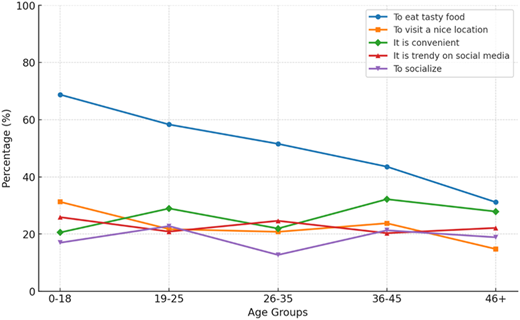
Question 10 (Figure 5) explores respondents’ motivations for visiting food trucks, allowing them to select multiple reasons. The primary motivation across all age groups is to eat tasty food, with the 0–18 age group showing the highest percentage (68.75%). However, this motivation declines consistently with age, dropping to 31.15% in the 46+ group, suggesting that the appeal of food truck offerings diminishes as consumers grow older. In contrast, convenience becomes more important with age, peaking at 32.18% in the 36–45 group, reflecting a growing preference for practicality among older respondents. This indicates that older consumers visit food trucks more for convenience than for novelty or experience.
Social media influence is most significant in the 0–18 group (25.89%) but steadily declines to 22.13% in the 46+ group, highlighting generational differences in digital engagement. Younger consumers are more influenced by social trends, while older groups are less swayed by social media. The motivation to visit a nice location remains relatively consistent but moderate across all age groups, ranging from 31.25% in the 0–18 group to 14.75% in the 46+ group. Additionally, the aesthetics of food trucks significantly influence customer choice, with 45% of respondents deeming it “extremely important.” Meanwhile, socializing is most prominent in the 19–25 group (22.77%) but declines slightly with age, indicating a shift toward more practical motivations among older consumers.
The food truck experience itself reveals preferences for convenience, as 71% prefer ordering from their cars, with 61% of respondents intentionally driving to a specific food truck. Once food is received, the majority (44%) eat in their cars near the food truck, staying for around 0–15 min. This underscores the impact of local mobility norms, climate, and privacy on the utilization of temporary spaces. This engagement mode exemplifies a unique interpretation of TPM, wherein the “publicness” of the location is influenced by the private confinement of the automobile. Instead of congregating on foot or interacting within a communal public space, many Kuwaitis engage in TPM via vehicular interactions, seamlessly integrating mobility with spatial appropriation.
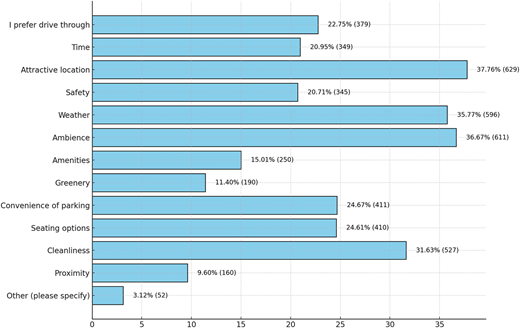
When considering factors that would encourage people to leave their car and interact more directly with food trucks (Figure 6, respondents can choose more than one reason), respondents valued the location’s attractiveness (38%), good weather (36%) and ambiance (37%) as the primary motivators. Furthermore, there is a strong desire for improved amenities near food trucks, such as trash/recycling bins (56%), restrooms (45%) and seating areas (53%). The results indicate that although food trucks in Kuwait provide a dynamic and youthful means of urban engagement, their capacity as instruments for inclusive and participatory place-making is influenced – and somewhat limited – by cultural norms and automobile-oriented urban infrastructure.
4.2.1.2 Access
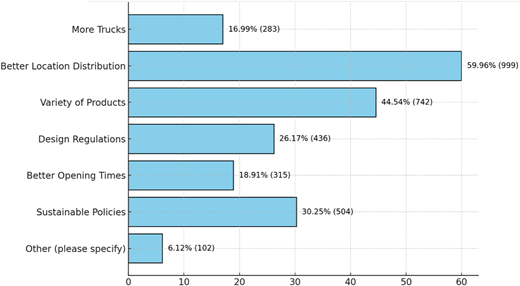
The survey also explores improvements to enhance the urban experience (Figure 7). Respondents favor distributing food trucks more widely, with 60% supporting better location planning. Popular locations for food trucks include parks (69%), seaside areas (59%) and parking lots (42%), showing that people prefer spots with high foot traffic and pleasant environments. However, there are concerns about the ambiance, with 15% describing the atmosphere around food trucks as chaotic. In addition, 57% support the expansion of food trucks in Kuwait, although 22% oppose it. Environmental concerns are notable, with issues such as noise (43%), smells (34%) and pollution (30%) being frequently raised. Despite these concerns, the overall perception of food trucks in Kuwait is largely positive. A significant number of respondents believe that food trucks have a positive impact on urban development (35%).
The survey results offer valuable insights into public opinions regarding food trucks in Kuwait, particularly around their accessibility, regulation and impact. A strong majority of respondents (76%) agree that food trucks should be easily accessible to pedestrians, with 49% stating it is “extremely important” and 27% considering it “very important” accessibility for cyclists also receives notable support, with 57% viewing it as important, although it is slightly less emphasized than pedestrian access. This indicates that while there is a preference for accommodating cyclists, pedestrian access remains a higher priority.
Regarding food truck locations, most respondents (64%) believe food trucks should be allowed in residential areas, while 55% support their presence along highways leading to farms and chalets. However, only 39% approve of food trucks in commercial areas, and just 20% favor their placement in industrial zones, suggesting that food trucks are more welcomed in community-focused and scenic areas rather than in industrial zones. This highlights the importance of strategically locating food trucks where they are most likely to be used and appreciated by the public. When it comes to satisfaction with current regulations, the results are mixed. While 38% of respondents express satisfaction with the existing framework (13% “very satisfied” and 25% “satisfied”), a significant portion (37%) remains neutral, and 25% are dissatisfied or very dissatisfied. This indicates that while there is some satisfaction with the regulatory system, improvements are needed to address concerns and raise overall satisfaction.
A considerable proportion of respondents perceive food trucks as contributing to urban development by revitalizing underutilized areas and promoting community engagement. These choices strongly correspond with the tenets of TPM, which underscore the significance of transient, adaptable interventions in fostering meaningful public spaces. In Kuwait, where public life frequently occurs within private vehicles due to climate, infrastructure and cultural norms, food trucks provide a distinctive, movable alternative that temporarily restores space for communal assembly. Nonetheless, contentment with existing restrictions is inconsistent, illustrating a wider tension within TPM between spontaneous, user-driven spatial development and the difficulties of formal governance. The Kuwaiti case exemplifies how movable food infrastructure may concurrently negotiate, oppose and transform existing urban norms through temporary, yet significant, place-making.
4.2.1.3 Environmental impacts
Food trucks are praised for fostering sustainability by minimizing the necessity for permanent infrastructure, revitalizing underutilized urban areas and bolstering local entrepreneurship through reduced entry hurdles. Nonetheless, their transience also prompts apprehensions over potential negative impacts, revealing mixed opinions on issues related to traffic, aesthetics, environmental effects and behavioral influences (Table 1). Consequently, the situation of food trucks exemplifies both the potential and the instability of TPM, wherein informal vitality coexists with conflicts regarding legitimacy and sustainability. Respondents were asked to indicate their level of agreement with five key statements. On issues contributing to vehicular accidents and traffic jams, most respondents are neutral or disagree, suggesting that concerns about safety and congestion are not overwhelmingly strong. Similarly, the idea that food trucks lead to visual pollution or environmental degradation (through waste and emissions) is met with mixed feelings. 32% agreed that food trucks contribute to visual pollution, while 39% disagreed, and 41% attributed environmental degradation to food trucks, citing waste and emissions, although 33% remained neutral.
The most significant point of agreement in Table 1 was the behavioral influence of food trucks, with 52% of respondents believing they encourage car-dependent habits. This reflects a broader awareness of their impact on urban mobility and planning. While food trucks are not universally perceived as problematic, concerns remain about their potential effects on both human and urban health. A key issue is their similarity to drive-throughs, as both contribute to long lines of idling vehicles that consume fuel and emit pollutants. These environmental concerns are directly linked to the duration of vehicle stays and movement while queuing. Many respondents (65%) keep their car engines running while waiting, which negatively affects the environment. The queue at the drive-through advances slowly and steadily, with each client being served individually, leading to a stop-start movement pattern (Dougherty, 1997), identified as idling, low-speed coasting and low-powered acceleration (Hill et al., 2016). Dougherty (1997) projected that a single drive-through facility, with an average service time of 3 min per customer and 2000 cars per week, might lead to an annual fuel usage of 780 liters greater than if the vehicles had been stationary. Mattingly (2009) projected that the closure of a drive-through would diminish nitrogen oxide (NOx) emissions by 60–70% in the surrounding area. Vehicle emissions comprise carbon dioxide (CO2), water vapor and nitrogen oxides (NOx), which, along with surface-level ozone and methane, constitute five of the most detrimental greenhouse gases (Rafferty, 2018).
Besides the environmental consequences, substances present in automobile emissions are associated with considerable health hazards. Employees in drive-throughs are particularly susceptible to prolonged exposure to elevated emission levels (Barnett, 2012). Vehicle emissions comprise hydrocarbons (HCs), which elevate cancer risk with sustained exposure, and carbon monoxide (CO), which diminishes the oxygen-carrying capacity of red blood cells, hence heightening the risk of heart attack. Cardiovascular disorders were recognized as the primary factor in pollution-related mortality (Ling-Yun and Lu-Yi, 2016). A study subjected pregnant mice to exhaust emissions revealed that the offspring had low birth weight and physiological immaturity at delivery (Krzyżanowski, Kuna-Dibbert and Schneider, 2005). Also, vehicle emissions adversely impact male fertility, with nitrogen oxide (NO) impairing sperm motility (Rosa et al., 2003). A recent Canadian study outlined many communities in Canada enacting bylaws to prohibit drive-through establishments (Nykiforuk et al., 2018). Many respondents conveyed skepticism regarding the potential environmental benefits of the ban and expressed reluctance to forfeit the convenience of drive-through services.
5. Discussion
The emergence of food trucks in Kuwait exemplifies TPM effectively. These mobile vendors arose in reaction to an increasing desire for accessible, informal dining and social environments, particularly in cities where public life frequently revolves around large shopping malls and indoor spaces (Sedighi and AlBader, 2019). Food trucks have converted abandoned parking lots and coastal promenades into lively social centers, reflecting TPM’s focus on flexibility. These environments are not formally constructed; instead, they are appropriated and reinterpreted through temporary actions. During cooler months or national holidays, food trucks congregate in locations such as Al Shaheed Park, Jaber Al-Ahmad Cultural Centre or the waterfront adjacent to Kuwait Towers, establishing transitory yet significant public spaces characterized by cultural expression, social interaction and communal vitality. The small business food truck phenomenon exemplifies TPM’s idea of reactive response – individuals recognizing and rectifying deficiencies in the urban landscape, especially where official systems have proven inadequate. As seen in the interview findings, a significant number of food truck proprietors are young Kuwaitis who, without access to conventional business prospects, saw mobile vending as a more attainable and adaptable avenue. This not only democratizes economic involvement but also invigorates the city.
Kuwait’s automobile-oriented urbanism offers a unique environment; however, similarities may be observed with mobile food infrastructure in cities like Los Angeles, Seoul and Istanbul, each demonstrating diverse adaptations of TPM. In industrial Los Angeles, the lonchera food truck scene has facilitated the emergence of gourmet food trucks by navigating regulatory obstacles. These food trucks function as economic ventures and cultural hubs, quickly expanding from both grassroots and highest levels, employing food truck placemaking as a tactic for civic enhancement (Wessel, 2024). The transient characteristics of temporary urbanism facilitate negotiation, adaptability and concession in confined urban environments. In Seoul’s Little Manila, vendors successfully retained their desired site and evaded displacement by minimizing and managing its sprawl (Hou, 2016). In Istanbul, illegal street vendors often occupy public spaces, obscuring the distinction between authorized and impromptu placemaking (Küçükersen, 2021). These instances illustrate how movable food infrastructure may bridge formal planning processes and daily urban existence, providing adaptable, culturally integrated solutions. This study positions Kuwait within a worldwide context, highlighting the possibilities of food trucks as local solutions to car reliance and as elements of a greater international dialogue on temporary, adaptive and inclusive urban activities.
Our analysis led us to conclude that TPM is grounded in six fundamental principles: citizen-led, reactive responses; adaptability across time and scale; holistic urbanization, flexibility in use and form; place-making that emphasizes local identity; and democratic urban governance. Table 2 delineates a systematic method for converting the principles of TPM into implementable legislation and policies, especially in the context of the nation’s expanding food truck movement. Each TPM principle corresponds to a proposed urban regulation that facilitates informal and community-oriented urban actions. Implementing a tiered license structure reduces entry barriers for emerging entrepreneurs, illustrating TPM’s focus on responsive, citizen-driven initiatives. Suggesting legal frameworks such as Urban Innovation Zones, where food trucks and other informal vendors can operate within a more lenient regulatory context, fosters innovation while enabling local officials to oversee and adapt policy in real time. Integrating food trucks into youth support programs addresses the economic aspect of urban living, fostering inclusive growth and nurturing local talent. Alternative recommended approaches, such as community-oriented site selection and incentives for cultural initiatives, guarantee that public spaces remain socially vibrant, regionally pertinent and democratically administered. Collectively, these approaches demonstrate the potential for legal frameworks to transition from stringent regulation to facilitating settings that endorse, rather than inhibit, informal and transient urban activities. By legitimizing and cultivating citizen-driven urbanism, cities may promote more dynamic, interactive and resilient public places that embody the daily reality and ambitions of their inhabitants. Ultimately, developing a cohesive urban design that includes lush landscaping, benches, shaded zones or intimate meeting spaces could improve the pedestrian experience, rendering it more appealing for individuals to pause, unwind and savor their meals outside of their cars.
6. Conclusion
This paper presents an exploratory analysis of the urban food truck phenomenon in Kuwait, proposing the concept of temporary placemaking within the larger framework of mobility. Although automobile usage – associated with prestige, comfort and convenience – remains ingrained in Kuwait’s urban culture, the absence of safe, accessible and dependable alternatives perpetuates this dependency. This study highlights the possibility of food truck sites for temporary placemaking instead of advocating for the complete elimination of drive-throughs: these sites serve as flexible, adaptive spaces that invigorate underutilized urban areas and provide more engaging, human-centered experiences. By emphasizing safety, comfort and sustainability in the design of these locations, food truck layouts can function as accessible interventions that initiate a transformation in public perception of space utilization – promoting more inclusive and pedestrian-friendly interactions. The difficulty persists in the predominance of vehicle-oriented development and the lack of legislative frameworks that prioritize public experience above automotive infrastructure. Nonetheless, temporary placemaking is a viable opportunity for re-envisioning the urban environment without necessitating permanent infrastructural changes. This research presents principles and proposed urban regulations to direct placemaking initiatives, emphasizing how food trucks – despite functioning under a car-centric model – can enhance sustainable and experiential urban settings. Instead of anticipating a complete overhaul in urban planning, architects ought to utilize the ephemeral characteristics of food trucks to institutionalize new spatial practices. By doing so, Kuwait and similar contexts can initiate a shift toward more inclusive, flexible and sustainable urban futures. Subsequent research may expand upon this exploratory study by conducting longitudinal analyses that monitor the evolution of mobile vendor practices over time, especially in relation to changing regulatory frameworks, customer behaviors and urban development patterns. Such studies would provide insights into the resilience and adaptation of food truck-based placemaking methods amid continuous socio-economic and infrastructural transformations. Furthermore, comparative research among Arab cities – each characterized by distinct cultural, climatic and governance contexts – could reveal regional trends and variations in the intersections of mobility, informality and temporary urbanization. The broadened perspectives would enhance the theoretical framework of temporary placemaking and evaluate its potential as a scalable and culturally adaptive instrument for urban development.