This article examines how small-scale, community-embedded spatial practices can generate durable sociocultural and ecological value despite limited resources and temporally constrained implementation. It reflects on broader lessons derived from three situated cases to articulate a set of principles for rethinking architectural agency, emphasising process-based design, collective stewardship and the integration of hybrid knowledge based on artistic, ecological and technical expertise.
The study adopts a qualitative, practice-based analytical framework grounded in ethnographic observation, participatory design methodologies and cross-case comparison. It examines how hybrid pedagogical-professional initiatives unfold in real time, analysing their negotiation processes, governance arrangements and socio-spatial outcomes. The approach foregrounds the situated knowledge generated through collaboration, making the process itself an epistemic lens.
The analysis identifies the emergence of a non-authorial design role centred on mediation, care and translation across institutional, ecological, neighbourhood and artistic domains. It highlights the long-term cultural and relational impacts of community-driven processes, and also exposes gaps in ecological design capacity, particularly within artistic and architectural education.
The article provides actionable insights for architects, cultural practitioners, educators and municipal actors seeking to support community-led initiatives. It demonstrates that collaboration with existing local processes, rather than imposing new prescriptive forms, enhances social cohesion, ecological sensitivity and project resilience.
The study shows how participatory spatial practices can strengthen collective agency, cultural rights and local identity. Beyond the outcome achieved with the final design, the development processes of co-creation restructures social relations, mobilises communities and expands residents' capacity to imagine and enact more liveable, sustainable futures.
This article advances a process-oriented, hybrid understanding of architectural practice that positions urban space as a shared ecosystem shaped through learning, negotiation and care. It contributes original conceptual clarity on the epistemic value of “small” interventions and the importance of non-authorial, translational design roles for contemporary urban transformation.
1. Introduction: beyond disciplinary approaches to urbanism
Cities, the main environment where human life actually runs, promise innovation, civilisation, prosperity and democracy for their inhabitants. As an example, innovation and technological advances have led to the development of methodologies aimed at facilitating or accelerating transformation processes towards more liveable, smarter, safer and more sustainable and accessible cities (Moreno, 2024). Simultaneously, and depending on the lens used to analyse them, cities are the loci of profound inequality and social injustice. The pressures generated by accumulative and extractive late neoliberal policies, in collusion with political powers increasingly focused on imposing standardised models, produce greater poverty, inequalities linked to access to services and infrastructures and social injustice. The difficulty of balancing both visions into an agreed agenda that fosters economic growth together with sustainability and social justice requires new approaches to claim and influence different models of development (Brenner and Schmid, 2015, p. 152).
In this context, the role of residents in the act of dwelling involves actively participating in the construction of the city. However, this role has gradually been lost, with residents now being reduced to the status of consumers. In this city, public space takes on a mutable character, shifting according to the objectives pursued: a commodified and privatised site for the commercial exploitation of late capitalism, a place of encounter, a space of protest, or one of mutual care. In all cases, it is clearly the spatial domain that most strongly shapes the model of life and development of its immediate surroundings, and therefore a fundamental site of analysis and experimentation in the contemporary context. While architects and urban planners tend to work with isolated objects – such as buildings or squares – what should be put at the centre of research are assemblages, agencements or machines: heterogeneous compositions that we inhabit and through which forms of life and modes of being in the world emerge. Thinking in terms of these assemblages allows us to understand the world more accurately – and, perhaps more importantly, to imagine its possible transformations (Pérez De Lama, 2024).
Such reflections point towards the need for hybrid methodologies that merge artistic experimentation, architectural design and social mediation as tools for reimagining urban life. These hybrid practices operate at the intersection of theory and action, proposing forms of knowledge production rooted in situated, collaborative and material engagements with place: art fosters imagination and critical engagement, architecture provides material and spatial expertise, and social mediation ensures interventions respond to local needs and promote collective authorship. Through them, the city is seen both as a laboratory and a living organism – an evolving ecology shaped by the interdependence between human and non-human actors, where changes, to be absorbed by citizens, should happen slowly, step by step (Sendra and Sennett, 2022, p. 27).
Within this framework, the article explores how artistic and architectural practices can support local stakeholders in reclaiming agency in urban transformation processes increasingly dictated by economic speculation and technocratic governance. Three selected case studies in the South of Spain demonstrate how new forms of collective authorship and spatial negotiation emerge when the focus shifts from producing objects to cultivating relationships, developing a practice aligned with what Nicolas Bourriaud would define as “relational aesthetic” (1998). Moreover, they reveal how care, understood as both an ethical and spatial practice, can act as a catalyst for rethinking the politics of urban space. This article centres on the repoliticisation of urban space through practices of care, proximity and cohabitation. The analysed experiences, based on open processes of participation and self-management, propose a form of urbanism that does not design for the community, but with it. The epistemic value of these practices does not reside primarily in their material outputs, but in the processual configurations they activate. Knowledge is not produced after the intervention through detached evaluation; it is generated during the unfolding of negotiations, adjustments, conflicts and collective decision-making.
2. Theoretical approaches to hybrid methodologies. From relational art to participative design
2.1 Hybrid artistic–architectural practices
Building on this framework, the theoretical approach situates hybrid artistic–architectural practices within a broader discourse on urban assemblages, care and collective agency, proposing them as critical tools to resist late neoliberal urban paradigms and to foster situated forms of spatial knowledge.
The city cannot be understood solely as a physical environment consisting of buildings and infrastructure, but fundamentally as a social environment made up of multiple, complex realities that interact and coexist within the act of inhabiting. This understanding requires collective decision-making, commitments and agreements for the benefit and prosperity of urban environments and their inhabitants. Public space constitutes the primary stage where community and shared action take shape. Its consistency – or lack thereof – directly influences the sense of the common, for when public life erodes, the link between collective action and public identity also dissolves (Méndez de Andés et al., 2020). A space becomes a place only when it is subjectivised, when human presence and interaction imbue it with memory, affection – with meaning and symbology (Augé, 2000; Grávalos Lacamba and Di Monte, 2014; La Cecla, 1993; Tuan, 1977). These interactions are not always harmonious; they often unfold through conflict and negotiation (Isin and Nielsen, 2008). Heterogeneity thus emerges as the essence of the urban: a condition of multiplicity, flexibility and coexistence that allows the unexpected, the encounter and, ultimately, transformation. Against the homogenising tendencies of privatised urban models – where the social fabric weakens and alterity is suppressed – it becomes essential to reaffirm public space as a territory of difference, flux and affect. Within this shifting landscape, contemporary practices that engage with the fragmentary and the transitory offer a renewed way to build upon the existing – working with the residual, the marginal and the meanwhile – as fertile ground for inclusive, participatory processes capable of redefining both the meaning and the experience of urban life.
Urban assemblage thinking offers a relational lens for understanding the city as a dynamic composition of heterogeneous elements rather than a collection of isolated objects. It provides “a form of critical urban thinking” and a flexible, open theory of urbanity rooted in Deleuze and Guattari's notion of how diverse elements “take on consistency” and cohere (Dovey et al., 2018). Assemblages help frame the city in terms of its capacities for change, linking actual urban conditions with their possible futures. Assemblage thinking is especially useful here because it foregrounds how situated forms of agency emerge from the contingent interaction of bodies, materials, infrastructures and everyday practices, rather than from predefined urban plans or fixed institutional frameworks (Farías and Bender, 2010). This shift displaces the traditional architectural focus on discrete objects – buildings, plots or spatial units – and redirects attention towards the relational dynamics that compose urban life. In this sense, assemblages offer a lens to understand hybrid artistic–architectural interventions that operate in the interstices of the city as processes of collective composition in which agency is distributed and negotiated across heterogeneous open-ended elements.
2.2 Ecofeminism: placing life at the centre
Recent approaches in the fields of urban studies, feminist theory and political ecology have foregrounded care as a crucial lens for understanding spatial production. Care shifts the focus from efficiency, growth and control – core values of neoliberal urbanism – towards the maintenance, repair and nurturing of the interdependencies that enable life to thrive (Tronto, 2013). Rather than being framed as an individual or domestic duty, care is increasingly understood as a collective and spatial practice, deeply embedded in everyday encounters, infrastructures and territorial relations (Chinchilla, 2020; Puig de La Bellacasa, 2017). Under this perspective, the city becomes an ecology of interdependencies where human and more-than-human bodies sustain one another, based on the need to place life at the centre (Herrero et al., 2019).
Public space is not merely a site for circulation or consumption, but a terrain of mutual support, where the material and symbolic conditions for shared life are continuously negotiated. Acts such as cleaning, repairing, watering plants, preserving soil or hosting community activities reveal alternative forms of spatial knowledge that remain marginalised in mainstream architecture discourse. Care also functions as a counter-hegemonic force. It contests the extractivist and speculative logic that reduces space to exchange value, instead reinforcing its status as a commons – a resource collectively produced and collectively managed (Stavrides, 2016). Within hybrid artistic–architectural practices, care becomes a methodology: time-intensive, relational and process-based; a disposition that privileges listening and proximity over imposition or authorship. These practices make visible the fragility of urban coexistence and foster advancing forms of repair that are slow, subtle and situated from an intersectional perspective (Hill-Collins and Bilge, 2016). Various projects in Andalusia, such as Cúpula de las Letras, Bosque Urbano Málaga and the various urban gardens in the surrounding area, such as Verdes del Sur and Huerta del Rey Moro in Seville, as well as other citizen initiatives for the care of natural spaces in cities across Europe, such as Lago Bullicante in Rome, the R-Urban project and Park Oasis in Clermont-Ferrand in Paris, demonstrate that “caring for the earth means that the earth cares for us”, thus generating a virtuous circular ecosystem (Sánchez and Toledano, 2004, min 04:15).
2.3 Collective agency: from collaborative work to a cooperative community
Hybrid urban practices operate through collective agency, where the capacity to act and transform space emerges not from a single designer or institution, but from the interactions – sometimes spontaneous – among diverse actors: residents, artists, architects, institutions and non-human elements. In this view, power is distributed rather than centralised, allowing decision-making and authorship to be shared across social and material networks (Latour, 2007). Collective agency emphasises co-authorship: communities are not mere recipients of design, but active participants in a permanent shaping of their environment. It challenges the top-down logic of conventional urbanism, fostering democratic engagement and enabling communities – particularly those historically marginalised – to assert spatial rights and influence local futures (Miraftab, 2009). In hybrid practices, collective agency manifests through negotiation, translation and mediation, where the role of the architect or artist shifts from author to facilitator. Collective agency transforms architecture from an act of control into a process of co-creation across social, technical and ecological dimensions, producing spaces that are negotiated, cared for and collectively owned.
In this context, where relationships are understood as a structural power, it is necessary to differentiate between collaboration and cooperation, opting for a more structured methodology that complements mere collaboration with greater solidarity and mutual dependence (Ovejero-Bernal, 2018). While collaboration promotes interaction between individuals or entities, cooperation involves designing the aforementioned interaction structure to achieve common goals through group work. Most importantly, this methodology, rather than encouraging competition between peers, promotes a more just, more egalitarian and more supportive society, as well as other democratic values that reinforce the sense of belonging to a common whole. An illusory community, capable of thinking globally and transculturally, including all human beings, and also non-humans, committed to diversity and indeterminacy (Augé, 2010). And this is where culture has the power to shape the collective imagination, promoting the ability to envision a future better than the present we have inherited (Martínez, 2020). By renewing the relationship between reality and imagination, it enables societies to imagine alternative urban futures. Without this capacity, cities' problems risk being reduced to technical matters, rather than understood as social issues that require collective responsibility and action (McEwan, 2024). Hence, the responsibility to launch symbolic and participatory cultural initiatives that nurture the belief in the possibility of change. Only if we can dream of an alternative can we venture to put it into practice and fight for its implementation. While the above debates have extensively addressed participation, care, and relational practices, their epistemic implications for architectural agency remain under-theorised. This article therefore shifts the focus from participation as a political strategy to hybridity as a mode of knowledge production.
2.4 Bottom-up approaches: horizontal processes for a democratic practice
Building on collective agency, bottom-up approaches translate shared power and co-authorship into structured, community-driven actions that generate tangible social and spatial change. First experiences of the power of small actions to have positive effects on the urban tissue emerged during the 60s of the past century, in a context of a radical counterculture linked with art experiences and significant changes in society, aimed at giving political and social meaning to architecture (De Carlo, 2015; Jacobs, 1961; Scott, 2017, pp. 9–23). The experience of Curitiba (Brasil) started in 1971, where its mayor – the architect and urban planner Jaime Lerner – was able to transform the city into one of the most thriving metropolises of the world, is the most significant experience of this approach in architecture (Lerner, 2014). The term urban acupuncture coined by Lerner gave space to a broader family of interventions aimed at improving the quality of neighbourhoods and urban areas directly used by communities and according to their needs. DIY urbanism, guerrilla urbanism, tactical urbanism, Do It With Others (DIWO), P2P urbanism and many other often interchangeable terms have proliferated especially since the Lehman Brothers financial crisis of 2007. In fact, with the freezing of economic resources by municipalities and governments, citizen claims have found space to be realised on minimal budgets, demonstrating the endless possibilities for action to transform political processes and enable the collective shaping of the public realm (Janoschka and Mateos, 2015). In short, this is an experimental, reversible approach that can be implemented quickly, in contrast to the long periods required for the approval of planning instruments or simply for obtaining building permits, validating the collaborative and cooperative approach. It emphasises participation, inclusion and local needs rather than the economic or political return of the intervention. Most importantly, these experiences have generated a durable form of empowerment: they have woven a social fabric capable of sustaining experimentation and continuously transforming its immediate environment. Originally more artistic than architectural in nature, these initiatives have also gradually developed in complexity and ambition. They naturally foster new transdisciplinary and self-managed collaborations, where mediation and guidance are more necessary than the presence of teams directing the actions. The most urgent challenge is scaling up from neighbourhood-level interventions to a macro scale capable of producing real urban transformation, which up to now has demonstrated to be difficult. Only by understanding these practices collectively and in a coordinated manner would it be possible to generate horizontal structures that can offer just forms of governance, focused on the common good of citizens and the improvement of their conditions (Cimadomo, 2022).
2.5 Situated practices: from an intersectional perspective
Taking an intersectional perspective, it is necessary to address social divisions based on class, race, gender, ethnicity, citizenship, sexuality or ability (Hill-Collins and Bilge, 2016). These factors generate a series of intersections that place each person in a specific situation far away from the myth of equality. In that way, situated artistic practices have the power to influence symbolic, social and political dimensions, as long as they maintain the connection with cultural reality (Camnitzer, 2009; Bishop, 2012). This can lead to the exchange of its poetic dimension for an activist function if the context requires it, assuming ethical and political responsibility above other values. The hybridisation of artistic and urban planning practices can lay the foundations for building true communities of coexistence and learning. The symbiosis of these processes and methodologies, which stem from academic pedagogical contexts in search of a logical connection with real-world problems (hooks, 2003, 2004, 2010), while feeding on the social dynamics of activism and citizen participation, strengthens commitment to reality and amplifies the power of social transformation, with the aim of exposing the mechanisms of hegemonic power and proposing alternative and undisciplined structures of action and vindication that challenge the imposed social order (Orihuela, 2022).
In these specific contexts, awareness-raising reflection must be promoted alongside planned and liberating action capable of transforming the extreme situation into a viable or possible new reality (Freire, 2000). And these processes must be designed with the community and not just for the community, since only the force that arises from below can be effective enough to suppress hegemonic power structures. These dynamics of empowerment dissolve the notion of authorship to make room for social change with the ultimate goal of allowing the initiative to be taken up by participants, involving others and generating a seismic effect in the community (Camnitzer, 2020).
While participatory urbanism and community-led design have been widely examined as political alternatives to technocratic planning, their epistemic implications remain under-theorised. In particular, little attention has been paid to how hybrid artistic–architectural practices generate situated knowledge that reshapes architectural agency beyond authorship and facilitation. This article addresses that gap by reframing such practices as epistemic infrastructures through which socio-ecological knowledge is collectively produced. The research therefore asks: How do hybrid artistic–architectural practices operate as knowledge-producing processes capable of redefining architectural agency and generating transferable insights for urban transformation?
3. Field experiences: Urban repair practices
Spain has been a fertile ground for experimenting with new participatory models, shaped by its young democracy and periods of sustained economic growth largely driven by construction. This growth was abruptly disrupted by the Lehman Brothers crisis, giving rise to novel forms of civic activism, such as the 15M movement, akin to Occupy Wall Street and resonant with the Arab Spring protests. These movements highlighted the potential of bottom-up social organisation, collective action and urban intervention, emphasising horizontal decision-making, solidarity and citizen agency. At the same time, Spain's Mediterranean social fabric – with its strong traditions of mutual support and family networks – has proven crucial during crises, as evidenced during the COVID-19 pandemic. Such networks reveal how communities can mobilise resources and care practices in ways that formal institutions often cannot, offering important lessons for urban interventions rooted in social and ecological collaboration.
Andalusia, located in southern Spain, exemplifies these dynamics. As one of Europe's largest regions by both area and population, its GDP per capita (€23,218 in 2023) falls significantly below the Spanish and EU average, classifying it as a convergence “Objective 1” region. The region's economic and social contrasts are further amplified by its status as a prime European tourism destination, accommodating cultural, natural and sun-and-beach tourism. These conditions generate tensions between late-capitalist pressures and the basic needs of local populations, making the region an ideal context for exploring alternative urban practices (Cimadomo et al., 2021).
Focusing on two major Andalusian cities allows this article to examine how hybrid urban ecologies – practices that combine art, architecture and social engagement – emerge in response to socio-economic precarity, contested public spaces and the aspirations of local communities. The selected case studies demonstrate how small-scale, situated interventions can foster collective agency, ecological care and participatory design, offering insights into the possibilities of redefining architectural agency and informing urban transformation. By analysing these experiences, where local proposals address the genuine requirements of their communities – which are often unmet by institutional models imposed by external actors – the article highlights the relevance of context-sensitive, community-driven approaches for envisioning sustainable and socially just urban futures. In the contemporary city, residents increasingly need to generate.
3.1 Ctrl + Z: self-construction processes for a low-tech architecture
Ctrl + Z is a one-person architectural firm that has operated from Seville since 2010. Its motto is that “real society will only become interested in architecture when architecture demonstrates an interest in real society” (Stasi, 2025). It starts from the premise that this mutual interest is currently lacking, which leads to more hostile and less liveable urban environments. The firm's practice and research explores the question of whether the act of building can be reconnected to the act of dwelling, and if so, how. This has led to an interest in working on community facilities, participatory architecture, interventions in public spaces and especially on those architectural processes related to social processes. The firm believes that architecture only acquires value and meaning when it is developed with society and the territories it serves in mind. This research is far from merely theoretical. The potential and applicability of this approach are demonstrated by several long-term projects, such as the case study developed in Seville (Spain).
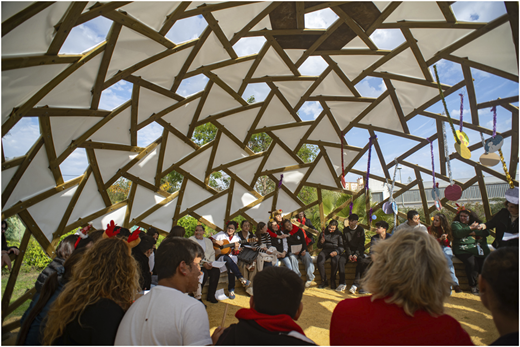
La Cúpula de las Letras (CDLL) is a community facility consisting of a geodesic structure and a superadobe bench located in the courtyard of Joaquín Romero Murube Secondary School. It is situated in the Polígono Sur neighbourhood of Seville, an area with high rates of social exclusion. In the collective imagination, this neighbourhood is associated with drug trafficking and consumption, marginalisation and illegality. Ctrl + Z was contacted by a programme that looked for a spectacular, ephemeral and short-term lighting programme, with none or very little points of contact with the sociocultural environment in which it was going to be developed under a top-down scheme. Ctrl + Z managed to completely manipulate the system's behaviour and transform the commission and resources received into an action that provided long-term support to a state school and local associations, which requests of support, the same institutions that funded the lighting program, were systematically ignoring.
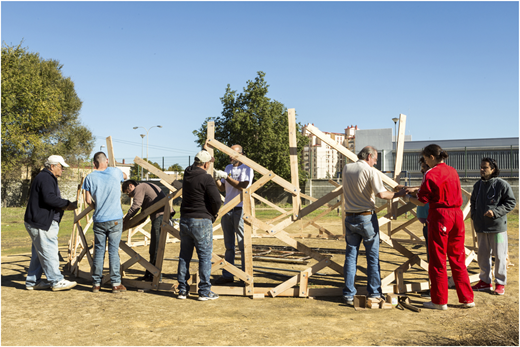
Rather than being based on aesthetic considerations, the design of the structure stems from the search for an easy-to-prepare and assemble construction system. The aim was not only to create a space for the neighbourhood residents, but also with them, providing the perfect opportunity to share with them the knowledge and technology necessary to maintain it by themselves. The assembly took place according to a self-build scheme, with the inhabitants playing a key role as the main protagonists for two days, and no particular problems were encountered. This demonstrates that careful planning enables people with no previous experience to play a significant part in constructing seemingly complex structures.
CDLL was built twice: The first time, in 2016 (Stasi, 2017) (Plate1), was an art installation as part of a public Christmas lighting programme; the second time, in 2024 (Stasi and Zorzetto, 2025), it was built as permanent equipment (Plate2). Although in 2016 it was commissioned as part of a programme lasting only a few weeks, it was designed and built to serve the community far beyond that timeframe. Its value lies in the synergies and correspondences it has established with the vocations, dreams and needs of the residents of the patio and the surrounding neighbourhood, and in offering them a suitable place to develop and experiment together. The inhabitants are not mere spectators, but rather essential protagonists. Thanks to the correspondence between the initiative and the local mental maps, we see how the 2016 ephemeral intervention, which was committed to last three weeks, has been able to gradually become permanent. The structure would not have lasted without the community's support, and a community supports something for many years only if it makes sense for local life. Now, the dome is embraced by both the school community and the neighbourhood.
Today everything is labelled, and this kind of architectural approaches are labelled as “rebel” or “subversive architecture”, or defined as “tactic urbanism” or as activities that “hack the system”. Really all of them incarnate a different approach of the same camouflaged top-down architecture: new hairstyle, same mind. In Ctrl + Z initiatives, “hacking” is not the main objective or even an objective of an initiative. It is neither spectacular nor self-referential or self-celebrating. It is a tool to deliver resources to segments of the population that deserve them but which the system neglects. Therefore, hacking is an action that looks much further into society, pursuing objectives beyond itself and completely focused on supporting and expanding the bottom-up sociocultural processes that make those initiatives necessary. These processes not only affect the social fabric on which the locals rely today, but they also constitute an urban laboratory from which new forms of organising and living in tomorrow's cities may arise.
The system hack culminated when Ctrl + Z renounced the ownership of the Cúpula and to any other media of control without avoiding professional responsibilities. This allowed the local community to take control of the building and its resources. The trajectory developed by local actors was certainly worthy of recognition, but the institution was not willing to support such initiatives. Ctrl + Z managed to reverse this pattern thanks to its participation in the lighting program.
Projects such as CDLL demonstrate the advantages of developing projects that focus directly on the communities and territories in which they are implemented. The social and urban value of the activities it enables is what motivates and justifies the community's maintenance of the project since 2016 and the financial support received in 2024 to consolidate it as a permanent architectural feature. The project also demonstrates the economic and sociocultural effectiveness of proposals that promote coexistence and collaboration. These proposals arise from, are based on and tailored to local realities, and are coordinated with social agents already operating in the territory, with the aim of promoting more inclusive and sustainable environments.
3.2 Artefacto Social: relational art as a catalyst for community ties and the reappropriation of public space
With the aim of analysing the social impact capacity of artistic practices in different situated contexts, the Artefacto Social project was initiated in 2021 (Rivas-Herencia and Alonso-Calero, 2022). The proposal was launched as part of the Key Project programme of the Vice-Rectorate for Social Innovation and Entrepreneurship at the University of Málaga (Spain). From the Faculty of Fine Arts, a team of students and academic staff took on the challenge of implementing collective creation skills to understand art as a tool for social transformation. This initiative sought to promote culture and art practice as a factor for change from a critical perspective, constituting a pillar of mediation and empowerment.
Throughout its history, Artefacto Social has reached out to various neighbourhoods in the city of Malaga, implementing different participation strategies. In all cases, it has sought to nurture the bond between communities and their territories through a practice focused on relationships. The different experiences based on artistic practices would allow for a better understanding of the reality of each of these contexts, which are marked in a particular way by exclusion. In the first two editions, the project would address issues in three paradigmatic neighbourhoods in Malaga: Los Asperones, Palma-Palmilla and El Palo. Each of these territories carries a series of stigmas in the collective imaginary of the city: due to their configuration as a gypsy ghetto, depending on how the power relations that shape them are understood (Agüero-Fernández, 2020; Filigrana, 2020); as a multicultural environment marked by poverty and the resulting effects of crime and other problems stemming from drug use and trafficking; or, due to the cultural idiosyncrasies of a humble neighbourhood with a fishing tradition and its particular internal exclusions based on class or ethnicity.
In its third edition, developed throughout 2023, and after concluding that the south exists in any quarter, Artefacto Social addresses the reality of Cruz Verde-Lagunillas neighbourhood to review the different strategies of collective creation for social transformation, insisting on the value of participation and the ethical and social commitment of artistic practices. This environment, condemned by institutional neglect, has become one of the areas with the worst quality of life in town, despite being part of the central district of the capital of Malaga, becoming “a piece of the city that stands out like a wounded organ”, a fragment of “a primitive Malaga, different, like a deeper genetic imprint” (Bujalance, 2010). Currently, due to its ideal location, this multicultural reality in which a majority Roma population coexists alongside a large number of migrants, not without difficulties, is the victim of the most savage gentrification (Sánchez, 2024).
From the outset, “the work would be self-managed cooperatively, putting into practice different social skills for negotiation and communication, developing meaningful learning by applying the content learned directly in the field” (Rivas-Herencia and Alonso-Calero, 2023), with special emphasis on relationships with the people who were part of each of these communities and, especially, on the identification with and love for their own territories, in what we might call topophilia (Tuan, 1974). With this aim, the teaching-learning space was moved directly to the territory of study, the neighbourhood, establishing a direct link with the context and the community. This enabled the construction of situated knowledge, based on specific emotional relationships to the environment and a sense of responsibility towards public space (Sobel, 2004). This shift brings the academic contexts of the university closer to the scenarios of citizen policies, connecting artistic practices with the dimension of reality. The different processes of listening and understanding, such as collective mapping (Cimadomo and Vargas-Díaz, 2026, pp. 34-35; Risler and Ares, 2013; Rivas-Herencia and González-Vera, 2023), laid the groundwork for the recognition of a reality traversed by the intersection of different dimensions and an appreciation of diversity (López-Melero, 2018). This constituted a democratic space where a plurality of voices could find their place and be included in a shared debate, beyond the hegemonic discourses established by white supremacist and patriarchal ideologies (hooks, 2003, 2004).
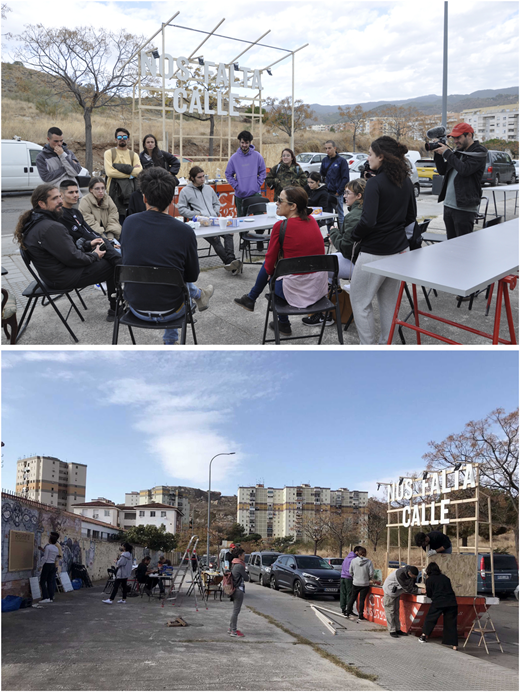
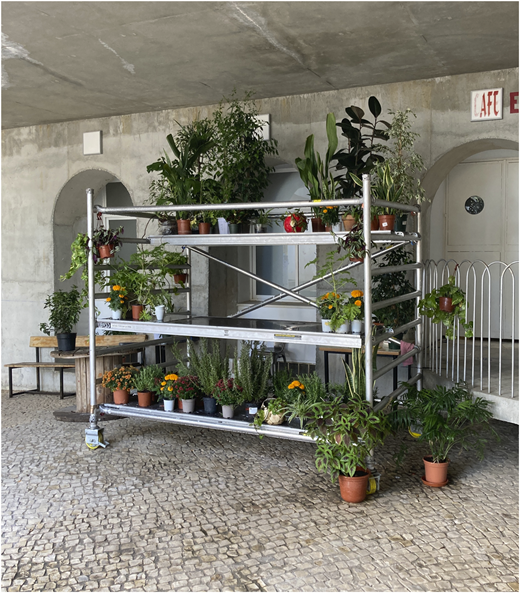
With NOS FALTA CALLE [We Lack Street] project (Plate3), the collective would intervene in these neighbourhoods through a symbolic and relational device, constructed from a construction bucket, creating spaces for exchange between students and different members of the communities. Among the various initiatives developed by Artefacto Social during its third edition, the relational proposal Mi barrio, mi jardín [My Neighbourhood, My Garden] (2023) paid special attention to the idea of mutual care (Plate4). Through a participatory process, it brought together a collection of plant pots donated by residents of the Cruz Verde and Lagunillas neighbourhoods in Malaga. These plants, arranged on a construction scaffold, formed a collective, temporary and moving garden, promoting exchange from an ecofeminist perspective and highlighting interdependence and eco-dependence. With this work, it was possible to highlight the need to put life at the centre and weave bonds of solidarity and cooperation through practices of care, proximity and coexistence in order to sustain the community (Herrero et al., 2019). From a posthumanist perspective, and in response to the politics and poetics of public space, this gesture sought to maintain a friendly and indeterminate tone, challenging the divisions between matter and meaning, in order to tune in to the trans nature of a queer garden (Barad, 2023).
This drifting garden proposed a review of human relationships and the powers that are articulated in the community networks that make up the social fabric. Through this situated practice, in which the collective worked in contact with the community, affective relationships were established and the commitment to the shared space was reinforced. This vision drew a symbiotic connection between real experience and the metaphorical dimension, reinforcing the power of artistic, architectural and urban practices by combining functional and symbolic – poetic and political – perspectives, and highlighting the value of interdisciplinary relationships for social transformation.
The various actions carried out by Artefacto Social fulfilled the purpose of bringing the academy to the streets, in an act of social giving back, connecting realities that should never have been separated (Rivas-Herencia, 2024), and defending a model of artistic practices committed to social justice, with the aim of constituting a powerful axis of transformation in the struggle for citizens' rights (Beirak, 2022). To this end, the inclusion of minority opinions would be promoted through cooperative listening strategies capable of reversing hegemonic orders and promoting horizontal relationships of knowledge exchange, networks of solidarity and empathy. In this way, collective thinking and a sense of belonging to a greater whole, a sense of community, would be fostered.
3.3 SArPe summerschool: Urban repair situated pedagogies
The Málaga edition of the SArPe Summer School forms part of a broader exploration that positions architecture education within real territories of conflict, negotiation and co-creation. SArPe – Socially Situated Architecture Pedagogies – is a collaborative research project that challenges conventional boundaries between academy and society, proposing alternative modes of learning grounded in active participation, civic responsibility and ecological awareness. The project advocates for educational environments where students become interlocutors and co-agents within ongoing urban struggles, shifting their role from distant designers to embedded actors capable of listening, adapting and transforming together with local communities. The Málaga Summer School, held between August 31 and September 4, 2025, exemplifies this pedagogical shift, with a learning-by-doing approach (Cimadomo, 2025). Its focal point was the transformative potential of the Bosque Urbano de Málaga (BUM), a contested site located in one of the most densely populated districts of the city. Since the decommissioning of the former Repsol gas tanks, the area has been the object of strong speculative interest, subject to real estate development proposals that would further intensify the pressures of urban neoliberalism in Málaga. In response, an active citizen platform advocates for the creation of a large public park – an urgently needed green lung – proposing a Mediterranean forest that supports biodiversity, recreation and social cohesion.
Central to the SArPe ethos is the belief that knowledge emerges through praxis. Theory and practice are not staged as separate phases but woven into the unfolding of the experience. The Summer School thus developed through a sequence of interlinked formats: preparatory individual reflection, collective fieldwork, co-design sessions, practical construction and shared celebration. Each stage emphasised learning – intended as the previous step to acting – by sensing, listening, making and caring. The design methodology was organised into three thematic clusters that structured the collaborative work: advocacy, signage and building. Each group explored a different entry point into urban repair, from communication strategies to spatial interventions and community activation. Running parallel, they acted as complementary layers of engagement, revealing how design operates simultaneously at symbolic, material and infrastructural scales. The Summer School engaged directly with this ongoing struggle. Rather than treating the BUM as a blank canvas for hypothetical design, the program approached it as a field that already contains political energy, collective dreams and more-than-human life. In this way, SArPe emphasises the ecological agency of the site and the capacity of its users – human and non-human – to shape spatial futures. Students from six European universities, including schools of architecture and the local Faculty of Fine Arts, were invited to work collaboratively with neighbours, activists and community organisers, positioning the city as a classroom that teaches through interaction.
The summer school activated new alliances between academia and practitioners operating with deeply community-rooted approaches. Among them, Ctrl + Z Arquitectura and Artefacto Social played an essential role due to their long experience and complementary approach to speculative experimentation and hybrid practices. Ctrl + Z brings a decade-long experience in socially embedded architecture developed through DIY, reproducible and low-tech construction methods. Their approach works to reinforce existing grassroots dynamics and empower communities as agents of transformation. Their participation enriched the building component of the Summer School, where modular furniture was collectively designed and constructed on-site. The emphasis was not on producing refined objects but on enabling shared authorship, spatial appropriation and a sense of ownership among local users. Artefacto Social contributed to the advocacy dimension. With a trajectory situated at the crossroads of art, urban activism and politicised spatial practice, they supported students in developing strategies of visibility and communication. Their guidance helped articulate visual campaigns, social media outreach and public actions that amplify the claims of the neighbourhood, reinforcing architecture's role as a tool for civic empowerment. This hybrid structure – uniting academic exploration with professional, activist and artistic expertise – strengthened the experimentality and legitimacy of the interventions, ensuring that proposals were not only pedagogical exercises but contributions truly integrated into the existing citizen struggle (Cimadomo, 2025).
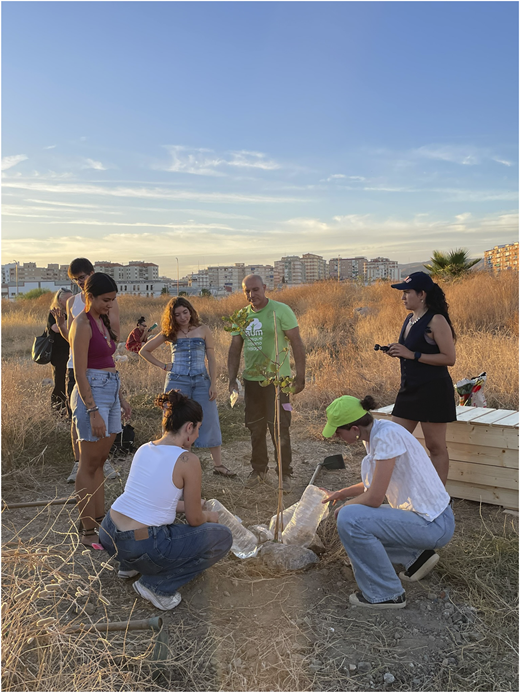
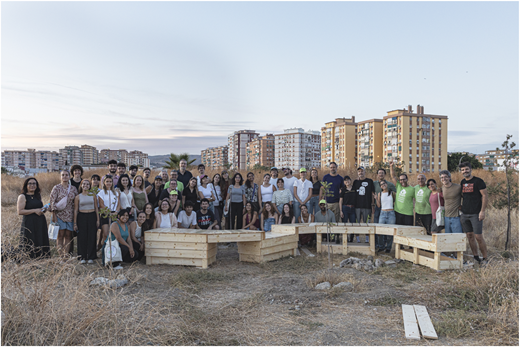
Design decisions throughout the Summer School were shaped by conversations, interviews and shared time with residents of La Unión, the neighbourhood surrounding the BUM. Guided walks, sensory mapping and participatory surveys brought to light the multiple identities and rhythms of the site: informal paths traced by dog-walkers, improvised shade structures created by early adopters of the emerging park, spontaneous ecological recovery processes slowly unfolding across the terrain. Local knowledge became a primary material. In the advocacy group, students developed a set of graphic pieces that communicate key messages about the future of the BUM and its environmental value. Posters were installed around the site, while a short video was designed for circulation on social media, serving the platform's ongoing campaigns. The signage group addressed the need for recognition and orientation within a space that functions as a park despite lacking official acknowledgment. They produced a monolith combining historical context with a tactile relief map that highlights significant landmarks – trees, pathways, viewpoints – making them visible and accessible. They also designed a playful exploration system for children, encouraging deeper engagement with the landscape and helping strengthen intergenerational stewardship. The building group materialised a gathering point where several footpaths converge, creating a new plaza equipped with a modular bench system. A manual for self-construction accompanied the installation, enabling neighbours to expand it autonomously over time. This gesture of open-ended design reinforces a principle at the heart of SArPe: architecture as a process that continues beyond the workshop (Acarturk et al., 2025). The final day of the Summer School was not conceived as an endpoint but as a moment of recognition and continuity. Participants, neighbours and members of the BUM association came together for a collective tree-planting activity (Plate5) to mark the inauguration of the new plaza. The concluding presentations reinforced the idea that design and activism are inseparable in contexts where the right to green public space is contested.
The Málaga Summer School stands as a testimony to the value of hybrid practices that intersect architectural design, artistic exploration, ecological care and collective action. Through the integration of community voices and more-than-human perspectives, participants learned to recognise cities as ecological assemblages where spatial justice, climate resilience and democratic participation are deeply intertwined (Plate6). By forging new relationships and constructing small but meaningful infrastructures of encounter, the Summer School contributed to an ongoing urban transformation – both on the ground and in the minds of future practitioners who will continue to question, care for and collaboratively shape the cities we inhabit.
The comparative reading of these cases reveals recurring patterns that will be further discussed in relation to architectural agency and hybrid epistemologies.
4. Discussion. Shared learnings: towards a new ecology of the project
The analysis of the three cases allows us to revisit the initial question regarding the epistemic role of hybrid practices. All of them opted for self-build schemes to promote community bounds development, a renewed relation with the territories in which the interventions are realised and culture of care, both under tangible and intangible focuses. At the same time, this scheme gives back to citizens an active role in shaping the surroundings they inhabit. In this sense, self-build operates not merely as a technical solution, but as a political and epistemic repositioning of architectural practice – shifting the locus of expertise from isolated authorship towards collective experimentation and shared responsibility. In this scheme, each individual contributes their knowledge and labour, but the most important aspect is the knowledge and agreements generated through working together during construction. These are fundamental to the sustainability and resilience of the resulting initiatives and the community itself (Stasi, 2025). Across the three experiences, a common thread emerges: the role of the designer is no longer that of an “authorial creator”, but rather a curator of processes and a caretaker of relationships. In each case, the project becomes a negotiated space where different stakeholders interact and co-produce meaning. The professional's value lies not in imposing a vision but in sustaining the conditions for collaboration, mediating conflicts and ensuring continuity in the fragile social and ecological networks that support the intervention from a situated perspective. This repositioning transforms the project into a site of knowledge production, where design decisions emerge from relational processes rather than from pre-defined formal intentions.
These practices also reveal the importance of translation as a core design skill. The capacity to move between institutional codes, neighbourhood cultures, ecological logics and artistic languages is essential for enabling mutual understanding and shared decision-making. Rather than operating within a single disciplinary frame, the practitioners involved learn to inhabit the interstices between worlds, aligning bureaucratic requirements with community aspirations or reconciling metaphorical thinking and artistic experimentation with urban or ecological constraints. This translational work is what ultimately allows the projects to become grounded, inclusive and impactful. Translation here is not a soft skill but a structural necessity in contexts where institutional, ecological and community logics coexist without naturally aligning, making mediation itself a core architectural operation. Often carried out with limited resources and without guaranteed institutional continuity, the most notable aspect of these projects is that they are embraced by the community through participation in their design and construction. This fosters a collective sense of belonging that not only generates mutual support and care among participants, but also care towards what has been collectively created. Far from idealising these processes, given the difficulties and resistances inherent to human relationships, the professionals who accompany their development play a crucial role in fostering the conditions and leaving the space for the stakeholders to develop this sense of ownership and cohesion. SArPe's approach particularly demonstrates that pedagogy itself can be a form of activism – one that does not romanticise participation but engages with the complexities, conflicts and fragile alliances that shape urban environments. The work carried out in Malaga supports the emerging understanding of architecture not as a discipline that delivers solutions from above, but as a medium for negotiation, support and shared imagination.
These initiatives highlight the need to distinguish between top-down participation, in which local stakeholders are removed from their environment to conduct a consultation process that is often quantitative and based on closed questionnaires, and bottom-up participation. The latter is exemplified by the three case studies, in which external stakeholders, such as technicians, institutional programmes and students, take the necessary steps to immerse themselves in local socio-cultural realities by moving into the territory of intervention and temporarily participating in local processes that justify the interventions. Although these two methodologies are categorised under the same term, they produce completely different scenarios. In the first, the population is effectively asked to disengage from their physical and mental surroundings in order to engage with an external process. This process can easily conceal and develop standard extractivist and speculative logics and schemes under the guise of “participation”. In the second methodology, external stakeholders engage with local stakeholders to cooperate in producing processes that genuinely support repair and care at a local level.
Furthermore, the case studies presented demonstrate that the applicability of the second approach largely hinges on the willingness of external parties to engage. This is evidenced by initiatives originating from institutional lighting programmes, artistic initiatives, and educational programmes. The second methodology also proposes shifting the focus from external stakeholders, whose involvement in the initiative is, by definition, short-term, to local residents, with a view to creating more resilient, long-lasting processes. The case studies are presented to question and debate the concept and application of participation as a whole. They show that significant results can be achieved from different starting points and can be used to structure future initiatives. Overall, the article emphasises the importance of viewing each architectural and artistic practice as an act of urban and social development, which cannot be realised without engaging with real territories and their inhabitants. This differs substantially from the heavily bureaucratic participatory processes widely practised today and proposes a debate on the tools and approaches that should be employed in urban development initiatives to ensure their efficiency, sustainability and resilience.
The three practices once again highlight the potential of the “small” to generate tangible and sustainable transformations in local contexts. They break with the paralysis of large urban projects, often hindered by bureaucratic frameworks, institutional dependencies and financial rigidities, operating tactically within their constraints, revealing alternative governance models embedded in micro-scale actions. However, it is important to note that they were made possible thanks to public funding (the Municipality of Seville and the Architects' Guild of Sevilla, the University of Malaga, the European Union). It was thanks to the promoters of these initiatives that the final activities did not fall within logics that follow administrative and programmatic top-down patterns but were able to tweak them and have a different collective approach, once again demonstrating the relevant role of the designer in shaping these opportunities. The long-term trajectory of the Cúpula de las Letras reinforces this point. Over nine years of continuity, the CDLL has demonstrated that it is possible to make economic and sociopolitical sense of developing architectural processes that consider the needs of society and the territories they serve, respecting their identities and that this orientation is what ultimately makes the resulting structures and relationships sustainable and resilient. As discussed in the Cúpula de las Letras case study, transferring ownership and renouncing any other means of controlling the artefacts produced, while not evading professional responsibilities, enabled the population to become more deeply involved. It addressed the concerns, openly expressed by the population during the initial meetings, that once their participation had been secured and the artefact had been built, it would be taken outside the community for others to capitalise and enjoy, following extractive and predatory practices. Ownership gives local stakeholders autonomy in its use, free from external programming control. Such decisions enable the creation of locally owned infrastructures, rather than interventions merely placed in the territory yet symbolically and materially tied to the architect in charge – a critical and far from self-evident shift in contemporary practice. Such gestures challenge entrenched professional hierarchies and suggest that relinquishing control can become a deliberate design strategy for fostering long-term resilience.
Finally, the three experiences demonstrate how hybridity operates as an epistemological tool. Knowledge is not only produced about the projects – as documentation, analysis or evaluation – but also through the projects, in the unfolding of their daily interactions, negotiations, failures and reinventions. This situated knowledge emerges from practice itself: from building and unbuilding, from testing forms of coexistence, from adjusting to ecological rhythms and from responding to and including community dynamics. Such hybrid methodologies blur the boundaries between research, design, activism and pedagogy, generating insights that conventional disciplinary approaches would struggle to access, and the boundaries between academia and society, generating synergies and new channels of knowledge transfer. The proposed experiences seek to establish, foster and promote this contact and dialogue through a methodology based on research-action, which involves the aim of directly influencing the transformation and improvement of the contexts under study. In doing so, they address a persistent gap in architectural research by demonstrating how participatory and hybrid practices can generate transferable forms of situated knowledge without reducing complexity to replicable formulas. Taken together, these learnings point towards a new ecology of the project – one in which designers cultivate relationships, translate between worlds, and embrace hybridity as a way to understand and transform the contemporary city from within.
5. Conclusions: towards an Urban culture of cohabitation
Architecture increasingly operates not through the delivery of finished objects but through processes based on hybrid methodologies that blend design, artistic practice, pedagogy, ecology and social mediation. These approaches recast the architect from a traditional authorial figure into a facilitator of processes and relationships. Knowledge is produced through practice – via collective experimentation, negotiation and iteration – rather than merely about practice. In doing so, these approaches address a persistent gap in architectural research, which often analyses participatory processes descriptively without examining how they generate transferable forms of situated knowledge. This shift suggests that architectural interventions function simultaneously as pedagogical tools and political instruments, cultivating civic capacities and enabling new forms of participation. This redefinition of architectural practice aligns with broader debates on cultural rights and the redistribution of power in urban decision-making, implementing formulas for participation and inclusion that are fundamental to social transformation (Beirak, 2025). When communities are recognised as legitimate cultural agents – holders and producers of knowledge, memory and imagination – urban transformation becomes a shared responsibility rather than an institutional prerogative. Hybrid methodologies thus support new forms of governance, where institutions host and reinforce community-led processes instead of imposing external project logics.
The shift towards hybrid, process-based architectural practice – and towards governance models grounded in cultural rights – necessarily requires an engagement with the existing capacities and ecologies of each territory. If institutions recognise citizens as cultural agents and architecture as a shared process, then design must begin not from abstract prescriptions but from the situated knowledge already embedded in local communities. This means acknowledging and reinforcing the social infrastructures, cultural practices, ecological rhythms and informal networks of care that shape daily life. Following La Cecla's notion of “mente locale” (1993), these local intelligences constitute the foundation upon which meaningful and durable transformations can emerge. Rather than importing external project logics, hybrid methodologies amplify dynamics already operative within the communities through symbolic experiences that generate meaningful relationships in particularly “situated” contexts, enabling forms of urbanism that are culturally resonant, socially cohesive and territorially grounded. In this way, the methodological shift discussed above becomes operational: participation and cultural rights translate into concrete practices that support autonomy, mutual learning and collective capacity-building.
These emerging practices underline a central lesson: meaningful urban transformation stems not from achieving a definitive design outcome, but from taking action together. As Federici (2020) argues, social change requires moving beyond opposition to the status quo towards the construction of alternative forms of life, however modest or provisional they may be. In this sense, the value of the “small” lies in enabling collective action that does not wait for definitive outcomes: initiating a process – even one that remains incomplete or produces no tangible built result – already reconfigures social relations, strengthens community agency and activates new forms of solidarity and imagination. Working on the symbolic dimension, these initiatives reshape the values and beliefs of the people involved, functioning as decisive impulses for the empowerment of communities and the assumption of civic responsibility. The act of gathering, deciding, organising and experimenting together constitutes a form of political practice in itself. These prefigurative actions demonstrate that urban change often begins well before any physical intervention materialises: it begins when communities exercise their capacity to act, to propose, and to collectively shape their environment. Thus, the importance of these initiatives lies less in their material permanence than in their ability to generate cultural, social and political effects through doing, reinforcing the idea that the process – its negotiations, alliances and shared learning – is already a transformative outcome. This suggests a decisive shift from evaluating architecture through its finished artefacts towards assessing its capacity to initiate and sustain collective symbolic processes.
Community-activated spaces operate simultaneously as sociocultural and ecological infrastructures. They anchor collective identities, hold shared memories and aspirations, and foster forms of belonging that are essential to resilient urban environments. At the same time, they respond to growing demands for greener, more accessible and more climate-responsive cities, where ecological functioning is inseparable from social wellbeing. Yet these initiatives also reveal a persistent gap in the professional skillsets that support such transformations: while artistic and community-driven practices excel at activating participation, they often lack specialised ecological and forestry design knowledge, which is increasingly necessary for managing soil, water, shade, biodiversity and long-term vegetal maintenance. This gap points to an urgent need for integrated training that brings together artistic, architectural and environmental expertise, enabling practitioners to work with living systems as confidently as they work with social ones. Strengthening this ecological literacy – especially within art-based or socially oriented programmes – would enhance the durability, environmental performance and regenerative potential of community-led interventions. In this view, urban spaces become hybrid ecosystems where technical, artistic and popular knowledge converge, producing environments that are simultaneously socially meaningful and ecologically robust.
Taken together, these insights invite the construction of a long-term research-action agenda capable of sustaining the forms of experimentation, cooperation and learning observed across the case studies. If the future of architectural practice lies in hybrid, process-based methodologies rooted in local ecologies, then the frameworks that support such work must also evolve. This requires institutional structures that can stabilise community-led initiatives without neutralising their spontaneity or subordinating them to top-down project logics. It calls for governance models that distribute responsibility across citizens, professionals and administrations, acknowledging the city as a shared ecosystem where technical, artistic, civic and ecological knowledge intersect and blend. An open research-action agenda must therefore operate at multiple levels. At the pedagogical level, it should cultivate the skills necessary for mediation, translation and ecological literacy, enabling future practitioners to work fluidly across social worlds and environmental systems. At the professional level, it should support practices that prioritise continuity over spectacle, relationships over objects and collaborative inquiry over pre-defined solutions. At the institutional level, it should foster long-term alliances that accompany communities in their self-organised initiatives, providing support without appropriation. Crucially, such an agenda must remain open – adaptive rather than prescriptive, iterative rather than finalised. Its aim is not to codify a new model, but to enable the ongoing production of situated knowledge that emerges through doing: through shared construction, negotiation, maintenance and care. Future research should therefore investigate how these hybrid practices can be institutionalised without being neutralised, and how ecological and social competences can be systematically integrated into architectural training. By embracing this openness, architecture, art and community work can converge as forces of collective repair, capable of imagining and enacting more equitable and resilient urban futures.