

This short note explains to contributing authors the concept of “desk rejection” as well as describing our recent experience with it since 2013, the year in which Academia became one of Emerald Group Publishing's management and business journals. So called “desk rejection” is the first screening that editors undertake of all submitted papers for review and publication. Today, desk rejection constitutes more that 50 percent of all rejections made on Academia. Desk rejection is based on specific criteria focussing on how well the paper fits the journal's editorial policy, the significance of the contribution, originality in the analyses and the quality of the data.
Background
Academia (ARLA) has experienced a sharp growth over the last five years. The journal is now positioned as one of the leading academic journals in management within the Iberoamerican region. Academia serves as a means of integration of a growing scholarly community that undertakes research in the field of management and its related disciplines in the region and for the region.
Among the success factors of a journal, the indexing outcomes are paramount. In September 2007, the journal was accepted for the Thomson Reuters Master Journal List and became indexed in Social Science Citation Index, the Social Scisearch, and Journal Citation Reports/Social Sciences Edition. Additionally, the journal is today covered in other indexes such as SCOPUS and databases like DOAJ, Redalyc, and IBSS among others. Every year Thompson Reuters publishes data and analysis of the number of citations received by each journal in the set of ISI scientific journals. The impact factor accounts for the number of average citations received by a paper published in the journal. The journals are then ranked according to the impact factor.
In July 2012, Emerald Publishers and CLADEA signed an agreement by which Emerald became the publisher of Academia. Emerald is a publishing house that handles around 290 journals. Among them, 62 are indexed in Thomson‐Social Science Citation Index (ISI). The first issue with Emerald was recoded as Vol. 26.1 (referring to the first issue of the journal's 26th year). Academia has increased its impact factor since its inception to the Thomson Master List in 2007. In particular, the two‐year reported impact factors have been 0.05 (2009); 0.165 (2011), and 0.395 (2013).
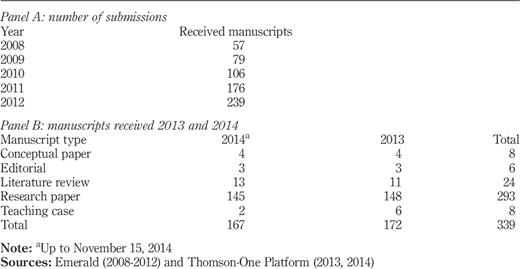
As a consequence, there was a sharp increase in the number of submissions made to the journal and in the diversification of contributing authors beyond Latin America (Table I). These numbers posed new challenges for editorial policies. The journal consolidated an editorial team of six associate editors, the editor in chief and the journal director. The journal director used to have editorial responsibilities until an editor position was established in 2004. He continues to coordinate the journal policies, serve as a reviewer and acts as a guest editor from time to time.
The editor in chief is in charge of the whole editorial process and decisions, such as the desk rejection. The journal also has a new managing editor from the Emerald group.
Second, there was a change in the journal's logistics. Academia, as with any other Emerald journal, is now run through the scholar‐one (S1) platform which is a leading software program designed for managing periodical publications. S1 allows the editorial team to keep track of dates and communications concerning all submissions and also any given paper evaluation, which helps to strengthen the desk rejection editorial policy. A fact of the world of academic journals is that approximately 50 percent of submitted manuscripts are rejected by editors.
Why is a paper desk rejected?
The following quote best answers this question:
Manuscripts are desk rejected when they do not fit the mission of the journal or are too underdeveloped to benefit from the review process. In such cases, two members of the editorial team go through the manuscript and provide a developmental letter to the author or authors to advance the article further. This helps free up the time of editors and reviewers to concentrate on the most promising manuscripts (Sharma, 2010, FBR, p. 5).
There are other related reasons that explain why most ISI indexed journals follow a strict desk rejection policy. One is that in management science, publishing today is more difficult than before. According to Ashkanasy (2010) papers that usually were sent out to review some years ago, today are desk rejected. One example relates to research methodology. In the field of organizational behavior an editor realizes from previous referee reports that research based on single self‐report surveys is not enough; today multi‐source data collection has become a pre‐requisite for publication. Another example is in financial management where the econometric analysis must include today comprehensive robustness tests in addressing endogeneity problems and showing that empirical results are solid enough to persuade reviewers about the quality of the data and the followed methodology.
A second factor is related with the increasing number of submissions as the academic market has become global and the number of ISI indexed journals has slightly increased over the last decade. The Journal of Organizational Behavior receives more than 600 submissions with a publishing capacity of 50 articles per year (Ashkanasy, 2010), and the Corporate Governance International Review gets more than 300 submissions and publishes around 32 articles per year (Judge, 2008). Academia has had the same experience, which implies that competition for authors to publish their research work has become tougher[1].
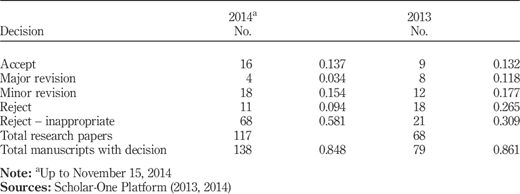
Table II displays the last two years decision statistics. Research papers represent the bulk of the evaluation work. The status reject‐inappropriate captures in full the desk rejected numbers, which is at this moment 58 percent. This number is twice the rate observed during the previous year.
Criteria for desk rejection
The natural question that arises is if we expect rejection ratios to increase over time. The answer is “yes” because in the case of Academia its reputation is probably growing, attracting more contributions. We expect to increase the journal's impact factor in the coming years. We have established three main criteria for rejecting an article during the editorial pre‐screening process. They are:
fit with the journal's scope and mission;
research questions and the paper's contribution; and
sources of information.
1. Relation to the journal scope and mission
The paper not fulfilling the journal's editorial policy is one main reason for desk rejection. In the case of Academia, the journal is an organic part of management research for the scholars in Latin America and more recently Spain and Portugal too. Authors should make a point of joining a conversation with this academic community, acknowledging previous contributions and current discussions.
We receive a great number of papers that ignore the Latin American literature, or assume ex‐ante that it is non‐existent. Many submissions only review the classical and most well‐known references and justify its focus because the data set, empirical design or qualitative information comes from Latin American or Spanish firms, organizations, and customers. Authors in the reviewing process usually find out that there are closely related studies published in Academia and in other journals from the region.
The editorial policy of Academia also points to advanced research orientation, with a preference for empirical studies. The journal is about management and related disciplines; some of the articles we receive may be better suited to economic journals, in public policy, or other fields. The journal is open to qualitative and quantitative methods. However, we have accepted cases, even teaching cases. The trend for the publication of cases in management journals is important, and the cases could integrate some theoretical discussions that are often part of a Teaching Note.
2. Research questions and paper's contribution
Many papers are submitted without being explicit in these two elements. Usually a well‐developed paper states in its introduction what the motivation is, which gap the paper pursues to fill or expand and what the main findings are. Papers that are country case studies must contrast the research with the international literature in order to provide a clear context. A paper's contribution must also be supported by the literature review section. Theory and analytical models should justify the propositions to test and highlight the novel elements based on a specific data set. Qualitative research papers aimed at building theory (rather than to test theory as in quantitative research) should go beyond the data collected and provide conceptual development or managerial implications.
3. Sources of information
Many papers just mention that their data comes from X survey, or “we carried out our own survey,” or the variables x 1, x 2, …. x n come from well‐known sources. The quality of the data is very important when it comes to publishing an article. Some authors do not analyze the working data and fail to explain the selection criteria, or they do not provide a proper descriptive statistics analysis (e.g. the identification of outliers, distribution percentiles, pair‐wise correlations, and scatter plots) to offer basic evidence of the expected relations; for example, among variables x 1, x 2, …., x n and variable Y. Failing this point, editors feel unsure about the data quality and the implemented quantitative/qualitative research methods.
Concluding remarks
We think that a desk rejection policy has a positive effect on contributing authors. The standard protocol involves a two‐stage process. In general, a submission is assigned to an associate editor (AE) that has expertise in a broad area (e.g. finance, organization theory, marketing, etc.). She writes a technical concept about why the paper is not appropriate to be sent out for evaluation. Then, the editor in chief reviews the concept and based on the AE's reports and his own reading of the paper, writes the final decision letter. If the above procedure is the norm, authors in most cases will find positive and prompt feedback on why the paper is not publishable at its current stage. A desk rejection letter usually highlights the flaws in the theoretical framework, the shortcomings in the empirical design, or in the finding results. It is most important for the author to know whether her or his paper lacks clear motivation or whether the research questions are missing or not well stated.
From an editor's perspective, the implementation of desk rejection protocol benefits the quality of the review process. University professors and researchers in the region are facing the implementation of tenure track evaluations in their schools. Leading universities and business schools in Latin America, Spain, or Portugal have undertaken international accreditation processes, which imply more pressure for faculty members to obtain discipline based peer review publications in indexed journals. A desk rejection policy implies the selection of the manuscripts with potential and high probability of survival in the review process. The principal reason is that referees’ time is a scarce resource and editors want to optimize their participation. When papers are good, quality reviewers are more willing to write better reports.
Finally, we want to advise authors to take into account the above comments before submitting a paper. Editors are interested in publishing great papers and in enhancing academic diffusion. Authors should bear in mind that most editors are also university professors who are also subject to desk rejections and they have to work hard to review and resubmit their own research work.
Note
For more details on desk rejection policy in management journals, interested readers may consult the following editorials Craig (2010), Eden (2010), and Linton (2012).

