
Skip to article sections
Purpose

The aim of this study was to establish the relationship between accountability as a pillar of public procurement and achievement of value for money in the context of Tanzania as fostered by Sustainable Development Goals (SDG) 16 to engage fairness in the conduct of society.

Design/methodology/approach

This study adopted a cross-sectional survey design using 270 respondents purposively selected from 14 Local Government Authorities (LGA) in four regions of Tanzania. The data were analysed quantitatively using the Covariance-Based Structural Equation Modelling (CB-SEM).

Findings

The results revealed that there is a strong and significant relationship between accountability and value for money.

Research limitations/implications

The study recommends that LGAs have a clear chain of responsibilities for both public officers and contractors of projects. Based on SDG number 16 of a fairer society under the National Implementation Strategy of Tanzania using target 16, the study recommends that bureaucratic approvals should be reduced because involvement of too many people makes it difficult to hold people accountable in case of any wrongdoing.

Practical implications

Public procuring entities in Tanzania should strengthen the lines of accountability in public procurement to achieve value for money and hence good governance.

Originality/value

The study contributes to the multidisciplinary growing debate on good governance in public procurement and the attainment of value for money as fostered by SDG under the National Implementation Strategy of Tanzania as per target 16.6. Also, the study contributes to the public value theory on how it is applied in the local context of Tanzania.

Procurement is generally described as the driving engine for the performance of entities (Kimario & Mwagike, 2024; Mwakyeja & Kimario, 2024). The public procurement market is considered to be the largest business sector in the world (Bosio, Djankov, Glaeser, & Shleifer, 2022). Specifically, public procurement is regarded as a driving engine that aids availability of all necessary requirements to the public in a highly transparent, equitable and fair manner using taxpayers' money and hence good governance (URT, 2013). The execution of public procurement process is in line with UN Sustainable Development Goal (SDG) of a fair society in terms of being based on strong institutions of accountability (Lauwo, Azure, & Hopper, 2022) as advocated by the Public Procurement Act of different nations and as fostered by world bank for the sake of justice whilst aiming at achieving value for money (VFM). It accounts for 13% to 20% of worldwide GDP (Testa, Annunziata, Iraldo, & Frey, 2016). Public procurement accounts for about 50% or more of total government expenditure in developing countries (Knack, Biletska, & Kacker, 2019). Additionally, according to Djankov, Islam, and Saliola (2016), about 14.5% or more of GDP is accounted for public procurement. Between 2015 and 2020 Africa has spent $16 billion on commodities, services and works, with the latter accounting for almost $12 billion. (African Development Bank Group, 2021). Public procurement has been widely recognised as a valuable policy instrument able to stimulate growth and promote sustainable economic development (Kalyuzhnova, Azhgaliyeva, & Belitski, 2022). Public procurement is one of the sectors that require attention in terms of good governance as it is directly related to the expenditure of public funds (Mwakolo, Siwandeti, Mahuwi, & Israel, 2024). Therefore, based on the importance of public procurement, there should be attainment of VFM.

The core principles of good governance that are also applicable to public procurement are; transparency, accountability, participation, efficiency, predictability and fighting corruption (Mchopa, Changalima, Sulle, & Msofe, 2024). Public procurement demands high-quality public governance in terms of transparency and accountability as well as effective management that can deliver optimum risk management and VFM outcomes (Seppäläinen et al., 2024). Procurement should always serve the public interest Mchopa, Kimario, & Panga, 2023; Changalima, Mushi, and Mwaiseje (2021). The problem of governance and corruption in public procurement is a worldwide problem, as it is a major concern of most of the developing societies (Kipo-Sunyehzi, Abubakari, & Banchani, 2024; Chikwere, Chikazhe, & Tukuta, 2023). Public sectors also require transparency and predictability of its decision-making processes and oversight mechanisms to guard against arbitrariness and ensure accountability in the use of public resources (Koeswayo, Handoyo, & Abdul Hasyir, 2024; Ng’eni & Joseph Mdodo, 2023). However, these oversight mechanisms do not eliminate the flexibility and delegation needed to respond quickly to changing circumstances. Public procurement is a highly regulated function with lots of regulatory, procedural, documentation and reporting requirements than most functional units in organisations (Adeniyi, Ojo, Idowu, & Kolawole, 2020). Public procurement is also increasingly considered as a core element of accountability in the way public funds are managed (Zhao, Thurairajah, Greenwood, Liu, & Yuan, 2023; Hafsa, Darnall, & Bretschneider, 2021). Good public procurement systems are central to effective government spending and a vital component in the strategy to improve the social and economic position of citizens in developing countries (Budi, 2024).

It has been argued that the reason behind Africa's development problem is the crisis of governance characterised by poor quality institutions, weak rule of law, absence of accountability, tight controls over information and high levels of corruption (Bräutigam & Knack, 2016). Due to its magnitude, procurement is an area that takes huge amounts of taxpayers' money and from this very fact, the function is prone to unscrupulous conducts including corruption, collusion and embezzlements (World Bank, 2016). Given the number and volume of procurement in LGA procurement cycles, it is expected increasing demand for accountability, transparency and scrutiny in regards to the manner in which choices regarding who, what, when, how and from whom to procure are made.

Accountability is one of the ethos of good governance highly pursued by the Government of Tanzania as part of National Implementation Strategy of SDG number 16 of Fairer Society using target number 16.6 which fosters on the need to have accountable institutions (Lauwo et al., 2022). It is required that the public procurement practice to always hold its practitioners responsible for enforcing and obeying the law, rules and regulations. It makes the practitioners subject to challenge and to sanction where appropriate, for neglecting or breaching those laws, rules and regulations (URT, 2013). Accountability exists when rights holders and duty bearers both deliver on their obligations. Consistent and professional procurement practices across governments can positively impact an effective expenditure of public funds (Shakya, 2012). The governance framework should ensure accountability and transparency of the decisions made in awarding the right contract to the best contractor (Changalima, Mwaiseje, Mchopa, & Panga, 2023; Panya & Awuor, 2023).

The underlying principle in balancing between efficiency and controls is that, those who have been delegated procurement authority need to be accountable for the public procurement decisions made by them (URT, 2013). They must be accountable for the effectiveness, efficiency, legal and ethical manner in which they conduct procurements (URT, 2013). Lack of efficiency, accountability and transparency in public procurement negatively affects the whole process and systems, and leads to mismanagement of public resources and corruption (Issah & Ackah, 2024; Fazekas, Sberna, & Vannucci, 2022). Sajari, Haron, Ganesan, and Khalid (2023), in their study revealed that the integrity system placed by the department in the public sector has a positive influence in nurturing accountability in the department which leads to enhancing public sector accountability in general. Proper and systematic internal control system is very important because it helps to grow confidence among the stakeholders. The study further noted that strong leadership and control mechanism for ethical behaviours are very important factors for accountability in public sector. Despite of the efforts by Tanzania government to establish public procurement, oversight institutions like the Public Procurement Regulatory Authority and the National Audit Office under the Controller and Auditor General, the procurement scandals have been continuously reported. To address these challenges, proper and effective governance systems are required. Therefore, it is along this background that the study examined the influence of accountability which is one of the indicators of good governance on VFM achievement in LGA's of Tanzania. Moreover, in order to achieve the purpose of this study, the following main research question was addressed;

RQ.

Does accountability in the procurement process influences achievement of value for money in LGAs?

This study was guided by Public Value Theory which was pioneered by Moore (1994). Public Value Theory assumes that in public sector management should be guided to assure that: managers should achieve their mandated purposes as efficiently and effectively as possible; professional standards can set benchmarks for public sector production; public value can be captured through analytic techniques such as program evaluation, cost-effectiveness analysis; and the idea that public value can be measured in the satisfaction of stakeholders and customers of governmental enterprises (Moore, 1994). Benington and Moore (2011) argue that public value theory envisages a manager's purpose as going beyond implementation of policy and adherence to institutional norms. This is also reflected in public procurement whereby procurement managers are expected to adhere to VFM rather than compliance to laws and regulations especially in project procurement where the outcome should be reflected through the usefulness of the project to the community rather than compliance with the laws and regulations. Public Value Theory presents a more modern view of the public sector executive, embracing accountability and viewing public managers as explorers commissioned by society to search for public value, and in doing so are expected to use their initiative and imagination (Moore, 1995). Kelly et al. (2004) believe that public value provides a broader perspective from which to assess public sector performance incorporating outcomes and the means used to deliver those outcomes as well as issues of trust and legitimacy. Public Value Theory attempts to create a dialog between administrators and citizens about what values public endeavours should pursue and to fully consider combining economic deficiency and organisational forms, including rational autonomous organisations. Focussing on citizens, Public Value Theory is concerned with means that engage citizens in an ongoing dialogue with officials and experts by making them accountable in the public procurement cycle. Public Value Theory provides a process-based model of public administration that encourages public administrators to make calculated decisions about how to pursue policy agendas (Turkel & Turkel, 2016). In this context Public Value Theory was used to explain the relationship between citizens and administrators by assuring accountability as part of the good governance requirement which leads to VFM in public procurement.

Accountability is one of the principles of good governance that guarantees one scruffles to deliver the value to the public (Han, Aryal, & Hwang, 2024). Accountability reassures more employee's engrossment, commitment to the job because of the devoted loyalty and hence healthier performance (Berghmans, 2022). Specifically, in procurement process more accountability calls for more commitment of the procurement personnel to devote their acquired skills and knowledge in line with the existing rules and regulations (Chikwere et al., 2023). Kibona et al. (2024) describes VFM as the best output of good public procurement practices in Tanzania. However, Kibona described VFM in public procurement from the perspective of professionalism of the personnel engaged in the process. Therefore, since professionalism goes with accountability of the personnel then this study aimed at analysing the role of accountability on achievement of VFM in Tanzania. Procedural requirements of tendering normally result in achievement of VFM in public procurement (Matto, Ame, & Nsimbila, 2021). The study at hand went a step further to that of Matto et al. (2021) by checking on how compliance to such tendering procedures serve as an accountability measure towards achievement of VFM in Tanzania. Mahuwi and Israel (2024) described that public procurement can realize benefits through capitalising on accountability measures. However, Mahuwi and Israel (2024) viewed performance in terms of reducing corruption but due to the problem motivated the conduct of this study accountability in public procurement was gauged against VFM. Equally important internal audit of public procurement is detailed to influence the good governance of the institutions by achieving VFM by checking on the compliance tests as an accountability measure (Karikari, Tettevi, Amaning, Opoku Ware, & Kwarteng, 2022) and hence this study among other things analysed accountability in form of internal auditing versus VFM. Public procurement of Tanzania allows aggrieved bidders to lodge their request to the procuring entity as an indicator of existence of questioning accountability of the employees of organisations (URT, 2024). Studies conducted in developed nations shows when accountability is well hands-on as part of good governance then the efficiency is likely to be high too (Lipman, 2023; Yauri-Miranda, 2021). However, despite of the usefulness of accountability, developing nations including Tanzania are not well conceding its usefulness (Samaratunge & Alam, 2021). Following the above milieu, this study hypothesises that;

H1.

Accountability in LGA procurement cycle has positive and significant influence on VFM adherence.

This study adopted a cross-sectional survey design which meant at data collection for two or more variables to be examined at a single point in time in a direction to detect variables patterns of association (Hunziker & Blankenagel, 2024). The design was preferred because of the robustness nature of objectives aiming revealing relationships among variables and the design allows inferences to be made on the effects of explanatory variables on an outcome variable (Creswell & Creswell, 2017). Further, this study was conducted in Tanzanian LGAs, specifically in four regions of Kilimanjaro, Arusha, Manyara and Tanga located in Tanzania. The reasoning for choosing the local government procurement stakeholders was built on the volume, number and nature of projects procured (URT, 2024). The four regions were selected based convenience sampling techniques since LGA in Tanzania are feast all over country and it is not imaginable to conceal altogether regions. According to Tanzania Census Report (2022), the northern zone correspondingly has the largest number of LGAs equated to other zones with 32 LGA out of 185 countrywide.

The target population was the stakeholders in the public procurement governance process in LGAs in Tanzania and the bidders of the public procurement offers in the country. The sample size of 270 respondents was adequate enough. The number of observations in terms of predictor variables do determines the adequacy of sample size to be used in SEM by ruling out that the sample size should be at least 20 times of the number of the predictor variables (Kline, 2023). Therefore, given the number of predictor variables in this study is 8 then it implies a sample size of 160 would even be adequate for this study.

The data were collected using an online survey and for the sake of ensuring the obtained information was reliable the pilot was conducted to few respondents whereby the noted errors such as lack of proper introduction and longevity of the questionnaire were adjusted before large scale data collection. Likert scale is described as suitable for describing the causal effect relationships in survey studies in order to come up with long-term strategic decision (Kriksciuniene, Sakalauskas, & Lewandowski, 2019). Other social science studies which employed Likert scale are Magoma, Kimario, and Kasheshi (2024), Magoma et al. (2021) and Kimario and Kira (2024). Exploratory factor analysis was first performed to specify the underlying factors for accountability and VFM. The goodness of fit was tested to assess the correspondence between the theoretical specification (all parameters) and empirical data. The tests include Chi-square likelihood ratio, Comparative fit index, Trucker-Lewis index and Root Mean Square Error of approximation. The criteria for fit indices were adopted from West, Wu, McNeish, and Savord (2023). Moreover, the study established the accountability index based on Likert mean between 1 and 10. In this study a mean ranging from 1 to 2 means very poor accountability, a mean ranging from 2 to 3 means poor accountability, from 4 to 6 means fair or moderate accountability, from 6–8 means good accountability and from 8 to 10 means excellent accountability as adopted from Taherdoost (2019). Data were collected through administered questionnaires in LGA of the four regions and all clarification were made to the respondents for reliability of the data collection process.

This study deployed a covariance-based Structural Equation Modelling (CB-SEM) is of paramount importance when studying VFM (VFM) in public procurement in Tanzania, with accountability as a key governance tool. As noted by Hair, Hult, Ringle, and Sarstedt (2017), CB-SEM is a powerful statistical approach that can effectively handle the analysis of latent variables, which are not directly observable but inferred from multiple indicators. Concepts like VFM and accountability fall into this category, being reflected through elements such as procurement efficiency (e.g., cost savings, timely delivery), transparency (e.g., public access to procurement data) and institutional integrity (e.g., absence of corruption, compliance with regulations) (Khan, Ahmad, & Javed, 2020). CB-SEM is crucial for testing the intricate mediation and causal pathways that exist in public procurement. According to Kline (2023), this method allows this study to explore how certain factors might have direct effect relationship between others. For example, it can be used to determine whether stronger legal frameworks enhance accountability, which in turn improves VFM, aligning with the principles of the “accountability triangle” theory (Mulgan, 2000). This study Testing Covariance-Based Structural Equation Modelling (CB-SEM) in Stata and made a combination of commands to specify the measurement and structural models, estimate parameters and assess model fit.

Covariance Based Structural Equation Modelling (CB-SEM) was used to analyse the individual relationship between good governance variables (transparency, accountability and competition) and VFM in public procurement cycles in LGAs. The model was used because it allows examination of the set of relations between one or more independent variables with one or more dependent variables, be discrete or continuous. Exploratory factor analysis for each governance construct was first performed to specify the underlying factors for transparency, accountability, competition and VFM. The goodness of fit was tested to assess the correspondence between the theoretical specification (all parameters) and empirical data. The tests include Chi-square likelihood ratio, Comparative fit index, Trucker-Lewis index and Root Mean Square Error of approximation. The criteria for fit indices was adopted from (Schumacker & Lomax, 2010).

In Tanzania's context, where public procurement outcomes are affected by numerous interconnected factors, CB-SEM helps address endogeneity and control for confounding variables, ensuring accurate causal inference (Bollen, 1989). Requiring a priori conceptual frameworks grounded in governance theories, it enables theoretically informed model testing, strengthening the credibility of research findings (Byrne, 2010). The insights derived from CB-SEM also have significant policy implications. As suggested by Donahue and Zeckhauser (2011), such detailed analysis can offer precision in designing interventions by identifying the most impactful components of accountability on VfM and provide generalisable results across different regions and sectors in the country, thus contributing to more effective governance and improvement in public procurement practices.

4.1.1 Perception on accountability in public procurement of LGAs

The findings shown in Table 1 revealed that the average mean and standard deviation for accountability variables in LGAs was 6.9 and 2.1 respectively and this represents a good accountability in procurement cycle based in established index. It was noted that efficient mechanism for audit has better mean of 7.03 which indicate that there is good audit exercise in procuring entity which enhance accountability and VFM. Public procurement is also increasingly considered a core element of accountability to the public on the way public funds are managed and sound stewardship of public funds is required to reduce the risk of corrupt practices (Rivadeneira, Dekyi, & Cruz, 2023). Governments should invest in public procurement accordingly and provide adequate incentives to attract highly qualified officials and also update officials' knowledge and skills on a regular basis to reflect regulatory, management and technological evolutions. Public officials should be aware of integrity standards and able to identify potential conflict between their private interests and public duties that could influence public decision making.

4.1.2 The perception on value for money in public procurement of LGAs

The study also assessed the perception of stakeholders on VFM adherence in LGA procurement cycle; therefore the study established the VFM index based on likert mean between 1 and 10. In this study a mean ranging from 1 to 2 means very poor VfM in LGA procurement cycle, a mean ranging from 2 to 3 means poor VfM adherence in LGA procurement cycle, 4 to 6 means fair or moderate VfM adherence in LGA procurement cycle, 6–8 means good VfM adherence in LGA procurement cycle and 8 to 10 means excellent VfM adherence in LGA procurement cycle.

The results shown in Table 2 reveal that the average mean and standard deviation for VFM (VfM) variables in LGA are 6.98 and 1.99 respectively. This represents a good perception level in VFM performance in LGA procurement cycle based on our established index. Some variables for VfM performance have indicated very good performance scoring above 7.0 likert mean like adequate monitoring of contracts, adequate supervision of construction contracts and consultancy services, pricing of the items in the BOQ for costing of projects, selection of competent bidders during tendering stage, keeping a complete and an adequate record of projects and honesty/integrity among the supervising engineers and technicians. Some variables like timely completion of contracts and issuing extension of time in management of contract variations scored lower mean compared to other variables.

The findings are contrary to CAG audit report for FY 2016/2017 that revealed delayed payment for executed works worth TZS 748,077,772/ = from two councils where contractors raised a claim and certified by projects manager and payment was not honoured for almost five (5) months in Muleba DC and 86 days for Kyela DC contrary to contracts clauses that require a contractor to submit monthly estimated value of executed works, which will be checked and certified by the Project Manager within 28 days. Failure to do so, the contractor has to charge interest on the unpaid amount using prevailing commercial borrowing interest rate. Thus, the delayed payment of the raised certificate could delay completion of the projects and increase costs and hence affects the VFM for those projects.

The following tests were conducted prior to the use SEM. 1. Multicollinearity tests were checked using Varriance Inflation Factor (VIF) factor and the value were all between 1.04 and 1.09 and hence less than 10 implying absences of multicollinearity between the predictor variables as suggested by Bayman and Dexter (2021). The sufficiency of sample size was checked by Kaiser–Meyer–Olkin (KMO) which bouts the degrees of the supposed correlation coefficients as equated to the partial ones for the cumulative summation of learning variables is 0.809 and hence valid because is greater than 0.6. Normality test was conducted suing Skweness value and it was noted that the skewness values for all variable were all close to 1 in the range of +1 as suggested by Iseringhausen, Petrella, and Theodoridis (2023). The study explored the validity and reliability using numerous metrics; Chi-square, Comparative Fit Index (CFI), Trucker and Lewis Index (TLI) and Root Mean Square Error Approximation (RMSEA) and Standardised Root Mean Square Residual (SRMSR). The goodness of fit is shown in Table 3 has met the recommended cut-off. Specifically, it is recommended that X2 value (276.49) of sample moments must be greater than estimated parameters while its p-values have to be less than 0.05. The recommended cut-off points for CFI and TLI are the values close to 1 (Sathyanarayana & Mohanasundaram, 2024). Therefore, since the CFI and TLI values are 0.947 and 0.935 respectively then it means there the data fitted the model. Also, the RMSEA and SRMSR is 0.078 and 0.076 respectively and hence falls between 0 and 1 and more specifically below 0.08 as suggested by West et al. (2023). It is revealed that accountability have a significant influence with a higher cut-off Goodness-of-Fit Index (GFI) > 0.90 as ruled out by Khairi, Susanti, and Sukono (2021). Thus, the model meets all the index fit criteria hence able to predict well the relationship between accountability in LGAs procurement cycles and VFM adherence. These findings support the theory of governance that good governance is aimed at achieving efficiency in public service delivery, encouraging competition, transparency and accountability. The theory of governance duly emphasises that good governance should be geared towards enhancing ways and means by which state bureaucracies carry-out state activities and utilise state resources so as to protect individual and personal liberties (Sheng, 2008). The findings are also in line with public value theory as suggested by Staples (2010) that, for public sector clients, the need for transparency and accountability underpins the procurement process in the pursuit of best value in construction projects. In the review of the Public Procurement Regulatory Authority of Tanzania Audit Report for financial year 2021/2022, it was noted that there was recommendation that disciplinary and legal actions should be recommended to the competent Authority for accounting officers, procurement officials and contractors who were alleged to received payments for ghost projects. The report also recommended Prevention and Combating of Corruption Bureau (PCCB) to intervene and start investigation on the projects with high corruption red flags.

To guarantee reliability, Cronbach's alpha was used as suggested by Creswell and Creswell (2017). The coefficients for reliability were 0.83 and hence above 0.8. The coefficient of reliability of above 0.8 signifies consistency of the used data. Also, Construct Reliability (CR) was employed to detect the overall reliability of items loaded on a latent construct as suggested by Hair et al. (2017) that good CR should be between 0 and 1 and for it to more meaningfully it should be above 0.7. The value of CR was found to be 0.75 implying good reliability of the data as indicated on Table 3. Model evaluation was also gauged by convergent validity for demonstration of affiliation between construct measures using Average Variance Extracted (AVE). The values were altogether greater than 0.7 as suggested by (Henseler, Ringle, & Sarstedt, 2015) implying the validity of the data for further use of SEM.

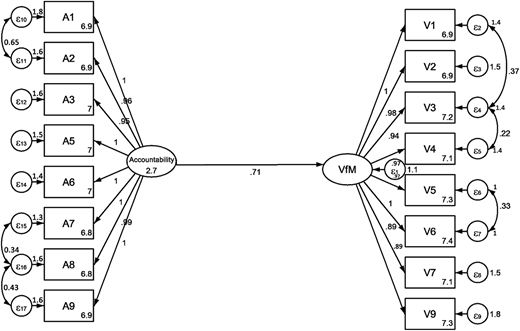
The purpose of structural equation modelling is twofold. First, it aims to obtain estimates of the parameters of the model, i.e. the factor loadings, the variances and covariance of the factor and the residual error variances of the observed variables. The second purpose is to assess the fit of the model, i.e. to assess whether the model itself provides a good fit to the data (Kline, 2023). The analysis for the Maximum likelihood estimation shows that 71% of VFM performance can be explained by accountability in LGAs procurement cycle and its specific parameter estimate shows statistically significant relationship (Coef = 0.71, Std err = 0.062, z = 10.73 and p> z = 0.000). Thus, the study findings support H1 that accountability in LGA procurement cycle has positive and significant influence on VFM adherence. This indicates accountability construct is a better predictor of VFM adherence in LGAs procurement cycle. Since VFM adherence has been contributed by transparency in the procurement cycle, therefore the improvement in governance has direct impact on VFM performance in public procurement projects. The statistical test for goodness of fit indicates that the model is consistent and over-identified or fit well with the data. This implies that goodness of fit adequately explains the hypothesised relationship accountability in LGAs procurement cycle and VFM adherence. The structural equation modelling output is presented in Figure 1.

The study findings confirmed that accountability in LGA procurement cycle has a positive and significant influence on value for money adherence. This finding is consistent with Anderson and Gray (2025) also agrees that to measure VFM for any given project or programme, accountability measures and legatee perceptions prerequisite to be well-thought-out. The study from Malinganya (2016) has a unlike opinion on how accountability is handled in Tanzania public procurement system where there is a lot of bureaucratic procedures with lot of hierarchical procurement decision making through different boards and committee which at the end inhibits individual accountability when things go off beam. His study further argues that, the collective decision-making approach by committees and boards should be reduced in predilection of individual decision-making excluding under special environments. Basheka (2021) also supports the study by asserting that, public procurement stresses on high-quality public governance in terms of transparency and accountability as well as effective management that can deliver optimum risk management and VFM. The findings concur with those of others because of the global contemporary traffic to embrace principles of good governance in terms of accountability as described by Ure (2024) who marked that presence of SDG 16 insists on fairer society spirit shouldn't from UN down to the organisational level in each country and ultimately to an individual level.

The study concludes that accountability is a very important governance agenda in public procurement because it helps those involved in the process to be responsible and reduces the chances for corruption in public procurement which in turn increase the chances for attaining VFM in public procurement cycle. Procurement personnel are also subjected to professional accountability marked by the compliance and appropriate professional practice of public officials in performing their duties. Therefore, the study concludes that there is a significant degree of accountability in LGA procurement cycle and statically significant positive relationship between accountability and VFM.

The study recommends the LGAs of Tanzania to have a clear chain of responsibilities for both public officers and contractors for better procurement project outcomes. Unaccountable decision making could increase the danger of corruption including the diversion of public resources, risk of costly project management and ultimately project failures. Based on SDG number 16 of a fairer society under National Implementation Strategy of Tanzania using target 16, the study recommends that the bureaucracy and long chain of approvals should be reduced because the engrossment of many people in procurement decision making makes it a grim to hold people accountable when anything goes off beam. Consequently, the difficult on who should be held accountable arises because of a very stretched process highlighted with absence of specific ownership of the decision.

However, this study has described the existing relationship between good governance and VFM of procurement process in the presence of accountability. The study was limited into only 14 LGAs from only 4 regions of Tanzania using the sample size of 270 respondents. Therefore, future study should include larger sample from more LGAs and from more regions of Tanzania for more appreciated representation of the subject matter for wider generalisation. Also, adoption of more advanced governance issues in procurement is a new fashionable practice to developing countries and therefore given this study was navigated using cross sectional design, future studies will benefit from using a longitudinal design to track on how accountability as the best public procurement practice is embraced in Tanzania.
Adeniyi
,
O.
,
Ojo
,
L. D.
,
Idowu
,
O. A.
, &
Kolawole
,
S. B.
(
2020
).
Compliance with the stipulated procurement process in local governments: A case from a developing nation
.
International Journal of Procurement Management
,
13
(
5
),
678
700
. doi: .
African Development Bank Group
(
2021
).
Annual report and financial report 2021
.
Retrieved from
 Link to the website (
accessed
 23 December 2024).
Anderson
,
J.
, &
Gray
,
B.
(
2025
).
A study of time value of money educational interventions
.
Financial Services Review
,
33
(
4
),
62
74
.
Basheka
,
B. C.
(
2021
). Public procurement governance: Toward an anti-corruption framework for public procurement in Uganda. In
Public Procurement, Corruption and the Crisis of Governance in Africa
(pp. 
113
141
).
Bayman
,
E. O.
, &
Dexter
,
F.
(
2021
).
Multicollinearity in logistic regression models
.
Anesthesia and Analgesia
,
133
(
2
),
362
365
. doi: .
Benington
,
J.
, &
Moore
,
M.
(
2011
). From private choice to public value. In
Public value: Theory and Practice
.
London
:
Macmillan Education
.
Berghmans
,
M.
(
2022
).
Accountability as a practice: A case study of a nongovernmental development programme in Tanzania
.
Development in Practice
,
32
(
5
),
647
659
. doi: .
Bollen
,
K. A.
(
1989
).
Structural equations with latent variables
.
New York, NY
:
Wiley
.
Bosio
,
E.
,
Djankov
,
S.
,
Glaeser
,
E.
, &
Shleifer
,
A.
(
2022
).
Public procurement in law and practice
.
American Economic Review
,
112
(
4
),
1091
1117
. doi: .
Bräutigam
,
D. A.
, &
Knack
,
S.
(
2016
).
Foreign aid, institutions, and governance in sub- Saharan Africa
.
Chicago, IL
:
The University of Chicago Press
.
Budi
,
A. S.
, &
Mashari
,
(
2024
).
Improving public service to achieve good corporate governance for the enhancement of regional revenue (PAD)
.
ICCCM Journal of Social Sciences and Humanities
,
3
(
2
),
55
64
. doi: .
Byrne
,
B. M.
(
2010
).
Structural equation modeling with AMOS: Basic concepts, applications, and programming
.
New York, NY
:
Routledge
.
Changalima
,
I. A.
,
Mushi
,
G. O.
, &
Mwaiseje
,
S. S.
(
2021
).
Procurement planning as a strategic tool for public procurement effectiveness: Experience from selected public procuring entities in Dodoma city, Tanzania
.
Journal of Public Procurement
,
21
(
1
),
37
52
. doi: .
Changalima
,
I. A.
,
Mwaiseje
,
S. S.
,
Mchopa
,
A. D.
, &
Panga
,
F. P.
(
2023
).
Challenges facing procurement and supply professions in Tanzania: Higher education students' perceptions
.
Journal of Applied Research in Higher Education
,
15
(
5
),
1407
1419
. doi: .
Chikwere
,
D.
,
Chikazhe
,
L.
, &
Tukuta
,
M.
(
2023
).
Value for money in public procurement: Experience from Zimbabwe’s rural district councils
.
Cogent Social Sciences
,
9
(
2
), 2244746. doi: .
Creswell
,
J. W.
, &
Creswell
,
J. D.
(
2017
).
Research design: Qualitative, quantitative, and mixed methods approaches
( (5th) ed.).
Thousand Oaks, CA
:
SAGE Publications
.
Djankov
,
S.
,
Islam
,
A. M.
&
Saliola
,
F.
(
2016
),
How large is public procurement in developing
.
Donahue
,
J. D.
, &
Zeckhauser
,
R. J.
(
2011
).
Governance and markets: Toward a new architecture for public policy
.
Cambridge, MA
:
Harvard University Press
.
Fazekas
,
M.
,
Sberna
,
S.
, &
Vannucci
,
A.
(
2022
).
The extra-legal governance of corruption: Tracing the organization of corruption in public procurement
.
Governance
,
35
(
4
),
1139
1161
. doi: .
Hafsa
,
F.
,
Darnall
,
N.
, &
Bretschneider
,
S.
(
2021
).
Estimating the true size of public procurement to assess sustainability impact
.
Sustainability
,
13
(
3
),
1448
. doi: .
Hair
,
J. F.
,
Hult
,
G. T. M.
,
Ringle
,
C.
, &
Sarstedt
,
M.
(
2017
).
A primer on partial least squares structural equation modeling (PLS - SEM)
.
Thousand Oaks, CA
:
Sage Publications
.
Han
,
Y.
,
Aryal
,
N.
, &
Hwang
,
K.
(
2024
).
Local governments accountability and public trust in Nepal: Does participation make a difference?
.
Asia and the Pacific Policy Studies
,
11
(
2
), e387. doi: .
Henseler
,
J.
,
Ringle
,
C. M.
, &
Sarstedt
,
M.
(
2015
).
A new criterion for assessing discriminant validity in variance-based structural equation modeling
.
Journal of the Academy of Marketing Science
,
43
(
1
),
115
135
. doi: .
Hunziker
,
S.
, &
Blankenagel
,
M.
(
2024
). Cross-sectional research design. In
Research Design in Business and Management: A Practical Guide for Students and Researchers
(pp. 
187
199
).
Wiesbaden
:
Springer Fachmedien Wiesbaden
.
Iseringhausen
,
M.
,
Petrella
,
I.
, &
Theodoridis
,
K.
(
2023
).
Aggregate skewness and the business cycle
.
Review of Economics and Statistics
,
53
(
1
),
1
38
. doi:.
Issah
,
O.
, &
Ackah
,
D.
(
2024
).
The role of organizational culture as a moderating factor in the relationship between e-procurement adoption, procurement performance, and value for money
.
African Journal of Procurement, Logistics and Supply Chain Management
,
7
(
9
),
1
23
. doi: .
Kalyuzhnova
,
Y.
,
Azhgaliyeva
,
D.
, &
Belitski
,
M.
(
2022
).
Public policy instruments for procurement: An Empirical Analysis
.
Technological Forecasting and Social Change
,
176
, 121472. doi: .
Karikari
,
A. M.
,
Tettevi
,
P. K.
,
Amaning
,
N.
,
Opoku Ware
,
E.
, &
Kwarteng
,
C.
(
2022
).
Modeling the implications of internal audit effectiveness on value for money and sustainable procurement performance: An application of structural equation modeling
.
Cogent Business and Management
,
9
(
1
), 2102127. doi: .
Kelly
,
G.
,
Mulgan
,
G.
, &
Muers
,
S.
(
2004
).
Creating public value: An analytical framework for public service reform
.
London, Cabinet Office Strategy Unit
.
Available from:
 Link to the website
Khairi
,
M. I.
,
Susanti
,
D.
, &
Sukono
,
S.
(
2021
).
Study on structural equation modeling for analyzing data
.
International Journal of Ethno-Sciences and Education Research
,
1
(
3
),
52
60
. doi: .
Khan
,
M. S.
,
Ahmad
,
S.
, &
Javed
,
A.
(
2020
).
Measuring value for money in public procurement: A conceptual framework
.
International Journal of Public Sector Management
,
33
(
7
),
863
879
.
Kibona
,
G.
,
Kimario
,
H.
, &
Kasambala
,
M.
(
2024
).
The value of professionalism: Implication for value for money in projects implemented by force account procurement method in Tanzania
.
African Journal of Accounting and Social Science Studies
,
6
(
2
),
62
80
. doi: .
Kimario
,
H. F.
, &
Kira
,
A. R.
(
2024
).
Cause – effect relationship of trust of buyer – suppliers' integration on procurement performance in large manufacturing firms in Tanzania
.
Journal of Global Operations and Strategic Sourcing
,
17
(
4
),
708
729
. doi: .
Kimario
,
H. F.
, &
Mwagike
,
L. R.
(
2024
).
Buyer–supplier collaboration's commitment. An antecedent for procurement performance of large manufacturing entities in Tanzania
.
Benchmarking: An International Journal
,
31
(
2
),
535
557
. doi: .
Kipo-Sunyehzi
,
D. D.
,
Abubakari
,
A. F.
, &
Banchani
,
J. P. S.
(
2024
).
Public procurement policies of Nigeria and Ghana: An analysis of the administrative challenges in achieving value for money
.
Journal of Public Procurement
,
24
(
2
),
193
209
.
Kline
,
R. B.
(
2023
).
Principles and practice of structural equation modeling
.
New York, NY
:
Guilford Publications
.
Knack
,
S.
,
Biletska
,
N.
, &
Kacker
,
K.
(
2019
).
Deterring kickbacks and encouraging entry in public procurement markets: Evidence from firm surveys in 90 developing countries
.
The World Bank Economic Review
,
33
(
2
),
287
309
. doi: .
Koeswayo
,
P. S.
,
Handoyo
,
S.
, &
Abdul Hasyir
,
D.
(
2024
).
Investigating the relationship between public governance and the corruption perception index
.
Cogent Social Sciences
,
10
(
1
), 2342513. doi: .
Kriksciuniene
,
D.
,
Sakalauskas
,
V.
, &
Lewandowski
,
R.
(
2019
).
Evaluating the interdependent effect for Likert scale items
. In
Business Information Systems Workshops: BIS 2019 International Workshops
,
Seville
,
June 26–28, 2019
,
Revised Papers 22
(pp. 
26
38
).
Springer International Publishing
.
Lauwo
,
S. G.
,
Azure
,
J. D. C.
, &
Hopper
,
T.
(
2022
).
Accountability and governance in implementing the sustainable development goals in a developing country context: Evidence from Tanzania
.
Accounting, Auditing and Accountability Journal
,
35
(
6
),
1431
1461
. doi: .
Lipman
,
P.
(
2023
). Beyond accountability: Toward schools that create new people for a new way of life. In
The Critical Pedagogy Reader
(pp. 
586
605
).
Routledge
.
Magoma
,
A.
(
2021
).
The influence of students’ perceptions on business mathematics performance: A case of the college of business education in Mwanza, Tanzania
.
Rural Planning Journal
,
23
(
2
),
23
39
.
Magoma
,
A.
,
Kimario
,
H.
, &
Kasheshi
,
E.
(
2024
).
Unveiling corporate environmental disclosure: The effects of gender diversity in boardrooms and audit committees
.
Journal of Artificial Societies and Social Simulation
,
5
,
131
149
. doi: .
Mahuwi
,
L.
, &
Israel
,
B.
(
2024
).
Promoting transparency and accountability towards anti-corruption in pharmaceutical procurement system: does e-procurement play a significant role?
 
Management Matters
,
21
(
1
),
20
37
.
Malinganya
,
E. C.
(
2016
).
The systemic flaws of the Tanzania public procurement act, cap. 410 and proposed solutions. A short paper submitted to the law review commission of Tanzania
.
Available from:
 Link to the website
Matto
,
M. C.
,
Ame
,
A. M.
, &
Nsimbila
,
P. M.
(
2021
).
Tender process and value for money in Tanzania public procurement
.
International Journal of Logistics Economics and Globalisation
,
9
(
1
),
1
23
. doi: .
Mchopa
,
A. D.
,
Kimario
,
H. F.
, &
Panga
,
F. P.
(
2023
).
Green procurement practices and performance of small scale manufacturing firms in Dar es Salaam region, Tanzania
. In
Applied Research Conference in Africa
,
Cham
(pp. 
233
242
).
Springer Nature Switzerland
.
Mchopa
,
A. D.
,
Changalima
,
I. A.
,
Sulle
,
G. R.
, &
Msofe
,
R. M.
(
2024
).
Public procurement trajectories in Tanzania: A review of reforms, practices, and compliance
.
Cogent Business and Management
,
11
(
1
), 2300498. doi: .
Moore
,
M. H.
(
1994
).
Public value as the focus of strategy
.
Australian Journal of Public Administration
,
53
(
3
),
296
303
. doi: .
Moore
,
M. H.
(
1995
).
Creating public value: Strategic management in government
.
Cambridge, Mass
:
Harvard University Press
.
Mulgan
,
G.
(
2000
).
Accountability: The governance of risk and trust
.
Oxford
:
Oxford University Press
.
Mwakolo
,
A.
,
Siwandeti
,
M.
,
Mahuwi
,
L.
, &
Israel
,
B.
(
2024
).
Procurement of good governance as a strategic tool for achieving value for money in public construction projects
.
LBS Journal of Management and Research
,
22
(
2
),
129
146
. doi: .
Mwakyeja
,
B.
, &
Kimario
,
H. F.
(
2024
).
Save life! Optimization of dynamics for pharmaceutical distribution performance
.
Management Matters
,
21
(
2
),
93
116
. doi: .
Ng’eni
,
F.
, &
Joseph Mdodo
,
Y.
(
2023
).
Impact of force account procurement methods in achieving value for money in Kigamboni municipal council, Tanzania
.
Local Administration Journal
,
16
(
4
),
463
480
.
Available from:
 Link to the website
Panya
,
K. O.
, &
Awuor
,
E.
(
2023
).
Public procurement reforms in Africa: Challenges, constraints and improvement opportunities
.
The Strategic Journal of Business and Change Management
,
10
(
2
),
1435
1456
.
Rivadeneira
,
A. M. R.
,
Dekyi
,
T.
, &
Cruz
,
L.
(
2023
).
OECD infrastructure governance indicators: Conceptual framework, design, methodology and preliminary results
.
Sajari
,
A.
,
Haron
,
H.
,
Ganesan
,
Y.
, &
Khalid
,
A. A.
(
2023
).
Factors influencing the level of ethics and integrity in Malaysian public sector
.
Journal of Islamic Accounting and Business Research
,
14
(
1
),
141
158
. doi: .
Samaratunge
,
R.
, &
Alam
,
Q.
(
2021
).
Accountability and transparency in emerging countries: Governance, democratic currents and change
.
Public Administration and Development
,
41
(
4
),
147
156
. doi: .
Sathyanarayana
,
S.
, &
Mohanasundaram
,
T.
(
2024
).
Fit indices in structural equation modeling and confirmatory factor analysis: Reporting guidelines
.
Asian Journal of Economics, Business and Accounting
,
24
(
7
),
561
577
. doi: .
Schumacker
,
R. E.
, &
Lomax
,
R. G.
(
2010
).
A beginner’s guide to structural equation modeling
( (3rd) ed.).
New York, NY
:
Routledge
.
Seppäläinen
,
K.
(
2024
).
Sustainability risk management in public procurement: A pathway to responsible governance
.
A thesis Submitted for the award of Master’s Programme in Supply Management at Lappeenranta - Lahti University of Technology, Finland
.
Shakya
,
R. K.
(
2012
, August). Procurement governance framework: Success to e-government procurement (E-GP) system implementation. In
5th international public procurement conference (IPPC5)
,
Seattle, United States
(pp.
17
19
).
Sheng
,
Y. K.
(
2008
).
What is good governance?
.
United Nations Economic and Social Commission for Asia and the Pacific (UNESCAP)
.
Available from:
 Link to the website
Staples
,
W. J.
(
2010
).
Public value in public sector infrastructure procurement (doctoral dissertation)
.
Australia
:
Royal Melbourne Institute of Technology
.
Available from:
 Link to the website
Taherdoost
,
H.
(
2019
).
What is the best response scale for survey and questionnaire design; review of different lengths of rating scale/attitude scale/Likert scale
.
Hamed Taherdoost
,
8
(
1
),
1
12
.
Testa
,
F.
,
Annunziata
,
E.
,
Iraldo
,
F.
, &
Frey
,
M.
(
2016
).
Drawbacks and opportunities of green public procurement: An effective tool for sustainable production
.
Journal of Cleaner Production
,
112
,
1893
1900
. doi: .
Turkel
,
E.
, &
Turkel
,
G.
(
2016
).
Public value theory: Reconciling public interests, administrative autonomy and efficiency
.
Review Pub Administration Management
,
4
(
2
),
189
. doi: .
Ure
,
J.
(
2024
). Civil society (SDGs 5, 9, 10, 12, 16). In
Achieving the United Nations Sustainable Development Goals: Late or Too Late?
(pp. 
115
164
).
Emerald Publishing
.
URT
(
2013
).
The public procurement regulations, 2013
.
Dar es Salaam
:
Government Printers
.
URT
(
2024
).
Controller auditor general report of Tanzania
.
Dodoma
.
West
,
S. G.
,
Wu
,
W.
,
McNeish
,
D.
, &
Savord
,
A.
(
2023
). Model fit in structural equation modeling. In
Handbook of Structural Equation Modeling
(Vol. 
2
, pp. 
184
205
).
World Bank
(
2016
).
Value for money: Achieving VfM in investment projects financed by the World Bank
.
Washington
:
World Bank Publications
.
Available from:
 Link to the website
Yauri-Miranda
,
J. R.
(
2021
).
Principles to assess accountability: A study of intelligence agencies in Spain and Brazil
.
International Journal of Intelligence and CounterIntelligence
,
34
(
3
),
583
613
. doi: .
Zhao
,
J.
,
Thurairajah
,
N.
,
Greenwood
,
D.
,
Liu
,
H.
, &
Yuan
,
J.
(
2023
).
Unpacking the context of value for money assessment in global markets: A procurement option framework for public-private partnerships
.
Engineering, Construction and Architectural Management
,
30
(
8
),
3583
3601
. doi: .
Cheung
,
G. W.
,
Cooper-Thomas
,
H. D.
,
Lau
,
R. S.
, &
Wang
,
L. C.
(
2024
).
Reporting reliability, convergent and discriminant validity with structural equation modeling: A review and best-practice recommendations
.
Asia Pacific Journal of Management
,
41
(
2
),
745
783
. doi: .
Karunasingha
,
D. S. K.
(
2022
).
Root mean square error or mean absolute error? Use their ratio as well
.
Information Sciences
,
585
,
609
629
. doi: .
URT
(
2016
).
Controller auditor general report of Tanzania
.
Dodoma
.
Published in the Business Analyst Journal. Published by Emerald Publishing Limited. This article is published under the Creative Commons Attribution (CC BY 4.0) license. Anyone may reproduce, distribute, translate and create derivative works of this article (for both commercial and non-commercial purposes), subject to full attribution to the original publication and authors. The full terms of this license may be seen at Link to the terms of the CC BY 4.0 licence.

Data & Figures

Figure 1
A structural equation model shows “Accountability” influencing “V f M” with multiple indicators and error terms.The structural equation model shows two latent variables, each represented by oval nodes labeled “Accountability” and “V f M”. “Accountability” is positioned at the center left with an inner value of “2.7”. From “Accountability”, eight arrows point leftward to eight rectangles arranged in a vertical series and labeled from top to bottom as follows: “A 1”, “A 2”, “A 3”, “A 5”, “A 6”, “A 7”, “A 8”, and “A 9”. These arrows are labeled “1”, “0.96”, “0.95”, “1”, “1”, “1”, “0.99”, and “1”, respectively. Each rectangle contains a numerical value in the bottom right corner. The values are as follows: “6.9”, “6.9”, “7”, “7”, “7”, “6.8”, “6.8”, and “6.9”, respectively. Each rectangle has an associated error term shown as circles labeled “epsilon 10”, “epsilon 11”, “epsilon 12”, “epsilon 13”, “epsilon 14”, “epsilon 15”, “epsilon 16”, and “epsilon 17”, respectively, positioned on the left. Individual arrows point to the rectangles, and the arrows are labeled as follows: “1.8”, “1.6”, “1.6”, “1.5”, “1.4”, “1.3”, “1.6”, and “1.6”, respectively. Curved double-headed arrows are present labeled as follows: between “epsilon 10” and “epsilon 11” is “0.65”, between “epsilon 15” and “epsilon 16” is “0.34”, and between “epsilon 16” and “epsilon 17” is “0.43”. A rightward arrow labeled “0.71” connects “Accountability” to “V f M”, positioned on the center right. From “V f M”, eight arrows point rightward to eight rectangles arranged in a vertical series and labeled from top to bottom as follows: “V 1”, “V 2”, “V 3”, “V 4”, “V 5”, “V 6”, “V 7”, and “V 9”. These arrows are labeled as follows: “1”, “0.98”, “0.94”, “1.1”, “1”, “0.89”, and “0.89”, respectively. Each rectangle contains a value in the bottom right corner. The values are as follows: “6.9”, “6.9”, “7.2”, “7.1”, “7.3”, “7.4”, “7.1”, and “7.3”, respectively. Each indicator has an associated error term shown as circles labeled “epsilon 2”, “epsilon 3”, “epsilon 4”, “epsilon 5”, “epsilon 6”, “epsilon 7”, “epsilon 8”, and “epsilon 9”, respectively, positioned on the right. Individual values are positioned to the right of the circles. The values are labeled as follows: “1.4”, “1.5”, “1.4”, “1.4”, “1”, “1”, “1.5”, and “1.8”, respectively. Individual rightward arrows point from the circles to the corresponding rectangles. Curved double-headed arrows are present, labeled as follows: between “epsilon 2” and “epsilon 4” is “0.37”, between “epsilon 4” and “epsilon 5” is “0.22”, and between “epsilon 6” and “epsilon 7” is “0.33”. An error term labeled “epsilon 1” with value “.97” points to “V f M” via a leftward arrow. The value “1.1” is positioned to its right.

Structural equation model results for accountability and VFM. Source: Field data (2023)

Figure 1
A structural equation model shows “Accountability” influencing “V f M” with multiple indicators and error terms.The structural equation model shows two latent variables, each represented by oval nodes labeled “Accountability” and “V f M”. “Accountability” is positioned at the center left with an inner value of “2.7”. From “Accountability”, eight arrows point leftward to eight rectangles arranged in a vertical series and labeled from top to bottom as follows: “A 1”, “A 2”, “A 3”, “A 5”, “A 6”, “A 7”, “A 8”, and “A 9”. These arrows are labeled “1”, “0.96”, “0.95”, “1”, “1”, “1”, “0.99”, and “1”, respectively. Each rectangle contains a numerical value in the bottom right corner. The values are as follows: “6.9”, “6.9”, “7”, “7”, “7”, “6.8”, “6.8”, and “6.9”, respectively. Each rectangle has an associated error term shown as circles labeled “epsilon 10”, “epsilon 11”, “epsilon 12”, “epsilon 13”, “epsilon 14”, “epsilon 15”, “epsilon 16”, and “epsilon 17”, respectively, positioned on the left. Individual arrows point to the rectangles, and the arrows are labeled as follows: “1.8”, “1.6”, “1.6”, “1.5”, “1.4”, “1.3”, “1.6”, and “1.6”, respectively. Curved double-headed arrows are present labeled as follows: between “epsilon 10” and “epsilon 11” is “0.65”, between “epsilon 15” and “epsilon 16” is “0.34”, and between “epsilon 16” and “epsilon 17” is “0.43”. A rightward arrow labeled “0.71” connects “Accountability” to “V f M”, positioned on the center right. From “V f M”, eight arrows point rightward to eight rectangles arranged in a vertical series and labeled from top to bottom as follows: “V 1”, “V 2”, “V 3”, “V 4”, “V 5”, “V 6”, “V 7”, and “V 9”. These arrows are labeled as follows: “1”, “0.98”, “0.94”, “1.1”, “1”, “0.89”, and “0.89”, respectively. Each rectangle contains a value in the bottom right corner. The values are as follows: “6.9”, “6.9”, “7.2”, “7.1”, “7.3”, “7.4”, “7.1”, and “7.3”, respectively. Each indicator has an associated error term shown as circles labeled “epsilon 2”, “epsilon 3”, “epsilon 4”, “epsilon 5”, “epsilon 6”, “epsilon 7”, “epsilon 8”, and “epsilon 9”, respectively, positioned on the right. Individual values are positioned to the right of the circles. The values are labeled as follows: “1.4”, “1.5”, “1.4”, “1.4”, “1”, “1”, “1.5”, and “1.8”, respectively. Individual rightward arrows point from the circles to the corresponding rectangles. Curved double-headed arrows are present, labeled as follows: between “epsilon 2” and “epsilon 4” is “0.37”, between “epsilon 4” and “epsilon 5” is “0.22”, and between “epsilon 6” and “epsilon 7” is “0.33”. An error term labeled “epsilon 1” with value “.97” points to “V f M” via a leftward arrow. The value “1.1” is positioned to its right.

Structural equation model results for accountability and VFM. Source: Field data (2023)

Close modal
Table 1

The perception on accountability in LGA procurement cycle

S/nAccountability variables in public procurementMeanS.D
A1Holders of public office are accountable for their decisions and actions on procurement6.93682.12828
A2There is clear chain of responsibility in LGA procurement cycle implementation6.94422.02610
A3There is effective internal audit and control mechanism6.98142.02310
A4Bidders' complaints are handled in an effective and timely manner6.72862.24039
A5There is a clear and efficient mechanism for audit7.02972.11230
A6Commitment of public officers to high standards for professional conduct and principles6.96282.01453
A7Existing systems and procedures for administrative sanctions against defaulting public officers6.75092.02624
A8Existing systems and procedures for bidders to file a protest in any stage of the procurement6.84012.06438
A9Defaulting public officers are made accountable for their decisions or misconduct in the procurement process6.88102.09316
 Average mean and standard deviation6.895052.0809
Source(s): Field Data (2023)
Table 2

Perception on value for money adherence in LGA procurement cycle

S/nVfMMeanStandard deviation
V1Quality control system in during project designs6.87361.97909
V2Relevance of the project to the community6.90331.98077
V3Pricing of the items in the Bill of Quantity (BOQ) for costing of projects7.22681.91534
V4Selection of competent bidders during tendering stage7.10781.91213
V5Adequate supervision of contracts7.32341.83749
V6Adequate monitoring of contracts7.41261.89579
V7Honesty/integrity among the supervising engineers and technicians7.11151.87546
V8Issuing extension of contract variations6.37552.35875
V9Keeping adequate record of projects7.26391.94539
V10Timely completion of Contracts6.22302.23825
 Average6.982141.993846
Source(s): Field data (2023)
Table 3

Goodness of fit for accountability in LGA procurement cycle against VFM

Type of testAmount of coefficient
Likelihood ratio measured by chi-square276.49
p-value0.000
Root mean squared error of approximation0.078
Standardised root mean square residual0.076
Comparative fit index0.947
Trucker-Lewis index0.935
Akaike's information criterion14,975
Bayesian information criterion15,173
Source(s): Field Data (2023)

Supplements

References

Adeniyi
,
O.
,
Ojo
,
L. D.
,
Idowu
,
O. A.
, &
Kolawole
,
S. B.
(
2020
).
Compliance with the stipulated procurement process in local governments: A case from a developing nation
.
International Journal of Procurement Management
,
13
(
5
),
678
700
. doi: .
African Development Bank Group
(
2021
).
Annual report and financial report 2021
.
Retrieved from
 Link to the website (
accessed
 23 December 2024).
Anderson
,
J.
, &
Gray
,
B.
(
2025
).
A study of time value of money educational interventions
.
Financial Services Review
,
33
(
4
),
62
74
.
Basheka
,
B. C.
(
2021
). Public procurement governance: Toward an anti-corruption framework for public procurement in Uganda. In
Public Procurement, Corruption and the Crisis of Governance in Africa
(pp. 
113
141
).
Bayman
,
E. O.
, &
Dexter
,
F.
(
2021
).
Multicollinearity in logistic regression models
.
Anesthesia and Analgesia
,
133
(
2
),
362
365
. doi: .
Benington
,
J.
, &
Moore
,
M.
(
2011
). From private choice to public value. In
Public value: Theory and Practice
.
London
:
Macmillan Education
.
Berghmans
,
M.
(
2022
).
Accountability as a practice: A case study of a nongovernmental development programme in Tanzania
.
Development in Practice
,
32
(
5
),
647
659
. doi: .
Bollen
,
K. A.
(
1989
).
Structural equations with latent variables
.
New York, NY
:
Wiley
.
Bosio
,
E.
,
Djankov
,
S.
,
Glaeser
,
E.
, &
Shleifer
,
A.
(
2022
).
Public procurement in law and practice
.
American Economic Review
,
112
(
4
),
1091
1117
. doi: .
Bräutigam
,
D. A.
, &
Knack
,
S.
(
2016
).
Foreign aid, institutions, and governance in sub- Saharan Africa
.
Chicago, IL
:
The University of Chicago Press
.
Budi
,
A. S.
, &
Mashari
,
(
2024
).
Improving public service to achieve good corporate governance for the enhancement of regional revenue (PAD)
.
ICCCM Journal of Social Sciences and Humanities
,
3
(
2
),
55
64
. doi: .
Byrne
,
B. M.
(
2010
).
Structural equation modeling with AMOS: Basic concepts, applications, and programming
.
New York, NY
:
Routledge
.
Changalima
,
I. A.
,
Mushi
,
G. O.
, &
Mwaiseje
,
S. S.
(
2021
).
Procurement planning as a strategic tool for public procurement effectiveness: Experience from selected public procuring entities in Dodoma city, Tanzania
.
Journal of Public Procurement
,
21
(
1
),
37
52
. doi: .
Changalima
,
I. A.
,
Mwaiseje
,
S. S.
,
Mchopa
,
A. D.
, &
Panga
,
F. P.
(
2023
).
Challenges facing procurement and supply professions in Tanzania: Higher education students' perceptions
.
Journal of Applied Research in Higher Education
,
15
(
5
),
1407
1419
. doi: .
Chikwere
,
D.
,
Chikazhe
,
L.
, &
Tukuta
,
M.
(
2023
).
Value for money in public procurement: Experience from Zimbabwe’s rural district councils
.
Cogent Social Sciences
,
9
(
2
), 2244746. doi: .
Creswell
,
J. W.
, &
Creswell
,
J. D.
(
2017
).
Research design: Qualitative, quantitative, and mixed methods approaches
( (5th) ed.).
Thousand Oaks, CA
:
SAGE Publications
.
Djankov
,
S.
,
Islam
,
A. M.
&
Saliola
,
F.
(
2016
),
How large is public procurement in developing
.
Donahue
,
J. D.
, &
Zeckhauser
,
R. J.
(
2011
).
Governance and markets: Toward a new architecture for public policy
.
Cambridge, MA
:
Harvard University Press
.
Fazekas
,
M.
,
Sberna
,
S.
, &
Vannucci
,
A.
(
2022
).
The extra-legal governance of corruption: Tracing the organization of corruption in public procurement
.
Governance
,
35
(
4
),
1139
1161
. doi: .
Hafsa
,
F.
,
Darnall
,
N.
, &
Bretschneider
,
S.
(
2021
).
Estimating the true size of public procurement to assess sustainability impact
.
Sustainability
,
13
(
3
),
1448
. doi: .
Hair
,
J. F.
,
Hult
,
G. T. M.
,
Ringle
,
C.
, &
Sarstedt
,
M.
(
2017
).
A primer on partial least squares structural equation modeling (PLS - SEM)
.
Thousand Oaks, CA
:
Sage Publications
.
Han
,
Y.
,
Aryal
,
N.
, &
Hwang
,
K.
(
2024
).
Local governments accountability and public trust in Nepal: Does participation make a difference?
.
Asia and the Pacific Policy Studies
,
11
(
2
), e387. doi: .
Henseler
,
J.
,
Ringle
,
C. M.
, &
Sarstedt
,
M.
(
2015
).
A new criterion for assessing discriminant validity in variance-based structural equation modeling
.
Journal of the Academy of Marketing Science
,
43
(
1
),
115
135
. doi: .
Hunziker
,
S.
, &
Blankenagel
,
M.
(
2024
). Cross-sectional research design. In
Research Design in Business and Management: A Practical Guide for Students and Researchers
(pp. 
187
199
).
Wiesbaden
:
Springer Fachmedien Wiesbaden
.
Iseringhausen
,
M.
,
Petrella
,
I.
, &
Theodoridis
,
K.
(
2023
).
Aggregate skewness and the business cycle
.
Review of Economics and Statistics
,
53
(
1
),
1
38
. doi:.
Issah
,
O.
, &
Ackah
,
D.
(
2024
).
The role of organizational culture as a moderating factor in the relationship between e-procurement adoption, procurement performance, and value for money
.
African Journal of Procurement, Logistics and Supply Chain Management
,
7
(
9
),
1
23
. doi: .
Kalyuzhnova
,
Y.
,
Azhgaliyeva
,
D.
, &
Belitski
,
M.
(
2022
).
Public policy instruments for procurement: An Empirical Analysis
.
Technological Forecasting and Social Change
,
176
, 121472. doi: .
Karikari
,
A. M.
,
Tettevi
,
P. K.
,
Amaning
,
N.
,
Opoku Ware
,
E.
, &
Kwarteng
,
C.
(
2022
).
Modeling the implications of internal audit effectiveness on value for money and sustainable procurement performance: An application of structural equation modeling
.
Cogent Business and Management
,
9
(
1
), 2102127. doi: .
Kelly
,
G.
,
Mulgan
,
G.
, &
Muers
,
S.
(
2004
).
Creating public value: An analytical framework for public service reform
.
London, Cabinet Office Strategy Unit
.
Available from:
 Link to the website
Khairi
,
M. I.
,
Susanti
,
D.
, &
Sukono
,
S.
(
2021
).
Study on structural equation modeling for analyzing data
.
International Journal of Ethno-Sciences and Education Research
,
1
(
3
),
52
60
. doi: .
Khan
,
M. S.
,
Ahmad
,
S.
, &
Javed
,
A.
(
2020
).
Measuring value for money in public procurement: A conceptual framework
.
International Journal of Public Sector Management
,
33
(
7
),
863
879
.
Kibona
,
G.
,
Kimario
,
H.
, &
Kasambala
,
M.
(
2024
).
The value of professionalism: Implication for value for money in projects implemented by force account procurement method in Tanzania
.
African Journal of Accounting and Social Science Studies
,
6
(
2
),
62
80
. doi: .
Kimario
,
H. F.
, &
Kira
,
A. R.
(
2024
).
Cause – effect relationship of trust of buyer – suppliers' integration on procurement performance in large manufacturing firms in Tanzania
.
Journal of Global Operations and Strategic Sourcing
,
17
(
4
),
708
729
. doi: .
Kimario
,
H. F.
, &
Mwagike
,
L. R.
(
2024
).
Buyer–supplier collaboration's commitment. An antecedent for procurement performance of large manufacturing entities in Tanzania
.
Benchmarking: An International Journal
,
31
(
2
),
535
557
. doi: .
Kipo-Sunyehzi
,
D. D.
,
Abubakari
,
A. F.
, &
Banchani
,
J. P. S.
(
2024
).
Public procurement policies of Nigeria and Ghana: An analysis of the administrative challenges in achieving value for money
.
Journal of Public Procurement
,
24
(
2
),
193
209
.
Kline
,
R. B.
(
2023
).
Principles and practice of structural equation modeling
.
New York, NY
:
Guilford Publications
.
Knack
,
S.
,
Biletska
,
N.
, &
Kacker
,
K.
(
2019
).
Deterring kickbacks and encouraging entry in public procurement markets: Evidence from firm surveys in 90 developing countries
.
The World Bank Economic Review
,
33
(
2
),
287
309
. doi: .
Koeswayo
,
P. S.
,
Handoyo
,
S.
, &
Abdul Hasyir
,
D.
(
2024
).
Investigating the relationship between public governance and the corruption perception index
.
Cogent Social Sciences
,
10
(
1
), 2342513. doi: .
Kriksciuniene
,
D.
,
Sakalauskas
,
V.
, &
Lewandowski
,
R.
(
2019
).
Evaluating the interdependent effect for Likert scale items
. In
Business Information Systems Workshops: BIS 2019 International Workshops
,
Seville
,
June 26–28, 2019
,
Revised Papers 22
(pp. 
26
38
).
Springer International Publishing
.
Lauwo
,
S. G.
,
Azure
,
J. D. C.
, &
Hopper
,
T.
(
2022
).
Accountability and governance in implementing the sustainable development goals in a developing country context: Evidence from Tanzania
.
Accounting, Auditing and Accountability Journal
,
35
(
6
),
1431
1461
. doi: .
Lipman
,
P.
(
2023
). Beyond accountability: Toward schools that create new people for a new way of life. In
The Critical Pedagogy Reader
(pp. 
586
605
).
Routledge
.
Magoma
,
A.
(
2021
).
The influence of students’ perceptions on business mathematics performance: A case of the college of business education in Mwanza, Tanzania
.
Rural Planning Journal
,
23
(
2
),
23
39
.
Magoma
,
A.
,
Kimario
,
H.
, &
Kasheshi
,
E.
(
2024
).
Unveiling corporate environmental disclosure: The effects of gender diversity in boardrooms and audit committees
.
Journal of Artificial Societies and Social Simulation
,
5
,
131
149
. doi: .
Mahuwi
,
L.
, &
Israel
,
B.
(
2024
).
Promoting transparency and accountability towards anti-corruption in pharmaceutical procurement system: does e-procurement play a significant role?
 
Management Matters
,
21
(
1
),
20
37
.
Malinganya
,
E. C.
(
2016
).
The systemic flaws of the Tanzania public procurement act, cap. 410 and proposed solutions. A short paper submitted to the law review commission of Tanzania
.
Available from:
 Link to the website
Matto
,
M. C.
,
Ame
,
A. M.
, &
Nsimbila
,
P. M.
(
2021
).
Tender process and value for money in Tanzania public procurement
.
International Journal of Logistics Economics and Globalisation
,
9
(
1
),
1
23
. doi: .
Mchopa
,
A. D.
,
Kimario
,
H. F.
, &
Panga
,
F. P.
(
2023
).
Green procurement practices and performance of small scale manufacturing firms in Dar es Salaam region, Tanzania
. In
Applied Research Conference in Africa
,
Cham
(pp. 
233
242
).
Springer Nature Switzerland
.
Mchopa
,
A. D.
,
Changalima
,
I. A.
,
Sulle
,
G. R.
, &
Msofe
,
R. M.
(
2024
).
Public procurement trajectories in Tanzania: A review of reforms, practices, and compliance
.
Cogent Business and Management
,
11
(
1
), 2300498. doi: .
Moore
,
M. H.
(
1994
).
Public value as the focus of strategy
.
Australian Journal of Public Administration
,
53
(
3
),
296
303
. doi: .
Moore
,
M. H.
(
1995
).
Creating public value: Strategic management in government
.
Cambridge, Mass
:
Harvard University Press
.
Mulgan
,
G.
(
2000
).
Accountability: The governance of risk and trust
.
Oxford
:
Oxford University Press
.
Mwakolo
,
A.
,
Siwandeti
,
M.
,
Mahuwi
,
L.
, &
Israel
,
B.
(
2024
).
Procurement of good governance as a strategic tool for achieving value for money in public construction projects
.
LBS Journal of Management and Research
,
22
(
2
),
129
146
. doi: .
Mwakyeja
,
B.
, &
Kimario
,
H. F.
(
2024
).
Save life! Optimization of dynamics for pharmaceutical distribution performance
.
Management Matters
,
21
(
2
),
93
116
. doi: .
Ng’eni
,
F.
, &
Joseph Mdodo
,
Y.
(
2023
).
Impact of force account procurement methods in achieving value for money in Kigamboni municipal council, Tanzania
.
Local Administration Journal
,
16
(
4
),
463
480
.
Available from:
 Link to the website
Panya
,
K. O.
, &
Awuor
,
E.
(
2023
).
Public procurement reforms in Africa: Challenges, constraints and improvement opportunities
.
The Strategic Journal of Business and Change Management
,
10
(
2
),
1435
1456
.
Rivadeneira
,
A. M. R.
,
Dekyi
,
T.
, &
Cruz
,
L.
(
2023
).
OECD infrastructure governance indicators: Conceptual framework, design, methodology and preliminary results
.
Sajari
,
A.
,
Haron
,
H.
,
Ganesan
,
Y.
, &
Khalid
,
A. A.
(
2023
).
Factors influencing the level of ethics and integrity in Malaysian public sector
.
Journal of Islamic Accounting and Business Research
,
14
(
1
),
141
158
. doi: .
Samaratunge
,
R.
, &
Alam
,
Q.
(
2021
).
Accountability and transparency in emerging countries: Governance, democratic currents and change
.
Public Administration and Development
,
41
(
4
),
147
156
. doi: .
Sathyanarayana
,
S.
, &
Mohanasundaram
,
T.
(
2024
).
Fit indices in structural equation modeling and confirmatory factor analysis: Reporting guidelines
.
Asian Journal of Economics, Business and Accounting
,
24
(
7
),
561
577
. doi: .
Schumacker
,
R. E.
, &
Lomax
,
R. G.
(
2010
).
A beginner’s guide to structural equation modeling
( (3rd) ed.).
New York, NY
:
Routledge
.
Seppäläinen
,
K.
(
2024
).
Sustainability risk management in public procurement: A pathway to responsible governance
.
A thesis Submitted for the award of Master’s Programme in Supply Management at Lappeenranta - Lahti University of Technology, Finland
.
Shakya
,
R. K.
(
2012
, August). Procurement governance framework: Success to e-government procurement (E-GP) system implementation. In
5th international public procurement conference (IPPC5)
,
Seattle, United States
(pp.
17
19
).
Sheng
,
Y. K.
(
2008
).
What is good governance?
.
United Nations Economic and Social Commission for Asia and the Pacific (UNESCAP)
.
Available from:
 Link to the website
Staples
,
W. J.
(
2010
).
Public value in public sector infrastructure procurement (doctoral dissertation)
.
Australia
:
Royal Melbourne Institute of Technology
.
Available from:
 Link to the website
Taherdoost
,
H.
(
2019
).
What is the best response scale for survey and questionnaire design; review of different lengths of rating scale/attitude scale/Likert scale
.
Hamed Taherdoost
,
8
(
1
),
1
12
.
Testa
,
F.
,
Annunziata
,
E.
,
Iraldo
,
F.
, &
Frey
,
M.
(
2016
).
Drawbacks and opportunities of green public procurement: An effective tool for sustainable production
.
Journal of Cleaner Production
,
112
,
1893
1900
. doi: .
Turkel
,
E.
, &
Turkel
,
G.
(
2016
).
Public value theory: Reconciling public interests, administrative autonomy and efficiency
.
Review Pub Administration Management
,
4
(
2
),
189
. doi: .
Ure
,
J.
(
2024
). Civil society (SDGs 5, 9, 10, 12, 16). In
Achieving the United Nations Sustainable Development Goals: Late or Too Late?
(pp. 
115
164
).
Emerald Publishing
.
URT
(
2013
).
The public procurement regulations, 2013
.
Dar es Salaam
:
Government Printers
.
URT
(
2024
).
Controller auditor general report of Tanzania
.
Dodoma
.
West
,
S. G.
,
Wu
,
W.
,
McNeish
,
D.
, &
Savord
,
A.
(
2023
). Model fit in structural equation modeling. In
Handbook of Structural Equation Modeling
(Vol. 
2
, pp. 
184
205
).
World Bank
(
2016
).
Value for money: Achieving VfM in investment projects financed by the World Bank
.
Washington
:
World Bank Publications
.
Available from:
 Link to the website
Yauri-Miranda
,
J. R.
(
2021
).
Principles to assess accountability: A study of intelligence agencies in Spain and Brazil
.
International Journal of Intelligence and CounterIntelligence
,
34
(
3
),
583
613
. doi: .
Zhao
,
J.
,
Thurairajah
,
N.
,
Greenwood
,
D.
,
Liu
,
H.
, &
Yuan
,
J.
(
2023
).
Unpacking the context of value for money assessment in global markets: A procurement option framework for public-private partnerships
.
Engineering, Construction and Architectural Management
,
30
(
8
),
3583
3601
. doi: .
Cheung
,
G. W.
,
Cooper-Thomas
,
H. D.
,
Lau
,
R. S.
, &
Wang
,
L. C.
(
2024
).
Reporting reliability, convergent and discriminant validity with structural equation modeling: A review and best-practice recommendations
.
Asia Pacific Journal of Management
,
41
(
2
),
745
783
. doi: .
Karunasingha
,
D. S. K.
(
2022
).
Root mean square error or mean absolute error? Use their ratio as well
.
Information Sciences
,
585
,
609
629
. doi: .
URT
(
2016
).
Controller auditor general report of Tanzania
.
Dodoma
.

Languages

or Create an Account

Close Modal
Close Modal
