


This study addresses the integration of Industry 4.0 (I4.0) technologies with circular economy (CE) principles in the UAE construction sector, aligning with the UAE Circular Economy Policy 2021–2031 (UAECEP). It explores how digital tools can facilitate sustainable construction practices by enhancing resource efficiency, reducing waste and supporting circularity across the building life cycle.
A systematic literature review (SLR) was conducted to identify frameworks that integrate I4.0 technologies with CE principles. Based on the review, a conceptual framework was developed and refined to meet the UAE construction sector’s specific needs, focusing on applying digital tools at different stages of construction.
Integrating I4.0 tools, including building information modeling (BIM), the Internet of Things (IoT) and artificial intelligence (AI), can enhance resource efficiency, reduce waste and promote sustainability in the UAE’s construction sector. The framework aligns digital transformation efforts with the UAECEP, indicating these technologies’ applicability in design, construction, operation and end-of-life stages. Key challenges include high initial costs, technical limitations and the need for regulatory support.
This study offers a novel framework tailored to the UAE construction sector, bridging the gap between policy objectives and practical implementation. It provides strategies to overcome local challenges through stakeholder collaboration and digital innovation, contributing to the UAE’s sustainability goals.
1. Introduction
Industry 4.0 (I4.0) represents advancements in production technologies, transitioning from human-driven processes to autonomous systems (Özköse and Güney, 2023). These technologies reduce costs, accelerate processes, and enhance productivity (Rüßmann et al., 2015), though sectors like construction have struggled with integrating them (Oesterreich and Teuteberg, 2016). The construction industry accounts for 40% of natural resource depletion and 25% of global waste (Kaza et al., 2018; Achayra et al., 2018), with 35% of construction and demolition waste (CDW) ending up in landfills (Menegaki and Damigos, 2018). Shifting from a linear model to circular economy (CE) principles, focusing on waste reduction and material reuse, is essential (Ossio et al., 2023). CE seeks to maximize resource recirculation and minimize waste (Ellen MacArthur Foundation, 2019).
Interest in CE within construction has surged, with publications rising since 2017 (Benachio et al., 2020). Pomponi and Moncaster (2017) emphasized the need for a holistic CE approach covering entire building life cycles, while Huang et al. (2018) highlighted the role of government incentives. As noted by van Bueren et al. (2019), standardized frameworks are also crucial. Research integrating digital technologies, such as Building Information Modeling (BIM) for material tracking (Akanbi et al., 2018) and the Internet of Things (IoT) for real-time monitoring of building materials (Sigrid Nordby, 2019), underscores their importance in advancing CE principles in construction (Hossain et al., 2020).
Despite progress, gaps remain in applying I4.0 technologies in the UAE’s construction sector. While life cycle assessments are vital for evaluating environmental impacts, they lack advanced digital technologies for CE practices (Dsilva et al., 2023), and procurement strategies often fail to leverage I4.0 for life cycle circularity (Ahmed et al., 2024). Similarly, managing CDW using BIM and 3D printing shows potential, but broader I4.0 applications across life cycle stages are underexplored (Nie et al., 2023).
The UAE’s Circular Economy Policy 2021–2031 (UAECEP) outlines a national agenda strategy for transitioning to a circular model focused on sustainable resource management (Sami Ur Rehman et al., 2022). While the policy sets broad goals, it lacks sector-specific guidelines on how these principles should be practically implemented, particularly concerning integrating digital tools. This study addresses this gap by developing a policy-aligned conceptual framework that operationalizes the UAECEP by integrating I4.0 technologies, offering actionable guidance for the UAE construction sector to enhance resource efficiency, reduce waste, and support sustainability.
This policy-aligned framework provides the sector-specific tools necessary to apply I4.0 technologies across the construction life cycle. By bridging the gap between policy objectives and real-world implementation, this framework contributes to the body of knowledge. It offers strategies for stakeholders, including government bodies, industry players, and regulatory authorities. This study aims to answer the following research questions:
How can I4.0 technologies be applied across the construction life cycle to promote circular economy principles and improve resource efficiency in the UAE construction industry?
What are the main challenges and limitations in implementing I4.0 technologies for CE practices in the UAE construction sector?
This article is organized into six sections. Section two discusses CE in the UAE construction industry, highlighting key initiatives and practices. Section three details the methodology, including research design, data collection, and analysis. Section four reviews existing frameworks for I4.0 tools in promoting circular practices. Section five presents the framework development. Section six concludes with recommendations and future research directions.
2. Mapping circularity in the UAE construction industry
2.1 The UAE sustainability agenda and the UAECEP
The UAE is committed to sustainable development and aligns its national strategies with global initiatives, such as the UN 2030 Agenda (National Committee in Sustainable Development Goals, 2018). The UAECEP, launched in March 2021, provides a national outline for transitioning to a CE, focusing on sustainable resource management and waste reduction (Government of the United Arab Emirates, 2021). Additionally, the UAE announced its Net-Zero Emission Strategy 2050, targeting key sectors such as industry, energy, and transport (National Committee on Sustainable Development Goals, 2022).
Aligned with SDG 12 and the Green Agenda 2030, the UAECEP has three main objectives: sustainable economic management and resource use, promoting CE to reduce environmental impact, and encouraging cleaner industrial production with I4.0 technology. It identifies four priority areas: sustainable manufacturing, green infrastructure, sustainable transportation, and sustainable food production and consumption (Government of the United Arab Emirates, 2021). The Green Infrastructure and Development component focuses on efficient infrastructure design and construction using circular strategies to reduce pollution, enhance urban productivity, and improve access to goods, services, and housing. It outlines six main action groups to achieve these goals:
Vision, strategy, information, and awareness: Four initiatives to develop smart urban plans, increase awareness of recycled materials, and emphasize data sharing for circular strategies.
Capacity, building, and business support: Seven actions focus on incorporating CE into business design and construction, enhancing the use of recycled materials, and promoting international cooperation.
Research development and collaboration: Eight actions support the R&D of new CE materials and frameworks, emphasizing public-private collaboration and stakeholder communication.
Public procurement and infrastructure investment: Eight actions promote CE principles in the public sector, integrating social, environmental, and economic dimensions into urban planning.
Legal and regulatory framework: Five initiatives analyze national policies to support circularity, propose frameworks favoring recycled materials, and incorporate CE principles into green building standards.
Economic incentives: Five actions propose economic measures to improve material use and implement circular practices in existing infrastructure.
Transitioning to a CE model will yield economic, environmental, and social benefits. The UAE’s highly competitive economy, market, and regulatory failures could hinder circularity adoption (Government of the United Arab Emirates, 2021).
2.2 Circular construction practices
The UAE’s construction industry is well-established and recognized globally. After transitioning from an oil-based economy, the country now relies on tourism and business, fostering grand-scale infrastructure projects (Sami Ur Rehman et al., 2022). Significant investments and government support promote non-oil activities and attract foreign investments. The UAE leads in integrating circular principles in construction to enhance sustainability and reduce waste. The UAECEP has initiated several circular construction practices. Dubai Municipality mandates BIM for major projects to ensure sustainability (Sweet, 2023). The UAE also recycles construction materials and repurposes waste into new building components. Emirates Recycling processes construction waste into reusable materials, supporting circularity (Emirates Recycling, LLC, 2021).
2.2.1 Progress, gaps, and challenges
Despite its robustness, the UAE construction industry faces limitations. Hittini and Shibeika (2019) noted issues such as a lack of waste management awareness, insufficient contractual incentives, inadequate recycling facilities, and poor design, leading to waste. Authorities report that 10–15% of building materials are wasted during construction, with most demolition materials ending up in landfills, comprising 70–75% of the total solid waste (Government of the United Arab Emirates, 2021). Policymakers identified gaps in material flow knowledge and data collection challenges. Emerging technologies can improve product tracking and decision-making for circular transition. The UAECEP aims to identify and address data gaps for potential CE opportunities (Government of the United Arab Emirates, 2021). However, there is a lack of research linking technology implementation to circularity in construction, and existing frameworks are limited, particularly in the UAE context.
3. Methodology
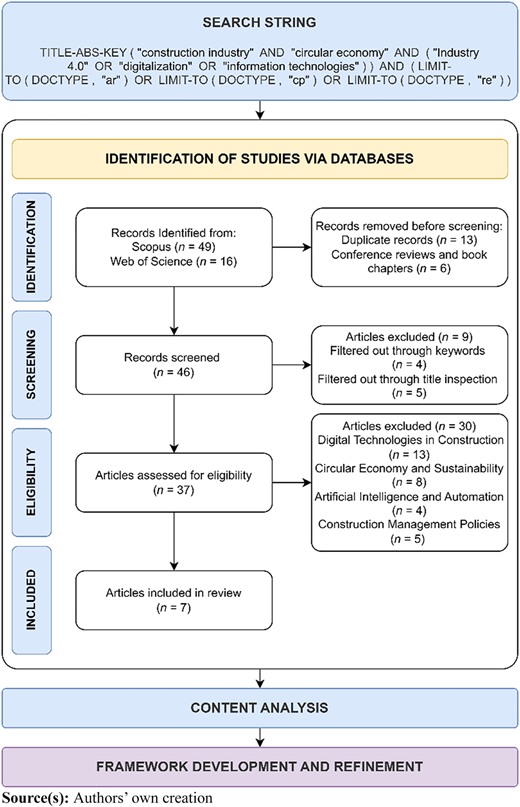
This study employs a systemic literature review (SLR) to develop a conceptual framework integrating I4.0 technologies with CE principles in the UAE construction sector. The methodological process is depicted in Figure 1. The SLR was designed to identify existing frameworks and tools applicable to the UAE’s transition toward a circular model, focusing on using I4.0 technologies in construction.
3.1 Data collection and search strategy
The literature search was conducted using two major databases, Scopus and Web of Science (WoS), selected for their extensive coverage of peer-reviewed construction, sustainability, and digital transformation research. These databases are frequent sources of SLR in circularity and have been used in studies such as those developed by Swarnakar and Khalfan (2024) and Oluleye et al. (2022a, b). The following search terms were applied to titles, abstracts, and keywords: “Construction industry,” “Circular Economy,” “Industry 4.0,” “Digitalization,” and “Information Technologies.” The initial search yielded 65 records.
3.1.1 Screening and eligibility criteria
After the initial search, 13 duplicate records and six irrelevant document types were removed. This initial selection left 46 articles for further screening, during which nine articles were excluded based on irrelevant keywords or title content. The remaining 37 articles were then assessed in greater detail for eligibility. At this stage, 30 articles were excluded due to various factors: a focus on digital technologies in construction without emphasis on circularity, general discussions on CE without specific integration of I4.0 tools, a focus on AI or automation without CE principles, and an emphasis on construction management policies without addressing technological integration. To ensure the selected studies aligned with the research objectives, the following inclusion and exclusion criteria were applied:
Inclusion Criteria:
Articles must discuss integrating I4.0 technologies with circular economy principles within the construction industry.
Papers that propose or evaluate frameworks relevant to different stages of the construction life cycle.
Studies that use systematic methodologies or provide empirical validation, such as case studies.
Exclusion Criteria:
Studies focused on other industries or sectors unrelated to construction.
Papers that discuss sustainability without specific reference to I4.0 or CE principles.
Theoretical papers that do not offer practical applications or framework-based contributions.
3.2 Data analysis
After finalizing the seven articles that met the inclusion criteria, a thematic analysis was conducted to extract key themes related to how I4.0 technologies can advance CE principles within the construction sector. This method is particularly suited for identifying patterns in qualitative data, offering insights into the interactions between technological innovations and sustainability practices. Thematic analysis has been effectively applied in the construction sector, especially in studies on digital tools enhancing resource efficiency and reducing waste (Elghaish et al., 2022; Jemal et al., 2023).
The analysis identified how I4.0 tools contribute to key CE outcomes, such as resource efficiency and waste reduction while addressing barriers and enablers. Key themes were organized based on the technological impacts of I4.0 across various construction life cycle stages, design, construction, operation, and end-of-life management (Jemal et al., 2023). This approach identified the barriers and enablers of I4.0 integration, providing valuable insights for developing the conceptual framework. Studies have highlighted the efficacy of thematic analysis in exploring circularity challenges and the potential of digital technologies to address gaps in regulatory frameworks (Pomponi and Moncaster, 2017).
3.3 Framework development
Based on the findings from the thematic analysis, a conceptual framework was developed to guide the integration of I4.0 technologies throughout the construction life cycle in the UAE. This framework is aligned with the UAECEP and offers structured guidance on how digital tools can be implemented to enhance sustainability, resource efficiency, and waste management.
The framework was developed iteratively. In the first phase, I4.0 tools identified in the literature were mapped to the relevant policy strategies in the UAECEP. In the next phase, these tools were aligned with the specific stages of the construction life cycle: design, construction, operation, and end-of-life, based on their relevance while identifying key stakeholders. This process resulted in a framework identifying the most relevant I4.0 technologies for each construction phase. By involving key stakeholders and addressing specific challenges like high implementation costs and regulatory constraints, the framework offers adaptable and scalable solutions across various construction projects in the UAE.
4. Review of I4.0 and circular construction frameworks
Recent research emphasizes blending CE principles with I4.0 technologies to make construction more sustainable, highlighting technology’s role in resource efficiency, collaboration, and data management throughout the construction life cycle. I4.0, encompassing cyber-physical systems, IoT, and cloud computing, creates smart factories (Singh et al., 2023). While upscaling CE requires these technological advances, innovation must align with sustainability to avoid negative impacts on social well-being and the environment (Lieder and Rashid, 2016; Karmaker et al., 2023).
Table 1 overviews digital technologies, gaps, and frameworks in the reviewed studies, showing I4.0 tools’ potential to drive sustainability and circularity in real-world scenarios. The tools are clustered into eight primary categories based on their functionalities and contributions: BIM, IoT, AI, Blockchain Technology, Additive Manufacturing, Digital Twins, AR/VR, and Cloud and Edge Computing. Despite their promise, gaps remain in applying these tools effectively in the UAE, particularly concerning regulatory frameworks, technological infrastructure, and stakeholder engagement. Addressing these gaps is critical for successfully leveraging I4.0 technologies to advance circularity in the UAE construction sector.
Overview of frameworks, identified gaps, and I4.0 technologies for circular economy implementation in the construction industry
| Reviewed studies with frameworks | |
|---|---|
| Reference | Framework synthesis |
| Jemal et al. (2023) | The framework integrates BIM for digital modeling, IoT for real-time monitoring and data collection, blockchain for secure and transparent data management, big data for analyzing and optimizing resource allocation, and cloud computing for remote access and collaboration. These technologies collectively enhance resource utilization, reduce waste, and improve efficiency throughout the construction lifecycle |
| Elghaish et al. (2023) | The framework integrates Industry 4.0 tools by using IoT for real-time data collection, blockchain for secure and transparent materials tracking, and AI for analyzing data and optimizing processes. These tools collectively enhance the management of building components throughout their lifecycle, promoting recycling, reuse, and resource efficiency |
| Kovacic et al. (2020) | The framework uses BIM for digital building models, MPs for tracking material properties, GPR and laser scanning for capturing existing building data, and gamification for user engagement in maintaining digital models |
| Çetin et al. (2023) | The framework uses AI and computer vision for automated data collection, laser scanning and photogrammetry for detailed material information, and AR/VR for visualizing building data. Machine learning algorithms predict hazardous materials and assess component conditions |
| Lamptey et al. (2021) | The framework uses BIM for project management and IoT for real-time monitoring and automation, enhancing green design and sustainable construction practices |
| Teisserenc and Sepasgozar (2021a) | The framework implements I4.0 tools through the Decentralized Digital Twin Cycle (DDTC) model, integrating blockchain with digital twins to enhance data integrity, cybersecurity, traceability, and transparency in the BECOM industry. It decentralizes IT infrastructures, uses smart contracts for automation, and employs decentralized storage and computing to overcome data silos and improve collaboration and information sharing |
| Teisserenc and Sepasgozar (2021b) | The framework integrates digital twins, IoT, and machine learning to enhance the efficiency and sustainability of construction processes. This digital ecosystem allows for real-time monitoring, data-driven decision-making, and predictive maintenance, ultimately fostering a circular economy in construction by optimizing resource use and extending the lifespan of building materials and components |
| Identified gaps | ||
|---|---|---|
| Gap | Description | References |
| Contextual differences | European studies differ in regulatory frameworks and market conditions compared to the UAE, requiring local adaptation | Çetin et al. (2023), Elghaish et al. (2022), Kovacic et al. (2020), Teisserenc and Sepasgozar (2021a, b), Charef et al. (2021) |
| Technological infrastructure | UAE needs upgrades in data storage, processing, and connectivity to adopt advanced digital technologies | Government of the UAE (2024), Jemal et al. (2023), Elghaish et al. (2023), Elghaish et al. (2022) |
| Regulatory support | Supportive regulatory frameworks are crucial for adopting new technology in the UAE’s construction industry | Elghaish et al. (2022), Chan et al. (2017), Lamptey et al. (2021) |
| Stakeholder engagement | Varying readiness and cultural resistance in the UAE construction industry need change management strategies | Çetin et al. (2023), Saradara et al. (2023), Kovacic et al. (2020), Lamptey et al., 2021) |
| Data privacy and security | Strict data privacy laws and security concerns are significant challenges for IoT and data-intensive technologies in the UAE | PwC (2019), Eghmazi et al. (2024), Tawalbeh et al. (2020a), Kovacic et al. (2020) |
| Scalability | Proposed frameworks must be scalable to fit the diverse and rapidly growing UAE construction industry | Ministry of Industry and Advanced Technology (2023), Lamptey et al. (2021), Kovacic et al. (2020) |
| Market readiness | Assessing the market’s readiness for adopting CE practices is crucial for planning and implementation | Elghaish et al. (2023), Jemal et al. (2023), Wuni (2022) |
| Tools categorization | |||
|---|---|---|---|
| Phase | I4.0 technologies | Applications | References |
| Design |
|
| Kovacic et al. (2020), Meng et al. (2023), Jemal et al. (2023), Elghaish et al. (2022, 2023), Teisserenc and Sepasgozar (2021a), Figueiredo et al. (2022) |
| Planning |
|
| Basbagill et al. (2013), Çetin et al. (2022, 2023), Jemal et al. (2023), Rejeb et al. (2022), Porter et al. (2014), Pal and Yasar (2023), Bibri et al. (2023), Elghaish et al. (2022), Oluleye et al. (2023), Mell and Grance (2011), Akbari (2023) |
| Construction |
|
| Çetin et al. (2023), Alahi et al. (2023), Çetin et al. (2022), Moon et al. (2019), Jemal et al. (2023), Yue et al. (2022), Ahmed (2019), Sauerwein et al. (2019), Chougan et al. (2023) |
| Operation and maintenance |
|
| Damianou et al. (2019), Meng et al. (2023), Preut et al. (2021), Liu et al. (2022a, b) |
| End of life |
|
| Munaro and Tavares (2021), Shojaei et al. (2021), Çetin et al. (2023), Koutamanis et al. (2018), Jemal et al. (2023), Lu (2017), Preut et al. (2021) |
Source(s): Authors’ own creation
4.1 Applications across life cycle stages
The reviewed frameworks recommend digital technologies for CE practices in construction, from design to end-of-life management, to enhance sustainability, optimize resources, and minimize waste. BIM, digital twins, and IoT are widely implemented. BIM provides digital representations for resource assessment and predictive modeling, helping prioritize recyclable materials (Kovacic et al., 2020). Integrating BIM with digital twins enhances visualization and efficient material usage. IoT sensors monitor material consumption and waste in real-time, optimizing processes (Çetin et al., 2023). These technologies improve stakeholder collaboration, decision-making, and process efficiency. AI and Big Data analytics further enhance resource optimization by analyzing data from IoT sensors to predict material needs and identify inefficiencies, allowing for real-time adjustments that reduce waste during construction (Bibri et al., 2023; Elghaish et al., 2022).
Several other digital technologies significantly contribute to CE practices in construction. AR and VR transform design and planning by creating immersive visualizations and enabling stakeholder interaction with virtual models, allowing users to interact with materials and collaborate remotely in real time. These technologies enhance decision-making, streamline collaboration, and optimize processes by enabling real-time adjustments to project designs (Jemal et al., 2023). BIM-supported Material Passports document material composition and life-cycle data, aiding material reuse and recycling decisions. These passports help track the reusability of materials and optimize their salvage value, facilitating just-in-time recycling and reuse. By providing detailed information on the materials used in construction, these tools enhance decision-making regarding circular economy strategies, ultimately reducing waste and improving resource efficiency (Elghaish et al., 2023). Blockchain provides a secure ledger for material life cycle data, enhancing transparency and trust (Teisserenc and Sepasgozar, 2021a). Additive manufacturing, or 3D printing, enables resource-saving on-demand production and supports complex designs with reduced environmental impact (Sauerwein et al., 2019). Edge computing processes information near the source, increasing security, reducing costs, and enhancing cloud computing capabilities in construction (Akbari, 2023).
5. Framework development
The construction industry’s digital transformation requires stakeholders to interconnect their systems at every value chain link. The conceptual framework aims to identify technologies that support stakeholders in adopting the UAECEP strategies and initiatives throughout infrastructure project life cycles. Figure 2 shows the framework development tailored to the local context, divided into six sections based on UAECEP strategies. Tools identified in the literature (Table 1) were allocated to each policy strategy based on their relevance and application. Some tools span the entire project life cycle, while others are crucial at specific stages. Similar strategies were clustered due to shared tools supporting their implementation.
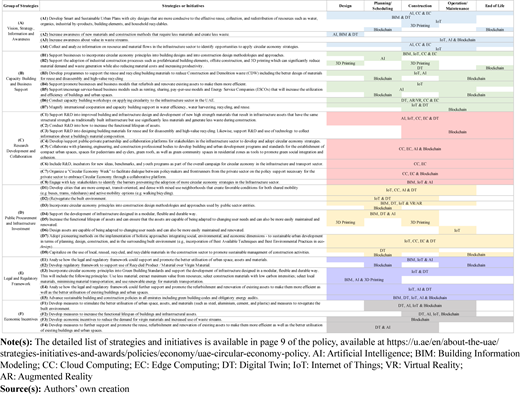
Distribution of I4.0 tools that enhance adopting the UAE circular policy 2021–2031 strategies
Distribution of I4.0 tools that enhance adopting the UAE circular policy 2021–2031 strategies
5.1 Integration of I4.0 tools with the UAECEP
5.1.1 Vision, strategy, information, and awareness (A)
Section A initiatives focus on developing sustainable smart urban plans and raising awareness of circular principles. Strategy A1 integrates tools emphasizing data collection, storage, and analysis for smart urban projects. These technologies enhance energy efficiency, urban mobility, connectivity, and waste management (Lombardi et al., 2012; Casali et al., 2022). Boeri et al. (2021) provide examples of using I4.0 tools to promote sustainability in urban projects, such as Positive Energy Districts similar to Austria’s “City of Tomorrow” program, which integrates IoT and AI for efficient energy management. Strategies A2 and A3 can be enhanced by cloud computing and digital twins, facilitating data sharing and best practices (Boje et al., 2020; Bilal et al., 2016). Strategy A4 relies on IoT sensors and cloud/edge computing for data collection and processing (Boje et al., 2020; Maksimovic, 2018). Han and Golparvar-Fard (2015) demonstrate using 4D BIM and 3D point clouds to monitor construction, enhance material usage awareness, and identify inefficiencies.
5.1.2 Capacity building and business support (B)
Section B’s strategies focus on incorporating CE into design/construction and developing programs for circular practices. Strategies B1 and B2 can use digital twins, IoT, and cloud computing for collaborative design platforms (Li et al., 2016). Gbadamosi et al. (2019) developed a BIM-based optimizer for assembly, integrating design principles for manufacturing and assembly and lean construction. This system was applied to assess and optimize the design of building components, such as precast concrete walls and prefabricated exterior insulation finish systems. Blockchain supports strategies B3, B4, and B5 by promoting transparency in construction material supply chains (Ma et al., 2024; Liu et al., 2022a, b). A UK project developed by Wilson et al. (2024) used blockchain and Material Passports for provenance tracking of wood materials, ensuring transparency and supporting refurbishment/recycling.
5.1.3 Research development and collaboration (C)
Strategies C1, C2, and C3 benefit from simulations to assess new materials and design concepts, allowing cost-effective optimization. Cloud computing enhances collaboration, while edge computing and IoT support real-time data collection and decision-making (Oluyisola et al., 2020; Du et al., 2023). A case study illustrates how a Norwegian confectionery company used a digital system to collect production data, which was processed by Big Data Analytics for insights and sustainability (Oluyisola et al., 2020). Blockchain enables smart contracts and ensures secure, immutable agreements, aiding transparency and trust in public-private partnerships. This is crucial for strategies C4, C5, and C7, which involve collaboration between public and private entities (Greenwald, 2020). A Turkish project used blockchain to automate construction progress payments, enhancing trust and streamlining processes. This platform utilized smart contracts to securely and transparently execute payment terms based on project milestones (Sonmez et al., 2023).
5.1.4 Public procurement and infrastructure investment (D)
Strategies in group D focus on the public sector adopting CE principles. AI supports Strategy D1 by predicting optimal mobility patterns (Wang et al., 2020). Digital twins, IoT, AI, and blockchain aid in Strategy D3 through real-time insights and process optimization (Elghaish et al., 2023). MIT researchers used AI to analyze travel choices in Singapore and London, enhancing urban mobility planning (Wang et al., 2020). Strategies D4, D5, and D6 benefit from 3D printing, accelerating construction and repairs (Sauerwein et al., 2019). Garusinghe et al. (2023) show that 3D printing supports modular construction, extending asset lifespan and promoting flexibility. The study presents the development of modular units that can be disassembled and reused in new projects, significantly extending the functional lifespan of assets and promoting flexibility in design, aligning with Strategies D4, D5, and D6.
5.1.5 Legal and regulatory framework (E)
AI algorithms processing data from IoT devices provide insights into regulatory changes, supporting strategies E1 and E2 (WU et al., 2022). Sharma (2023) discusses a smart waste management system using AI and IoT to optimize waste collection, predicting routes and schedules, thus informing regulatory frameworks for better material utilization. Blockchain enhances the traceability of construction materials, ensuring compliance with green building codes and aiding in strategy E5. Mssassi and El Kalam (2024) describe the Provenance platform, which uses blockchain to verify building materials’ origins, ensure adherence to sustainability standards, and facilitate regulatory compliance across different geographical contexts.
5.1.6 Economic incentives (F)
Section F initiatives propose economic measures to promote better asset utilization. DT, IoT, and AI provide the technological infrastructure for optimizing resources, extending asset lifespan, and creating economic incentives (Rodrigo et al., 2024; Alahi et al., 2023). These technologies benefit strategies F1, F2, and F4. Alahi et al. (2023) discuss IoT and AI in smart cities, enhancing urban resource management and infrastructure. IoT sensors collect real-time data, and AI analyzes it to predict maintenance needs and optimize resources, supporting strategies F1, F2, and F4 by promoting better asset utilization and extending lifespan.
5.2 Conceptual framework refinement
Most I4.0 tools can be applied by stakeholders at various project life cycle stages, with some tools being more relevant to specific phases. Figure 3 illustrates the final conceptual framework, covering the life cycle stages of new and existing infrastructure projects. The framework has three sections: the upper section shows stakeholder correlation with each life cycle stage, the middle section highlights essential I4.0 tools for circular practices, and the lower section categorizes UAECEP strategies by their relevant life cycle stages and indicates supporting tools.
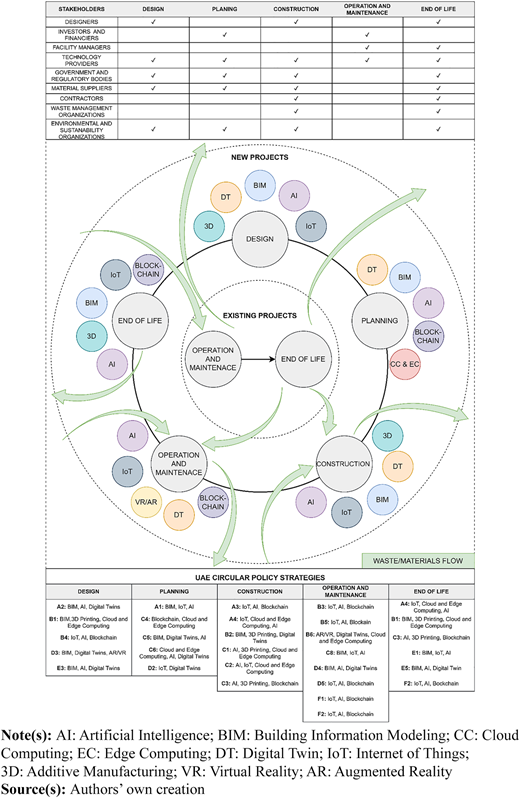
Conceptual framework for endorsing circular practices throughout the life cycle of infrastructure projects within the UAE circular economy policy 2021–2031
Conceptual framework for endorsing circular practices throughout the life cycle of infrastructure projects within the UAE circular economy policy 2021–2031
5.2.1 Design
In the design stage, BIM provides detailed digital models for resource assessment and predictive modeling, supporting strategies A2 and B1 (Kovacic et al., 2020). AI optimizes material selection and construction methods, aligning with strategy B4 (Elghaish et al., 2023). Digital twins enable virtual testing of designs for sustainability, supporting strategy D3 (Boje et al., 2020). Additive manufacturing creates prototypes using sustainable materials, aligning with Green Building Standards E3 (Sauerwein et al., 2019). Cloud and Edge Computing process large datasets and run simulations, which is essential for smart urban planning A1 (Mell and Grance, 2011).
5.2.2 Planning
In the planning stage, BIM aids visualization and collaboration, supporting Smart Urban Plans A1 and public-private partnerships C4. AI optimizes urban planning and infrastructure design (Basbagill et al., 2013; Çetin et al., 2022). Digital twins simulate and optimize resource flows in planned areas (Jemal et al., 2023). Cloud and edge computing provide scalable resources for data processing, supporting R&D, and improving programs C6 (Mell and Grance, 2011). Blockchain ensures secure, transparent collaboration and decision-making (Greenwald, 2020).
5.2.3 Construction
In the construction stage, BIM monitors material consumption and progress in real-time (Çetin et al., 2023). AI optimizes construction, reducing waste and supporting strategies B2 and C3 (Elghaish et al., 2022). Blockchain ensures secure materials tracking, reducing fraud risk (Moon et al., 2019). Additive manufacturing produces building components on demand, reducing waste and supporting strategy B1 (Chougan et al., 2023). Digital Twins monitor and optimize construction activities, enhancing efficiency and supporting strategy E5 (Boje et al., 2020).
5.2.4 Operation and maintenance
In the operation and maintenance stage, AI uses predictive analytics to forecast maintenance needs and optimize operations, supporting strategy B3 (Meng et al., 2023). Digital Twins provide real-time data on building performance, identifying inefficiencies, and supporting strategy B5 (Jemal et al., 2023). Cloud and Edge computing enable real-time data processing and predictive maintenance, supporting strategy B6 (Mell and Grance, 2011). AR and VR technologies offer immersive training for facility managers and remote maintenance assistance, reducing downtime and costs (Ahmed, 2019).
5.2.5 End of life
AI optimizes deconstruction by identifying methods for material recovery, supporting strategy C3 (Elghaish et al., 2023; Koutamanis et al., 2018). Digital twins enable detailed planning and simulation for efficient material recovery, supporting strategy E5 (Boje et al., 2020). Blockchain ensures transparent tracking of materials for reuse, aligning with strategy B1 (Moon et al., 2019). 3D printing produces components from recycled materials, supporting strategy C3 (Sauerwein et al., 2019).
5.3 Stakeholder and organizational roles
In the context of the UAE’s ambitious goals to transition towards a CE, several organizations and stakeholders play pivotal roles in implementing and advancing this framework. Each entity contributes uniquely to integrating circular economy principles within the construction and demolition industry, leveraging their respective areas of influence and expertise (Table 2).
Roles of UAE organizations and stakeholders in implementing the CE framework and the application of I4.0 technologies
| Organization | Role in CE implementation | Role in I4.0 tools adoption |
|---|---|---|
| Ministry of Climate Change and Environment (MOCCAE) MOCCAE (2020) | Oversees the implementation of the UAE Circular Economy Policy 2021–2031, focusing on sustainable resource management, waste reduction, and regeneration of natural systems, setting regulations, monitoring environmental impact, and promoting green practices across various sectors, including construction and demolition | Promotes I4.0 technologies to monitor environmental impact, optimize resource management, and enhance waste reduction strategies |
| Ministry of Industry and Advanced Technology (MOIAT) MOIAT (2023) | Integrates advanced technologies and promotes sustainable industrial practices, fosters innovation through Industry 4.0 technologies, and supports digital transformation necessary for a circular economy, ensuring environmentally sustainable and economically viable industrial processes | Promotes and supports the development of IoT, AI, and blockchain technologies to drive digital transformation and enhance sustainability in industrial processes |
| National Committee on Sustainable Development Goals (Government of the United Arab Emirates, 2021) | Monitors and reports progress towards the SDGs, aligns national policies with international sustainability standards, and coordinates between governmental and non-governmental entities for a unified approach towards sustainable development and circular economy principles | Encourage the use of data analytics and digital platforms to monitor and report SDG progress, ensuring alignment with circular principles and international sustainability standards |
| Dubai Supreme Council of Energy (Government of Dubai, 2021) | Oversees energy sustainability and implements energy-efficient strategies that align with circular economy principles, develops policies and initiatives to promote renewable energy use, and reduces waste in energy consumption | Utilizes smart grid technologies, IoT, and AI to enhance energy efficiency, monitor energy consumption, and optimize renewable energy use |
| Abu Dhabi Department of Energy (Department of Energy of the, 2024) | Focuses on sustainable energy solutions and supports circular economy through energy policies, enhances energy efficiency, promotes clean energy use, and implements sustainable practices in energy production and consumption | Employs digital twin technology, IoT, and AI for real-time monitoring and optimization of energy systems to reduce the carbon footprint and promote clean energy |
| Emirates Green Building Council (Emirates GBC) Emirates Green Building Council (2023) | Promotes sustainable building practices and supports the transition to a circular economy within the construction sector. Advocates for green building standards provide certification programs and facilitate knowledge exchange among industry stakeholders | Uses BIM, IoT, and digital twin technologies to promote sustainable building designs, track building performance, and facilitate the adoption of green building standards |
| Masdar (Masdar, 2024) | Develops and implements large-scale renewable energy projects, promotes sustainable urban planning, invests in innovative technologies, and demonstrates practical application of circular economy principles in urban development | Leverages IoT, AI, and renewable energy technologies to create smart, sustainable urban developments and optimize resource use in large-scale projects |
| Local Administrations of Each Emirate | Implement regulations and initiatives for sustainable urban development and waste management, oversee construction standards, manage waste collection and recycling programs, and ensure urban development projects adhere to environmental guidelines | Incorporate smart city technologies, to enhance urban sustainability, optimize waste management, and ensure compliance with environmental regulations |
| Abu Dhabi Waste Management Center (Tadweer) Tadweer (2024) | Focuses on waste management and recycling, develops and implements waste management strategies, promotes recycling and waste reduction initiatives, ensures efficient resource use, and minimizes waste generation in the construction industry | Uses IoT and AI to optimize waste collection, monitor recycling processes, and enhance resource efficiency, contributing to reduced waste generation and increased material reuse |
Source(s): Authors’ own creation
Collaboration among organizations is crucial for implementing the UAECEP. Each entity contributes unique strengths in sustainability, technology, regulation, and stakeholder engagement. Together, they address challenges like high initial costs, technical limitations, and regulatory adaptations. MOIAT and technological stakeholders enhance construction efficiency with advanced digital technologies. Environmental agencies like MOCCAE and EmiratesGBC prioritize green practices. Energy councils in Dubai and Abu Dhabi support sustainable energy use, while Tadweer focuses on waste minimization and resource efficiency. Their coordinated efforts are essential for creating a sustainable, resource-efficient, and economically viable construction sector aligned with CE principles.
5.4 Challenges and limitations for implementation
Implementing I4.0 technologies for CE practices in the UAE construction sector faces challenges and limitations across several dimensions. One major challenge is the lack of contextualization, where current policies are based on generic principles that may not fully consider the UAE’s specific construction conditions, leading to ineffective implementation (Pomponi and Moncaster, 2017). High initial investment costs and technical limitations remain significant barriers, particularly without sufficient financial incentives and support programs to encourage wider adoption of technologies like IoT, AI, and blockchain (Mittal et al., 2018; Kumar et al., 2020).
Technical limitations persist, particularly in the immaturity of some I4.0 tools, such as BIM and IoT, which have not yet been fully integrated across all construction life cycle stages. These technologies also require extensive data and infrastructure that may be lacking in many firms. Additionally, there are scalability challenges; while I4.0 tools may perform well in smaller projects, they may not easily scale to larger, more complex projects (Oesterreich and Teuteberg, 2016; Hossain et al., 2020).
Regulatory barriers further complicate adoption. The UAE construction sector lacks standardized regulations that promote digital tools for circular economy practices, creating uncertainty for firms looking to invest in them (Benachio et al., 2020). Additionally, data privacy and security concerns related to IoT and AI systems must be addressed to ensure compliance with UAE regulations (Tawalbeh et al., 2020; Oluleye et al., 2022a, b).
Financially, significant upfront investments in software, hardware, and training are required, especially for small and medium-sized enterprises, which often hesitate to adopt these technologies without clear ROI or government support (Adabre et al., 2023). The UAE construction sector faces a skills gap, with limited expertise in managing advanced technologies like AI, blockchain, and additive manufacturing. Overcoming these challenges will require coordinated efforts from government, industry, and academia, alongside targeted support programs to help firms transition to digital and CE practices.
6. Conclusions and future work
This study developed a policy-aligned conceptual framework to integrate I4.0 technologies with CE principles in the UAE construction sector. The framework supports resource efficiency, waste reduction, and sustainability goals by applying digital tools across the construction life cycle. Aligning these technologies with the UAECEP aims to transition the construction industry towards a more sustainable model, addressing pressing issues like resource depletion, waste generation, and environmental degradation.
Key organizations, including MOCCAE and MOIAT, play essential roles in promoting sustainability and advanced technology integration. At the same time, local administrations and the National Committee on Sustainable Development Goals oversee regulatory compliance and monitor progress. The UAE’s commitment to sustainable development provides a solid foundation for successfully implementing these solutions.
However, several methodological limitations must be acknowledged. The systematic literature review was limited to two databases, Scopus and WoS, excluding broader sources like Google Scholar, which may have restricted the scope of the literature reviewed. Additionally, while the framework offers theoretical insights, it has not been empirically validated in real-world UAE construction projects, making further research essential to confirm its practicality and effectiveness. The study’s focus on the UAE context may also limit the generalizability of the findings to other regions where regulatory and market conditions differ.
Future research should focus on conducting empirical studies to validate the proposed framework within UAE construction projects. Pilot projects demonstrating the cost-effectiveness and benefits of I4.0 technologies in promoting CE practices will provide valuable insights into their scalability. Further exploration of financial incentives and support programs, especially for SMEs, is necessary to facilitate the broader adoption of digital tools. Developing scalable solutions for varying project sizes is crucial for widespread implementation across the UAE’s diverse construction landscape. Additionally, enhanced stakeholder engagement through awareness campaigns and change management strategies will help address resistance and promote innovation. Research into emerging technologies such as blockchain and additive manufacturing can further support circularity by improving material tracking and reuse.
These efforts will contribute to the full implementation of the UAECEP, driving the UAE construction industry toward a more sustainable, resource-efficient future.
Funding: This research was conducted with the support of Khalifa University of Science and Technology, Abu Dhabi, United Arab Emirates, under Award No. FSU-2023-007 - Project 8474000460.

