


Hempcrete has the potential to reduce both CO2 emissions and energy usage in buildings. Hempcrete has a high sound absorption capacity, excellent moisture regulator and outstanding thermal insulation properties. However, hempcrete traditionally uses lime-based binders, which are carbon-intensive materials. The low-carbon binders to increase the sustainability of hempcrete are the current research gap. Geopolymer binders are low-carbon binders composed of aluminosilicate precursors dissolved in a high alkalinity solution. This study investigated the suitability of calcined clay and ground granulated blast furnace slag geopolymer binder as a low-carbon binder for hempcrete applications.
Two types of hemp hurds with different water absorption capacity and particle size distributions were used. Hempcrete properties tested were compressive strength, bulk density, sound absorption coefficient by a two-microphone impedance tube and thermal conductivity by a Hot Disk system.
The particle size distribution and water absorption capacity of hemp hurds did not affect the compressive strength of hempcrete when following a mixing procedure, ensuring the hurds in a saturated surface dry condition. The geopolymer hempcrete achieved a compressive strength about four times higher than the reference hydrated lime hempcrete. All hempcrete specimens achieved outstanding acoustic performance. The increase in bulk density led to the decrease in the maximum sound absorption coefficient. The geopolymer hempcrete achieved the lowest thermal conductivity.
The outcomes of this paper reveal that the low-carbon geopolymer binder appears to be a promising option for manufacturing hempcrete, achieving significantly higher compressive strength and lower thermal conductivity than the reference hydrated lime-based hempcrete.
1. Introduction
Decarbonisation of the built environment has been a key role in achieving the net-zero targets, as this sector contributes to approximately 40% of the total greenhouse gas emissions (Mouton et al., 2023; Manso et al., 2021). These emissions come from the construction materials during the construction phase as well as the energy usage throughout the operational phase of the building lifecycle (Kumar et al., 2020; Le et al., 2023). In addition, the population growth resulting in high density in urban areas is likely to increase the impacts of the built environment sector on the environment (Feitosa and Wilkinson, 2020). Concrete, which is the most-consumed construction material, is carbon intensive (Habert et al., 2020; Nguyen et al., 2018). Low-carbon construction materials or materials that have carbon capture and storage capacity have been a viable approach to mitigate the environmental impacts of the built environment sector on the climate (Miller et al., 2021). Bio-based construction materials, derived from plants, can be a rational alternative, as they can capture and store carbon during the plant growth (Le et al., 2023). Among bio-based materials, hempcrete, which is manufactured from the hemp hurds, a by-product of industrial hemp, has been the most-studied bio-based construction material recently. Hempcrete is produced from hemp hurds, which are extracted from hemp stalk, binder and water. Hempcrete was reported to have a low bulk density, high sound absorption capacity, excellent moisture regulator and good thermal insulation properties (Niyigena et al., 2016; Delhomme et al., 2020, 2022; Rivas-Aybar et al., 2023b; Kumar et al., 2020). Moreover, common cleaning products were able to reduce 94% of the fungal growth in hempcrete, indicating the feasibility of using hempcrete in warm temperate to tropical climates (Chau et al., 2023).
However, most hempcrete-related studies were from Europe or the United States of America. Only a few limited studies were conducted in Australia or the Oceania region (Barbhuiya and Das, 2022; Rivas-Aybar et al., 2023a; Amziane and Collet, 2017). The characterisation of Australian hemp hurds was reported in the previous study (Delhomme et al., 2020), showing that Australian hemps had very similar properties to European hemps. Traditional binder used for hempcrete is hydrated lime, which is a carbon-intensive material involving the decarbonation of limestone (Simoni et al., 2022). As a result, low-carbon binders present the potential to significantly increase the carbon capture and storage capability of hempcrete. An alkali-activated binder, so-called geopolymer, is a low-carbon binder composed of aluminosilicate precursors dissolved in a high alkalinity solution (Noushini et al., 2021). Geopolymer binders offer the advantage of utilising by-products from other industries such as fly ash, slag, marble powder or glass powder as precursors (Arslan et al., 2024; Bayrak et al., 2023; Dener et al., 2024; Turkoglu et al., 2023). Moreover, waste tyres or waste glass could also be used as alternative to natural aggregate in hempcrete to enhance sustainability (Bayraktar et al., 2024; Benli, 2024). Calcined clay and ground granulated furnace slag (GGBFS)-based geopolymer is a promising binder for industrial-scale production due to the global availability of calcined clay (Gomes et al., 2023). In this study, different Australian hemp hurds, farmed in different regions, were used to fabricate hempcrete. Hydrated lime and geopolymer binder with calcined clay and GGBFS were utilised. Hempcrete performance was evaluated through compressive strength, bulk density, sound absorption and thermal conductivity. The effects of hemp hurd characteristics and binder type on hempcrete properties were also investigated in this study.
2. Materials and mix designs
2.1 Hemp hurds
The hemp hurds were obtained by using a hemp decorticator machine to separate the hemp hurds and the bast fibre from the woody core of the hemp stalk. Hemp hurd-1 was grown in Hunter Valley, whilst hemp hurd-2 was farmed in Tamworth, New South Wales, Australia. All the hemp hurds used were investigated in retted condition. The retting process can be conducted either by field, water or chemical method (Sisti et al., 2018). In this study, the retting process was the field method by storing hemp stalks outdoors on the ground for approximately 6 weeks.
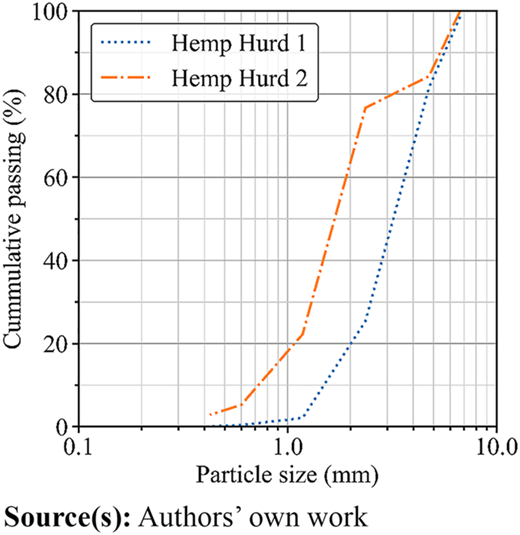
Figure 1 shows the particle size distribution (or gradation) of the different hemp hurds, measured by the sieve analysis (Amziane et al., 2017). Hemp hurd-1 has a coarser particle size distribution than that of hemp hurd-2. To be specific, 0% and 20% of hemp hurds passed 1 mm sieve size for hemp hurd-1 and hemp hurd-2, respectively.
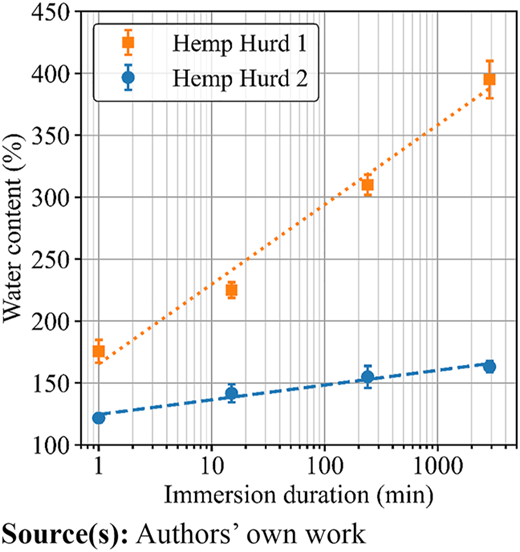
The water absorption from 1 min to 48 h of hemp hurds, as presented in Figure 2, was measured based on a test protocol of RILEM TC 236-BBM (Amziane et al., 2017). The water absorption after 1 min and after 48 h of immersion was denoted as initial water content (IWC) and final water content (FWC), respectively. Figure 2 exhibits significant differences between the water absorption capacity of hemp hurd-1 and hemp hurd-2. Hemp hurd-2 presented much lower IWC and FWC values at approximately 121 and 163%, respectively. The IWC value of hemp hurd-1 was 179%, while the FWC value of hemp hurd-1 was 375%.
2.2 Binder and sand
The hydrated lime, complying with the Australian standard AS 1672.1 (AS, 1997), was used as the binder to fabricate the reference hempcrete mix. Ground granulated furnace slag (GGBFS) and calcined clay were utilised to create the geopolymer-based hempcrete. GGBFS was compliant with Australia standard AS 3582.2 (AS, 2016), whilst the calcined clay was produced by the flash calcination technique from raw clay containing a kaolinite content of 55% (low-grade clay) (Gomes et al., 2023; Nguyen et al., 2020). The GGBFS and calcined clay were activated by using a combination of sodium hydroxide pellets and sodium silicate solution to generate the geopolymer binder for hempcrete. The sodium hydroxide pellets had a purity of 98% and a specific gravity of 2.1. The sodium silicate solution had the ratio SiO2:Na2O between 3.16 and 3.26 and a water content of 61%. Sydney sand with a relative density of 2,876 kg/m3 was used as fine aggregate in this study.
2.3 Hempcretes mix design
Three hempcretes were investigated in this study, as shown in Table 1. Two hempcrete mix designs (mix 1 and mix 2) with conventional hydrated lime were produced in this study, and one geopolymer hempcrete was investigated (mix 3). The mix design with hemp hurd-1 and hydrated lime binder (mix 1) contained no Sydney sand, whilst the two mixes with hemp hurd-2 (mixes 2 and 3) had Sydney sand as fine aggregate. The geopolymer hempcrete mix (mix 3) contained GGBFS and calcined clay as the binder. A previous study investigated the effects of different proportions of calcined clay and GGBFS as well as different ratios SiO2/Na2O in the activator solution on the compressive strength of geopolymer mortar (Gomes et al., 2023). The compressive strength results are exhibited in Figure 3. The results indicated that increasing the GGBFS content or the SiO2/Na2O ratio leads to an increase in compressive strength at 28 days. As the applications considered for hempcrete are non-bearing, the geopolymer mix composition with 70% calcined clay, 30% GGBFS and a SiO2/Na2O ratio of 1, presenting approximately 25 MPa after 28 days, was selected for this study. The highest possible percentage of calcined clay was considered because the worldwide availability of GGBFS is limited. Therefore, its usage in emerging construction materials must be reduced. 100% calcined clay mix could not be selected due to its poor strength performance observed in Figure 3. Sodium silicate solution can contribute as much as 90% of the total emissions in geopolymer mixes (Provis, 2018). Therefore, the lowest molar ratio SiO2/Na2O = 1 was selected, resulting in lower usage of sodium silicate solution, enhancing the sustainability of geopolymer-based hempcrete.
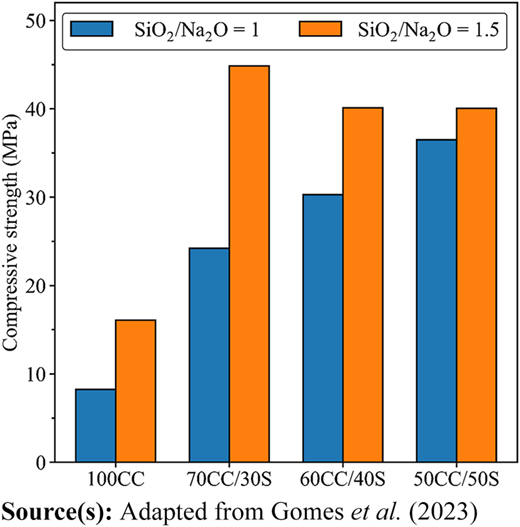
Preliminary results regarding the effects of calcined clay, GGBFS content and SiO2/Na2O ratio on the 28-day mortar compressive strength
Preliminary results regarding the effects of calcined clay, GGBFS content and SiO2/Na2O ratio on the 28-day mortar compressive strength
Hempcrete mix composition
| Quantity (kg) | Mix 1 | Mix 2 | Mix 3 |
|---|---|---|---|
| Hemp hurd-1 | 5 | – | – |
| Hemp hurd-2 | – | 5 | 5 |
| Sydney sand | – | 5 | 5 |
| Hydrated lime | 9 | 9 | – |
| Calcined clay | – | – | 8.23 |
| GGBFS | – | – | 3.53 |
| Sodium hydroxide pellets | – | – | 0.77 |
| Sodium silicate solution | – | – | 3.27 |
| Free water | 10 | 10 | 5.5 |
Source(s): Authors’ own work. Line 132, Page 8 in the manuscript
In mix 3, the activator solution, which includes sodium hydroxide pellets, sodium silicate solution and free water, was prepared 24 h before mixing to allow it to cool down. The mixing procedure was carried out in an electric pan mixer. The hemp hurds were mixed in the mixer for 30 s. Then, to achieve the saturated surface dry (SSD) of hemp hurds, an exact amount of water based on the IWC was added to the mixer and mixed for 1 min. This step ensured that the hemp hurds did not absorb any of the free water or activator (Table 1), which is required for the binder reaction process. Consequently, the binder and free water were put into the mixer and mixed for 2 min. The fresh hempcrete mixture was cast into 100 mm × 200 mm cylinders and 100 mm × 50 mm discs. The specimens were compacted by using a 2.7 kg compacting hammer. The cylinders were filled by three layers, while the discs were filled by one layer. The hammer was dropped five times per layer to maintain the compacting energy of 38 kJ/m3. All hempcrete specimens were demoulded after 24 h of casting and continually stored in a controlled room at a temperature of 23 ± 2 °C and a relative humidity of 55 ± 3% until 28 days.
3. Methodology
3.1 Maximum compressive strength
After 28 days of curing, three cylindrical samples (100 × 200 mm) of each mix design were used for the compressive strength test.
3.2 Bulk density
The bulk density was measured by the dimension and weight of the hempcrete specimens after 28 days of curing. Dimensional measurements were performed on the samples using a precise calliper. These values were then used to calculate the volume of the cylinder. The mass of each sample was determined using scales of 0.01 g precision. The bulk density value is the average of three measurements. The bulk density (kg/m3) is calculated based on Eq. (1) as follows:
where m (kg) is the sample mass and V (m3) is the sample volume of the specimen.
3.3 Sound absorption coefficient
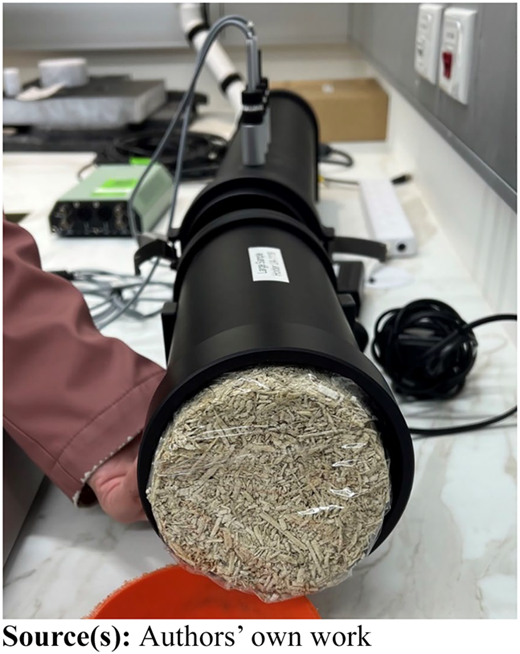
The cylindrical specimens with 100 mm diameter and 50 mm thickness after 28 days of curing were used to determine the sound absorption coefficient. The measurements were performed by a two-microphone impedance tube B&K 4,206 based on the transfer-function method in compliance with ISO 10534-2 protocol, as shown in Plate 1. The frequency range in this study was between 50 and 1,600 Hz.
3.4 Thermal conductivity
The thermal conductivity of cylindrical hempcrete specimens (100 mm diameter and 50 mm thickness) was measured using a Hot Disk system (Delhomme et al., 2020, 2022). The thermal power ranged from 100 to 250 mW with a measuring duration of 640 s.
4. Results and discussion
4.1 Compressive strength
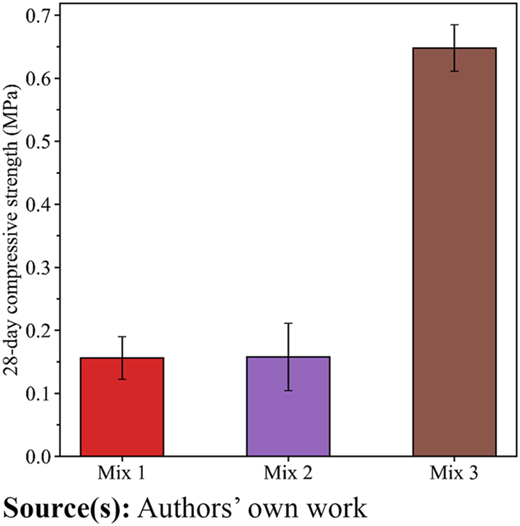
Figure 4 presents the hempcrete compressive strength after 28 days of curing. Mix 1 and mix 2 showed similar compressive strength of approximately 0.15 MPa. This compressive strength value was well aligned with previous studies (Niyigena et al., 2016, 2018; Chabannes et al., 2015). It should be noted that the compressive strength presented in Figure 4 was achieved under ambient curing, indicating that calcined clay and GGBFS geopolymer-based hempcretes are suitable for broader applications compared to heat-cured geopolymer. In addition, mix 2 compressive strength was similar to mix 1, showing that the influence of the different water absorption values of hemp hurd-1 and 2 (Figure 2) could be eliminated by the mixing procedure adopted, ensuring that hurds are always in SSD condition, as described in Section 2.3. Also, the addition of sand in the hempcrete mix is not influencing the compressive strength significantly. Noticeably, mix 3 using the geopolymer binder exhibited a much higher compressive strength at 0.65 MPa, which was four times higher than the other two mixes. This revealed that the binder type is governing the compressive strength, not the particle size distribution, water absorption capacity of the hemp hurds or the addition of sand. The higher compressive strength can allow hempcrete to be used in load-bearing structures.
4.2 Bulk density
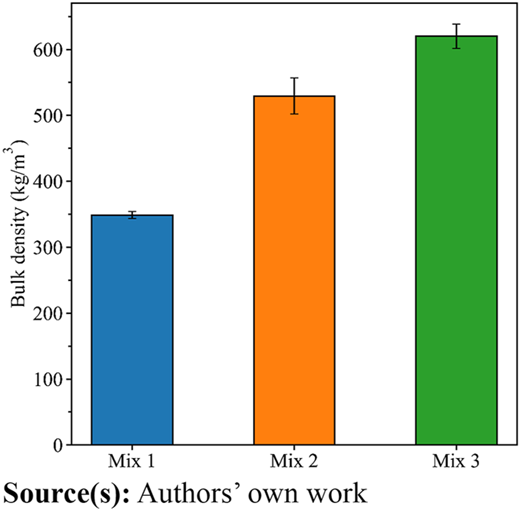
The bulk density of hempcrete after 28 days is shown in Figure 5. The bulk density values were within the range reported by previous studies (Seng et al., 2019; Arnaud and Etienne, 2012). The higher bulk density of mix 2 compared to mix 1 can be attributed to the presence of Sydney sand in the mix composition. Mix 2 and mix 3 had a bulk density of 530 kg/m3 and 620 kg/m3, respectively. Mix 3 exhibited the highest bulk density among the three mixes, mostly due to the higher density of the activator solution compared to water.
4.3 Sound absorption
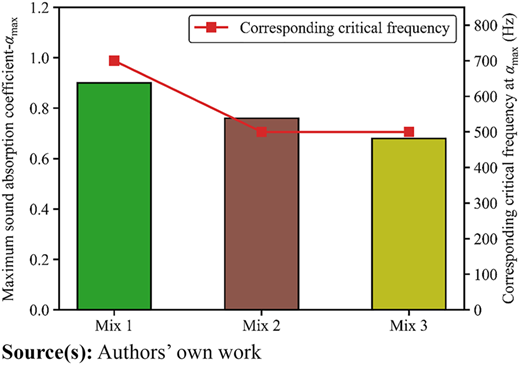
The maximum sound absorption coefficient (αmax) and corresponding critical frequency at αmax are shown in Figure 6. These values indicated the outstanding acoustic performance of hempcrete (Kinnane et al., 2016). Mix 3 exhibited the lowest αmax value of 0.68, whilst mix 2 had a αmax value of 0.76. Mix 2 and mix 3 had the same corresponding critical frequency at αmax of 500 Hz. In general, the variation in maximum sound absorption coefficient was linked to the variation in bulk density as reported in Section 4.2. Specifically, the increase in bulk density led to the decrease in maximum sound absorption coefficient and corresponding critical frequency at αmax. The presence of Sydney sand and the usage of geopolymer binder in mix 2 and mix 3 resulted in the increase of bulk density and the decrease of the sound absorption coefficient in comparison with mix 1. Sand seems to be the predominant reason, as evidenced by the little sound absorption coefficient difference observed between mix 2 and mix 3. The higher bulk density relates to a lower total porosity and fewer air-filled voids, which are efficient in trapping sound to increase the sound absorption coefficient.
4.4 Thermal conductivity
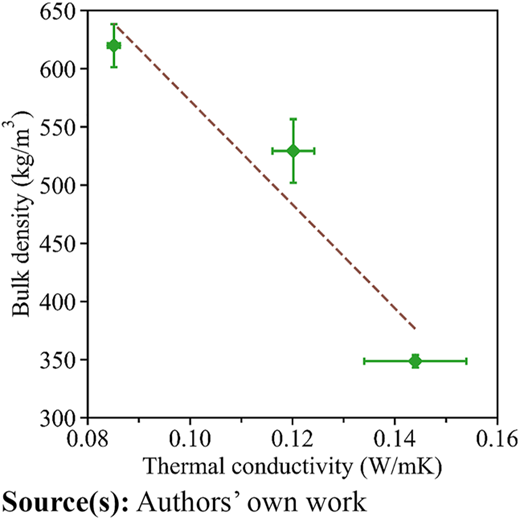
Figure 7 presents the thermal conductivity of the four mixes after 28 days. The thermal conductivity values in this study were consistent with the previous study on hempcrete (Barbhuiya and Das, 2022). All hempcrete had thermal conductivity values less than 0.15 W/mK. Mix 1 exhibited the highest thermal conductivity at 0.144 W/mK, whilst mix 3 showed the lowest thermal conductivity at 0.085 W/mK. Mix 2 lower value at 0.120 W/mK can be due to the sand, increasing the bulk density of hempcrete. Both binder composition (including hydrated lime or geopolymer) and sand impacted the thermal conductivity.
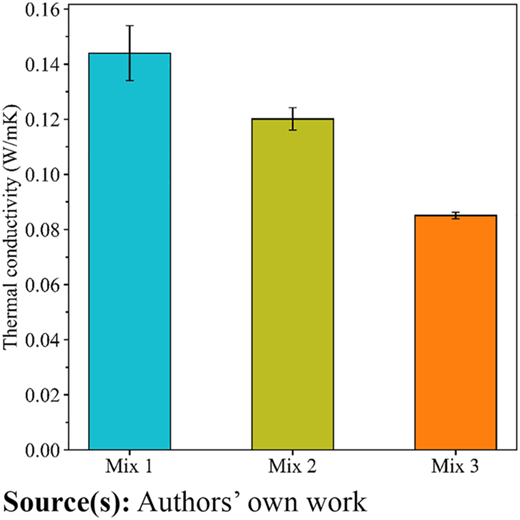
Figure 8 shows the relationship between bulk density and thermal conductivity for the three hempcrete mixes. The decrease in bulk density led to the increase in thermal conductivity of hempcrete, which is consistent with a previous study reporting a similar relationship between bulk density and thermal conductivity (Barbhuiya and Das, 2022). The lowest thermal conductivity of geopolymer-based mix (mix 3) revealed that geopolymer binder using calcined clay and GGBFS is a promising option for manufacturing hempcrete. To be specific, the low thermal conductivity can create a more stable and comfortable indoor environment by reducing the temperature fluctuations. Moreover, the higher bulk density is generally consistent with better structural integrity and durability, which is essential for the building’s longevity.
4.5 Discussion and outlook
The hempcrete fabricated using a calcined clay and GGBFS-based geopolymer binder shows promising potential to enhance sustainability. According to Arehart et al. (2020), the hydrated lime global warming potential (GWP) at about 1.2 kg CO2e/kg material is much higher than that of metakaolin at only 0.421 kg CO2e/kg material. Furthermore, metakaolin is high-purity calcined clay obtained from the calcination of the purest form of kaolinite clay (Sabir et al., 2001). The production of low-grade calcined clays, such as the one used in this study, can result in lower GWP values than metakaolin. In addition, the GWP of GGBFS is only 0.02 kg CO2e/kg material (Moghadam et al., 2021). In general, using geopolymer binders with precursors composed of calcined clay and GGBFS as an alternative to hydrated lime binder is expected to greatly reduce the carbon footprint of hempcrete and improve sustainability. A thorough life cycle assessment of hempcrete using calcined clay and GGBFS-based geopolymer binders will be presented in a future paper. Additionally, further research into the long-term durability of geopolymer-based hempcrete including moisture content or freeze-thaw resistance as well as using hemp hurds from different global regions is necessary to accelerate the adoption of this material by the construction industry.
5. Conclusions
This study investigated the suitability of a calcined clay and GGBFS geopolymer binder for hempcrete applications. Two types of hemp hurds with different water absorption capacity and particle size distributions were used. Hempcrete properties tested were compressive strength, bulk density, sound absorption coefficient and thermal conductivity. The main outcomes of this study are summarised as follows:
The particle size distribution and water absorption capacity of hemp hurds did not affect the compressive strength of hempcrete when following a mixing procedure ensuring hurds SSD condition. The geopolymer hempcrete achieved a compressive strength about four times higher than the reference hydrated lime hempcrete.
The hempcrete bulk density ranged from 350 to 620 kg/m3, depending on the binder and the inclusion of sand in the mix. The geopolymer hempcrete exhibited the highest bulk density due to the higher density of the activator solution compared to water.
All hempcrete specimens achieved outstanding acoustic performance. The increase in bulk density led to the decrease in the maximum sound absorption coefficient and corresponding critical frequency. This can be attributed to a lower total porosity and fewer air-filled voids, which are efficient in trapping sound to increase the sound absorption coefficient.
The thermal conductivity measured ranged between 0.08 and 0.15 W/mK. The water absorption capacity showed no effect on the thermal conductivity of hempcrete. The geopolymer hempcrete achieved the lowest thermal conductivity, about 30% lower than the reference hempcrete. The decrease in thermal conductivity was well correlated with the increase in hempcrete bulk density.
Overall, the low-carbon geopolymer binder appears to be a promising option for manufacturing hempcrete, achieving significantly higher compressive strength and lower thermal conductivity than reference hydrated lime-based hempcrete.
This research was funded by the Australian Hemp Masonry Company Pty. Ltd. and the ARC Linkage project (No. LP200200779) titled “Decarbonising built environments with hempcrete and green wall technology”.
Declaration of competing interest: The authors declare that they have no known competing financial interests or personal relationships that could have appeared to influence the work reported in this paper.

