This study proposes a model of the effect of financial and non-financial performance measures on nonprofit organizations’ (NPOs’) effectiveness where internal stakeholders' trust play an intervening role in the aforementioned relationships.
Data were collected from 218 employees working at the largest Palestinian NPOs. The perceptions of these employees were used to measure the variables, and structural equation modeling was used to examine the hypotheses.
Results suggest that the use of financial and non-financial performance measures was positively related to NPOs' effectiveness. Internal stakeholders' trust showed a significant mediating effect between the use of performance measures and NPOs' effectiveness.
This study may be of value for NPOs' managers due to the positive effects performance measurement (PM) can have on NPO effectiveness. Managers and boards should seek to enhance their internal stakeholders' trust to achieve higher levels of effectiveness.
This study has three main contributions. First, it is one of the very few papers which empirically examines the links between PM and NPOs' effectiveness, rather than providing conceptual lens. Second, the paper investigates the role of stakeholders' trust as a mediating mechanism in the proposed model, a topic that has been neglected by NPOs governance researchers. Finally, the study uses data from the Palestinian context, contributing to the PM literature by providing evidence on the relationship between performance measures and NPOs' effectiveness from a non-Western context.
Introduction
The working environment has significantly changed, requiring nearly all aspects of organizations and management to adapt appropriately (Anderson and McAdam, 2004). Today, nonprofit organizations (NPOs) operate in working environments that are characterized by complexity, ambiguity and economic limitations. Declines in aid from international donors and local governments and the intense competition between NPOs to search for sources of donations have pushed these organizations to find novel ways to deal with these continuously changing requirements (Young et al., 2012) in order to foster effectiveness. Moreover, the increasing role of NPOs in contributing to socioeconomic growth in developing countries (Liston, 2008) has led to an expansion in the number of these NPOs with multiple stakeholders (Cestari et al., 2018). Consequently, this has increased the demands and pressures on NPOs to demonstrate the accountability of their services (Kim et al., 2019) and the emphasis on the importance of measuring performance (Lee and Clerkin, 2017; LeRoux and Wright, 2010). Furthermore, performance measurement (PM) in service-based organizations is more complex than measuring performance in other settings (Yasin and Gomes, 2010). Hence, in light of these acute competitive and economic pressures, NPOs are required more than ever to demonstrate excellence in their performance in order to secure financial resources (Cairns et al., 2005; Martikke, 2008). It has always been thought that competition for financial resources and innovative projects is linked to the practices of PM in NPOs (Carlson et al., 2010). In developing countries, NPOs also strive to obtain staff and resources to ensure successful delivery of their goods and services and sustain excellent levels of effectiveness.
On the significance of PM in NPOs, the extant literature reveals that PM is positively associated with financial performance (Carnochan et al., 2014), goal attainment (Henderson et al., 2002), program and decision-making effectiveness (LeRoux and Wright, 2010; Mausolff and Spence, 2008) and goal clarity (Berman and Wang, 2000). However, although measuring performance is thought to be an important factor in influencing effectiveness and competitiveness (Gomes and Yasin, 2011; Grossman and Mccaffery, 2001), the literature provides mixed and inconclusive results (Lee, 2020). For instance, a number of studies found that PM has a positive association with NPOs' effectiveness at the organizational level (see. Grossman and Mccaffery, 2001; Mausolff and Spence, 2008). On the other hand, other studies claimed that PM diminishes the quality of improvements and NPOs' performance (Poister et al., 2014). Moreover, LeRoux and Wright (2010) reported that some managers of NPOs are not persuaded of the benefits of employing PM. Likewise, Carman and Fredericks (2008) highlighted that not all NPO leaders view PM as an effective management tool; rather, many see it as a marketing and promotional instrument, which causes resources to diminish. This was supported by Julnes and Holzer (2001) who argued that resources and efforts invested in performance management implementation, rather than adoption, may have negative effects on internal stakeholders (e.g. volunteers, administrators, employees). Therefore, the assumption provided by performance management theory that PM might lead to greater levels of organizational effectiveness requires a conclusive evidence (Alexander et al., 2010). The authors further elaborated that the causal links between PM and NPOs' performance are not adequately addressed. Hence, these conflicting findings call for more empirical investigation on how PM (e.g. measures, practices, systems) positively contribute to organizational success and organizational effectiveness in NPOs (Teelken, 2008).
Moreover, the mainstream literature has largely focused on general mechanisms of NPOs' governance (i.e. PM, NPOs' effectiveness), thus neglecting the essential role played by the stakeholders in these NPOs (Zollo et al., 2019), such as internal stakeholders which are represented by paid employees. Furthermore, it has been argued that very few studies have examined the role of stakeholders in NPOs (Cornforth, 2012; Wellens and Jegers, 2014). Because both internal and external stakeholders are increasingly demanding a better definition of how NPOs can measure performance and ensure high levels of effectiveness (Zollo et al., 2019), it is necessary to deepen this study through investigating the role of internal stakeholders' attitudes toward their NPOs.
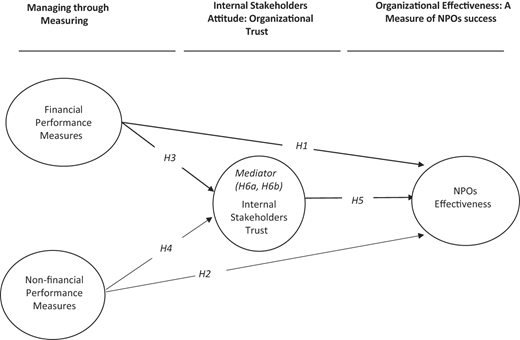
Given the previous discussion and building on the stakeholder theory, this research proposes and empirically examines a model that explains the relationship between PM and NPOs' effectiveness. Specifically, internal stakeholders' trust is hypothesized as the underlining mechanism that governs the aforementioned relationship as shown in Figure 1. Based on the argument that including stakeholders' perceptions in evaluating NPOs' effectiveness and performance would provide a better explanation of how well NPOs are performing (Brown, 2005; Zollo et al., 2019), this study utilizes an individual perspective to provide an evidence of how internal stakeholders' perceptions of NPOs' PM significantly impact their levels of trust toward the NPO, thus resulting in higher perceptions of NPOs' effectiveness. Although our research spots a gap in the NPO literature, it follows a “box-breaking” research approach (Alvesson and Sandberg, 2011), which challenges the present specialized “boxed-in” mainstream literature in NPOs that ignores the individual perspective in PM research.
Stakeholder theory: relevance to NPOs
In general, the focus of the stakeholder theory is on the notion of stakeholders (Barrane et al., 2020). Stakeholders have been defined by Freeman (2010, p. 46) as “any group or individual who can affect or is affected by the achievement of the organization's objectives.” Although different researchers build their work on stakeholders' perspectives as a mechanism for understanding organizational management in different sectors, the implications of the stakeholder's perspective remain limited within the NPO research. This theory is relevant to NPOs because the effective functioning of these organizations is affected by the manner in which stakeholder relationships are managed (Wellens and Jegers, 2014). This implies that the likelihood of NPOs being perceived as more effective increases when the NPOs better manage the prospects of stakeholders toward the governance of their NPOs.
While stakeholders demand accountability in the way NPOs try to achieve their missions, it has been argued that the best way to demonstrate accountability to diverse stakeholders is to measure performance through clearly identified measures (Alexander et al., 2010; Mitchell, 2014). Therefore, we argue that stakeholders' experiences with their NPOs are considered the lenses through which they evaluate PM practices in these organizations, thus shaping the degree to which they trust their NPOs (Sarstedt and Schloderer, 2010; Willems et al., 2016) and, consequently, perceive them as being more effective (Packard, 2010).
Performance measurement in NPOs: a closer look
In general, there is no consensus among NPO researchers on the most relevant performance measures that should be used to evaluate NPOs' performance (Gamble et al., 2019). The argument about how to measure NPOs' performance is still under debate in operations research (Franco-Santos et al., 2007) in general and more specifically in NPO research (Carman, 2010; Glassman and Spahn, 2012; Lecy et al., 2012; Moura et al., 2019; Packard, 2010; Sowa et al., 2004; Word and Sowa, 2017). There are different reasons for these conflicting views among scholars pertaining to PM in this sector. For instance, Clarkson et al. (2010) found that PM systems and indicators differ from one context to another. Others such as Amirkhanyan (2010) reported that NPOs that provide services on behalf of government agencies are more likely to be evaluated based on qualitative indicators that are mainly concerned with the public image of NPOs and their ability to comply with the legislation. In addition, the complex nature of measuring NPOs can be attributed to the social mission and the legal statutes of these organizations (McHatton et al., 2011). Keating and Frumkin (2003) added that the nature of the social values embedded in the mission of NPOs makes it very difficult to determine easily quantifiable performance measures to assess NPOs' performance.
In general, previous research on PM in this sector has focused on two main aspects. The first internal aspect concerns the overall financial health of NPOs (Argyris, 2009), such as fundraising efficiency (Aldrich, 2009), revenue growth and fiscal performance (Boateng et al., 2016; Ritchie and Kolodinsky, 2003), resources diversification (Boateng et al., 2016) and resources efficiency (Barman, 2007). It is very necessary to view NPOs as program- and project-based organizations (Aboramadan and Borgonovi, 2016), which implies the performance of their projects and services in terms of efficiency and effectiveness should be evaluated together with their financial health (Kareithi and Lund, 2012). This leads us to the second external aspect of performance measures, which concern the relationship between NPOs and the environment. Those measures include the ability to satisfy multiple stakeholders, such as clients and donors (Campbell and Slack, 2006; Moore, 2000), the public value of the services provided by NPOs to the beneficiaries (Lampkin et al., 2007), networking (Bagnoli and Megali, 2011) and non-financial efficiency represented by the number of persons served (Barman, 2007; Boateng et al., 2016; Kendall and Knapp, 2000). In addition to these measures, quality of the services provided has been suggested to be an important performance measure in the work of NPOs (Boateng et al., 2016). On the other hand, Packard (2010) suggested that clients' and employees' satisfaction, outcomes and output accomplishments, NPOs' ability to adapt to changes and adequate funding are the most beneficial performance measures in this sector.
Others (see, for example, Epstein and Buhovac, 2009; Poister et al., 2014; Tom and Frentzel, 2005) developed program-based frameworks to measure the performance of NPOs. Their frameworks highlighted the measures from the angle of program performance, including examining effectiveness, efficiency (inputs–outputs), activities and the overall impact. On the contrary, Kendall and Knapp (2000) developed a multidimensional framework known as the “Adapted Production Welfare Framework,” which mainly highlights four performance indicators, namely, efficiency, effectiveness, equity and financial performance, and Kaplan (2001) proposed the “Adapted Balanced Scorecard for NPOs.” Following the approach of Kednall and Knapp (2000), Aboramadan (2019) utilized diverse financial performance and non-financial performance measures while assessing the performance of Saudi nonprofits.
NPOs' effectiveness
For decades, the concepts of organizational effectiveness and organizational success have received great attention from scholars and researchers (Lecy et al., 2012; Willems et al., 2016). Nevertheless, there is no common agreement among scholars on how to define and operationalize organizational effectiveness (Bryan, 2018). In NPO research, in particular, scholars have failed to provide a satisfactory definition of what constitutes this construct (Lecy et al., 2012) and the appropriateness of the selection of most of the cases utilizing one measure or dimension, such as financial performance or productivity. In general, organizational effectiveness has been defined as a measure of how well an organization is performing (Jackson and Holland, 1998), or the managerial attempt to perform well to gain competitive advantage (Simons and Merchant, 1986). Despite the lack of consensus on what really defines organizational effectiveness, several authors endeavored to operationalize this construct (Sowa et al., 2004). Beamon and Balcik (2008), for instance, viewed organizational effectiveness as the extent to which the clients' needs are being met. Benjamin and Misra (2006) defined organizational effectiveness as the NPO's ability to achieve its social mission and accomplish its predefined goals and objectives.
Approaches to measuring organizational effectiveness have been recapitulated into four approaches, namely, “goal attainment, systems resource approach, reputational approach and multidimensional approach” (Lecy et al., 2012). The goal attainment perspective suggests that organizational effectiveness can be measured by assessing progress toward accomplishing the desired goals. This perspective received criticism, as NPOs lack clear and specific objectives. The second perspective, system resources, addressed the concept of organizational survival, which concerns the ability of NPOs to obtain the limited resources necessary to accomplish objectives (Ritchie and Kolodinsky, 2003). This approach was also criticized due to its overemphasis on financial measures. Moving to the reputational perspective, this perspective is based on the subjective evaluation of perceptions to assess organizational effectiveness (Herman and Renz, 2004). This approach might introduce bias and lack of consensus among the stakeholders in their evaluations of organizational effectiveness. Finally, the multidimensional perspective of NPOs' effectiveness, which was proposed by Lecy et al. (2012), focuses on four domains, namely, organizational management, partnership and networking, programs design and implementation and responsiveness to the environment. Although the multidimensional approach provides a detailed breakdown of how to measure NPOs' effectiveness, the research suggests that such a framework is difficult to practice and implement in NPOs because of lack of resources, complexity and unfamiliarity with such frameworks (Carman, 2007; LeRoux and Wright, 2010).
The relationship between PM and NPO effectiveness
Although several previous studies demonstrated the important role PM plays in several sectors, such as the private sector (Bourne et al., 2005; Dey and Cheffi, 2013) and public sector (Lega et al., 2013; Tapinos et al., 2005), research in this domain remains limited in the NPO sector (Bititci et al., 2012; Micheli and Kennerley, 2005). The extant literature on NPOs reveals the positive impact of PM on NPOs' effectiveness in terms of better financial performance, goals achievement, decision-making quality and goals clarity (Berman and Wang, 2000; Carnochan et al., 2014; Henderson et al., 2002; LeRoux and Wright, 2010). With all these studies on the links between PM and NPOs' effectiveness, the remaining question is to what extent does the PM system represent a process of controlling through the use of measures (Franco and Bourne, 2003), and are these measures representative? Hence, in the PM framework, both financial and non-financial measures should be reflected (Aboramadan, 2018; Kaplan and Norton, 1996).
In this research, we argue that the use of financial and non-financial measures in PM positively contributes to NPOs' effectiveness. Theoretically speaking, the link between performance measures and NPOs' effectiveness can be explained by the presence of the stakeholder theory (Freeman, 2010), which provides an effective and practical way to manage organizations operating in complex environments (Freeman et al., 2007) such as those of NPOs. Two possible reasons can be associated with why stakeholder theory could serve as a framework for explaining the links between the use of PM and organizational effectiveness. First, performance measures are often influenced by the presence and involvement of the stakeholders of the organization (Montanari et al., 1990). Second, the stakeholder theory is significant from a managerial standpoint, as leaders have the tendency to highlight the things that could lead to better performance in light of what is being measured (Kaplan and Norton, 1996; Sachs and Rühli, 2011).
On the other hand, the use of performance measures would enable managers to utilize the information produced by such a process to make effective decision (Moynihan, 2005), which, in turn, enhances the overall effectiveness of the organization. Furthermore, generating performance data through utilizing performance measures would enable managers and leaders alike to allocate resources in an efficient manner, which eventually contributes positively to overall performance (Kim et al., 2019; Word and Sowa, 2017). Obtaining performance information would help leaders to evaluate the present performance and to make decisions on the improvement of existing management systems to ensure greater levels of effectiveness. In the same vein, when PM systems are designed in a way that provides a mechanism for leaders to keep control over the organization, funding and stakeholders, NPOs are more likely to achieve the desired results (Poister et al., 2014). Finally, performance measures of efficiency, quality, customer satisfaction and outputs can be utilized by NPOs to manage their operation in an effective manner (Poister et al., 2014). Hence, well-configured performance measures can enhance employees' attitudes and encourage them to work toward achieving the organizational objectives and to contributing to the overall effectiveness of NPOs. Moreover, the use of well-defined performance measures provides managers and administrators levels of control over the relationship between micro-level practices and results (Zuiderwijk and Janssen, 2014).
Given this discussion and to unlock the black box of PM vs. NPOs' effectiveness in the research, and following the previous suggestions that a blend of both financial and non-financial performance is the most appropriate way to measure performance, we posit the following two hypotheses:
The use of financial measures is positively related to NPOs' effectiveness.
The use of non-financial measures is positively related to NPOs' effectiveness.
The relationship between PM and internal stakeholders' trust
In general, the concept of trust has received great attention from researchers, but there is still no commonly accepted definition of trust (Burke et al., 2007; Lewicki et al., 2006). The existing literature reports that the concept of trust can be examined from different angles. Trust within an organizational context can have different forms: trust in supervisors, trust in coworkers or trust in the organization (Schoorman et al., 2007). Because in this study we are concerned with the level of trust of internal stakeholders in their NPOs, we will discuss the concept of organizational trust rather than trust at the individual level. Moreover, we consider here internal stakeholders' trust as a “collective psychological attitude concerning the trustworthiness of their NPOs.”
On the relationship between PMs and internal stakeholders' trust in their NPOs, we argue that use of clear performance measures in NPOs provides a basis for integrity and transparency (Crucke and Decramer, 2016), which consequently will help to inspire confidence of internal stakeholders in NPOs, thus generating elevated levels of trust in them. This argument is supported by Palanski and Yammarino (2009), who mentioned that organization integrity is positively related to stakeholders' trust, and by Pavlou (2002), who reported that transparency depicts a positive relationship with trust. In fact, the ambiguity represented by the absence of clear management practices (i.e. PM) would push stakeholders to consider the organization as insincere and, thus, perceive the organization as not trustworthy (Ben-Ner, 2002). These arguments are also embedded in the social exchange theory (Blau, 1964), which highlights the social exchanges between the organization and the employee. Appling this theory to the NPO context, we can argue that when internal stakeholders see their NPOs using clear approaches in measuring performance, this will generate a perception among stakeholders that these NPOs are transparent and sincere, which will generate a form of reciprocation represented by higher levels of stakeholders' trust in their NPOs. Given these above arguments we posit the following hypotheses:
The use of financial measures is positively related to internal stakeholders' trust.
The use of non-financial measures is positively related to internal stakeholders' trust.
The relationship between internal stakeholders' trust and organizational effectiveness
In this section we predict that internal stakeholder trust has a positive impact on NPOs' effectiveness. First, trust has been often viewed as a key element to achieving organizational success (Davis et al., 2000). By establishing a trustful relationship between the organization and its stakeholders, trust can be a key driver for competitive advantage (Barney and Hansen, 1994). For instance, trust can increase employees' satisfaction (Pirson and Malhotra, 2010) and facilitate operations efficiency (Nooteboom, 1996). Second, trust exerts positive effects on commitment, engagement, creative behaviors, information sharing, decision-making and innovation (Yasin Fadol and Sandhu, 2013; Nahapiet and Ghoshal, 1998; Osterloh and Frey, 2000; Politis, 2003), which would, in turn, enhance the overall performance of the organization. In line with the social exchange theory (Blau, 1964), employees who have trust in their organizations work harder and show greater levels of solving problems in an effective manner (Tremblay et al., 2010) and channel their energies toward achieving the desired results (Chia et al., 2014). In contrast, those employees who have lower trust levels in their organizations are more likely to reduce their work effectiveness (Dirks and Ferrin, 2001) and engage in negative work-related behaviors (Bies and Tripp, 1996), which will ultimately obstruct achieving higher levels of organizational effectiveness. Finally, when positive attitudes among staff, such as commitment, motivation and trust, are encouraged by an organization, this yields excellent results in terms of accomplishing the desired outcomes (Packard, 2010). Based on this the above argument, we posit the following hypothesis:
Internal stakeholder trust is positively related to NPOs' effectiveness.
The mediating role of internal stakeholders' trust
Internal stakeholders provide the necessary human resources an NPO needs to achieve its mission, and they straightforwardly influence the success of the NPO, as they have interest in the outcomes and outputs (Dicke et al., 2016). In this paper, we argue that internal stakeholders’ trust in their NPOs can serve as an effective intervening mechanism between the use of performance measures and NPOs' effectiveness. The use of performance measures, which forms the basis of accountability and transparency, will be positively perceived by internal stakeholders who see their NPOs as genuine, which, in turn, will generate higher levels of trust of in their NPOs. Due to this quality of the social exchanges, employees with higher levels of trust in their organization, on the other hand, will exert more effort to contribute to NPOs' effectiveness. Finally, the social exchange theory (Blau, 1964) provides a strong theoretical foundation to understand the role of trust played in the examined relationship in this study through highlighting the quality of the social exchanges between the NPOs and internal stakeholders.
Empirically, the study of Chia et al. (2014) found that trust in supervisors has an indirect effect in the relationship between the use of business performance measures and managerial performance in Singapore. Moreover, Verburg et al. (2017) found that organizational trust mediates the relationship between the control systems and performance outcomes. Based on that, we propose the following hypothesis:
Internal stakeholders' trust mediates the relationship between a) the use of financial measures and NPOs' effectiveness and b) the use of non-financial measures and NPOs' effectiveness.
Research method
In general, Palestinian NPOs play a significant role in socioeconomic development through delivering important social and economic services to the Palestinian community. Most of the Palestinian NPOs rely on international donations from major funders such as the European Union and the World Bank, in addition to funds provided by international organizations that work in partnership with these NPOs (NDC, 2010).
A list of active and large 90 local NPOs operating in Gaza Strip was provided by the Palestinian NGO network to the researcher. These NPOs in Gaza strip provide services to the targeted beneficiaries in areas such as education, women rights, health care, economic development and youth activities. The researcher contacted via phone these 90 NPOs to check their availability to participate in the study. Only 76 NPOs gave their permission to conduct the study. A self-administered questionnaire was then distributed to the employees working in these NPOs.
Out of 533 questionnaires distributed, 220 were received back, and 2 of these questionnaires were removed because they included missing information. The remaining 218 questionnaires were useable for statistical analysis, representing a response rate of 40.90%. Questionnaires were distributed and collected using the drop-off and pick-up technique to guarantee a strong response rate. All respondents were given two weeks to fill in the questionnaire. Using the technique of back translation method, the questionnaires were translated from English to Arabic.
In terms of gender, 69.7% of the respondents were males and 30.3% were females. Nearly one-third (29.8%) of the respondents were between 30 and less than 35 years old, 36.3% were between 35 and less than 40 years old and 33.9% were more than 40 years old. Concerning experience, 8.7% had experience of less than 3 years, 14.2% had between 3 and less than 5 years of experience, 11.9% had between 5 and less than 7 years of experience and 65.2% had more than 7 years of experience. The working positions of these respondents included administration, project management and coordination, fundraising and logistics.
Data analysis strategy
Before analyzing the data for hypotheses verification, data normality analysis was run to determine whether the data were normally distributed or not. First, the results of a Shapiro–Wilk test indicated that the data are normally distributed with p-values higher than 0.05. Second, to check for multicollinearity, we have run the analysis of the variance inflation factor (VIF) in which all the VIF values ranged between 1.0 and 1.243. These values are less than the value of 3, as recommend by Hair et al. (2019). To check for the linearity, we ran a curve-estimation for all the relationships in our model and found that all relationships are sufficiently linear. Given the previous discussion, we can see that the assumptions of normality, multicollinearity and linearity were met, and analysis can be conducted using multivariate SEM techniques that account for measurement errors (Hair et al., 2019). The data were analyzed using SEMAMOS 22 which adopts covariance-based multivariate statistical techniques (Byrne, 2016). SEM AMOS runs confirmatory factor analysis using the maximum likelihood method as suggested by Anderson and Gerbing (1988). It has been recommended to use covariance-based analysis where possible as it provides the researcher more flexibility with relatively greater information and better analysis in terms of data fit to the model (Hair et al., 2019). Finally, following the suggestions of Preacher and Hayes (2008), we have utilized the 5000 bootstrapping method to check for mediation.
Measures
Instead of relying on existing performance measures and organizational effectiveness frameworks that focus on one aspect of performance, we have developed the measures through selecting the items from different articles representing performance measures and organizational effectiveness to follow the strategy of “in-house assumption” (Alvesson and Sandberg, 2011).
Financial performance measures: This scale was measured using three items adopted from Boateng et al. (2016). These items were revenue growth, fundraising expenses to income ratio and diversification of revenue sources. Using a 7-point scale, respondents were asked to assess the degree of adoption of these measures in their NPOs. The internal reliability was 0.773.
Non-financial performance: This scale was measured using nine items adopted from Boateng et al. (2016) and Packard (2010). Eight items were adopted from Boateng et al. (2016): “quality of product/service, beneficiary's satisfaction, timeliness of service provision, community involvement, donor sustainability, competitors' overall performance, output/number of persons served, and compliance to statement of recommended practices” One item was adopted from Packard (2010): employee satisfaction. Using a 7-point scale, respondents were asked to assess the level of adoption of these measures in their NPOs. As this scale was adopted from two sources, exploratory factor analysis (EFA) was conducted to check for construct validity (DeVellis, 2012). The results of EFA using the principal component method showed that the nine items had an item-total correlation higher than 0.30 and a SD greater than 0.40 (Churchill, 1979). Factor loadings and communalities were greater than 0.5 and 0.4, respectively (Costello and Osborne, 2005). The value of the Kaiser–Meyer–Olkin test was 0.944, and the Bartlett's test of sphericity showed a significant chi-square value (1028.760, df = 36, p = 0.000). Finally, the internal reliability was 0.91.
Internal stakeholders' trust: We have adapted four items developed by Mayer and Davis (1999) to assess the level of employees' trust in their NPOs. Respondents were asked to assess this construct on a 7-point scale where 1 indicated “absolute disagreement” and 7 indicated “absolute agreement.” A sample item was “My organization has a strong sense of integrity.” The internal reliability was 0.83.
NPOs' effectiveness: As there is no consensus among NPO researchers on how to operationalize organizational effectiveness in NPOs, we have measured this scale using six items: four items were included from Langer and LeRoux (2017), and two items were developed from the multidimensional model of Lecy et al. (2012). Respondents were asked to assess how effective their NPOs are on the following items using a 7-point scale: “influencing policy or government decisions (local, state, or national) that pertained to the mission, raising public awareness of their organization's cause, achieving the mission statement, increasing the organization' funding” (Langer and LeRoux, 2017), achieving strategic goals through networks and partnerships and the effectiveness of core management activities and functions such as HR, leadership, teams amd board (Lecy et al., 2012). Like the construct of non-financial performance measures, we have run EFA to check for its construct reliability. Using the principal component method, the results were as follows: item-total correlation higher than 0.30, SD greater than 0.40, communalities higher than 0.4, factor loadings higher than 0.5, the Kaiser–Meyer–Olkin test = 0.897 and the Bartlett's test of sphericity showed a significant chi-square value (630.699, df = 15, p = 0.000). Finally, the internal reliability was 0.89.
Control variables: Given the nature of this research, we have controlled for age, gender and professional experience of the respondents.
Non-response bias
In this research, we have relied on several techniques before and after data collection in order to minimize the non-response bias. First, following the recommendations of Churchill and Iacobucci (2002), respondents were encouraged to participate in the study through making the questionnaire more participant-friendly, reducing its length, minimizing the refusal rate through follow-up and proving a letter to the participants explaining the objectives of the study and that their personal information will be kept confidential. Finally, participants were promised to get descriptive analysis of the study as an incentive for their participation. Second, following the guidelines of Armstrong and Overton (1977), participants were categorized into two groups as late and early respondents. Following that, independent sample t-test was performed on these two groups regarding their demographics (gender, experience and working position) in which the results showed that there were no significant differences between these two groups at a significance level of 0.05. Therefore, we provide a conclusion to high degree of confidence that our data were not influenced by the non-response bias.
Common method bias remedies and confirmatory factor analysis
Two statistical techniques were used to ensure that the data are free of common method bias (CMB). First, Harman's single factor test showed that a single factor had a variance of 37.39%, which is below the value of 0.50 that is suggested by (Podsakoff et al., 2003). Second, the common latent factor method was used to check the differences between the standardized regression weights from the model with the common factor and the standardized regression weights of the model without the common factor. The results show that all research variables yielded only 2.7% of the common factor, which is significantly below the 25.0% threshold that is suggested by Podsakoff et al. (2003). Second, the unmeasured latent method factor was created as another tool to check for common method variance. All questionnaire items were loaded on this factor and their congruent variables, with the correlation set to zero between the new factor and the research variables (Podsakoff et al., 2003). The sum of the differences between the standardized loadings in the hypothesis model and the unmeasured latent method factor counted for 2.7% which is below the cut-off point of 25% suggested by Podsakoff et al. (2003). Therefore, we conclude that our data were not contaminated by CMB.
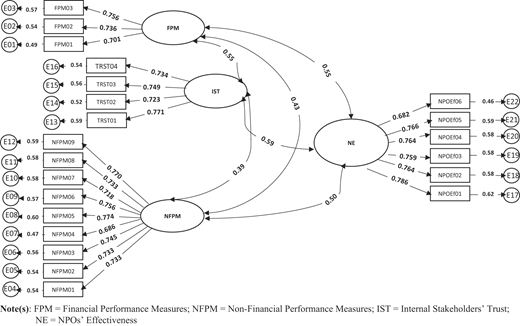
Following the method of maximum likelihood used by Anderson and Gerbing (1988), we run a confirmatory factor analysis. The results presented in Figure 2 showed that all items had significant standardized loadings ranging from 0.682 to 0.786. All items were retained in the model without deleting any items. The fit indices of the confirmatory factor analysis demonstrated an acceptable fit to the data of the hypothesized model (χ2 = 276.696, df = 203, χ2/DF = 1.36, p < 0.001; CFI = 0.969; TLI = 0.964; SRMR = 0.031; and RMSEA = 0.041).
The average variance extracted (AVE) values for financial measures, non-financial measures, internal stakeholders' trust and NPOs' effectiveness were 0.535, 0.546, 0.537 and 0.546, respectively, as shown in Table 1. The values of composite reliability (CR) for financial measures, non-financial measures, internal stakeholders' trust and NPOs' effectiveness were 0.775, 0.915, 0.823 and 0.878, respectively. The results are in line with Fornell and Larcker (1981) who suggested that the acceptable values of CR are above 0.7 and those for AVE are above 0.5. This indicates that the condition of convergent validity is met. On the other hand, discriminate validity was checked using the Fornell and Larcker (1981) criterion comparing the square root of AVE to correlations with the research variables. The results suggest, as presented in Table 2, that the square root of the AVE was higher than the correlations between the variables, suggesting the presence of discriminant validity.
Analysis
In Table 2, we present the means, standard deviations and correlations among the examined variables in the study. Positive correlations were found between the financial measures and NPOs' effectiveness, non-financial measures and NPOs' effectiveness, internal stakeholders' trust and NPOs' effectiveness
Hypotheses testing
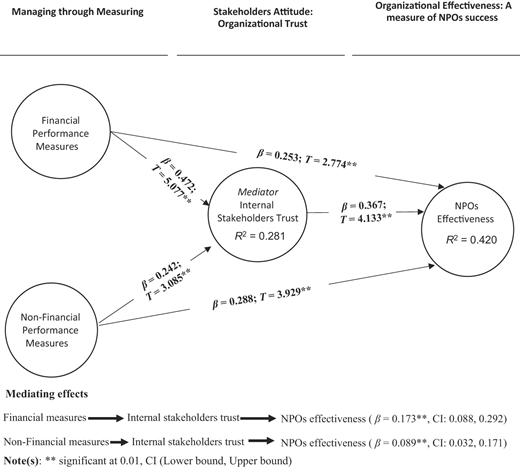
To test the proposed hypotheses, the analysis used a partial structural equation model, as presented in Figure 3. The findings of the model suggest that the data fit with the model, as the fit indices were satisfactory (χ2 = 307.61, df = 204, χ2/DF = 1.508 p < 0.001; CFI = 0.956; TLI = 0.950; SRMR = 0.08; and RMSEA = 0.048). In terms of the direct effects, the results show that the use of financial performance measures was positively related to NPOs' effectiveness (β = 0.253, p = 0.006), which lends support to H1. Moreover, the use of non-financial performance measures was found to positively affect NPOs' effectiveness (β = 0.288, p = 0.000), supporting H2. On the relationship between the use of performance measures and internal stakeholders' trust, the results indicated that the use of both financial performance measures (β = 0.472, p = 0.000) and non-financial performance measures (β = 0.242, p = 0.002) was positively associated with international stakeholders' trust. These results lend support to H3 and H4. On another note, internal stakeholders' trust was found to exert a significant positive effect on NPOs' effectiveness (β = 0.367, p = 0.000), which supports H5.
On the mediating effects of internal stakeholders' trust, the results revealed that internal stakeholders' trust played a significant mediating effect in the relationship between the use of financial performance measures and NPOs' effectiveness (β = 0.173, p = 0.000) and the use of non-financial performance measures and NPOs' effectiveness (β = 0.089, p = 0.000). These results lend support to hypotheses H6a and H6b. Finally, among the control variables, only age was found to have a significant effect on internal stakeholders' trust (β = 0.253, p = 0.02).
Discussion and implications
This paper aimed to investigate the links between performance measures and NPOs' effectiveness via the mediating effect of internal stakeholders' trust. On the relationship between financial performance measures and NPOs' effectiveness, the results suggest that financial performance measures depict a positive relationship with NPOs' effectiveness. Similarly, the results suggested that non-financial performance measures were positively related to NPOs' effectiveness. These results were in line with what has been documented in previous studies (e.g. Davis and Albright, 2004; Iwu et al., 2015; Upadhaya et al., 2014) of the private sector, which found that the use of both financial and non-financial measures exerts a significant positive effect on organizational effectiveness. This implies that the use of performance measures would give managers the opportunity to efficiently allocate resources, thus positively contributing to overall performance of an organization (Word and Sowa, 2017).
On the relationship between performance measures and internal stakeholders' trust, the results suggested that both financial and non-financial performance measures are positively associated with internal stakeholders' trust. This indicates that the use of clear performance measures represents practices of integrity and accountability, which, in turn, contribute to increased stakeholders' trust and confidence in their NPOs.
Considering the relationship between internal stakeholders' trust and NPOs' effectiveness, the results illustrated that internal stakeholders' trust positively influenced NPOs' effectiveness. This implies that when an NPO, through practices of integrity and transparency, encourages positive work-related attitudes (e.g. trust) among internal stakeholders, this will lead to higher levels of effectiveness in terms of achieving the desired results (Packard, 2010).
Finally, the results showed that the mediating effect of internal stakeholders' trust in the PM–NPOs' effectiveness relationship was significant. The results lend support to what has been discussed under the umbrella of stakeholder theory, which suggests that the experiences of stakeholders with their NPOs' PM practices define the level of stakeholders' trust toward their NPOs and, ultimately, yields positive results for NPOs' effectiveness. Based on this, both practical and theoretical implications can be derived from the idea of using measures to manage performance in order to provide better support for achieving the desired outcome of organizational effectiveness, considering the significant role of stakeholders' trust in their NPOs.
Practically, we suggest NPOs' managers to focus on building their internal stakeholders' trust as an asset. On the other hand, NPOs' managers are required to take steps to develop and use their clearly identifiable performance measures, which, in turn, enhance the overall effectiveness of the organization in terms of mission achievement, raising public awareness, increasing funds and so forth. As internal stakeholders' trust was found to play a role in enhancing NPO effectiveness, we recommend NPOs' management to involve stakeholders in their decision-making process, as well as PM design and implementation. This could lead to strengthen stakeholders' positive work-related attitudes, such as trust, which ultimately enhances stakeholders' support for NPOs to achieve their desired results. Finally, NPOs should search for clearly identifiable performance measures that can capture their sophisticated achievements.
Theoretically, this paper aimed to respond to the gaps concerning the relationship between PM and NPOs' effectiveness. First, this research contributes to the literature on NPOs through investigating the role of internal stakeholders' trust toward their NPOs, a topic which has not been addressed by previous research. Second, this research generally contributes to the literature on PM in NPOs, as there is a lack of research in the area (Chenhall, 2006; Lynch-Cerullo and Cooney, 2011). Third, the research represents an empirical endeavor to investigate the black box of the PM–NPOs' effectiveness relationship; in a way, it provides an empirical evidence of the positive impact PM can exert on NPOs' effectiveness. Therefore, this study advances the literature on the relationship between PM and NPOs' effectiveness through empirical investigation rather than by offering conceptual or theoretical assumptions.
Fourth, this research contributes to the literature of PM in NPOs by investigating the aforementioned variables in developing countries. According to Wadongo and Abdel-Kader (2011), most of the empirical studies in the NPO sector were carried out in the USA and UK, with few exceptions from developing geographical zones. Fifth, while most of the performance management studies in NPOs are either systematic inquiry research (Lecy et al., 2012) or case-study qualitative analysis (Yap and Ferreira, 2011), quantitative research designs using questionnaires are very limited (LeRoux and Wright, 2010).
Study limitations and future research
Although this study contributes to the literature pertaining to the relationship between PM and NPOs' effectiveness, we still have some limitations that can open doors for future research. First, the nature of the study is cross-sectional, which did not allow us to examine causal relationships. Therefore, future studies may consider using longitudinal study designs to examine the changes in the variables over time. Second, the study focused only on Palestinian NPOs working in Gaza Strip, which might threaten the generalizability of the results to other NPOs working in other Palestinian zones such as the West Bank. Hence, future research might consider examining the study variables with a sample composed of Palestinian NPOs in both geographical zones and including non-Palestinian NPOs. Third, this research employed only internal stakeholder trust as a mediating variable in the relationship between performance measures and NPOs' performance. Future research might consider examining the role of external stakeholder trust (e.g. donors, governments, beneficiaries), and other attitudinal outcomes such as work engagement which showed to be influenced by PM effectiveness in business settings (Kakkar et al., 2020). Future work may consider social networking (Asamoah et al., 2020), and big data and predictive analytics (Jeble et al., 2019) as intervening mechanisms in the relationship between PM and NPOs' effectiveness. Finally, it is recommended that future research uses mixed-methods designs to provide better explanations of the relationship between performance measures and NPOs' effectiveness.