The adoption of robots at the workplace reshapes work design. This study aims to investigate whether such integration lifts employee performance and clarifies the psychological chain (i.e. employees’ perception of job (in)security, followed by their engagement at work), through which potential gains may emerge.
Using the Indian information technology (IT) services as a case of a tech-driven industry in an emerging economy, a two-wave time-lagged survey was conducted to capture the views of 398 IT service professionals employed in Bangalore, Chennai, Delhi, Hyderabad and Pune. The collected data were assessed using exploratory and confirmatory factor analyses, while the hypothesized relationships were tested using a serial mediation analysis via PROCESS Macro Model 6 in Statistical Package for the Social Sciences.
This study shows that workplace robot adoption directly improves employee performance and that this effect grows when employees feel secure and (thus) engage more deeply with their work. However, perceived job insecurity erodes engagement and neutralizes performance gains. These results suggest that signaling continued employability is essential to achieve productivity improvements.
This study extends the theoretical generalizability of cognitive appraisal theory to technology-driven work design involving automation by demonstrating that employees view robots as a threat to their jobs and adjust their engagement at the workplace accordingly. Noteworthily, the model established herein integrates technology adoption and human resource perspectives to equip scholars with a theoretically grounded and empirically validated psychological reasoning that explains employees’ perception and reaction to the adoption of robots at the workplace and, by extension, provides managers a clear message: reassure staff first, then expect enhanced performance.
1. Introduction
Competitive pressure and rising labor costs have persuaded many firms to turn to workplace robotics for speed, precision and data-driven decision-making (Sun and Jung, 2024; Wang et al., 2025). For instance, the Indian information technology (IT) services, renowned for their process maturity, have embraced this shift with particular vigor, using advanced robotics to streamline software testing, infrastructure monitoring and client support (Pathak et al., 2024). These deployments signal more than an operational upgrade; rather, they redraw workflows, alter skill requirements and place human-robot collaboration at the center of value creation (Simões et al., 2022; Tandon et al., 2024).
Enthusiasm for efficiency sits uneasily beside apprehension about job continuity (Yam et al., 2023). Empirical work shows that task automation frees employees from routine chores yet triggers anxiety about redundancy, especially in skill-intensive sectors where work identities are tightly bound to expertise (Adekiya, 2024). Notably, job insecurity depresses motivation, weakens engagement and erodes performance (Cao and Song, 2025), as employees who believe their roles may be automated experience disengagement, burnout and lowered morale, which further reduces their performance (Etehadi and Karatepe, 2019) – a pattern observed across service settings (Willems et al., 2023). In this regard, tech-driven organizations in the service industry, especially in emerging economies, are likely to face the same dilemma at heightened speed because demand for specialized talent coexists with relentless pressure to automate. Managers, therefore, require evidence on whether and through which mechanisms, robotics adoption lifts or lowers individual performance at work.
Scrutiny of extant literature suggests that scholars (e.g. He et al., 2025) often concentrate on tangible gains of automation (e.g. cycle time, cost savings, error reduction), leaving the attendant psychological effects thinly documented (Wang et al., 2025), with only a small stream that links automation-induced insecurity to disengagement, burnout and diminished morale (Etehadi and Karatepe, 2019). Yet, research rarely investigates these phenomena in a sequential manner that traces the full pathway from technological change to performance via job security perceptions and engagement, which limits explanatory power for when productivity gains materialize or stall. This omission is consequential in emerging economy settings such as India, where technology diffusion outpaces institutional support and where employees increasingly interpret automation through the lens of rapidly evolving career expectations (Bansal et al., 2025). Without that sequential account, firms risk investing in robots while losing the very engagement that converts technology into performance.
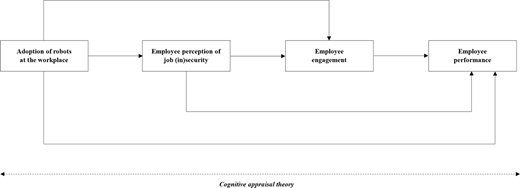
Drawing on cognitive appraisal theory (CAT; Lazarus and Folkman, 1984), this study proposes that employees confronting the adoption of robots at work undertake a two-stage evaluation: first, a cognitive assessment of whether their employment remains secure, and second, a motivational judgement about whether to invest effort. In this regard, positioning job (in)security as the primary appraisal and engagement as the secondary response clarifies why the adoption of automated technologies like robots can inspire or demoralize staff. The sequential mediation relationship tested here, therefore, enriches the theory’s reach from stress research into technology-driven work design involving automation. Consistent with this account, the study finds that workplace robot adoption improves employee performance directly and, more strongly, when employees feel secure and engage more deeply, whereas insecurity erodes engagement and can neutralize the gains.
This study contributes on several fronts. Conceptually, the model integrates technology adoption and human resource perspectives, demonstrating that perceived job security anchors engagement and, by extension, performance. Empirically, the study examines 398 IT service professionals across India’s major technology hubs, offering the most comprehensive test to date of the proposed pathway in an emerging economy. Practically, the findings advise executives to couple automation with transparent communication, reskilling opportunities and supportive policies – actions that safeguard morale while unlocking productivity.
The remainder proceeds as follows: the next sections discuss the theoretical foundation that informs the hypotheses, while the sections thereafter detail the methodology, results, implications, limitations and directions for future research.
2. Theoretical background
CAT (Lazarus and Folkman, 1984) offers a profound and suitable lens for investigating how employees interpret and react to the adoption of robots at the workplace. The theory frames adaptation as an appraisal process in which individuals first judge whether an event threatens valued goals and then decide how much effort to invest in coping. Such dual-stage reasoning mirrors the psychological course likely to unfold when robots enter a job that once relied exclusively on human expertise.
Competing theories leave important gaps. The technology acceptance model (Davis, 1989) excels at predicting whether users will adopt a system, yet its focus on perceived ease of use and usefulness sidelines the existential concerns that surface when automation can displace labor (Venkatesh and Davis, 2000). The job demands-resources model (Demerouti et al., 2001) links demands and resources to strain and motivation, but the model presumes relatively stable task environments and stops short of detailing how threats to job security ignite anxiety. CAT, in contrast, explicitly addresses threat appraisal and emotional coping (Lazarus and Folkman, 1984), thereby capturing the stress reactions that shape engagement when automation arrives. This theoretical choice also aligns with the IMPACT criteria for theory selection (i.e. interestingness, matching, parsimony, applicability, conceptual rigor and testability; Hollebeek et al., 2025). Noteworthily, CAT offers strong matching because its threat and coping logic maps directly onto perceived job (in)security and engagement in the face of robot adoption, and it strengthens interestingness by shifting the discussion from acceptance to stress appraisal and coping under displacement risk. CAT also supports parsimony via a single, coherent explanation for the full sequence; sustains conceptual rigor through explicit appraisal mechanisms and clear construct roles; yields testability through a straightforward serial mediation that can be empirically falsified; and ensures applicability, as the model produces an actionable diagnostic for managers to reduce threat perceptions, sustain engagement and protect performance.
Two appraisal stages clarify the relevance of CAT for this study: primary and secondary appraisals (Lazarus and Folkman, 1984). Primary appraisal involves gauging whether robot adoption endangers continued employment – a judgement reflected in perceived job (in)security. Secondary appraisal concerns the decision to invest discretionary effort in response to that judgement, captured here as engagement. Research already shows that threat-oriented appraisals foster anxiety, disengagement and lower morale (Cao and Song, 2025; Gupta and Dhar, 2024), whereas challenge-oriented appraisals promote energy and learning (Karatepe et al., 2020). Aligning these insights with CAT, therefore, allows a direct test of how security perceptions feed forward into engagement and, in turn, performance.
Context intensifies the need for such a theoretical lens (Venkatesh, 2025). Indian IT services operate under rapid release cycles, volatile client demand and comparatively weak employment safeguards (Bansal et al., 2025). These conditions magnify the salience of automation-related threat appraisals, making the appraisal–engagement link especially consequential. Compared with Western settings where institutional buffers mute displacement fears, Indian professionals face sharper uncertainty and, therefore, represent an ideal population for probing CAT’s explanatory power. In this regard, a serial mediation model emerges, where the adoption of robots at the workplace influences employee performance indirectly through sequential appraisals of job (in)security and engagement (Figure 1). Positioning CAT at the core of this logic advances theory by connecting technology adoption to stress-coping dynamics and equips managers with a diagnostic sequence: secure the workforce psychologically, cultivate engagement and only then expect performance gains.
3. Hypothesis development
3.1 Adoption of robots at the workplace
Robots offer increased efficiency while provoking concern about human displacement (Wang et al., 2025). Defined as programmable systems able to execute complex tasks autonomously or semiautonomously (Shishehgar et al., 2018), workplace robots automate repetitive, precision-dependent activities, thereby cutting costs, enhancing productivity and raising accuracy (McKinsey, 2017; Zhang et al., 2023). In IT services, automation shifts staff effort toward design, problem solving and other high-order activities that rely on imagination and analytical skill (Biswal et al., 2020).
Yet, early evidence shows that technological displacement follows predictable patterns: automation augments some roles while eroding others (Autor et al., 2003). Later studies document automation anxiety, a forward-looking stress response rooted in uncertainty about future employability (Deng et al., 2021; Frey and Osborne, 2017). Noteworthily, workers do not passively accept these shifts, as many engage in digital job crafting to reshape their roles to maintain relevance (Arntz et al., 2016; Parker and Grote, 2020; Wrzesniewski and Dutton, 2001).
The present study draws on CAT (Lazarus and Folkman, 1984) and positions job (in)security (De Witte, 2000) and engagement (Schaufeli et al., 2006) as the sequential psychological mechanisms through which workplace robot adoption influences performance among employees. This perspective advances prior work by moving beyond descriptive links and offering an integrative explanation suited to high velocity, technology-driven contexts such as IT services.
3.2 Adoption of robots at the workplace and employee performance
Robots heighten precision and speed by assuming routine, rule-based operations, thereby freeing employees for tasks that demand analysis, creativity and judgment (McKinsey, 2022; Zhang et al., 2023). IT services, where vast data flows and tight deadlines prevail, illustrate this dynamic especially well. Automated code testing, overnight data cleaning and real-time infrastructure monitoring remove much of the labor from daily work, allowing professionals to channel effort toward architecture design, client problem solving and innovation. Evidence consistently shows that, when aligned with process requirements, robots compress cycle times and narrow error margins, producing measurable gains in individual and team output (Špirková et al., 2024). Specifically, automated scripts process low-value data at a fraction of previous run times, giving analysts latitude to investigate root causes and propose system improvements, which, in turn, elevates performance ratings (Etehadi and Karatepe, 2019).
Performance payoffs, however, hinge on how employees interpret the technology. Workers who frame robots as allies that remove tedium report higher motivation, deeper engagement and stronger productivity (Paliga, 2022). Colleagues who regard the same machines as causes of redundancy often retreat, displaying lower discretionary effort and weaker outcomes (McKinsey, 2017). Organizational practices therefore matter: transparent communication, timely training and clearly signaled career paths shape favorable perceptions and help the workforce convert technical capability into human performance gains (Wang et al., 2025). Given this, we hypothesize:
Adoption of robots at the workplace improves employee performance.
3.3 Employee perception of job (in)security as a mediator
Extant discussions of workplace robotics tend to pivot on technical efficiency (Urrea and Kern, 2025). However, the decisive question for performance, arguably, lies in whether staff regard the technology as a threat to continued employment. CAT (Lazarus and Folkman, 1984) explains this evaluation as a primary appraisal in which employees weigh the probability and severity of job loss that may follow automation. A threat appraisal erodes motivation, raises stress and triggers withdrawal behaviors that stifle discretionary effort (Etehadi and Karatepe, 2019). Recent studies reinforce this pattern, reporting steeper productivity declines when workers believe that machines will replace rather than complement them (Cao and Song, 2025).
Employee reactions are seldom binary. Noteworthily, some professionals may view workplace robots as a complement rather than a replacement, for instance, an opportunity for skill enrichment and career longevity, especially when management communicates clearly, supplies retraining and signals pathways for progression (McKinsey, 2022), as transparent dialogue and timely reskilling shift the appraisal from threat to challenge, protecting morale and strengthening commitment, in line with CAT (Lazarus and Folkman, 1984).
These insights suggest a mediating chain: workplace robot adoption shapes perceived job (in)security, which then conditions performance. Perceived insecurity suppresses effort and undermines gains, whereas perceived security unlocks the productive potential of automation. Organizations that privilege job security signaling, through candid communication, continuous learning and redeployment policies, should, therefore, better position themselves to harvest the performance dividends of implementing robots at the workplace. In light of this, we hypothesize:
Employee perception of job security mediates the relationship between adoption of robots at the workplace and employee performance.
3.4 Employee engagement as a mediator
Employee engagement, characterized by vigor, dedication and absorption in one’s role, has long predicted discretionary effort as well as task quality and persistence (Schaufeli et al., 2006). Elevated engagement channels cognitive and emotional resources toward work goals, thereby lifting performance far beyond what formal job descriptions require (Aggarwal et al., 2024). In line with CAT (Lazarus and Folkman, 1984), technology can either fuel or drain that resource reservoir, depending on how employees interpret its purpose and impact, with workplace robots adoption providing a suitable test of this logic. Specifically, when managers frame robots as allies that relieve labor and create space for creative problem-solving, employees are likely to experience higher autonomy and task significance – two antecedents of engagement widely validated in organizational psychology (Cotič et al., 2025). For instance, analysts who hand routine data cleansing to scripts may report stronger enthusiasm for complex debugging and solution design, showing that their engagement rises accordingly, as do their output metrics. Conversely, when robots are introduced with opaque objectives or without credible reskilling pathways, employees may read the technology as a prelude to redundancy, disengage and allow performance to slide. CAT clarifies this divergence: a challenge appraisal (e.g. seeing robotics as a resource) stimulates intrinsic motivation and focused effort, whereas a threat appraisal curtails involvement and narrows attention to self-preservation (Lazarus and Folkman, 1984). Therefore, job (in)security perceptions set the stage for (dis)engagement, but (dis)engagement itself serves as the immediate behavioral conduit translating appraisal into performance. Recognizing this sequence helps organizations design communication, training and career development initiatives that shift appraisals toward opportunity and lock in the performance benefits of automation. On this basis, we hypothesize:
Employee engagement mediates the relationship between adoption of robots at the workplace and employee performance.
3.5 Employee perception of job (in)security and employee engagement as serial mediators
CAT (Lazarus and Folkman, 1984) maintains that employees process disruptive change in two stages. The first, a primary appraisal, answers the question, “Does this threaten my job?”; the second, a secondary appraisal, asks, “Given that judgement, how much effort should I invest?” Introducing workplace robots, therefore, launches a sequence in which perceived job (in)security sets the tone for engagement, which, in turn, drives performance.
When employees judge robots as complements rather than replacements, they feel safe, pursue reskilling opportunities and invest discretionary effort in higher-value tasks (Karatepe et al., 2020). Secure employees display greater absorption and dedication (Joubert et al., 2023), examples of engagement behaviors that repeatedly link to stronger productivity (Abdelwahed and Doghan, 2023). Conversely, a threat appraisal triggers caution, narrows attention to self-preservation and deprives the organization of the engagement needed to translate technical capability into output (Shoss et al., 2023). These insights, in turn, imply a conditional, sequential pathway: workplace robots deliver performance gains only when employees first feel secure and then engage. Organizations that address insecurity early (e.g. through candid communication, targeted reskilling, visible career paths) should, therefore, be able to harness the full productivity potential of automation. To this end, we hypothesize:
Employee perception of job (in)security and employee engagement sequentially mediates the relationship between adoption of robots at the workplace and employee performance.
4. Methods
4.1 Instrumentation
The questionnaire comprised two segments. The opening segment captured demographic background (age, education, gender, work city and work experience) so that subsequent analyses could control for potential differences, while the subsequent segment measured the study’s focal constructs with multi-item scales drawn from prior research and scored on five-point scale formats for comparability across instruments. In particular, eight items were adapted from Liu and Cao (2022) and Zhang et al. (2023) to measure the extent to which robots are adopted at the workplace, while four items were adapted from De Witte (2000) to measure the extent to which jobs are perceived to be (in)secure – both scales were measured on a five-point scale, where “1” denotes “strongly disagree” and “5” represents “strongly agree.” Whereas, six items were adapted from Schaufeli et al. (2006) to measure the extent to which employees are engaged in the workplace, while another six items were adapted from Koopmans et al. (2014) to measure the extent to which employees are performing well – both scales were measured on a five-point scale, where “1” denotes “never” and “5” represents “always.”
Following Hinkin, 1995, Behr (2017) and Lim (2024), all items underwent a contextualization process to establish content validity. Two Indian human resource managers in the IT services industry and two organizational psychology scholars reviewed each item for conceptual clarity and equivalence, where wording adjustments addressed minor linguistic or idiomatic issues specific to Indian IT services. A pilot study with 42 professionals then examined item clarity (establishing face validity) and internal consistency (establishing reliability; Lim, 2025). Cronbach’s alpha values exceeded the recommended 0.70 threshold for every construct (Nunnally and Bernstein, 1994): adoption of robots at the workplace (α = 0.88), employee perception of job security (α = 0.84), employee engagement (α = 0.81) and employee performance (α = 0.87), thereby confirming reliability prior to full data collection.
4.2 Sampling
The survey targets Indian IT service professionals who work with, or alongside, robotic process automation, as the industry offers an ideal context of accelerating deployment of automation and frequent public debate over employment stability (McKinsey, 2022; NASSCOM, 2023).
Survey population frame and site selection: Bangalore, Chennai, Delhi, Hyderabad and Pune are five major cities in India that account for the majority of national IT revenue and host the largest concentrations of robotic process automation projects (Ministry of Electronics and Information Technology, 2022). Sampling in these cities also maximizes variation in automation maturity, client portfolio and firm size (Economic Times, 2023), while retaining a common industrial context.
Sampling strategy: Purposive sampling was conducted and ensured that every respondent held a full-time position in IT services, had at least one year of tenure and worked in a department where robotics (automated tools) were in use. This sampling approach is ideal when the population is specialized and highly difficult to access through random sampling (Lim, 2025). Professional networks (LinkedIn groups, city-level industry associations) and internal champions in partner firms circulated an electronic questionnaire during January–March 2024.
Survey safeguards: An information sheet outlined study aims, guaranteed anonymity and emphasized voluntary participation. Respondents provided informed consent online before accessing the questionnaire. All procedures followed the Declaration of Helsinki and institutional guidelines for social science research.
Sample size and response rate: Out of 600 invitations, 417 surveys were returned (69.5%). Nineteen contained excessive missing data and were discarded, leaving 398 usable responses – an effective response rate of 66.3%. The final count exceeds guidelines for serial mediation models: Kline (2015) recommends at least 200 cases and Hair et al. (2020) encourage 10–20 observations per estimated parameter, a threshold comfortably met here.
Split sample validation: To cross-validate the measurement model, cases were randomized into an exploratory factor analysis (EFA) subset (n = 198) and a confirmatory factor analysis (CFA) subset (n = 200). Such partitioning avoids capitalizing on chance when refining item structure.
Sample profile: Most participants are younger than 40 years (88.0%: 52.0% aged 20–30; 36.0% aged 31–40; 12.0% aged 41–50; see Appendix Table A1). Slightly more than three-fifths hold a postgraduate degree (61.1%), with the remainder at the undergraduate level (38.9%). Males comprise 59.8% of the pooled sample, while females account for 40.2%. Respondents are spread across five IT hubs in India – Bangalore (23.9%), Chennai (17.1%), Delhi (19.8%), Hyderabad (20.6%) and Pune (18.6%) – each close to one-fifth of the sample. Nearly half report 1–5 years of work experience (49.0%), about one-third have 6–10 years (32.9%) and the rest exceed 10 years (18.1%). χ2 tests indicate no significant differences in age, education, gender or experience distributions between the EFA (n = 198) and CFA (n = 200) subsets (p > 0.05), confirming that the random split did not introduce bias.
5. Results
5.1 Preliminary analysis
Initially, we computed the Mahalanobis distance (D2) to detect multivariate outliers (Byrne, 2010). No significant outliers were found, indicating that the data are suitable for further analysis. Subsequently, we evaluated normality via skewness and kurtosis, all of which fell within ±2, demonstrating an approximately normal distribution (Garson, 2012).
To address common method bias (CMB), we used a procedural remedy and engaged in a statistical check (Lim, 2025). From a procedural perspective, we adopted a two-wave, two-week time-lagged design. Wave 1 collected data on the mediating variables (employee perceptions of job security and employee engagement) and the dependent variable (employee performance). Wave 2 conducted two weeks later, measured the independent variable (adoption of robots at the workplace). Participants were informed during Wave 1 that a follow-up would occur and unique identifiers were used to link responses across waves while preserving anonymity. From a statistical perspective, we performed Harman’s single-factor test, where an EFA revealed that one unrotated factor accounted for only 24.5% of the total variance, well below the 50% benchmark, and thus indicating no major issue with CMB (Podsakoff et al., 2003).
5.2 Exploratory factor analysis
We conducted an EFA to uncover the underlying structure of our adapted scales and confirm their dimensionality (Fabrigar et al., 1999; Hinkin, 1995). We used maximum likelihood extraction to obtain robust factor solutions and to allow statistical testing of loadings (Cautin and Lilienfeld, 2015), followed by Varimax rotation to simplify interpretation by minimizing cross-loadings (Kaiser, 1958).
Data suitability was confirmed by a Kaiser–Meyer–Olkin measure of 0.820 (above the 0.60 threshold) and a significant Bartlett’s test of sphericity (p < 0.01), indicating adequate sampling (Kaiser and Rice, 1974) and factorability (Guadagnoli and Velicer, 1988), respectively. All items loaded above 0.50 on their respective factors. Seven (sub)factors emerged naturally – namely, adoption of robots at the workplace, employee perception of job (in)security, employee engagement (vigor, dedication and absorption) and employee performance (contextual performance and task performance), which collectively explained 73.96% of the total variance (Appendix Table A2), surpassing the minimum 60% threshold (Goretzko et al., 2021).
Reliability, as seen through Cronbach’s α, was strong for most (sub)scales: adoption of robots at the workplace (α = 0.923), employee perception of job (in)security (α = 0.904), dedication (α = 0.752), absorption (α = 0.723), contextual performance (α = 0.726) and task performance (α = 0.890). The vigor subscale, however, yielded an α of 0.684 and given its two‐item composition, this value is marginally below the minimum 0.70 threshold but still within an acceptable range for initial scale validation.
5.3 Confirmatory factor analysis
CFA was used to validate the measurement model. We began by examining model fit. The relative chi-square (χ2/df) was 2.89, below the recommended maximum of 3.0 (Hair et al., 2020). The root mean square residual (RMR) was 0.045 and the root mean square error of approximation was 0.049, both under the maximum 0.08 threshold (Steiger, 1990). The goodness of fit index equaled 0.912, above the minimum 0.90 benchmark (Shevlin and Miles, 1998); the normed fit index (NFI) was 0.852, beyond the minimum 0.80 cutoff (Bentler and Bonett, 1980); the adjusted goodness of fit index was 0.875, exceeding the minimum 0.80 standard (Byrne, 2001); and the comparative fit index reached 0.910, surpassing the minimum 0.90 threshold (Hair et al., 2020). Hence, these indices collectively indicate that the model fits the data well.
Convergent validity was assessed via composite reliability (CR), average variance extracted (AVE) and standardized factor loadings (Fornell and Larcker, 1981; see Appendix Table A2). All standardized factor loadings exceeded 0.50, the minimum recommended level (Byrne, 1994). CR ranged from 0.753 to 0.910, above the minimum 0.70 benchmark, while AVE ranged from 0.553 to 0.692, beyond the minimum 0.50 cutoff. In every case, CR exceeded AVE, confirming that each construct explains more variance in its items than remains in measurement error, thus establishing convergent validity.
Discriminant validity was initially evaluated by ensuring that no interconstruct correlation exceeded the maximum 0.85 standard (Kline, 2015). Subsequently, the Fornell and Larcker (1981) criterion was applied by comparing the square root of AVE for each construct (shown on the diagonal in Appendix Table A3) to its correlations with other constructs, wherein all instances, the square root of AVE was higher, confirming that each construct shares more variance with its own measures than with others, thus establishing discriminant validity.
5.4 Hypothesis testing
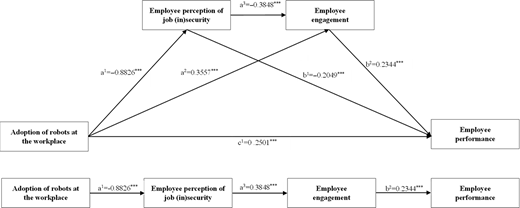
To evaluate the proposed sequential mediation – namely, that the adoption of robots at the workplace influences employee performance via employee perception of job (in)security followed by employee engagement – we used PROCESS Macro Model 6 in the Statistical Package for the Social Sciences (Hayes et al., 2017; Figure 2). This approach was chosen over traditional covariance-based structural equation modeling as PROCESS Macro Model 6 provides direct estimates of serial mediation paths with bias-corrected bootstrapped confidence intervals and, more importantly, does not assume normality of the indirect effect sampling distribution, an assumption frequently violated in mediation research (Hayes, 2018; Preacher and Hayes, 2008; Zhang et al., 2023). This approach is also especially appropriate for moderately sized samples such as ours (n = 398), where traditional SEM techniques may yield less stable parameter estimates. We generated 5,000 bootstrap samples to construct 95% confidence intervals around each indirect effect (Appendix Table A4), wherein an effect was deemed statistically significant if its interval did not include zero (Lim, 2025).
The direct effect of adoption of robots at the workplace on employee performance was strong and positive [β = 0.5939, t(396) = 15.63, p < 0.001], indicating that workplace robots can improve employee performance, thus supporting H1. When controlling for mediators, the direct effect remained significant [β = 0.2501, t(394) = 4.31, p < 0.001], indicating that a substantial portion of the workplace robots–employee performance relationship is not fully mediated, thus further supporting H1.
The aggregate indirect effect (β = 0.3439, BootSE = 0.0623, 95% CI [0.2242, 0.4697]) was also significant. Examining specific mediation pathways, the first indirect path – through employee perceptions of job (in)security alone – was significant (β = 0.1809, BootSE = 0.0577, 95% CI [0.0555, 0.2847]), indicating that alleviating the fear of job loss when robots are adopted at the workplace contributes to better performance among employees, thus supporting H2. The next specific path – through employee engagement alone – was also significant (β = 0.0834, BootSE = 0.0336, 95% CI [0.0311, 0.1692]), indicating that workplace robots can directly boost engagement to improve performance among employees, thus supporting H3. More importantly, the serial mediation pathway – i.e. adoption of robots at the workplace → employee perception of job (in)security → employee engagement → employee performance – was significant (β = 0.0796, BootSE = 0.0319, 95% CI [0.0323, 0.1612]), indicating that these two mediators jointly transmit the effect of workplace robots onto employee performance, thus supporting H4.
These results align with CAT (Lazarus and Folkman, 1984), which posits that individuals first make a primary appraisal – here, an assessment of job (in)security – and then a secondary appraisal – whether to invest effort and engagement. The stronger indirect effect through job (in)security underscores that employees are unlikely to commit emotionally until their existential fears of job loss are addressed. Maslow’s (1943) hierarchy of needs similarly suggests that basic security must be satisfied before higher‐order motivations like engagement can flourish. The weaker, though still significant, engagement-only pathway indicates that workplace robot adoption does not automatically elicit affective investment unless accompanied by assurances of stability and support. These insights, in turn, enriches prior research showing that engagement often remains muted without perceived psychological safety, especially in hierarchical or risk-averse cultures (Parker and Grote, 2020; Wrzesniewski and Dutton, 2001), as witnessed in India and its IT services industry, respectively. Therefore, the theoretical contribution of this study arises from its integration of technology adoption and human resource perspectives into a unified, serial appraisal framework, whereby the demonstration of both direct and indirect pathways enables the study to extend CAT into technology-driven work design and highlight the central roles of employees’ perception of job (in)security and engagement in ensuring that workplace robots adoption ends up improving, rather than diminishing, employee performance. Extrapolating this from theory to practice implies a clear, strategic sequence for practitioners: organizations should first communicate job-security assurances, offer reskilling opportunities and institute supportive policies before deploying engagement-enhancement initiatives, as only by prioritizing employee security can organizations unlock the full performance benefits of workplace robots.
6. Conclusion
6.1 General discussion
The present study offers new insights into the mechanisms by which the adoption of robots at the workplace influences employee performance with evidence from the Indian IT services industry. Consistent with our hypotheses, we found a strong positive direct relationship between implementing robotic technologies and employee performance. This effect remains significant even when controlling for psychological intermediaries, suggesting that, beyond indirect pathways, robots can themselves drive productivity gains among employees. However, the magnitude of the total indirect effect – mediated sequentially through employee perception of job security and then employee engagement – highlights the critical role of these psychological responses in shaping outcomes.
To elaborate, the strong direct effect of robots on performance corroborates prior evidence that automation delivers efficiency and quality improvements in knowledge-work environments. For instance, Zhang et al. (2023) observed that automating routine processes reduces error rates and cycle times, while a report by McKinsey (2022) showed that organizations embracing robotics achieve higher throughput and lower costs. Similarly, Yang et al. (2024) revealed that when employees are relieved of repetitive tasks, they redirect effort toward creative problem-solving and strategic initiatives. Hence, our results extend these findings by quantifying the performance improvement among employees attributable solely to workplace robot adoption, independent of attendant shifts in employee mindset.
Despite these operational benefits, our study confirms that employee perceptions of job (in)security constitute a key mediator of robot impact. In line with CAT (Lazarus and Folkman, 1984), employees appraise robot integration first as a potential threat to their continued employability. When perceptions of job insecurity rise, engagement and performance suffer. Ghorbanzadeh et al. (2024) similarly reported that threat appraisals erode motivation and commitment during technology transitions. Thus, by isolating this pathway, the present study demonstrates that any productivity gains from automation may be partially offset if employees feel that their roles are jeopardized.
Employee engagement emerged as a second, complementary mediator. Consistent with Schaufeli et al. (2006) and Yam et al. (2023), we observed that employees who interpret robots as an enhancement to their work role report higher vigor, dedication and absorption, which, in turn, improves performance. This finding underscores the dual nature of engagement: it is both a response to improved task design and a precondition for realizing the full benefits of new technology. Therefore, employees who perceive robotics as supportive, rather than threatening, are more likely to invest discretionary effort and thereby amplify the direct effects of automation.
Importantly, the serial mediation analysis reveals that the path from workplace robot adoption to performance is strongest when employees first feel secure in their jobs and then engage with their tasks. This cascading effect aligns with the hierarchy of psychological needs, suggesting that security appraisals must be resolved before higher‐order engagement can develop (Maslow, 1943). This supports prior scholars who contended that secure employees display greater openness to change and invest more fully in novel work arrangements (Gupta and Dhar, 2024). In contexts characterized by hierarchical cultures or risk-aversion, this sequence may be especially pronounced, as employees await reassurance before committing emotionally to new workflows.
When taken collectively, these results illustrate that the productivity potential of workplace robots depends not only on mechanical efficiency but also on addressing employees’ psychological responses. The direct performance gains of automation can be significantly reinforced or undermined by how employees perceive job security and choose to engage with their evolving roles. In turn, this finer-grained understanding underscores the value of integrating technological and human perspectives when evaluating and implementing automation initiatives.
6.2 Theoretical implications
This study expands the explanatory scope of research on workplace automation and employee psychology in five key takeaways.
First, this study articulates how CAT (Lazarus and Folkman, 1984) can be firmly integrated into technology-driven work design. Placing employees’ perceptions of job (in)security ahead of engagement validates the two-stage appraisal logic originally proposed for stress episodes. Earlier investigations tended to focus on workload (Zacher and Rudolph, 2024) or technology-related stress (Dutta and Mishra, 2024), stopping short of tracing how threat appraisals translate into motivational responses. The present evidence confirms that, when robots are introduced at the workplace, employees first render a verdict on their continued employability and only then decide whether to invest discretionary effort.
Second, this study broadens technology adoption research by showing that psychological pay-offs matter alongside operational gains. Whereas most prior accounts linked robots adoption to cost savings or error reduction (Wang et al., 2025), our findings demonstrate that automation also reshapes mindsets – in particular, perceptions of job (in)stability – which, in turn, drive employee performance. A truly comprehensive theory of automation must therefore consider economic and psychological outcomes as interdependent rather than separate streams.
Third, this study clarifies the mechanics of employee engagement by identifying perceived job (in)security as a gating condition in the context of automation. Classic engagement models emphasize resources such as supervisory support (Alam et al., 2024) and role clarity (Majid et al., 2023), whereas our results indicate that vigor, absorption and dedication flourish only once employees feel secure in their jobs. Future research can, therefore, test whether this gating effect recurs in other, more specific high-velocity domains, such as cloud services, digital marketing or financial technology (FinTech), where technological change is both constant and disruptive, to improve the theoretical generalizability of the psychological mechanisms and employee outcomes witnessed in this study.
Fourth, this study delineates a methodological roadmap through sequential mediation. Demonstrating that perceptions of job security and engagement operate in series, rather than in parallel, reveals a multistage psychological mechanism linking automation to performance. Future research could, therefore, include additional considerations (e.g. learning orientation, organizational identification, perceived fairness) as potential modifiers (e.g. moderators) onto this scaffold to unpack the complex processes by which technological change unfolds.
Fifth, this study emphasizes the role of cultural and institutional context by focusing on the Indian IT services industry, where automation advances rapidly yet employment protections remain comparatively weak (Pillai and Paul, 2023). In such settings, threat appraisals may be magnified, making job security concerns especially salient. Comparative investigations in jurisdictions with stronger job safeguards can, therefore, reveal how national frameworks may moderate and, by extension, further enrich these appraisal pathways.
Overall, these theoretical contributions exemplify theoretical novelty and theoretical interestingness (Lim, 2026) as they move beyond “robots affect performance” as a generic claim and instead specify a nonobvious psychological mechanism with clear sequencing, boundary conditions and actionable logic. The study is novel in theorizing automation as a stress-appraisal episode by positioning job (in)security as the primary appraisal and engagement as the secondary appraisal while validating a serial pathway rather than treating key mediators as interchangeable. The study is interesting, as it challenges the taken-for-granted assumption that engagement is mainly a function of resources and work design, showing that engagement is first gated by threat appraisal when automation signals potential displacement, with context sharpening this tension in a setting where institutional buffers are weaker.
6.3 Practical implications
Managers and policymakers seeking value from implementing workplace robots must treat employee psychology as central, not peripheral.
First, start with clear security signals. Early disclosure of task redesigns, town hall briefings and written guarantees of redeployment can help to mitigate anxiety and reduce speculation. For instance, an organization that spells out “no compulsory layoffs during the first eighteen months of automation” can buy the goodwill required for later engagement initiatives.
Second, pair reassurance with structured reskilling. Certification programs (e.g. bot supervision, script development), which not only upskills but also recognizes the effort that employees invest to do so with excellence, can help to convert latent fear into career opportunity. Joint design of these programs, where employees help identify skill gaps, reinforces shared ownership.
Third, recraft roles to highlight human problem-solving. Revised job descriptions should spell out how robotic support frees employees for architecture reviews, client consulting or prototype design. Performance evaluations that reward those higher value contributions further enhance the perception that the technology complements, rather than replaces, human expertise.
Fourth, measure engagement continuously. Quarterly pulse surveys that include items on vigor, dedication and absorption (e.g. the measures in Appendix Table A2) will help to flag slipping morale before performance metrics deteriorate. In turn, when engagement dips coincide with negative chatter about job security, managers can intervene swiftly with information sessions or mentoring.
Fifth, advocate supportive public policy. Tax credits or training grants tied to demonstrable employee development would nudge organizations toward human-centered automation. Industry associations in collaboration with academics from higher education institutions and case publishers (e.g. Emerald Publishing, Harvard Business Review, Ivey Publishing, Nikkei BizRuptors and Sage Business Cases) could also curate case repositories that document successful blends of robotics and skill enrichment, thereby accelerating diffusion of effective practices across the industry.
Noteworthily, adopting these steps in the sequence of security first, capability building next and engagement thereafter, therefore, aligns organizational and employee interests by ensuring that the mechanical gains of robotics translate into sustainable performance improvements.
6.4 Limitations and future directions
Despite its contributions, this study has several limitations that point to opportunities for further inquiry.
First, despite the multiwave design deployed herein, the study remains limited to the cross-sectional measure of perception and performance, where ratings for each measure were only sought once from the participants, which, in turn, constrains causal interpretation. Employee appraisals and engagement may evolve as organizations move from pilot deployments to full-scale automation. Future research should, therefore, adopt longitudinal or panel designs that track changes in employees’ job (in)security perception, engagement and performance over multiple waves of workplace robot integration. Such designs would, in turn, clarify the time-ordering of appraisals and reveal whether reassurance efforts have lasting effects.
Second, the study’s focus on India’s IT services sector offers depth but limits external validity. Indian IT organizations operate under rapid release cycles, skill-driven labor markets and comparatively weak employment protections (Pillai and Paul, 2023), conditions that may amplify threat appraisals. Re-examining the sequential mediation model in other industries, such as health care, finance or manufacturing and in settings with stronger job security legislation would test the model’s boundary conditions and theoretical generalizability. Cross-cultural comparisons across emerging and developed economies could further uncover how institutional frameworks shape the job (in)security–(dis)engagement pathway.
Third, this study investigated only two mediators: employee perception of job (in)security and engagement. Although these constructs capture core appraisal and coping responses, other psychological factors, such as perceived organizational support, self-efficacy or openness to change, could also influence how employees adapt to workplace robotics. Future studies should, therefore, incorporate these variables, as well as potential moderators such as automation complexity and task interdependence to explain why some employees navigate technological shifts more smoothly. Using mixed-methods approaches, including qualitative interviews or field experiments, would further enrich evidence and understanding of the processes that underpin technology-driven performance outcomes at work.