The purpose of this study is to understand how leaders of entrepreneurial small and medium-sized enterprises (SMEs) in Australia and Pakistan strategise and design their organisational environments to enable innovation and enhanced organisational performance.
Drawing from the resource-based view (RBV) theory, this study investigates the mediating role of workplace innovation between design leadership and organisational performance across entrepreneurial SMEs in Australia and Pakistan. Data were obtained from 367 top-level executives in Australia and 367 from Pakistan using paper-based and online surveys.
The results highlight significant cross-country differences, indicating that entrepreneurial SMEs in Pakistan tend to overlook the creation of an enabling work environment favourable for innovation, which reduces the positive impact on organisational performance. In contrast, Australian SMEs exhibit a stronger alignment between innovation and performance outcomes.
The study makes a theoretical contribution by extending RBV theory within the contexts of design leadership, workplace innovation and SME performance, particularly in comparative international settings.
The findings offer actionable strategies for SME leaders, particularly in developing economies, highlighting the significance of encouraging internal abilities such as a conducive innovation culture. This could model strategic development and training schemes designed to achieve sustainable competitive advantage through improved organisational performance.
This study uniquely reveals the differential mediating effect of workplace innovation on the design leadership–performance nexus in developed versus developing countries. The absence of significant mediation in Pakistan stresses the distinct entrepreneurial underlying forces and challenges faced by SMEs in developing economies.
Introduction
Small- and medium-sized enterprises (SMEs) play a pivotal role in driving a nation’s economic growth (Fernández-Serrano et al., 2018). As hubs of innovation, adaptability and expansion, SMEs contribute significantly to the economy through their entrepreneurial activities (Tapan, 2001). These enterprises are sources of systemic novelty (Langlois, 2007) and typically using fewer than 200 workers in Australia (Le and Valadkhani, 2014) and 250 in Pakistan (Zou et al., 2021), face unique challenges and opportunities, especially in resource-constrained environments. Despite these limitations, SMEs leverage market opportunities by focusing on technology start-ups and niche markets (Mayr et al., 2021). Their ability to exploit such opportunities depends not only on external market conditions but also on internal resources, particularly leadership and entrepreneurial orientation, which have been identified as crucial drivers of success (Zaharuddin et al., 2024, Van Vugt and von Rueden, 2020).
The role of leadership in these entrepreneurial ventures is not only critical but highly context-dependent. The influence of leadership styles and entrepreneurial orientation on innovation, adaptability and organisational performance varies significantly depending on the socio-economic and cultural landscapes in which SMEs operate (Van Vugt and von Rueden, 2020; Zaharuddin et al., 2024). While leadership in Western contexts has been widely studied (Lam et al., 2012), there remains a gap in understanding how leadership behaviours manifest and influence SME performance in different cultural and economic settings (Szczepańska-Woszczyna, 2015), particularly in non-Western contexts like Pakistan.
Australia and Pakistan, though geographically distant, share similarities in recognising the importance of SMEs in their economies. In Australia, SMEs contribute a substantial $590bn, or nearly one-third of the nation’s GDP, illustrating their critical role in sustaining the economy (Counts, 2024). Similarly, in Pakistan, SMEs make up over 99% of businesses, contributing to more than 40% of the GDP (Safdar et al., 2024), underscoring their importance in economic development and employment generation. However, despite these shared contributions, SMEs in the two countries face distinct challenges. Australian SMEs benefit from advanced infrastructure, government support programs and a diversified business environment, focusing heavily on sectors like technology and services (Bank and Lewis, 2021). In contrast, Pakistani SMEs, often centred around industries like textiles, manufacturing and agriculture, struggle with limited financial resources, technological integration and regulatory hurdles (Kumar et al., 2022; Arshad et al., 2024).
These differences highlight the importance of context in shaping the internal resources SMEs rely on for competitive advantage. Leadership and entrepreneurial orientation, crucial in both settings, are influenced by each country’s unique institutional environment (Balubaid, 2025). While Australian SMEs can harness advanced technologies and skilled labour to drive innovation, Pakistani SMEs are more focused on resource efficiency due to their reliance on unskilled labour and raw materials in a factor-driven economy (Alam and Adeyinka, 2021; Bagh et al., 2017). Thus, understanding the impact of leadership in these contrasting environments offers valuable insights into the ways these SMEs leverage their internal resources, including leadership, to sustain innovation and performance (Harsono et al., 2025).
The study of leadership in SMEs has predominantly focused on external factors like market conditions and economic threats (Aslan et al., 2011; Joel and Oguanobi, 2024). However, there is a notable gap in the literature regarding the role of internal resources, specifically leadership, in shaping innovation and driving organisational performance. Entrepreneurial orientation, which encompasses proactivity, innovation and risk-taking, is widely acknowledged as fundamental for SMEs to gain competitive advantages in resource-constrained settings (Desa and Basu, 2013; Bacq and Eddleston, 2018). Studies have yet to explore the influence of design-oriented leadership on innovation and organisational success, particularly within the SME context.
This study aims to fill this gap by investigating how design leadership, combined with entrepreneurial orientation, impacts the performance and innovation outcomes of SMEs. While prior research has established the importance of leadership in driving innovation (Zhu and Huang, 2023; Choudhary et al., 2013), it has not adequately connected leadership behaviours with design thinking, which plays a crucial role in fostering innovation and competitive advantage in SMEs. Strategic leadership, particularly in virtual environments, is essential for nurturing a culture of creativity and innovation (Verma et al., 2023; Elkington et al., 2018). By understanding how design leadership and entrepreneurial orientation interact, this study seeks to provide new insights into the internal expertise driving SME success, highlighting the importance of design thinking and strategic leadership in fostering workplace innovation.
This research is grounded in the resource-based view (RBV) theory, which posits that competitive advantage is achieved when firms leverage unique and difficult-to-imitate internal resources (Barney, 2001; Rumelt, 2005). Design leaders, through their ability to foster a culture of creativity, play a key role in leveraging internal resources to promote innovation and improve organisational performance. By aligning design thinking with entrepreneurial orientation, SMEs can create a sustainable competitive advantage, enhancing their ability to adapt and thrive in diverse business environments.
This study makes significant theoretical and practical contributions. Theoretically, it enriches the RBV by understanding design leadership as a strategic internal resource that drives innovation and performance. It highlights how design leadership enhances adaptability and performance through the incorporation of design thinking into business strategies. Practically, the study provides valuable insights for policymakers and business managers, informing strategies that foster innovation and improve managerial practices in both Australia and Pakistan. It also contributes to the global conversation on cross-cultural leadership and innovation, offering insights into how leadership influences organisational success in diverse socio-economic contexts.
Australia ranked second globally for its entrepreneurial ecosystem, stands out for its innovation-driven economy (GEM, 2018). SMEs contribute significantly to the Australian economy, particularly in the tech and service sectors, benefitting from advanced technologies and government support. Pakistan, on the other hand, is an emerging economy where SMEs constitute 99% of businesses and contribute significantly to the GDP (Soomro and Shah, 2019). With a young population and rapid economic growth, Pakistan is poised to harness its entrepreneurial potential despite challenges such as resource constraints and market volatility (Syed, 2019).
The lack of empirical research examining the interplay between individual, team and organisational factors within the unique environment of Pakistani SMEs further hinders a comprehensive understanding of workplace innovation. This gap is particularly critical given the dynamic challenges faced by SMEs in Pakistan, such as resource constraints, market volatility and the need for continuous innovation to remain competitive (Khan et al., 2024).
By comparing the entrepreneurial ecosystems of Australia and Pakistan, this study provides a unique opportunity to understand the role of leadership in fostering innovation and performance in both innovation-driven and factor-driven economies. This cross-cultural comparison will shed light on how leadership can be adapted to different economic contexts, offering insights into how SME leaders in both countries can leverage their internal resources, such as design leadership and strategic thinking, to drive innovation and achieve sustainable competitive advantages (Choudhary et al., 2021; Dwivedi and Pawsey, 2023).
The research question guiding this study is:
To what extent does design leadership influence workplace innovation and organisational performance among entrepreneurial SMEs in Australia and Pakistan?
Literature review
Resource-based view theory
The RBV theory provides a foundational framework for understanding how entrepreneurial SMEs leverage internal resources to achieve competitive advantages and enhance organisational performance. According to RBV, resources are the key drivers of sustained competitive advantage, especially when they are valuable, rare, inimitable and non-substitutable (Barney, 2001). RBV emphasises that businesses must focus on identifying and cultivating these unique resources to improve performance, particularly in the face of external market changes and evolving customer needs (Kostopoulos et al., 2002).
In the context of entrepreneurial SMEs, the RBV is particularly relevant as it helps identify the resources that are central to creating and sustaining a competitive edge. These resources are often socially complex in nature, such as human capital, organisational culture and leadership capabilities, which are difficult for competitors to replicate (Carpenter, 2002). Through the RBV lens, firms can build a supportive environment conducive to innovation, a crucial factor for SMEs to develop their competencies and attract investment (Bacq and Eddleston, 2018). Thus, RBV enables SMEs to align their internal strengths with innovative practices, positioning them for long-term success in an ever-evolving market landscape (Oeij and Dhondt, 2017).
Workplace innovation, driven by creative ideas, processes and systems, emerges from the interaction of unique organisational resources such as human capital (e.g. skilled workforce) and leadership capabilities. As such, workplace innovation serves as a key organisational capability that enables SMEs to create value, improve performance and achieve a competitive edge (Bacq and Eddleston, 2018). Leadership is viewed as a strategic resource that guides the organisation in effectively using its internal capabilities. Design leadership, in particular, emphasises creativity, problem-solving and the alignment of resources to drive innovation (Kostopoulos et al., 2002). By aligning the firm’s internal resources with design thinking and innovation strategies, design leadership acts as a resource that shapes organisational culture, encourages creative thinking and fosters innovation across various business functions. This unique resource is difficult for competitors to replicate, thus providing SMEs with a sustainable competitive advantage. In the RBV context, organisational performance reflects how well a firm can manage and deploy its resources to achieve its strategic objectives (Cruz et al., 2012). These connections highlight the importance of aligning these variables with the RBV to understand how they contribute to the competitive advantage and performance of entrepreneurial SMEs.
Design leadership
Design Leadership, as defined by Reinmoeller (2002) involves leaders who blend vision and reality by empowering information processes and development through clear articulation of organisational values, competitive reality and vision (Muenjohn and McMurray, 2017; Roald, 2006; Verganti, 2003). Gloppen (2009) describe design leadership as operating at a strategic level by shaping the vision for how design could be used within an organisation to achieve corporate goals. Modern leadership hinges on clarity and analytics, making design thinking crucial for innovation and competitiveness (Elkington et al., 2018). Researchers identify four key characteristics of design leadership: envisioning the future, manifesting strategic intent, directing design investment and nurturing an innovative environment (Muenjohn and McMurray, 2016; Muenjohn et al., 2013; Muenjohn and McMurray, 2015). Envisioning the future helps articulate a vision and mission for desired outcomes (Galli et al., 2017), while manifesting strategic intent links strategic vision with practical application, involving all stakeholders (Muenjohn et al., 2013). Directing design investment focuses on resource allocation for quality improvement (Topalian, 2002) and nurturing an innovative environment promotes continuous innovation crucial for SME growth (Muenjohn et al., 2013). Design leaders should engage customers in co-creation to enhance products’ social, economic and aesthetic value (Eisermann et al., 2005; Dalrymple et al., 2020). There are two types of design leaders: design pullers, who focus on feasibility, and design pushers, who use design solutions for strategy (Joziasse, 2011). Combining both types can maximise design leadership potential in entrepreneurial SME ventures (Turner, 2016).
Workplace innovation
Workplace innovation integrates new and old elements from work organisation, supportive technologies and human resource management (Frank, 2011). It is a process where new ideas are generated, and products or outcomes are developed or reinvented (Von Treuer and McMurray, 2012; Simmers and McMurray, 2019). It encompasses four dimensions: organisational, team and individual innovation and the environment for innovation (Frank, 2011; McMurray and Scott, 2013; Muenjohn and McMurray, 2017; Simmers and McMurray, 2019). Organisational innovation is linked to leadership, where motivated and committed employees excel in creativity (McMurray et al., 2013), and refers to a venture’s ability to stimulate and implement innovation (Laforet, 2011). Team innovation results from organisational and leadership processes leading to novel ideas (Tang et al., 2020). Individual innovation involves introducing and implementing useful ideas intentionally (Gomes et al., 2015). The climate for innovation is shaped by employees’ perceptions of organisational support for innovation (Agnihotri et al., 2019). Workplace innovation involves strategic changes in organisational behaviour to enrich employees’ work-life and performance (Oeij et al., 2011; Oeij et al., 2014), ultimately improving the working environment and organisational performance (Frank et al., 2020). It has also been linked to achieving a sustainable competitive edge (Muenjohn et al., 2021). Research on workplace innovation should be conducted globally, including in both developed and developing countries (Oeij and Vaas, 2016).
Organisational performance
Organisational performance is the ability of a venture to maintain a competitive edge, achieve goals, increase market share and implement sustainable strategies (Reschka et al., 2015). Constant improvement is pursued through differentiation strategies (Zhao et al., 2016) and key performance indicators (KPIs) to track and assess performance (Oyemomi et al., 2019). Evaluating individual, team and organisational performance against set criteria is crucial for high-performing ventures, which continuously refine KPIs for a sustainable competitive advantage (Oyemomi et al., 2019). For entrepreneurial SMEs, organisational performance is vital for evaluating strategy (Nazarian et al., 2017) and staying on track (Ho, 2008). Research in entrepreneurship often focuses on financial performance, such as profitability and return on investment (Lin et al., 2019). Organisational performance also considers product and service innovation, quality and customer satisfaction (Tippins and Sohi, 2003).
Relationship between workplace innovation, design leadership and organisational performance
Design leadership refers to the strategic ability to integrate the design processes to achieve goals. This process involves setting a compelling vision to foster creativity and innovation (Verganti, 2003; Roald, 2006; Muenjohn and McMurray, 2017; Iqbal et al., 2021). Design leaders foster a creative culture to ensure employees are involved in the creativity process thereby enhancing the overall brand and customer experience through creative leadership (McMurray et al., 2021; Koomans and Hilders, 2016). Workplace innovation, shaped by leadership, plays a significant role in enhancing both organisational performance and job quality (Gerlach et al., 2020; Iqbal et al., 2021; Borah et al., 2022). In entrepreneurial SME ventures, leaders are tasked with motivating teams, articulating a vision, mobilising resources (Ouakouak et al., 2020), foster an innovative culture (Nguyen, 2020) while also adopting design thinking approaches. Earlier research shows the relationship between various leadership behaviours with innovation such as transformational leadership (Jung et al., 2003; García‐Morales et al., 2008; Golden III and John, 2016; Mokhber et al., 2018), inclusive leadership (Javed et al., 2019), authentic leadership (Novitasari et al., 2020) and servant leadership (Wang et al., 2019). Design leadership has also been linked with health-care innovation (Koomans and Hilders, 2016), work value ethic and innovation in SMEs in Thailand and Vietnam (Muenjohn and McMurray, 2017).
Leaders establish a culture of innovation by developing employee skills and creativity (Schein, 1992). The relationship between leadership and innovation has been well documented in the literature, however, the relationship between design-driven leadership, innovation and organisational performance has received less attention (Koomans and Hilders, 2016). This is important because design leadership programs assist staff in articulating a facilitative work environment (Dopson et al., 2019). Design leadership fosters innovation in small and medium enterprises, but the level of impact varies in different countries (Muenjohn and McMurray, 2017; Muenjohn and McMurray, 2016). Such leaders assist in creating a dynamic environment that fosters workplace innovation, especially in not-for-profit ventures where resource generation for meeting demands is imperative (McMurray et al., 2013).
Hence, relying on the RBV theory, this study draws on a firm’s unique resources and capabilities such as leadership to foster innovation and performance. Ultimately, by positioning design leadership with RBV philosophy, organisations can efficiently use their assets to drive innovation, yielding improved performance and sustained competitive advantage. Workplace innovation bridges the gap between leadership’s strategic knowledge, employees’ professional expertise and workplace culture, creating a win-win for all stakeholders and enhancing performance (Frank et al., 2016). Phoosawad et al. (2014) argue that organisational innovation mediates the relationship between leadership and performance. Santos-Vijande et al. (2012) found that innovation directly improves organisational performance and fosters a sustainable competitive advantage. Similarly, Szczepańska-Woszczyna (2015) noted that culture and leadership significantly impact individual innovation, leading to higher productivity. Hence, we propose the following hypotheses as shown in Figure 1:

Design leadership positively influences workplace innovation in Australian and Pakistani entrepreneurial ventures.
Workplace innovation positively influences organisational performance in Australian and Pakistani entrepreneurial ventures.
Workplace innovation mediates the relationship between design leadership and organisational performance in Australian and Pakistani entrepreneurial ventures.
Methodology
Procedure
To address the research question, this research uses quantitative methods to study the relationships between predetermined theoretical constructs of interest (Aguinis et al., 2021). Entrepreneurial SME ventures across Australia and Pakistan were used as the population for this study as they are the driving force enhancing economic growth (Perera and Baker, 2007) in developed and developing countries. In Pakistan, the contact details of entrepreneurial SME ventures were acquired through the Securities and Exchange Commission of Pakistan (SECP), Small and Medium Enterprise Development Authority (SMEDA) Pakistan, Federation Chamber of Commerce and Industry (FCCI) Pakistan, entrepreneurial associations and incubation centres (Roomi and Harrison, 2010) and have attended entrepreneurial expo conducted throughout the country. Top executives of these ventures (i.e. CEO, Director, Manager or the entrepreneur) were asked to fill out the online or hardcopy survey. The questionnaire added a question regarding their designation and role to identify if the respondent belongs to the executive level. In the case of the hardcopy survey, a ballot-type box was used to collect the responses and ensure anonymity.
In Australia, a third-party organisation (CINT) was used to collect the data. The third-party organisation (CINT) used its existing database of specific relevant population samples to collect data from respondents in entrepreneurial SME ventures operating in Australia. A screening question was used at the start of the survey to identify whether the respondent was an executive working in an entrepreneurial SME venture (Arnaudova et al., 2024). We have clarified the criteria by including the following description of SME. The definition for such businesses includes those firms that prioritise entrepreneurship, and focus on innovation, adaptation and expansion (Tapan, 2001; Langlois, 2007) while using fewer than 250 workers (Zou et al., 2021).
According to Sekaran (2016), 384 respondents in each country are a sound number to conduct structural equation modelling (SEM) analyses. The study aimed for a large sample size to generalise results and validate findings. Simple random sampling was used, providing extensive information (Patton, 2002; Tashakkori and Teddlie, 2010). Data was collected non-identifiably from Australia and Pakistan to ensure integrity and fairness. The data was collected from 367 respondents in Australia using an online web-based survey, while 396 respondents provided complete responses using a hard copy survey in Pakistan. The data was examined through the Statistical Package for Social Sciences (SPSS 25) and structural equation modelling (SEM) using Analysis of Moment Structures (AMOS 25) for reliability, validity, demographics, correlation and regression analysis. Given the line of inquiry in this research, SEM is appropriate for the analysis (Hoe, 2008).
Measures
An independent sample t-test was conducted and the results showed no significant difference between online and hardcopy survey data. A 64-item questionnaire gathered cross-sectional, firm-level data from entrepreneurs, leaders, managers, CEOs and top executives in Australia and Pakistan. SPSS 25 was used for basic and demographic analysis, and AMOS 25 for measurement and structural modelling.
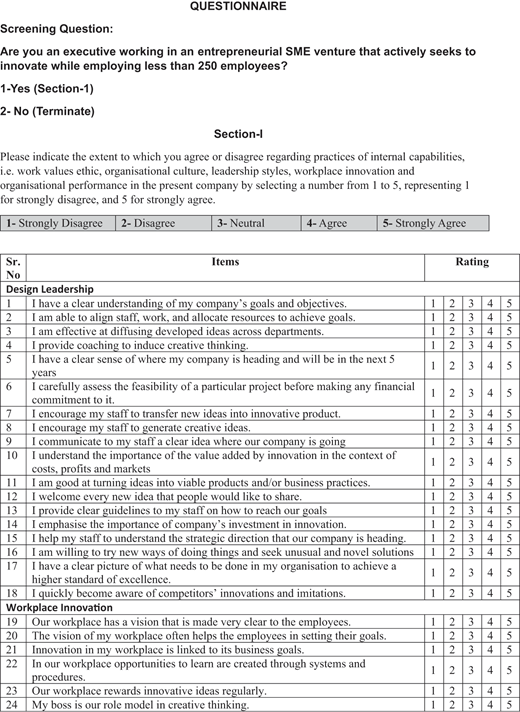
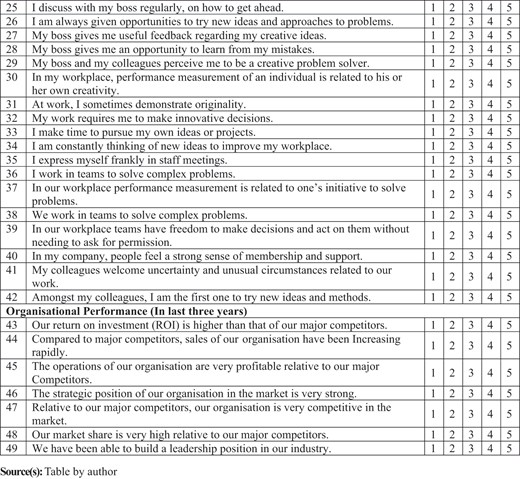
The 24-item Workplace Innovation Scale (WIS) was used in this study, comprising the four sub-dimensions of organisational innovation, team innovation, individual innovation and climate for innovation (Muenjohn and McMurray, 2017). The 24-WIS also demonstrated high reliability (α = 0.913) (McMurray and Dorai, 2003),
The seven-item Organisational Performance Scale was used in this study, consisting of the two dimensions of financial performance and strategic performance. A seven-item scale for organisational performance had consistent reliability (α = 0.84) (Lin et al., 2019; Sulaiman, 2016).
The 18-item Design Leadership Questionnaire (DLQ) was used in this study, which comprises four dimensions: envisioning the future, directing design investment, manifesting strategic intent and nurturing an innovative environment (Muenjohn and McMurray, 2017). The DLQ with 18 items showed high reliability (α = 0.911) (Muenjohn and McMurray, 2017). The instruments were added in the Appendix.
Data analysis
Reliability, validity and method bias
Data was analysed for SEM assumptions, outliers, multicollinearity, normality and common method bias. Harman’s single-factor test is one of the most used conventional methods to identify common method variance (Saunders et al., 2016). It is particularly favoured by researchers in the entrepreneurship and leadership field to identify common method variance (Cheung and Wong, 2011). All the items are loaded into exploratory factor analysis (EFA), using the unrotated format, to identify how many factors were explaining the total variance. If the majority (more than 50%) of the variance was loaded on a single factor or general factor, then common method bias can be presumed (Podsakoff et al., 2003). The researcher loaded all the factors into EFA, using the unrotated principal component analysis method, for all three data sets. In all three data sets, the results of the extraction sums of squared loadings and the first-factor percentages of variance were well below the threshold of 50% (Pakistan, 9.284; Australia, 27.591; Combined, 17.975). Hence, it is concluded that common method bias is not detected in these data sets.
Pre-tests and pilot tests were conducted to validate and ensure the reliability of the questionnaire (Podsakoff et al., 2012). No missing values were identified, and outliers were excluded using the Mahalanobis-D test, removing three Australian and seven Pakistani responses. Data was normal, with skewness and kurtosis within the −1 to +1 range. Cronbach’s alpha scores indicated reliable scales, with all above α = 0.7 (see Table 1) except for design leadership in Pakistan (α = 0.679), still within an acceptable range (De Vaus and de Vaus, 2013). Multicollinearity was not an issue, as VIF values ranged from 1 to 4, and tolerance values were above 0.2 in both countries, meeting the criteria suggested by Hair et al. (2010).
Cronbach’s alpha
| Reliability | PK (393) | AU (360) | No. of items |
|---|---|---|---|
| Dlead | 0.679 | 0.910 | 18 |
| WIscl | 0.733 | 0.916 | 24 |
| Oper | 0.721 | 0.804 | 7 |
Table 2 shows that for the Australian data set, the average variance extracted (AVE) exceeded the 0.5 threshold, and construct reliability for all variables was above 0.7. Mean values ranged from 3.64 to –3.91, indicating respondents generally agreed or strongly agreed on a five-point Likert scale. The standard deviation ranged from 0.53 to –0.61, showing slight dispersion from the mean. Pearson’s correlation was significant at the 0.01 level, indicating moderate correlations between variables.
Validity, reliability and descriptive statistics – Australia
| CR | AVE | Mean | SD | Oper | Dlead | WIscl | |
|---|---|---|---|---|---|---|---|
| Oper | 0.916 | 0.846 | 3.6444 | 0.60148 | 1 | ||
| Dlead | 0.986 | 0.948 | 3.9028 | 0.55862 | 0.598** | 1 | |
| WIscl | 0.955 | 0.843 | 3.8073 | 0.53043 | 0.638** | 0.815** | 1 |
Note(s): **Correlation is significant at the 0.01 level (2-tailed)
For the Pakistani data set (Table 3), AVE for organisational performance and design leadership was above 0.5, while AVE for workplace innovation was slightly below 0.5. Construct reliability for all constructs was above 0.7, indicating reliability. Mean values ranged from 3.35 to –3.96, and the standard deviation ranged from 0.31 to –0.62, indicating slight variation from the mean. Both data sets showed no issues with discriminant and convergent validity.
Descriptive statistics
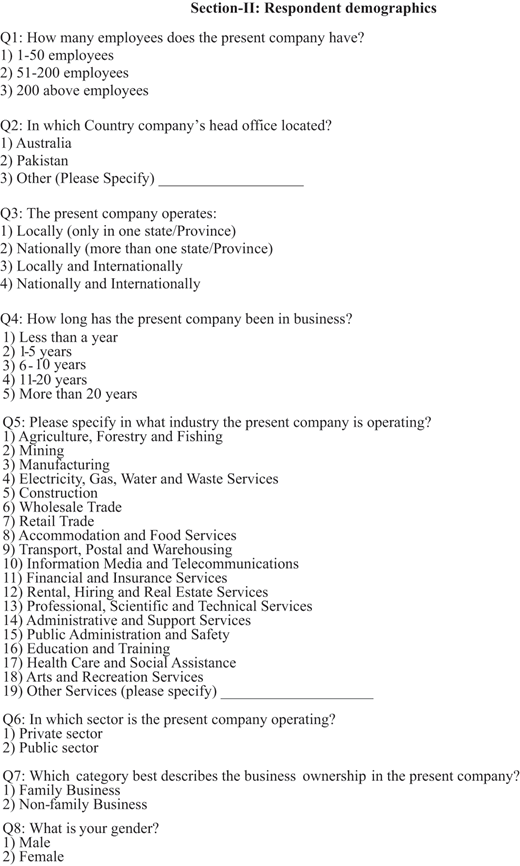
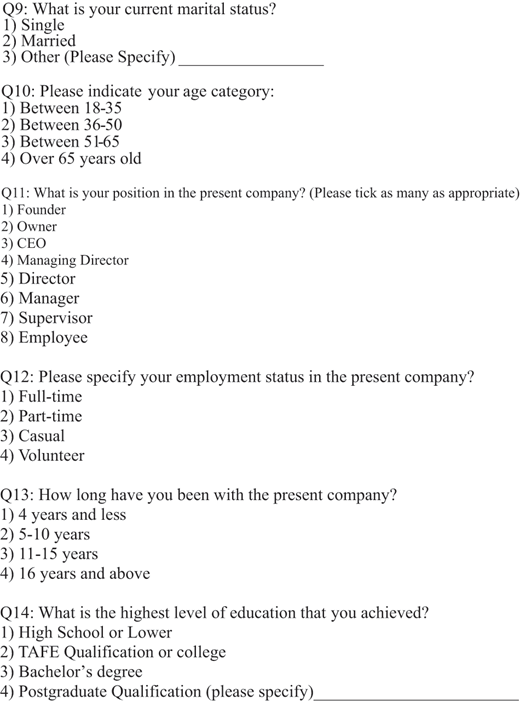
The survey achieved an 18% response rate in both countries, with 2200 surveys distributed in Pakistan and 2030 in Australia, yielding 396 complete responses from Pakistan and 367 from Australia. Demographic analysis showed over 50% of Australian respondents were female, while 70% of Pakistani respondents were male. In Pakistan, over 65% of respondents were aged 18–35. The primary industries represented were manufacturing, IT and retail, with 80% of businesses in the private sector. About 79% of ventures had fewer than 200 employees. In Pakistan, 91% of respondents held a university degree, compared to 60% in Australia.
Factor analysis and hypotheses testing
A confirmatory factor analysis was conducted to determine how well-observed variables represented latent constructs (Hair et al., 2010). Items with low standardised estimates, high modification indices and high standardised residual covariances were deleted to refine the measurement models. H1 suggested a significant positive relationship between design leadership and workplace innovation. H2 proposed that workplace innovation positively impacts organisational performance. H3 anticipated that workplace innovation mediates the relationship between design leadership and organisational performance in Australian and Pakistani entrepreneurial ventures. These hypotheses were tested using structural modelling in AMOS 25, with the refined measurement model converted into a structural model to explore these relationships.
Figure 2 shows the structural model for the Australian data set, with goodness-of-fit (GOF) statistics in Table 4. The X2/df was less than 3, and RMSEA and SRMR were below 0.08. GFI exceeded 0.9, indicating an acceptable fit (Thadani and Cheung, 2011). Incremental and parsimony fit indices were within acceptable limits. Figure 3 presents the structural model for the Pakistani data, with GOF statistics also in Table 4. All fit indices, absolute, incremental and parsimony were within acceptable ranges, indicating a good model fit. The X2/df value was 1.533, well below the threshold of 5. The second-order construct was leading to a better fit compared to treating it as first-order, it demonstrates a more parsimonious approach. A more streamlined model can be easier to interpret and can reveal clearer relationships among variables (Hair et al., 2017).

GOF Statistics for Australian and Pakistani data sets
| Goodness of fit | GOF statistics | Level of acceptance | Australia | Pakistan |
|---|---|---|---|---|
| Chi-Square | χ2/df | Between 1–5 | 2.970 | 1.533 |
| Absolute fit indices | RMSEA | < 0.1 | 0.074 | 0.037 |
| SRMR | < 0.09 (if CFI >0.92) | 0.013 | 0.012 | |
| GFI | >0.90 or >0.80 | 0.951 | 0.975 | |
| Incremental fit indices | CFI | >0.90 | 0.970 | 0.957 |
| IFI | >0.90 | 0.970 | 0.959 | |
| TLI | >0.90 | 0.958 | 0.940 | |
| Parsimony fit indices | PCFI | >0.50 | 0.834 | 0.869 |
| PNFI | >0.50 | 0.742 | 0.647 |

Tables 5 and 6 present regression estimates for the Australian and Pakistani data sets. For the relationship between design leadership and workplace innovation, the regression estimate was β = 0.95 in Australia and β = 0.73 in Pakistan, both with p-values of 0.001. For workplace innovation’s relationship with organisational performance, the estimate was β = 0.91 in Australia (p-value = 0.005) and β = −0.17 in Pakistan (p-value = 0.378). Thus, only the Australian data supported the positive relationship between workplace innovation and organisational performance.
Regression estimates – Australia
| Hypotheses | Std Est. | S.E. | C.R. | p-value | Status |
|---|---|---|---|---|---|
| H1: Dlead → WIscl | 0.95 | 0.061 | 15.345 | *** | Significant |
| H2: WIscl → Oper | 0.91 | 0.324 | 2.786 | 0.005** | Significant |
| H3: Dlead → Oper (Direct) | −0.13 | 0.315 | −0.403 | 0.687 | Non-significant |
| H3: Dlead → Oper (Indirect) | 0.86 | 0.390 | (Indirect) | 0.015* | Full mediation |
| Dimension wise effect | |||||
| Dlead →fper | 0.55 | 0.038 | (Indirect) | 0.008** | Effect |
| Dlead →sper | 0.60 | 0.039 | (Indirect) | 0.012* | Effect |
| Dlead →tinvo | 0.71 | 0.028 | (Indirect) | 0.014* | Effect |
| Dlead →IInvo | 0.79 | 0.023 | (Indirect) | 0.012* | Effect |
| Dlead →iclim | 0.71 | 0.035 | (Indirect) | 0.007** | Effect |
| Dlead →OInvo | 0.77 | 0.031 | (Indirect) | 0.013* | Effect |
| WIscl →fper | 0.68 | 0.286 | (Indirect) | 0.016* | Effect |
| WIscl →sper | 0.74 | 0.317 | (Indirect) | 0.022* | Effect |
Notes(s):
Sig level
***=0.001,
**=0.01,
*=0.05
Regression estimates – Pakistan
| Hypotheses | Std Est. | S.E. | C.R. | p-value | Status |
|---|---|---|---|---|---|
| H1: Dlead → WIscl | 0.73 | 0.172 | 5.565 | *** | Significant |
| H2: WIscl → Oper | −0.17 | 0.379 | −0.882 | 0.378 | Non-significant |
| H3: Dlead → Oper (Direct) | 0.40 | 0.536 | 1.918 | 0.055 | Non-significant |
| H3: Dlead → Oper (Indirect) | −0.13 | 0.183 | (Indirect) | 0.481 | No mediation |
| Dimension wise effect | |||||
| Dlead → fper | 0.14 | 0.071 | (Indirect) | 0.009** | Effect |
| Dlead → sper | 0.17 | 0.071 | (Indirect) | 0.010** | Effect |
| Dlead → tinvo | 0.23 | 0.052 | (Indirect) | 0.006** | Effect |
| Dlead → IInvo | 0.37 | 0.051 | (Indirect) | 0.010** | Effect |
| Dlead → iclim | 0.42 | 0.064 | (Indirect) | 0.006** | Effect |
| Dlead → OInvo | 0.43 | 0.057 | (Indirect) | 0.007** | Effect |
| WIscl → fper | −0.09 | 0.139 | (Indirect) | 0.434 | No effect |
| WIscl → sper | −0.11 | 0.143 | (Indirect) | 0.351 | No effect |
Notes(s):
Sig level
***=0.001,
**=0.01,
*=0.05
The direct relationship between design leadership and organisational performance was non-significant in both data sets. The indirect relationship was significant only in the Australian data set, with an indirect effect value of β = 0.86 (p-value = 0.015). In Pakistan, the indirect effect was β = −0.13 (p-value = 0.481). Thus, workplace innovation fully mediates the relationship between design leadership and organisational performance in Australia, supporting H3. However, in Pakistan, workplace innovation did not mediate this relationship, leading to the rejection of H3.
The indirect effect of design leadership on workplace innovation and organisational performance dimensions was examined. Results indicated that design leadership positively influences all four dimensions of workplace innovation and two dimensions of organisational performance in both data sets. In Australia, design leadership significantly affects individual innovation, while in Pakistan, it impacts organisational innovation more. Design leadership also has a significant positive relationship with organisational performance in both data sets.
H1 was supported by both Australian and Pakistani data, showing that design leadership positively impacts workplace innovation. H2 was supported only by the Australian data, indicating that workplace innovation improves organisational performance. H3 was also supported only by the Australian data, demonstrating that workplace innovation mediates the relationship between design leadership and organisational performance.
Discussion
The impact of human capital and technology on innovation capabilities varies culturally, as shown by differing results from Australian and Pakistani SME ventures (Ramadani et al., 2019). In Australian SMEs, design leadership significantly enhances individual innovation and organisational performance, reflecting the country’s individualistic culture (Muenjohn and McMurray, 2017). The integration of advanced technologies facilitates individual innovation by providing tools and resources that employees can leverage to enhance their creative outputs(Sawyer and Henriksen, 2024). The alignment of individual and organisational goals creates a fertile environment for innovation, with employees feeling motivated to experiment and pursue novel ideas (Koivula et al., 2023).
On the other hand, Pakistani SMEs, which operate in a collectivist society, see greater effects of design leadership on organisational innovation and organisational performance. Additionally, while workplace innovation boosts organisational performance in Australian SMEs, it negatively impacts Pakistani SMEs’ organisational performance (Dibrell et al., 2014). The negative impact of workplace innovation on organisational performance in Pakistani entrepreneurial SMEs suggests a more complex interplay between innovation practices and organisational dynamics. Factors such as limited access to resources, and potential misalignment of innovation initiatives with broader organisational goals may hinder the expected benefits of workplace innovation (Choudhary et al., 2021). Pakistani SMEs benefit from leadership that emphasises teamwork, shared goals and collective problem-solving. The impact of design leadership on workplace innovation reflects a cultural preference for collaborative approaches, where success is measured by the group’s achievements.
Envisioning the future correlates strongly with individual innovation and organisational performance in Australia, whereas directing design investment is more influential in Pakistan. These findings challenge Muenjohn and McMurray (2017) conclusions, highlighting the cultural context’s role in the relationship between leadership, innovation and performance in SME ventures. Leaders who cultivate a forward-thinking mindset empower employees to explore new ideas and embrace change. This approach aligns with Australia’s individualistic culture, where personal initiative and creativity are highly valued (Volery and Tarabashkina, 2021). Employees are encouraged to think beyond conventional boundaries, leading to innovative solutions that not only benefit their personal growth but also enhance the organisational performance of the organisation. The strong correlation between future-oriented visioning and individual innovation suggests that Australian SMEs thrive when leaders articulate clear, ambitious goals that inspire and motivate their teams (Vettorello and Burke, 2021).
Conversely, in the context of Pakistani SMEs, the emphasis on directing design investment takes precedence. In a collectivist culture, where group harmony and collaboration are prioritised, the allocation of resources towards design and innovation becomes a strategic imperative for fostering workplace innovation (Choudhary et al., 2021). Leaders in Pakistan are more effective when they focus on channelling investments into collaborative projects and initiatives that leverage the collective skills and talents of their workforce. This approach not only enhances workplace innovation but also strengthens the overall organsiational performance by ensuring that innovations are aligned with the needs and capabilities of the entire team. The divergent impacts of future visioning and design investment illustrate that leadership strategies cannot be universally applied, rather, they must be tailored to fit the unique cultural and operational landscapes of the organisations (Shipman et al., 2010).
The results unexpectedly indicate that leaders in entrepreneurial ventures in Pakistan do not grasp the importance of strategic and design thinking in creating a conducive workplace to foster innovation at various levels, ultimately improving performance. The role of innovative entrepreneurial ventures in a country’s economy is well-recognised (González-Pernía et al., 2015). However, the finding presents the novelty that entrepreneurial SME ventures differ significantly between developed and developing countries. In a developing country, entrepreneurial SME ventures do not view workplace innovation as a crucial tool for enhancing organisational performance. These findings are significant as no previous study has established the link between workplace innovation and organisational performance in the context of a developing country.
Dynamic capabilities are crucial for performance outcomes (Baía and Ferreira, 2024). This study further extends the notion of dynamic capabilities within the RBV theory by examining and emphasising the role of design leadership in fostering innovation and performance. The findings corroborate past studies by establishing individual links between design leadership and workplace innovation (Muenjohn and McMurray, 2017) and between workplace innovation and organisational performance. However, this study is significant in establishing the mediating role of workplace innovation between design leadership and organisational performance. This finding extends the literature on workplace innovation and design leadership, as discussed by Muenjohn and McMurray (2017), while further linking it with organisational performance. On the other hand, the findings for Pakistani entrepreneurial SME ventures significantly contradict past studies, highlighting differences between entrepreneurial SME ventures in developed and developing countries.
Theoretical implications
This study extends the RBV theory (Barney, 1991; Grant, 1991) by investigating the role of design leadership in influencing workplace innovation and its mediating influence on organisational performance. A crucial contribution lies in emphasising how contextual differentiation influences the application of RBV assumptions. In particular, the study shows that workplace innovation mediates the relationship between design leadership and organisational performance in Australian SME ventures but not in the Pakistani context. This underscores the important role of context (cultural, social, economic and structural) in understanding the applicability of resource base theory.
These findings support the view of earlier studies (vom Brocke et al., 2016; Wintersteiner, 2024) that highlights the importance of context in management research where the processes could not be fully understood without effectively considering the social, cultural and structural factors that comes into play. This aligns with the findings of our study where the unique factors that shape Australian and Pakistani contexts significantly impacts the relationship between key variables, design leadership, workplace innovation and organisational performance, demonstrating the significance of contextual awareness in management research and practise.
The research supplements the work on design leadership (Khan, 2021) by signifying how cultural alignments, such as individualism in Australia versus collectivism in Pakistan, influence the key processes through which leadership influence workplace innovation and organisational performance. The comparative analysis of entrepreneurial SME ventures in these two different contexts expands the knowledge of internal resources and their influence on organisational outcomes.
By positioning the findings within the unique settings of a developed (Australia) and a developing (Pakistan) economy, the study identifies empirical evidence of the conditional adaptability of RBV across diverse settings. This inclusion of theory and context provides valued insights into the adaptableness of leadership and innovation procedures, stressing the need for contextually informed theoretical models.
Practical implications
The practical implications of this study accentuate the significance of adapting leadership approaches to the peculiar cultural and organisational settings of SME enterprises. The findings emphasise how tailored methods to design leadership can efficiently nurture workplace innovation and improve organisational performance, positioning with the unique needs of distinct settings.
In Australia, where individualism and independence/autonomy are valued culturally, organisations should rely on improving individual abilities to lead self-self-reliant creativity. Leadership policies that foster autonomy, experimentation and risk-taking can foster a culture of innovation, contributing to competitive advantages. Australian leaders may adopt visionary leadership approaches that stimulate and encourage workers to take lead, allying with the cultural inclination for autonomy and innovation-determined work surroundings (Muenjohn and McMurray, 2017).
In Pakistan, where collectivism is more obvious, leadership approaches should highlight building collaborative arrangements that fosters team capacity. Practical approaches might include team-building activities, enhancing communication networks and providing formal support for combined innovation designs. Leadership approaches should exhibit local cultural values by promoting shared objectives and resource division to improve group creativity (Choudhary et al., 2021).
This integration of theory and practice shows how leadership methods embedded in global theoretical experiences, such as RBV, can be effectively adapted to local work contexts. By positioning leadership methods with cultural and structural experiences, organisations can augment the significance and influence of their initiatives. This context-sensitive application not only improves innovation and performance but also confirms that leadership approaches resound with the unique underlying forces of distinct entrepreneurial settings. The study underlines the interconnection of theoretical models and practical relevance, demonstrating that contextual understanding is important to achieving both academic and real-world influence. By bridging theory and practice through a contextual lens, the research provides a robust base for future research studies and actionable approaches tailored to particular organisational and cultural work settings.
Conclusion, limitations and future research directions
Comparative studies are few and far between where data is collected simultaneously across two countries to make empirical comparisons in similar contexts. For example, Australia and Pakistan are culturally very different, particularly if we consider GLOBE and Hofstede’s model of national culture, yet this study considers similar issues faced by entrepreneurial SME ventures in both countries. Cultural differences may impact an organisation’s resource capabilities and performance, yet this could be considered a possible agenda for future research and a limitation of this research. This comparative study empirically establishes workplace innovation as a mediating link between design leadership and organisational performance in a developed country yet denies this in a developing country’s context, signifying the differences between developed and developing countries’ entrepreneurial SME ventures.
The key finding is that workplace innovation does not mediate performance in SME ventures in developing countries, highlighting the need for further investigation of this relationship in such contexts. The study underscores the importance of design thinking and leadership in fostering innovation within entrepreneurial SME ventures in developing countries. Policymakers and entrepreneurs in both developed and developing countries are encouraged to view workplace innovation as more than a productivity tool. It can enhance the overall workplace environment and improve employees’ work-life balance (Frank et al., 2020), which may ultimately lead to better organisational performance.
Furthermore, the donor and government agencies should provide more resources to those ventures with a designed mechanism to cultivate innovation (Wolf et al., 2012). Such cultivation of workplace innovation and better use of strategic and design capabilities will assist ventures in surviving and thriving during any crisis such as COVID-19. Continuous creativity and innovation is an integral part of successful ventures. The government and private ventures and universities should collaborate and focus on developing strong internal capabilities, promoting an entrepreneurial culture and providing a favourable working environment for sustainable and innovative growth (Wolf et al., 2012). One of the important managerial implications is that the leaders in entrepreneurial SME ventures should use activities such as brainstorming, idea pitching, the idea of the month and training on stimulating creativity and design strategies, which could establish maker’s space to cultivate innovative and design solutions.
This study collected cross-sectional data from entrepreneurial ventures of two countries only, which could be viewed as a possible limitation of this study. Future studies could collect longitudinal data from multiple countries, contexts and sectors. In addition, future studies could investigate how the cultural context and other internal resource capabilities of the ventures such as organisational culture, work value ethics and employee commitment or engagement may impact these relationships. This study contributes to the RBV theory, design leadership, workplace innovation and organisational performance literature. Practically, this study is significant as it may assist entrepreneurial ventures, leaders and managers in exploring and identifying different internal resource competencies, which may assist in improving their organisational performance and in turn achieving a sustainable competitive advantage for their ventures.
The authors would like to express our sincere gratitude to Professor Adela McMurray (Dean (Research) Flinders University) and Dr Nuttawuth Muenjohn (Associate Professor, University of Bradford) for their invaluable guidance, support, and insightful contributions throughout the course of this research.
References
Appendix