


Open figure viewer
The Teacher Advancement Program (TAP) began as an initiative of the Milken Family Foundation. TAP has continued to grow, and therefore, we have expanded our efforts in broader reform areas. In 2005, the urgent need for teacher quality, coupled with experience and expertise gained from implementing TAP led to the establishment of an independent entity now known as the National Institute for Excellence in Teaching (NIET), where TAP remains our primary program.
(Chart 3.1) We know from national data that achievement levels among our students have remained relatively unchanged for the past 30 years, while (Chart 3.2) achievement gaps have remained significant—this despite the fact that funding for K-f2 education has grown steadily over these years. Though investments are high, the results are not significantly different. However, while student outcomes are slow to change, we have seen a shift in the discussions about education. As recently as seven years ago, when we began developing TAP, we did not hear a lot of discussion about teacher incentives, teacher quality, and the impact of teachers on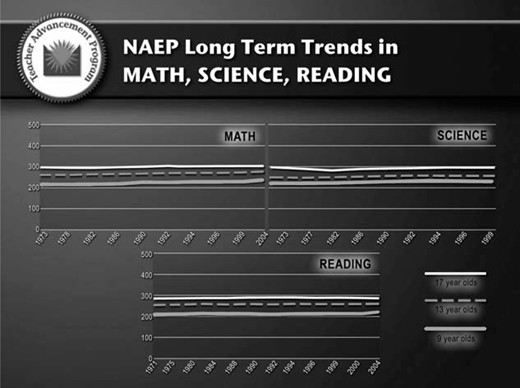
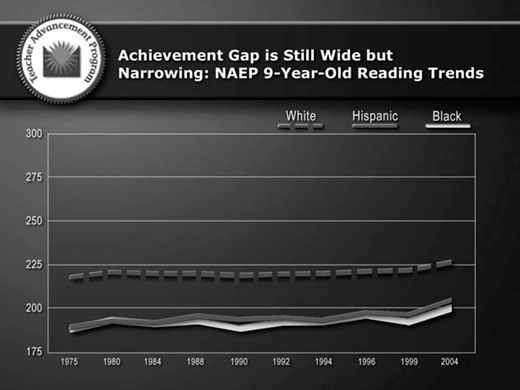 student achievement. Now, these are widely discussed among education policymakers, administrators, and teachers alike.
Chart 3.1
Chart 3.2
© 2007 Emerald Publishing Limited
2007
Emerald Publishing Limited
Licensed reuse rights only
