This study aims to identify the main environmental drivers and impact areas activated by digital technologies (DTs) when adopted in different operations management processes for fostering circularity and environmental sustainability.
This paper carries out a systematic literature review of 195 articles. Content-based analysis is employed to code the three constructs of digital technologies, operations management processes and environmental drivers. Frequency and contingency analyses are conducted to identify 21 statistically significant relationships among the constructs. A research framework and research directions are then derived.
The findings highlight consolidated, emerging and specific relevant relationships between digital technologies and operations management processes, as well as the nature of the environmental drivers triggered by their interplay. Literature has so far placed particular emphasis on the resource efficiency environmental driver to exploit the sustainability potential of digital technologies. The potential of activating the most circular environmental drivers (i.e. lifetime extension, intensified asset usage and closing the loop) deserves deeper investigation.
The identified relationships and their impact mechanisms can serve as practical guidelines for managers seeking to deploy digital technologies within operations management processes to foster circularity and sustainability. Specifically, managers can draw indications into where (i.e. which operations management process) and how (i.e. through which impact domains) digital technologies can be applied to activate specific environmental drivers.
While digital technologies have been widely recognized as enablers of circularity and sustainability in manufacturing, their detailed operative mechanisms within different operations management processes are still under-investigated. The identified mechanisms, their discussion and the developed research framework contribute to fill this gap.
1. Introduction
Digital technologies (DTs), such as the Internet of Things (IoT) and artificial intelligence (AI), are driving the evolution of manufacturing and supply chains (Frank et al., 2019). The integration of DTs with operations management (OM) processes – such as product development (PD), supply chain management, production, distribution, maintenance and reverse logistics (REVLOG) – also holds significant potential for enabling environmentally sustainable and circular operations by enhancing energy efficiency, minimizing waste, promoting resource reuse, and facilitating closed-loop material cycles (Barteková and Börkey, 2022, Aldrighetti et al., 2023; Neri et al., 2023). For example, Johnson and Johnson leveraged the Industrial IoT by using real-time sensors to collect data, leading to a 43% reduction in material waste. Similarly, Schneider Electric achieved a 17% reduction in material waste through the use of IoT and AI (World Economic Forum, 2022).
However, companies face obstacles to achieve sustainability outcomes, such as economic barriers, compatibility, scalability, interoperability between existing and new systems, cultural and skills gaps (Cannas et al., 2024; Rajput and Singh, 2021). At a scientific level, a comprehensive understanding of the adoption of DTs in OM processes for environmental sustainability outcomes is still lacking. From one side, when analysing the role of DTs for environmental sustainability and circularity, the literature provides a quite fragmented picture (Alcayaga et al., 2019; Birkel and Müller, 2021; Bressanelli et al., 2022; Taddei et al., 2022). On the other hand, while general claims about the environmental potential of DTs abound, the detailed mechanisms of such interplay – in terms of specific impacted areas and triggered environmental sustainability drivers – have not been adequately investigated to date (Das et al., 2024; Schilling and Seuring, 2024). To fill this gap, this study addresses the following research question:
How digital technologies acting on operations management processes contribute to foster environmental sustainability and circularity?
The paper carries out a systematic review of the literature dealing with DTs acting on OM processes, and their environmental implications. Descriptive, frequency, content-based and contingency analyses are carried out, based on an original research framework. The findings uncover that the adoption of DTs in different OM processes activates diverse environmental drivers to increase sustainability and circularity, with resource efficiency as the dominant driver. Moreover, consolidated, niche, and emerging relationships between DTs and OM process are highlighted.
The remaining of the paper is structured as follows. Section 2 provides the background and develops the research framework. Section 3 describes the methodology. Section 4 details the literature review findings. Section 5 engages in a discussion and conceptualization of the results. Lastly, Section 6 concludes summarizing the theoretical contributions, managerial implications and limitations of this study.
2. Background and research framework development
This section provides a background on the key concepts of DTs, OM processes, and environmental sustainability drivers. It also elucidates the research gap and presents the developed research framework.
2.1 Digital technologies and their environmental sustainability potential
DTs are changing production systems through their capabilities in “real-time, intelligent, and digital networking of people, equipment, and objects for the management of business processes and value-creating networks” (Luu et al., 2023). Their adoption often focuses on promoting human-machine integration to enhance productivity and efficiency in operations (Ghobakhloo et al., 2022; Rajput and Singh, 2021). Table 1 provides a categorization of the main technologies driving digitalization in the manufacturing sector, based on (Lu, 2017; Machado et al., 2020; Paschou et al., 2020; Russmann et al., 2015).
Previous studies have examined how specific DTs support sustainable manufacturing and supply chain practices by reducing inefficiencies, waste, and non-value-added activities (Bag et al., 2020; Di Maria et al., 2022; Hmamed et al., 2024; Neri et al., 2023; Yu et al., 2022). The IoT enables efficient data collection and sharing to monitor production data, which can reduce material waste and improve energy efficiency (Guo and Zhong, 2023; Rane et al., 2023). Big Data Analytics (BDA), including machine learning and other AI methods, can transform product-in-use data into valuable information to minimize carbon emissions (Bag et al., 2020). The integration of these technologies can optimize performances in areas such as inventory management and efficient material processing (Del Giudice et al., 2021; Edwin Cheng et al., 2022; Rane et al., 2023). For example, Walmart implemented AI for predictive maintenance, resulting in a 5–7% reduction in maintenance costs and a 6% decrease in energy consumption (IEA, 2025). Furthermore, Cloud Computing (CC) platforms offer organizations an efficient and scalable data storage solution on the Internet, providing faster services and enhanced accessibility (Sharma, 2023). Blockchain technology (BCT) and Cybersecurity, instead, enhances transparency and traceability in supply chains by providing visibility into product flows and the history of raw materials (Younis et al., 2024). Process-driven or smart manufacturing technologies, such as Industrial Robotics (IR), Cyber Physical Systems (CPS) and Additive Manufacturing (AM), support minimizing waste and energy consumption (Aldrighetti et al., 2023). Additionally, they support recycling and remanufacturing processes, thus closing the loop in material cycles and reducing the demand for virgin resources (Schlesinger et al., 2023; Thao, 2023). Lastly, AM enables local, on-demand production of spare parts to support repair, which extends the lifetime of products (Ferreira et al., 2023a, b).
2.2 Operations management processes
OM processes refer to the activities and systems that organizations use to oversee the production and delivery of goods and services. These processes focus on efficiently managing resources, optimizing the production process, and ensuring smooth material and information flows, to achieve cost minimization, greater customer satisfaction, or both. In the context of a Circular Economy (CE), OM must consider the closed-loop nature of logistics systems and consequently extend their spatial and temporal horizon throughout the product lifecycle, including end-of-life management aspects (Kleindorfer et al., 2005; Aldrighetti et al., 2023). Managing, planning and executing OM processes is complex and inherently interdisciplinary; operating closed-loop supply chains such as managing product returns, sorting, and recycling, in particular, presents additional challenges and complexities (Guo and Zhong, 2023). Based on the literature, OM processes can be grouped into seven classes, as reported in Table 2 (based on (Cannas et al., 2024; Kleindorfer et al., 2005)).
2.3 Environmental drivers
Environmental sustainability is the preservation of nature’s services at an appropriate level, achieved by enhancing the integrity of the Earth’s life-supporting systems (Moldan et al., 2012). Previous studies have highlighted various ways DTs can achieve sustainability benefits in manufacturing, such as by reducing resource consumption or increasing the utilization of existing assets (e.g. through sharing) (Ferreira et al., 2023a, b). However, the adoption of DTs does not inevitably lead to environmental sustainability: reasons are related to environmental impact inherent to the use of DTs, and the so-called rebound effects (Sorrell and Dimitropoulos, 2008). In fact, environmental benefits are achieved when operating mechanisms are aligned with factors triggering environmental sustainability, such as resource consumption, lifecycle duration, or prevention of CO2 emissions, counterbalancing any potential negative impact. Saccani et al. (2024)’s study synthesizes from the literature a set of factors that drive improved environmental performance, referred to as environmental value drivers. Building on that study, this research focuses on investigating five key drivers of environmental sustainability and circularity, relevant for the adoption of DTs in OM processes. These environmental drivers are described in Table 3 (adapted from Saccani et al., 2024).
2.4 Research gap
Table 4 summarizes recent literature reviews that examine the intersection of DTs and environmental sustainability or CE, specifically within the context of OM or supply chain management to identify current knowledge and gaps. The table excluded bibliometric literature reviews, focusing instead on review articles (systematic literature reviews or content-based analyses) directly relevant to the integration of DTs and sustainability or CE.
Overall, the analysed literature highlights that DTs facilitate the adoption of sustainability and CE principles across a range of manufacturing and supply chain activities (Kristoffersen et al., 2020; Luthra et al., 2020). However, despite their potential environmental benefits have been acknowledged across various domains, a comprehensive analysis of how DTs act on different OM processes to realize these benefits is still lacking. In particular, existing reviews tend to either focus narrowly on individual technologies (such as BDA, IoT, AI or BLC) or discuss DTs in broad but rather unspecific terms, frequently within the context of servitized or circular business models. Furthermore, most reviews do not address the role of DTs in OM processes, or concentrate on one OM process alone, such as production. As a result, there is a lack of in-depth analysis on how these DTs specifically connect with OM processes and to the abstraction of the mechanisms that generate sustainability and circularity benefits. Most papers do not address the specific environmental drivers or mechanisms leading to sustainability benefits, besides the examples provided. In sum, despite the attention recently devoted to the topic, the literature has overlooked investigating with a comprehensive perspective the linkage between DTs and OM processes as the key domain where the generation of environmental benefits occurs, as well as the mechanisms of the DT-OM processes interplay – in terms of specific impact areas and environmental sustainability drivers triggered (Das et al., 2024; Schilling and Seuring, 2024).
2.5 Initial research framework
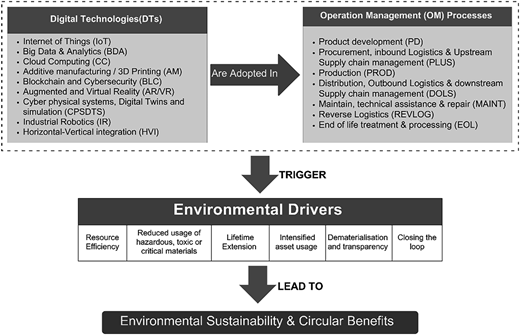
Based on the theoretical background and research gap described above, Figure 1 proposes the conceptual research framework used in this study to address the sustainability and circularity impacts of DTs in their interplay with OM processes. As illustrated in the framework, the nine DTs described in section 2.1 act on the seven OM processes categorized in section 2.2, potentially activating the environmental drivers described in section 2.3, leading to environmental sustainability and circularity benefits.
The research framework allows to operationalize the research question introduced in section 1. In particular, this study will identify which are the main environmental drivers activated by each DT when adopted in (each) OM process.
3. Methodology
This study is based on a systematic literature review (Tranfield et al., 2003).
3.1 Literature selection
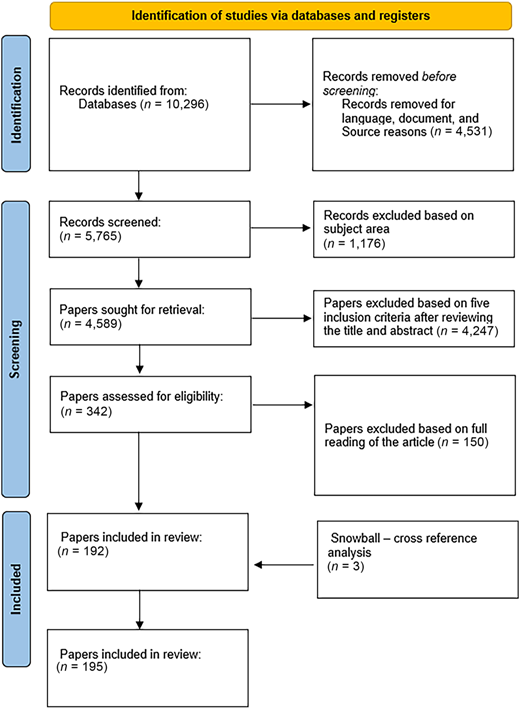
The selection process was guided by the Preferred Reporting Items for Systematic Reviews and Meta-Analyses (PRISMA) guidelines (Moher et al., 2009) to ensure clarity, transparency, and limited bias. The followed steps are depicted in Figure 2.
First, to identify relevant articles, a review protocol and search strategy were developed. The search strategy consists of two sets of keywords. The first set of keywords focused on DTs, and the second set of keywords was based on “Circular economy” and “Sustainability”. The search was conducted using the search string TITLE-ABS-KEY (“Internet of Things” OR “Cyber physical systems” OR “Cloud computing” OR “Industrial robotics” OR “Data analytics” OR “Big data” OR “Additive manufacturing” OR “3D printing” OR “Industry 4.0” OR “Digital Technologies”) AND TITLE-ABS-KEY (‘Circular Economy’ OR ‘Sustainability’), which resulted in the extraction of 10,296 articles.
The second phase involved practical screening of the articles extracted. During the screening process, only journal articles published in English language were included: conference papers, books, and other sources were excluded. This was done to ensure that only peer-reviewed papers were selected for further analysis. Then, the articles were scrutinized to include only those subject areas such as engineering, operations, services, manufacturing, computer and social sciences, and business management. This step led to select 4,589 relevant articles among all the retrieved papers.
Then, the titles and abstracts of the papers were reviewed. Given the objective of this study, only the papers that met the following inclusion criteria were selected:
Have a specific focus on DTs or Industry 4.0/5.0, rather than discussing these topics in general terms.
Have a specific focus on CE or environmental sustainability, rather than discussing these topics in general terms or merely acknowledging them as relevant trends.
Focus on the manufacturing or business OM processes of manufacturing goods.
Discuss the application of DTs on one or more among the OM processes described in Table 2.
Are not based purely on a literature review but include analytical or conceptual modelling or empirical analyses (e.g. case studies, surveys, etc.).
Applying these criteria end to a set of 342 pertinent articles for detailed analysis. During the full reading step, all inclusion criteria were again applied, leading to 192 articles. To mitigate potential keyword limitations in the database search, cross-reference analysis was also employed, leading to the identification of three additional papers. As a result, a total of 195 papers are included in the literature sample of this study. Additionally, some relevant recent grey literature was considered in the background part of this study (IEA, 2025; MIMIT, Italian Ministry for Entreprises and Made in Italy, 2025; World Economic Forum, 2022; Gleiser I. 2023; European Policy Centre, 2020; ETC CE, 2025).
3.2 Literature analysis
We carried out descriptive, content, frequency and contingency analyses.
A descriptive analysis was carried out based on the paper classification by publication year and outlet.
A content-based analysis was carried out to uncover insights and patterns within the articles’ content. A structured approach was followed to classify the 195 articles, based on the research framework of Figure 1 and a MS Excel database of the literature. The analysis incorporates the DTs addressed (options are reported in Table 1), the OM processes addressed (options in Table 2), the impact domain (how DTs acts on the OM process, qualitative classification), the environmental drivers activated (options in Table 3) and the environmental benefits (qualitative classification). The data resulted from the content-based analysis coding was subject to a frequency analysis, to understand the diffusion of the three coded constructs (DTs, OM processes and environmental drivers) in the literature sample. The codebook’s validity was ensured through multiple reviews, aligning it with the framework. A single researcher conducted the coding, with support and quality checks from co-authors.
Content analysis alone often has limited value when viewed as individual items, since it lacks the ability to establish links between different constructs. A contingency analysis was therefore carried out to explore the relationships between constructs within the articles (de Lima et al., 2022; Fleiss et al., 2003). The contingency analysis was conducted in other literature reviews related to sustainable supply chain management and DTs (de Lima et al., 2022; Hettiarachchi et al., 2022; Schilling and Seuring, 2024). In particular, the aim of the contingency analysis is to identify associations from co-occurrences of DTs and OM processes, using contingency tables, comparing the observed and expected frequency of observation of each couple DT-OM process in the framework, and assessing them for statistically significant correlation. The “crosstabs” function of the statistical software SPSS 26.0. is used to analyse each relationship. The contingency analysis included carrying out a Chi-square test to determine the phi coefficient, which indicates the strength of the association between the constructs and the significance value (p-value) (Fleiss et al., 2003). A p-value lower than 0.05 identifies a significant relationship, and a phi coefficient greater than 0.1 is considered an enough strong association between the dimensions (Akoglu, 2018).
4. Results
4.1 Descriptive results
Concerning the time distribution, the earliest publication analysed dates to 2014: the growth in publications started in 2018, with exponential increase in 2022 and 2023.
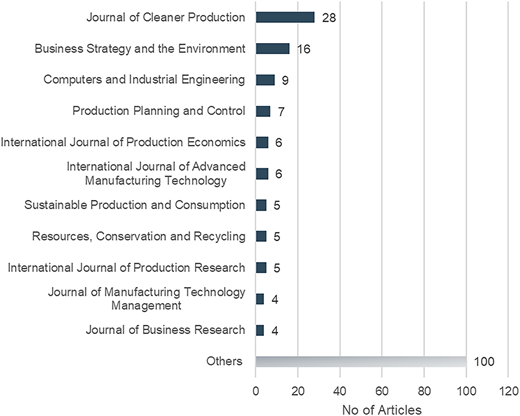
Figure 3 represents the journal distribution of the sample. The 195 analysed articles are spread across 85 journals. Only 11 journals published 4 papers or more. Notably, a substantial portion (48%) of the articles can be found in relevant journals within the fields of CE, sustainability and OM. These include Journal of Cleaner Production, Business Strategy and the Environment, Computers and Industrial Engineering, Production Planning and Control, International Journal of Advanced Manufacturing Technology, International Journal of Production Economics, and Resource, Conservation and Recycling.
4.2 Frequency analysis
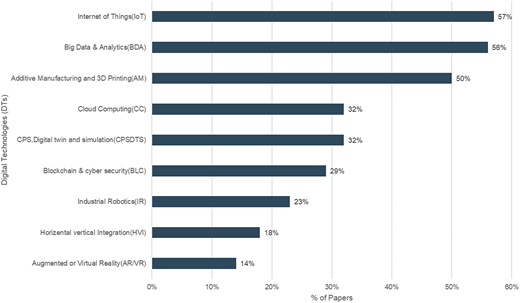
Figure 4 illustrates the number of articles addressing the nine DTs. It is observed that IoT (addressed by 57%, of the sample), BDA (56%) followed by AM (51%) are the most investigated technologies. IoT and BDA enable data acquisition, transfer and elaboration (Rizvi et al., 2023). They may optimize resource management (Chiarini et al., 2020) and improve performance throughout the value chain (Kristoffersen et al., 2020) through real-time information sharing (Dev et al., 2020), cooperation (Gupta et al., 2021), and coordination among processes (Kusi-Sarpong et al., 2023). AM enhances production processes, making them suitable for high product complexity and customization, enabling minimal material consumption and greater energy efficiency compared to traditional manufacturing (Kahhal et al., 2023). On the other hand, AR/VR and Horizontal-Vertical Integration (HVI) are the least discussed DTs. This may reflect their relatively recent relevance to OM processes.
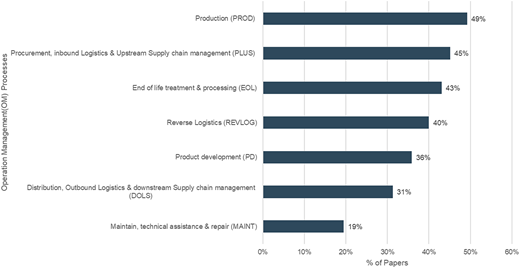
Figure 5 illustrates how frequently the OM processes have been addressed in the literature. The PROD process (49%) was the most frequently discussed, followed by PLUS (45%) and End-of-life treatment and processing (EOL) (43%). The frequent discussion surrounding PROD highlights how DTs can reduce environmental impacts by increasing efficiency and optimizing the use of resources and energy. Papers dealing with PLUS highlighted the role of DTs in transforming traditional supply chains into digital ones, thereby offering logistic advantages, enhancing operational efficiency and improving supplier coordination (Ali et al., 2023; Kusi-Sarpong et al., 2023; Tavana et al., 2023). From a CE standpoint, EOL management is critical: the reviewed papers highlight the importance of DTs for technically improving or optimizing EOL activities, including disassembly, material sorting, recovery, recycling, upcycling, and non-organic material reuse (Delpla et al., 2022; Garrido-Hidalgo et al., 2020; Kumar et al., 2023). Finally, Maintain, technical assistance and repair (MAINT) was the least addressed process, indicating a limited investigation of the role of DTs in these activities.
4.3 Results of contingency and content analyses
The literature sample was analysed to first explore the contingency relationships among the different DTs, and then between DTs and OM processes.
4.3.1 Step 1: Contingency relationships among DTs
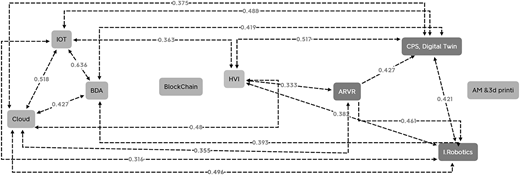
The first contingency analysis among DTs was carried out to identify significant correlations among DTs and to support their grouping, so to simplify and increase the conceptual relevance of the subsequent contingency analysis between DTs and OM processes. Figure 6 shows the contingency relationships between pairs of technologies expressed through the values of phi coefficients. The 20 relationships with phi coefficient exceeding 0.3 and p-value lower than 0.05 are reported, in order to focus only on the strongest and statistically significant relationships.
The relationship between IoT and BDA has the greatest strength (phi value of 0.636), demonstrating the strong interdependence between the two, as IoT acts as a base technology for BDA. Similarly, the strong relationship between IoT and CC (phi 0.518), suggests a critical role of CC in providing data storage and computational resources. Also, BDA and CC exhibit a strong relationship (0.427). These dependencies are essential within manufacturing systems, given the complementary roles of these technologies in collecting and managing data, facilitating interconnectivity, and transforming the information flow within the system (Di Maria et al., 2022; Lopes de Sousa Jabbour et al., 2023). As a result of their interdependence, IoT, BDA, and CC are grouped into one technological group named “Data collection and processing technology (DCPT)”, as supported by the extant literature (Di Maria et al., 2022; Prakash and Ambedkar, 2023). On the other hand, Cyber physical systems, Digital Twins and simulation (CPSDTS), IR, and AR/VR are recognized as automation technologies by the literature (Di Maria et al., 2022). However, the grouping of these technologies is less apparent because CPSDTS is more strongly linked with HVI (0.517) and IoT (0.488) than IR (0.421) and AR/VR (0.427). Again, IR is more strongly associated with CC (0.496) than with AR/VR (0.461) and CPSDTS (0.421). This suggests that while these technologies are all related to automation, their relationships and co-applications with other technologies can differ. Moreover, HVI is connected with five technologies, as shown in Figure 6. Kusi-Sarpong et al. (2023) considered HVI as a key and foundational technology for integration and information flows and one of the strongest enablers of circularity. Finally, BLC and AM exhibit no significant connections with other technologies and thus have emerged as standalone technologies.
Based on these findings, DCPT, is considered as a single “macro” technology group and substitute IoT, BDA and CC for the second step of analysis, along with the six other DTs (BLC, HVI, AM, CPSDTS, IR, and AR/VR).
4.3.2 Step 2: Contingency relationships between DTs and OM processes
The 49 relationships among the seven DTs resulting from Step 1 and the seven OM processes have been investigated through a contingency analysis. The 21 relationships exhibiting statistical significance (p-values lower than 0.05) and significant strength (phi >0.1), indicating relevant connections, are listed in Table 5. The observed frequency in the table provides the actual number of papers where the mentioned DTs and OM processes are jointly discussed. On the other hand, the expected frequency represents the anticipated count for a particular relationship based on probability count (see section 3.2).
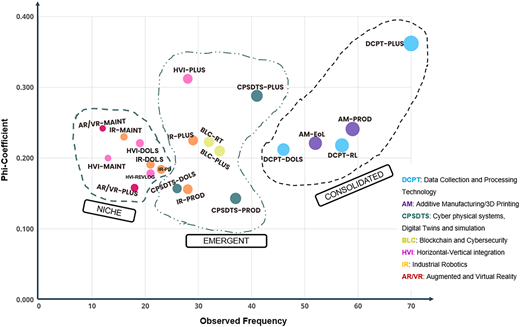
Figure 7 visualizes the 21 significant relationships reported in Table 5, reporting the observed frequency and the phi coefficient (indicating the strength of the relationship). This visualization allows identifying three groups of relationships: Consolidated, Emerging and Niche.
The Consolidated group consists of the 5 couples with the highest observed frequency and medium-to-high phi coefficient values. It involves only two technologies, DCPT and AM, covering all their contingency relationships with five different OM processes. The Emergent group includes 8 relationships with medium frequency. In this group, a significant focus concerns the PLUS process: it is addressed for the sustainability and circularity potential enabled by four different technologies (CPSDTS, BLC, IR and HVI). All the relationships involving CPS and BLC fall within this group. The relationships involving HVI and IR, instead, are distributed between the Emergent and the Niche groups, due to their low degree of investigation and a wide number of relationships. The Niche group highlights significant relationships, despite their limited frequency: it consists of 8 relationships, connecting HVI, IR and AR/VR with four different OM processes (PD, PLUS, DOLS, REVLOG and MAINT). MAINT appears three times, having been less investigated in the literature sample compared to the other OM processes, but at the same time proving significantly impacted by DTs.
The results from the content analysis for each of the 21 relationship are then presented in Table 6. For each DT, the table summarizes the OM processes connected, the impact domains (i.e. where and how the DTs act within the OM process), and the activated environmental drivers. It also illustrates the strength of each environmental driver activation, based on distinct impact domains involved in the DT–OM process association (the number of ‘•’ in the table represents the strength of the links, which is qualitatively assessed based on the number of impact domains involved). A detailed description of the findings in Table 6 and of the impact domains activated is available in the supplementary material. In the next section, these findings are discussed in the light of the research framework.
5. Discussion
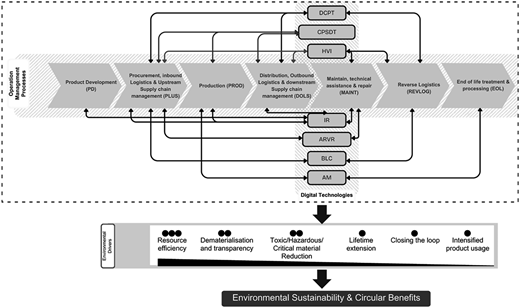
Based on the results of the literature analysis, the framework of Figure 1 has been revisited and re-populated, as suggested by (Durach and Wieland, 2017). The final framework is shown in Figure 8. In the upper part, the 21 significant relationships between DTs and OM processes are illustrated. In the lower part, instead, the environmental drivers have been re-ordered based on the intensity they are triggered in the 21 contingency relationships.
Also, Table 7 provides a summary - organized according to DTs - of the findings about the relationships with OM processes, impacted domains, environmental drivers triggered (the number of ‘•' in the table reflects a qualitative understanding of the driver’s relevance across multiple impact domains) and research directions identified. They are discussed hereafter.
Combining the frequency and contingency analyses, we observe that two technologies, namely DCPT and CPSDTS, have had both a large coverage of literature and contingency relationships with a significant number of OM processes (3 each). DCPT groups three lower-level technologies (IoT, CC and BDA) and is a foundational data collection and sharing technology (Di Maria et al., 2022) that enables or empowers other DTs, such as CPSDTS, HVI, AR/VR, and IR, as shown by the contingency analysis within DTs in section 4.3.1 (Marković and Jemović, 2024). Moreover, this study highlights that DCPT allows achieving sustainability benefits when is adopted in the three external interfaces of OM processes: with upstream, forward downstream, and reverse supply chain partners, supporting previous findings (Gholami et al., 2022). Through real-time information sharing, visibility and enhanced data analysis, DCPT supports optimized decision-making (Yadav et al., 2020). Thus, sustainability benefits are achieved mainly leveraging resource (material and especially energy) efficiency and dematerialization (“make information flows work instead than materials” (Bressanelli et al., 2022)), and only to a lesser extent triggering the other environmental drivers.
CPSDTS (Cyber-Physical Systems, Digital Twin and Simulation) have also been significantly addressed in the literature. Differently from DCPT, CPSDTS act especially within internal activities (production, inbound and outbound logistics and warehousing) supporting the optimization of execution and planning through virtualization and simulation. The environmental drivers activated to achieve sustainability are again mainly resource and energy efficiency, and dematerialization. The transition to DCPT is proving to be a game-changer for older factories, significantly enhancing their productivity and operational efficiency. For example, LG Electronics in Korea implemented a digital twin and AI-enabled material transport system, resulting in a 17% increase in productivity and a substantial reduction in line downtime (World Economic Forum, 2022). So, while CPSDTS is empowered by the adoption of DCPT, it reveals to be complementary to DCPT in reducing resource consumption and waste in a range of internal (to the manufacturing company) OM activities.
AM, the second most addressed technology in the literature sample, has a more focused role: it has been extensively associated to production and end-of-life treatment. The potential for waste and energy consumption reduction, and the opportunity it provides to enable local, closed-loop supply chains for secondary raw materials have been highlighted (Walachowicz et al., 2017; Wu et al., 2022). Therefore, along with resource efficiency, AM triggers also the “closing the loop” environmental driver, enabling circularity. Research gaps in this case are mainly on the technical side: detailed sustainability evaluation of recycling and manufacturing methods should be carried out, as well as the use of secondary raw materials as AM powders, and design reverse supply chains to collect them (Das et al., 2024; Ferreira et al., 2023a, b).
BLC also encountered a focused interest in the literature. They trigger environmental sustainability through dematerialization and virtualization, i.e. enabling the tracking and security of materials and product history data, allowing for upstream traceability and digital product passports (Schilling and Seuring, 2024), or smart contracts providing rewards to circular consumers behaviour (Chaouni Benabdellah et al., 2023; Younis et al., 2024). This leads to the ability to reduce hazardous, toxic and critical raw materials usage and waste within the product lifecycle, especially thanks to lifecycle data visibility and green procurement. Further research and practical implementation are needed to fully realize the potential of these emerging technologies, as the current literature lacks extensive empirical studies (Ghobakhloo et al., 2022), and challenges to their adoption are persistent, such as the lack of specialized tools and applications for BLC in remanufacturing operations (Govindan, 2022).
A call for further investigation about the role of IR, HVI and AR/VR for environmental sustainability emerges from our study. IR and HVI have a higher number of relevant relationships with OM processes than any other DTs. IR is connected to five OM processes, and its potential for resource efficiency across physical activities from warehousing and handling to maintenance has been highlighted, supporting also lifetime extension through improved asset lifetime service. Beyond theoretical relationships, practical implementations are already showcasing IR’s impact. For instance, Johnson and Johnson’ Latina facility implemented robotics-enabled logistics, resulting in a 10% increase in resource efficiency across distribution operations. This example illustrates the role of IR in streamlining downstream supply chain processes and supporting more sustainable manufacturing practices (World Economic Forum, 2022). HVI, as DCPT, emerges from the contingency analysis as a foundational technology for integration and information flows, and it is related to four OM processes. Similarly to DCPT, its role in enabling environmental sustainability occurs especially within interface activities and HVI mainly triggers resource efficiency and dematerialization. However, it has been much less investigated in the literature with respect to DCPT.
Finally, AR/VR has a strong relevance especially for MAINT, enabling lifetime extension and resource efficiency through dematerialization, yet it has received limited investigation in the literature. Despite this focused potential, widespread adoption of these technologies in “after-sales” service is challenging due to their implementation complexity linked to high costs, limited accessibility, technical setup difficulties, remote connectivity limitations, the need for significant computing power to deliver high-quality data, latency issues and integration challenges with existing information technology infrastructure (Aquino et al., 2023). While several articles discussed the promising role of DTs, some of them also acknowledged their potential negative or rebound effects (OECD, 2022). The growing reliance on DTs can lead to new environmental burdens, including increased resource consumption, substantial waste generation, energy use, and greenhouse gas emissions associated with the development and maintenance of digital infrastructure (Alcayaga et al., 2019; Dantas et al., 2021). Consequently, adopting a more balanced and critical approach is essential to ensure that the twin transition (Digital-Circular economy) progresses in a sustainable and resilient manner. Therefore, future research should assess both the positive and negative impacts of this nexus using different methodologies, such as Life Cycle Assessment (Bressanelli et al., 2024).
Moreover, the populated research framework of Figure 8 points to the relevance of environmental drivers as a means to achieve circularity and sustainability. From the analysis of the relationships among DTs and OM processes (see section 4.3.3), resource efficiency stands out as the predominant environmental driver triggered by DTs in OM processes. The adoption of DTs leads to reduced energy or fuel consumption through the monitoring and optimization of physical activities, and to reduced material consumption thanks to process optimization (e.g. waste reduction) and informed decision-making (e.g. improved recovery rates, or optimal scheduling of transportation or production activities). Resource efficiency is the main sustainability driver across all the different DTs and OM processes (with one exception), supporting that DTs are seen primarily as a way to make manufacturing and supply chain operations more efficient (Neri et al., 2023; Schöggl et al., 2024). The underlying equation is that through greater operational efficiency and productivity, DTs entail cost savings that translate also into environmental benefits (Gupta et al., 2021; Nascimento et al., 2019). Schilling and Seuring (2024) found similar evidence, but while their research focused on the supply chain management practices entailed by generic DTs, this study provides deeper insights on the detailed role of each DT and of its impact mechanisms on OM processes (Table 6). The only DT with a different prominent environmental impact is BLC that triggers dematerialisation/transparency and reduction of hazardous/toxic/critical materials more extensively than resource efficiency, thanks to its peculiar role. In fact, it guarantees information reliability and security, especially supporting material-related decision-making.
Other two sustainability drivers are frequently entailed in the impact mechanisms analysed. Dematerialization and transparency is quite obviously triggered by DTs, since they allow the virtualization of previously physical activities, reducing material flows and connected environmental impacts. Reduced usage of hazardous, toxic or critical materials is another frequent driver, mainly activated by DTs in PLUS process (as a result of traceability and green purchasing practices), and REVLOG, based on improved decision-making about repurposing products and materials (e.g. defining the best strategy among reuse, remanufacture or recycle).
The other drivers are much less apparent in the literature in the action of DTs on OM processes. However, Table 6 suggests that DTs also trigger other environmental drivers, when applied to niche OM processes. For instance, DTs in REVLOG allow for effectively closing the loop. The same driver is activated by DTs in end-of-life. Lifetime extension, instead, is mainly enabled by DTs acting on the MAINT process (notably AR/VR, HVI and IR). These technologies enhance decision-making and augment physical and technical capabilities of the workforce servicing assets, thus increasing their repairability and lifetime duration. Therefore, a call emerges for investigating the potential of DTs to trigger closing the loop, lifetime extension and intensified asset usage, i.e. drivers that go beyond sustainability gains purely achieved through efficiency and optimization, towards a fully circular approach.
6. Conclusions
DTs for manufacturing and supply chains have been among the most popular topics in information and OM research since more than a decade. However, their implications for environmental sustainability and circularity have been addressed only recently. This study provides four main conceptual contributions to knowledge accumulation in this domain, by addressing how DTs acting on OM processes contribute to foster environmental sustainability and circularity.
First, this study adopts a systemic and comprehensive approach in interpreting the literature about the role of DTs for sustainability, by explicitly analysing their interplay with OM processes and the environmental drivers activated as a means to improve environmental sustainability and circularity. To the best of our knowledge, this is the first study to date to adopt this theoretical approach, illustrated by the initial and final research frameworks of Figures 1 and 8.
Second, the findings shed light on the “how” - i.e. the mechanisms through which DTs acting on OM processes lead to environmental sustainability and circularity, thus unveiling antecedent-process-outcome patterns (Schilling and Seuring, 2024). Such type of knowledge is needed to achieve a thorough understanding of the role of DTs for sustainability and inspire managerial practice. This study suggests that the environmental benefits of DTs are contingent on the OM process to which they are applied and the mechanisms, i.e. the environmental drivers, triggered. The specific findings, including the maturity of investigation of each DTs, their interrelations with other DTs and OM processes, as well as areas for future research have been discussed in Section 5 and summarized in Table 7.
Third, this study points out that DTs, with limited exceptions, lead to environmental benefits through increased efficiency of operations, triggering the resource efficiency driver as a consequence of the productivity and cost reduction effects of DTs’ adoption. Dematerialization and, to a lesser extent, reduced usage of hazardous, toxic or critical materials are frequently activated drivers, too. Other environmental drivers have been rather under-investigated, disclosing the need for research to move forward, thoroughly addressing how DTs can lead to achieving the promise of truly circular supply chains, in particular through intensified asset usage, lifetime extension, and closing the loop.
Fourth, from a methodological point of view, this paper carries out a structured content analysis, using a statistical methodology to analyse contingency relationships. Thus, it contributes to the diffusion of such a methodology in OM research, as posited by recent studies (de Lima et al., 2022; Schilling and Seuring, 2024).
The fine-grained yet systemic analysis of the relationships among the three constructs (DTs, OM processes and environmental drivers) for sustainability and circular outcomes also entails managerial implications. In particular, it calls for practitioners to consider the environmental implications when making managerial decisions about DTs implementation and OM processes redesign. Companies most often implement DTs to achieve operational or cost advantages: environmental implications come as an afterthought, and managers are confronted with how to best deploy DTs to achieve also environmental benefits (Das et al., 2024). The relationships illustrated in Figure 8 and the impact mechanisms illustrated in Table 6 can serve as guidelines to identify how to best employ an already-selected DT for environmental benefits. Conversely, the findings support decision-making by managers willing to define investments in DT adoption in the light of their environmental potential. In particular, they can draw indications on where (which OM processes and impact domains) to apply DTs to trigger which environmental driver(s), and thus sustainability or circularity improvements. To ensure the effective adoption of DTs in industries, transformative industrial policy from the government is essential (Javaid et al., 2022). For instance, the Italian government “Transition 5.0” plan offers tax credits and grants to encourage companies to implement DTs that lead reduction of energy consumption (MIMIT, Italian Ministry for Entreprises and Made in Italy, 2025). More generally, public bodies play a critical role in facilitating the adoption of DTs and CE practices by improving infrastructure, reducing taxes on technology investments, and providing subsidies or funding support. Therefore, our findings offer valuable insights for policymakers to better understand dynamics triggering environmental value generation and to design future strategies and incentives effectively.
As any research, this study has acknowledged limitations, too. Despite adopting a rigorous approach in the selection and analysis of the literature, relevant studies in the area may have been overlooked. Moreover, the content analysis has inherent limitations, particularly the risk of subjectivity. In particular, this study primarily focuses on academic literature, considering limited real-world case studies from industry. Hence, future research could aim to empirically validate the proposed mechanisms in the conceptual framework by performing qualitative interviews and industry-based case studies. As well, the research directions suggested may not be comprehensive of all areas and gaps. Therefore, further research investigating especially the DTs and the OM processes that received less attention would be helpful to deepen or disconfirm the findings summarized in Table 7. Finally, we indicated that DTs through environmental drivers lead to sustainability and circularity outcomes; however, fundamental questions about how these outcomes are measured and whether DTs adoption may lead to different magnitudes of environmental benefits have not been in the scope of this study. In addition, this study overlooks the potentially negative impact of DTs on sustainability and circularity, highlighting the need for a more critical perspective (Denu et al., 2023). Investigating such aspects would constitute an extension to this research with relevant conceptual and practical implications.
This study was carried out within the MICS (Made in Italy – Circular and Sustainable) Extended Partnership and received funding from Next-GenerationEU (Italian PNRR – M4 C2, Invest 1.3 – D.D. 1551.11-10-2022, PE00000004).
The supplementary material for this article can be found online.