


This study aims to examine the proficiency of records practitioners in using artificial intelligence (AI) to enhance records management practices at the Gauteng Department of Education (GDE) in South Africa.
This study utilised a convergent mixed-methods research approach, using interviews and questionnaires for data collection. Analysis of the collected data involved both verbatim and statistical methods, and the results were presented through tables and figures.
This study revealed that none of the GDE records management practitioners had the skills and competencies to manage records using AI. However, the study also unveiled that the GDE practitioners possessed foundational technical skills that could serve as a strong foundation for the introduction of AI.
Therefore, the study proposed a comprehensive framework that can assist in upskilling records management practitioners to effectively manage records using AI. This framework can be adopted by archives and records management institutions that are interested in leveraging AI for effective records management.
Introduction and background
Records practitioners require appropriate skills to be able to use artificial intelligence (AI) to enhance the records management practices in various organisations. The skills required by records practitioners refer to the capability to use AI to manage records effectively and efficiently. AI is a field of study that focuses on the development of specialised software machines designed to perform human tasks with improved efficiency and security (Omigie et al., 2023; Younus, 2021). AI is one of the emerging technologies in the Fifth Industrial Revolution (5IR) that can manage records effectively and efficiently (Modiba, 2021).
The 5IR comprises the notion of harmonious human−machine interaction; it blends the best aspects of both worlds – humans and robots – collaborating to increase efficiency (Noble et al., 2022; George and George, 2020). Without proper skills, the records practitioners might be unable to use AI for effective records management. However, AI-skilled records management practitioners can leverage AI to efficiently digitise and classify massive amounts of records quickly and accurately (Modiba, 2021).
Once the records have been digitised and classified, the records management practitioners can then oversee the seamless transfer of the data to cloud storage. Furthermore, these practitioners play a pivotal role in supporting users in retrieving records effortlessly through various devices such as desktops, laptops or tablets (Modiba et al., 2023). AI-skilled records management practitioners are crucial in ensuring the successful integration and utilisation of AI in managing records effectively. Therefore, this study intended to investigate the skills required by records management practitioners to manage records using AI.
The emergence of cutting-edge technological advancements driven by 5IR has precipitated a notable surge in the need for archives and records managers to enhance their skills in response to transformative technologies. These innovative advancements have revolutionised the management of records, prompting professionals in this field to continuously engage in upskilling and reskilling endeavours to effectively align themselves with these disruptive changes (Omigie et al., 2023; Tella et al., 2021).
AI occupies a pre-eminent position as a leading technology in 5IR. Modiba’s study confirmed AI’s potential to automate and streamline records management processes, offering benefits such as easy digitisation of records through AI robotic machines, error reduction, improved retrieval speeds and optimised record classification and accessibility (Modiba, 2021; Modiba et al., 2023). However, the successful utilisation of AI for records management hinges on records management practitioners possessing the necessary AI skills and knowledge. AI skills are specific technical competencies that individuals possess to work effectively with AI technologies and systems (Arisa, 2023). The use of AI in records management requires specialised skills and knowledge among records practitioners, enabling them to organise, store, index, archive and retrieve documents for administrative and research purposes (Omigie et al., 2023). By acquiring AI skills and staying updated with the latest AI advancements, records managers can harness the full potential of AI to enhance records management practices and support broader organisational goals.
Jaillant and Rees (2022) highlighted that insufficient skills pose a significant barrier to the wider implementation of AI within archival and records management institutions. These findings imply that organisations, such as the Gauteng Department of Education (GDE) in this context, will need to allocate substantial resources to enhance the capabilities of their workforce through upskilling initiatives (Romsey, 2020). Hence, this study aims to examine the skills required for the utilisation of AI to enhance records management practices at the GDE in South Africa. The GDE is a government department that is specifically responsible for overseeing primary and secondary education in the Gauteng Province of South Africa. Enshrined in the South African Constitution of 1996, the GDE is entrusted with the constitutional obligation to ensure the provision of fundamental education to all learners in Gauteng (Annual Report, 2021 / 22; Annual Report, 2020 / 21; The Constitution of the Republic of South Africa, 1996). This study intends to investigate the skills required for records management practitioners to use AI to manage records at the GDE.
Contextual setting
The GDE is responsible for providing primary and secondary education in Gauteng. Its performance is guided by the National Development Plan and the Medium-Term Strategic Framework, as well as the provincial strategy called “Growing Gauteng Together 2030” (GGT2030) (GDE Annual Report, 2021 / 2022). According to the South African Constitution (Act 108 of 1996), the GDE is mandated to provide basic education to all learners in Gauteng. The education system should be transformed and democratised, promoting human dignity, equality, human rights, freedom, non-racism and non-sexism (The Constitution of the Republic of South Africa, 1996). The South African Schools Act No. 84 of 1996 states that public schools should admit learners and meet their educational needs without any unfair discrimination (South African Schools Act No. 84 of 1996, 1996, 1996). Based on this, the vision of the GDE is to ensure that every learner in Gauteng does well at school and leaves our institutions with the knowledge, skills and qualifications that will give them the best chance of success in adult life.
The GDE generates a significant number of records daily in both paper and digital forms, but it faces difficulty in managing these records efficiently. However, implementing AI can assist the GDE in resolving issues related to overcrowded shelves caused by inadequate storage and delays in retrieving records promptly when needed. This can be accomplished by digitising paper-based records through the use of intelligent robotic and cobotic machines (Modiba, 2021; Modiba et al., 2023). In addition, AI can provide reliable and ample storage capacity through cloud computing storage. Using intelligent robotic and cobotic machines, records managers can quickly locate and track records through the use of keywords, Boolean searches and filtered searches (Ripcord Company, 2019). These findings suggest that AI has the potential to manage records effectively and efficiently. However, realising the full capabilities of AI within the GDE records management system necessitates the enhancement of the skills of records management practitioners at the GDE. AI-skilled practitioners play a pivotal role in maximising the benefits of AI for managing records successfully.
Conceptual framework
According to Adom and Hussein (2018), a conceptual framework constitutes a theoretical structure that the researcher perceives as most effectively explicating the logical progression of the topic under investigation. The conceptual framework integrates fundamental ideas and central concepts from extant theoretical frameworks (Shikalepo, 2020). The conceptual framework provides clear objectives to guide the research process and outlines how these objectives relate to each other, ultimately leading to a logical and cohesive conclusion (Swaen and George, 2022). This study’s conceptual framework is underpinned by the digital transformation model (DTM) and records management theories. Figure 1 depicts the conceptual framework of the study.
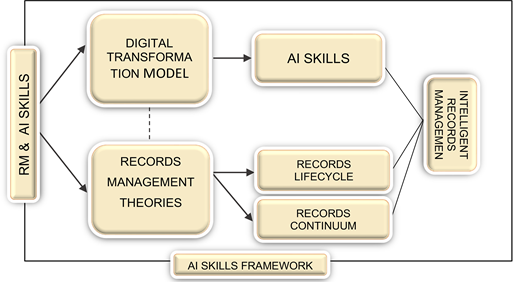
The DTM is a very popular term used in academic and organisational sectors due to the “digital transformation” that is taking place because of the advancement in technology (Aras and Büyüközkan, 2023). As posited by Tratkowska (2019), the primary objective of the DTM is to identify and address the gaps that exist within each phase of digital transformation, thereby providing a framework for guiding the change process. According to the DTM, three pivotal areas require consideration for successful technology adoption: skills, processes and infrastructure. However, this study focused on the concept of skills to assess the proficiency of the GDE records management practitioners in using AI to manage records.
Furthermore, this study incorporates records management theories, such as the records life cycle and records continuum models, as they are essential to understanding the context and scope of this study. The concept of a life cycle and records continuum model is central to most records management programmes, as it serves as the basis for their operational activities (Matlala and Maphoto, 2020). The records life cycle model, which encompasses the creation, use, maintenance and disposal of records, enables the identification of critical stages in the records management process (Bolouri and Memon, 2019). Furthermore, the records continuum model highlights the importance of considering the dynamic nature of records throughout their life cycle, including the various transformations and changes that occur over time (Purdy and Norris, 2017).
Problem statement
The effective management of records using AI is contingent upon possessing the necessary skill set. However, the GDE records practitioners lack the requisite skills to use AI to manage records effectively and efficiently. Without the prerequisite skills, records management practitioners at the GDE cannot manage records effectively with AI technology. However, with the most appropriate skill set, the GDE can make progress in managing records through AI. Records management activities can be automated and streamlined, offering benefits such as easy digitisation of records through AI robotic machines, secure and unlimited cloud-based storage, error reduction, improved retrieval speeds and optimised record classification and accessibility (Modiba, 2021; Modiba et al., 2023). Hence, this study aims to examine the records practitioners’ skills required for the utilisation of AI to enhance records management practices at the GDE.
Purpose of the study
The purpose of the study is to investigate the proficiencies of record practitioners to use of AI to enhance records management practices at the GDE in South Africa.
The objectives of this study are as follows:
To assess the proficiency of record practitioners in the use of AI to enhance records management practice at the GDE.
To propose a framework to apply the proficiency to use AI to enhance records management practice at the GDE.
Literature review
This section provides a comprehensive literature review of the study on the skills required for the utilisation of AI for the effective and efficient management of records.
Skills are learned abilities that enable individuals to achieve predetermined results with a high level of certainty (Zhang, 2019; Echtelt, 2018). Consequently, the integration of AI in the domain of records management necessitates that professionals in archives and records management possess robust technical skills. This implies that organisations need to ensure their employees have a solid foundation in technical expertise before identifying the specific AI-related skills and knowledge required for effective records management (Theodotou, 2023).
Computer proficiency
Computer proficiency refers to the aptitude that allows one to engage with the digital world around them (Coursera, 2023). According to Dadhaniya (2023) and Denomme (2021), computer proficiency is typically acquired through a combination of formal education, hands-on training and practical experience, as well as the use of specialised tools and software.
Computer proficiency encompasses a wide array of competencies, for example, expertise in computer software, proficiency in various operating systems, knowledge of networking protocols, familiarity with AI applications and proficiency in handling work-specific tools and machinery across different industries (Coursera, 2023; Borsellino, 2020).
Ajmal (2022) highlighted that acquiring computer proficiency can lead to significant improvements in productivity and efficiency within various organisations. Ngoepe (2017) urged that there exists a notable deficiency in technological advancement skills among records management practitioners, particularly in Africa. This implies that the acquisition of computer proficiency by records management practitioners can have a significant positive impact on productivity and efficiency within their field. Nonetheless, for the successful implementation of innovative technologies like AI, records management professionals must possess the necessary computer proficiency. Luciol (2022) emphasised the importance of organisations providing computer proficiency training for their employees to keep them up to date with the latest technology trends.
Artificial intelligence skills
The incorporation of 5IR technologies, such as AI, in the archives and records management field brings forth various considerations for skills development and education (Kayembe and Nel, 2019). As outlined in a study conducted by PwC (2017), using these technologies frequently demands particular expertise that exceeds fundamental digital literacy. Therefore, organisations aiming to successfully implement AI technologies need to invest resources in reskilling and upskilling initiatives to empower their employees with the necessary skills to collaborate with AI systems (Theodotou, 2023).
The introduction of AI technology has brought about a revolutionary transformation in the field of archives and records management. A prime example of this transformative power is the utilisation of AI robotic machines to automate various records management activities, which have become an indispensable component for organisations seeking to streamline their operations and optimise efficiency (Colavizza et al., 2021; LinkedIn, 2023). Therefore, organisations must acquire a comprehensive understanding and develop skills in automation and the digitisation of records using AI-powered robotic machines.
In addition, Wu and Kaluvi (2018) asserted that machine learning (ML), deep learning (DL) and natural language processing (NLP) are the subsets of AI that greatly contribute to the advancement of archive and records management activities. Therefore, to fully harness the benefits of these technologies, organisations should prioritise acquiring the necessary skills and knowledge in working with ML, DL and neural network algorithms. Organisations that lack proficiency in skills required to work with AI technologies may face challenges in completing tasks efficiently, leading to a negative impact on overall productivity (Gurchiek, 2023; Kayembe and Nel, 2019). The implementation of an intelligent records management system requires a workforce that possesses the necessary knowledge and skills to effectively use AI technologies (Kayembe and Nel, 2019). The absence of such expertise can result in inefficiencies and productivity losses, underscoring the importance of ensuring that employees possess the necessary training and knowledge to effectively use AI-based systems. To overcome this challenge, it is crucial to prioritise training and skills development programmes. This can be achieved through various means such as workshops, vendor-provided programmes, professional seminars and courses at colleges or universities (Maluleka et al., 2018). By partaking in training programmes, workshops and online courses, employees can acquire the requisite expertise to competently operate and use intelligence records management systems (Theodotou, 2023).
Research methodology
In this study, a mixed-methods approach with a convergence design was used. A parallel sampling technique was opted for to gather both qualitative and quantitative data simultaneously (Creswell and Creswell, 2018; Kumar, 2014). The study was conducted from the perspectives of ontological pluralism and epistemic pragmatism (Ngulube, 2020). The population of this study included six respondents – all employees of the GDE. The respondents comprised one records manager, four records manager assistants and one information technology (IT) technician. The records manager and the IT technician provided qualitative data through interviews. To analyse quantitative data, the researcher used descriptive analysis and data was presented in the form of tables, figures and graphs. However, for qualitative analysis data, the researcher quoted the participants verbatim to analyse data, meaning the researcher quoted the participants word for word.
Findings, discussions and recommendations of the study
Computer proficiency
For the application of AI to manage records, records management practitioners must be computer literate. The respondents were asked which computer programmes they were proficient at. Three respondents indicated that they were proficient in Microsoft Office Suite (Word, Excel, PowerPoint, Outlook), search engines Google Chrome, Yahoo, Bing, etc.), Microsoft Access and Microsoft Teams.
The respondents were therefore asked to use the provided scale in the questionnaire to rate their proficiency in the programmes they chose. The scale was: , , , and . Table 1 presents the ratings of respondents as follows: three respondents rated themselves as five in all programmes. One respondent rate was three in all programmes.
Ratings for GDE records management practitioner’s computer proficiency
| Computer skills | |||||
|---|---|---|---|---|---|
| Microsoft Office Suite (Word, Excel, PowerPoint, Outlook) | 0 | 0 | 1 | 0 | 3 |
| Search engines Google Chrome, Yahoo, Bing, etc.) | 0 | 0 | 1 | 0 | 3 |
| Microsoft Access | 0 | 0 | 1 | 0 | 3 |
| Microsoft Teams | 0 | 0 | 1 | 0 | 3 |
Participants were asked how often they work with these programmes. All four respondents indicated that they work with these programmes daily.
Interview participants were asked which computer skills they were proficient in. Respondents indicated the few skills that they are proficient in. The responses were as follows:
Participant 1 indicated that “I can work proficiently with MS Office (Word, Excel, PowerPoint, Outlook), Microsoft Teams, and Microsoft Access”.
Participant 2 indicated that:
Computer programs I can use proficiently are Microsoft Office packages, operating systems, network administration, security technologies such as firewalls, virtual private network (VPN), antivirus and malware protection, hardware repairs (laptop, desktop, and server hardware installations, repairs, and upgrades) and basic machine learning and artificial intelligence skills.
Artificial intelligence skills
AI has the potential to manage records effectively and efficiently. The participants were asked if they possessed skills in managing records with AI. Four participants indicated that they do not have any skills in the area of managing records with AI.
Interview participants were also asked if they possessed skills in managing records with AI. The participants indicated that they do not have any skills in the area of managing records with AI. The responses were as follows:
Participant 1 stated, “I don’t have any skills in managing records using AI, it is my first time hearing about it”.
Participant 2 stated, “I have skills in AI but not in the area of managing records”.
Furthermore, the participants in the survey were asked an open-ended question to indicate what they think can be done to equip them with AI skills. Figure 2 presents findings as follows: two participants indicated that they should be provided with training. One participant indicated that they should be provided with workshops and skill improvement training. One participant indicated that AI training, seminars and workshops should be provided to assist them on how to manage records using AI.
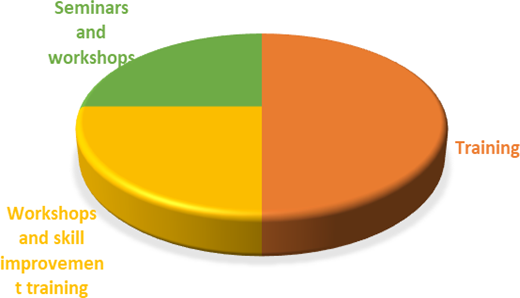
The responses were as follows:
Participant 1 stated, “Staff should be trained on how AI works”.
Participant 2 stated, “workshops, training and skill improvement can assist in gaining more knowledge of AI”.
Participant 3 stated, “the whole staff must be trained not only online but practically as well; staff must also be allowed to attend workshops and seminars in AI”.
Respondent 4 stated, “training”.
Interview participants were also asked to indicate what they think can be done to equip them with AI skills. Participants indicated that training, seminars, and workshops should be provided on how to manage records using AI.
The responses are as follows:
Participant 1 stated, “training on how to use AI to manage records”.
Participant 2 stated, “training, workshops, seminars, and official can take short courses that can equip them with AI skills”.
Participant discussion of the results
Computer proficiency
According to Kloefkorn (2023), computer proficiency is the ability of an individual to use a computer and its different software programmes such as word processing, spreadsheets and internet navigation. The purpose of this particular section was to assess the level of technical skills possessed by the officials of the GDE. The findings revealed that three respondents have great proficiency in the Microsoft Office Suite, which includes applications like Word, Excel, PowerPoint and Outlook, as well as search engines such as Google Chrome, Yahoo and Bing. They also have experience in using Microsoft Access and Microsoft Teams.
The respondents were then asked to rate themselves from 1 to 5, with 5 being the highest level of proficiency. Interestingly, three of them rated themselves at level 5, which indicated their outstanding skills in these programmes. Meanwhile, one respondent noted that they were good in all these programmes, but their rating was at a moderate level of 3.
During the interview, it was revealed that the participants possessed different levels of proficiency in various technical skills. The first participant mentioned that they were proficient in popular software applications such as Microsoft Suite and Search engines. On the other hand, the second participant had a wide range of technical skills and knowledge in areas such as network administration, security technologies and even ML and AI skills. The second participant’s vast technical skills could be attributed to their role as an IT technician. It was clear that they regularly engaged in tasks such as hardware repairs, upgrades and installations related to laptop, desktop and server hardware. They also had in-depth knowledge of security technologies, including firewalls, VPNs and antivirus software, and the participants also possessed basic knowledge and skills in ML and robotics.
Artificial intelligence skills
According to Arisa (2023), AI skills refer to a specific set of technical skills that can be customised for various AI applications. These skills are greatly valued by organisations that recognise the potential for AI to revolutionise their operations.
To effectively manage records using AI, organisations must possess key skills such as proficiency in automation, ML, DL, NLP, black box analysis, neural networks and cloud computing.
The findings revealed that none of the four respondents possessed the necessary skills to manage records using AI. However, one participant who was interviewed did claim to have some knowledge of AI, although it was not specific to record management. The respondents and participants unanimously agreed that adequate training, skill development, workshops and seminars could be the best solution to this problem. It was apparent that enhancing the skills and knowledge of individuals would be crucial for efficient record management through AI. Access to suitable resources would aid in the development of these competencies, thereby leading to increased efficiency in their respective fields.
Recommendation, proposed framework and conclusion
Recommendations
This section presents recommendations on the records practitioners’ skills required for the utilisation of AI to manage the GDE records. Records management practitioners should have proficiency in computer programmes and be willing to learn more technical skills. To develop AI skills, it is recommended that the GDE should arrange training and workshops for the records management practitioners, with a focus on AI for records management. The training should be provided through various platforms, including Microsoft Teams, which will enable the records management practitioners to access the training material and participate in webinars. In addition, practical training should be conducted repeatedly to ensure that the records management practitioners can apply the acquired skills in a real-life setting. Once the records management practitioners have gained the knowledge of AI, it is crucial to practice working with AI robotic machines as part of training to gain practical experience.
Proposed framework
The study proposed a framework for the development of the records management practitioners’ skills required to manage records using AI, as illustrated in Figure 3. The framework begins with the assessment of the technical skills of the GDE records management professionals, which is the ability to use computers and proficiency in computer programmes. The adoption of modern technologies such as AI requires that staff have a basic understanding of technology such as the use of computers. Subsequently, the framework recommends introducing the GDE records management practitioners to the concept of AI in general, as well as highlighting the numerous benefits of using AI for records management. This training can be delivered internally through service providers who offer on-site training, or institutions can be identified where records management practitioners can attend training courses. Afterwards, the GDE records management practitioners must be introduced to the core concepts, technologies and applications of AI in records management. Extensive training should cover topics such as ML, NLP, auto-classification and the usage of AI-powered robotic machines specifically designed for records management.
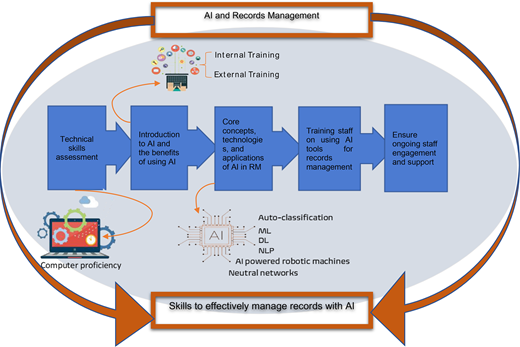
Framework for the development of the records management practitioners’ skills required to manage records using AI
Source: Authors’ own work
Framework for the development of the records management practitioners’ skills required to manage records using AI
Source: Authors’ own work
The framework also emphasises the importance of training the GDE records management professionals on effectively using AI for records management purposes. This includes identifying and providing training on specific AI skills related to records management. It is crucial to offer a comprehensive overview of commonly used AI technologies and tools in records management, such as ML, NLP, auto-classification and the usage of AI-powered robotic machines specifically designed for records management. By providing high-quality training on the utilisation of AI in records management, the GDE can guarantee that records professionals possess the necessary expertise to leverage AI effectively for efficient record management.
In addition, the framework recommends conducting hands-on training sessions where the GDE records management practitioners can gain practical experience in using specific AI tools and technologies relevant to records management. Demonstrations should showcase how AI tools can automate routine tasks, improve search capabilities and extract insights from large volumes of data.
Finally, the framework advises establishing a supportive system that fosters continuous engagement and assistance for the GDE records management practitioners throughout and after the AI implementation. This includes addressing any concerns, questions or challenges that the practitioners may encounter. The GDE records management practitioners should be encouraged to provide feedback and share their experiences in using AI tools for records management.
Conclusion
Effective and efficient management of records using AI requires advanced technological skills and knowledge. Organisations that recognise the advantages of AI are compelled to provide the necessary training, workshops or seminars to equip professionals with the requisite AI skills. To facilitate a clear understanding of AI technology and its benefits in the field, records management practitioners must possess comprehensive knowledge, which can be obtained through internal or external training programmes. Records management practitioners must be well-trained in how to use AI for records management purposes; otherwise, the adoption of AI can result in a wasteful expenditure of resources.
Acknowledgements
The author would like to express his sincere gratitude to Dr Mashilo Modiba for his essential support in the publication of this article. His knowledge, guidance and motivation played a crucial role in making this work a reality.

