

This study examines the role of local radio in crisis communication within Europe, focusing on Thessaloniki, Greece. It explores how local stations operate under pressure to provide accurate information, foster community engagement and maintain public trust amid crises such as disasters and environmental emergencies and how these practices align with European Union objectives of communication resilience and social cohesion.
The study employs a qualitative research design based on semi-structured interviews with ten journalists representing eight officially registered, news-oriented radio stations in Thessaloniki. Data were analysed through thematic analysis following Braun and Clarke's six-phase framework to identify recurring patterns, professional practices and institutional dynamics. Ethical standards of voluntary participation, confidentiality and informed consent were strictly observed.
Local radio remains a trusted and community-driven medium in times of crisis. Journalists display strong civic commitment but face challenges, including limited preparedness, lack of training and absence of psychosocial support. Their professional routines centre on the triad “ask–learn–verify”, reflecting improvisational resilience rather than formal crisis planning. Radio functions as both informational and emotional infrastructure, absorbing citizens' anxiety and facilitating two-way communication. However, uneven digital skills, centralised information flows and ad hoc coordination constrain efficiency.
The study reframes local radio as a resilience infrastructure within Europe's crisis communication ecosystem. By highlighting its dialogic and psychosocial dimensions, it expands current crisis communication scholarship – largely focused on digital media – towards inclusive, community-based and trust-centred models. It contributes to theory and practice by proposing an initial, empirically grounded European model -emerging from the case of Thessaloniki, Greece-of resilient crisis communication rooted in pluralism, accessibility and democratic values.
Introduction
In recent decades, Europe has faced a multiplicity of crises of unprecedented magnitude, ranging from natural disasters such as wildfires, earthquakes and floods, to technological accidents such as the Tempi railway tragedy in Greece, terrorist attacks in European capitals, public health emergencies including the COVID-19 pandemic and geopolitical disruptions linked to Russia's war of aggression against Ukraine and the broader reconfiguration of global power. These crises are not isolated incidents but interconnected stress tests for Europe's democratic institutions, social fabric and media ecosystems (Preventis and Triantafillidou, 2024; Triantafillidou and Yannas, 2020, 2024). In this context, public communication – understood as communication conducted by public institutions, in the public interest and for the public good – becomes not merely an accessory to crisis management but a fundamental dimension of European resilience.
Against this backdrop, the role of radio remains particularly significant (Spence et al., 2023). Despite the digital turn and the pervasiveness of social media, radio continues to be one of the most trusted, accessible and resilient communication infrastructures in Europe (EBU, 2022, 2024; London and Matthews, 2022; Malecki et al., 2021). It serves simultaneously as a local lifeline and a pan-European connective medium, reaching vulnerable populations and ensuring access to verified information in crises when other infrastructures may fail. Crucially, local radio stations – often closer to communities than national broadcasters – have the capacity to disseminate timely information, provide psychosocial support, facilitate cooperation with authorities and engage citizens in participatory dialogue during crises.
This article critically reflects on the state of the art in crisis communication research with a specific focus on European contexts, highlighting the limitations of prevailing paradigms while advancing a theoretical framework that positions radio as a strategic actor in public crisis communication. The study's overarching aim is to explore the practices, challenges and societal impact of local radio stations in crisis situations, with a particular focus on Thessaloniki, Greece.
By integrating empirical findings from the Greek case with cutting-edge theoretical perspectives and global policy frameworks, the study seeks to frame radio as a resilience infrastructure towards the development of a broader European model of inclusive and resilient public crisis communication: one that is future-proof, forward-looking and societally embedded; capable of addressing the complex realities of crisis while reinforcing Europe's democratic resilience (European Commission, 2021–2023, 2024; Smillie and Scharfbillig, 2024; OECD, 2025; ESPAS, 2024;United Nations, n.d.).
Literature review
Crisis communication research
Crisis communication has been a vibrant field of scholarly inquiry for more than 3 decades, with seminal contributions by Coombs (2007, 2022), Reynolds and Seeger (2007), Sellnow and Seeger (2021), Ulmer et al. (2023) and others shaping the theoretical architecture of the discipline. Much of this scholarship, however, has been United States (US)-centric, business-oriented and primarily focused on reputation management during the acute response phase of crises (Coombs, 2007).
While valuable, such approaches are limited in at least three respects. First, they often adopt a one-way, single-voice communication model, assuming publics as passive receivers of organisational messaging (Frandsen and Johansen, 2017). Second, they foreground organisational survival and reputation, sidelining broader societal impacts, public trust and community resilience (Reynolds and Seeger, 2007; Sellnow and Seeger, 2021). Third, they remain insufficiently attuned to the European contexts, where crisis communication unfolds within multilevel governance arrangements and strong public service media traditions, and where cohesion, subsidiarity and solidarity shape institutional expectations and public communication norms (European Commission, 2014–2020, 2021–2027; OECD, 2025). In Europe, public institutions, local authorities and public service media play distinct – and often independent – roles in crisis communication, which heightens the importance of place-based infrastructures and trusted intermediaries.
At the same time, crisis communication scholarship and practice are beginning to move beyond ad hoc approaches to embrace accountability and impact evaluation. The AMEC Barcelona Principles 4.0 (AMEC, 2025) highlight that communication should be assessed not only by outputs (e.g. content volume, reach) but also by outcomes and impacts: changes in trust, understanding, engagement and resilience. This orientation is particularly relevant to public-interest crisis communication because it invites analysis of how trust is produced and maintained under pressure, and it supports evidence-based, outcome-oriented models that foreground public value and resilience rather than messaging volume alone (foregrounding impact over output).
Taken together, these debates inform the analytic focus of the present study in two ways. First, they direct attention from crisis “messages” towards crisis communication as situated sensemaking, where professional routines shape what becomes credible and actionable in the public sphere. Second, they justify examining radio not only as a channel of dissemination but as an institution that can stabilise trust and enable community coping.
European perspectives and the shift to multivocality
In Europe, crisis communication scholarship has sought to address these limitations by increasingly emphasising interactional models, participatory engagement, multivocality and inclusivity. Frandsen and Johansen (2017) introduced the concept of the rhetorical arena, highlighting that crises are shaped by multiple voices – organisations, media, citizens, Non-Governmental Organizations (NGOs) and governments – interacting dynamically. This multivocality approach challenges the myth of a single organisational voice and calls for embracing dialogue and engagement (Coombs and Holladay, 2012).
Similarly, Macnamara (2018, 2025) critiques content-centric paradigms, instead advancing a participation paradigm that foregrounds listening, dialogue, and stakeholder co-creation of meaning.
This approach aligns with European democratic norms of participation and deliberation, but its relevance here is primarily analytical: it clarifies why radio's interactive formats are not peripheral “engagement tactics”, but central mechanisms through which publics seek reassurance, exchange local knowledge, and co-produce crisis understanding, which are the topics under research in this study, as well.
A European perspective therefore calls for a paradigmatic shift: from organisational reputation to collective resilience; from unidirectional information to dialogic engagement and from universalised models to context-sensitive, place-based approaches.
Radio as a resilient and inclusive medium
Despite being less studied in recent years, radio continues to play a central role in crisis communication. While digital and social media dominate contemporary crisis communication scholarship (Jin et al., 2014, 2022; Liu et al., 2016), evidence from natural disasters demonstrates that radio remains operational when digital infrastructures fail (EBU, 2022).
This resilience is not simply technical; it is also social, because radio is embedded in local routines and trusted relationships that become particularly salient when uncertainty is high.
Historically, radio has been a trusted and low-threshold medium (Spence et al., 2009). UNESCO (2021) reports that radio continues to reach over 80% of global populations daily and plays an indispensable role during emergencies. Its accessibility, affordability, linguistic diversity, and ability to reach rural and older populations position it as a democratic medium par excellence. During COVID-19, community and public service radio stations provided timely health guidance, countered misinformation and offered psychosocial support to isolated populations (Hasnain et al., 2022).
These functions anticipate two empirical emphases of the present study: (1) radio as dialogic infrastructure enabling two-way communication and citizen contribution and (2) radio as psychosocial infrastructure where journalists absorb anxiety, offer reassurance and maintain social connection – often without formal guidance.
Radio is also central to public service broadcasting, a European tradition that underpins pluralism, cultural diversity and democratic resilience (Iosifidis, 2010). In crises, public service radio ensures not only the dissemination of accurate information but also the mobilisation of solidarity and social cohesion (Spence et al., 2009, 2011, 2023; Park and Avery, 2018). Local radio thus emerges as both a legacy medium and a future-relevant infrastructure contributing to resilience by providing trusted, accessible and place-based communication.
Emerging challenges: digitalisation, misinformation, inclusivity and polycrisis
Over the past 2 decades, Europe has faced crises of diverse origins and intensities which have tested the capacity of democratic institutions to communicate effectively, transparently and inclusively under pressure.
The European crisis communication landscape is shaped by interrelated challenges. Digitalisation has shifted attention to social media. While social media platforms such as Twitter/X, Facebook and TikTok have been widely studied in crisis communication (Jin et al., 2014, 2022; Liu et al., 2016; Fraustino and Liu, 2017), European research reveals a lack of localised, comparative analysis of how these platforms are used by municipalities, NGOs and public organisations during crises (Preventis and Triantafillidou, 2024; Triantafillidou and Yannas, 2020, 2024).
Misinformation and disinformation pose systemic threats to democratic resilience. The European Union (EU) has identified disinformation and hybrid threats as critical challenges (European Commission, 2022). Research shows that crises increasingly manifest as “infodemics” (where false or misleading information circulates widely) (Cinelli et al., 2020) and “slopaganda” (where generative AI-driven propaganda floods the information space with plausible but shallow content) (Klincewicz et al., 2025).
These challenges sharpen the relevance of verification routines and credibility maintenance – precisely the domain captured in this study through journalists' “ask–learn–verify” practice and their cautious management of audience inputs.
Within this context, the EU's preparedness and resilience strategies, such as the European Commission's Strategic Agenda and Foresight Reports (European Commission, 2021-2023, 2024; ESPAS, 2024), the European Democracy Shield (European Commission, 2025a,b), along with regulatory instruments including the Digital Services Act (DSA), the EU Code of Practice on Disinformation and the online hub on Strategic Communication and Countering Foreign Information Manipulation and Interference (European Commission, 2018, 2022, 2025a, b), emphasise the importance of place-based approaches to regional development. Furthermore, they all stress the centrality of strengthening communication as an enabler of societal resilience, public trust and democratic security.
This underscores the enduring importance of trusted communication infrastructures, such as radio, which retain high levels of public trust (EBU, 2022, 2024). Much existing research privileges general publics or consumers, neglecting victims, rural communities, migrants, vulnerable and digitally excluded citizens; thus, inclusivity is an issue that should be considered. Yet crises disproportionately affect these groups, requiring victim-centred, community-based communication models (Sellnow and Seeger, 2021; Ulmer et al., 2023; Macnamara, 2025). Radio provides a crucial communication bridge for such communities, but doing so effectively requires both inclusive formats and disciplined verification boundaries.
In another aspect, Europe and the world are confronted with multiple, interlinked and mutually reinforcing crises. Unlike linear crisis, polycrisis scenarios demand not only reactive communication but also systemic resilience and anticipatory governance (Nicoli and Zeitlin, 2024; Zeitlin and Nicoli, 2019).
In such conditions, communication infrastructures that are locally embedded and operationally robust, such as radio, are uniquely positioned to support resilience, provided they are integrated into preparedness arrangements and supported with training and psychosocial resources.
Policy and strategic priorities: communication as an enabler of resilience
European policy frameworks increasingly frame communication as an enabler of resilience and democratic security. Instruments and initiatives emphasise the importance of trustworthy public communication and institutional coordination (European Commission, 2018, 2022, 2025a, b).
In this article, these policy materials are used selectively to contextualise the European communication-resilience agenda rather than to drive the conceptual argument. Their main relevance is to underscore why trusted, accessible and place-based media infrastructures matter for preparedness and cohesion. From this perspective, radio's public value lies in its capacity to provide verifiable local information, maintain continuity when infrastructures are strained, and support inclusion for citizens who may be digitally excluded or crisis-affected (European Commission, 2014–2020, 2021–2027; OECD, 2025). Foresight work on megatrends further reinforces the need for crisis communication strategies that remain effective under uncertainty and systemic stress (European Commission, 2021–2023; ESPAS, 2024).
In this light, crisis communication should no longer be understood merely as a technical exercise in damage control. Instead, it must be reframed as a foundational pillar of social cohesion, civic trust and territorial justice – especially when crises are prolonged, overlapping and deeply local in their impacts.
Theoretical framework
To address the identified gaps and align the scholarly debate with the study's empirical aims, this research builds its theoretical framework on four (4) interconnected pillars. Importantly, each pillar is translated into observable dimensions explored in the interviews and later traced in the thematic findings (e.g. verification routines, audience participation, coordination dynamics and psychosocial demands).
From Content to Participation
Building on Macnamara (2018, 2025) and Villanueva et al. (2016, 2017), the axiom that “content is king” is increasingly challenged. In crises, what matters is not the volume or virality of content but its trustworthiness, inclusivity and participatory nature. Radio exemplifies this shift: it is not merely a content delivery channel but a platform for dialogue – hosting call-ins, expert panels, community updates, live coverage and multivocal narratives. Through these participatory and emotionally resonant formats, it empowers citizens to articulate grievances, share coping strategies and contribute to recovery communication.
Multivocality and dialogic communication
The rhetorical arena theory (Frandsen and Johansen, 2017) and dialogic communication principles (Kent and Taylor, 2002; Freire, 1970) converge in emphasising crises as discursively constructed through multiple voices. Multivocality views crises as communicative arenas where multiple actors - authorities, citizens, NGOs, journalists – negotiate meaning. This polyphonic landscape requires platforms that can facilitate dialogue, negotiate meaning and sustain trust. Radio fosters multivocality by bringing together public officials, emergency services, local citizens and journalists in real time. This creates a participatory crisis communication ecology that contrasts with one-way, single-voice institutional messaging.
Communication infrastructure and media ecology
Drawing on Communication Infrastructure Theory (Kim and Ball-Rokeach, 2006a, b; Kim et al., 2006; Villanueva et al., 2016, 2017), radio is conceptualised as part of a wider ecology of interpersonal networks, local institutions and digital media. Local and community radios act as anchor institutions within this ecology, ensuring culturally and linguistically appropriate communication during crises. They can serve as localised trust anchors, capable of translating macro-level policies into culturally resonant and locally intelligible narratives.
Resilience communication and radio as infrastructure of resilience
Informed by resilience theory (Manyena, 2006; Norris et al., 2008), communication infrastructures can be conceptualised as critical resources for adaptive capacity. Radio, due to its accessibility, reach and robustness, serves as an infrastructure of resilience, particularly in rural and crisis-affected areas. It enhances social capital, collective efficacy and trust, and it sustains engagement across the crisis lifecycle, from preparedness and acute response to recovery and institutional learning (Reynolds and Seeger, 2007; Sellnow and Seeger, 2021).
Radio's sustained presence in local life allows it to accompany communities before, during and after crises, supporting psychosocial recovery, commemorative storytelling and institutional critique – functions central to European democratic vitality.
Towards a European model of inclusive and resilient public crisis communication
Bringing these dimensions together, this study advances a European model of inclusive and resilient public crisis communication grounded in four interlinked principles: trustworthiness, inclusivity, multivocality and foresight. Radio operates at the intersection of these principles by combining verified, place-based information with dialogic formats that sustain participation and social cohesion under pressure.
Taken together, these strands justify an empirical focus on: (1) verification and sensemaking under uncertainty, (2) audience interaction and the management of multivocality, (3) coordination with public authorities and information flows and (4) preparedness and psychosocial demands across crisis phases. These constructs directly inform the interview guide of the empirical case of Thessaloniki and guide the thematic analysis addressing RQ1–RQ3. Figure 1 illustrates the conceptual model of how local radio operates as a crisis resilience infrastructure.
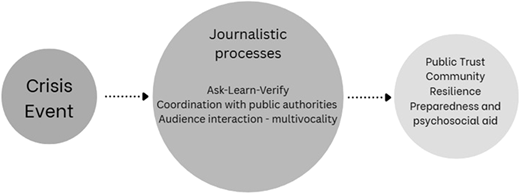
Local radio as a crisis resilience infrastructure. Figure created by the authors
Local radio as a crisis resilience infrastructure. Figure created by the authors
Methodology
The overarching aim of the study is to explore the practices, challenges and societal impact of local radio stations in crisis situations, with a particular focus on Thessaloniki, Greece.
Given that radio remains one of the most resilient and reliable communication media – particularly vital during emergencies for its immediacy, accessibility and credibility – that can support inclusivity and democratic trust, the research focuses on understanding how local stations contribute to public communication under pressure. To examine this dynamic, the study employs qualitative methods, specifically semi-structured interviews with journalists representing officially registered radio stations in Thessaloniki, aiming at capturing their perceptions, professional practices and communication strategies during crisis situations while maintaining comparability across cases.
The interview guide involved ten parts with questions on the following broad items: (1) personal information, (2) crisis experience, (3) crisis-related operational practices, (4) comparative crisis management, (5) timeliness and accuracy of information, (6) audience engagement, (7) integration of technology and social media, (8) emotional and psychological support, (9) crisis preparedness and planning and 10 the value of local radio in crisis situations. Finally, there was an open question to add anything that was considered important and was not among the questions according to participants' judgement. The research questions this study sought to answer are:
How do local radio journalists in Thessaloniki, Greece, perceive and define crises, and how do these perceptions shape their understanding of the role, responsibility and impact of local radio in informing and supporting the community during such events?
How do local radio stations in Thessaloniki, Greece, manage crisis reporting through their professional practices, communication strategies and institutional preparedness, including decision-making processes, coordination with authorities and the existence of formal crisis management frameworks?
How do audience interaction, digital media and technological tools shape the practices, impact and community role of local radio in Thessaloniki, Greece, during crises, particularly in terms of communication management, information co-production, emotional support and the integration of new media platforms?
Research sample and procedures
At the time of the research (summer 2025), eight (8) news-oriented radio stations were officially operating in Thessaloniki, all of which were registered in the records of the Journalists' Union of Macedonia and Thrace Daily Newspapers (ΕΣΗΕΜΘ). The stations are Status FM 107.7, 102FM ERT3, Radio Thessaloniki 94.5FM, Municipal Radio FM100, Sto Kokkino 91.4FM, Flash 99.4 FM, Praktoreio FM 104.9 and Focus FM 103.6. The sample consisted of ten journalists – four women and six men – representing these stations, as presented in Table 1. One journalist was selected from each radio station, with the exception of 102FM ERT3 and Municipal Radio FM100, from which two participants were included due to their larger staff size and organisational complexity. During the period of data collection, 102FM ERT3 employed approximately 30 permanent and contract journalists, while additional reporters from ERT3 Television occasionally contributed to radio coverage during emergencies. Similarly, Municipal Radio FM100 employed around 10–12 journalists, with TV100 television reporters also supporting radio broadcasts when required.
Profile of Interview Participants
| Participant | Journalistic field | Years of experience |
|---|---|---|
| 1 | Local government reporting | 24 |
| 2 | News | 35 |
| 3 | Culture/Society | 22 |
| 4 | News programme – news editing and anchoring | 25 |
| 5 | Political reporting | 33 |
| 6 | Daily commentary programme | 27 |
| 7 | Political reporting | 18 |
| 8 | Radio site | 13 |
| 9 | News programmes and news bulletins | 30 |
| 10 | Political and sports reporting | 37 |
The semi-structured interview questions, designed to be answered in writing, were distributed via email and social media accounts (personal messaging) on June 9, 2025, followed by three reminders sent on June 11, June 16 and June 19, 2025, to encourage participation. Despite the repeated follow-ups, reaching journalists proved challenging, particularly due to their demanding work schedules and the open-ended nature of the questions. This difficulty highlights the practical constraints of conducting qualitative research with active media professionals, whose time limitations and fast-paced work environments often hinder participation in lengthy surveys or interviews.
The study adhered to ethical research principles, ensuring voluntary participation, informed consent, and confidentiality. Participants were fully briefed about the purpose of the study and their right to withdraw at any stage. Identifying details of individuals and stations were anonymised in the analysis to protect privacy and professional integrity. Each participant received a unique alphanumeric identifier composed of the letter “I” followed by a number (e.g. I.1 denotes Interviewee 1). Access to the code list linking these identifiers to individual participants was restricted to members of the research team.
Data analysis
Thematic analysis was employed to identify recurrent patterns, key concepts and underlying meanings in the data following Braun and Clarke's (2006) six-phase approach, which includes familiarisation with the data, generation of initial codes, theme development, theme review, definition and naming of themes, and final report production. In the familiarisation stage, the researchers repeatedly read the transcripts while listening to the recordings to capture contextual nuances and develop an overall understanding of participants' perspectives. Codes were developed both inductively, emerging from participants' narratives and deductively (Armat et al., 2018), based on the study's theoretical framework concerning media resilience and crisis communication, employing a combination of descriptive and empirically derived codes (Willig and Stainton Rogers, 2017). Coding, to ensure validity and reliability, was performed manually, independently by two of the researchers, using printed transcripts to enable close engagement with the data and iterative refinement of codes (Madill et al., 2000; Castleberry and Nolen, 2018). Line-by-line open coding (Williams and Moser, 2019) was used to identify key concepts and patterns related to the research questions.
Conceptual frameworks related to crisis communication and resilience were introduced at the interpretation stage to contextualise the empirical findings, rather than to structure the coding process a priori. This approach allowed the analysis to remain grounded in participants' experiences while enabling theoretical engagement.
The resulting codes (such as: radio as trusted source, reliance on professional judgement, audience as information source, dependence on official sources, lack of digital training and training demand) were organised into preliminary sub-themes, based on the original interview themes, which were subsequently refined through comparison and cross-case analysis to identify both shared and unique patterns across participants. The sub-themes represent empirically derived insights that inform, and are later situated within, broader scholarly and policy debates on crisis communication and local media. In the next stage, the final thematic categories were developed based on descriptive and interpretive data. Ultimately, six major themes emerged, encapsulating the most salient dimensions of participants' narratives.
Findings – themes' analysis
Theme 1: the role, value and function of local radio in crisis coverage
The research findings demonstrate that local radio serves as a crucial medium for public communication during crises, operating both as an immediate source of information and as a community connector. Journalists working in local radio stations face diverse types of crises – social, political, environmental and natural – and their conceptualisation of a “crisis” varies according to personal and professional experience.
Four of the respondents consider that the fatal train accident in Tempi, Greece on 28 February 2023 represented the most significant crisis they had encountered in their professional careers. Other crisis examples included the political crisis and referendum of 2015, the murder of Alkis Kampanos, the Samina shipwreck, the floods of 2018, seismic events and the NATO intervention in Yugoslavia in 1999. One participant (I.6) drew attention to the differential perception of crises, noting that “environmental issues, such as Thessaloniki's air pollution, are considered crises, but they lack the duration and intensity of more visible events”.
Most respondents emphasised the necessity of accurate, analytical, and continuous information during crises, asserting that local radio holds a central role within the local community, verifying once more what the research has outlined that radio is often regarded as a preferred communication medium during disaster situations (Spence et al., 2023). The medium was described as a direct and accessible channel for disseminating verified information and facilitating citizen engagement. I.4 stated, “It is the community's informative refuge and the voice of the public to the outside world”. Furthermore, I.3 underlined the immediacy of radio, remarking, “When something happens, we usually know before the police or fire service”, while stressing that “local radio must stand by the citizen, respond to their needs, and never disregard them”.
The interviewees highlighted the importance of maintaining objectivity, pluralism and editorial independence during crisis reporting. One respondent (I.5) succinctly summarised this principle: “Media during crises must inform citizens in a pluralistic and objective manner, free from subjective judgments and external influences—whether from ownership or political power—that could distort the flow of information”.
Theme 2: professional practices, information strategies and crisis typologies
The analysis revealed that crisis coverage in local radio is grounded in specific professional practices aimed at ensuring reliability and public trust. Among these practices are cross-verification of information, immediate response and readiness, communication with official authorities and experts, and the organisation of emergency broadcasts.
The predominant strategy identified involves corroborating information obtained by field reporters with data provided by institutional or official sources, while also attempting to represent multiple viewpoints on the issue. Journalists described their method as “ask–learn–verify”, underscoring the cyclical nature of their information-gathering process.
Another recurrent theme was the reliance on common sense and professional judgement during emergencies. As one respondent (I.8) noted, “Common sense is essential as a filter because panic is rarely a good advisor”. Larger radio organisations, such as ERT3 with 32 employees, were found to rely not only on official communications but also on their correspondents, who act as reliable sources in the field.
While coordination and supervision occur in most stations, the study revealed a notable absence of formal crisis communication plans. Decisions are often made collectively in ad hoc meetings or left to the discretion of individual journalists based on experience, competence and initiative. One station stood out as an exception, reportedly maintaining a structured emergency response plan and corresponding training procedures.
Overall, the findings indicate a lack of institutionalised training and standardised protocols for crisis management, resulting in a system that depends heavily on individual agency and informal collaboration rather than formalised crisis communication plans, highlighting a gap between theoretical best practices and newsroom realities.
Theme 3: communication with the public, audience participation and community impact
With regard to public communication and emotional support, most journalists acknowledged that their stations do not possess formal frameworks or guidelines for offering psychological or social assistance to listeners. As one participant (I.1) stated, “We are not specialized journalists for that”.
Nevertheless, local radio was recognised as a trusted outlet for emotional expression, particularly during periods of collective stress or hardship, UNESCO (2021) reports that radio continues to reach over 80% of global populations daily and plays an indispensable role during emergencies. Listeners often engage with radio programs to share their experiences, fears and opinions, thereby transforming the medium into a participatory and empathetic space. Some journalists reported offering informal support on a personal initiative, I.9 stated that “There is no official plan, but I do it voluntarily”.
A small number of stations have institutionalised listener participation. One journalist (I.3) noted, “We act as psychologists for frustrated listeners—such as those stuck in traffic—and we are always available”. In these cases, audience members also play a role in the dissemination of information: “The best reporter of the radio is the listener”.
Conversely, in public radio stations, the verification of information from the public remains a prerequisite before it can be integrated into the news flow. Many journalists expressed reservations about allowing listeners on air due to concerns regarding credibility and the potential spread of misinformation.
Audience ratings were not reported by any of the participants, suggesting limited access to formal audience data. Instead, indicators of social impact were identified through telephone calls, messages and social media interactions, which increase significantly during emergencies. As in the case of an earthquake, I.4 replied: “Listeners immediately phoned in to share their experience or to ask for more information. This happens every time something serious occurs in the city”. These spontaneous communications were viewed as evidence of radio's continuing social relevance and community role.
Theme 4: communication with official authorities
The collaboration between local radio journalists and official agencies, including police, fire departments, coroners, and seismologists, was characterised as fundamental to accurate and timely reporting. Radio can play a protagonist role in reinforcing multivocality, which is vital in crises and developed further through the rhetorical arena theory (Frandsen and Johansen, 2023), where multiple actors – authorities, citizens, NGOs, journalists – negotiate facts, meaning, truth, solutions and reassurance. Most respondents described their cooperation with these entities as excellent, though a few noted occasional challenges, describing interactions as “cautious or even competitive, but usually constructive” as I.5 stated.
A recurring structural issue identified in the data concerns the centralisation of information flow in Athens, which often delays or restricts access to localised updates, even when the events occur within the immediate broadcasting area. This imbalance was perceived as a barrier to the efficiency and autonomy of local journalism during crises.
Theme 5: technology and digital media
All participants confirmed that they actively use digital platforms and social media alongside traditional broadcasting to enhance audience reach and responsiveness during crises. Digital media have become indispensable tools for real-time communication and information sharing. As one journalist (I.8) succinctly observed, “Our lives are multitasking—so is journalism”.
However, the research found that the use of social media in local radio often occurs without formal training or institutional guidance, relying instead on the individual journalist's digital proficiency. This indicates a need for capacity-building and the development of standardised digital communication strategies tailored to crisis contexts.
Theme 6: recommendations for improving crisis management
The participants proposed several measures aimed at strengthening the ability of local radio stations to respond effectively to crises. These include the development and implementation of comprehensive crisis management plans with clearly defined procedures and regular training and education of journalists in emergency communication and safety protocols. I.2 clearly pointed out that “there must be a plan and appropriate information for staff so that it can be implemented immediately. Complete and detailed information for employees so that roles are understood from the very beginning”. In that framework, the organisation of seminars and workshops by professional associations (e.g. ESHEM-TH) and public institutions would be valuable.
Furthermore, they mentioned the need for detailed staff briefings to clarify roles and responsibilities during the initial stages of a crisis, which are considered critical for maintaining public trust and ensuring accurate reporting. Enhanced cooperation between local radio stations and central government authorities to improve information flow and logistical support is also of outmost importance.
Finally, the provision of psychological support for journalists, recognising the emotional strain and cognitive overload they may experience while covering crises was also pointed out.
Discussion
Supported by the findings
The findings affirm that local radio remains a vital medium in times of crisis, offering timely, trustworthy and community-oriented information. This aligns with wider European and international evidence that radio continues to function as a resilient and inclusive medium, maintaining operations even when digital infrastructures collapse (EBU, 2022) and Spence et al. (2009, 2011, 2023), who emphasise radio's enduring public-service role during emergencies through immediacy, accessibility and community trust. Despite limited resources, journalists demonstrate strong professional commitment and civic responsibility, reinforcing radio's historic role as a democratic, low-threshold medium (RQ1) as argued by Iosifidis (2010).
Importantly, this evidence is grounded directly in interview material rather than normative expectation: journalists consistently describe radio as both an informational infrastructure and an emotional or psychosocial infrastructure, absorbing citizens' anxiety, offering reassurance and maintaining social connection during acute and prolonged crises. This “care work” (Sellnow and Seeger, 2021; Ulmer et al., 2023) builds social capital and collective efficacy, though informality exposes gaps between normative ideals and newsroom realities.
Yet, gaps in institutional preparedness, training and emotional support persist. Training needs are grounded in the repeated references to reliance on personal experience, “common sense” and improvisation in the absence of formal preparation (Themes 2, 5 and 6). Respondents explicitly noted the lack of institutionalised crisis training and digital guidance, particularly regarding verification under pressure, trauma-aware interviewing and the use of social media during emergencies. Journalists' anxiety about the need for protocols comes along with the largely limited disaster preparedness in mass media outlets, which previous research has verified (Spence et al., 2011). Strengthening these areas through planning, education, and digital integration would enhance local radio's resilience and credibility as a pillar of public communication (European Commission, 2021–2027).
The interviews reveal local radio as a “living interface” between citizens and institutions, not merely a transmission channel (RQ3). This supports prior research identifying radio as a communicative infrastructure that bridges publics and authorities during emergencies (UNESCO, 2021; Hasnain et al., 2022). Crises—from the 2023 Tempi rail disaster to floods and pollution in Thessaloniki – demonstrate that crisis meanings are plural and co-produced by reporters, authorities and citizens.
Professional routines centre on the triad “ask–learn–verify”, reflecting journalists' improvisational resilience in the absence of formal crisis plans (RQ2). Despite differences in ownership and institutional status (private–public–municipal), all radio stations seem to rely heavily on direct contact with society. Private stations actively integrate the public as an information source, including event reporting. Public stations restrict public participation due to concerns over reliability and institutional accountability, but have the advantage of a wider network of professional reporters across the city and the country. Comparative analysis shows that public and municipal stations prioritise accuracy over speed in a more institutionalised manner, while private stations display greater flexibility and dependence on professional experience. Across all station types, there is an almost complete absence of official audience data known to the journalists. Moreover, there is a lack of official, documented, and tested crisis management plans, although there is broad acknowledgment across all participants, that: (a) clear role distribution is necessary and (b) training and preparedness exercises are essential. Furthermore, most stations operate reactively rather than proactively, which introduces significant risks in high-pressure crisis environments. Such adaptive improvisation is consistent with resilience theory's emphasis on flexibility and sensemaking under uncertainty (Macnamara, 2025). Local radio's dialogic practices enable citizen participation, though verification boundaries are essential to preserve credibility amid disinformation and AI-driven “slopaganda” (Klincewicz et al., 2025). The findings further resonate with Spence et al. (2023), who revisited radio's contemporary crisis role and stressed the growing importance of multiplatform communication within increasingly hybrid media ecosystems.
Constructive but uneven relations with authorities underscore the need for decentralised, place-sensitive crisis coordination that recognises local stations as co-equal partners in resilience governance.
Building on the evidence above, normative recommendations that derive from the findings and aim to strengthen radio's resilience function while preserving its dialogic and community-based character are proposed.
As near-term/low-cost actions, radio organisations and newsrooms should adopt minimal crisis protocols, including role allocation during peak events, basic verification checklists and contact trees for authorities. Furthermore, journalists' associations (e.g. ESHEM-TH) should offer short training modules on crisis verification, safety, trauma-aware interviewing and digital-platform literacy, drawing directly on practitioners' reported needs.
As medium-term/capacity-building actions, media regulators and policy actors should incentivise preparedness and resilience capacity-building, including funding for training, accessibility measures (e.g. multilingual crisis messaging) and psychosocial support mechanisms.
Radio organisations and authorities should integrate local radio into crisis preparedness exercises and simulations, recognising its role as a trusted intermediary rather than a passive broadcaster.
All above resonate with the EU's emphasis on cohesion, inclusivity, and participatory communication in its Civil Protection Mechanism and European Democracy Action Plan. Local radio's contribution to democratic resilience thus aligns with the broader European model of crisis communication that prioritises trust, pluralism and inclusivity (European Commission, 2024; ESPAS, 2024).
Digitalisation is widespread but unevenly professionalised. Hybrid practices combining FM and social media enhance responsiveness but increase verification burdens and burnout risks (Triantafillidou and Yannas, 2020, 2024). Targeted capacity-building – verification workflows, role separation and platform literacy – are therefore critical to balancing immediacy and reliability (Preventis and Triantafillidou, 2024). Moreover, digital platforms cannot fully substitute the local embeddedness and credibility of radio, especially during infrastructural or polycrisis conditions when trust and accessibility are paramount (EBU, 2024; Nicoli and Zeitlin, 2024).
The Thessaloniki case shows that local radio is not a legacy artefact but a resilience infrastructure translating European values of trust, inclusivity and foresight into daily practice. Empirically, it advances a European model of crisis communication grounded in trust, inclusivity and adaptive capacity – positioning local radio as a community anchor and democratic safeguard amid disruption and polycrisis (Zeitlin and Nicoli, 2019).
While this study does not measure audience ratings, advertising revenue or financial performance, the findings suggest a plausible organisational pathway through which crisis preparedness and credible performance may carry economic significance.
Based on interview evidence, journalists' reliance on verification routines, heightened audience interaction during crises and radio's psychosocial role suggest that credible crisis performance may sustain public trust. Conceptually, this operates as: preparedness and credible crisis reporting → perceived trustworthiness → consistent listenership and loyalty → organisational stability (including potential advertising value and community legitimacy).
This is an implication rather than an economic finding. The study offers qualitative evidence of mechanisms – trust work, audience reliance and community embeddedness – rather than financial measurement. It does not assess economic outcomes. Future research could test these pathways using audience metrics, revenue indicators and comparative organisational data across media systems.
Local radio should be recognised as a critical partner in crisis communication strategies across Europe. Public authorities, civil protection agencies and media regulators can enhance societal resilience by integrating local radio into crisis preparedness plans, especially in rural and digitally underserved areas. Policymakers should invest in sustaining trusted, community-based media infrastructures as pillars of democratic resilience and inclusive public communication - without assuming that trust automatically translates into economic gain.
Limitations and future directions
While the study provides valuable insights into the role of local radio in crisis communication, certain limitations should be acknowledged. The relatively small sample size, the focus on a single urban area and the written answers rather than oral conversations limit the generalisability of the findings to other regions or media contexts. Moreover, as the research relies on self-reported data from journalists, responses may reflect personal perceptions rather than direct observation of practices. Future studies could complement these findings through audience-based research or comparative analyses across different localities to provide a more comprehensive understanding of radio's role in crisis resilience.
The authors would like to acknowledge and thank all participating journalists for their time, cooperation, and valuable contributions to this research.

