


While companies in developed countries are increasingly turning to indigenous employees, integration measures have met with mixed results. Low integration can lead to breach of the psychological contract, i.e. perceived mutual obligations between employee and employer. The purpose of this paper is to identify how leadership and organizational integration measures can be implemented to promote the perceived insider status (PIS) of indigenous employees, thereby fostering fulfillment of the psychological contract.
A search for relevant literature yielded 128 texts used to identify integration measures at the level of employee–supervisor relationships (leader-member exchanges, inclusive leadership) and at the level of employee–organization relationships (perceived organizational support, pro-diversity practices).
Measures related to leadership included recruiting qualified leaders, understanding cultural particularities, integrating diverse contributions and welcoming questions and challenges. Organizational measures included reaching a critical mass of indigenous employees, promoting equity and participation, developing skills, assigning meaningful tasks, maintaining good work relationships, facilitating work-life balance, providing employment security, fostering support from communities and monitoring practices.
While PIS has been studied in western and culturally diverse contexts, it has received less attention in indigenous contexts. Yet, some indigenous cultural values are incompatible with the basic assumptions of mainstream theories. Furthermore, colonial policies and capitalist development have severely impacted traditional indigenous economic systems. Consequently, indigenous people are facing many barriers to employment in ways that often differ from the experiences of other minority groups.
Introduction
Companies in developed countries are increasingly turning to a diverse workforce – including indigenous[1] employees – to adjust to legal reforms, counter labor scarcity or favor social acceptability of their projects (Brereton and Parmenter, 2008; Lucas and Knights, 2014; Russell, 2013). Job creation is often at the heart of negotiations between indigenous communities and extractive industries, as part of impact and benefit agreements, which are required for project approval in some areas (McCreary et al., 2016; O’Faircheallaigh, 2006, 2013). Governments and industries show a growing will to increase the socioeconomic status of indigenous communities, notably by overcoming barriers to employment (Brereton and Parmenter, 2008; Haar et al., 2018).
Generally young, growing and available for work, indigenous populations are increasingly considered a potential solution to labor scarcity (Brereton and Parmenter, 2008; Ewing et al., 2017; Haley and Fisher, 2014; Maru and Davies, 2011). In the natural resources sector, companies must consider indigenous people as key stakeholders in order to obtain a “social licence to operate,” i.e. the on-going acceptance and approval of a project by local community members (Prno and Slocombe, 2012; Thomson and Boutilier, 2011). In this sense, providing jobs to indigenous people and maintaining good relationships with indigenous communities favor social acceptability (Owen, 2016; Russell, 2013; Sammartino et al., 2003). However, while progress is being made, measures to integrate indigenous employees to the workforce still do not yield the expected results, as many qualified indigenous people remain unemployed (Biddle et al., 2009; Kalb et al., 2014; Parkins et al., 2006; Pearson and Daff, 2011, 2013).
If properly managed, the skills, knowledge and expertise of a diversified workforce can generate a competitive advantage (Van Knippenberg et al., 2007), providing higher levels of performance, creativity and innovation (Crawley and Sinclair, 2003; Groysberg and Connolly, 2013). While employees show a lower turnover rate when they perceive that their organization applies an ethical management approach (McKay et al., 2007; Stewart et al., 2011), increased diversity within the work group can jeopardize successful employee integration (Randel et al., 2018). Members of cultural minorities are more susceptible to marginalization (Pelled et al., 1999; Tang et al., 2017) and inappropriate behaviors (Biddle et al., 2013; Rerden and Guerin, 2015), including discrimination, prejudice, racism and violence (Goldman et al., 2006; Shore et al., 2009; Stewart et al., 2011). Discrimination is not limited to relationships between colleagues and can also come from supervisors. Employees from cultural minorities sometimes have less access to support, training, information, decision processes and promotion opportunities (Mor Barak, 2017; Tang et al., 2017), consequently lowering their sense of integration within the organization (Pelled et al., 1999) and contributing to breach the psychological contract, i.e. the perceptions of mutual obligations between employee and employer (Coyle-Sapiro and Parzefall, 2005; Rousseau, 1989). Employees from cultural minorities are thus more susceptible to stress and dissatisfaction at work, contributing to reduced well-being and higher absenteeism (Gee, 2008; Mor Barak et al., 2001) and generating costs for the employers (Herring, 2009).
To benefit from a diversified workforce, companies should provide an inclusive work environment (Oswick and Noon, 2014; Shore et al., 2011). Indeed, employees’ perceived insider status (PIS) is positively related to professional satisfaction, performance, retention and well-being (Mor Barak and Levin, 2002; Nishii and Mayer, 2009; Stamper and Masterson, 2002). PIS promotes the adoption of organizational citizenship behaviors, such as altruism, mutual assistance, conflict resolution and obedience to organizational norms (Chompookum and Brooklyn Derr, 2004; Van Dyne and LePine, 1998). Organizational citizenship behaviors increase efficiency, productivity and innovation within the organization (Babcock-Roberson and Strickland, 2010; Mujtaba and Afza, 2011; Organ, 1997).
While PIS has been studied in western (Rousseau and Schalk, 2000) and culturally diverse contexts (Andrews and Ashworth, 2015; Findler et al., 2007; Guerrero et al., 2013), it has received less attention in indigenous contexts (Brougham and Haar, 2012). Yet, some indigenous cultural values are often incompatible with the basic assumptions of mainstream theories, especially in terms of entrepreneurship (Peredo et al., 2004), egalitarianism, sharing, kinship ties and communal activity (Dana and Anderson, 2011). The lack of knowledge and consideration for indigenous traditions, cultures and contexts is one of the stumbling blocks to implementing a work climate conducive to integration (Haar and Brougham, 2013; Pearson and Daff, 2013; Purdie et al., 2006).
Several indigenous cultures are collectivist rather than individualistic (Haar et al., 2018; Haar and Staniland, 2016; Redpath and Nielsen, 1997) and they favor employment opportunities that will benefit their communities (Haley and Fisher, 2014; Hobart, 1981; Johnson and Basile, 2006; Kunz et al., 2000; Lawrence, 2005; Loxton et al., 2012; McRae-Williams and Gerritsen, 2010; Pearson and Daff, 2013; Ruwhiu and Elkin, 2016; Trigger, 2002). When seeking for a job, indigenous people rely more on personal connections than on other methods (Caron et al., 2019; Haley and Fisher, 2014; Hunter and Gray, 2006; Maru and Davies, 2011). Furthermore, indigenous cultures have a strong relationship to the land and therefore give a higher priority to traditional activities than to wage work (Haley and Fisher, 2014; Pearson and Daff, 2013; Young and McDermott, 1988), in addition to focusing on short-term needs (Caron et al., 2019; Haley and Fisher, 2014). Indigenous teaching and learning styles are more based on observation, experiential learning, and social interaction than western approaches (Barnhardt, 2005; Kawagley, 2006; Walker, 1989).
Decades of colonial policies and the hegemony of capitalist development have severely impacted traditional indigenous economic systems, particularly in Australia and North America (Daschuk, 2013; Dockery and Milsom, 2007; Milloy, 2008; Trigger et al., 1996). The consequences of this economic and cultural upheaval will last for many generations (Dockery and Milsom, 2007), making it hard for many indigenous job seekers to enter the workforce and remain in the job market (Brereton and Parmenter, 2008; Pearson and Daff, 2013; Russell, 2013; Thiessen, 2016). Hence, indigenous people face barriers to employment in ways that often differ from the experiences of other minority groups, and previous studies have emphasized the need to improve employment policies and practices that specifically address integration of indigenous people to the labor market (Dockery and Milsom, 2007; Purdie et al., 2006).
The barriers to employment faced by indigenous people include poor living conditions (Commonwealth of Australia, 2005; Purdie et al., 2006), high crime environments, speaking a different language and being largely disregarded by governments and industries (Caron et al., 2019; Purdie et al., 2006). These barriers are compounded by lack of self-confidence, family obligations and lack of skill or work experience (Dockery and Milsom, 2007; Hunter and Gray, 2001; Purdie et al., 2006). Moreover, distance between community and workplace, low access to training opportunities, reticence to renounce to traditional activities, lack of familiarity with the industrial way of life, importance given to productivity by supervisors and discriminatory or inappropriate behaviors complicate the integration of indigenous workers (Haley and Fisher, 2014; Loxton, Schirmer, and Kanowski, 2012; O’Faircheallaigh, 2006; Pearson and Daff, 2013; Purdie et al., 2006).
Given the desire of many indigenous people to improve their socioeconomic status (Anderson et al., 2006) and given the growing will of companies to integrate indigenous people into their workforce, this review aimed to identify how leadership and organizational measures can be implemented to promote the PIS of indigenous employees, thereby favoring fulfillment of the psychological contract.
Conceptual framework
Employers and employees are linked by a psychological contract, i.e. they have perceptions of mutual obligations toward each other. Building on previous research on human resources management, this review is based on the following assumptions: to fulfill their side of the psychological contract, employers provide appropriate work conditions reflected by perceived organizational support and pro-diversity practices where this applies; employers also make sure that supervisors display inclusive leadership and are engaged with employees in fruitful leader-member exchanges; perceived organizational support, pro-diversity practices, leader-member exchanges and inclusive leadership promote the PIS of indigenous employees, who in turn display organizational citizenship behaviors, hence fulfilling their side of the psychological contract (Figure 1).
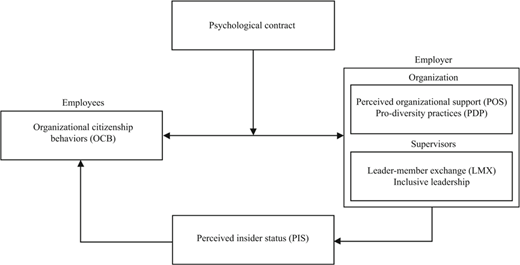
Proposed conceptual framework showing how the fulfillment of the psychological contract by the employer (perceived organizational support, pro-diversity practices, leader-member exchange, inclusive leadership) favors perceived insider status by the employees, who then fulfill the psychological contract by adopting organizational citizenship behaviors
Proposed conceptual framework showing how the fulfillment of the psychological contract by the employer (perceived organizational support, pro-diversity practices, leader-member exchange, inclusive leadership) favors perceived insider status by the employees, who then fulfill the psychological contract by adopting organizational citizenship behaviors
Psychological contract
The psychological contract refers to perceived mutual obligations between employee and employer (Coyle-Sapiro and Parzefall, 2005; Rousseau, 1989). These obligations can be implicit or explicit and need not be unanimously accepted by both parties for the contract to be in effect (Kotter, 1973; Robinson and Rousseau, 1994). For the employee, the perceived obligations of the employer may include employment security, training, remuneration and career progression (Robinson and Rousseau, 1994). Employees feel more important within the organization when they perceive the employer’s obligations are being met (Pearce and Randel, 2004; Stamper and Masterson, 2002). For the employer, the perceived obligations of the employee may include commitment and trust toward the organization, display of organizational citizenship behaviors and having no intension to leave (Coyle-Shapiro and Kessler, 2000; Coyle-Shapiro and Parzefall, 2005; Robinson, 1996; Robinson and Morrison, 1995; Turnley and Feldman, 1999). When fulfilled, the psychological contract is beneficial to both parties (Shore and Tetrick, 1994). Breach of the psychological contract from either side will have negative consequences (Turnley and Feldman, 1999). If it is the employer that breaches the psychological contract, employees can feel frustration or anger (Triana et al., 2010), express dissatisfaction, limit their commitment, lose motivation, demonstrate less organizational citizenship behaviors and, ultimately, leave the company (Chen et al., 2008; Farrell, 1983). When the breach comes from the employees, employers can reduce support, leading to deterioration of the relationships between supervisors and employees (Chen et al., 2008; Mujtaba and Afza, 2011).
Based on the focus, time frame, stability, scope, and tangibility of perceived obligations, psychological contracts have been classified into two main categories: transactional and relational (Macneil, 1985; Rousseau, 1990). While transactional contracts are characterized by economically oriented perceived obligations that occur during a specific period of time (e.g. competitive wages), relational contracts are rather based on open-ended, non-economic perceived obligations focused on maintaining the long-term relationship between employer and employee (e.g. training and development) (Jensen et al., 2010; Rousseau, 1990).
Perceived insider status (PIS)
The PIS refers to the degree to which an employee considers having earned a “personal space” and being accepted within their work organization (Masterson and Stamper, 2003; Stamper and Masterson, 2002). PIS is an indicator of successful integration, as it reflects positive work experience and psychological satisfaction (Kim et al., 2010). Employees with PIS feel they are an important part of the organization and have a high sense of belonging (Masterson and Stamper, 2003; Pelled et al., 1999; Shore et al., 2011). PIS generates many positive benefits, as it favors acceptation of responsibilities, respect of norms, performance, professional satisfaction, retention, well-being in the workplace, creativity and organizational citizenship behaviors (Chen and Tang, 2018; Findler et al., 2007; Horng et al., 2016). Consequently, PIS reinforces the quality of the social exchange between the employees and the organization (Chen and Tang, 2018), and favors fulfillment of the psychological contract (Coyle-Shapiro and Parzefall, 2005). PIS is mediated by supervisors through leader-member exchanges and inclusive leadership (Katrinli et al., 2011; Wang et al., 2010), and by the organization through perceived organizational support (Ding and Shen, 2017; Hui et al., 2015; Stamper and Masterson, 2002) and pro-diversity practices (Guerrero et al., 2013).
Leader-member exchanges and inclusive leadership
The supervisor is in charge of implementing the policies and procedures of the organization and to ensure an appropriate work environment; as such s/he is at the forefront of the employee–organization relationship (Liden et al., 2004; Zaccaro et al., 2001). Quality of the relationships between employees and supervisors can be expressed through the concept of leader-member exchanges (Schyns and Day, 2010; Wayne et al., 2002). Quality exchanges are characterized by open communication, mutual trust, respect, support, loyalty and affection (Graen and Uhl-Bien, 1995; Liden et al., 1997). Quality of leader-member exchanges can vary from one employee to another within a work group (Ellemers et al., 2004; Graen and Uhl-Bien, 1995; Lee et al., 2007), and such variation can generate conflict (Boies and Howell, 2006; Hooper and Martin, 2008; Stewart and Johnson, 2009), affect employment satisfaction, commitment, well-being and, in turn, performance (Hooper and Martin, 2008; Schyns, 2006). Inclusive leadership is complementary to leader-member exchanges in favoring PIS, particularly in contexts of cultural diversity (Randel et al., 2018; Shore et al., 2011). Inclusive leadership includes a range of behaviors that simultaneously promote employees’ uniqueness and sense of belonging, integrating all members of the work group and supporting their various contributions and abilities (Randel et al., 2018).
Perceived organizational support
Perceived organizational support relates to the relationship between employee and organization (Wayne et al., 2002). It is the perception by the employees of the degree to which the organization appreciates their contribution, worries about their well-being, and is committed to them (Eisenberger et al., 1986; Graen et al., 1972). The support measures deployed by an organization contribute to establish a feeling of being valued (Eisenberger et al., 1997) and important (Masterson and Stamper, 2003). Although employees can feel that employers value their contribution without necessarily perceiving themselves as insiders (Stamper and Masterson, 2002), increasing POS has been shown to favor PIS (Hui et al., 2015; Stamper and Masterson, 2002; Wayne et al., 1997) and adoption of organizational citizenship behaviors (Eisenberger et al., 1986; Rhoades and Eisenberger, 2002; Wayne et al., 2002).
Pro-diversity practices
Defined as the measures implemented by organizations to develop perceptions of fair human resource policies and to integrate cultural minorities, pro-diversity practices are positively related to PIS (Guerrero et al., 2013). By itself, diversity does not necessarily bring advantages without additional conditions being met (Ferdman, 2014). Cultural differences need to be reconciled (Chesley, 2016) and diversity management needs to be anchored in an inclusive culture, described as an “organizational environment that allows people with multiple backgrounds, mindsets and ways of thinking to work effectively together and to perform to their highest potential in order to achieve organizational objectives based on sound principles” (Pless Maak, 2004, p. 130). Inclusion is defined as “the degree to which an employee perceives that he or she is an esteemed member of the work group through experiencing treatment that satisfies his or her needs for belongingness and uniqueness” (Shore et al., 2011, p. 1265). Pro-diversity practices promote bilateral fulfillment of the psychological contract as they are positively related to employee commitment (Downey et al., 2015), as they feel valued and that they work for a responsible employer, concerned of their well-being (Andrews and Ashworth, 2015; Guerrero et al., 2013). It is worth noting that pro-diversity practices are only positively related to PIS if leader-member exchanges are of high quality (Guerrero et al., 2013).
Collectivism as an indigenous cultural trait
In cross-cultural organizations, the alignment of human resource management processes with the cultural values of employees influences job satisfaction, work motivation, organizational citizenship behaviors, teamwork, as well as fulfillment of the psychological contract (Gelfand et al., 2007). Hence, cultural particularities of employees must be considered by employers to implement relevant and inclusive practices and to adopt coherent behaviors (Haar and Brougham, 2011; Ramamoorthy and Carroll, 1998; Stoermer et al., 2016). A commonly used definition of culture was coined by British anthropologist Edward B. Tylor in 1871 as “that complex whole which includes knowledge, belief, arts, morals, law, custom and any other capabilities and habits acquired by [a human] as a member of society” (Gullestrup, 2006, p. 32). While a culture can be characterized in many ways (Hofstede, 2003; Stoermer et al., 2016), the individualistic/collectivist distinction has garnered most attention from scientists conducting research on PIS and organizational citizenship behaviors (Gelfand et al., 2007; Haar et al., 2018; Harris et al., 2016; Hofstede, 1984; Hui et al., 2015; Wang et al., 2017). In collectivist cultures – including many indigenous cultures (Haar et al., 2018; Haar and Staniland, 2016; Redpath and Nielsen, 1997) – employees seek to meet group objectives, to preserve harmony and give high importance to relationships, customs and traditions, whereas in individualistic cultures employees are more inclined to satisfy their own interests, consider themselves autonomous and central to decision making, have a competitive spirit, and communicate less (Fitzsimmons and Stamper, 2014; Hofstede, 1984, 2003; Ramamoorthy and Carroll, 1998). As PIS is about group objectives and interests – belongingness, equity and empathy (Nishii, 2013; Pless and Maak, 2004) ‒ it is more compatible with a collectivist standpoint (Haar et al., 2018; Hui et al., 2015; Wang et al., 2017).
Fulfillment of the psychological contract is linked to organizational citizenship behaviors in non-western collectivist cultures (Hui et al., 2004; Kickul et al., 2004). Moreover, collectivism has a moderating effect on the relationship between PIS and organizational citizenship behaviors: highly-collectivist employees show more organizational citizenship behaviors if they perceive organizational inclusion, and are more motivated to help their supervisor or organization reach their objectives (Hui et al., 2015). Encouraging collectivism and supporting cultural identity in the workplace not only promote organizational citizenship behaviors (Haar and Brougham, 2011; Kuntz et al., 2014), but also mental health of indigenous employees (Brougham and Haar, 2013), leadership (Pillai and Meindl, 1998), professional satisfaction (Haar and Brougham, 2013; Haar and Staniland, 2016; Harris et al., 2016; Lai et al., 2018), self-determination (McIntosh et al., 2004), authenticity, pride, loyalty (Haar and Brougham, 2011), as well as global organizational performance (Haar and Delaney, 2009). Globally, cultural well-being of indigenous employees promotes good relationships with the employer (Haar and Brougham, 2013; Haar and Spell, 2004). In turn, good relationships favor fulfillment of the psychological contract (Rousseau, 1989; Shore and Tetrick, 1994). Although indigenous people share several cultural and contextual characteristics, generalization and “one-size-fits-all” measures should be avoided, as beliefs, values and attitudes vary (Bousquet, 2012; Clugston et al., 2000). Thus, while it is important to implement general measures that will apply to most indigenous contexts, care should be taken to understand and take into account the specificities of each people, community, family and person.
Methodology
The EBSCO, Scopus, Repère, ProQuest and Google Scholar databases were searched in June 2018 for the expression “perceived insider status.” Verification of the 389 articles retrieved showed that 13 took cultural diversity into account. Additional searches were done for “inclusive leadership,” “inclusive management” and “pro-diversity practices,” allowing to retrieve 29 more articles based on relevance of title and abstract. To be considered relevant, articles had to specifically address leadership or organizational practices or measures to favor the inclusion of minority groups. The search ended when information saturation was reached. As few of the retrieved studies were conducted in Indigenous contexts, an additional search was done combining the keywords “Aboriginal” OR “Indigenous” OR “Native” OR “First Nation*” AND “employ*” OR “job” OR “workplace” OR “work*” OR “staff.” Titles and abstracts were evaluated for relevance based on their mention of success factors or barriers related to the inclusion or integration of indigenous employees into the labor market. The search ended when information saturation was reached, yielding 86 additional articles. A thematic analysis was performed on the retrieved studies to identify best practices in terms of inclusion of indigenous employees and sort them into two main categories depending if integration measures were related to leadership or to organizational functioning. The information within each category was then grouped into coherent measures of which four were related to leadership and nine were organizational.
Results
Integration measures related to leadership
Inclusive leadership could promote the PIS of employees from minority groups – including indigenous employees – and, consequently, favor fulfillment of the psychological contract. Four integration measures have been identified that are related to leadership: recruiting qualified leaders, understanding cultural particularities, integrating diverse contributions and welcoming questions and challenges (Table I).
Applications of leadership integration measures to promote the perceived insider status (PIS) of indigenous employees
| Measures | Applications with indigenous employees | References |
|---|---|---|
| Recruiting qualified leaders | Select leaders that promote the development, autonomy and psychological well-being of indigenous workers through commitment, consultation, respect and understanding of cultural particularities | Love (2017) and Roche et al. (2018) |
| Select leaders who respect Indigenous values such as integrity, honesty, kindness, hospitality, empathy, collectivism, humility, self-discipline, generosity, authenticity and altruism | Haar et al. (2018) and Ruwhiu and Elkin (2016) | |
| Understanding cultural particularities | Develop sustainable, positive relationships based on trust; show interest for indigenous employees personally rather than limiting interest to their work | Burgess and Dyer (2009), Love (2017) and Thiessen (2016) |
| Detect and resolve conflicts; understand indigenous employees’ tendency to avoid conflict and adapt to problematic situations rather than to raise issues | Haley and Fisher (2014) and Thiessen (2016) | |
| Respect indigenous employees’ silent, observational, non-verbal behavior and propensity to avoid physical or eye contact | Burgess and Dyer (2009) | |
| Apply concrete actions and policies aiming at the appropriate use of natural resources given indigenous employees’ strong link to the land | Kuntz et al. (2014) | |
| Understand the barriers to employment affecting indigenous people and commit to overcome them (e.g. poor living conditions; high crime environment; lack of familiarity with the industrial way of life; discriminatory or inappropriate behaviors; lack of self-confidence, skills or work experience; reticence to renounce to traditional activities; obligations towards the extended family) | Commonwealth of Australia (2005), Dockery and Milsom (2007), Haley and Fisher (2014), Haar et al. (2012), Hunter and Gray (2001), Jose (2013), O’Faircheallaigh (2006) and Purdie et al. (2006) | |
| Provide cultural training and informal support to non-Indigenous employees, to improve their understanding and sensitivity to Indigenous history, barriers and cultures | Brougham and Haar (2012), Haar and Brougham (2016) and Lai et al. (2018) | |
| Integrating diverse contributions | Share power with indigenous employees; apply a collaborative approach based on mutual understanding, respect and reciprocity, compatible with collectivist indigenous cultures | Crawley and Sinclair (2003), Haar et al. (2018), Kuntz et al. (2014), Love (2017), Roche et al. (2018), Ruwhiu and Elkin (2016), Thiessen (2016) and Trompf (1996) |
| Avoid paternalistic initiatives | Crawley and Sinclair (2003) | |
| Make constructive comments to foster self-confidence and professional satisfaction of indigenous employees | Dwyer (2003), Haar and Brougham (2016), Jose (2013) and Lai et al. (2018) | |
| Welcoming questions and challenges | Pay particular attention to indigenous needs and questions as some prefer not to accomplish tasks rather than admitting being unable to fulfill them | Haley and Fisher (2014) |
| Support indigenous employees going through personal challenges, beyond the organizational context | Burgess and Dyer (2009) and Day et al. (2004) | |
| Collaborate with indigenous mentors and elders | Burgess and Dyer (2009), Day et al. (2004), Ewing et al. (2017), Mills and Clarke (2009) and Russell (2013) |
Recruiting qualified leaders
As a first step, it is essential to select and recruit leaders and supervisors with certain qualities and skills to establish and maintain an inclusive culture in the context of organizational diversity (Nembhard and Edmondson, 2006; Pless and Maak, 2004; Randel et al., 2018). Supervisors should take responsibility for inclusion, and they should understand and communicate how it is an integral part of the mission and vision of the organization (Ely and Thomas, 2001; Ferdman, 2014). The selection and recruitment of qualified leaders was shown to be particularly important to Māori employees in New Zealand, whereas inadequate supervision was shown to be negatively related to perceived organizational support and employee retention (Haar et al., 2016).
Indigenous leaders encourage skill development, autonomy and psychological well-being in the workplace through commitment, consultation, respect and understanding of relationships within the extended family (Love, 2017; Roche et al., 2018). For example, high quality leader-member exchanges (Haar et al., 2018) and group well-being (Love, 2017) are priorities to some Māori leaders, and taking into account the aspirations, needs, wishes and hopes of indigenous employees allows them to feel like family members (Roche et al., 2018). Other values of indigenous leaders are accountability toward employees, integrity, honesty, trust, kindness, hospitality, empathy, clear-sightedness, collectivism, humility, self-discipline, generosity, authenticity and altruism (Haar et al., 2018; Ruwhiu and Elkin, 2016). To ensure fulfillment of the psychological contract, organizational leaders – indigenous or not – should invest efforts in the adoption of behaviors in line with indigenous values. Senior management support of leaders is important (Avery and McKay, 2010; Guillaume et al., 2014; Homan et al., 2007), especially for indigenous supervisors who might feel caught between their culture on one side and company objectives on the other side, as shown in a Māori context (McRae-Williams and Gerritsen, 2010).
Understanding cultural particularities
Cultural differences can affect relational preferences and the capacity to fulfill the psychological contract (Brougham and Haar, 2013; Durie, 2003; Fitzsimmons and Stamper, 2014; Pearson and Daff, 2013; Ramamoorthy and Carroll, 1998). Supervisors that actively encourage a personal, humane, transparent, frank and on-going dialog (Ferdman, 2014; Pless and Maak, 2004) can better adjust to different cultural norms and values (Mor Barak, 2000). While indigenous employees are not homogeneous in their beliefs, values and attitudes (Day et al., 2004), studies with indigenous peoples in Australia and Canada have shown that they are often interested in developing relationships that are positive, sustainable and based on trust (Burgess and Dyer, 2009; Love, 2017; Thiessen, 2016). Therefore, the interest given to indigenous employees should not be limited to the work they do, but also to the persons they are (Mosselman, 2016). Sharing personal experiences is a good way for supervisors to establish positive relationships and to encourage authenticity (Ferdinand et al., 2014; Ferdman, 2014; Wasserman et al., 2008). The more the employees are comfortable to express their personality, the more they are creative and the more they identify to their workplace (Nishii and Rich, 2014). Indigenous employees in the USA and Canada often tend to avoid conflict and adapt to problematic situations rather than raise issues (Haley and Fisher, 2014; Thiessen, 2016). Hence, supervisors need to be careful to detect and resolve conflicts (Thiessen, 2016). Indigenous employees sometimes communicate differently, for example in Australia by adopting a silent, observational and non-verbal behavior, and by avoiding physical or eye contact (Burgess and Dyer, 2009). Those particularities must be understood by supervisors (Haar and Brougham, 2011) so as to not be interpreted as timidity, rudeness or hostility (Elsworth, 1986). Given their strong link to the land, indigenous employees expect concrete actions and policies aiming at the appropriate use of resources (Kuntz et al., 2014).
Supervisors have to understand the barriers to employment affecting the indigenous workforce and commit to overcome them in an honest and transparent manner (Jose, 2013). Cultural training and informal support can help better understand and develop a sensitivity to indigenous history and cultures. Furthermore the promotion of indigenous employees to management positions can also help infuse sensitivity to indigenous challenges in the decision-making process (Brougham and Haar, 2012; Haar and Brougham, 2016; Lai et al., 2018).
Integrating diverse contributions
Promoting inclusive leadership entails to integrate contributions from a diversified workforce (Nembhard and Edmondson, 2006; Van Knippenberg et al., 2004), by explicitly asking employees what is their vision of organizational development, by listening actively to different viewpoints and by integrating different voices to decision making (Pless and Maak, 2004; Randel et al., 2018; Tang et al., 2017). Such practices are in line with indigenous leadership in Canada, New Zealand and Australia, which is often based on collaboration, mutual understanding, humility, respect, reciprocity, long lasting relationships and helping family and community (Haar et al., 2018; Kuntz et al., 2014; Love, 2017; Ruwhiu and Elkin, 2016; Thiessen, 2016).
Indigenous leaders take care of fellow employees, involve them and listen to them (Kuntz et al., 2014; Love, 2017; Roche et al., 2018). Supervisors should therefore be ready to share a certain level of power, unless organizational initiatives will stay symbolic and paternalistic (Crawley and Sinclair, 2003). Furthermore, autocratic leadership and power imbalance can stress indigenous employees and undermine their health and professional well-being, as was shown in Canada and the Torres Strait Islands (Thiessen, 2016; Trompf, 1996). Appreciating employees for their differences and considering them as equals answer two important identity preoccupations: belongingness and reputation (De Cremer and Tyler, 2005; Ferdman, 2014; Janssens and Zanoni, 2014; Pless and Maak, 2004; Shore et al., 2011; Tang et al., 2017). Supervisors should support members of minority groups (Ewing et al., 2017; Randel et al., 2018), manifest consideration (Mosselman, 2016) and offer feedback on their work (Mosselman, 2016; Nembhard and Edmondson, 2006). Constructive comments from supervisors were shown to be important in the construction of self-confidence and professional satisfaction of indigenous employees in Australia and Canada (Dwyer, 2003; Haar and Brougham, 2016; Jose, 2013; Lai et al., 2018).
Welcoming questions and challenges
Inclusive leaders welcome questions and challenges from employees, they are tolerant, not resentful and do not reprimand employees when mistakes are revealed, hence fostering psychological security, mutual learning and development (Ferdman, 2014; Nembhard and Edmondson, 2006; Nishii, 2013; Tang et al., 2017). Welcoming questions and challenges from indigenous employees is important for the fulfillment of the psychological contract, as much as support, encouragement and empathy, which are among the most contributing factors to positive workplace experience (Thiessen, 2016). Because some indigenous employees in the USA would prefer not to accomplish certain tasks rather than admitting not being able to fulfill them (Haley and Fisher, 2014), supervisors need to pay particular attention to their needs and questions. Offering support to indigenous employees regarding personal challenges beyond the organizational context has also been shown to be important in Australia (Burgess and Dyer, 2009; Day et al., 2004). While supervisors can take on this role, mentorship systems have proven more efficient (Burgess and Dyer, 2009; Day et al., 2004; Ewing et al., 2017). Collaboration with elders also allows to better solve some of the problems met by indigenous employees in Canada (Mills and Clarke, 2009; Russell, 2013).
Organizational measures of integration
Organizational measures of integration refer to the different policies, practices, programs and initiatives aiming to create an environment of acceptation, support and participation for employees from minority groups (Ferdman, 2014; McKay et al., 2008; Tang et al., 2017). To fulfill the psychological contract, senior management need to install a respectful atmosphere (Mor Barak, 1999; Rynes and Rosen, 1995), which will then lead to the implementation of organizational measures favoring integration: reaching a critical mass of indigenous employees, favoring equity and participation, fostering skill development, assigning meaningful tasks, maintaining good work relationships, facilitating work-life balance, providing employment security, obtaining support from communities and monitoring practices (Table II).
Applications of organizational integration measures to promote the perceived insider status (PIS) of indigenous employees
| Reaching a critical mass of indigenous employees | Have a critical mass of Indigenous employees allows them to refer to fellow colleagues sharing a history and culture and to benefit from mutual support; it favors a feeling of pride for hired friends and family members improving their living conditions | Caron et al. (2019), Ewing et al. (2017), Haar et al. (2012), Haley and Fisher (2014), Loxton et al. (2012) and Rerden and Guerin (2015) |
| Use recruitment means that have proven effective in indigenous contexts: liaison officers, local and social medias, paper forms, selection committees with Indigenous or culturally trained members, situational and behavioral interviews | Day et al. (2004), Ewing et al. (2017), Haley and Fisher (2014), Hunter and Gray (2006), Jain et al. (2000), Jose (2013), Maru and Davies (2011), Rerden and Guerin (2015), Russell (2013) and Thiessen (2016) | |
| Promoting equity and participation | Provide indigenous employees with equal wages and equal access to career development opportunities, advantages, compensations, awards and decision making power | Crawley and Sinclair (2003), Ewing et al. (2017), Haley and Fisher (2014), Howlett et al. (2016), Hunter and Hawke (2002), Kunz et al. (2000), Lai et al. (2018), Loxton et al. (2012) and Roche et al. (2018) |
| Developing skills | Hire indigenous or culturally trained mentors (modeling, counseling, motivational and friendship functions) | Daly and Gebremedhin (2015), Day et al. (2004), Dwyer (2003), Ewing et al. (2017), Haley and Fisher (2014), Jose (2013), Lai et al. (2018), Loxton et al. (2012), Rerden and Guerin (2015) and Russell (2013) |
| Develop personalized career pathways to indigenous employees | Lai et al. (2018) and Russell (2013) | |
| Focus on hands-on rather than theoretical training, to better correspond to indigenous ways of learning | Barnhardt (2005), Haley and Fisher (2014), Jose (2013), Kawagley (2006) and Loxton et al. (2012) | |
| Collaborate with indigenous communities in the development of training programs | Haley and Fisher (2014), Lai et al. (2018) and Loxton et al. (2012) | |
| Assigning meaningful tasks | Assign functions allowing indigenous employees to contribute to their community’s well-being | Brown and Fraehlich (2012) |
| Assign tasks that are respectful of the environment, given indigenous employees’ connectedness to the land | Haley and Fisher (2014), Kunz et al. (2000), Lawrence (2005), Loxton et al. (2012), McRae-Williams and Gerritsen (2010), Pearson and Daff (2013) and Ruwhiu and Elkin (2016) | |
| Maintaining good work relationships | Ban racist behaviors, as indigenous employees would rather not work than be victims of inappropriate behaviors | Biddle et al. (2013) and O’Faircheallaigh (2006) |
| Implement mandatory cultural awareness programs for all employees; develop contents of cultural awareness programs with communities | Brereton and Parmenter (2008), Burgess and Dyer (2009), Chesley (2016), Crawley and Sinclair (2003), Day et al. (2004), Ewing et al. (2017), Ferdinand et al. (2014), Haley and Fisher (2014), Jose (2013), Lai et al. (2018), Lawrence (2005), Mills and Clarke (2009), Parmenter and Trigger (2018), Rerden and Guerin (2015) and Russell (2013) | |
| Organize activities unrelated to work and focusing on indigenous cultures | Daly and Gebremedhin (2015), Rerden and Guerin (2015) and Thiessen (2016) | |
| Involve indigenous mentors or supervisors in dispute settlement | Burgess and Dyer (2009) and Rerden and Guerin (2015) | |
| Facilitating work-life balance | Organize family and community events valuing the bonds of indigenous employees with their extended family and larger social network | Daly and Gebremedhin (2015), Haar and Brougham (2011), Haar et al. (2012), Hunter and Hawke (2001), McRae-Williams and Gerritsen (2010) and Thiessen (2016) |
| Accommodate indigenous employees in their practice of cultural activities | Brereton and Parmenter (2008), Brougham and Haar (2012), Gibson and Klinck (2005), Haley and Fisher (2014), Haar and Brougham (2013), Harris et al. (2016), Kuntz et al. (2014), Lai et al. (2018), Lam et al. (2002), Lawrence (2005), Love (2017), Loxton et al. (2012), Maru and Davies (2011), McRae-Williams and Gerritsen (2010), Pearson and Daff (2013), Rodon and Lévesque (2015) and Young and McDermott (1988) | |
| Establish a cultural center providing information on indigenous cultures and a culturally safe work environment | Brereton and Parmenter (2008) and Russell (2013) | |
| Providing employment security | Offer permanent jobs, as short-term contracts can generate stress and ungratefulness in Indigenous employees; respect the preference of some Indigenous employees to work sporadically to more easily pursue traditional activities on the land | Day et al. (2004), Haley and Fisher (2014), Lai et al. (2018), Loxton et al. (2012), McRae-Williams and Gerritsen (2010) and Rerden and Guerin (2015) |
| Fostering support from community | Encourage family support, promote Indigenous models and success stories | Brereton and Parmenter (2008), Burgess and Dyer (2009), Maru and Davies (2011), McRae-Williams and Gerritsen (2010), Rerden and Guerin (2015) and Rodon and Lévesque (2015) |
| Organize awareness-raising activities regarding the benefits of Indigenous involvement in the labor market | Burgess and Dyer (2009), Haar et al. (2012), Haley and Fisher (2014), Jose (2013), Lawrence (2005), Loxton et al. (2012), Maru and Davies (2011), Parmenter and Trigger (2018), Pearson (2000) and Russell (2013) | |
| Contribute to the economy of indigenous communities by buying local goods and services, donating to non-profit organizations and sponsoring events | Haley and Fisher (2014) | |
| Monitoring of practices | Develop and implement employment policies and practices in collaboration with indigenous communities, taking into account that cultures are dynamic and that needs evolve | Brougham and Haar (2012), Day et al. (2004), Ewing et al. (2017), Haley and Fisher (2014), Jose (2013), Kuntz et al. (2014) and Rerden and Guerin (2015) |
Reaching a critical mass of indigenous employees
According to the critical mass theory, a threshold number of participants has to be crossed before a social movement can occur (Oliver et al., 1985). Hence, the proportion of socially and culturally different people in a work group is shaping interaction dynamics within the group (Kanter, 1977a, b). Reaching a critical mass of indigenous employees is thus particularly important, as being surrounded by peers was shown to be a central element of employment well-being in Canada, USA, New Zealand and Australia (Ewing et al., 2017; Haar et al., 2012; Haley and Fisher, 2014; Loxton et al., 2012). Concretely, this allows indigenous employees to refer to people sharing a history and culture and to benefit from mutual support (Haar et al., 2012; Rerden and Guerin, 2015). Having a critical mass of indigenous employees can also generate positive impacts on work relationships, as it encourages interactions with and brings more support from non-indigenous employees (Caron et al., 2019; South et al., 2005; Tang et al., 2017). Being exposed to other cultures can reduce prejudices and negative perceptions and promote equal treatment, therefore reducing discrimination and conflicts within work groups (Andrews and Ashworth, 2015; Rerden and Guerin, 2015). Indigenous employees in Australia have stated they were proud when friends or family members became work colleagues and had jobs allowing them to improve their living conditions (Ewing et al., 2017). If a critical mass is not reached, the few indigenous employees can feel isolated (Rerden and Guerin, 2015).
One reason that a critical mass of indigenous employees is seldom reached is that this workforce is disadvantaged by conventional recruitment processes requiring submission of a resume and passing job interviews (Ewing et al., 2017; Gray et al., 2012; Pearson and Daff, 2011). Passive recruitment, where positions are advertised in the media or online, is often not successful in indigenous contexts. Considering the importance given to trust and relationships, active recruitment is more efficient, as it involves local organizations, community liaison officers (sometimes called brokers) and benefits from word-of-mouth within the community, as was shown in Canada, USA, New Zealand and Australia (Day et al., 2004; Ewing et al., 2017; Haley and Fisher, 2014; Hunter and Gray, 2006; Jain et al., 2000; Maru and Davies, 2011; Rerden and Guerin, 2015; Russell, 2013; Thiessen, 2016). Local media, such as community radio stations, are also efficient (Haley and Fisher, 2014; Jain et al., 2000), and so are social media (Molyneaux et al., 2014; Rice et al., 2016). Job interviews should be conducted in the communities, and paper forms should be privileged over online applications (Haley and Fisher, 2014). Having indigenous members, or at least culturally trained members, within selection committees prevents discrimination (Day et al., 2004; Jain et al., 2000; Jose, 2013). Indigenous people in Australia and USA have shown reluctance to bring forward their qualities or individual realizations, as personal credit is secondary to collective accomplishment (Diamond, 2003; Haley and Fisher, 2014; Wares et al., 1992). Thus, promotion systems based on performance should be used with precaution as they are contradictory to collectivist values (Gomez-Mejia and Welbourne, 1991; Ramamoorthy and Carroll, 1998). Interviews should rather be informal, situational and behavioral (Day et al., 2004). Care should however be taken to avoid bias that could occur in the recruitment and the promotion processes (Beattie and Johnson, 2012). Newly hired indigenous employees should quickly be introduced to fellow colleagues, from whom they will obtain support (Burgess and Dyer, 2009; Daly and Gebremedhin, 2015; Day et al., 2004; Lai et al., 2018). Mentorship has also been shown to facilitate integration and adaption of indigenous employees to the workplace in Australia and Canada (Day et al., 2004; Dwyer, 2003; Rerden and Guerin, 2015; Smith, 2005).
Indigenous people often face barriers to career progression which can prevent reaching a critical mass of indigenous people in higher management positions in Australia and Canada (Dwyer, 2003; Ewing et al., 2017; Loxton et al., 2012). Fulfilling the psychological contract thus entails to implement measures to promote the accession of indigenous employees to management positions (Crawley and Sinclair, 2003; Molyneaux et al., 2014; Rerden and Guerin, 2015; Russell, 2013), where they can play a significant role in helping other Indigenous employees (Loxton et al., 2012). However, some indigenous people in Australia and USA are not reaching for management positions because telling others what to do or how to do it would be a source of discomfort (Brereton and Parmenter, 2008; Haley and Fisher, 2014; McRae-Williams and Gerritsen, 2010).
Promoting equity and participation
Equity and participation can favor job satisfaction, commitment and trust (Ferdman, 2014; Janssens and Zanoni, 2014; Mor Barak, 2017; Nishii and Rich, 2014; Randel et al., 2018; Shore et al., 2011; Stoermer et al., 2016). Inclusive organizations clearly define the limits of acceptable behavior (Wasserman et al., 2008), and allow employees to be involved in the discussion and to contribute to organization development by sharing their opinions and experiences (Ferdman, 2014; Tang et al., 2017; Van Knippenberg et al., 2004). Indigenous people have long had fewer job opportunities and lower wages than non-indigenous people (Crawley and Sinclair, 2003; Ewing et al., 2017; Howlett et al., 2016; Hunter and Hawke, 2002; Kunz et al., 2000). Companies willing to favor PIS and to fulfill the psychological contract should provide employees with equal access to opportunities, career development opportunities, advantages, compensations, awards, decision-making power and management positions (Haley and Fisher, 2014; Lai et al., 2018; Loxton et al., 2012; Mor Barak, 2000, 2017; Mosselman, 2016; Pelled et al., 1999; Pless and Maak, 2004; Roche et al., 2018; Shore et al., 2011; Stockdale and Crosby, 2004). However, because collectivist cultures tend to favor group harmony over equity (Bond et al., 1982; Hofstede, 1984), these matters should first be discussed with the indigenous employees.
It is important to pay adequate salaries as the feeling of being insufficiently compensated for a stressful or heavy workload has been shown to contribute to high turnover rate of indigenous employees (Cosgrave et al., 2017; Ellemers et al., 2004). Finally, PIS is favored by participatory decision making (Hill et al., 2001; Kuntz et al., 2014; Roche et al., 2018; Shore et al., 2011) and by capacity to influence organization development (Ding and Shen, 2017; Hui et al., 2015; Loxton et al., 2012; Mor Barak et al., 1998; Pelled et al., 1999; Pless and Maak, 2004; Randel et al., 2018; Whiteside et al., 2006).
Developing skills
Continuous skill development through training programs and mentorship can promote internal progression and career development and favor integration of cultural minorities (Chesley, 2016; Cox, 1993; Ferdman, 2014; Mor Barak, 1999; Pless and Maak, 2004), including indigenous people (Day et al., 2004; Dwyer, 2003; Jose, 2013). The fact that an organization invests in employees’ skill development sends them a signal that they are important, which contributes to well-being, integration and retention (Lai et al., 2018; Mor Barak, 1999; Trompf, 1996). Mentorship has often been mentioned as a way to favor skill development of Indigenous employees in Australia, USA and Canada (Daly and Gebremedhin, 2015; Day et al., 2004; Dwyer, 2003; Ewing et al., 2017; Haley and Fisher, 2014; Jose, 2013; Lai et al., 2018; Loxton et al., 2012; Rerden and Guerin, 2015). Mentors assume modeling, counseling, motivational and friendship functions that are coherent with indigenous cultures (Burgess and Dyer, 2009; Kram, 1986). Mentors also facilitate communication between indigenous employees and their supervisors (Burgess and Dyer, 2009). It is important that mentors be indigenous or, minimally, that they demonstrate a deep understanding and respect toward indigenous cultures (Burgess and Dyer, 2009; Ewing et al., 2017; Jose, 2013). Being paired to a mentor working on the same shift can also favor attendance (Haley and Fisher, 2014).
While mentorship seems to be a preferred measure for skill development in indigenous contexts, other measures were suggested, for example internal or external training programs to favor career progression in Australia (Brereton and Parmenter, 2008; Ewing et al., 2017; Lai et al., 2018; Loxton et al., 2012). Personalized career pathways combined with support measures are recommended (Lai et al., 2018; Russell, 2013). Development of training programs should involve indigenous people and elders (Haley and Fisher, 2014; Lai et al., 2018; Loxton et al., 2012), and focus on hands-on rather than theoretical learning (Barnhardt, 2005; Haley and Fisher, 2014; Jose, 2013; Kawagley, 2006; Loxton et al., 2012).
Assigning meaningful tasks
Delegation to employees of important tasks (Guest et al., 2006; Rose, 2018) and of some decisional power, implying attribution of new responsibilities and authority to exercise them, can promote PIS (Chen and Aryee, 2007), specifically for employees belonging to groups generally occupying inferior positions (Martin and Chernesky, 1989). Indigenous employees need to feel trusted and valued by management, hence favoring autonomy and belongingness (Roche et al., 2018; Thiessen, 2016), and strengthening team cohesion (Man and Lam, 2003). Furthermore, attributing tasks concordant with employees’ values can promote motivation and PIS (Chen and Tang, 2018). Following collectivist values, indigenous employees prefer to assume functions allowing them to contribute to community well-being (Brown and Fraehlich, 2012). They also attribute more value to jobs within their communities and that are respectful of the environment, as was shown in Australia, New Zealand and USA (Haley and Fisher, 2014; Kunz et al., 2000; Lawrence, 2005; Loxton et al., 2012; McRae-Williams and Gerritsen, 2010; Pearson and Daff, 2013; Ruwhiu and Elkin, 2016). Working on challenging, stimulating projects, in a collaborative and constructive manner, in relation with colleagues, encourages feelings of dignity and accomplishment (Durie, 2003; Ewing et al., 2017; Roche et al., 2018; Thiessen, 2016) and can contribute to fulfillment of the psychological contract. To the contrary, attribution of repetitive or trivial tasks decreases interest toward work, and increases the risk of resigning (Mills and Clarke, 2009; Pearson and Daff, 2013; Rerden and Guerin, 2015). Task variety is also appreciated by indigenous employees in Australia (Ewing et al., 2017; Loxton et al., 2012; Rerden and Guerin, 2015). However, it is important not to overcharge employees so that they can have free time to engage in innovative behavior (Wang et al., 2017) and to achieve objectives (Guillaume et al., 2014). Indeed, work overload can cause stress, exhaustion and lead to resignation (Lai et al., 2018). The attribution of clear, adequately defined, realistic and attainable objectives favors psychological health and well-being (Lai et al., 2018; Trompf, 1996; Whiteside et al., 2006). Assigning meaningful tasks also aligns with Elkington’s (1994) “triple bottom line” framework, which includes environmental, social and economic dimensions of performance to measure organizational impacts on community development (Slaper and Hall, 2011).
Maintaining good work relationships
Racism is one of the main obstacles to indigenous people’s participation in the workforce (O’Faircheallaigh, 2006). Since some indigenous people would rather not work than be victims of inappropriate behaviors (Biddle et al., 2013), fulfillment of the psychological contract necessitates the establishment of high-quality relationships (Ferdinand et al., 2014). Indeed, high-quality relationships between employees favor PIS in culturally diversified contexts (Chesley, 2016; Mor Barak, 2017; Nishii and Rich, 2014). While employees from individualistic cultures tend to value accomplishment over relationships, collectivist employees consider that quality relationships are more important than professional accomplishment (Hofstede, 1994). For indigenous employees in Australia and Canada, good relationships can favor task accomplishment, performance and retention (Hatcher, 2012; Thiessen, 2016), reduce the risk of emotional tiredness, stress and exhaustion (Lai et al., 2018), increase professional satisfaction (Hartung et al., 2010; Ruwhiu and Elkin, 2016; Thiessen, 2016) and contribute to identity definition (Thiessen, 2016).
Awareness programs about cultural diversity can increase respect, support and appreciation of the values held by employees from minority groups, therefore favoring well-being, satisfaction, commitment and work efficiency and reducing the risks of discriminatory situations (Chesley, 2016; Ferdman, 2014; Mor Barak, 1999, 2000; Rynes and Rosen, 1995). Cultural awareness programs were shown to yield the same positive results in many indigenous contexts in Australia, USA and Canada (Brereton and Parmenter, 2008; Burgess and Dyer, 2009; Day et al., 2004; Ferdinand et al., 2014; Haley and Fisher, 2014; Mills and Clarke, 2009; Rerden and Guerin, 2015; Russell, 2013). However, to really be effective, awareness programs should allow for bidirectional learning where indigenous and non-indigenous employees learn about each other’s reality (Crawley and Sinclair, 2003). Paternalistic viewpoints that suppose only indigenous employees need training should be avoided. Indigenous employees in Australia and Canada appreciate cross-cultural training as it helps them learn about the industrial culture (Jose, 2013; Lawrence, 2005) and communicate more efficiently with non-indigenous employees, in a non-conflictual manner (Whiteside et al., 2006). For non-indigenous employees, cross-cultural training can instill understanding of cultural particularities and awareness of the problems encountered by indigenous employees in the workplace, as well as provide the necessary skills to efficiently communicate with indigenous colleagues (Day et al., 2004; Ferdinand et al., 2014). Consciousness of cultural realities can reduce prejudice (Parmenter and Trigger, 2018) and feelings of favoritism (Rerden and Guerin, 2015). Cross-cultural training should thus be offered to all members of the personnel, including mentors and supervisors (Day et al., 2004; Ewing et al., 2017; Haley and Fisher, 2014; Lai et al., 2018). While exposing historical or current injustice incurred by indigenous people is important, awareness programs should avoid taking an accusatory stance that could create more prejudice. Training content and trainer should be chosen in collaboration with indigenous communities (Parmenter and Trigger, 2018).
Integration is also favored by collaboration (Ferdman et al., 2010), especially by having teams made of different cultural groups occupying functions characterized by task interdependency and requiring frequent and substantial communication between group members (Janssens and Zanoni, 2014). Organizing activities unrelated to work allowed indigenous and non-indigenous employees in Australia and Canada to learn about each other in informal contexts and to develop relationships (Daly and Gebremedhin, 2015; Rerden and Guerin, 2015; Thiessen, 2016).
Mechanisms aiming to settle conflicts in a collaborative, respectful and authentic manner can favor integration (Ferdman, 2014; Ferdman et al., 2010; Hunter and Hawke, 2001, 2002; Loxton et al., 2012; Pless and Maak, 2004). As indigenous employees are generally more comfortable reporting problematic situations to indigenous mentors, their collaboration is important (Burgess and Dyer, 2009; Rerden and Guerin, 2015).
Facilitating work-life balance
Measures favoring work-life balance have been underlined as a key factor favoring integration in a culturally diversified context (Pless and Maak, 2004; Ryan and Kossek, 2008). Indigenous employees in Australia sometimes have difficulty finding a balance between their professional and private lives (Lai et al., 2018), particularly in the first 6–12 months following hiring (Dockery and Milsom, 2007). Because of their collectivist orientation, indigenous people have a different vision of family relationships than employees from majority groups from individualistic cultures. For the latter, emphasis is put on their own needs and those of their immediate family (Haar et al., 2012; Harrington and Liu, 2002), whereas indigenous employees have bonds with their extended family and are part of a large social network providing resources and support in difficult times and contributing to knowledge and identity building (Daly and Gebremedhin, 2015; Haar and Brougham, 2011; Haar et al., 2012; McRae-Williams and Gerritsen, 2010; Thiessen, 2016). Work-life balance warrants particular attention in indigenous contexts, as supervisors often provide more support to employees belonging to their own culture (Foley et al., 2006), and as indigenous employees are often subject to discrimination (Hunter and Hawke, 2001).
Traditional activities, including hunting and fishing, are important to indigenous cultures (Haley and Fisher, 2014; Pearson and Daff, 2013; Young and McDermott, 1988). Reduced presence on the land, combined to increased contacts with non-indigenous people, can undermine identity affirmation (Gibson and Klinck, 2005) and, consequently, reduce professional well-being (Haar and Brougham, 2013; Lam et al., 2002). Indigenous employees in Alaska have mentioned they would rather leave their job than miss community events (Haley and Fisher, 2014). Several authors have mentioned that measures are needed to allow indigenous employees to continue practicing traditional activities, e.g. flexible working modalities (Brereton and Parmenter, 2008; Brougham and Haar, 2012; Haley and Fisher, 2014; Lai et al., 2018; Lawrence, 2005; Love, 2017; Loxton et al., 2012; Maru and Davies, 2011; McRae-Williams and Gerritsen, 2010; Pearson and Daff, 2013; Rodon and Lévesque, 2015). Other organizational measures, such as permission to sing or pray (Harris et al., 2016; Kuntz et al., 2014), establishment of a cultural center, and organization of activities involving community members and employees have also been recommended (Brereton and Parmenter, 2008; Russell, 2013). Employers can resort to an on-call workforce (Haley and Fisher, 2014) to fill-in for indigenous employees on leave due to death in the extended family, especially as reverence due to the dead often implies a longer grieving period in indigenous contexts (Harris et al., 2016; Jose, 2013; Kuntz et al., 2014). Organizations showing understanding and support for cultural customs and needs favor PIS (Brougham and Haar, 2012) and fulfillment of the psychological contract.
Providing employment security
Employment security can favor PIS in culturally diversified contexts (Pelled et al., 1999), contributing to professional well-being and retention of indigenous employees (Lai et al., 2018; Loxton et al., 2012; Rerden and Guerin, 2015). However, whereas short-term contracts have been shown to generate stress and ungratefulness in indigenous employees in Australia (Day et al., 2004), some authors have argued that permanent jobs are less preferred by other indigenous employees in Alaska and Australia, who prefer to work sporadically to more easily pursue traditional activities on the land (Haley and Fisher, 2014; McRae-Williams and Gerritsen, 2010).
Fostering support from community
Lack of family support is one of the most important barriers to indigenous participation in the labor market (Haar et al., 2012; Juntunen et al., 2001). Indigenous people have few models to follow within their family and community (Burgess and Dyer, 2009; Rerden and Guerin, 2015). Hence, an integration measure specific to indigenous contexts is to raise awareness within communities about how indigenous employees can benefit their families and communities, notably by contributing to positive changes within the industry (Parmenter and Trigger, 2018) and by improving living conditions (Burgess and Dyer, 2009; Lawrence, 2005; Loxton et al., 2012; Pearson, 2000; Russell, 2013). That being said, while sharing is important in indigenous cultures (Macdonald, 2000; McRae-Williams and Gerritsen, 2010), indigenous employees in Canada and Australia sometimes feel pressure to share their revenues with family and community members (Maru and Davies, 2011; McRae-Williams and Gerritsen, 2010; Rodon and Lévesque, 2015). Such pressure can reduce perseverance in the labor market (Brereton and Parmenter, 2008; Maru and Davies, 2011; McRae-Williams and Gerritsen, 2010).
Entertaining relationships with family and community members may allow companies to better understand the barriers to employment facing indigenous people and to obtain suggestions as to how integration measures could be improved (Haar et al., 2012; Jose, 2013). To show reciprocity, companies can contribute to community economy by buying local goods and services, donating to non-profit organizations and sponsoring events (Haley and Fisher, 2014). Long-term company–community relationships are facilitated by community liaison officers (Haley and Fisher, 2014; Maru and Davies, 2011).
Monitoring of practices
Monitoring cultural diversity policies and practices in a continuous improvement perspective is a key factor favoring PIS (Ferdman, 2014). Managers should consider indigenous cultures as being dynamic, and consequently implement policies and practices allowing to meet employees’ needs in an evolving and case-by-case manner (Brougham and Haar, 2012). Monitoring should be based on clear and measurable objectives (Ewing et al., 2017). Indigenous employees can provide constructive suggestions for improvement of practices (Day et al., 2004; Haley and Fisher, 2014; Jose, 2013; Kuntz et al., 2014; Rerden and Guerin, 2015).
Conclusion
Indigenous communities can be influential partners in organizations active on their lands and are increasingly considered by companies who wish to adjust to legal reforms, counter labor scarcity or favor social acceptability of their projects. To ensure fulfillment of the psychological contract with indigenous employees, employers should deploy measures favoring PIS. Being positively related to well-being and professional satisfaction, PIS promotes performance, adoption of organizational citizenship behaviors, and employee retention. The leadership and organizational measures found to meet the perceived mutual obligations between employers and indigenous employees are characterized by non-economic agreements focused on maintaining a long-term relationship, and are thus closer to the relational than to the transactional end of the psychological contract continuum (Rousseau, 1990, 1995).
This review identified integration measures involving supervisors (leader-member exchanges and inclusive leadership) and organizations (perceived organizational support and pro-diversity practices). Four integration measures are linked to leadership: recruiting qualified leaders, understanding cultural particularities, integrating diverse contributions and welcoming questions and challenges. The nine organizational measures of integration are: reaching a critical mass of indigenous employees, favoring equity and participation, fostering skill development, assigning meaningful tasks, maintaining good work relationships, facilitating work-life balance, providing employment security, fostering support from communities and monitoring practices. Although most of these leadership and organizational measures are relevant for other groups of employees, this study addressed how they should be implemented in indigenous contexts, considering specificities related to culture, values, needs and barriers to overcome. Moreover, fostering support from the community was found to be an integration measure specific to collectivist indigenous cultures.
It is important to recall that variation in the quality of leader-member exchanges from one employee to another can generate conflict (Boies and Howell, 2006; Hooper and Martin, 2008; Stewart and Johnson, 2009), affect employment satisfaction, commitment, well-being and, in turn, performance (Hooper and Martin, 2008; Schyns, 2006). However, it is appropriate for leaders to treat employees differently, as long as the basis of differential treatment is clearly established (Chen et al., 2018), and if supervisors foster a personal, humane, transparent, frank and on-going dialog with employees (Ferdman, 2014; Pless and Maak, 2004), notably to adjust to different cultural norms and values within the work group (Mor Barak, 2000). Along these lines, multicultural or diversity committees facilitate the effective implementation of pro-diversity practices, while favoring a positive work climate for indigenous and non-indigenous employees (Caron et al., 2019; Purnell et al., 2011). Additional research is needed to further inquire into the measures favoring PIS of indigenous employees and fulfillment of the psychological contract. Future research on integration of indigenous employees could consider societal, work group and individual factors (Guillaume et al., 2014; Tang et al., 2017). As indigenous people are not a monolithic group (Day et al., 2004), it would be interesting to determine to what extent employees’ attitudes are influenced not only by culture, but also by personal, demographic and situational factors (Clugston et al., 2000). Although both indigenous-owned and non-indigenous-owned organizations were considered in this review, the influence of ownership on PIS of indigenous workers needs to be explored more in depth. Furthermore, while this review focused on the organizational measures that can be implemented to fulfill the employer’s side of the psychological contract, further studies could focus on the employees’ side of the contract. Finally, while the individualistic/collectivist aspect of culture has received more attention from researchers (Brewer and Chen, 2007; Triandis, 2001), other cultural dimensions (Hofstede, 2003; Stoermer et al., 2016) could influence integration and would thus deserve to be explored. Concretely, Hofstede’s (2003) and Hofstede et al.’s (2010) conceptualization of culture is comprised of five other cultural dimensions: power distance, uncertainty, masculinity-femininity, long-term/short-term orientation and indulgence. As it is the case with collectivism, an inclusive working climate can also be fostered by low short power distance, low uncertainty, gender equality, long-term orientation and high indulgence (Stoermer et al., 2016) It would thus be interesting to further study how indigenous cultures stand on these complementary dimensions (see Haar et al., 2018).
Note
Indigenous communities, peoples and nations are those which, having a historical continuity with pre-invasion and pre-colonial societies that developed on their territories, consider themselves distinct from other sectors of the societies now prevailing on those territories, or parts of them. They form at present non-dominant sectors of society and are determined to preserve, develop and transmit to future generations their ancestral territories, and their ethnic identity, as the basis of their continued existence as peoples, in accordance with their own cultural patterns, social institutions and legal system. […] On an individual basis, an indigenous person is one who belongs to these indigenous populations through self-identification as indigenous (group consciousness) and is recognized and accepted by these populations as one of its members (acceptance by the group). This preserves for these communities the sovereign right and power to decide who belongs to them, without external interference (United Nations, 2009).

