Based on studies combining sustainable development competencies and green consumption values, this paper aims to explore the relationship between Generation Z's sustainable development competencies and green consumption values and to determine how sources of sustainable knowledge acquisition moderate this relationship.
The data collected from 1,570 students were analyzed using structural equation modeling.
Our research confirms that sustainable development competencies positively and significantly impact Generation Z’s attitudes toward green consumption values. Furthermore, sources of sustainability knowledge acquisition moderate the relationship between sustainability literacy and Generation Z attitudes toward green consumption values. The findings suggest that the acquisition of sustainability knowledge from multiple sources is critical in shaping Generation Z attitudes toward green consumption values.
The key to increasing attitudes toward green consumption values among Generation Z is to provide access to sources of sustainable development knowledge acquisition. Adequate information support generated by sources of sustainable development knowledge acquisition can help shape attitudes toward green consumption values that translate into appropriate purchasing decisions.
The survey indicates the significance of diversifying sources of sustainable development knowledge. Although the study received results suggest that Generation Z’s sustainable development competencies influence attitudes toward green consumption values, they allow us to note that much greater effects are generated when a variety of sources of sustainable development knowledge acquisition are used. Thus, it is desirable not only to communicate about sustainable development but also to tailor the sources of sustainable development knowledge acquisition to the audience’s expectations are desirable.
This study analyzes the relationships between sustainable development competencies and green consumption attitudes, thus filling the gap in sustainable development competencies research and broadening its scope. The results indicate the need to change attitudes through the development of competencies that should enable active and responsible participation in sustainability. At the same time, the research shows some links between green consumption and purchasing behavior, suggesting the influence of green consumption values and orientations on sustainable and environmentally friendly consumption.
Introduction
In 2015, the UN General Assembly adopted the Agenda for Sustainable Development (2015) based on five pillars, i.e. people, planet, prosperity, peace, and partnership. It intends to lead to inclusive and transformative social change (Ranjbari, Shams Esfandabadi, Scagnelli, Siebers, & Quatraro, 2021). Although the Agenda assumes to achieve its goals by 2030, research to date suggests that the world is not on track (Lekagul, Chattong, Rueangsom, Waleewong, & Tangcharoensathien, 2022; Moyer & Hedden, 2020) and that there are still many gaps (Filho, Manolas, & Pace, 2015; Allen, Metternicht, & Wiedmann, 2017) that we need to address by expanding knowledge and ensuring appropriate competencies (MacDonald, Clarke, Ordonez-Ponce, Chai, & Andreasen, 2020).
Assuming that today’s Generation Z students will become leaders and decision-makers in the next decade who will support the transition to a more sustainable society (Bask, Halme, Kallio, & Kuula, 2020), authorities should attribute a critical role in the long-term success of the implementation of the 2030 Agenda to preventive education for sustainable development (Arrobas, Ferreira, Brito-Henriques, & Fernandes, 2020) and increasing the role of young people in sustainable development decision-making (Wee, Ariffin, Ng, & Shabudin, 2017). Sustainable development will only become second nature if students are convinced of its validity (Tang, 2018). Of course, developing competence in sustainable development is not only about increasing the competency level but also about changing the attitudes and behaviors of future generations. In particular, increasing sustainable development competencies should be reflected in attitudes toward green consumption values, which reflect the trend of expressing customers’ concern for the environment through sustainable consumption behaviors (Bailey, Mishra, & Tiamiyu, 2016). Green consumption values are based on universal systemic values (Schwartz, 1992) and reflect the extent to which consumers translate their values into sustainable development (Yan, Keh, & Wang, 2021). When analyzing the influence of sustainable development literacy on attitudes toward green consumption values, we should consider the extent to which the knowledge that members of Generation Z acquire from different sources shapes this relationship. We may learn that the insufficient level of influence results from insufficient knowledge saturation, or vice versa; appropriately shaped relationships between sustainable development literacy and attitudes toward green consumption values result from ensuring an adequate level of knowledge acquired from different sources.
Based on the literature review, we identified a research gap. The room for research was the link between sustainability competencies and Generation Z’s attitudes toward green consumption values, which seems obvious but has not yet been sufficiently explored. Meanwhile, we can point to studies related to the assessment of students’ competencies in sustainable development (Barth, Godemann, Rieckmann, & Stoltenberg, 2007; Kyburz-Graber, 2015), which explains Generation Z’s attitudes toward the value of green consumption (Kautish, Khare, & Sharma, 2020; Gong, Li, Xie, Zhang, & Lou, 2021), or, more broadly, the link between of green consumption values and sustainability-oriented and environmentally friendly consumption (Halder, Hansen, Kangas, & Laukkanen, 2020), which also suggests the importance of knowledge sources for sustainable development.
The article aims to explore the relationship between Generation Z’s sustainable development competencies and green consumption values. It also aims to determine how the sources of sustainability knowledge acquisition moderate this relationship.
Compared to current research, the contributions of this study are as follows. First, by analyzing the relationship between sustainable development competencies and green consumption attitudes, this study fills the gap in sustainability competency research and expands its scope. Second, we explored the moderating role of sources of knowledge acquisition, because we assumed that sources of knowledge acquisition affect the strength of the relationship in question. Third, based on the literature review, we developed a conceptual framework to assess the relationship between sustainable development competencies and attitudes toward green consumption values. This provided the theoretical foundation for empirical research. Finally, this article empirically examines the relationships between the key constructs. The results indicate the need to change attitudes through the development of competencies that should trigger active and responsible participation in sustainability. Moreover, the research demonstrates links between green consumption and purchasing behavior, suggesting the significance of green consumption values and orientations on sustainable and environmentally friendly consumption. The study shows that the sources of sustainable development knowledge acquisition for Generation Z are important for the transfer of sustainable development competencies and essential for the development of attitudes toward green consumption values.
The article’s structure is as follows. First, we will present the theoretical background, focusing on sustainable development competencies, green consumption values, and sources of sustainable development knowledge acquisition. Next, we will present a proposed theoretical model and two hypotheses. We will then outline the research methodology. Finally, we will provide the results of the calculations, describe the results, and present conclusions.
Literature review
Sustainable development competencies
The United Nation’s 2030 Agenda for Sustainable Development (UNHQ, 2015) covers 17 sustainable development goals (SDGs) based on a solid commitment to people-centered development, human rights, and environmental sustainability (Jayasooria, 2016). Thus, it provides a safe, fair, and sustainable space for development for all people (Hope, 2019). Achieving global sustainable development requires the formation of sustainable development competencies defined as a set of knowledge, skills, and attitudes that lead to effective task performance and address global challenges and opportunities for sustainable development (Wiek, Withycombe, & Redman, 2011). Mochizuki and Fadeeva (2010) suggest that the increased interest in sustainable development competencies results from the need to implement education for sustainable development (ESD), assess progress in its implementation, and strive to develop ESD thinking and practices from a higher education perspective. Barth et al. (2007) demonstrate the usefulness of considering sustainable development as a prescriptive starting point for the development of relevant critical competencies. Schank and Rieckmann (2019) have a similar view. They embed sustainable development in the learning process and point to the need to change attitudes through the development of competencies that should enable active and responsible participation in the sustainable development of a global society.
Research on sustainability competencies shows considerable diversity in approaches to their operationalization, with Thomas, Barth, and Day (2013) distinguishing four variables, Wiek et al. (2011) five, Kyburz-Graber (2015) nine and MacDonald et al. (2020) 11. This diversity leads to problems in interpreting research findings, with unclear terminology fostering different views on best practices for identifying, measuring, and assessing competencies (MacDonald et al., 2020). Mochizuki and Fadeeva (2010) make a similar observation and point to the complex nature of conceptualizing sustainable development competencies. They argue that the key competencies necessary for sustainable development are not always universal. However, Kyburz-Graber’s findings (2015) suggest that there is some agreement on the most dominant key competencies in sustainable development.
We bore in mind the differences in approaches to classifying sustainable development competencies and share the view of Wiek et al. (2011) that with the increase in sustainable development competencies, it is essential not only to master individual competencies but also to combine them in a meaningful and effective way. Therefore, we based our approach on the premise of studying sustainable development competencies through the prism of the five pillars of the 2030 Agenda, i.e. people, prosperity, planet, partnership, and peace (UNHQ, 2015). Even though the pillars of the 2030 Agenda are general, and sometimes lead to problems in clearly assigning individual SDGs to them, the embedding of individual goals in the pillars allows for a better understanding of the complexity of sustainable development (Tremblay, Fortier, Boucher, Riffon, & Villeneuve, 2020).
Attitudes toward green consumption values
Varshneya, Pandey, and Das (2017) suggest that increased consumer awareness and sensitivity have led to the emergence of green consumers, who are willing to purchase ecological products that are safe for the environment and health. Similarly, the findings of De Silva, Wang, and Kuah (2021) indicate that awareness of responsibility to purchase environmentally friendly products has a significant impact on purchase intentions. In discussing the need to change consumption habits from conventional to ecological products, scholars have noted that green consumption behavior requires a commitment to its benefits (Yan et al., 2021). This allows us to perceive green consumption as a concept that reveals the consumers’ responsibility to solve environmental problems through environmentally friendly behavior (Testa et al., 2021). Haws, Winterich, and Naylor (2013) define green consumption values as a trend that expresses the value of environmental protection through consumers’ consumption behaviors and purchases.
Yang, Chen, Long, and Yang (2022) suggest that green consumption values refer to consumers’ perceptions of real value, which is an effective driver of green consumption stimulating consumers to change their positive attitudes toward practice. Varshneya et al. (2017) treat green consumption values as a way to protect the environment through various individual activities. Alagarsamy, Mehrolia, and Mathew (2021) describe how the green consumption value refers to an individual’s need to buy only food that meets their environmental and sustainable development expectations. Noteworthy, the research findings suggest that green consumption values are part of a broader nomological network that concerns not only environmental resources but also the development of society, the environment, and society (Haws et al., 2013; Wang, Wang, & Gao, 2020). Chatterjee, Sreen, Sadarangani, and Jyoti Gogoi (2021) suggest that consumers with green consumption values tend to be more cautious about financial resources when making decisions and are willing to use the full value before disposing of their possessions.
Wang et al. (2020) suggest that consumers with strong green consumption values tend to consider individual and environmental benefits when purchasing products. Mannem, Heintz Tangari, and Baran (2023) found that self-efficacy impacts the influence of environmental information on intentions to purchase pro-environmental alternatives. van Tonder, Fullerton, and de Beer (2020) note that consumers with solid ecological consumption values support environmentally friendly behavior and prefer products that are unlikely to harm the environment. Moreover, these consumers consider environmental issues in their purchasing decisions. Research also reveals links between ecological consumption values and environmentally friendly products (Halder et al., 2020; Gong et al., 2021), brands (Rizomyliotis, Poulis, Konstantoulaki, & Giovanis, 2021), green purchasing intentions (Martin & Czellar, 2017; Varshneya et al., 2017; Berki-Kiss & Menrad, 2022), environmentally conscious behavior (Alagarsamy et al., 2021), the credibility of green information providers (Bailey et al., 2016), and resource use (Sheth, Sethia, & Srinivas, 2011).
Generation Z’s sustainable development competencies and attitudes toward green consumption values
Sheth et al. (2011) found a positive relationship between generativity and green consumption, generativity and purchase behavior, and generativity and prosocial attitudes. Regarding changes in consumer habits in recent decades, Testa et al. (2021) suggest that consumers are less willing to make purchasing decisions based on brand loyalty or price. They are more likely to seek sustainable products that address their environmental, ethical, and social values. Research by Halder et al. (2020) shows a link between green consumption values and sustainability orientation and green consumption. Horlings (2015a, b) points to the importance of values concerning the challenges in implementing sustainable initiatives and suggests that developing and engaging participants’ values can develop co-creative competencies in sustainable projects and contribute to change. Cabral and Dhar (2021) underline that it is desirable to focus on the dimensions of green values and green beliefs in the empirical research on green competencies, due to the low level of constructs conceptualization in these dimensions.
Although some studies suggest that green consumption values might be under the influence of demographic characteristics, these studies focus on adults’ values and very rarely refer to the green consumption of Generation Z, which is slowly becoming one of the dominant consumer groups (Gong et al., 2021). The expectation that the current Generation Z will become leaders and decision-makers influencing corporate activities in the next decade (Bask et al., 2020) raises the question of their attitudes toward green consumption values. Therefore, we hypothesized:
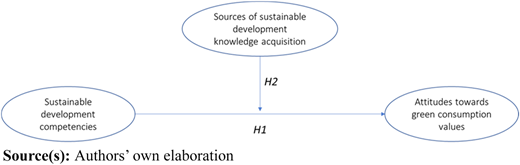
Sustainable development competencies have a positive and significant impact on Generation Z’s attitudes toward green consumption values.
Sources of sustainable development knowledge acquisition
Scholars have found that lacking integration of knowledge-sharing with knowledge acquisition sources negatively affects the costs of knowledge search and transfer, and reduces the efficiency of knowledge-sharing processes (Liu & Liu, 2008). MacDonald et al. (2020) reached similar conclusions and emphasized the importance of information seeking and information sources as competencies necessary to expand knowledge on sustainable development issues and topics. We may find further support for these arguments, as scholars have suggested that a rise in consumer knowledge about a product, resulting from the influence of appropriate knowledge sources, influences the understanding of the product’s nature and reduces the influence of social norms (White, Habib, & Hardisty, 2019). Berki-Kiss and Menrad (2022) drew similar conclusions. They show that research on green purchasing behavior suggests the importance of specific consumer knowledge about intentions and final behavior.
Scholars have confirmed the influence of various institutions on the systematic acquisition of knowledge in sustainable development, i.e. schools, media, ministries, associations, businesses, local governments, universities, and governments (Nikolic, Vukic, Maletaski, & Andevski, 2020). Although Althaus (2012) suggests that to fulfill the role of an informed citizen, one must learn about politics and current events, it would be difficult to expect Generation Z to only enter the labor market and acquire knowledge about social phenomena (de Boer & Bordoloi, 2022) and be aware of all the complexities of politics at the level of regions, states, or more broadly, economic communities. Therefore, assuming the limited real potential of Generation Z to evaluate the influence of entities from the macro-environment, we focused on entities from the meso- and micro-environment that are sources of knowledge acquisition on sustainable development (Szymkowiak, Melović, Dabić, Jeganathan, & Kundi, 2021; Laor & Galily, 2022; Kagan & Lissitsa, 2023): (1) family, (2) school/university; (3) traditional media (television, radio, newspapers); (4) websites; (5) social networks, and (6) friends.
Gong et al. (2021) demonstrate the importance of family. They suggest that parents exert a profound influence on children in the process of ecological socialization and that parents’ ecological consumption behavior may play a critical role in transmitting green consumption values to children. Presumably, higher education institutions are essential to execute the international 2030 Agenda for Sustainable Development at the national level (Elmassah, Biltagy, & Gamal, 2020). Universities can promote the integration of different knowledge categories. The education for sustainable development aims to support students in their personal, professional, and economic lives (Nikolic et al., 2020). Scholars argue that universities should lead the overall sustainable development movement by instilling common values and beliefs among students and spreading knowledge (Tang, 2018). Biasutti and Frate also suggest that education is the main channel for disseminating sustainable development principles. Caldana et al. (2021) extend these conclusions. They suggest that educating students who are well-versed in sustainable development issues and systematically introducing sustainable development into educational systems is an appropriate strategy for universities interested in promoting sustainable development. Recognizing the limited impact of readership and the declining audience of traditional news media, the growing importance of acquiring knowledge from social networking sites has been demonstrated, as the Internet are the second most important source of news for citizens and the first source of information for the young people (Boukes, 2019). Szymkowiak et al. (2021) found that members of GenZ are more likely to choose learning through mobile apps and video content than traditional forms. Although families can strongly influence environmental awareness, friends rank last among the factors influencing young people’s opinions on sustainable development (Nikolic et al., 2020). Therefore, we hypothesized:
Sources of sustainable development knowledge acquisition moderate the relationship between sustainable development competencies and the attitudes of Generation Z toward green consumption values
Figure 1 presents a conceptual model with the formulated hypotheses.
Methods
As a basic survey method, we used computer-assisted web interviews (CAWI) with a standardized method developed by Haws et al. (2013). We also referred to the five pillars of the 2030 Agenda (UNHQ, 2015) and proposed a scale to measure the sources of sustainable development knowledge acquisition based on the reconstruction of the literature and the discussion of the expert panel. Using a five-point Likert scale, we measured the scales of this study: “1 = Not at all; Very strongly disagree” to “5 = Frequently, if not always; Very strongly agree.” Below, we describe, the individual parts of the questionnaire.
Measurement scales
Participants assessed the sustainable development competencies (denoted as A7) using a 5-item scale based on the five pillars of the 2030 Agenda, i.e. people, prosperity, planet, partnership, and peace (UNHQ, 2015).
Participants also assessed attitudes toward green consumption values (denoted as C1) using a scale developed by Haws et al. (2013).
Participants rated sources of sustainable development knowledge acquisition (denoted as A4) using a 6-item scale (family, school, traditional media (TV, radio, newspapers), websites, social networks, friends). We did not find a scale that would allow us to assess the sources of sustainable development knowledge acquisition. Therefore, we offered a list of 8 sources of sustainable development knowledge acquisition based on the literature review. This list was reviewed by a purposively selected group of 30 experts, including 10 students, 10 representatives of business practitioners involved in CSR, and 10 academic community experts in communication and CSR. After the recommendation, regarding the removal of two factors from the macroenvironment, we identified six factors related to the meso- and microenvironment. Sample items were “I acquire knowledge about sustainable development from my family,” “I acquire knowledge about sustainable development from school.”
Sampling and respondent profile
We collected the survey data from students at two Polish public universities, i.e. the Nicolaus Copernicus University in Toruń and the Poznań University of Economics. The Nicolaus Copernicus University in Toruń is a research university with a broad scientific and research profile that educates students in 80 fields of study. The Poznań University of Economics and Business is a university with an economic and business profile that educates students in 14 fields of study. Both universities emphasize social responsibility and sustainable development in their strategies, and the curricula of both universities, especially in the fields of economics and business, include subjects related to sustainability and green values.
We chose Polish universities because Poland was ranked last in the EU Green Index in 2022 (Helak, 2022). Although ongoing research showed that issues of sustainability and corporate social responsibility are concepts present in public discourse in Poland (Kudłak, 2020; Matuszak & Różańska, 2020; Cierniak-Emerych, Mazur-Wierzbicka, & Rojek-Nowosielska, 2021), scholars draw attention to the limited propensity of Polish companies to undertake socially responsible activities (Halaburda & Bernaciak, 2020). Kudłak (2020) notes that Polish companies focus their efforts primarily on supporting community development, improving working conditions, and protecting the environment. Doś and Pattarin (2021) suggest that Polish companies use their untapped resources to engage in social responsibility only when there is strong institutional pressure of a normative or regulatory nature. Matuszak and Różanska (2020) show that Polish entrepreneurs often understand responsibility as compliance with existing regulations, which differs from the understanding of responsibility in Western European countries. This means that sustainability issues can be socially accepted and established in Poland provided that there is long-term education to support a change in social attitudes. Therefore, we determined the relationship between Generation Z’s competence in the field of sustainable development and the value of green consumption, and how the sources of acquired knowledge about sustainability moderate this relationship.
In total, 1,570 students completed the online questionnaire. Participation was voluntary and anonymous. Participants were free to discontinue the study at any stage of the survey.
Table 1 shows the demographic information. Students from the Nicolaus Copernicus University in Toruń had a slight advantage in the sample (55.8%). Women dominated the sample (59.6%). Among them most had work experience (76.2%) and studied for a bachelor’s degree (86.6%). Although the fields of study are characterized by a certain dispersion (however, they are related to economics), the received responses from those studying management, economics, accounting, and e-business accounted for almost 2/3 of all responses (60.9%).
Results
Measurement model assessment
We used structural equation modeling (SEM) for the empirical analysis. The study consisted of two phases. In the first stage, we conducted a confirmatory factor analysis (CFA) and then constructed SEM. We used the CFA model to determine how latent variables were defined and explained by observable variables (items). In turn, the structural models allowed us to determine the relationships between the latent variables and thus verify the hypotheses.
From the complete number of observations collected (1,570), we removed those with incomplete responses (115) and outliers (414). We used the Mahalanobis distance metric to identify outliers (Teo, Ting, & Chih-Chien, 2013; Hair, Hopkins, Georgia, & College, 2014). We then examined the collinearity and normality of the distributions of the analyzed factors. The study revealed that the factor indices did not show significant collinearity and did not meet the assumption of a multivariate normal distribution. Therefore, in the following step of the analysis, we estimated the CFA and SEM models using most probability with robust standard errors (MLM) and the Satorra-Bentler scaled test statistic. We evaluated the model parameters and the stochastic structure using R software.
We based the research procedure on the assumption that the measurement model (CFA) meets the requirements of reliability, validity, and measures’ consistency. To meet these criteria, it was necessary to change the item number for the latent variables. Table 2 shows the results of the measures of construct validity and goodness of fit of the CFA. Furthermore, Table 2 shows the correlation coefficients between the latent variables below the main diagonal.
As Table 2 shows, all the constructs had Cronbach’s alpha values above 0.79 and CR values above 0.818. This indicates the consistency and high reliability of the items within each proposed construct. Furthermore, the average variance extracted (AVE) values were smaller compared to the composite reliability (CR) values and exceeded 0.5. This indicates that the items assigned to a particular construct strongly related to other items of the same construct (convergent validity). The factor loadings, which determine the direct effect of the latent variables on the items, were statistically significant and indicated a robust fit of the model components. The standardized factor loadings were consistently greater than 0.753 (except for friends (A4_6)). Furthermore, the data met the Fornell-Larcker criterion (Hair, Ringle, & Sarstedt, 2011; Hair et al., 2014).
We used several evaluation methods to assess the goodness of fit of the measurement model, including the χ2 test, selected comparison indices, and general fit measures. Although the result of the χ2 test did not meet the desired criteria (requiring rejection of the null hypothesis), the standardized χ2 (i.e. χ2/df < 3) provided a satisfactory result. Moreover, the selected comparison indices (CFI, TLI, and GFI) were all above 0.98 and the general fit measures remained below 0.05. These values indicate an acceptable fit. The results confirmed that the selected items explain the latent variables well, thus confirming their suitability for evaluating the formulated hypotheses (H1, H2).
Hypothesis testing
The analysis confirmed both hypotheses (Tables 3 and 4). We examined the impact of sustainable development competencies (A7) on attitudes toward green consumption values (C1) by applying SEM (Table 3).
The goodness of fit indicators that we obtained through the SEM model were satisfactory. The CFI, TLI, and GFI measures were more than 0.986. The RMSEA and SRMR were both lower than 0.05, indicating a very good fit.
The connection between sustainable development competencies (A7) and attitudes toward green consumption values (C1) was significant (β = 0.509, Std. Err = 0.036, t-statistic = 14.295, p-value = 0.000). Thus, we accepted Hypothesis 1. As sustainable development competencies increase, so do attitudes toward green consumption values.
Assuming a 6% significance level, the interaction term between sources of sustainable development knowledge acquisition and sustainable development competencies (A4*A7) was significant and positive (β = 0.036, Std. Err = 0.019, t-statistic = 1.898, p-value = 0.058). This means that sources of sustainable development knowledge acquisition (A4) exert a positive and significant moderating effect on the relationship between sustainable development competencies (A7) and attitudes toward green consumption values (C1).
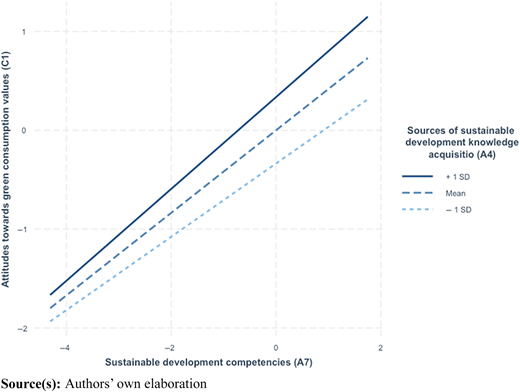
The results in Table 4 demonstrate that the simple effect of sustainable development competencies on attitudes toward green consumption values was 0.419. This could mean that the relationship between sustainable development competencies (A7) and attitudes toward green consumption values (C1) was 0.419 for an average level of sources of sustainable development knowledge acquisition (A4). Figure 2 shows such a relationship as the middle line (dashed line in Figure 2). Another 2 lines show the relationship between sustainable development competencies (A7) and attitudes toward green consumption values (C1) for low and high levels of the moderator construct sources of sustainable development knowledge acquisition (A4). A low level of sources of sustainable development knowledge acquisition (A4) is one standard deviation unit below its average (dotted line in Figure 2). In comparison, a high level of sources of sustainable development knowledge acquisition (A4) was one standard deviation unit above its average (straight line in Figure 2). The relationship between sustainable development competencies (A7) and attitudes toward green consumption values (C1) was positive for all three lines, as indicated by their positive slopes. Thus, higher levels of sustainable development competencies (A7) are associated with higher levels of attitudes toward green consumption values (C1). As long as a positive moderating effect was (β = 0.036, p-value = 0.058), the slope of the high moderating line was slightly steeper. That is, the relationship between sustainable development competencies (A7) and attitudes toward green consumption values (C1) becomes slightly stronger with high(er) levels of sources of sustainable development knowledge acquisition (A4). The slope was flatter for low(er) sources of sustainable development knowledge acquisition, as shown in Figure 2. Thus, with low(er) levels of the moderator construct sources of sustainable development knowledge acquisition (A4), the relationship between sustainable development competencies (A7) and attitudes toward green consumption values (C1) becomes weaker.
Discussion
While the literature highlights the growing importance of the green consumption values phenomenon, the relationship between Generation Z’s sustainable development competencies and green consumption values has been understudied, because scholars have discussed the two constructs separately (Barth et al., 2007; Kautish et al., 2020; Kyburz-Graber, 2015; Gong et al., 2021). To fill this gap, we aimed to enrich the current research on how Generation Z’s sustainable development competencies shape their attitudes toward green consumption and to determine whether sources of sustainable development knowledge acquisition moderate this relationship.
Specifically, we examined the factors that influence attitudes toward green consumption values among Generation Z consumers. Using CB-SEM analysis, we found that Generation Z sustainability competencies have a significant positive impact on attitudes toward green consumption values. Our results are consistent with Schank and Rieckmann’s findings (2019), which indicate the need to change attitudes through the development of competencies that should enable active and responsible participation in global sustainability. Furthermore, our findings reinforce previous research showing links between generativity, green consumption, and purchasing behavior (Sheth et al., 2011). This suggests the influence of green consumption values and orientations on sustainable and green consumption (Halder et al., 2020).
The study shows that the sources of sustainable development knowledge acquisition for Generation Z can play a key role in the transfer of sustainable development competencies and are essential for building attitudes toward green consumption values. In fact, the more diverse the sources of sustainable development knowledge acquisition, the stronger the relationship between sustainable development competencies and attitudes toward green consumption values. This observation suggests that the key to success in building attitudes toward green consumption values is to guarantee that Generation Z representatives have the right information delivered through the right knowledge channels. This finding is consistent with the findings of MacDonald et al. (2020), who emphasize the significance of information seeking and information sources as competencies necessary to increase knowledge of sustainability issues and topics. Our findings are also consistent with those of Nikolic et al. (2020), who indicate the influence of different actors on the systematic acquisition of sustainability knowledge.
Theoretical implications
This study advanced the current understanding of attitudes towards green consumption values and sustainable development skills in four key areas. First, the study offered and tested a model for building attitudes toward green consumption values through sustainable development competencies. The identified model proved to have good consistency and explanatory power, indicating that sustainable development competencies can be considered as a basis for shaping attitudes toward green consumption values. Second, we explored the sources of sustainable development knowledge acquisition as a moderating variable to determine how attitudes toward green consumption values enable the evolution of sustainable development competencies. This study suggests that providing adequate access to knowledge influences attitudes toward green consumption values. In doing so, we must note that the literature on sustainable development literacy has not yet paid sufficient attention to the study of sources of sustainable development knowledge acquisition, especially in the context of attitudes toward green consumption values. Third, we recognized the significance of diversifying the sources of sustainable development knowledge acquisition, which opens up new areas of research as it provides a starting point for seeking answers about the optimal consumption values from the point of view of attitudes toward green and arrangement of sources of sustainable development knowledge acquisition. Fourth, although the literature indicates that we can consider the issue of attitudes toward green consumption values an intensively explored area of research, we must note that previously conducted studies have not considered the specificity of Generation Z, which is now entering the labor market. Thus, there are apparently still gaps in the current knowledge and understanding of Generation Z behavior.
Practical and societal implications
Regarding practical and societal implications, the study provided some insights into two particular lesser-known issues. First, the key to increasing attitudes toward green consumption values among Generation Z is to provide access to sources of sustainable development knowledge acquisition. Adequate information support generated by sources of sustainable development knowledge acquisition can help shape attitudes toward green consumption values that translate into appropriate purchasing decisions. The results of our research suggest that the most effective sources of acquiring knowledge on sustainability are the Internet, schools, and social networks. Meanwhile traditional media (TV, radio and newspapers), family, and friends display much lower effectiveness. This observation enables the formulation of an appropriate set of strategies for engaging with representatives of Generation Z. Second, the survey results indicate the significance of diversifying sources of sustainable development knowledge. Although the results suggest that Generation Z’s sustainable development competencies influence attitudes toward green consumption values, they allowed us to note that the effects are much greater when using a variety of sources of sustainable development knowledge acquisition. Thus, it is desirable not only to communicate about sustainable development but also to tailor the sources of sustainable development knowledge acquisition to the audience’s expectations.
Conclusions
We can draw three important conclusions from this study. First, sustainability development competencies have a positive and significant impact on Generation Z’s attitudes toward green consumption values. Second, sources of sustainability knowledge acquisition acted as a moderating variable in the relationship between sustainability literacy and Generation Z’s attitudes toward green consumption values. Third, the research highlighted the importance of using diverse sources of sustainability knowledge to shape Generation Z’s attitudes toward green consumption values.
This study has several limitations that could suggest future research directions. Although the research sample was large, the respondents were business students knowledgeable about the concept of value. Thus, it is impossible to generalize the results to the entire population of Gen Z individuals. It could be interesting to relate the results to the assessment of students in the humanities, medicine, and science, which would provide more complete insight into Gen Z’s approach to attitudes toward green consumption. Second, shaping sustainable development competencies is a long-term activity. However, we conducted a cross-sectional survey that examined participants’ responses at one point in time. Therefore, it would be worthwhile to continue the study and examine how the cumulative effect of shaping competencies affects attitudes toward green consumption values. Third, the evaluation focused on identifying the moderating role of sources of sustainable development knowledge acquisition on the relationship between Generation Z sustainable development competencies and attitudes toward green consumption. Moreover, the research did not address the very important issue of the effectiveness of using individual sources of sustainable development knowledge acquisition in shaping attitudes toward green consumption. Therefore, future research could explore which sources of sustainable development knowledge have the most impact on shaping effective attitudes toward green consumption.
Funding: This work was supported by an internal grant from the Poznań University of Economics and Business “Perception of the greenwashing phenomenon: The perspective of employees and consumers”.