This paper examines the integration of artificial intelligence (AI) in higher education to prepare graduates for an evolving digital landscape and future labour market demands, with specific reference to the Caribbean context.
The study adopts a mixed-methods approach, combining desk-based literature review with quantitative analysis of data from the innovation, firm performance and gender (IFPG) survey, which covers 1,979 firms across 13 Caribbean countries.
AI is shown to enhance teaching, learning and administrative efficiency through personalized learning systems, analytical tools and automation. However, adoption varies significantly across countries, sectors and firm sizes, with larger firms leading in uptake. The findings highlight the growing demand for AI-related skills and the need for curriculum reform to align education with labour market needs.
The study relies on secondary data and survey evidence, which may not fully capture the rapidly evolving AI trends. Nonetheless, it provides a strong empirical basis for further research on AI integration and skills development in small island developing states.
The paper recommends curriculum innovation, faculty training, industry partnerships and investment in AI infrastructure to support effective integration in higher education institutions.
AI integration can improve access, inclusivity and learning outcomes, but requires careful attention to ethical concerns, data privacy and potential inequalities.
The study contributes Caribbean-specific evidence linking AI adoption in industry with higher education reform, offering practical insights for policymakers, educators and stakeholders.
1. Introduction
Artificial intelligence (AI) enables machines to perform tasks requiring human intelligence, such as reasoning, learning and decision-making (Patel & Kore, 2020). Recent AI advancements are revolutionizing industries such as manufacturing, healthcare, business and education (Mungoli, 2023). In higher education, AI can enhance teaching, improve student outcomes and streamline administration but raises ethical concerns and job displacement risks (Makridakis, 2017). The rise of AI necessitates redefining educational frameworks to prepare graduates for the digital landscape (Grubaugh & Levitt, 2023). The innovation, firm performance and gender (IFPG) survey [1] highlights the need for AI skills and calls for policies in curriculum development, faculty training, industry partnerships and infrastructure investment to integrate AI into higher education and prepare a skilled workforce (Al Samman, 2024).
This study explores the integration of AI into higher education to equip graduates with essential skills for the digital landscape and future job market demands. Using insights from artificial intelligence in education (AIEd) (Tahir, Hassan, & Shagoo, 2024) and data from the IFPG survey across 13 Caribbean countries, the paper examines how educators and graduates can effectively use these modern tools. It highlights AI's transformative impact on higher education, enhancing student engagement, personalized learning and administrative efficiency. The research traces AI's evolution in education, from abstract concepts to practical applications and the reshaping of teaching and administration. The paper discusses AI's roles in higher education, including AI-driven learning platforms, student assessment analytics and automated systems, showing the positive impacts on learning outcomes and workflows. Additionally, IFPG survey data reveals AI adoption levels in two industrial sectors and its implications for education and AI-driven jobs in the Caribbean.
Despite advancements in AI and its applications, challenges in seamless AI integration persist, raising issues such as faculty capacity, curriculum development and ethical considerations (Rizvi, 2023). To address these challenges, the paper proposes effective AI integration strategies, stressing the importance of funding AI research and development (R&D), facilitating collaboration between educators and AI experts and integrating AI concepts across diverse academic disciplines. This research serves as a comprehensive resource for educators, employers and other stakeholders in higher education, advocating for AI incorporation into education systems to meet the evolving demands of the digital era. The findings emphasize the positive effects of combining AI with education, individualized learning and effective administration. Drawing from the IFPG survey, which highlights varying AI adoption rates across Caribbean countries and sectors, the study addresses this by suggesting practical integration strategies.
This paper examines how artificial intelligence (AI) is changing higher education. It starts by summarizing key findings from previous studies on AI's development and its role in academia, highlighting the pros and cons for teaching and learning. The paper then describes the research methods used. Next, it looks at the skills students will need for jobs in an AI-driven world. It also discusses results from the IFPG survey, which provide insights into how different sectors and companies of various sizes are adopting AI. The second-to-last section considers how AI can be integrated into university courses, drawing on lessons from past research, current educational trends and the IFPG survey data. The paper ends with recommendations for policies that could overcome obstacles, spark innovation and encourage collaboration between educators, researchers and the business community. The conclusion recaps the main points and suggests areas for further study.
2. Theoretical framework
This study interprets Caribbean faculty adoption of AI through the technology acceptance model (TAM) and its well-validated extension, TAM2. TAM proposes that an educator's decision to use a tool rests on two tightly linked cognitions. First, perceived usefulness (PU) is the belief that AI will enhance teaching, research, or administrative performance; decades of empirical work show PU to be the single strongest predictor of behavioural intention (Davis, 1989; Holden & Rada, 2011). Second, perceived ease of use (PEOU) captures the effort educators expect to expend; easier tools feel more useful because cognitive resources shift from troubleshooting to pedagogy (Teo, 2011).
TAM2 broadens this core, arguing that those beliefs crystallize within powerful social and organizational currents (Venkatesh & Davis, 2000). Subjective norm – the sense that respected colleagues or supervisors expect AI use – and image – the status conferred on early adopters – shape PU by signalling career and reputational pay-offs. Parallel “cognitive-instrumental” cues such as job relevance, output quality and result demonstrability connect AI directly to an educator's day-to-day responsibilities. Meta-analyses confirm that these contextual levers are especially salient where resources are scarce and risk tolerance is low (King & He, 2006; Tarhini, Hone, and Liu, 2015).
In the Caribbean, three macro-variables channel those TAM2 forces down to the faculty level. Institutional support – stable broadband, help desks and leadership funding – lowers PEOU by reducing technical friction and simultaneously signals the tool's importance, inflating PU. Training and professional-development opportunities build computer self-efficacy; as educators master AI interfaces, perceived complexity shrinks and usefulness becomes more visible. Finally, policy mandates – from curriculum standards to performance appraisals – embed AI in core academic duties, heightening job relevance and forging a compelling subjective norm to adopt. Taken together, the extended TAM offers a parsimonious yet context-sensitive lens for interpreting our mixed-methods findings: it links the Caribbean's institutional realities to the micro-cognitions that ultimately decide whether AI tools diffuse or pause.
3. Review of the literature
3.1 The role of AI in higher education
The historical development of AI in higher education has been marked by significant milestones and evolving applications. AI was coined in 1956, and since then, AI has undergone constant development, with its application in education increasing dramatically over the years (Sanabria-Navaro et al., 2023). The field of AIEd has been the subject of academic research for over 30 years, combining interdisciplinary AI and learning sciences to create adaptive learning environments and flexible tools (Hamal, El Faddouli, Harouni, & Lu, 2022). According to Chiu, Xia, Zhou, Chai, and Cheng (2023), the initial phase of AIEd, spanning from 1970 to the mid-1990s, was characterized by pioneering explorations and the formation of a cohesive research community, which later fragmented into various sub-communities. AI in higher education has seen a dramatic increase, especially in the last two decades. This has been accompanied by a significant rise in research output and interdisciplinary studies involving computer science, engineering and the social sciences. AI technologies such as machine learning, biometric recognition and virtual reality have fundamentally transformed educational methods, management and learning processes. This has led to more personalized and efficient learning experiences.
AI's historical influences on Higher education range from being a catalyst for reform-oriented policies to shaping educational frameworks that capitalize on its necessity, affordances and effectiveness in higher education. For example, in Serbia and Romania, educational reforms and the introduction of advancing technologies have been driven by EU policies to meet market demands and increase digital competencies (Bucea-Manea-Ţoniş et al., 2022). Chan and Hu (2023) outline the AI Ecological Education Policy Framework proposed in Hong Kong, which addresses the multifaceted implications of AI integration in university teaching and learning, focussing on the pedagogical, governance and operational perspectives.
Over the past 50 years, AI studies in education have identified key research themes such as adaptive learning, deep learning algorithms and educational human-AI interaction, while also highlighting the often-overlooked area of ethics (Akgun & Greenhow, 2022). Over these decades, AI has transitioned from theoretical constructs to practical tools, influencing various educational paradigms. Williamson and Eynon (2020) noted that in recent years, AI has become integral to higher education, addressing the Sustainable Development Goals (SDGs) by prompting inclusive and equitable quality education through innovative teaching and learning approaches. As Guleria, Krishan, Sharma, and Kanchan (2023) opined, the most recent rapid advancement of AI, exemplified by tools like ChatGPT, has raised ethical concerns, particularly regarding scientific fraud and academic authenticity. Nonetheless, the historical trajectory underscores the transformative impact of AI on higher education, driven by technological advancements and evolving educational needs.
3.2 Benefits of artificial intelligence in higher education
AI significantly enhances student engagement in higher education by offering personalized learning experiences, adaptive assessments and real-time feedback, which cater to individual student needs and learning paces. Sušnjak, Ramaswami, and Mathrani (2022) argue that AI integration in hybrid learning environments promotes better communication and collaboration among students and instructors, making the learning process more interactive and engaging. Hasselmann and Lurkin (2023) also assert that AI applications such as intelligent tutoring systems and AI-enabled educational platforms provide customized content and instant feedback, improving learning efficiency and motivation. Additionally, AI-driven tools like ChatGPT can enhance critical thinking and knowledge transfer, although they may raise concerns about academic integrity (Almusaed, Almssad, Yitmen, & Homod, 2023). Researchers have also argued that the use of AI in project-based and competition-based courses, such as those involving AI agents in board game tournaments, introduces gamification elements that further boost student engagement and learning outcomes (Guerrero-Quiñonez, Bedoya-Flores, Mosquera-Quiñonez, Mesías-Simisterra, & Bautista-Sánchez, 2023; Lukianets & Lukianets, 2023). AI also supports inclusivity and accessibility in education by providing tailored support and resources, which is particularly beneficial for international students experiencing unique challenges, thus improving their overall engagement (Chang, Pan, Manikandan, & Ramesh, 2022). Moreover, AI's ability to automate administrative tasks allows educators to focus more on meaningful interactions with students, enhancing the overall educational experience (Küçüküstel, 2022).
AI has been instrumental in grading and assessment, freeing educators to concentrate on providing quality instruction and developing curricula. This affords what is coined “teaching-facing” AI (Tan, 2023) in higher education. Teaching-facing AIEd refers to the application of AI technologies to support and enhance educators' roles and responsibilities. This includes automating routine tasks such as grading and providing prompt feedback on student progress. This can significantly reduce teachers' administrative burden and allow them to focus more on personalized instruction and student engagement.
AI implementation in higher education has led to more efficient, adaptive and effective educational models, as evidenced by the development of AI-assisted integrated teaching–learning frameworks (Hasselmann & Lurkin, 2023). However, it is crucial to address ethical and privacy concerns, ensuring transparency, fairness and student data protection to maximize AI benefits in education. AI's role in higher education is transformative, significantly improving student engagement through personalized, interactive and efficient learning experiences. AI's implementation in higher education has led to significant improvements in access, personalization, efficiency, skill acquisition and administrative processes. In addition, it prepares students for future workforce demands.
3.3 Integration of AI in higher education: challenges and opportunities
There are several challenges associated with integrating AI into higher education, including faculty development, curriculum development and ethical issues. According to Slimi and Carballido (2023), faculty development is hindered by educators having to acquire relevant skills and adapt to AI-driven tools, which can represent a major shift from traditional teaching methods. To prepare faculty members for this transition, comprehensive training programs are needed (Rizvi, 2023). Curriculum development also faces challenges since AI must be integrated in a way that enhances learning without compromising quality. As part of this process, AI-specific courses must be created and AI tools must be integrated into existing curricula, which requires a thorough understanding of AI's capabilities and limitations (Popenici et al., 2023). According to Ma and Jiang (2023), ethical considerations are paramount, as AIEd raises concerns about biased algorithms, data privacy and the displacement of human educators. A critical component of mitigating these risks is ensuring that AI systems are transparent and accountable (Slimi and Carballido, 2023), protecting vulnerable student populations from biases and inequities. To prevent alienation from students' personalities and bridge the digital divide, AI's ethical implications must also be addressed. To navigate these challenges responsibly, institutions need to develop robust ethical frameworks and data governance policies. This could exacerbate existing educational inequalities. In general, AI integration requires a balanced approach that takes into account faculty development, curriculum innovation and ethical considerations. In this way, the benefits of AI technology can be maximized while risks can be minimized.
4. Methodology
This study uses desk research and quantitative data from the IFPG survey. It began with a comprehensive review of academic journals and books on AI in higher education (Popenici, Catalano, Mestic, & Ani-Rus, 2023), systematically searching key databases for relevant scholarly articles. The IFPG survey data provides empirical evidence on AI adoption barriers and challenges across firms in various Caribbean countries and sectors (Bharadiya, 2023). This combined methodology enabled a thorough synthesis of existing knowledge, identification of literature gaps and generation of valuable insights for the research.
5. Strategies for effective AI integration in higher education
A range of studies have explored the potential of AI in higher education, highlighting its ability to enhance learning, research and administrative processes (Tarisayi, 2023). In the area of funding research and development, a multifaceted approach is essential for effectively funding R&D in AI within educational institutions. Tarisayi (2023) emphasizes the need for dedicated funding schemes designed to support both fundamental research and practical deployment of AI technologies in education. Engaging various external stakeholders, such as government agencies, industry partners and philanthropic organizations, is vital for securing financial support (Vest, 2006). Such collaboration not only offers financial assistance but also creates a dynamic ecosystem for knowledge transfer and skill-sharing. Aligning AI-focused projects with national and industry priorities requires collaborative efforts among stakeholders, emphasizing responsible AI development (Hadley, 2022). Educational institutions can attract funding by strategically positioning themselves and leveraging relationships with philanthropic organizations dedicated to technological innovation in education (Bonaminio et al., 2020). Advancing AI research in education also necessitates interdisciplinary collaboration, drawing on expertise from various fields to address the multifaceted nature of AI applications (Hoppe, Verdejo, & Kay, 2003; Looi, McCalla, & Bredeweg, 2005).
Mohammed et al. (2020) discuss the necessity of a pivotal strategy for integrating AI into higher education, emphasizing the importance of establishing collaborative platforms that facilitate communication between educators and AI experts. These platforms enable seamless knowledge exchange, allowing educators to learn about AI technologies and AI specialists to understand the educational context. This symbiotic relationship enhances both fields (Kandlhofer, Steinbauer, Hirschmugl-Gaisch, & Huber, 2016; Looi et al., 2005). AIEd offers both promise and peril, enriching education while raising ethical and practical issues (Lampou, 2023; Rizvi, 2023). Addressing these challenges requires collaboration among educators, AI experts and industry professionals (Mills & Shelly, 1996). This approach ensures responsible and effective AI use, developing solutions that are feasible and responsive to educational needs (Timmons et al., 2010). Ongoing professional development for educators is crucial. Workshops, training sessions and conferences keep educators updated on AI advancements, enabling mutual learning and enabling effective integration of AI into pedagogical practices (Zhao & Liu, 2019).
To effectively infuse AI concepts across academic disciplines, a comprehensive approach is essential. This includes integrating AI concepts into existing courses, enabling students from various fields to gain foundational AI knowledge and its applications (Allen, McGough, & Devlin, 2021). Additionally, developing specialized AI courses and interdisciplinary programs offers deeper insights into AI technologies and their specific applications within different disciplines (Eaton, 2017; Mishra & Siy, 2020). Creating interdisciplinary programs encourages collaboration and a holistic understanding of AI among students from diverse backgrounds (Russell & Markov, 2009; Bennett, 2017). Furthermore, establishing AI competency frameworks ensures that students acquire essential AI skills throughout their academic journey. These frameworks guide educational institutions in structuring AI curricula to align with industry needs, equipping students with the knowledge and skills required for the evolving job market (Lau, Bonilla, & Gárate, 2019; Danyluk & Buck, 2019; Radermacher & Walia, 2013).
6. Impact on the future labour market
AI is reshaping the future labour market, creating both opportunities and challenges across various sectors. While AI technologies enhance efficiency and automation, they also pose the risk of displacing workers (Shaukat et al., 2020; West, 2018; Frank et al., 2019). Proactive strategies are needed to align workers' skills with the new technological landscape. McCURDY (1989) emphasizes matching the skills of displaced workers with those required by new jobs, while Sorgner (2017) notes that job automation can lead to more self-employment in less automatable fields. As AI takes over routine tasks, human skills like critical thinking, creativity, emotional intelligence and complex problem-solving become increasingly important (Tiwari & Srivastava, 2020; Huang, Rust, & Maksimovic, 2019). The evolving nature of work demands that educational systems adapt accordingly. Additionally, AI's impact should be viewed in terms of new job opportunities, including roles in ethical AI governance (Görmüş, 2019; Khatri, Pandey, & Penkar, 2020). Educational institutions must align curricula with industry needs, emphasizing both technical skills and human-centric qualities (Dec et al., 2022; Ma & Siau, 2019; Eaton, 2017; Mishra & Siy, 2020).
A key challenge for higher education today is integrating AI into curricula and pedagogy to prepare graduates for the modern workforce. Dwivedi et al. (2021) emphasize the critical importance of AI skills due to its transformative impact across sectors. AI's rapid advancement and diverse applications enhance education quality and efficiency. Chen, Chen, and Lin (2020) show that AI technologies stimulate student engagement by providing personalized learning experiences, while Gkrimpizi, Peristeras, and Magnisalis (2023) demonstrate how AI enables adaptive learning environments with customized feedback and guidance.
AI integration in education also addresses academic challenges like faculty capacity and curriculum development. Lampou (2023) suggests AI-powered tools help educators manage large classes and develop dynamic curricula aligned with industry needs. However, ethical issues such as biases and privacy risks, as noted by Zaman (2023) and Tiwari (2023), must be addressed. Effective AI integration requires interdisciplinary collaboration and investment in R&D. Partnerships between educators and AI experts, as advocated by McCardle (2002) and introducing AI concepts across fields, as emphasized by Sofia et al. (2023), prepare a workforce with the necessary AI-based skills for the future job market (Khatri et al., 2020).
6.1 Insights from the IFPG survey on the use of AI by businesses in the Caribbean
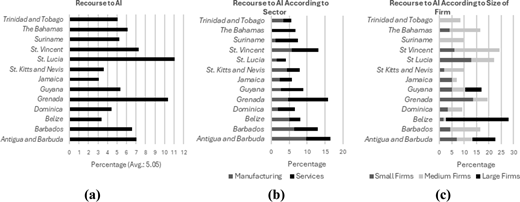
AI is increasingly being utilized across various business functions, including operations, analytics, marketing, sales, customer service and human resources (Abousaber & Abdalla, 2023). Its adoption by small and medium enterprises (SMEs) is particularly advantageous, providing opportunities for business development and a competitive edge (Bhalerao, Kumar, Kumar, & Pujari, 2022). In 2020, a survey of 1,979 firms in the manufacturing and services sectors across 13 Caribbean countries collected data on 987 variables related to various facets of business. Figure 1a illustrates AI usage levels across all surveyed firms, with St. Lucia exhibiting the highest adoption rate at 11.05%. When disaggregated by sector (Figure 1b), Grenada's services sector demonstrates the highest level of AI adoption. Notably, the services sector in most countries showed a higher AI usage rate, which aligns with the region's heavy reliance on tourism for revenue generation.
The survey data highlights significant disparities in AI integration between small, medium and large enterprises, underscoring the necessity for targeted strategies to enhance AI adoption uniformly (Figure 1c).
Large firms demonstrate the highest levels of AI adoption, with Belize leading at 25.48%, followed by Antigua and Barbuda at 18.18%. This trend suggests that larger enterprises, particularly in the manufacturing sector (Kinkel, Baumgartner, & Cherubini, 2022), are more capable of integrating advanced technologies due to their greater resources and infrastructure. Conversely, several countries, including Barbados, Dominica, Grenada, Jamaica, St Kitts and Nevis, St Vincent, Suriname and The Bahamas, report zero AI adoption in their large firms. This indicates possible structural or regulatory barriers that hinder technology uptake, which is critical for sectors like manufacturing where AI can drive significant efficiency improvements (Raj, Dwivedi, Sharma, Ana Beatriz Lopes de Sousa Jabbour, & Rajak, 2020). Medium-sized firms show varying AI adoption rates, with notable figures in Barbados (17.3%), Dominica (10.62%) and St. Vincent (13.53%). However, countries such as Grenada, Jamaica, St. Kitts and Nevis and The Bahamas report no adoption, highlighting inconsistencies which may be due to financial constraints or lack of technical expertise, both of which are critical for competitive advantage in the manufacturing sector. Small firms generally exhibit lower AI adoption rates, with notable exceptions in St. Lucia (10%) and The Bahamas (10.39%). This indicates that while small firms in the manufacturing sector can integrate AI, widespread adoption is limited, probably due to resource constraints and the lack of supportive frameworks.
7. Discussion
AI, particularly in an online format, brings advanced teaching concepts, immersive methods, a broader reach of content, diversified teaching approaches, enhanced control of teaching progress and improved efficiency (Li & Su, 2020). AI is expected to significantly enhance learning methods by integrating existing information and communication technologies, offering new opportunities for free, open and cost-efficient learning on Open Education Resource platforms (Tlili et al., 2021).
Expert systems enhance Learning Management Systems by improving interaction quality and pedagogical planning. Intelligent tutors or agents tailor the learning process to individual students by providing personalized resources, advice and feedback. Despite their benefits, these systems face challenges, including cost, scalability, privacy, ethical issues and a lack of clear, practical instructions. Machine learning systems play a crucial role in analyzing large-scale student data, creating predictive models and implementing preventive and adaptive interventions. Personalized learning systems or environments facilitate interactions, improve e-learning and offer customized learning materials. Visualizations and virtual learning environments promote collaborative learning, engagement and visual feedback, providing immersive experiences. However, these technologies must address various challenges to realize their full potential in enhancing teaching and learning outcomes in higher education.
The growing advancements of AI in the manufacturing and industrial sectors highlight the importance of preparing students for an AI-driven labour market. The IFPG survey data shows significant AI adoption among large firms, particularly in Belize and Antigua and Barbuda, emphasizing the need for higher education institutions to develop relevant skills in students. Small and medium-sized firms, however, lag in AI adoption, pointing to the necessity for targeted educational policies and support to bridge this gap. The integration of AI in higher education is driven by key trends that benefit both students and teachers (Nemorin, Vlachidis, Ayerakwa, & Andriotis, 2023). As education is increasingly recognized as a catalyst for national economic growth and development, the implementation of new technologies can be designed to serve as a tool for poverty eradication. Integrating AI into higher education necessitates a thorough assessment of AIEd technologies to ensure that high standards of ethics and safety are upheld in teaching and learning environments.
The alignment of AIEd development with SDG 4 ensures the provision of quality education (Owens, 2017). AI tools should be accessible, unbiased, compatible with all operating systems, capable of communicating with other systems, self-monitoring and assessable for functionality, performance and reliability (Dempere, Kennedy, Hesham, & Ramasamy, 2023). AI technologies offer several perceived benefits and challenges for students and teachers. Benefits include personalized and immediate learning support, writing and brainstorming assistance, research and analysis support, visual and audio multimedia support and administrative efficiency. However, challenges such as low response accuracy, privacy and ethical concerns and the need for stringent data protection measures must be addressed. Teaching and learning activities should integrate AI to enhance classroom productivity while maintaining essential human skills (Chan & Hu, 2023). Promoting quality education with AI involves addressing data ethics, algorithmic biases, gender equality and proper monitoring and evaluation of technologies (Miao, Holmes, Huang, & Zhang, 2021). AIEd's goal should consider where AI is used, by whom, how it is operationalized, at what levels and its net performance (Holmes, Persson, Chounta, Wasson, & Dimitrova, 2022).
8. Policy recommendations
To address the low AI adoption among employers despite technological advancements and a skilled workforce (Broecke, 2023), a comprehensive policy framework is essential. Recognizing the uncertainty in technological limits, stakeholders must acknowledge AI's potential to solve global challenges such as climate change, disease, poverty, malnutrition and inadequate education while facilitating unified decision-making to define AI benefits (Autor, 2022). AI applications should consider cultural and societal impacts to avoid generalization (Laitinen & Sahlgren, 2021). In education, AI should enhance cognitive learning, support collaborative knowledge construction and empower students in educational planning (Adiguzel, Kaya, & Cansu, 2023). Interdisciplinary planning, ethical AI use and supporting local AI innovations are essential (Miao et al., 2021). Ethics must be integrated into AI algorithms to ensure socially responsible responses (Chatila, Firth-Butterflied, Havens, & Karachalios, 2017; Schwab, 2017), and the AI Ecology Education Framework should align with OECD's principles for trustworthy AI (Truby, 2020).
Integrating AI and data science into educational curricula with a focus on practical applications and industry-aligned training programs is crucial. Continuous professional development for educators is necessary to keep pace with AI advancements, incorporating emerging trends and technologies. Partnerships between faculty and industry experts can bring real-world applications into the classroom, enhancing the learning experience. Investing in infrastructure such as AI labs and research centres will provide students with hands-on experience and facilitate cutting-edge research. Encouraging collaboration with local businesses on AI projects can enrich student learning and directly benefit local industries. Supporting SMEs in AI adoption through tailored programs and incentives like tax breaks is vital. Funding AI research focused on practical applications can directly benefit local industries, particularly SMEs.
Incorporating ethics and responsible AI use into educational curricula ensures that graduates understand the implications and responsibilities of AI technologies. Ethical considerations should be integrated into AI algorithms and applications to promote socially responsible responses. Enhancing data collection methods and conducting annual surveys to track AI adoption trends in education and industry will inform policy adjustments. Using survey data, such as the IFPG survey, to identify areas for improvement and success ensures policies remain relevant and effective. Implementing these recommendations will promote AI integration in higher education, preparing graduates for the evolving digital landscape and future job market demands. The IFPG survey data underscores the importance of targeted support for different firm sizes and industries, highlighting the need for tailored educational policies to bridge gaps in AI adoption. Emphasizing AI's role in enhancing education quality, efficiency and equity, while addressing ethical and practical challenges, will ensure a balanced and forward-looking approach to AI in higher education.
9. Conclusion
This study explores the challenges and opportunities of integrating AI into higher education, highlighting the experiences of institutions that have implemented AI initiatives. The findings show AI's potential to enhance teaching, learning outcomes and promote access and equity, but also point to ethical, social and technical challenges. Effective collaboration among educators, AI experts, policymakers and students is crucial to address these complexities. A central theme is the need for a holistic and strategic approach to AI integration, including curriculum reform, pedagogical innovation, professional development, infrastructure investment and stakeholder engagement. The IFPG survey underscores the varied levels of AI adoption among Caribbean firms, highlighting the importance of preparing students for the evolving technological landscape, particularly in manufacturing and services. Large firms, especially in Belize and Antigua and Barbuda, lead in AI adoption, indicating the need to support smaller firms and educational institutions.
The paper recommends actions to support AI integration in higher education, such as increased funding for AI research, scaling and evaluating AI initiatives and promoting interdisciplinary collaboration. Introducing AI concepts across disciplines is crucial for preparing students for the labour market and cultivating digital literacy. Governments must address barriers to AI adoption, especially for smaller firms, through financial incentives, technical assistance and industry-academia partnerships. In summary, AI is both a technological and educational transformation, requiring a collective and proactive response from the higher education community. By addressing challenges and leveraging AI opportunities, higher education can drive innovation, enhance productivity and support economic growth in the Caribbean.
Note
The IFPG Survey was conducted in 2020, surveying 1,979 businesses across 13 Caribbean countries and two sectors – Manufacturing and Services.