This paper examines the development and implementation of a strategic partnership between the New England Institute of Technology (NEIT) in the United States and the University College of the Cayman Islands (UCCI) in the Cayman Islands. It aims to explore how inter-institutional collaboration can create structured academic pathways that enhance workforce readiness, expand access to higher education and support national development priorities in small island jurisdictions.
This study employs a mixed-methods case study approach to examine the development of a strategic partnership between the University College of the Cayman Islands (UCCI) and the New England Institute of Technology (NEIT). Data were collected through stakeholder consultations with institutional leaders, participant observation during site visits, student engagement activities, and document analysis of memoranda of understanding, articulation agreements, curriculum plans, and policy documents. Quantitative enrollment and academic performance data were also reviewed to assess the feasibility and effectiveness of proposed academic pathways. The triangulation of qualitative and quantitative evidence provided a comprehensive understanding of the partnership development process and its outcomes.
The study finds that purposeful partnerships between higher education institutions can effectively bridge gaps in local capacity by aligning academic programs with workforce demands. The NEIT–UCCI collaboration demonstrates that structured articulation agreements, stakeholder engagement and data-informed program design can facilitate seamless student transitions, improve access to international education and reduce reliance on foreign labor. Additionally, financial support mechanisms and strong institutional alignment were critical to the partnership's success.
This paper contributes to the limited literature on North–South higher education partnerships in the Caribbean by presenting a practical, replicable framework for developing academic pathways. It offers a detailed case study that integrates conceptual modelling, stakeholder alignment and policy considerations, providing insights for institutions seeking to build sustainable, mutually beneficial collaborations in a post-pandemic and rapidly evolving global education landscape.
Institutional setting and backgrounds
The Cayman Islands
Located in the western Caribbean, the Cayman Islands consist of three islands: Grand Cayman, Cayman Brac and Little Cayman. The Cayman Islands are a self-governing British Overseas Territory. The population estimate of the Cayman Islands in 2022 was in the range of 81,000, with Caymanians accounting for 48% of that figure (www.eso.ky). This represents a significant increase from the population size in 2018 which was in the range of 65,000, with Caymanians accounting for 56% of that amount (Data Commons, n.d.). Based on these statistics, the steadily increasing expatriate community accounts for more than 50% of the population. The vast majority of the population resides on Grand Cayman in close proximity to the capital and economic center, George Town. The 2021 Caymanian Gross Development Product (GDP) per capita was $86,569 USD (Data Commons, n.d.), the second largest in North America. Between 2018 and 2022, it has remained in that range, making it consistently one of the highest in the Caribbean region. The service sector dominates the gross domestic product at a contributing rate of (91.3%). As a significant offshore financial center, insurance and financial services represent a notable GDP component of the services sector (Moody's, n.d.). It is often debated whether tourism or financial services is the main revenue generator for the Cayman Islands based on the overlap and interdependence between both sectors. According to renowned Caribbean Economist, Marla Dukharan however, “if we add the auxiliary professional services, financial services is responsible for KYD1.463 billion in exports - approaching three times the tourism sector” (Dukharan, 2024, p. 7). It is further suggested that “The Cayman Islands' flagship sector is financial services, supported by auxiliary professional services, such as legal and accounting. This sector consistently directly accounts for about one-third of GDP on average, and about one-third of Government revenue, on average” (Dukharan, 2024). At the time of this publication, Cayman remains one of the few countries in the Caribbean which customarily records annual budget surpluses and is considered a high-income country, when juxtaposed to its low- and mid-income small island developing states (SIDS) counterparts in the region (Phillip-Durham, 2024).
Rhode Island, United States of America
Rhode Island is the smallest state in the United States, but it is known for its rich history and diverse geography. The state is located in the New England region of the country and is bordered by Connecticut to the west, Massachusetts to the north and east and the Atlantic Ocean to the south. Nicknamed the “Ocean State”, Rhode Island has over 400 miles of coastline and the large bays and inlets that make up about 14% of its total area. The majority of the population resides in its major cities including Providence, the capital and hub for business, industry and culture. Rhode Island's major industries include healthcare, tourism, manufacturing, maritime industries and financial services. Rhode Island's GDP in 2021 was $60,185 (Department of Numbers, n.d.). While Rhode Island's economy is comparatively small with respect to other states, regionally, Rhode Island economically benefits from its proximity and connectivity to metropolitan Boston, Massachusetts. Facilitated by an extensive highway and commuter rail system, 13.2% of Rhode Island residents obtain employment within Massachusetts (RIDLT, 2024), the 13th largest state economy in the United States (Statista, 2024).
University College of the Cayman Islands
The University College of the Cayman Islands (UCCI) was established in 1975 and is the only public university on the island. UCCI offers academic programs at the certificate, associate's, bachelor's and master's degree levels. Core academic programs include computer science, business, natural science, education and nursing. Technical and vocational education and training (TVET) are particularly strong at UCCI. The student population is approximately 2000. UCCI has a range of programmatic accreditations including for some of its TVET Programs, Teacher Education, Nursing and Business Programs. UCCI also has Accreditation Service for International Colleges (ASIC) Accreditation and remains desirous of pursuing Southern Association of Colleges and Schools Commission on Colleges (SACSCOC) Accreditation.
New England Institute of Technology
The NEIT is located in East Greenwich, Rhode Island, USA and was established in 1940. NEIT is a private, non-profit technical university with approximately 2000 students, like UCCI. NEIT offers associate's, bachelor's, master's and doctorate degrees in various disciplines. Core academic program areas include computer science, health science, engineering, architecture and the professional building trades. NEIT is accredited by the New England Commission of Higher Education (NECHE) and maintains programmatic accreditation in over 20 majors.
Networking and partnership foundation
Partnerships in general, are based on the premise that more can be accomplished collectively rather than going it alone (Eddy, 2010). It is based on this understanding that the objective for the NEIT–UCCI partnership has been established. In the changing global labor market and higher education landscape, it remains important for institutions to remain agile and responsive to the evolving needs of the multiple interest groups, which contribute to economic growth and development. Increasingly, higher education institutions are being called upon to mediate between broad and narrow societal needs and make the strategic investments that are necessary to close any gaps where they may exist. These investments are not necessarily fiscal investments but may include partnerships and memorandum of understanding (MOU) with key stakeholders and mutual exchanges of benefits which may be leveraged to close these gaps. The current higher education nexus which has seen a depreciating value in many instances for terminal and traditional degree credentials, has signaled the need for HEIs to be more reflective and intentionally rationalize their products and services.
In a comprehensive UNESCO Report (2019), it has been stated that:
As Caribbean societies become more modernised
and knowledge-based driven, critical institutions like universities, colleges and
other TLIs, as the main producers of knowledge and builders of human capital,
must re-align their vision, institutional mission, strategic processes and policies
to enable them to act as engines of socio-economic change and innovation
and critical partners in achieving growth and sustainable development. As
such, they must be encouraged to collaborate more effectively to ensure that
peer learning and the exchange of ideas and best practices in tertiary education-
private sector engagement can be adopted or adapted to serve the particular
institution’s needs, circumstances, and ambitions.
Consequently, given the growing importance of knowledge in the 21st century,
it is imperative for a new paradigm of social and economic development to
be pursued which privileges the contribution of a strengthened, capacity-enabled,
empowered, cost effective, and streamlined tertiary education sector, as a
key catalyst or driver of the knowledge economy and society…
A similar sentiment is expressed by Beckles and Richards-Kennedy (2021, p. 363), who note that “progressive societies invest in higher education institutions to help them meet their current and anticipated workforce needs, to find innovative solutions to their most pressing development problems, to think deeply and push the frontiers of knowledge and to help craft a better future”. In the Caribbean region, however, structured and sustained funding for education at the tertiary level has had its fair share of challenges over time, calling into question policy priorities at national and regional levels and the status of a shared vision for tertiary education specifically and the role it is set to play in the creation and sustenance of knowledge-based and driven economies. Conversely, north-south collaboration in the sphere of higher education, in so far as it is not merely transactional, has the potential to yield long-term and lasting benefits that can contribute to the building of the progressive societies envisaged. By way of example, formal relationship building with international institutions such as NEIT provides an opportunity to remove traditional barriers to access, inter alia, affordability and geographic proximity and also aids in the internationalization of local universities such as UCCI, thereby increasing its attractiveness and appeal for local students.
It has been pointed out that while colleges provide a fertile ground for creating a range of collaborative efforts, many of these collaborations fail as a result of inadequate policy and administrative oversight, commitment of resources and overall challenges with structures and processes that promote success and sustainability (Eddy, 2010). In the development of the NEIT–UCCI partnership, NEIT leveraged its preexisting knowledge and network of reputable leaders within Caribbean tertiary institutions in the identification of potential partners that would be likely to ensure that structures and processes would be sufficiently robust to yield a successful outcome. That being said, prior collaboration between NEIT leadership and the (then) incoming President of UCCI who assumed his role in 2022, offered the ideal window for partnering. UCCI President Robertson's comprehensive understanding of the relationship between higher education and sustainable economic development were viewed as an essential centerpiece for collaboration by NEIT. The preparation of individuals for careers that may serve business, industry and society has traditionally been the lynchpin of the NEIT workforce readiness trajectory and with this common and current focus, the forged partnership with UCCI was not only timely but constructed upon the basis of mutual trust. In early 2023, visits were made by representatives from each institution to the other, to further explore the opportunities and challenges of a formal partnership with a focus on workforce readiness and labor assessment needs in mind. These crucial fact-finding visits laid the foundation for intercollegiate engagement in developing educational pathways from UCCI to NEIT, memorialized by a MOU, signed in 2023. To further contextualize this and provide a roadmap for easy adoption, the subsequent conceptual framework outlines how institutional strengths and gaps can be assessed, measured and adjusted within the parameters of these partnerships. This approach aims to address workforce readiness and build localized capacity, thereby reducing the reliance on the importation of foreign labor. Before turning our attention to the conceptual framework model, we present the methodology which has guided the process and structure formation in the following subsection.
Identification of stakeholders
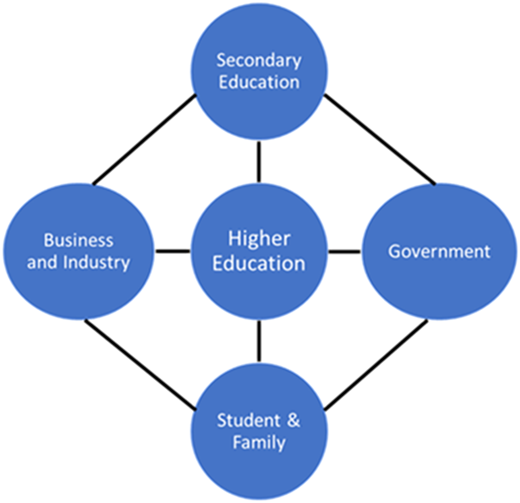
As a first step, UCCI and NEIT jointly explored the myriad stakeholders who would play a role in the new partnership. It was understood and agreed by both parties that higher education would serve as a nexus connecting industry, government, secondary education and the student (Figure 1). Each sector has its own unique interests. Business, industry and government are in constant need of a customized workforce with varying degrees of education and training. Government, relying on the tax revenue from business and industry, invests in education both at the secondary and tertiary levels to offer educational tracks that meet the national human capital requirements. The individual student ultimately seeks to participate in the national economy and experience a rewarding career both professionally and monetarily. Yet, it may be argued that only the Higher Education sector can comprehend and generate a coordinated response to the varied, but complementary demands of each stakeholder group within this context. Indeed, an important role of a national university is to formulate purposeful academic programs that enable the symbiotic relationship described above (Fredua-Kwarteng, 2021).
Understanding and aligning to workforce demands
The Caribbean has the “lowest higher education enrolment in the hemisphere…less than 25% compared with the North American average of near 60% and the Latin America average of 52%” (Beckles & Richards-Kennedy, 2021, p. 364). For a society to function properly, its educational institutions, particularly those at the post-secondary level, must provide a sustainable, skilled and educated workforce to meet the demands of business, industry, critical institutions and government (Fredua-Kwarteng, 2021). A properly skilled and educated workforce, tailored to the holistic needs of society, generally results in desirable and tangible outcomes. First and foremost is a lower(ing) unemployment rate. While the Cayman Islands boast one of the lowest unemployment rates in the Caribbean, that is, between 2% and 3.5% from 2018 to 2022, this positive rate is largely sustained by the importation of foreign labor (www.eso.ky; Dukharan, 2024; Robertson and Paul, 2023). It goes without saying that meeting national human capital needs simultaneously minimizes a dependence on foreign labor and reduces unemployment. Furthermore, educational systems that are aligned to workforce demands naturally send their graduates into the workplace where they become valued assets, suitable for long-term employment.
As the expertise and technical competence of the national workforce increases, so too, does the reliability and sustainability of critical infrastructure. The continuous operation of power supply systems, water and waste systems, transportation networks and healthcare facilities establish the underpinnings of successful developing countries. Adjacent benefits also include housing and food security, access to quality health care, a sustainable tax base and low crime rates. Within this environment, socioeconomic and political stability has the opportunity to become normative. Without this environment, opposite conditions should be expected.
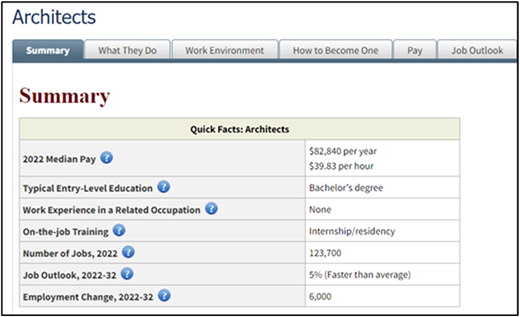
With such high stakes in play, it is necessary for institutions of higher education to understand national workforce demands. Within the United States, the US Bureau of Labor Statistics generates a number of documents that provide current and projected workforce demands. According to the Bureau, its “Occupational Employment and Wage Statistics (OEWS) programme produces employment, and wage estimates annually for approximately 830 occupations. These estimates are available for the nation as a whole, for individual states, and for metropolitan and nonmetropolitan areas; national occupational estimates for specific industries are also available”. The Bureau's Occupational Outlook Handbook (OOH) provides concise information on entry-level education and job outlook in terms of percentage and number of positions to be filled in a given 10-year period (Figure 2). This type of information from a reputable, governmental source is necessary for informing the creation or revision of academic programs.
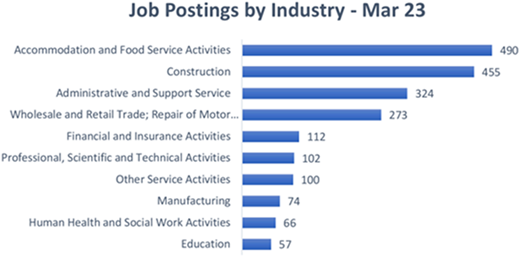
In the Cayman Islands, the Economics and Statistics Office (ESO) and the Department of Immigration via Workforce Opportunities and Residency Cayman (WORC) generate a number of documents and collate data which provide current and projected workforce demands. In 2023, UCCI collaborated with the WORC, to produce a labor market assessment report. This document provided invaluable snapshot data on current labor market demands, from which projections could be made. It should be noted that as the main Division of oversight and administration of work permits, WORC is best placed to generate and provide the relevant data required for this type of assessment. Among other key functions that fall within its remit, WORC generates monthly job postings reports that offer a leading indicator of labor demand. As shown in Figure 3, the quantitative data within these reports demonstrate and informs where investment in education may reasonably occur to meet the greatest demand. Other data sources, such as the Global Skills Report (Coursera, 2023) and Bridging Skills Gap in the Caribbean (Inter-American Development Bank, 2017) were relevant reference points for triangulation of information.
While governmental, institutional and private consultant reports offer substantial quantitative data in terms of human capital demands and can point institutions of higher education toward the continuation or creation of programs in support of these requirements, they lack specific qualitative data in the nature of individual programs. To ensure the currency and relevance of an academic programme, steps must be taken to gather what aspects of a curriculum should be added and emphasized to address the technical skill and content knowledge preferences. This information must come directly from an island's major employers within specific sectors. Examples might include the identification of digital architecture and software programs utilized by local business and service providers, programming and diagnostic tools used by local manufacturing and repair industries, or course material and clinical requirements necessary to meet accreditation requirements of a nursing degree programme. More granular in nature, this qualitative information will inform curriculum development, investment in lab facilities and retention and hiring of faculty with appropriate experience and credentials.
At both UCCI and NEIT, the institutions exercise robust outreach to the industries they support. At NEIT, each academic programme maintains a Technical Advisory Committee (TAC) composed of representatives from medium to large employers. Semi-annual meetings of the TAC include the presentation and critique of the curriculum, courses, experiential learning opportunities, material resources. UCCI maintains a similar model, whereby Advisory Boards which comprise industry leaders and experts, provide input and feedback on a quarterly basis, which informs programmatic reviews and rationalization exercises. Having identified the key stakeholders and gained an appreciation for workforce demands, the next step was to identify a conceptual framework which could be deployed to augment the foundation set in the initial stages.
Assessing institutional strengths and gaps – a conceptual framework
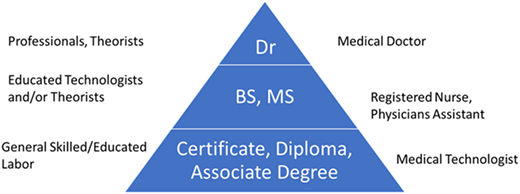
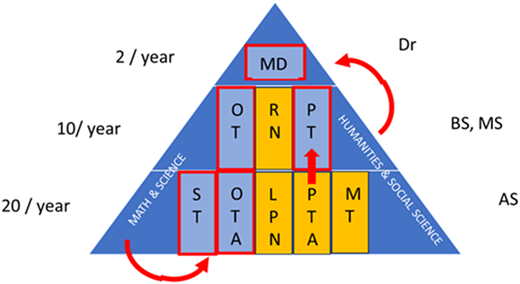
Furnished with both quantitative and qualitative data on workforce demands, institutions of higher learning can more effectively proceed to assess their current academic programme structure versus demand for graduates. A macro framework for this initiative is useful. The pyramid in Figure 4, utilized by Dr Henry Young of NEIT shows a suggested proportionality between societal workforce demand and education level in island or developing countries. At the base is general skilled/educated labor for which required educational attainment might be acquired through a certificate, diploma or associate degree programme. In the health science field, this could equate to a medical technologist or certified nursing assistant. The demand for this labor level is usually the largest. Moving up to the next higher, and narrower level of the pyramid is the more highly educated technologist or theorist. Here, the academic credential would typically be a bachelor's or master's degree. In the example shown, this could equate to a registered nurse or physician's assistant. At the pyramid's pinnacle is the professional and senior theorist. This position represents the small, but critical, demand for a few highly educated professionals. A doctorate degree is the usual academic credential for this level, although professional (terminal) degrees such as an MBA might suffice. In the foregoing illustration, this would equate to a medical doctor (MD).
Given this framework, an institution can begin to populate Young's pyramid with actual programs, illustrating pathways from lower to higher education levels. Figure 5 illustrates a notional example of the national demand for health-related employees per year, showing an assemblage of corresponding degree programs to achieve that goal, at each level of education within the pyramidal framework. The shaded programs are taken to be existing programs at a national university. Unshaded programs are not offered and thus represent educational gaps. At this point, the university must make the strategic decision to create and offer new programs to produce the human capital required by the health sector or collaborate with an overseas educational partner. Assuming financial constraints preclude the immediate construction of new facilities with expensive laboratories, hiring seasoned and properly credentialed faculty and committing resources to the accreditation standards compliance, the university will likely opt to collaborate with an overseas higher education partner.
Young's pyramid is conceptual, and exceptions certainly exist. However, for the leadership of developmental universities with limited resources, it may serve to inform where strategic investments should and should not be made. For instance, in the above health science-based example, a logical inference would direct resources toward the maintenance and expansion of academic programs (serving a broad societal need) at the national university as opposed to construction of a medical school for the training and education of doctors (serving a narrow societal need). The latter need can more efficiently and effectively be met through international partnerships and the exploration of transition points in 2 + 2 programme options.
Identification and vetting of an educational partner
It has been established that a key tenet of partnering lies in its potential to create the ultimate win-win situation (Eddy, 2010). In this case, the efforts undertaken by both institutions went beyond restoration of intercollegiate relationships but focused on the creation of new academic trajectories that serve the needs of the student, the industries served in their home country and Caymanian society as a whole. Importantly, NEIT aspired to regenerate an international population and enrich the educational and cultural experiences that are a hallmark of US institutions of higher education. While UCCI and NEIT seemed to be perfectly aligned on a programmatic basis, a deeper vetting was exercised preemptive to a formal affiliation.
The ultimate selection of a partner to fill and complete the educational pathways identified in the previous step is an exercise in comprehensive due diligence. The investment in time and resources can be significant. It should be understood that both potential educational partners will be closely examining each other to confirm that collaboration is feasible and supportive of their respective missions and strategic direction (Lundy & Ladd, 2020). With respect to the NEIT-UCCI partnership vetting process, institutional data were collected through college websites, academic ranking queries, review of policies and accreditation documents, referrals from institutional leaders outside the partnering universities and physical site visits that included campus tours and meetings with academic, government and industry stakeholders.
In these preliminary engagements, both parties sought to confirm a variety of aspects of the partnering university. These institutional characteristics include:
Academic quality
It is imperative that partnering institutions maintain accreditation status for both the institution and academic programs if applicable. For instance, it was important for NEIT to demonstrate full 10-year compliance with the New England Commission on Higher Education (NECHE), its regional accrediting body and programmatic accreditations such as the American Board of Engineering and Technology accreditation for NEIT's mechanical and electrical engineering programs. Meeting and demonstrating these nationally (and globally) accepted accreditations ensure students completing their education abroad will have a valuable and respected degree upon graduation. Similarly, UCCI's institutional accreditation through ASIC, signifies high standards of education that would promote student success once they matriculate at NEIT. While accreditation status is generally posted on the university website, recommended documents to accomplish a more thorough review included the most recent self-study reports prepared for institutional and programmatic accreditation.
Faculty
Partnering between institutions of higher education generally implies relationship building and collaboration between like academic programs of both the sending and receiving universities. The generation of articulation agreements will require faculty of both institutions to jointly analyze their respective academic programs to identify programs and course outcomes, course equivalents, competencies, general education requirements, lab skills, etc. Department chairs, specifically, will play a central role in this effort. The collaborative energy between faculties is a leading indicator of the potential success of the partnership.
Campus fit
The sending institution has a responsibility to ensure the receiving institution will be a good “fit” for their ongoing students. In other words, is the holistic campus environment of the receiving institution conducive to the success of student learning and social engagement? Campus size, geographic location, campus safety, student demographics, class size, etc. are important aspects that students may not be aware of but should be. Campus visits are valuable to confirm the physical nature of the receiving institution and allow both parties to draw conclusions on this important and sometimes nebulous characteristic. To this end, UCCI has even arranged for candidate transfer students to visit NEIT to see the campus, engage in live classes and tour the local environs.
Classrooms and laboratories
Partnering institutions should both have comparable and compatible laboratories and classrooms. Depending on the academic programs, competency building (i.e. the utilization of a software programs), may begin early in parallel with general education and theory-based courses. Ideally, there is compatibility with software programs, diagnostic tools, clinical equipment and protocols, etc. This will ease the assimilation of new students into the receiving institution and eliminate the necessity for prerequisite “bridge” courses that require completion prior to entry into an academic programme.
Programme alignment
As described earlier in the text, within the context of Young's pyramid, meaningful partnerships can be built when the academic programs of the sending and receiving institutions align. For example, it is desirable that there is a seamless transfer for a student matriculating from an associate degree at their home institution to a bachelor's degree overseas. The potential is easily assessed through an examination of college catalogs, programs documents and preliminary discussions between academic leaders (i.e. deans or the equivalent). Based upon further curriculum analysis, articulation agreements can be constructed and “bridge” courses identified that ensure all perquisites for successful continuation have been met. Other opportunities may exist to facilitate efficient and continuous matriculation such as the receiving institution offering a prerequisite course online to transfer candidates while they are still completing their foundational coursework at their home institution.
Industry and government connection
Both institutions within the partnership need to demonstrate their strong connection to business, industry and government. The interaction, sensitivity and responsiveness to regional and national workforce demands and its influence upon the content and delivery of curriculum is a hallmark of a dynamic, mission-driven and locally respected university. As discussed, a sound institution of higher education serves as the nexus between industry, business, government, secondary education and students. Both partners should be prepared to articulate that interaction and introduce their stakeholder group. Both UCCI and NEIT have toured and met the leadership of major industries which they send their graduates to, government leaders and current students during respective campus visits.
Commitment to the partnership
The evolution of the partnership manifests itself in a general sequence of steps. Initially, an introduction is made between institutional leadership, conversations ensue and a mutual belief in the benefit of engagement between institutions develops. This can occur at academic conferences, industry symposiums, or events that draw leaders of higher education together. With the UCCI–NEIT partnership, the (now) President of UCCI was an invited guest to an NEIT graduation. During his visit to Rhode Island, he toured and met representatives from the University. An outcome of the UCCI President's visit was a recommendation to explore potential academic collaborations to enable a continued educational trajectory from his institution to NEIT. The initial academic areas to consider were computer science, professional building trades, automotive technology and construction management. These areas represented sectors of the island workforce with substantial skill gaps. They also represented areas where academic programs appeared well-aligned and supportive of matriculation from certificate, diploma and associate degrees at UCCI to higher level educational credentials at NEIT.
Subsequently, both institutions engaged in a series of campus visits by select academic leadership. A detailed curriculum analysis of academic programs was conducted to the satisfaction of both institutions. A MOU between UCCI and NEIT was co-authored and signed in early 2023, enabling collaboration between the faculty of the targeted academic programs. The now formally teamed institutional faculty in the targeted academic areas mapped out a continuous curriculum pathway from UCCI to NEIT. Additionally, student and programs outcomes were confirmed, standards for transfer were established and bridge courses were identified where necessary. In sum, the outcomes of this effort were memorialized in articulation agreements, providing a definitive process and pathway for students wishing to continue their education at NEIT. The signing of the articulation agreements was celebrated at the UCCI campus in May 2023. Ongoing collateral benefits of the partnership include joint conference presentations, faculty development training and digital twinning between campuses. These events and initiatives create lasting bonds between institutions that facilitate sustainable, efficient and purposeful relationships.
Affordability
The cost of continuing one's education abroad is perhaps the greatest barrier for students (Greenberg, 2023). The monetary outlay for tuition, room and board, travel and other incidentals expenses, can be prohibitive without a substantial subsidy. This is not a problem to be faced single-handedly by the student and their family. Rather, it is imperative the financial challenge be addressed by all the stakeholders mentioned earlier. Since society at large will benefit when a local student studies abroad in a purposeful academic programme, it follows that stakeholders should be prepared to make contributions to the educational cause. If the stakeholders have been participants in the building of the intercollegiate partnership, they will clearly see the value.
In the case of the NEIT–UCCI partnership, the Caymanian Ministry of Education (MOE) was involved and invested in the educational collaboration from the early stages. NEIT officials were introduced to MOE while in the Cayman Islands, providing the opportunity to expound on the societal benefits envisioned from purposeful academic pathways to higher levels of education abroad. Caymanian MOE officials traveled to NEIT to see firsthand the facilities and faculty dedicated to the educational process, the experiential education process that is a hallmark of an NEIT education and the tight relationships that exist between NEIT and state government and regional industries. Subsequently, the generous scholarships provided by the Caymanian government were extended to students who might opt to travel overseas to study at NEIT. Understanding the benefits of a campus rich in diversity, with students from foreign countries, NEIT provided robust matching scholarships for incoming Caymanian students. Collectively, the primary academic partners decreased the cost of attending NEIT to nearly zero (Mayhew, 2023). With other international collaborations, scholarships have also been provided by industry associations (i.e. Rotary) and philanthropic groups.
There are other strategies that might be employed to reduce the cost to students. For instance, articulation agreements should be crafted to enable the maximum amount of transfer credit possible from the home country institution. This narrows the required coursework taken at the new host institution to high value experiences not available in the home country institution, shortens the stay abroad and thus decreases cost. If possible, coursework that could be taken online (at the host country university) prior to traveling also works to accomplish this financial objective. UCCI and NEIT are twinning their computer science labs to accomplish this endeavor, which also allows students begin the NEIT assimilation process before departure. The opportunity for international students to engage in paid internship or Co-Op experiences may create an opportunity to “earn while you learn” (Mayhew, 2023), not to mention the longer-term benefits of working for US industries, businesses and public institutions. These opportunities are also available to Cayman students through NEIT's Curricular Practical Training (CPT) programs.
Communicate the partnership
Extraordinary effort is expended to create solid and sustainable academic partnerships between island nations and overseas institutions of higher education. While the pathways may be well constructed and feasible, if no students take advantage of the created opportunities, all is for naught. Thus, it is crucial that the home institution generate a robust marketing campaign to raise awareness among their existing student populations that their educational trajectories can now be extended in new and exciting directions. As well, a pathway to fully credentialed, renown universities overseas via the home institution, can have a positive impact on institutional branding and recruiting new students for foundational studies.
In the Cayman Islands, UCCI planned and executed a marketing campaign that touched all modes of national media, beginning at their institutional web site. Details of the evolution of the partnership were carried on social media outlets, print media and local radio and television. These included interviews with both UCCI and NEIT officials. NEIT representatives were invited and attended a variety of college and career fairs, visited local high schools and participated in on-campus workforce development panels. In reciprocation, NEIT highlighted their partnership accomplishments on similar stateside news venues. The response was and continues to be impressive, with NEIT receiving over 20 applications for Fall 2024 enrollment from Caymanian students.
Continuous improvement
Higher education processes are inherently cyclical, revolving around the academic calendar. A central tenet to US regional accreditation standards is the requirement for the continuous improvement of those processes that impact the academic delivery and operations of a university (NECHE, 2021). The proper maintenance of MOU's, articulation agreements and other articles of collaboration with external institutions falls within the purview of such criteria. Indeed, the underlying assumptions used and codified in an MOU or articulation agreements are dynamic and must be revisited to remain current, relevant and improved whenever possible.
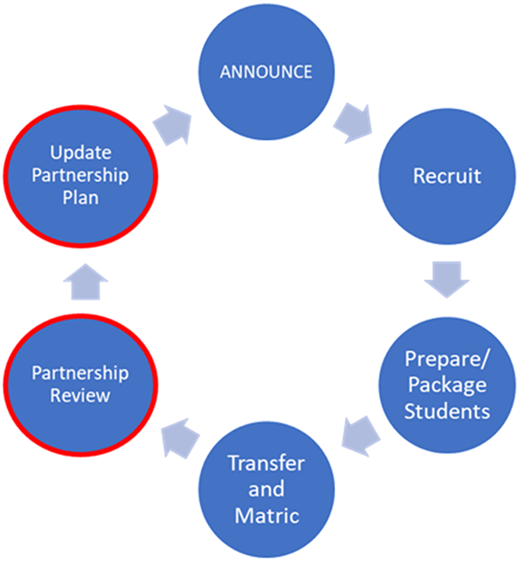
The steps for the continuous improvement of partnership plans (including all relevant documents) may follow the steps outlined in Figure 6. Typically, in late autumn, the partnership plans are reviewed with input from all stakeholder groups (usually organized as an advisory committee). Updates are proposed, reviewed and approved by the stakeholders soon thereafter. This enables a late autumn announcement of the revised plan during the traditional time when high school seniors are in the midst of their college search, or matriculating college students are beginning to contemplate continued education after the coming spring graduation. This provides adequate lead time to recruit students into the articulated pathway either as new students entering the home institution for foundational studies with an eye toward future overseas education, or graduating students from the home institution to complete college applications and scholarship requests. Transferring students are then packaged by the receiving, overseas institution (including transfer credit review, scholarship award verification, visa requirements, etc.) and ultimately begin matriculation in the late summer or early autumn. Throughout the process, data were collected on strengths and weaknesses of the process and discussed at the partnership review in the autumn; and the process repeats.
Conclusion
This paper has underscored the significance of strategic partnerships in higher education, demonstrating how collective efforts can achieve more than individual endeavors. The NEIT–UCCI partnership exemplifies this principle, highlighting the importance of agility and responsiveness in addressing the evolving needs of the global labor market and higher education landscape. As institutions strive to mediate between broad societal needs and specific economic demands, strategic investments – such as partnerships and mutual exchanges – play a crucial role in bridging gaps and fostering development.
This collaboration between NEIT and UCCI is particularly noteworthy given the challenges faced by Caribbean tertiary education institutions, including limited funding and policy support. By establishing a formal relationship with NEIT, UCCI has been able to enhance accessibility, affordability and geographic reach, thus contributing to the internationalization and appeal of local higher education, particularly as it relates to transition points for 2 + 2 programs. The conceptual framework presented in this paper demonstrates how institutional strengths and gaps can be assessed and adjusted through partnerships, ultimately promoting workforce readiness and reducing reliance on foreign labor in the Cayman Islands.
The NEIT–UCCI partnership, built on a foundation of mutual trust and a shared focus on economic development, showcases the potential for north-south collaborations to yield long-term benefits. The partnership's success is attributed to the comprehensive understanding of the relationship between higher education and economic development held by UCCI's executive leadership and NEIT's commitment to preparing individuals for careers that serve business, industry and society. This case study offers valuable insights into the processes and outcomes of effective inter-institutional partnerships, providing a replicable model for other institutions seeking to build resilient and impactful collaborations in the post-pandemic era and during the fifth industrial revolution as the implications of generative artificial intelligence and all of its entailments are contemplated by universities and employers alike.