The purpose of this study is to show how the adoption of emission-reducing but cost-inferior technologies/fuels, e.g. hydrogen, may be justified. Contributing to the debates about financial viability and acceptability of low-carbon solutions, the authors suggest an opportunity cost-based framework for corporate governance in energy-intensive industries.
The study analyses production processes heavily dependent on fossil fuels and the trade-off between environmental and financial performance. Considering emission constraints, the authors derive the relationship between output price, emission parameters and input fuel prices suggesting the acceptable conditions to deploy low-emission technologies, which are used to define hydrogen demand and sustainable corporate strategies.
The demand for hydrogen or other low-emission solutions emerges as a function of a variety of exogenous parameters and firm’s choices. It implies that decisions on emission targets or environmental stewardship are intertwined with procurement choices, shareholder/customer preferences and other corporate governance decisions defining the pace of net-zero transition.
The willingness to invest in clean technologies is interpreted within development strategies, highlighting conditions and sectors where hard-to-abate industries are likely to adopt net-zero solutions. Numerical simulations provide insights into how companies can optimize the balance between financial and environmental performance and identify suitable market environments that facilitate this transition.
This paper presents an innovative perspective on the factors underpinning adoption of low-emission technologies. Using insights from numerical simulations, the study elucidates the corporate strategy implications, providing market-driven analysis of the pathways for industrial decarbonization.
1. Introduction
Climate change, exacerbated by anthropogenic greenhouse gas emissions (GHG), has urged the public to re-evaluate their preferences and priorities (Steffen et al., 2015). The dissemination of information regarding the risks and catastrophic consequences of global warming has generated significant public pressure, compelling governments and businesses to balance financial performance and environmental needs (Jehn et al., 2022). To achieve sustainability and environmental goals, national governments and industry must play a more active role in mitigating the impacts on the natural environment. In this context, corporate governance emerges as a crucial instrument for addressing environmental challenges and supporting decisions on adopting technologies and resources to achieve long-term climate goals (Aguilera et al., 2021).
To bring a change into corporate behaviour and implement GHG emission reduction investments and strategies aimed at reducing GHG emissions, a shift away from the traditional cost-effective solutions dictated by financial objectives is in order. Justifying the deployment of “clean” or low environmental impact solutions, such as solar or wind power, requires businesses to adopt a multi-objective framework and perspective (Naciti, 2019). This transformation involves recognizing externalities and values associated with environmental protection, as demanded by shareholders and stakeholders. By incorporating environmental considerations into their decision-making processes, firms can enhance the profit-maximizing paradigm and shift to a more responsible attitude towards the natural environment, thereby fostering sustainable business models (Beckmann et al., 2014).
Balancing multiple objectives, including financial and environmental goals, presents a challenging task requiring careful deliberations and significant efforts, particularly when compared to more straightforward approaches focused on financial objectives. The financial viability of investments in “clean” technologies, such as hydrogen, which appears economically inferior, has sparked fierce debates on managing these conflicting objectives (Oehmke et al., 2023). The trade-off between financial and environmental performance is especially pronounced in energy-intensive industries heavily dependent on fossil fuel-based technologies, which are hard to substitute. As stakeholders increasingly demand environmental stewardship in these so-called “hard-to-abate” industries and governments impose regulations urging changes, producing companies receive little guidance on strategies for sustainable long-term corporate governance (Jakhar et al., 2020). This underscores the need for analysis to inform governance debates, underpin strategic developments and navigate the complexities inherent in the pursuit of sustainability.
In light of the aforementioned challenges, the aim of this paper is twofold. Firstly, we provide a framework that facilitates understanding how hard-to-abate industries can navigate their net-zero transition by substituting fossil fuels with cleaner resources, such as hydrogen while balancing their financial and environmental performance. Secondly, we apply the critical insights from production transition analysis to elucidate the integral role of governance and strategic development decisions in supporting sustainable production.
That agenda translates into a set of intertwined questions defining our research:
What roles do (voluntary or mandatory) emission allowances or emission-associated payments, such as carbon pricing, play in the production transformation decisions?
What combinations of technical and economic parameters allow for adopting clean technologies, e.g. low-carbon hydrogen?
What governance directions or strategic choices can help support the deployment and scaling of low-carbon solutions, including clean hydrogen?
Addressing the above questions, this study aims to contribute to a comprehensive understanding of the complex interplay between technical, economic, environmental and governance factors. By developing and solving a model that examines the production technology choices faced by energy-intensive industries, we identify the conditions necessary for the adoption of clean technologies. We interpret these conditions regarding procurement decisions, market choices, and other corporate activities, thereby providing new arguments and rationales to guide sustainable corporate governance. Furthermore, to ensure the practical usability and applicability of the derived insights, we complement our analytical discussion with numerical simulations that mimic hard-to-abate industries, particularly the European steel industry. The public and regulatory pressure to undertake inter-fuel substitution and technological transformation make it an exemplary case for the analysis. The simulations suggest actionable recommendations that can guide policy and corporate decision-making in the transition towards more sustainable practices.
Our study contributes to the fast-growing literature on industrial decarbonization, highlighting the imperative role of emission constraints, along with technological, economic, and social barriers in inter-fuel substitution (Bauer et al., 2015; McCollum et al., 2018; Riahi et al., 2017; Rogelj et al., 2018; Unruh, 2000; Van Vuuren et al., 2018). Recognizing the positive effect of the historically dominant yet environmentally detrimental fossil energy resources, namely natural gas, oil and coal, on industrial production and economic growth, studies search for feasible pathways to reduce emissions and manage climate change (Coulon, 2021; European Commission, 2022; GCAP UNFCCC, 2025; Group of Seven, 2021; IEA, 2021; IPCC, 2018, 2021; UNFCCC, 2016, 2020). However, the commercial viability of technically feasible net-zero technology alternatives often remains a challenge, leading companies across various industries to cancel their investments in clean solutions and reconsider the questions of financial and environmental performance (Douglas and Boulstridge, 2024; Tsatsaronis, 2024). Building on successful cases (Gupta, 2022), our study aims to deepen and enhance the understanding of factors that help ensure positive outcomes by integrating production and governance perspectives.
We draw on the existing studies that have investigated the role of energy markets (Newell et al., 1999), consumer preferences (Acemoglu et al., 2012; Aleti and Hochman, 2020; Damette et al., 2018; Kim, 2019; Papageorgiou et al., 2017) and other aspects critical for investment decisions (Atkinson and Halvorsen, 1976; Fuss, 1977; Griffin, 1977; Halvorsen, 1977; Pindyck, 1979). However, we complement these techno-economic and market-oriented perspectives with corporate governance and development strategy arguments (Beckmann et al., 2014; Berntsen et al., 2006; Pindyck, 1979). Our analysis emphasizes the importance of recognizing the dependence of external parameter values on geographical locations, the regulatory environment, its future development and corporate expectations from a macroeconomic perspective. Additionally, we highlight that non-techno-economic barriers to the net-zero transition, such as public acceptance, play a significant role in the adoption of low-carbon technologies (Fernández-I-Marín et al., 2021; John, 2011; Knill and Tosun, 2020; Sovacool, 2009; Steinebach, 2023). By integrating these various factors, we better understand the conglomerate of market, regulatory and corporate elements that influence the transition to low-carbon technologies.
The rest of the paper is structured as follows. Section 2 presents the analytical approach to the adoption of technology, with a focus on the discussion of production technology choices and the mechanisms for CO2 emission reduction, such as carbon pricing and emission targets. This production theory-inspired modelling exercise is accompanied by arguments related to corporate governance and strategic development. Section 3 enriches the analytical analysis by providing graphically illustrations, suggesting practical implications and offering recommendations for the energy-intensive industries. We conclude in Section 4 by reviewing the answers to the original research questions and proposing directions for further analysis.
2. Analytical model
With a focus on hard-to-abate industries such as steel, cement, glass and chemicals, this study begins with a theoretical framework used to examine the adoption of low-emission technologies and fuels. The analysis delves into corporate governance and the production strategies of companies, with a particular emphasis on the role of fossil fuels and their associated emission intensities. The presented stylized model follows the classical producer theory, focusing on a firm that selects inputs and technologies for its production processes while confronting the need to reduce associated emissions. By solving the model, we derive the relationship between the technology mix outcomes and exogenous industry-specific, market-determined and emission-related factors. The analytical results provide the basis for numerical simulations in the next section, offering further understanding of the interplay between technological adoption, economic factors and environmental outcomes.
We consider a rational and risk-neutral industry-representative firm that maximizes its profit by selecting the optimal combination of inputs, determining its output level. To avoid extra complexity, without loss of generality, we assume that the firm is relatively small and thus operates as a price-taker [1]. The production technologies under consideration differ in three primary aspects: emission intensity, technological efficiency and costs. The choice of technologies and the corresponding input factor composition are driven by the following:
emission constraints or voluntarily targets;
profitability considerations;
potentially; and
output obligations.
The combination of these constraints enables us to represent the current situation around emission-reduction solutions and examine the mechanism for their adoption. By solving the constrained profit maximization, we account for the multi-objective nature of the firm and incorporate parameters suggesting the pathways for the net-zero transition.
2.1 Production model
Extensive empirical literature indicates that production processes and their marketable output Y in various industries, particularly those designated as “hard-to-abate”, can be characterized by some production function: Y = f (.,qi). This function captures the dependence of output and its composition on the quantities of input factors q. In the context of emission-reduction efforts, we distinguish between high-emission fossil fuels, grouped and denoted by qf, and low-emission hydrogen, qh, that may substitute the environmentally detrimental fossil feedstock [2].
To capture and analyse the substitutability of the two resources, we use a translog form of the production function. Other inputs or raw materials, qi, according to the general form of the translog function presented in Appendix 1, can be nested into the energy efficiency coefficients α(.., qi, ..) ∼ a ⋅ log(qi), allows for some practical simplification:
The traditionally assumed and confirmed by empirical studies diminishing returns assumption implies that parameter αi ∈ [0,1]. To avoid cumbersome equations, we drop the technology multipliers in front of each summand in (1), those could be introduced back at the empirical analysis or simulations, as shown in the Results section and discussed in Appendix 1.
Such a form of the production function allows for an interpretation that highlights the significance of geographical location in production decisions. Specifically, countries that can use more advanced technologies are characterized by higher parameter values of αi. Conversely, locations equipped with more outdated production facilities are associated with lower values of αf. This distinction underscores the impact of technological sophistication and infrastructure on production efficiency across different geographical locations and its effect on the industry transformation.
2.2 Profit, revenues and cost functions
The defined or empirically estimated production function serves as a basis for analysing production decisions and their implications on both financial and environmental performance. We focus on the costs associated with inputs characterized by a high-emission footprint, which the firm might be inclined to substitute with cleaner technologies, neglecting the costs of non-energy inputs. Consequently, we posit that the profit function, Π, is directly proportional to, though not necessarily equal to, the difference between net revenue and energy costs:
This stylized framework enables an assessment of the firm’s willingness to adopt cleaner technologies, weighing the trade-offs between profitability and environmental impact. By rewriting the profit function, we highlight the significance of input prices, efficiencies and the price of output:
Here, the output price pY can be viewed as a proxy for the value of the portfolio of output products, as the netback price or an otherwise adjusted output value, as elaborated in Appendix 2.
This approach allows us to analyse how variations in these factors influence the firm’s decision to adopt cleaner technologies. In this setup, the “financial performance” of the firm can be quantified through two key metrics: the cash flow or operational profit, π(qf, qh), which partially or completely may be allocated for future investments or dividend payments, and the capital efficiency ratio, R/C. Although in practice, the non-negativity of profit or operational cash flow, Π(qf, qh) or π(qf, qh), may occasionally be breached, this condition is often invoked in long-term strategic analyses to underscore that a firm cannot sustain itself if this condition is violated over an extended period. The persistence of negative profit or cash flow would indicate a critical failure in the firm’s financial health and viability.
On the other hand, shareholders may consent to and accept zero-profit or reduced-profit outcomes, acknowledging and valuing non-monetary benefits such as environmental protection. In such scenarios, a firm’s management may choose to diverge from profit-maximizing production decisions in favour of environmentally preferable strategies, even if these strategies yield lower, yet financially sustainable, outcomes. This approach indicates that corporate governance can be shaped by a more comprehensive set of objectives, including environmental stewardship, as long as these objectives are aligned with the interests of shareholders and their appreciation for non-monetary benefits in addition to financial returns. This alignment underscores the potential for corporate decision-making to incorporate a broader range of stakeholder interests, balancing financial performance with social and environmental responsibilities.
2.3 Benchmark solution
To explore the above arguments and their implications, we derive the classical or benchmark solution to the profit optimization problem, defining the input selection and production as follows:
This solution serves as a baseline for subsequent analyses. The formulation (6) illustrates how the demand for inputs is influenced by the prices of output and inputs, as well as the efficiencies α, which can vary depending on the scale and location of production. Upon rewriting input demand equations (6), it becomes apparent that the inverse demand function ph (qh) for hydrogen exhibits the property of constant elasticity. This characteristic is crucial for understanding the behavioural responses of demand to changes in prices and other variables.
Next, if we define the initial point qh = 1 as the state at which the firm decides to deploy the technology, i.e. use hydrogen at the smallest scale, we find that such a decision is financial justified once ph = αh ⋅ pY. In contrast, if the efficiency of hydrogen is insufficient to cover the input costs, the firm will opt out of adopting hydrogen, resulting in qh = 0. This scenario is observed in industries where hydrogen solutions have not been found economic feasible, leading to decisions against its implementation.
Considering the environmental and social (ES) benefits of hydrogen, the current barriers to its adoption may be mitigated. If the costs of hydrogen production could be partially or fully offset by the generated profits, this would introduce an additional segment to the hydrogen demand function beyond what is described by equation (6). Assuming that producers might be willing to invest a portion or all of their profits in clean solutions, either due to their belief in the future economic viability of hydrogen or the necessity imposed by regulatory requirements, we can derive a threshold value pmaxh that redefines the point of hydrogen adoption:
This approach acknowledges that the economic feasibility of hydrogen production can be enhanced when producers are willing to allocate a significant portion of their profits towards clean energy solutions, thereby influencing the adoption threshold and potentially accelerating the transition to hydrogen-based technologies. Expression (7) also implies that the firm may finance clean technologies internally, but would need external support, such as governmental subsidies, to use hydrogen at a higher price.
Building on that result, we establish a piecewise demand function:
Here, the final segment is defined by , which represents the scenario where the technology becomes financially attractive for investment. In contrast, the segment D1 aligns with the principles of corporate responsibility and corporate governance, where the deployment of clean technologies can occur as long as it does not compromise the firm’s long-term solvency. We provide details for the second segment D1 in the next section.
By combining (6) and (7), we determine the condition under which the two non-zero segments of the demand function collide. The intersection point is crucial for understanding the threshold at which the adoption of clean technologies becomes economically viable. Expressing such viability conditions in terms of hydrogen efficiency to highlight the important role of technology, we derive:
One can reformulate equality (9) further to feature the threshold price for output or else. By combining equations (8) and (9), it becomes apparent that a firm with higher efficiency αf or lower energy costs pf may achieve a higher threshold due to its enhanced capability to invest in the deployment of clean technologies.
When considering pY as a decision variable related to the firm’s target group or market location, it becomes evident that prioritizing buyers with higher financial capabilities or those who are willing to accept the non-monetary value of clean production can facilitate the firm’s transition towards net-zero emissions. By associating the values in the derived demand for clean solutions with geographical locations, shareholders’ preferences and consumer attitudes, we highlight the necessity for companies to explore new production venues, such as those in emerging economies, and to adopt innovative marketing strategies targeting high-income consumers who are environmentally conscious. Looking beyond traditional markets may enable the firms to capitalize on untapped opportunities and align their production and marketing strategies with the growing demand for sustainable products.
By delineating the traditional model to input selection and production, we establish a foundational framework that allows us to subsequently examine the nuances and variations that arise from the introduction of new variables or constraints. This methodological approach facilitates a systematic and comprehensive analysis of the firm’s production decisions and their implications within the context of a new environmental regulatory framework and allows for a detailed understanding of how production decisions are influenced by changing regulatory and environmental conditions, as we discuss next.
2.4 The role of emission pricing and emission allowances
Drawing inspiration from the diverse array of regulations imposed or proposed globally, we focus our investigation on the two distinct mechanisms influencing the willingness or ability to pay for clean technologies. Firstly, we examine the introduction of an emission levy, such as a carbon dioxide price pCO2. Second, we analyse the implementation of emission constraints or targets, denoted as E. Looking at each mechanism separately, we aim at developing a better understanding of similarities and differences in their impacts.
By examining each mechanism separately, our objective is to develop a more nuanced understanding of their similarities and differences in impact. Formally, we incorporate into our stylized model a constraint or voluntary target that limits the use of a 'dirty’ alternative, as well as an emission-based payment that increases the consumer price:
This approach enables us to compare and contrast the effects of these two mechanisms on the adoption of clean technologies, providing insights into their respective efficiencies and limitations in driving environmental sustainability. The introduced price, often referred to as the “clean price”, incorporates the emission intensity ef of a given fuel. Although treated as a constant in our analysis, this price can fluctuate with the scale of production and over time, influenced by emission prices. Even when produced using renewable energy, hydrogen possesses a non-zero emission footprint, ei ≠ 0. However, clean hydrogen regulations stipulate a minimum allowed limit on emission intensity. Therefore, in our framework, we assume .
Assuming all other factors remain constant, an increase in the price of fossil inputs could lead to a decrease in the use of fossil energy and consequently, a reduction in profits. This diminished profitability would result in fewer funds available for investments in clean technologies. This dynamic highlights the interplay between input prices, emission intensities, and the financial viability of transitioning to cleaner energy sources.
The adjustment in the threshold price stemming from emission-associated payments affects the upper boundary of the demand segment D1:
At the extreme case, it could potentially lead to the elimination of this demand segment entirely with . Otherwise, we examine the adjustment in the range for the second demand segment and proceed to estimate the marginal willingness-to-pay, thereby determining the demand segment D1.
For this analysis, it is essential to impose a condition that ensures the producer’s preference for hydrogen over fossil inputs when deciding to invest all or part of its profit to increase output compensating for the reduction due to the increase in the price of fossil energy. Therefore, we introduce the incentives compatibility constraint that guarantees the attractiveness of clean hydrogen relative to the chosen alternative, in this case, fossil fuel. This constraint is crucial for validating the economic viability and environmental benefits of adopting hydrogen technologies over traditional fossil fuel-based inputs:
Applying that condition, we derive the inverse demand or willingness-to-pay for hydrogen as a function of clean price, technological efficiencies and the price of output:
The resulting inverse hydrogen demand function, as expressed in equation (14), allows for empirical estimation of the demand function parameters under the assumption that the observed production levels and input usage in reality are quasi-optimal and correlated with Y(q*f). This approach enables the estimation or modification of the demand function based on the currently employed technologies and inputs, with or without the presence of a CO2 levy. It is crucial to note that this segment of the inverse demand function is applied in conjunction with the non-negative profit condition, ensuring that the firm’s production decisions remain economically viable on the firm level. This derived demand function also reveals how the adoption and scaling of the clean technologies are influenced by various factors, including technological choices and regulatory measures such as carbon pricing.
By analogy, reformulate this demand segment to incorporate emission constraints by incorporating equation (10) into condition (13):
This alternative inverse demand function illustrates how emission targets can influence hydrogen demand. Clearly, that as the emission target E → 0, equation (16) reduces to the demand function expressed in equation (6), implying that hydrogen must reach its own financial viability if a firm to survive the zero-emission target without additional support or channels or reduce emissions such as CCUS.
With the hydrogen demand function defined, we proceed to develop a series of numerical simulations to demonstrate the applicability and usability of our methodology. These simulations will help elucidate how the integration of emission constraints affects the demand for hydrogen and the overall feasibility of transitioning to a low-carbon economy.
3. Simulation results
This section presents the results of numerical simulations designed to model the energy transition in a hard-to-abate industry. Our simulations concentrate on the current scenario, particularly focusing on the cases characterized by zero and D1 hydrogen demand segments. These simulations offer additional insights and intuition that complement the discussions from the analytical model.
We begin by outlining a set of numerical assumptions used to represent the parameters that would typically be estimated through empirical data analysis. These assumptions are crucial for simulating the behaviour of the industry under various conditions, helping understand the transition dynamics. The simulations are structured to capture the key factors influencing the adoption of hydrogen technologies in hard-to-abate sectors, offering valuable perspectives on the feasibility and implications of such transitions.
3.1 Numerical assumptions
Inspired by the challenges inherent in European heavy industries and manufacturing, which is characterized by high energy intensity, we outline the critical parameters and assumptions that underpin our simulations (Table 1). Specifically, our simulations are designed to elucidate how the adoption of hydrogen-based technologies might proceed in the steel industry.
The steel industry has a significant opportunity for decarbonization through the adoption of hydrogen-based technologies and electrification. Hydrogen-based direct reduction of iron ore (H2-DRI) and hydrogen-based electric arc furnace (EAF) processes are gaining prominence. The success of companies like SSAB, which has demonstrated the feasibility of non-fossil, green steel production, serves as a compelling example. Our simulations aim to build on this precedent, exploring the potential pathways for transitioning to hydrogen-based production also in other industries.
In contrast to the analytical model, we introduce the emission intensity of hydrogen, eh, to show how the model might be extended to accommodate various types of hydrogen. In our simulations, we adopt a conservative value of 1 kg CO2 per kg of H2 produced, focusing on the green hydrogen adoption and aligning with the Green Hydrogen Organization Standard (U.S. Department of Energy, 2022). To convert this emission intensity to tons of CO2 per MWh, we utilize the energy content of hydrogen, where 1 kg of hydrogen is equivalent to approximately 35 kWh. This conversion leads us to the emission intensity expressed in a more relevant unit for energy production.
The calculation of the fossil fuel emission intensity, ef, presents a complex problem that requires a thorough understanding of the diverse fossil fuel-based production processes and assumption on the iron ore quality. In our analysis, we consider Basic Oxygen Furnace (BF-BOF) production dominating in the European steel industry and assign the corresponding efficiency based on the reported energy footprint of steel at around 6.8 MWh per ton of steel and emissions estimated at close to 1.75 ton of CO2 per ton of steel (Joint Research Centre, 2022). To analyse the impact of emission allowances E, we establish a range that represents a stepwise envisioned reduction from 80% to 20% of the total emissions compared to the benchmark case. This approach allows us to assess the sensitivity of our model to varying levels of emission constraints.
Next, we select the ranges and reference points for the prices, including the price of steel, carbon emissions and natural gas, based on market statistics over the past five years. We use the rounded median values of these prices and incorporate assumptions from the Net Zero Emissions (NZE) Scenario as presented in the World Energy Outlook by the International Energy Agency (Ember, 2023; IEA, 2023). In each scenario presented in the next section, we use as benchmark values of 700 €/t of steel price, 50 €/MWh of fossil fuel (natural gas) price, fossil fuel and hydrogen efficiency of 0.5, and the minimum necessary emission reduction of 80%.
Using these reviewed assumptions and parameter values, we proceed with the stylized calculations of the willingness to pay for hydrogen. Specifically, we assess and discuss:
The current economic viability of green hydrogen under the current price in Europe, which exceeds 10 €/kg (equivalent to approximately 300 €/MWh).
The ability of non-profit entities to adopt green hydrogen under the present or future market conditions and regulatory frameworks.
By examining these aspects, our objective is to provide a comprehensive understanding of the economic and regulatory factors that influence the development of the hydrogen economy. We seek to identify the conditions under which non-profit entities or companies oriented towards net-zero transitions can viably integrate green hydrogen into their operations. This analysis will help elucidate the critical factors that facilitate or hinder the adoption of green hydrogen, enabling a more informed assessment of the feasibility and potential impact of this technology on various industries and sectors.
3.2 H2 demand projections
Our simulations serve to assess the financial sustainability of green hydrogen under current market conditions and prices for industrial and energy applications. The high production costs of green hydrogen, influenced by factors such as electricity prices and the availability of renewable energy sources, are commonly identified as significant obstacles. Our goal is to assess the viability of green hydrogen, determining under what conditions the steel industry might opt for hydrogen as a substitute for coal and natural gas.
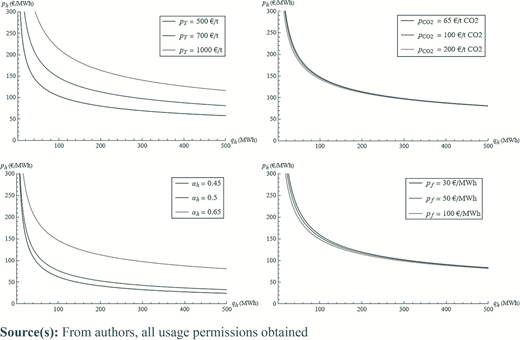
Firstly, we present numerical simulations that illustrate the scenario where the industry must compensate for the detrimental effects of its emissions by paying an emission price. Following the derivations of the demand function given by equation (14), we plot the inverse hydrogen demand function under various assumptions regarding steel prices, emission prices, hydrogen efficiency and fossil fuel prices (Figure 1).
A visual inspection of the plots with the upper boundary of the hydrogen willingness-to-pay value of 300 €/MWh, reveals that under current conditions, a price of 10 €/kg or lower is necessary to incentivize the use of hydrogen. This finding indicates that while some steel-producing companies, such as SSAB, are on the brink of investing in pilot projects involving hydrogen, a reduction in the currently observed prices is essential for the majority of the industry to adopt hydrogen-based technologies. The price reference of 3 €/kg, equivalent to 100 €/MWh, as indicated in the German and EU Hydrogen Strategy documents, would indeed facilitate the scaling up of hydrogen-based technologies. This price point aligns with the strategic goals of promoting hydrogen adoption and reducing emissions.
Our study further shows that the willingness to deploy hydrogen can be driven by various parameters, each with different efficiencies. Enhancing the efficiency of hydrogen-based technologies will have a positive effect, enabling an earlier transition to hydrogen. However, the willingness of consumers to pay a “green” premium may override other factors in influencing this transition. In contrast, the sensitivity to carbon prices appears to be insignificant. Similarly, changes in fossil fuel prices have only mild effects on the overall investment in hydrogen or other emission reduction technologies. This is because lower fossil fuel prices, while generating higher revenue, are offset by the higher costs associated with emissions. These countervailing forces result in an overall insignificant change in profits that could be invested in clean solutions. Contrary to the often-used argument that higher fossil fuel prices create incentives to invest in clean technologies, our findings suggest that fossil energy prices have little to no positive effect on investments in hydrogen or other emission reduction technologies until these technologies become financially viable without subsidies from other production units of the company.
In the context of corporate governance, investments in environmental sustainability require long-term commitments, raising questions about the allocation of limited company resources within the company and across the supply chain or other involved economic agents. Our analysis highlights that competition for profit fund allocation, along with the production setup, is critical and must be driven by a common value: the recognition of the need to balance financial and environmental performance of the firm and the industry. The price undercutting stemming from a lack of agreement and alignment among industry representatives can be particularly damaging, underscoring the importance of coordinated efforts and aligned strategies to support the transition to hydrogen-based technologies.
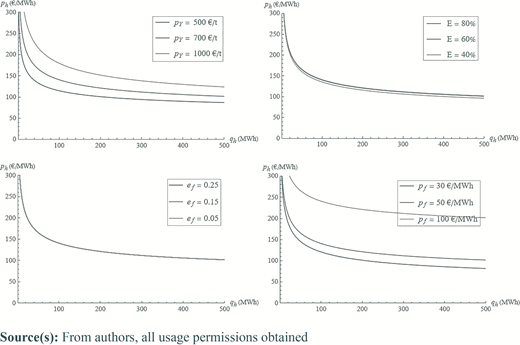
Next, we proceed to examine the impact of mandatory or voluntary emission targets on the willingness to adopt hydrogen or similar clean technologies (Figure 2). In particular, we are interested to see whether setting more aggressive emission targets could accelerate the transition to hydrogen-based technologies. The results of our simulations indicate that, for most of the considered parameter scenarios, the price of 10 €/kg of hydrogen serves as a threshold. Only when the market price falls below this value do we observe an increasing number of industry consumers willing to use hydrogen as a substitute for fossil fuel inputs.
Furthermore, our analysis reveals a striking insensitivity of hydrogen demand to emission targets and the carbon intensity of fossil fuels. This can be attributed to the fact that more aggressive emission cuts by companies, which reduce the use of preferable fossil fuels, also lead to lower profits. These reduced profits limit the funds available for investments in clean technologies. Similarly, reducing the emission footprint of fossil fuels, for example through the use of carbon capture, utilization and storage (CCUS), allows firms to relax their emission constraints, resulting in a hydrogen demand that remains fairly unchanged.
The limitations imposed by company profits also explain another interesting result: the high sensitivity of hydrogen demand to fossil fuel prices, particularly when compared to the previous case of clean price regulation. As the company’s ability to adopt hydrogen is constrained by its profit margins (until hydrogen becomes viable on its own), the impact of fossil fuel price changes appears more dramatic in this scenario than it did previously.
The increasing marginal effects of output prices on hydrogen demand again highlight that a specific combination of parameters can result in a relatively low willingness-to-pay for hydrogen. This limitation constrains the scale at which hydrogen can be adopted, persisting unless significant changes occur in factors such as technological efficiency or steel prices.
Our analysis indicates that while stringent emission targets may not singularly expedite the transition to hydrogen technologies due to profit constraints, their impact can be significantly amplified when coinciding with fluctuations in fossil fuel prices and output prices. This interplay highlights the complexity inherent in transitioning to a low-carbon economy, emphasizing the necessity for a multifaceted approach that balances economic viability with environmental sustainability.
Therefore, we conclude that the effective integration of hydrogen adoption into corporate governance strategies must consider a range of factors, including market output prices and their elasticity, the prices of clean substitutes such as fossil fuels and production efficiencies. This holistic approach is crucial for navigating the intricate dynamics of the energy market and ensuring a sustainable transition to hydrogen-based technologies.
4. Conclusions and next steps
Governments globally are actively developing and implementing policies to facilitate the adoption of hydrogen and other clean technologies. To align with these national and international policies, companies must integrate their strategies in a manner that considers the environmental and social impacts of their governance approaches. The incorporation of Environmental, Social and Corporate Governance (ESG) principles, although costly, is essential. However, industries face numerous challenges that can be mitigated or overcome through strategic decisions that balance environmental and financial performance, stakeholder management, production allocation and supply strategies.
This analysis addresses several gaps in the existing literature and contributes to the ongoing debates surrounding decarbonization and the net-zero transition, with a particular focus on the adoption of hydrogen. Firstly, it demonstrates how integrating a comprehensive array of factors, including policy considerations and market characteristics, provides a more holistic perspective on the adoption of low-carbon technologies such as clean hydrogen.
The developed approach and the numerical simulation results emphasize the need for firms to be more proactive in positioning their “cleaner” production within the market. Additionally, firms must be more transparent regarding the non-monetary benefits and the impacts of production transformation. Our work highlights that the dynamic nature of current technologies, global energy markets, and policy frameworks creates a complex interplay of factors that significantly influence the growth of the hydrogen economy. We illustrate that the growth of hydrogen will not be solely driven by reductions in hydrogen production costs but also by a confluence of these factors.
The net-zero transition necessitates that companies navigate complex strategic choices, underscoring the need for long-term discussions on reduced or zero profitability among shareholders, government, and consumers of industrial goods. These discussions should have both an intra-industry and inter-industry focus and be informed by domestic and international economic development and regulatory frameworks.
Finally, this analysis calls for more articulated empirical research to inform policymakers and industry experts. While this paper relied on benchmarked values from institutional and market entities to estimate techno-economic variables, there is a need to improve the quality of the underlying database, transitioning from arbitrary simulations to those based on real data. The theoretical approach presented here, with simulations serving to provide insights and intuitions, underscores the importance of empirical validation to enhance the robustness of these findings.
Notes
We treat all the costs and prices as parameters for simplicity. However, the model setup can be easily extended to include strategic market interactions or other complexities.
Note that more complex functions could be used without loss of generality to incorporate more inputs or nested production functions (Smyth et al., 2011).
Funding: Bundesministerium für Bildung und Forschung: MINDSET_Clean_H2 project (grant no. 03SF0780A).
References
Further reading
Appendix 1
In this Appendix, we will detail the theoretical approach that lies behind the production function used in the research paper. Thus, our aim is structured in two steps: we address the question of why a specific form of production function – i.e. the translog – fits our analysis; and how a general form of translog function was simplified to avoid cumbersome notations while keeping the necessary essence, eventually to get to the production function used in the research.
A profit-maximization problem like the one we performed in the research paper requires the creation of a production function representing the hard-to-abate output in relation with different technologies and production units combined:
where Y is the physical output of the industrial activity (e.g. tonnes of steel) and (x1, x2,…, xn) are the input required in the industrial process (e.g. for the case above: coke, iron ore, electricity, natural gas and other non-energetic input…). Because of this intrinsic non-aggregate empiric, it appears necessary to decide for a function enabling a formal consideration of input, thus we decided the translog type.
Translog production functions are an established, long-standing tool in the history of economic analysis that allow a higher-detailed granularity of input (Ackerberg et al., 2015; Berndt and Christensen, 1973; Christensen et al., 1973; Gandhi et al., 2020; Kim, 1992; Luo and Zhang, 2024; Res and Boisvert, 1982). As such, the originality of our research does not lie on the choice of this specific econometric tool, but rather on how it is used and in which field – to the knowledge of the authors indeed a translog production functions has not yet been used to understand the substitutability of low-carbon hydrogen in hard-to-abate European industrial processes.
We report in the equation below in its general form:
where Y is the output, α0 an efficiency parameter, xi and xj input, αi and βij efficiency parameters. By imposing the logarithm to both terms of (2A), and holding two main simplifications hypotheses, as per in Berndt and Christensen (1973) – i.e. constant returns to scale and Hicks-neutral technical change – we can simplify in the equation below:
As the energy intensive, industrial processes rely on more than just one type of input (e.g. energetic), and the aim of our analysis lies in the substitution between emission-intensive and low-emission-intensive input, we find the elements of equation (3A) and lnα0 not representative. This brings to the following simplified equation:
Bringing the equation (4A) with the notation that is used in the paper, and deleting the constant and the numeraire j without losing the general sense of the equation:
where f and h, represents the energetic element of the input (i.e. fossil fuels and hydrogen respectively), and r all the other non-energetic input. Now, based on the energy-intensive nature of the industrial activities that we are considering, we are simplifying the equation by incorporating the numeraire r inside the other energetic input f and h:
And we reach a further simplified notation as used in the research:
where xi represent the energetic input of an energy intensive, hard-to-abate industrial process and the αi the efficiency parameters. The other, non-energetic input are incorporated inside the energetic ones.
Appendix 2
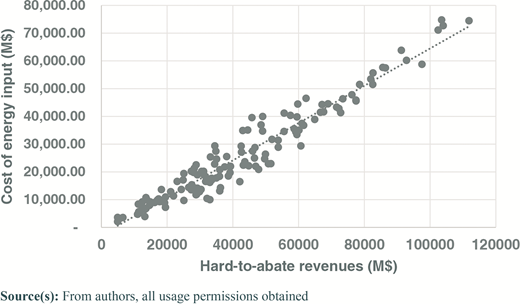
In this Appendix, we focus on the hypothesis taken in our research of considering the output price pY as a proxy for the value of the portfolio of output products, as the netback price or an otherwise adjusted output value. To support that, we leverage on the energy IEA database, building up a selected view on oil refineries for the timeline (1999–2018), some key European countries (i.e. France, Germany, Italy, Spain, Poland, the Netherlands, Belgium).
It is clear from Figure A1 that there is a clear proportional relationship between the cost incurred by an oil refinery to procure its input and the price that the oil products are sold to the market. We can say that based on the hypotheses of constant operations at almost full-capacity – something that is an industry standard in the world of oil refinery.