


Poor quality – or lack of information during the production phase is one of the main problems in construction, and improved information transfers between the design and production phases are needed. The purpose of this study is to investigate how companies use information deliveries, construction production planning and common data environments (CDE) to identify requirements for an integrated solution, where planning of information deliveries is connected to planning of construction production through a CDE.
Two case studies and a workshop were conducted. The first case study investigated use of CDEs in Swedish companies. The second study looked into a single company’s procedures for working with planning and information deliveries. The workshop consisted of discussions on these topics with industry professionals.
If communicated properly, Information Delivery Manual, Information Delivery Specification and Level of Information Need could aid in streamlining information deliveries. Companies have a significant difference in knowledge about these topics and the CDE requirements set by ISO 19650 are difficult to adhere to, despite using established software solutions. However, the results also indicate a shift from traditional software centric solutions to more data centric solutions.
The findings highlight the need for an industrial-wide shift from software centric solutions to data-centric solutions for managing project information.
Using a data-centric approach to project information management should enable integrated planning of construction production and planning of information deliveries.
1. Introduction
The evolution of building information modelling (BIM) has resulted in the Architecture, Engineering Construction and Owner Operated (AECOO) industry using more digitalized workflows for authoring of construction documents and transfer of information. Standardized formats, such as Industry Foundation Classes (IFCs), have also enabled information sharing between different software and disciplines. As IFC is capable of handling characteristics, attributes and relationships of elements in models (buildingSMART, 2023b), information delivery needs have also changed due to the increased detail and availability of information. To further increase collaboration, common data environments (CDEs) have emerged and evolved. CDEs enable different disciplines to collaborate within a project by providing a shared project platform where project members can upload their models and documents. The enabling of a continuous flow of information and file updates have resulted in the industry viewing CDEs as the general solution for increased collaboration (Borrmann et al., 2018). The definition of CDE is contained in ISO 19650-1 (2019). The 19650 standards also introduces the concept of “level of information need” (LOIN) (Godager et al., 2022), which was originally defined in EN 17412-1 (2020), now adopted into an international standard in ISO 7817-1 (2024). LOIN describes, both in a human- and machine-readable way, the granularity of exchanged information, where different purposes have different needs of information and documentation (ISO 7817-1, 2024). To ensure adherence to information requirements, buildingSMART have developed the Information Delivery Manual (IDM) and the Information Delivery Specification (IDS) for project participants to know what information to deliver at what point in the project (buildingSMART, 2022, 2024).
In this work, we use the ISO 12006-2 definitions and terminology, as it is applied worldwide to harmonize different classification systems for everyday use (Ekholm, 2005; Royano et al., 2023). Information is created in different processes, such as design processes or production processes. These processes are variants of construction processes. A construction process is defined by ISO 12006-2 (2020) as a “process which uses construction resources to achieve construction results”. Construction information is any information of interest in a construction process. A construction resource is any human, tool, product or information needed to complete a construction process (ISO 12006-2, 2020). The result of one process can then be the resource needed for another. Construction information can therefore be seen both as a construction resource (for a production process) and a construction result (from a design process). A visual representation of these relationships can be found in Borrmann et al. (2018). A construction process can also be divided into different construction activities (ISO 12006-2, 2020). The construction resources are therefore also needed to complete the various construction activities that make up the construction process. Having these relations, the ISO 12006-2 categories can be used to create work breakdown structures (Schlenger and Borrmann, 2024). By establishing a relationship between construction activities and their required construction information through the LOIN, planning of information deliveries could be integrated with the construction production planning to enable a combined planning approach. Consistent use of a CDE during production enables construction monitoring tracking of changes in the project (Hamledari et al., 2017; Park et al., 2017). A CDE could therefore provide access to the latest information on construction resources and activities. In turn, this would improve the planning process by enabling quicker response to changes and create a foundation for automation in production planning. However, poor information quality leads to rework (Zadeh et al., 2017), and verification of information is necessary for any automated solutions to be reliable. Using IDS, IDM and LOIN to verify information deliveries could aid in increasing information quality by ensuring that the right information is delivered to the right place at the right time. This would then reduce time and resources needed for correcting errors.
1.1 Problem
A study from Koch et al. (2018) report that up to 70% of the total project cost is due to problems created by insufficient or low-quality drawings and documents from the design stage. There is therefore a clear need for improved information transfers between the design and production phases as well as improved quality of the delivered information. Today, planning of construction activities and planning of information deliveries is done separately. However, as completion of construction activities requires information, it would be beneficial to combine the two different planning processes. This would be especially impactful in design-build projects, where the overlap of the production phase and the design phase requires an effective and reliable information flow. Effective management of information flows is essential for streamlined communication among project participants. CDEs could enhance real-time information sharing and collaboration to ensure accurate, consistent and accessible information. In a CDE acting as a centralized repository for project information, the integration of information during the ongoing progress of construction projects could identify clashes, optimize resource allocation and enhance decision-making processes (Sacks et al., 2022). Acknowledging the dynamic nature of construction projects, there is a need for an iterative planning approach involving frequent reviews and adjustments of both information deliveries and production plans based on project developments. By adopting an integrated approach, construction projects could benefit from synchronized planning, leading to improved coordination, reduced delays and, ultimately, successful project outcomes. To support the development of such an approach, this paper presents two case studies and a workshop that investigates the current working methods for planning of information deliveries and planning of construction production in southern Sweden. It also investigates contractors’ current use of commercially available CDE software for information deliveries and progress monitoring.
2. Theoretical background
2.1 Information deliveries
According to ISO 19650-1 (2019), all information that is to be supplied during the life cycle of an asset should be specified through sets of information requirements. The information requirements need to address all project information requirements and should be issued to each lead appointed party (ISO 19650-1, 2019). In order for “all participants in the organization to know which and when different kinds of information have to be delivered”, buildingSMART has developed IDM (buildingSMART, 2022). Defined in ISO 29481-1 (2016), IDM provides the basis for reliable information exchange and sharing, so that the appointing party can be confident that information they receive from the appointed party is accurate and sufficient. It also defines information that is required for automatic code checking rules (Ciotta et al., 2021a). Integrated information allows allocation of resources to achieve specific outcomes and provides tools for anticipating consequences that may occur due to taken actions (Fischer et al., 2017).
IDS is a format developed by buildingSMART for “defining information requirements in a computer interpretable form” (buildingSMART, 2024). It allows for compliance checking on IFC models (buildingSMART, 2024). The purpose of IDS is to provide a way of authoring and validating nongeometrical information requirements (Tomczak et al., 2022). However, the information that can be asked for in IDS is limited and rely strictly on the IFC schema (Tomczak et al., 2022). As different terms have different meanings within various languages, cultures and contexts, there is also a need for a way to properly define and translate those terms in a machine-readable way (ISO 23386, 2020). For this purpose, buildingSMART developed the buildingSMART Data Dictionary (bsDD), which “provides a standardized workflow to guarantee data quality, information consistency and interoperability” (buildingSMART, 2023a).
To know what information should be delivered, parties should define the “level of information need” (LOIN), to make sure that they get the information they need and only the information they need (ISO 19650-1, 2019). LOIN should be specified based on the purposes (why?), milestones (when?), actors (who?) and objects (what?) to clarify why the information is needed, when it is needed, who is requesting – and who is delivering information, and what it should contain (ISO 7817-1, 2024). LOIN therefore contributes to the exchange information requirements, which in turn defines the IDS (Gragnaniello et al., 2024). The purpose-driven aspect of LOIN allows for analysis of requirements for different purposes at the same information delivery milestone (Oliveira et al., 2024). LOIN also complements the IDS where document requirements are needed since IDS is mainly focusing on IFC and thus does not have the capacity to link documents as required information (Liu et al., 2023). Using LOIN also allows for the use of customized ontologies for simple information searches and management (Godager et al., 2024). A LOIN ontology, based on the EN 17412-1 (2020) – recently adopted in ISO 7817-1 (2024), was developed by Liu et al. (2023). BIM models are currently built without information requirements, while still being checked through advanced automated methods such as rule checking with IDS (Mellenthin Filardo et al., 2024). Information requirements should be defined so that decisions can be made at different points in a project (ISO 19650-1, 2019). LOIN is therefore a part of this information flow, which could be seen as a digital supply chain. As the LOIN defines the requirements on construction information, it could be used to establish relationships between construction resources and activities. Information requirements also need to provide information for construction activities. The activities will then also become part of the information flow supply chain. The information flow starts with the appointing party setting requirements and then proceeds with planning the information delivery. In the next step, the appointed party delivers the requested information which, if correct, the appointing party will approve (ISO 19650-1, 2019). This process is demonstrated in Figure 1.
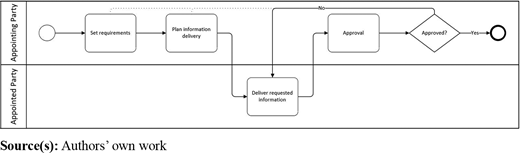
Aligning information exchanges with planned project activities would allow for the activities to act as a base for LOIN. This would in turn establish a connection between the LOIN for an activity and LOINs related to objects, models or documents. The process in Figure 1 could then happen continuously, in tandem with the changes.
2.2 Project delivery process in construction
In Sweden, there are two main contracting forms: design-build and design-bid-build (Boverket, 2023). The study by Koch et al. (2018) shows that partnering is also starting to gain traction in various forms, and that it is a successful approach in most projects that use it. However, this study mainly focuses on design-build projects, as that is presently the most commonly used form of contracting in Sweden (Koch et al., 2018). Although design-build has advantages compared to design-bid-build, it can be risky for inexperienced contractors (Öztas and Ökmen, 2004). Delays still occur and many projects exceed the calculated costs (Liang et al., 2020; Chen et al., 2016). Incomplete or low-quality information from the design phase are the most common causes of construction defects and reasons for rework (Koskela, 1999). The study by Koch et al. (2018) reaffirms this statement by finding that a large part of the total cost in some Swedish projects can be attributed to problems related to the design and the communication between the design team and the contractors. On top of this, Ballesteros-Pérez (2017) states that unsuccessful coordination will result in increased costs and/or lead times.
In design-build contracts, it is common that part of the production is conducted parallel to the design. The availability of information and the information flow to and from the construction site is therefore essential for decision-making. Having accurate, updated information in real-time improves monitoring capabilities and makes anticipation of potential problems possible (Andújar-Montoya et al., 2023). Updated information on activity progression also enable managers to identify critical activities that could potentially affect other activities due to various circumstances (Garcia-Lopez and Fischer, 2024). Any decisions made regarding budgeting, schedule, productivity and production changes must also recognize their interdependence (Ballard, 2000). Some overlap of activities due to schedule compression is possible, but only to a certain degree (Ballesteros-Pérez, 2017), and although it is possible to predict the frequency of rework for a specific time period, it is not possible to predict its specific time of occurrence (Wang and Feng, 2023).
2.3 Common data environments
ISO 19650 defines CDEs as “an agreed source of information for any given project or asset, for collecting, managing and disseminating each information container through a managed process” (ISO 19650-1, 2019). Today, there are many different software solutions that can be used as a CDE available on the market, such as Autodesk Construction Cloud (Autodesk, 2024b), BCDE (Bentley Systems, 2024), Dalux (Dalux, 2024), OpenSpace (OpenSpace, 2024) and Trimble Connect (Trimble, 2024). Although companies choose CDE platform based on quality and project requirements, such as collaboration opportunities and project status overview (De Sa and Alfaro, 2021), ISO 19650-1 (2019) specifies several requirements that a CDE should be able fulfil or give access to. Bucher and Hall (2020) describe CDE as a tool that connects all actors in a project through a cloud platform to enhance collaborative performance. They also state that the evolution of CDEs has resulted in increased interoperability in construction projects. A CDE with interconnected information structures, integrated with semantics also enables an advanced level of information retrieval (Klemt-Albert et al., 2018). By acting as a shared database for files, a CDE also enables viewing of BIM-models for all participants (Park et al., 2017). To properly keep track of updates, record the start and completion dates of tasks and enable a continuous flow of information, it is important to use the CDE every day during a project (Park et al., 2017; Hamledari et al., 2017). This makes it possible for all project participants to access the latest models and run simulations, which aids in decision-making (Seidenschnur et al., 2022). An unstructured information system can instead lead to increased costs, delays and lower productivity, which is why standardized and structured data is needed (Radl and Kaiser, 2019). Many of the errors in construction production are results of human error in the information flow and handling of documents, and a CDE can support this process by structuring the information in a single storage, which increase reliability and efficiency (Ciotta et al., 2021b). The CDE, therefore, also needs to be available to all project participants (Bucher and Hall, 2020). However, participants might have difficulties following the set protocols due to a lack of understanding of the document control processes (Soman and Whyte, 2020). Usually, there is no single source of truth for information, but projects instead use a variety of tools and sources simultaneously (Jaskula et al., 2024). Jaskula et al. (2024) argue that it would be difficult to develop a CDE that can act as a single source of truth throughout the whole life cycle of a built asset, as a tool used as a CDE must fulfil many different requirements.
Because of these problems, some researchers are now suggesting that it is better to have project data as the source of truth instead of various files. An example of such a solution is the system proposed by Sacks et al. (2022). The so-called “Cloud BIM” they propose supports many functionalities that are normally featured in off-the-shelf CDE software, but instead of storing data in ICF or software-specific files, it uses knowledge graphs. The proposed Cloud BIM system works by compiling BIM models as sub-graphs and connecting them with a cloud database. This allows for semantic linking across various sub-graphs, which enables development of software modules to support functions that “require a more meaningful representation of buildings than is possible in current state-of-the-art BIM software” (Sacks et al., 2022).
3. Method
The work presented in this paper is based on a qualitative approach, which is suitable for studies that require detailed descriptions, incorporating context when deriving results (Patton, 2014). The results are based on two case studies and a workshop. Case studies are suitable for investigating complex phenomena where more in-depth knowledge is required (Säfsten and Gustavsson, 2020), and for answering questions such as why, how and what (Yin, 2018), which is why it was used in this study. The purpose of interviews is to, through careful questioning and listening, obtain thoroughly tested knowledge (Kvale and Brinkmann, 2009). Due to the complex questions this study attempts to answer, and their direct relevance to individuals and their professions, semi-structured interviews were selected as the primary data collection method for the case studies. A qualitative approach using semi-structured interviews gives the opportunity to understand different phenomena by identifying various themes (Kvale and Brinkmann, 2009). Semi-structured interviews are widely used in engineering science and are usually performed with the help of interview guides, containing key questions that need answering to achieve the interview’s objectives (Säfsten and Gustavsson, 2020). As this study contained several different cases, a separate interview guide was created for each case. Workshops acts as a platform for researchers and practitioners to work together to identify a problem or potential solutions to a problem (Ørngreen and Levinsen, 2017). The purpose of the workshop in this study was to get a better understanding of the various problems that the participants experienced in their work and how they are solved.
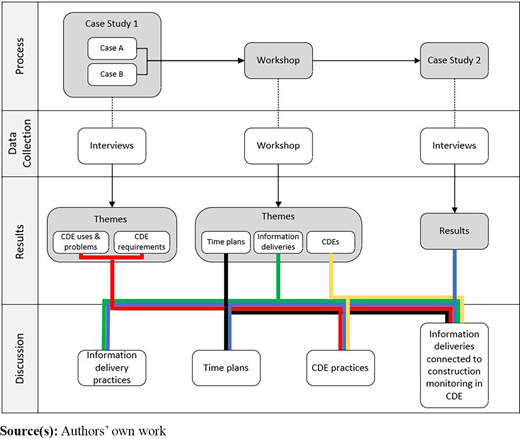
Case Study 1 consisted of two cases, with the purpose of investigating the use of CDEs in construction production, where Case A focused on the experience of site managers, team leaders and lead fitters, whereas Case B focused on the BIM manager point of view. These cases were investigated in parallel to each other and were done to get a holistic view from many different participants in projects. Case Study 1 was followed by a workshop, where the goal was mainly to investigate how companies worked with production plans, connected to CDEs and information deliveries. Case Study 2 was then designed to cover the gaps in the results from the workshop, particularly on the information deliveries. A single company was therefore selected for a deeper analysis. The company was selected because they seemed to have an established process for information deliveries. The full process and connections between the methods, results and discussion are demonstrated in Figure 2.
3.1 Case Study 1
3.1.1 Case A.
Case A investigated how a Swedish company worked with the CDE “Dalux” (Dalux, 2024) during the production phase. The company currently uses the two Dalux products: “Box” and “Field”. The purpose was to investigate how CDEs currently support the construction production process and what potential problems there are. The study included eight semi-structured interviews with workers in various positions: three site managers, three team leaders and two lead fitters. Their experiences varied between half a year and 13 years. See Table 1 for a list of interview participants.
Case A respondents and their role and years of experience
| Respondent | Role and identifier | Years of experience |
|---|---|---|
| Respondent 1 | Site manager 1 | 7 |
| Respondent 2 | Team leader 1 | 1.5 |
| Respondent 3 | Lead fitter 1 | 13 |
| Respondent 4 | Site manager 2 | 12 |
| Respondent 5 | Team leader 2 | 1 |
| Respondent 6 | Site manager 3 | 2 |
| Respondent 7 | Lead fitter 2 | 3 |
| Respondent 8 | Team leader 3 | 0.5 |
All interviews except one were conducted in person at the respondent’s worksite. Hand-written notes were taken during the interviews. All interviews were also voice-recorded to enable proper transcribing.
3.1.2 Case B.
In Case B, 10 respondents from seven different companies were interviewed about their use of CDEs. The respondents had a mix of roles, but most of them were BIM-managers or had similar responsibilities. Most of the companies used Dalux as their CDE of choice, but BIM 360 (Autodesk, 2024a) and other solutions were also represented, either as the main platform (BIM 360), or as a complement to Dalux. The interviews were semi-structured and were recorded for easier and more accurate transcribing. The questions asked focused on the use of CDE and their use in monitoring construction processes. A representation of the participants and their respective roles and experience can be found in Table 2.
Case B respondents and their role, years of experience and CDEs used
| Respondent | Role | Years of experience | CDE used |
|---|---|---|---|
| Respondent A | BIM manager | 4 | Dalux, Omega 365, Aconex |
| Respondent B | BIM coordinator | 3 | Dalux |
| Respondent C | Civil engineer | 7 | Dalux, Ibinder |
| Respondent D | Project engineer | 3.5 | BIM 360, Sharepoint |
| Respondent E | VDC manager | 1.5 | Dalux, Projektportalen |
| Respondent F | HVAC manager | 11 | Dalux |
| Respondent G | Project manager | 3 | Dalux, Ibinder, Sharepoint |
| Respondent H | Project manager | 4.5 | Dalux |
| Respondent I | Change manager/Digital coach | 5 | BIM 360 |
| Respondent J | Civil engineer | 8 | BIM 360 |
3.2 Workshop
The workshop was planned as the final part of an educational day about BIM and digital tools for the construction industry. There was a total of 14 participants from seven different companies of varying sizes. The participants were a mix of site managers and team leaders, with a wide range of ages and experience. Most of the participants worked on projects related to buildings, but a few of them worked with infrastructure projects. The workshop consisted of group discussions, with three or four participants in each group. The groups were divided in a way so that group members varied in age and experience as much as possible and represented different companies. The questions related to three main themes: production plans, information deliveries and CDEs. The groups discussed the questions and compared their individual experiences to then agree on a summarized answer that was written down. After the group discussions, the participants gathered for a final summary of the day where they had the opportunity to comment on the other groups’ answers.
3.3 Case Study 2
Case Study 2 consisted of an interview study with two participants from a major Swedish contractor. Respondent 1 works as a BIM manager, whereas Respondent 2 is a business developer. The interviews were semi-structured, with a lot of room for the respondents to fully explain their answers, and follow-up questions were asked based on those answers. The questions focused on information deliveries and production plans connected to CDEs. The interviews lasted for approximately one hour each. Notes were taken during the interviews, and the second interview was recorded, with permission from Respondent 2. The purpose of this case study was to investigate the company’s approach to managing information deliveries, CDEs and production planning to gain insights into their digital workflow.
4. Results
4.1 Case Study 1
4.1.1 Common data environments uses and problems.
The company in Case A did not have a set standard or strategy for how to use CDEs in their projects. Access to Dalux (their CDE software of choice) and the way they use it differs between projects. The use of the CDE also depended on the respondent’s role in the team. The CDEs used by the companies in Case B are represented in Table 2, located in the methods chapter. Companies mainly use CDEs for visualization, but in some projects more processes and functions are integrated into the CDE, such as self-checks and inspections. Respondent 1 stated that it would be desirable to use the CDE in that way for all projects, but the lack of knowledge among workers would probably create a lot of problems. They also mentioned that access to different functions often was decided based on budgeting from the client. Respondent 4 stated that “the software will never be better than the way we use it” and emphasized that it is they themselves who set the standard for how it is used, a view other respondents also shared. Two respondents in Case A also mentioned that they felt it was a bit too easy for the design team to change drawings during the production phase, which in their cases had led to some tasks already being completed when changes were made. Some respondents believed that if people had more knowledge of how to use the CDE, communication between different teams would be improved. Respondent 1 stated that some of the problems, especially when it comes to clashes, are results of the way designers author the models. They therefore wanted stricter protocols for how design teams author their models, which drawings and documents that should be delivered, and what they should contain, emphasizing that models should be authored as you build.
In Case A, it varied between projects if the main CDE (Dalux) is used for all purposes. Respondents said that iBinder (iBinder, 2024), Dropbox (Dropbox, 2023) and Byggnet (Byggnet, 2023) were used for various purposes in projects where Dalux was not used for those purposes. In Case B, BIM 360 was also a common alternative. Respondent 2 stated that, in a project where Dalux was used as a complete solution, self-checks worked well, as they were traceable, and that they had no issues in creating a template based on their own internal routines. Respondent B said that they use quality control forms in Dalux, which needed to be signed by all team members who were involved in the task. They then used those forms to compare executed work with the as-planned BIM-model to check whether the work was done according to plan. Respondent 6 stated that using a CDE to its full capacity would free up a lot of their time as they would not have to go around and answer as many questions, an opinion other respondents also shared. Respondent 1 also said that the value and credibility of documents in a CDE is higher compared to a handwritten note. People using other means of communication was the biggest issue for many of the respondents in Case B, with Respondents C, D, F and I stating that any information communicated via e-mails or phone is practically lost, as it is not shared with the rest of the project participants. Respondent A also said that this information cannot be used for construction monitoring, since it is not traceable. Most respondents believed that the main reason that people communicate outside of the CDE is either lack of knowledge or reluctance to change. Some respondents in Case A believed optimal results require CDE adoption alongside paper drawings. Attitudes toward CDE varies among construction workers, with some finding it convenient while others found it cumbersome.
4.1.2 Common data environments requirements.
Different actors wanted different information to be available in the CDE. Site managers needed information on quantity takeoffs, federated drawings, where drawings from different disciplines were connected, and a good 3D model for visualization. Team leaders needed structured information from the design phase, with a possibility to trace information from earlier in the project. Finally, the lead fitters requested drawings with proper information on dimensions and angles for installations with the possibility to filter and hide certain elements in a view. Although all respondents in Case A agreed that the best results would be achieved if everyone involved in a project had access to the CDE, they also agreed that there should be limitations on what different people are able to do to avoid misuse.
4.2 Workshop
4.2.1 Production plans.
During the workshop, all groups said that production plans are made digitally. Usually, everyone in a project has access to the production plans. However, one group said that only the site manager and team leaders have access to them, but that a paper copy is sometimes put up in the field offices. Changes are made regularly and plans are usually updated before every meeting. In general, the site manager is responsible for follow-up of production plans and is always present on the construction site. Requests for new production plans are usually made by the client or subcontractors, either through verbal communication or e-mails. Plans are often shared through e-mail, but if a CDE or another digital platform was used, the plans would also be shared through those. The way companies work with – and implement production plans changes between projects. One group mentioned that the plans work better when there is a built-in buffer for some tasks (for example, when something that takes 13 days is planned for 15 days), as many activities are usually not problem free. They stated that despite such planning there are still never any “gaps” in the planning where part of – or all work slow down or stop, as there are usually some unforeseen disturbances that causes activities to take a bit longer than calculated. A lot of participants also said that there are less problems when production plans are managed correctly and updated regularly, as this gives them the opportunity to react to errors and enforce the completion date of the project. The participants felt that the plans generally work well, but that the updating procedure could be better. One participant also mentioned that the main production plan is sometimes made before construction documents are finished. This often resulted in bigger changes having to be made during production, as the plans do not always fit the finished construction documents.
4.2.2 Information deliveries.
Information deliveries are usually done weekly, but how it is done varies between projects. Some follow a standardized system but emphasize that this work could be improved. Requests for information deliveries are usually made when needed via e-mail or through CDE. When a CDE is used, the requested information is delivered there. One participant mentioned that they, despite being in a design-build project, “inherited” the model and project and were not involved from the beginning. This created some confusion when planning the production, as all documents and part of the planning were done without them. They also had no opportunity to influence how the collaboration should work in the project. None of the participants had any experience of using IDS or other tools for information deliveries. If they were used, it was handled by other colleagues, and site managers just had to request information. Information deliveries were almost always verified manually, but on some occasions, it was done online. However, the participants did not know what this process looked like, as they were not directly involved.
4.2.3 Common data environments.
Most participants used a CDE in most projects. The CDE they use mostly varies between Dalux and Trimble Connect. Other software, such as iBinder and Solibri (Solibri, 2024) are also sometimes used in addition to Dalux and Trimble. These are most often used for file sharing and storage (iBinder) and for doing quantity takeoffs (Solibri). How companies work with the software and what functions they use differ on a project-to-project basis. In most cases, it is the client that decides whether a specific solution should be used. The use is often based on project budgets, and for that reason CDEs are usually not used in smaller projects. Checking drawings and models, self-checking, protocols, safety-rounds and inspections were the most used features. In some companies, only team leaders and their superiors have access to the CDE. In other companies, everyone in the project is included in the CDE, but not all participants can access everything. All groups agreed that the main advantage of using a CDE is that all information is gathered in the same place. One example that was mentioned was that they could register their checks and controls in the same system that they had the drawings in. They also stated that CDEs aided communication, as everyone had access to the same information. In projects where they did not have access to all the necessary features, several platforms were instead run in tandem. The participants said that this made it very difficult to organize all the information and make sure that it was kept up to date on all platforms. This also meant that they often had to search for information on multiple platforms, as it was not always clear where it was stored. They therefore emphasized that they should focus on increasing their use of CDEs and learn how to use them better.
4.3 Case Study 2
The investigated company is currently undergoing a big change in how they work with data and information deliveries. The aim is to enable access to – and use of internal data on a company-wide level through a “data-lake”. The data-lake will contain data gathered in all their projects, so that they can access it for reference. They are currently working with LOIN to identify and verify the information required from various deliveries. On a high level, their approach to the information delivery workflow contains the following steps:
A LOIN document is produced and sent to design teams. The LOIN is usually produced as an Excel file.
The design teams create parameters and put the requested information into the models.
Once they receive the BIM models from the design teams, they check that the requested information is included in the models. This check is done manually in BIMCollab. The company is currently investigating if they can implement IDS in this process and will probably adopt it soon.
To create production plans, the company use Asta Powerproject (Elecosoft, 2024) to connect activities to elements in a BIM model. However, they do not connect it to LOIN or information deliveries in any way. Respondent 1 mentioned that they should have the possibility to connect planning of information deliveries to the planning of construction production through the connection between the activities and the model, but that is not yet implemented. Their goal is to enable follow-up of schedules by using a 4D BIM model during project meetings to visualize- and keep track of progress. The company has a standardized structure for their production plans. The plans follow a hierarchy, starting at the top level with “building”, then divided by floor, followed by zone, functional space and activity. This allows them to plan big projects by sectioning up the different stages. They can then have an overarching plan for the entire project, with the possibility to make more detailed plans for specific zones. Respondent 2 stated that it would be impossible for them to plan bigger projects without this structure. However, they only make the structure of the production plans, meaning that they know what to do and in which order but not the exact number of hours for each activity. Plans are shared with the team through a CDE, which is linked to a central database containing data related to the specific project. This database acts as a connector between the various software that they use in different stages of the project. By enriching the connector with data, they can use it to enrich the previously mentioned structure with exact time (hours), quantities and costs. Using this method, detailed plans are made for two weeks at a time as the project progresses. Through the connector, quantities can then also be taken based on the zones included in the active production plan. Respondent 2 said that they only plan two weeks ahead, because the plans are difficult to follow up if they are made for a longer period. Any deviations that occur are reported through their collaboration platform. Figure 3 demonstrates how the company uses the connector to connect different functions. As the company is still developing this system, the functions shown are examples of currently established connections or examples that were mentioned during interviews.
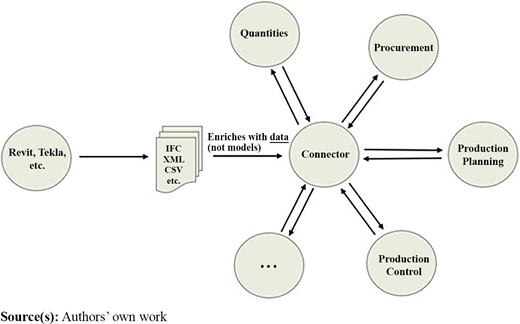
An example of how the company’s central database is used to connect different functions
An example of how the company’s central database is used to connect different functions
5. Discussion
5.1 Production planning
Production plans are usually made using digital tools, but how plans are made and who has access to them seems to differ depending on the company. Workshop participants said that despite having built-in buffer in production plans there is still never any down-time, which shows the ever-changing nature of production schedules. Enforcing completion dates is therefore very difficult. This is also visible in Koch et al. (2018), where “certainty of delivery” has the lowest value when the clients evaluate the contractors, meaning a lot of projects do not deliver on time. The company in Case Study 2 said that the structure of the production plans is more important than the specific time and date that activities are allocated to. Having a structure, they could then make more detailed plans for two weeks at a time. Such an approach means that plans will be updated regularly, which, according to the participants in the workshop, is important to be able to enforce completion dates. However, if workers do not report their times, it would be difficult to make accurate plans, since then information will not always be up to date. Updated information is necessary to enable anticipation of potential problems (Andújar-Montoya et al., 2023). Structuring production plans in the same manner as the company in Case study 2 will also aid in visualizing the interdependence of the activities, which according to Ballard (2000) is important when making adjustments to the plans. However, production plans are sometimes made before construction documents are finished, which results in major changes during production. This is more common in design-build projects, where construction starts before the design is fully completed. Although schedules can be compressed to some degree, there are still limits to how much (Ballesteros-Pérez, 2017), based on preceding activities and required resources. This also has further repercussions on information deliveries. If production plans change, the delivery dates of information deliveries also have to change. However, if new requirements are not properly communicated, designers will not know exactly what the new delivery should contain. Inaccurate design information is the main cause of problems during the production phase (Koch et al., 2018; Koskela, 1999). It is therefore crucial that teams use information delivery methods that enable real-time updates, as it would increase their ability to detect potential problems (Andújar-Montoya et al., 2023). Using LOIN would provide companies with more structured information requirements that are traceable throughout the project process, ensuring that all participants know which information to deliver and when it should be delivered.
5.2 Information delivery practices
Very few companies are currently working actively with LOIN and/or IDS, and it seems the company investigated in Case Study 2 is among the frontrunners in adopting these methods. Most companies still verify information manually. Working with methods outlined in various standards can be complicated, especially for smaller companies, who might not have a “BIM-expert”. This is because some of those methods rely on deeper knowledge of how different formats, such as IFC, are structured. For example, the IDS relies strictly on the IFC schema (Tomczak et al., 2022). IDS could therefore be difficult to understand for someone who is not familiar with the IFC schema. Further automation of planning tasks, especially if connected to information deliveries, will require a wider adoption of machine-readable formats for automated information verification. This requires the use of LOIN to put requirements on information deliveries, so that models can be verified based on various parameters that are specified in the request for information. Although the company investigated in Case Study 2 has not fully embraced IDS, they currently use LOIN for information requests and have established a framework for managing machine-readable data. This indicates their potential readiness for IDS adoption, given LOIN’s integral role in defining IDS (Gragnaniello et al., 2024). In addition, their central database can accommodate diverse formats for information deliveries, facilitating further automation of the delivery process. This system also holds promises for enriching models based on LOIN requirements, potentially streamlining processes and minimizing errors. An integrated system where information deliveries are automatically verified and connected to production planning through a CDE, will enable all project participants to access the latest updates, aiding in decision-making (Seidenschnur et al., 2022). Integrating the CDE with semantic connections would also enable a more advanced level of information retrieval (Klemt-Albert et al., 2018).
5.3 Common data environment practices
The results of this study show that CDEs are rarely used to their full potential. Decisions on which features and software to use are often made by the client, usually derived from economic reasons resulting in companies using different tools or systems for different purposes. This match the findings of Jaskula et al. (2024) and Soman and Whyte (2020), who state that different stakeholders often use different tools and workflows. This leads to fragmented data as it is spread out on multiple platforms, which in turn means that teams do not actually use CDE according to ISO 19650. Jaskula et al. (2024) states that a single source of truth is difficult to achieve due to many different requirements from different participants, and based on the responses from respondents it seems that this is indeed true. Using phone calls and e-mails for sharing information instead of using the CDE makes it difficult to trace file versions (Ciotta et al., 2021b). This in turn creates a gap in the documentation of a project and makes it difficult to properly monitor the project progress. This defeats the purpose of using a CDE to track project progress, as it will not be possible to achieve a continuous flow of information where everyone can access the latest files and updates, which according to Hamledari et al. (2017) is essential for progress monitoring. One of the purposes of a CDE is to reduce human errors in information flows (Ciotta et al., 2021a), but in these cases, the human error has extended to the use of the CDE itself. Some of the respondents (particularly in Case Study 1 – Case B) singled out this problem as the main issue in their work with CDEs. This could be a worker attitude – or discipline problem but, as mentioned by several respondents, it could also be knowledge related. It seems that many project participants do not feel like they possess enough skills or knowledge on how to use the CDE. It probably does not help that the norm for educating workers in how to use CDEs seems to be through self-learning. In some projects, there are shorter introductions on how to use a CDE in that specific project before the start of the production phase, but this is not always the case. Research on how to create more support and guidelines for different stakeholders on how to use CDE is therefore needed.
5.4 Information deliveries connected to construction monitoring in common data environment
Currently, not all companies use CDEs. Of the companies that do use them, only the company in Case Study 2 are close to achieving a true connection between information deliveries and construction monitoring. They are also the only company in this study that has established standardized working methods for both information deliveries and construction monitoring. However, the two methods are not yet fully connected. The structure of their system have similarities with the Cloud BIM solution presented in Sacks et al. (2022), except that Sacks et al. use links between functions instead of a central database. Both the solution from Sacks et al. (2022) and the solution used by the company in Case Study 2 use data rather than files for information transfer, which enable connections between different software. This essentially means that software used by designers is also part of the CDE, as the software (if compatible) can access and generate data to the database. It seems then that a data-centric approach, rather than a software-centric approach, is the way forward. Such a system should also enable automated solutions for various planning and control tasks if it is accessible from various software used over the course of a project. By using the database to enable interaction with different software for production control and production planning, the CDE should then support integration of information delivery planning with production schedules.
To enable automation of planning and control tasks such as automated verification of information deliveries, LOIN and IDS workflows need to be adopted. A solution where data is gathered and stored in a central database connected to various functions (such as planning, quantities etc.), like the one used by the company in Case Study 2, should be able to support those workflows. Such a solution can then use the connection between the central database and the various functions to either create or verify information requirements using LOIN and IDS. For planning purposes, the LOIN needs to consider the various prerequisites for an activity. This includes aspects such as preceding activities, location/space, the construction system, component and element, as well as the required personnel, materials and equipment (Koskela, 1999). These aspects will then create a work-breakdown in the LOIN, related to a project activity. A structured information exchange based on the workflow suggested in ISO 19650-1 (2019) is therefore needed to enable a fully integrated approach to production planning. The information exchange should be driven by a LOIN-based workflow connected to production milestones. Identifying necessary information deliveries and their relation to the milestones would then allow for definition of information requirements using LOIN. A conceptual model of such an approach is showcased in Figure 4.
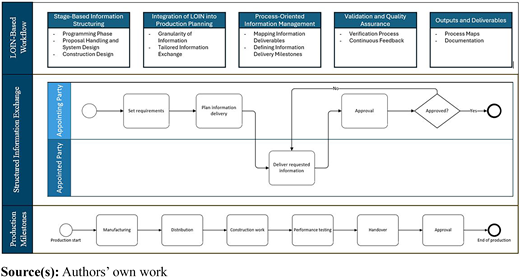
Conceptual model of a LOIN-driven information exchange for construction production
Conceptual model of a LOIN-driven information exchange for construction production
Once a structured information exchange is established it should enable continuous updates of production plans and LOINs based on project progression. The updated plans and LOINs could then be shared through a CDE. Although the empirical data presented in this paper is limited to the Swedish AECOO industry, the suggested approach should be applicable on an international level. To use an integrated approach, companies must first adopt a LOIN-based workflow. The next step in this research will therefore be to map information deliveries in the production phase to create a framework for LOIN-driven information exchange connected to production planning.
6. Conclusion
As is evident from this study, the AECOO industry is still behind research in information delivery systems and application of formats like LOIN and IDS. There are also big differences between different companies in how information deliveries are made. Although CDEs have seen increased use, they are often not complete and there seems to be a lack of education in how they work and how they should be used in a project. The ISO 19650 definition of a CDE is therefore usually not fulfilled in practice. However, the requirements outlined in the standard seem difficult to adhere to using only the current “off-the-shelf” CDE solutions available on the market. Research hints toward a movement from software-centric CDE solutions to data-centric solutions, where multiple software can work together in an ecosystem through connection with a central database or a link-based system. Judging by the results from Case Study 2, the industry may shift toward such solutions as well. A shift toward data centric solutions should also enable companies to truly adopt CDEs in accordance with ISO 19650. This shift therefore seems both necessary and inevitable. Future studies should focus on developing user-friendly tools (APIs) and frameworks (knowledge-graph based) that support LOIN integration, particularly for small- and medium-sized enterprises, which may lack the resources to adopt complex standards. As this study focused on design-build, a study on how a data-centric solution would work for other contracting forms, such as design-bid-build is also recommended to ensure that this type of solution can work seamlessly across all projects. Finally, the use of smart contracts as a way of pushing people to use CDEs in specific ways could also be worth investigating.
This work is part of the COMBPLAN research project, which is sponsored by Jönköpings Läns Byggmästareförening (Sweden). The authors would like to acknowledge their industrial partners for their contribution to the project. The authors would also like to thank the students, Alicia Kaker, Tuva Jacobsson, Matin Khagebahri and Nebiyat Kassahun Assefa, whose thesis projects contributed with gathering data by conducting interviews for Case Study 1.

