In international business research, distance connotes unfamiliarity and misunderstanding. This paper aims to theorize the distance between low-income and higher-income countries, taking as point of departure that low-income countries are generally unimportant business partners of high-income countries, but dependent on the goods, services and markets of many of them.
Because low-income countries are dependent upon higher income countries, they have a greater incentive to understand high-income countries than the reverse. Higher income countries not only know little about low-income countries, but among themselves also have varied and often competing interests and concerns. This changes how low-income countries, actors with little influence, make sense of distance. The authors use literature on psychic distance and institutional fields to develop this argument.
Rather than managing a series of dyadic distances, low-income countries seek to situate themselves optimally vis-à-vis the range of higher income countries with which they interact. By developing a holistic view of the entire transnational institutional field, they can better navigate and strategically position themselves amongst the more influential high-income countries.
This work is conceptual, and the authors recommend future research to empirically test their propositions.
This work explains why low-income countries do not necessarily seek aligned interests among higher income counterparts.
Distance is rarely researched from the perspective of low-income countries. Building on the psychic distance literature, the authors argue that low-income countries have asymmetrically greater motivation and opportunities to overcome distance. This understanding of distance represents a resource for them in conducting business internationally.
Introduction
In this conceptual paper, we theorize distance from the perspective of the “least developed countries”, i.e. low-income countries. In a globally interconnected world, low-income countries have little choice but to stand in a relationship to the high-income countries, and it is therefore of great consequence for low-income countries to understand the culture, the economic and political strengths and the administrative requirements for trade with and investment by high-income countries. These are typical distance dimensions – in this case, the dimensions of Ghemawat’s (2001) CAGE model – but we suggest that distance functions differently for low-income countries compared to what is typically presumed.
From the vantage point of high-income countries, low-income countries are insignificant entities: their markets are small, their technologies virtually non-existent and their political influence limited. It is therefore not worth the trouble for high-income countries to develop a nuanced understanding of their low-income counterparts. In contrast, low-income countries need to operate with a keen understanding of the typical distance dimensions of high-income countries. This creates a situation where the one party in the “relationship” has only a superficial and largely disinterested interest in the doings of the other, whereas the other actively seeks to understand and orient itself to the requirements of its powerful but less invested counterpart.
The unfamiliarity, misunderstanding and ignorance implied by distance presents an especially pertinent threat to low-income countries because they must engage with a large number of foreign partners. Low-income countries need the offerings of many of the more developed countries, for example, their financial services, technologies around transportation (e.g., vehicles, airplanes or trains) and communication technologies and devices. But in trying to secure globally available offerings, low-income countries have such small markets that advanced multinational enterprise (MNEs) may not even wish to directly operate in those locations.
In seeking to trade with the rest of the world (e.g. selling agricultural produce), low-income countries continue to need the offerings of more advanced economies, e.g. fertilizers, harvesting and distribution technologies. They also need to understand the regulations of buyer countries (in our example, around agricultural produce), whether buyers are from the European Union (EU), North America or elsewhere. Indeed, unless they have a single buyer who routinely buys the entire harvest, low-income countries need to understand and comply with the diverse and potentially even contradictory regulatory requirements from all their buying countries.
We suggest that this proliferation of consequential foreign partners results in a two-part response from low-income countries. First, it increases their motivation to overcome the disadvantages of distance. Second, there is clear value in developing a holistic understanding of the distance-related expectations of all their international partners. Low-income countries therefore seek to understand the concerns and interests of the entire transnational institutional field in which they operate. This integrative field view allows entities from low-income countries to better manage dyadic distance with any given high-income country partner and therefore provides strategic value to them. In this paper, we theorize the value for low-income countries of conceptualizing distance as a field.
The first building block for our argument comes from the literature on psychic distance, and specifically its asymmetrical functioning (Håkanson et al., 2016; Yildiz and Fey, 2016). We argue that low-income countries have a far greater incentive to overcome distance-related challenges than their more influential higher income country counterparts. At the same time, and functioning in a complementary way, low-income countries experience a smaller psychic distance than their counterparts from higher income countries, for example because of the dominance of Western media (Håkanson and Ambos, 2010). Low-income countries are likely to be far more familiar with media outlets like the BBC, CNN and Bloomberg than foreigners are with any given low-income country’s domestic media outlets. Tertiary education conducted in high-income countries and often considerable migration from lower to higher income countries have also resulted in personal experience and social networks in the more developed countries (Blumenstock et al., 2023).
We also use the emerging body of work on transnational institutional fields (Manning et al., 2012) to develop our argument. This work builds on the established body of work on institutional fields (Zietsma et al., 2017) that theorizes how economic actors in a field relate to each other. It has long been acknowledged that actors are in a relational situation to each other and take into account the actions and power of other parties as they operate (Martin, 2003). The literature on transnational institutional fields extends this work across borders (Marano and Kostova, 2016), and we suggest that the field dimension of distance is particularly important for low-income countries.
Low-income countries likely find it helpful to be aware not only of the distance-related dimensions between them and their foreign partners but also of distance between the different foreign partners. We argue that differences in the interests and power among the different countries with which they engage have an important influence on how low-income countries make sense of and navigate distance. We develop propositions to explain why understanding distance as a field is of strategic value for low-income countries.
Asymmetry and psychic distance in international business
When Johanson and Vahlne introduced the notion of “psychic distance”, they defined it as “the sum of factors preventing the flow of information from and to the market” (Johanson and Vahlne, 1977, p. 24). This “from and to” statement suggests that they saw symmetry or at least reciprocal interest as central to the definition: Much as a Swedish MNE might wish to better understand the UK, a British MNE would also seek to improve its understanding of Sweden.
This paper is about low-income countries, countries that initially were largely absent from international business. (see Table 1Low-income countries, 2024, for a list of current low-income countries) The assumption of symmetry is clearly challenged when looking at how low-income countries make sense of distance. The enterprises of developed, high-income countries rarely need to understand the culture, administrative practices or legal requirements (i.e. distance elements) of the least developed countries. These countries represent negligible markets and advanced MNEs are often not even physically present in such countries, as they can also choose to use emerging market MNEs (Barnard, 2021) and distributors from the region (Ng’ombe et al., 2023) as their local representatives. Even if advanced MNEs choose to be present in those locations, the economic and political power of their home countries means that they are relatively insulated from the institutional dysfunction of their low-income host countries (Barnard and Mamabolo, 2022).
At the same time, we suggest that in an era of globally interconnected business, poor underdeveloped countries have no choice but to engage with and thus seek to understand wealthy powerful countries. Advanced economies and advanced MNEs are important sources of not only investment but also sophisticated goods and services. It is therefore important for low-income country parties to develop a solid understanding of the motives and expectations of the economically powerful countries.
Importantly, they do not only have a greater incentive to understand high-income countries – it is also much easier for actors from low-income countries to develop such an understanding than it is for high-income countries to do of them. The global dominance of Western and especially US media means that countries across the globe have exposure to the countries most frequently portrayed in the media, i.e. high-income countries. In fact, they often assess themselves against that yardstick (Banjo and Umunna, 2022; Håkanson and Ambos, 2010). In terms of personal experience, high-income countries are desirable locations for study and migration, and thus many decision-makers in low-income countries have personal experience or social networks in the more developed countries (Blumenstock et al., 2023). Thus low-income countries have not only the need to better understand the perspectives, practices and priorities in high-income countries than the reverse, but likely also a better (although of course incomplete) actual understanding.
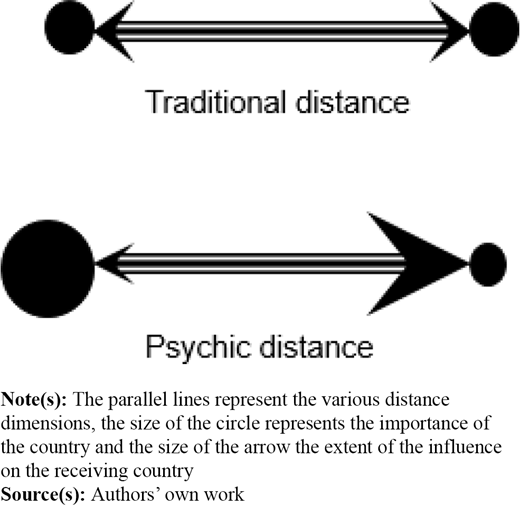
The idea that distance works differently for low-income countries compared to high-income countries has been previously explored in the work on psychic distance. The implicit assumption of symmetry was challenged already decades ago, when Shenkar (2001) pointed out that much distance research operated with an illusion of symmetry, stability and linearity (among others). Subsequent work further explored the implications of his argument, and confirmed that countries with lower levels of development, status and income generally experienced the more developed countries as closer than developed countries experienced them. Dow and Karunaratna (2006) found that especially geographical distance and also differences in education and industrial development explained psychic distance better than culture measures. Like Dow and Karunaratna (2006), Håkanson and Ambos (2010) found not only a strong effect for geographical distance but also that differences due to differing levels of economic development and in the size of the economy were significant. Figure 1 provides a stylized summary of how psychic distance is argued to operate relative to traditional understandings of distance. The parallel lines represent the various distance dimensions (cultural, institutional, geographic etc.), the size of the circle represents the importance of the country, and the size of the arrow the extent of the influence on the receiving country.
In follow-up work, Håkanson et al. (2016) explore why such asymmetry in distance arises, and found that individual-level exposure to a country (e.g., via migration or the media) limits psychic distance. In addition, social comparison effects related to country reputation have a U-shaped relationship to psychic distance. The work of Yildiz and Fey (2016) confirms the asymmetric functioning of distance as well as the importance of country status as a key mechanism for such asymmetry. Although the main influence on psychic distance remains national (i.e. geographical distance), a non-trivial proportion of factors operate at the individual level, and are likely to change with digitalization and migration (Håkanson et al., 2016). Indeed, one key question that remains in psychic distances research is about the relative importance of individual perceptions relative to national-level differences, and more recent work has tended to examine the role of individual perceptions (Lumineau et al., 2021; Nebus and Celo, 2020; Wang et al., 2023).
We can summarize that body of work and present the first part of our argument about how low-income countries experience distance by proposing as follows:
The smaller the economic power of a country, the greater is its knowledge about other countries.
The greater the economic power of a country, the less is its knowledge about other countries.
Whereas psychic distance has been studied at the national and individual level, its effects have been found at the organizational level where greater psychic distance counterintuitively resulted in better performance. Azar and Drogendijk (2014) showed a positive relationship between psychic distance and innovation, and explained that the perceived high level of difference in psychically distant markets intensified the firm’s efforts to innovate to assist the firm in coping with an unfamiliar environment. Other studies have also shown support for this argument (Evans and Mavondo, 2002; Magnusson et al., 2014). The central explanation is that performance improves because managers are aware of and make use of the distance. This phenomenon has been termed the “psychic distance paradox” (Magnusson et al., 2014), and it importantly suggests that it is not distance per se that challenges or enables performance, but how managers relate to and engage with parties across space.
In recent years, the topic of asymmetry in distance has received relatively little scholarly attention. An earlier review paper on distance directly linked asymmetry in distance to lower socio-economic development and argued that it was an important area for future research (Hutzschenreuter et al., 2016). But neither of the influential reviews of Beugelsdijk and co-authors (Beugelsdijk et al., 2018a, 2018b) make any mention of asymmetry in how distance is understood.
We argue that low-income countries’ asymmetrical understanding of distance and the functioning of the associated psychic distance paradox are potentially of value to them. But to strategically position themselves amongst the more influential high-income countries, they also need to develop a holistic view of how they fit into the web of relationships between them and their foreign partners. In developing this integrative perspective, we draw on the literature on (transnational) institutional fields.
Transnational institutional fields
The notion of institutional fields, embedded in institutional theory and defined as “relational spaces that provide an organization with the opportunity to involve itself with other actors” (Wooten and Hoffman, 2017, p. 64, their emphasis), has a long history in management research. Power is central to institutional fields; of the four elements that Zietsma et al. (2017) identify as common across various institutional fields, two relate to power, namely hierarchies of status, influence and power, as well as contestation and competition arising from power differentials. The other two are common meanings and interests, and boundaries (constituted by shared meanings and relationships).
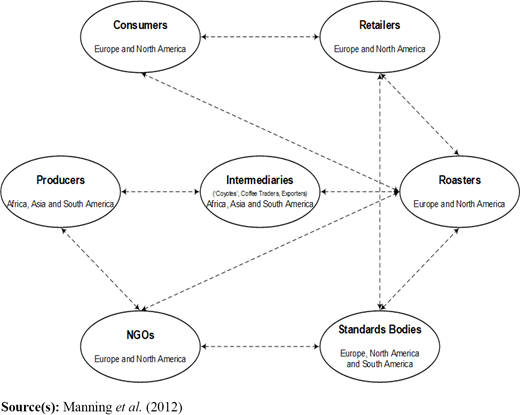
Even though it is known that the economic and social actions of organizations have increasingly become transnational (Djelic and Quack, 2008), relatively few international business scholars have investigated transnational institutional fields. Existing work shows clearly that low-income countries have low power and status in these fields. Manning et al. (2012) did a case study on sustainability standards development and adoption in global coffee value chains, and a visual depiction of the institutional field that Manning et al. (2012) examined shows that low-income country partners occupy mainly the producer role (Figure 2). Producers have little power in the institutional field, with “no direct connection to, and little knowledge of, the world market for which they grow their products” (Manning et al., 2012, p. 198).
As is predicted by the psychic distance literature, even these marginal players have some knowledge of the global market, but their connections in the field are almost exclusively with intermediaries who have access to the high-income-based country-based roasters (the most lucrative actors in the field). The intermediaries (themselves based in lower income countries) do not have linkages to the other more powerful players in the value chain like consumers, retailers or standards bodies, all of which are located in high-income countries. In sum, neither the producers nor the intermediaries are influential in the field. We argue that the insights from Manning et al.’s (2012) transnational institutional field study are relevant at the country level, and propose that:
The less the economic power of a country, the smaller is its influence in a transnational institutional field.
The greater the economic power of a country, the larger is its influence in a transnational institutional field.
Thus, the psychic distance from low- to high-income countries is smaller than the reverse – low-income countries are more familiar with high-income countries than the reverse – but this does not translate to influence in the transnational institutional field. To concretize the argument, we give as an example how US businesses might relate to their Ugandan counterparts. US firms are likely to find it much harder to grasp the challenges and specificities of doing business in Uganda than Ugandan businesses would find the USA. But work on transnational institutional fields suggests the knowledge base about a foreign country is not the core issue. The research of Manning et al. (2012) implies that US-based businesses would have so much more power than their Ugandan counterparts that the USA would dominate all four of Zietsma et al.’s (2017) institutional field elements: in terms of status and influence, in assigning common meanings and interests, determining boundaries as well as any contestation about the nature of the field. In sum, Ugandan business may have more knowledge about the USA, but the USA has much more power than Ugandan business.
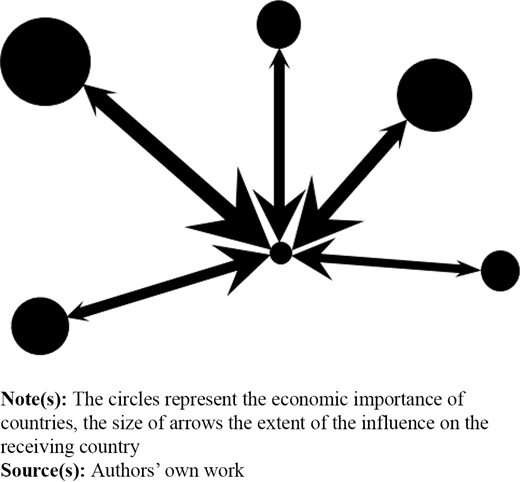
We also want to suggest that Ugandan businesses need to know about many more countries than only the USA. Given its technologically advanced offerings, there is no doubt that business with the USA is of great importance to Uganda. But other countries are also likely to be important, for example, Uganda’s previous colonial master, the UK, and India, historically (and still) an important trading partner, as well as China, given its growing interest and influence in Africa, and South Africa as the regional, albeit emerging market, powerhouse. Whereas there are power differentials between these countries, all of them are likely to dominate in their engagements with Uganda. Figure 3 provides a stylized representation of how Uganda is likely to experience its engagement with these countries.
In another study of institutional fields in international business, Marano and Kostova (2016) did a quantitative study of corporate social responsibility adoption by MNEs. They found that economic dependence on another country shapes behavior in a transnational institutional field. Specifically, to the extent that other countries are economically dependent on one country, that country has power over the others. Moreover, power in the field increases when countries in the field are institutionally aligned, as it is harder to disregard pressures when they are relatively similar.
Although there is limited literature on institutional fields in international business (Jacob et al., 2022), the studies that do exist almost always take place in what could be defined as fragmented fields, using the language of Zietsma et al. (2017): fields that are both weakly institutionalized (across the various countries) and with unsettled logic prioritizations, given that different countries tend to occupy different roles in global value chains (Kano et al., 2020). The institutional norms and pressures of different countries that are members of an institutional field thus vary substantially and certainly also in terms of institutional distance (Kostova et al., 2020).
This contrast with mainstream management research where the process of alignment and re-alignment is seen as central to the stability of the institutional field, with “central and elite actors often the actors defending the status quo arrangements that privilege them” (Zietsma et al., 2017, p. 406). Over and above other considerations that require future research from international business scholars, it is important to note that the instability in a transnational institutional field is potentially of value to low-income countries.
The interests of powerful actors are likely not always aligned, because transnational institutional fields tend to be “issue fields” where field members come from different populations with different views about status hierarchies (Zietsma et al., 2017). This lack of alignment potentially limits the influence of high-income countries on a low-income country. The insight of Marano and Kostova (2016) that the influence on a country is greatest when the interests of the various other countries are aligned calls to mind the analogy of being in water with strong currents. Sometimes, the currents force the actor in a direction that is not desired. Some of the currents may be useful, going in the desired direction. Currents and counter-currents can sometimes cancel out each other. This creates the potential for an actor to take advantage of how the currents move, either by finding a way to not comply (where pressures are not aligned) or by using them to change its position. This process likely prevails for especially low-income countries, and we formalize our argument with the following propositions:
When the interests of economically powerful countries are aligned, their influence on an economically less powerful country is greater.
When the interests of economically powerful countries are not aligned, their influence on an economically less powerful country is smaller.
Given that the work on institutional fields in management and especially international business literature is still emerging, field theory from sociology is also useful to explore how low-income countries navigate distance. Field theory takes as point of departure that “most of social life occurs in arenas where actors take one another into account in their actions” (Kluttz and Fligstein, 2016, p. 200). Because relationships are central, fields are not absolute, but reflect a situation at a given point in time. Relationships can in principle change, but this is determined by the structure of power positions and how “internal constellations of positions depend on the structure of power positions in the fields in which they are embedded” (Robinson et al., 2021, p. 2).
In other words, change is shaped by existing power relationships. In our case, it may appear that the distance experienced by low-income countries is almost deterministic, in that low-income countries find themselves with limited opportunities to engage meaningfully with higher income countries simply by virtue of their economic status. However, because of the functioning of psychic distance, economically less powerful low-income countries have greater knowledge of their counterparts than the institutional fields literature generally assumes. Such knowledge provides a way for low-income countries to navigate the transnational institutional field. For example, from a political perspective, Vietnam has long played a delicate game of balancing the imbalanced power relationship with China by garnering “international support, particularly from China’s rival powers such as the US, Japan, India, Australia and the EU” (Vu, 2024, p. 395).
In terms of economic relationships, the case of “Silicon Savannah” in Kenya shows the benefit of knowing how foreign partners assess a field. The positioning of Silicon Savannah and the regular references to high-profile technology entrepreneurs like Mark Zuckerberg suggest that Kenya is the host of cutting-edge technological advancements in a way that is comparable to Silicon Valley. Even though empirical research suggests that the technological development taking place there is more modest (Friederici et al., 2020), the “Silicon Savannah” positioning has proved useful from the perspective of attracting international attention and investment (Ndemo and Weiss, 2017).
In other words, low-income countries can use their knowledge of high-income counterparts to achieve a more favorable position in the transnational institutional field. This leads to our final proposition:
Economically less powerful countries use their greater knowledge of other countries to navigate the transnational institutional field within which they find themselves.
Discussion
International business has been defined as the study of distance (Zaheer et al., 2012), and it therefore matters to have as precise a conceptualization of distance as possible. Yet despite the vast body of scholarship that has evolved on this topic (Beugelsdijk et al., 2018a, 2018b), the perspectives of low-income countries (as with most other topics in business), have received little attention. We take as point of departure not only that there is a global economic hierarchy, but also that it matters where countries find themselves in that hierarchy (Barnard, 2021).
By studying distance from the perspective of the participants at the bottom rather than the top of the global economic hierarchy, our work makes a contribution to scholarship. We suggest that low-income countries are aware of their limited power in how they relate to economically more powerful foreign counterparts. They use the lower psychic distance that accrues because of this asymmetry to optimally position themselves in the transnational institutional field. We discuss first the distance, and then the field dimensions of this strategy in turn.
The distance dimension of a transnational institutional field
It is worth reminding ourselves that the countries about which the initial theorizing of distance was done – Germany, the UK, USA, Japan, etc. – were the focus of scholars’ attention because they were the early internationalizing countries (e.g., Wilson, 1980). This meant that the initial theorizing of distance was done of countries that were comparable in terms of a number of factors, including power. However, at least three consequential shifts have taken place since then.
First, high-income countries have become clearly differentiated from middle- and low-income countries by virtue of not only their income levels but also more fundamentally their capacity to harness the various technological revolutions (Fagerberg and Verspagen, 2021). Second, although there are distinct differences (beyond income levels) between high-, middle- and low-income countries, the rise of globalization has resulted in internationalization also by firms from middle- and even low-income countries (Barnard et al., 2023). Finally, increased digital connectedness can reduce psychic distance, and once again in an asymmetric way (Yamin and Sinkovics, 2006). Indeed, given the underrepresentation of knowledge online about and from lower-income countries (Graham et al., 2015), digitalization intensifies the existing situation where lower-income countries can develop greater knowledge about their high-income counterparts than the reverse. Indeed, this is evidenced by the Silicon Savannah example.
With the actors actively engaged in international business having become both more and more diverse, it is therefore important to develop a theoretical framing that accounts for how distance is navigated by countries that have previously received little scholarly attention. We suggest that low-income countries, aware of both their greater knowledge and more limited influence, seek to better manage dyadic distance with any given high-income country by developing an integrative transnational field-level perspective.
We develop this argument by invoking an “extreme case” (Barnard et al., 2017), specifically a single low-income country in relation to various influential, high-income countries. Many other configurations are possible: When multiple low-income countries stand in relationship to each other, there is a relatively small difference in economic (and other forms of) power between them. The same is the case for middle-income countries like Brazil, Turkey and Indonesia. We suggest that current insights about distance (e.g., Azar et al., 2024; Yan et al., 2023) are likely to remain central when the focus is on countries that differ only slightly in terms of power. Apart from empirically testing the propositions in this study, we suggest that another important avenue for future research is to establish how frequently it happens that countries with very different levels of income (and thus, we argue, power) seek to engage, and to what purpose.
Another important avenue for future research relates to middle-income countries. It seems that distance can be usefully conceptualized as a field to the extent that the focal country is relatively insignificant. Middle-income countries tend to have more power, but not as much as high-income countries, suggesting the value of some form of field logic. An example may be instructive.
South Africa under sanctions sourced its oil from Iran (Crawford and Klotz, 1999), worked with various Western nations to develop nuclear capacity (Möser, 2025) and traded extensively with Russia (Gilmour, 2022). This wide engagement continued after the end of Apartheid: At Mandela’s inauguration, unlikely fellow guests included Yasser Arafat, Fidel Castro, Al Gore and Prince Phillip. South Africa has not condemned Russia for invading Ukraine, and is deepening trading ties with China and India while seeking to maintain relationships with the UK and the USA, historically central trading partners. On the diplomatic front, the BRICS group (Brazil, Russia, India, China and South Africa) has been extended to also include Egypt, Ethiopia, Iran, the United Arab Emirates and Indonesia. This marks a shift from informally managing diverse relationships to its greater institutionalization.
This example suggests two possible extensions of our argument. The first would be to assess how middle and perhaps even high-income countries simultaneously assess and respond to the demands from multiple countries. The second is about the value or not of formalizing the field of actors with which a country engages into at least diplomatic alliances: Does the resultant transnational field gain power from being visible, or do the lower power partners gain precisely because relationships are somewhat opaque?
The field dimension of the transnational institutional field
Extant literature suggests that distance has multiple dimensions (e.g. the cultural, administrative, geographic and economic dimensions of Ghemawat’s, 2001 CAGE model), but a case can be made that within a field, distance functions in a more unidimensional way. The focal country is not seeking to establish a nuanced relationship with a counterpart, but to comply in the required ways with the expectations of the more powerful country or countries. Because power in an institutional field in business stems from economic power, we focused on a single, salient dimension of power – the income of a country.
Country-level indicators are powerful predictors of overall distance perceptions (Dow and Karunaratna, 2006), and we argue that total GDP can be used as an indicator of economic power, also in future empirical work to examine the propositions of this paper. For example, investors are generally more interested in India than in Bangladesh. Even though the two countries have a similar GDP per capita, are neighbors and culturally close, there is little doubt that India trumps Bangladesh as investment destination. We argue that Bangladesh’s much smaller population (only about 170 million), and thus total GDP – about a tenth of that of its populous neighbor – are key in explaining Bangladesh’s lower economic power and influence. If our argument is correct, then Bangladesh is likely to rely more heavily on an integrative field-level perspective of distance than India, whereas the traditional distance dimensions may instead be more important when India engages with a country like the USA. Future research is needed to establish to what extent this is the case.
Nonetheless, economic distance is not the only form of distance, and one of the limitations of our argument is therefore that we focus only on economic distance. This focus allows us to link with prior distance literature, but it also means that we do not consider political power, an arguable serious oversight. As is seen especially clearly in the case of China, economic and political goals are interrelated (Li et al., 2022), and political power is likely an important consideration in how low-income countries navigate distance. Future work should seek to develop a richer conceptualization of power. It is also likely that distance functions differently in different domains. Given that China is a big investor in infrastructure across Africa (Li et al., 2022), it is better positioned than European countries to shape building practices and standards in a country like Kenya. But the EU is a very important market for agricultural produce from Kenya, and Europe therefore exerts substantial power in terms of food and agricultural safety requirements. These nuances all require further research.
Most transnational institutional fields are brought together around issues. Issue fields tend to be fragmented (Zietsma et al., 2017); actors in transnational institutional fields are often from different countries and are likely to prioritize different logics. By their nature, transnational institutional fields tend not to be very stable, but our work also suggests that it may be in the interest of low-income countries to have tensions between the various high-income countries. Because the pressure on a country is greatest when the interests of several countries are aligned (Marano and Kostova, 2016), low-income countries may well look for and exploit interstices between the powerful, typically high-income country actors in the institutional field to secure greater agency for themselves.
If this were indeed the case, it is a concerning scenario. Issue fields are where social challenges are dealt with (Zietsma et al., 2017), and if international business is to play its part in helping address challenges like poverty and inequality (Doh et al., 2023), it is important to ensure that transnational issue fields function as well as possible. Indeed, one of the core issues that may need to be addressed to advance a pro-social global agenda is dealing with the asymmetries that result in low-income countries having an incentive, however risky to themselves, to destabilize transnational institutional fields.
The saying is that “knowledge is power”, and per the findings of the psychic distance literature, low-income countries tend to have substantial knowledge of higher income countries. They can use such knowledge to best position themselves in the field. Moreover, from their perspective, the very complexity of the field may provide them with some useful avenues to assert themselves. Work at the level of the firm suggests that firms can put more effort to learn the legitimating requirements of their foreign trading partners under conditions of complexity (Kostova and Zaheer, 1999) and devise creative ways to seek and perhaps influence alternative paths to legitimacy (Quirke, 2013). Thus, the diversity of the field brings about learning opportunities for firms to integrate and leverage different business practices which itself can lead to enhanced competitive advantages (Meyer et al., 2011).
Especially given the geopolitical tensions of the day, it is important to empirically establish how low-income countries navigate transnational institutional fields, when they seek to find and exploit tensions between their partners (and why), and when they use their knowledge of their more powerful counterparts to instead seek an optimal position.
Conclusion
Scholars have previously pointed out that differences may exist in the analysis of distance depending on whether the focus is on the dyadic differences between pairs of countries or on the configurations of countries (Ambos and Håkanson, 2014). We advance that line of thinking, and contribute to international business research by highlighting the very different way that economically “unimportant” countries experience and seek to navigate distance. There are many more low-income countries in the world than high-income countries, and we demonstrate the value of paying greater attention to these participants in a globally interconnected world.
At the same time, all countries stand in different and changing power relationships to each other. Nobody would claim that the far wealthier Liechtenstein is more powerful than China. This implies that distance can operate as a field not only for low-income countries, but in fact for any country where power (of some type) is salient in the relationship, perhaps via one of, or in addition to, the more typical distance dimensions. Moreover, the complexity of operating in a field may under some conditions result in learning. Such learning could result in actors occupying more powerful positions in the field, or could result in better-functioning fields. Future research can thus extend the notion of distance as a field to countries in general and can seek to examine when the very process of learning to navigate the transnational institutional field is a source of learning and even competitive advantage.
In other words, although we develop a general argument about how distance can shape interactions in a transnational institutional field, we are only scratching the surface of the idea of an integrative field-level perspective of distance. We argue that low-income countries can better manage dyadic distance with any given high-income entity to the extent that they have a holistic view of the dynamics of the field. Much more research is needed to examine what are the implications of this insight, not only for low-income but also various countries, and specifically also at the firm-level.