

The effect of power and publicity on all men[1]
The effect of power and publicity on all men[1]
Keywords: Internet, Advertising
I've just been thumbing through the publicity in Volume 26 Number 4 of your favourite Circuit World. I have been amazed. Taking the display advertisements, it is surprising that some of them do not mention a Web site URL. Sometimes, it is even large companies which are not giving the information that buyers would require to see what their products are. Quite frankly I do not understand it. And then, at the end of the Journal, we have the International PCB Manufacturers' Guide and a Classified Buyers' Guide.
I have checked out many of these advertisers and find that they do indeed have Web sites. Why do they not publicise this fact? Do they not realise that a purchasing manager, if confronted with such an advertisement, may want to know more about the company and its products? The immediate reaction, today, is to try and find it on the Internet. Why are they making life difficult for their customers or potential customers?
The other puzzling fact about some of these advertisements is that some of the companies do not seem to have any Web site, at all. Why? Even the very smallest company can afford to have an Internet presence. It is even possible to have a simple site created and hosted free of charge. So it cannot be a question of money. In any case, some of these companies are quite large with at least a seven-figure turnover. Is it ignorance or, perhaps, even fear of the unknown? I recently had correspondence with a company in our industry and they proudly stated that they didn't have a single computer in their works! Believe it or not, their accounts department wrote everything into ledgers by hand and their sales department used typewriters (yes, they had graduated to electric ones!). In this day and age, a high-tech company without a computer? To quote Victor Meldrew in that excellent BBC sitcom, One Foot in the Grave, "I don't believe it!"
I am therefore going to devote my prologue to getting started with a site on the Internet. This can be divided into three stages. Deciding what you want to put on it; creating or having created the Web site itself; and uploading it to a host. The small company should not be too ambitious and should start with a very simple, small site which is sharply focused on the company's products or services. Probably the most important part of an Internet site is the Home Page. As I have often stated, this should be minimal yet contain a certain number of essential data. The ideal Home Page should not be heavy in graphics and I suggest that these be limited to something like the logo which you have on your company letterhead, perhaps slightly larger if it is very small. The ideal size would be between 20 and 30mm square. The second thing that you need is the company name, and this should stand out. Under this, place between three and ten lines of text briefly describing what your company does and I recommend that this be followed by the address, telephone and fax numbers and e-mail address. You will also require some form of menu to link into the other pages of the site. Nothing more. The other pages will depend a lot on the type of product or service you are offering. You should carefully think out the minimum of what you want to say and how to say it. Remember that this is your publicity, which may be seen worldwide. Keep it simple but as complete as you can. If possible, break up the text into pages which are never more than about two screens high. This would be roughly similar to an A4 page. Other than what you are offering potential customers, you may want to give a potted history of your company and its personnel and explain why you are better than any of your competitors. The important point is that what you put on the Internet is not like a piece of paper sent to a prospective customer, who puts it down on his desk after having skimmed through it and then may pick it up again a few hours later. A Web site has to convince straight away. If you have a specific technology about which you have published some data, a few technical pages describing the finer points may be useful.
Having sketched out a preliminary draft, the next stage will be to have it created into a Web site. There are two ways of doing this: if you are really computer-literate, have a knowledge of HTML and have plenty of time then, yes,you can do it yourself, especially if you have a slightly artistic bent. Much more realistic would be to engage a specialist company to do it for you. Ideally, the specialist or consultant should have a knowledge, at least minimal,of your branch of industry. He should have a track record of creating sites for companies of the same size as your own. Have a look at some of what he has done and, if you do not like what you see, go elsewhere: the choice is wide. Get competitive quotations, remembering that it makes no difference whether he is next door to you, the other end of the country, or even overseas. Having decided on your creator, the next stage is to discuss with him the very small details,colour scheme, general theme to present a consistent package and so on. Listen to his suggestions very carefully: he probably knows a lot more about the problems than you do and he can probably save you a lot of money and produce a better-looking site. Instruct him to keep it simple without any fancy gadgets. Make sure you realise that, every time you make a modification, the cost may go up. So, how much should a small company budget for a simple Web site, say, fewer than ten pages? As this journal is published in the UK, I'll make the suggestion in pounds sterling. Probably, the answer should be between £200 and£1,000, as a rough guideline. Compare this with the cost of advertising in a trade journal or magazine, remembering that this investment can last several years and be seen worldwide. One factor that is very important is to ask your creator to ensure that maximum chances are given to your site being looked upon favourably by the various search engines. I did mention that you could have your site created free of charge. Yes, this is possible but there are usually severe limitations. You will be restricted to three or four pages; each page will bear an advertisement; the choice of artistic theme to the site will be confined; the number of graphics that can be incorporated will be limited and so on. This is not to say that the limitations rule out the possibility of using such a service, and it may be a good starting-point until you crystallise your ideas.
Having created the site, you will want it hosted on a server which is accessible to the Internet. There are free servers available, but these usually have more severe limitations than the free creation. The real problem is that they are so popular that they are very frequently overloaded, meaning that the potential visitor will not be able to access your site. So, how much can you expect to pay to have a reasonable host? The minimum is about £5 per month, often with a yearly contract, payable in advance. If you choose your host service provider well, this can give you a service, for a small site, which is every bit as good as something costing very much more. It may be that your creator can advise you but, if he wants to charge you more than £10 or£15 per month for a site with fewer than 20 pages, then he may be trying to rip you off. Read the small print of the service provider before you go ahead: in particular, check the connections he has into the Internet backbone and the guarantee he can give against breakdowns. A good service provider will have at least two or three optical fibre links into different Internet nodes,adequate back-up, fast servers and emergency power. Don't settle for anything less. Have a look at some sites already hosted by an ISP, several times, over a few days. If they are consistently slow, go elsewhere.
Finally, before I start my review, I should like to say that everything that I have written here, such as about free Web sites and creation, can be substantiated. It is not my place to advertise companies which offer this kind of service. If anybody wishes to know more about getting started at a low cost on the Web, let them feel free to contact me privately.
For the purposes of my review, I'll devote it to a few of those companies which advertise in this journal but do not indicate their Web site URL, so that you can see what you may not otherwise be aware of.
The most glaring example of a display advertiser who does not want his Web site address known to all and sundry is the Excellon Automation Company of Torrance, California. This is something which I cannot understand, because the site itself is certainly not one of the worst I have ever reviewed. In fact, it is not bad, at all. This is not to say that it is above criticism. The Home Page is divided into two frames. The left hand frame is essentially a menu, but it has the most aggravating and distracting animation using Macromedia techniques at the top of it. The main frame is quite plain and simple. The whole page downloads reasonably fast, but it could download more than twice as fast without the banner advertisements for exhibitions. I should like to ask the question whether the Excellon Webmaster really wants people to click on these advertisements, rather than to explore the interior of his own Web site? The page has meta keywords but no meta description: however, I should like to suggest that these keywords would be more effective if they were in lower case than in upper case. On the positive side, the full company co-ordinates appear,correctly, on the Home Page. Navigation into the other pages is very straightforward either from the menu in the left hand frame or from hyperlinks at the foot of the page. On the whole, the contents of the other pages are exactly what you would expect with the possible exception that there is no history of the company, which I know must be well over 30 years old, since I bought my first Quadramatic from them in 1968. There are two parts of this site which I would particularly like to mention: a spare parts catalogue(downloadable in PDF format) and, under the heading "Articles", the one and only is a good description of the rationale behind drilling blind via holes. Most of the pages, with the exception of those which perforce must have a number of illustrations, download rapidly, with the same general style as the Home Page. I do have one particular criticism in terms of the "Contact Us"page, which gives the co-ordinates of the total sales and service organisation throughout the world, but without e-mail addresses for any of them, other than the general address in California. Does this mean that a customer e-mailing a request for technical support from, say, Europe on the Fourth of July or any other US national holiday cannot have his message transmitted to the local offices until the afternoon of the following day?
The Home Page of Braude is one of those very irritating ones which invite you to enter their site, even though you are already in it. It also has a broken graphic which makes one wonder whether they ever look at the site themselves!Like the last one, it has meta keywords but not a meta description. It was designed in Microsoft Word, with all the usual unnecessary remarks, which pad out the text to three or four times what it need be. Pressing the Enter link,you are taken into what the company calls their Home Page – even if it isn't – and this does nothing to improve its image. It is horrendously large, for what it contains; it can be viewed comfortably only on a 1,024 by 768 pixel screen; neither it nor its real Home Page contains the full name and address of the company with contact details; it has a photograph of an exhibition stand that looks ready to fall over and the background is a dingy brown. On the positive side, it does give a description, a brief description, of the company products. However, there is a link to a page called "Products"which has a menu to a number of pages each describing one product line in slightly more detail. One link in one of these pages did not work at all. There are two other pages, "Contact Us" and "Distributors". I'm sorry,but this site does not convey a feeling of professionalism.
In the PCB Manufacturers' Guide, it seems remarkable that Fuba, one of Germany's largest printed circuit manufacturers, does not mention their Web site. The Home Page invites you to enter but, in this case, this is fully justified because you need to select which language, German, English or French,you wish to work with. The Home Page itself is simple, attractive and downloads rapidly, despite a reasonably large artistic graphics. Clicking on the Union Flag, for the English-language version, brings you to a two-frame page, the main frame of which reproduces the Home Page plus a small list of hyperlinks which repeats the menu in the left-hand frame. Clicking on, for example, "Printed Circuit Boards" takes you to a further menu with a choice of board types. If we explore further by clicking on "Multilayer Boards", we see a very simple page, well set out, describing all possibilities that the company offers,along with specifications. I was slightly perplexed in their page entitled 3 D MID-technology, which appears to be a form of metallised moulded plastic,complementary to the conventional printed circuit board, although this was not very clear to me. Another page describes "Assembly Services", without a great deal of detail. I was quite excited when I saw that one menu item was entitled "Electronic Recycling". My excitement diminished slightly when I found that it was relevant only to unassembled printed circuit boards and the company's own scrap. When I saw the title "Company Overview", I imagined something very different from the reality, which is really just a listing of the commercial addresses and the products of each plant in Europe, Africa and Asia. I like the "Contact Page", in that it gives the name and direct e-mail link for each branch of the business, as well as their telephone and fax numbers. Notwithstanding, the head office details are correctly on the Home Page, as well. What is not there is the presence of any meta keywords or description.
Is it that printed circuit manufacturers do not realise the importance of meta keywords and descriptions? Certainly, neither the last one nor this one seem to. Artetch Circuits Ltd of Littlehampton in the UK have what is potentially a good Home Page. Unfortunately, they have tended to spoil it by graphics which are either animated or too large.
 Figure 1Artetch Circuits Limited Home Page with the file size of each of the individual features superimposed (see text)
Figure 1 shows what I mean: I have superimposed over the image the number of kilobytes of each item on the Home Page. There are a few of these which need comment. The logo has been reduced from a larger image without resampling it to the number of pixels it actually needs. This would reduce it by more than half,with no change in quality. The four arrows are animated with no real need for it: static ones would have reduced the aggregate size from nearly 14 kilobytes to less than two kilobytes. The text graphics could have been put in a borderless one-cell table with a shadow background and straight text for less than two kilobytes. The animated e-mail graphics is very complex: as a static one, it could have been done for less than one kilobyte or a simple animated one for about two kilobytes. These modifications would have made the page half the file size with absolutely no loss of corporate image and the gain that users would be able to load the page in half the time from a rather "iffy"server. Nevertheless, the result is visually very acceptable. Everything that needs to be is on the Home Page. This includes the company logo, a menu, an indication of what the company does and where it is with full co-ordinates. The Home Page menu has only six possibilities. The first one purports to be about the company and gives a brief description and history. There are four broken graphics on the page. The one entitled "Capabilities" offers only a very brief run-down of what they are and is possibly insufficient to provide the viewer with enough information to shortlist the company. The page entitled "Contact Information", in reality, gives only a couple of extra e-mail addresses,over and above that on the Home Page. Nevertheless, this page also gives directions how to find the plant, with maps. Amusingly, the two maps for approaching from the East and West are from two obviously very different sources. At the time of writing, an online quotation page is being prepared. This leads one to the question as to whether a page under construction should even be put on a Web site. The same applies to the pages "News@Artetch"and "Information". In this case, I suggest that, as this represents half the site, it would have been better to have totally omitted the pages under construction. As it is, it tends to detract from the value of what will possibly become an interesting Web site.
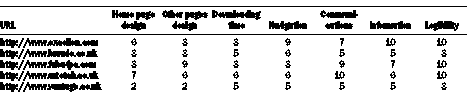
As the Home Page of this site from Vantage Circuit Products Limited, of Bolton, UK, loads up, one gets the impression of frames gone mad! In fact, there are eight of them, admittedly most of them being filled with black. These surround a tiny white window in which you see all the useful detail that may be on the site. I don't think that this is really a very happy solution to being original. Anyone with a "no-frames" browser would be left totally in the dark, because no alternative is offered. Like the first two sites, meta keywords but no meta description are provided. Naturally, the first thing I looked at was the menu item entitled "Products". These are mostly chemicals of various descriptions used by printed circuit manufacturers. A very wide range of products for different processes is offered, frequently four or five of one type. Selection of the right one for a given application is not easily seen. One thing that is excellent is the detailed maintenance and disposal of solutions. Another thing that is less excellent is the lack of MSDSs. Actually, this may not be strictly true because of the difficulty of navigation. Clicking on the menu item "Technical Data" produces a list of about 125 data sheets,referenced only by a number which is totally cryptic to anyone not in the know. Who can tell that Td1920 means that it describes a flux remover? From the Home Page, it is not possible to know where the company is situated or to contact it in any way. There is a menu item "Contact Vantage" which takes you to the company co-ordinates and, if so required, a request-information form. I was not really very euphoric with this site, especially as the server or the connection to it was also painfully slow at times.
Brian EllisCyprusMAILTO:b_ellis@protonique.com
Note
- 1.
Henry Brooks Adams, "The effect of power and publicity on all men is the aggravation of self, a sort of tumour that ends by killing the victim's sympathies", The Education of Henry Adams, 1907, ch. 10.

