

Internet commentary
Tis not enough to help the feeble up,But to support him after[1].
Keywords: Internet, IPC
This issue of Circuit World is the first of Volume 30. It is quite an achievement for a technical journal consecrated to a volatile hi-tech industry to last 30 years; it is a testimony to the quality of the publication. I take this opportunity to congratulate both the original publishers, Wela Publications, and the present ones, Emerald (MCB), for their consistent high standard.
Having worked with and programmed small computers for over two-and-a-half decades (long before the PC or the Internet saw the light of day), I consider myself reasonably computer-savvy. I am nevertheless occasionally stumped when I encounter a problem, usually at a software level. Most of the time, I find a workaround for the problem, but this must be difficult for the near-computer-illiterate who constitute over 90 per cent of the users. This was brought to notice recently by a couple of events.
The first did not involve myself, but my daughter, who pretends she is illiterate but probably knows more than the average user and is, by no means, an idiot. She had a problem in that, if she downloaded an .exe file over the Internet, using Netscape 7.02, her computer saw this as a .jpg graphics file. If she tried to execute it, it tried to open in a graphics application. I visited her at the time it was happening and I admit freely that I could not find a cause. I did an assiduous search on the Netscape Web site and forums and could not find anything relevant. Now Netscape is a freebie software, so it would be unreasonable to expect free support for the feeble, into the bargain, but I did find a page which offered paying e-mail support for USD 9 per incident. This seemed to be a very reasonable price to pay, under the circumstances, and it was a world-wide service so we started a dossier and sent off an enquiry. To our total surprise, an answer came back, stating that they offered the service only in English for English versions of Netscape (with no suggestion of a refund, I might add)! We then sent them a terse message that our question was written in good English and applied to English-language Netscape (she is an English language teacher in Switzerland, so I can only assume that a computer saw the origin was not a country with English as a national language and sent an automatic reply, assuming wrongly the language, without checking). This time, we received another reply with a suggestion that seemed valid, to sort out the problem. I do not know yet whether it actually works, but I think it will. I would give Netscape a mark of 5/10 for the quality of their paid service. They have lost points because there does not seem to be any support for foreign-language versions, at least on the main Web site, and they assumed wrongly we had a foreign-language version.
The second incident was one I encountered myself, with Symantec, for their Norton AntiVirus software. In the past, when my yearly update subscription expired, I had no problems renewing it, over the Internet, for a nominal sum. This year, I saw the usual warnings a couple of weeks or so before the expiry date. I tried to follow the instructions, but the system demanded a"subscription key", which I did not have. It said that, in the event you do not have this vital key, phone a US number for help. As there was no apparent means of obtaining help over the Internet or by e-mail and because I had no desire to spend USD 50 or more on hold with a transcontinental call, while their voice mail played irritating music interspersed with inane comments, such as "all our operators are busy; we'll put you through to a real live person if you are patient enough", I tried to find an alternative. I found on their Web site a real e-mail address for their Middle East offices, the nearest one to here. Of course, I did not receive an answer, let alone the mysterious subscription key. By this time, I was becoming anxious, as my subscription had expired and I was not being updated. I then sent an e-mail, addressed to support, info and sales @both norton.com and symantec.com asking for e-mail help, pretending that I was unable to use a phone. I got a webmaster reply, telling me to call their number... So I replied back, repeating I was unable to and needed an e-mail reply. This time, they sent me a web page URL (which I had already tried, but would accept only addresses in continental USA). This page had a link for international users, but it opened another page for just 5 or 10 s and then reverted back to the US one. Hopeless! I replied back that this was useless and this time they gave me a link to a page that worked. I finally got my e-mail virus-protected, 18 days late, but what a hassle! I therefore give Norton 1/10 for the quality of their support. This is a pity for such a superb product.
These two experiences made me think a little harder about previous support catastrophes. I believe the worst one I had with Microsoft, but not on software. I had two optical mice, where a design fault caused the conductors to break where the tail is attached to the body of the rodent (no stress relief). Some hours or so of phone calls to Ireland, England and Germany got me a case number and promised me of free replacement: I am still waiting after more than 2 years,despite numerous reminders. I must give them 0/10 for hardware. Software is slightly different. Microsoft have an enormous knowledge base with over 300,000 entries. Therefore, for any issue that you need help is available, if you can find it! This alone is worthy of at least 5/10. However, to get on-line support outside the USA is quasi- impossible and, even if you pay USD 500 for a product,you have to pay another USD 35 for each issue, if you do manage to obtain Internet support or phone in (installation problems excepted). This is extortion; how easy it is to charge the customer for the errors one makes! I therefore knock off two points for this. The other possibility is to use a netlist, which is often helpful, but slow. I therefore award Microsoft 3/10 for help with such software as Outlook or Internet Explorer.
A few months back, I tried Eudora as an e-mail client. There are three versions available and only the paid one gives the user any right to service. The knowledge base on the Web site is very poor, totalling only about 250 issues. This leaves two or three forums and netlists as the only hope for those who do not pay for their browser. I remember joining one of these and was disgusted by an arrogant, "holier-than-thou" attitude of the moderator. For the freebie e-mail client, it hardly merits more than 3/10 for support.
I have just had a quick glance at the Opera Web site. Opera is a combined browser and e-mail client, like Netscape. This powerful software is popular amongst connoisseurs; I tried it a couple of years back but, at that time, it offered no advantages over Netscape. Maybe it does now. The knowledge base contains over 690 articles but, again, e-mail support is available only for the paid version, for which you obtain a lot more than with Eudora for about the same price. I have no sure way of judging the quality of the support, but offer a tentative 4/10.
If we go beyond Internet software to, say, general office or graphics software, the situation becomes far worse. For example, Corel (WordPerfect,Draw!, Ventura, Quattro Pro etc.) clearly states "Classic Service offers 30 days of complimentary technical support on a toll line and is designed to meet the basic service needs of registered individual users.". So, you have to pay for at least a phone call, if you happen to live in a country whose phone number is given, which I don't. If you discover a bug on the 31st day after registration,then it is just hard cheese. In the USA, you can opt for a "pay-as-you-go"number at USD 2 per minute; not bad, if you are kept on hold for 30 min or so and then the "technician" at the other end spends another 15 min reading the knowledge base of his screen (as if you had not already done the same). The Corel web site is very carefully designed so that you cannot report a problem by e-mail or over the Internet. Corel are not alone; there are hundreds of other software vendors who offer an equally bad service, or even worse. I can think of only one word to describe this situation: abusive. I give 0/10 to all these companies who do not realise that, by closing the support door to millions of potential users, they are shooting themselves in the foot. With WordPerfect, for example, which is a far superior product to the market leader in the field,Microsoft Word, better support than Microsoft would have been a strong sales argument, instead of a poorer one.
Very occasionally, one gets a pleasant surprise, with a company providing a real after-sales support. I remember, when I was selling the Vutrax ECAD software in Switzerland, one of my customers phoned in with a problem that appeared to be a genuine bug. I confirmed that the problem was real and reported it to the authors. I was happy to be able to e-mail my customer a patch to correct the problem the following afternoon. That is superior support. I have had other examples of good service, even with a few mass-distribution softwares. For example, ZoneLabs, the makers of my firewall software, still offer a 10/10 support service by several means, including over the Internet. If they can do it, why can't others?
A few months back, the IPC rehashed their Web site and I am taking the opportunity to review the new one, having let the bug-dust settle.
I am not sure that I like the new layout; in fact, I am sure that I don't. There is a terrible waste of space and real estate, because everything is compressed into a fixed screen width of 790 pixels, presumably because 800×600 is one of the standard screen sizes. If the authors had allowed full screen width to be used, those (most of us) with a higher resolution screen, would have profited from the space, making for easier reading and navigation. This problem is exacerbated by the use of an inordinately large type face (font size) in the central pane, where all the useful information is. This is shown in Plate 1,with just 20-odd lines of text, and about seven words per line, over just 375 pixels (in the case of this screen shot, the information column is 29.3 per cent of the screen width). This combination of facts results in an unnecessary and painful need to scroll downwards, which could have been easily obviated by having the width adjust automatically to the screen and have fixed-pixel left and right panes (not that the right pane even serves any useful purpose in this illustration).
While on the subject of site generalities, I would also like to mention that some of the pages have 30 or more graphics items plus important scripting for the menus. This does not allow for quick downloading for those of us constrained to using a phone line modem. Most of the graphics are small and of relatively little consequence, except for the page headers, which cannot be cached and must be downloaded afresh each time and for each subject. If the 'Net is busy, this also makes for painful use of the site.
Navigation is easier than with the old site, thanks to a neat scripted menu system, with hovering drop-down menus from the five main items, at the bottom of the page header, and detailed context-sensitive sub-menus in the left pane,which could be made slightly narrower, in my opinion, to offer even more space. There are some additional administrative menu items at the top right of the header.
So, what of the content? I don't think there is a great deal of difference except in the way it is organised and set out. But it is difficult to improve on something that is already excellent. This does not imply absolute perfection;there are probably sins of both omission and commission. What is impressive is the way that it is kept up-to- date. This is something that requires resources and the IPC has obviously been devoted sufficient time to ensure constant refurbishing. This is unusual amongst such organisations. The main organisation is hierarchically grouped under five main menu headings, IPC, Industry, Knowledge, News and Events. From these, there are three to seven sub-menus, with any number of sub- sub-menus and even to a fourth generation selectable by little triangles. Obviously, to follow each one of these through and to comment on them would require much more space that the Editor thinks I merit, so I will just mention what I consider some key pages. I will indicate the path for each one.
IPCjAbout IPCjMission statement. As the name implies, the mission statement tells surfers what the organisation is all about.
IndustryjIndustry data. This opens a sub-menu with eight important items, including market trends and market research reports. Also visible, at this stage, are other menus covering US Government Relations and Environmental and Health and Safety issues. These pages are mainly American, even though the IPC has world-wide membership and influence.
KnowledgejStandards. For me, the greatest value that the IPC offers is as a standardisation organisation and this opens a sub-menu with a number of very appropriate items. Of course, the sheer number of standards makes the subject a nightmare, especially as some may have been developed with what is, at present, old technology. I have always said that standards should be tempered with sound common-sense, rather than applied too rigidly.
KnowledgejE-mail forums. This is a popular feature of the IPC offerings, especially TechNet, which currently has a tad less than 1,000 subscribers (with little dead wood, as the list has been recently revised). This page catalogues a total of 14 forums or netlists and I am a little bit puzzled why the IPC have not seen fit to give the full list, which I believe numbers over 20. For example, I subscribe to the EnviroNet, so I know that it exists with, I think, about 100 subscribers.
NewsjIndustry news. As an illustration of how this is maintained, on the day of writing this article, eight news items have been added, each with a hyperlink to the origin. The next sub-menu item, IPC News is also updated regularly, even if news is not necessarily a daily event. There are five other news sections on the sub-menu, so that no one has an excuse for not knowing what is happening to, within and around our industry.
EventsjCalendar. This page gives a list of all the IPC meetings and suchlike over the next 6-9 months. Happily, unlike some similar calendars run by other organisations, this is not a history book of what has happened in the past, but appears to be maintained on a daily basis. There are separate pages for the combined 2004 APEX/ EXPO show, in Anaheim, next February.
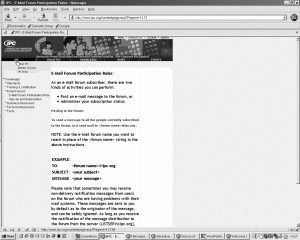
Plate 1 A random sampling of a page on the IPC Web site, showing the waste of monitor real estate
In summary, an excellent site for content and constant updating, but I have to give less than full marks for the implementation, which is less than user-friendly. This is a shame, because I am sure that some more attention to detail and layout could have made this one of the best, all-categories, Web sites on the Internet.
Brian EllisCyprus,b_ellis@protonique.com
Note
1 William Shakespeare, Timon of Athens (c. 1607) act 1, sc. 1, l. 108

