The paper presents a comparison of China's Belt and Road Initiative (BRI) and the EU’ Global Gateway (GG).
The paper undertakes an economic and institutional comparison of China's BRI and EU's GG to assess their differences and similarities and their effect on developing countries.
China's strategy was successful, but with time it met with some economic and political difficulties. So far GG was unable to really compete with BRI, although it may offer an interesting complement to developing countries and feeble chances of cooperation between the two initiatives.
The comparison between BRI and GG concentrates on facts and achievements, including the accuracy of criticism and prize for each of the two initiatives, but avoids political and partisan judgements.
1. Introduction
The international financial crisis of 2007–2009 weakened international economic relations, further strengthened by restrictive stabilization policies. The crisis was actually concentrated in the Western countries, whose economies slowed down significantly, with negative consequences for their international trade and foreign investments. Particularly serious was the effect in the European Union (EU) that went through a second dip in 2011–2012. Although not directly hit by the crisis, the importance of economic relations with Western crisis contributed to the slow-down of China's economic growth, accompanied by unbalances in the internal market. Moreover, for China, it was important to find a replacement for the increasingly problematic investment in US treasury bonds.
The Chinese government emerged with a novel, innovative idea: revive the old Silk Road (Quah & Nursultan, 2023). The name recalled 1,500 years of open markets and prosperity connecting Eastern China and Western Europe. Historically, the Silk Road run from 130 B.C. when the Han dynasty opened trade to the world, until 1453 C.E., when the Ottoman Empire closed trade with the West. The modern approach of China was pragmatic and strategic. Resources backing the project were abundant and immediately available. Returns and advantages were appealing and significant. With BRI, China and the participating countries had a powerful instrument for playing a fundamental role in globalization and attract the interest of the rest of the world.
President Xi announced the initiative in 2013, at the beginning of his office, while visiting Kazahstan. The aim was to involve numerous countries crossed by the six overland economic corridors and touched by the Maritime Silk Road. The development of BRI went hand in hand with the transformation of China from an emerging economy into a world economic and technological leader. It proved to be central to Chinese foreign and economic policy, promoting trade connectivity and granting China a leadership role in global economic and political affairs.
The success of the initiative is widely recognized and prompted a number of imitators around the world, although it also rose criticism for real or supposed deficiencies and problematic effects. This article aims to look at BRI from a European perspective, considering the place of EU countries in BRI and comparing the latter with the parallel EU initiative of Global Gateway (GG). The next section highlights the main achievements and problems of BRI in its experience so far (Section 2). It continues by examining the main criticisms and positive assessments of BRI (Section 3). Section 4 considers the BRI relation with the European Union and its cooperation with EU countries and continues in Section 5 by examining the parallel EU initiative of Global Gateway. Section 6 compares the main features and outcomes of BRI and GG. Section 7 aims at presenting a balance of the two initiatives by comparing their advantages and disadvantages. Section 8 concludes.
2. BRI and its achievements
BRI is a cooperation platform with a complex yet pragmatic approach. It is endowed with abundant financial resources, based on political flexibility, and aims at coordinating the activities of public and private companies with national interests. An important support was the establishment of the Asian Infrastructure Investment Bank (AIIB) in 2014 with the aim of raising and managing funds for infrastructural investments.
BRI has provided abundant financial resources and organizational capabilities to successfully promote economic growth and created opportunities for the cooperating countries and China. Its effect can be seen in the development of infrastructure and the reduction of costs of mobility. These are important components for the advancement of production and trade relations in both China and the participating countries, together with the development of a Renminbi-based regional payment system.
The assessment of BRI and its achievements is generally positive. A recent OECD/EUIPO (2025, p. 3) report observes that the initiative “has made significant contributions to global economic growth, mobilising hundreds of billions of USD in investment in infrastructure projects across 151 participating economies. This strategic endeavour aims to enhance trade routes while also extending China's contribution to areas such as food security and cultural ties. Thousands of projects have been initiated, notably in the transport and energy sectors, often providing crucial development opportunities for recipient countries. … The BRI projects have brought numerous benefits to a wide range of countries, spurring economic activity and boosting trade.”
BRI's success is also stressed by the number of participating countries, their weight in terms of population and GDP, investment and infrastructure development. According to China Daily, “more than 150 countries — representing nearly 75% of the world's population and over half of the global GDP — have joined the BRI” in early 2025 [1]. The exact number is slightly uncertain because in a few countries there is no certifiable information on the effective signature or renewal of the Memorandum of Understanding (MoU) necessary to be a BRI member. Independent sources put the number of effective members at between 146 and 150, including China (Nedopil, 2025). The highest number of member countries is in Africa (53 countries), followed by Europe (29 countries), Latin America and the Caribbean (21 countries), the Pacific (12 countries) and Southeast Asia (10 countries). The remaining member countries are in the Middle East, Central Asia, South Asia and East Asia. The only continent without member countries remains North America. Two countries (Panama and Italy) have exited BRI.
This membership is impressive. Equally remarkable is the activity that BRI has achieved since its announcement in 2013. BRI pursues five priorities as expressed in the BRI official website: policy coordination, facilities connectivity, unimpeded trade, financial integration, people-to-people bond [2]. In all these fields, BRI reached significant achievements as of the end of 2025, and the acceleration during 2025 was particularly impressive, which “saw the highest BRI engagement ever for any year, with USD 128.4 billion in construction contracts and about USD 85.2 billion in investments” (Nedopil, 2026). Record achievements extend to energy – by far the preferred sector for Chinese investments – both fossil and renewable, metals and mining, real estate, technology, transport, utilities and manufacturing. Among the geographic areas, Africa stands out with nearly tripling investments and nearly half of the Chinese construction investments. Central Asia had one-third of investments in other sectors (with Kazakhstan receiving the highest amount of $25.8 billion in 2025) and South-East Asia nearly one-fourth. The latter two regions are where industrial delocalization from China is most prominent.
The impressive BRI investment activity was driven particularly by private companies, except in construction, where state-owned enterprises (SOEs) dominate. The cumulative value of Chinese investments through BRI since 2013 reached the impressive amount of $1.399 trillion, of which $837 billion is in construction. In 2025, there was a significant increase in the share of investment in metals and mining, technology and manufacturing and a strong decrease in transport.
These investments are driven by the need of host countries, but they also clearly reflect the needs and priorities of China and the international situation. For instance, Nedopil (2026) reports that the abrupt surge of investments in Africa in 2025 may be linked to US tariffs that are lower for various African countries than for traditional Chinese investment destinations in South-East Asia. A particularly significant sector for investments is energy, where overall investments and related activities (including exploitation, processing facilities and pipeline projects) more than doubled in 2025 to $93.9 billion compared to 2024. While in China investments in renewable energy have been booming in recent years and China is the most advanced country in green energy production, Chinese investment in fossil energy is still dominant elsewhere, also in line with local opportunities and resources. Indeed, investments and related activities in renewable energy within BRI more than doubled in 2025 compared to 2024 to $21.4 billion (wind, solar, waste-to-energy and hydro). This is the highest level since 2013. However, investment in fossil energy almost tripled in the same period, to $71.5 billion. Even if coal mining continues to attract interest, the main effort was in gas procurement. Considering the resources invested in all activities necessary for energy development, oil is still the most important source of energy (44% of total) followed by gas (29%) and renewable energy (20%).
An important and interesting aspect of BRI strategy concerns industrial cluster cooperation and regional supply chain stabilization in China, Central Asia and Russia in a time when globalization appears to be in retreat (Wang, Li, Ma, & Wang, 2026). Uncertainty is shadowing the world economy, global industrial and supply chains are increasingly under attack and the geopolitical and economic environments of China are becoming more complex and volatile. BRI is important in this context because it offers a strategic platform for regional industrial cluster cooperation involving China, Central Asia and Russia.
3. Criticism and reality
While BRI achievements are impressive, various observers and scholars have raised some concerns, particularly related to financial stability, local communities and the environment. While a precise assessment would require to consider the many particularities of each involved country and implemented projects, a summary of criticism is provided in CISL (2022, p. 4) “…despite important variations in local planning and governance processes, the implementation of BRI projects in different places across the Global South and North includes the following four key elements”: (1) BRI projects have not paid sufficient concern to environmental regulation and impact assessment, also because of the easing approach of host countries, leading to negative environmental and social effects; (2) large BRI projects have often negative consequences for local communities, leading to pollution or displacement and leaving solutions to local governments; (3) BRI projects may worsen local labor relations, standards and conditions of employment, particularly in relatively developed countries; (4) neither BRI projects nor local governments sufficiently include local communities in decision-making processes nor provide accurate information on the relevant project.
In reality, it is difficult to reach a correct and univocal assessment of a complex set of initiatives as BRI is. It is also difficult to assess the final cause of some problems that have occurred, such as cases of debt distressed. The ambition of some projects and the weak economies of some of the participating countries have raised concerns that forced China to turn into an ultimate lender (Horn, Parks, Carmen, Reinhart, & Trebesch, 2023). Moreover, and particularly in the present-day international context, the danger is that political prejudices or partisan interests distort information and assessment. The most controversial issue is probably the one of finance.
Some studies support the view that China is now more a recipient of repayments than a lender of fresh capital. For example, Duke (2025) finds that China “…that was once the developing world's largest source of new finance has now wholly transitioned to being the world's largest single destination for developing country debt service payments. The Belt and Road Initiative hit its peak in the mid-2010s; peak repayment was reached in the mid-2020s. Now, and for the rest of this decade, China will be more debt collector than banker to the developing world.” Similar are the conclusions that Lu (2023) reaches: “…China's lending for BRI projects has plummeted, largely a casualty of the COVID-19 pandemic and the country's own economic slowdown. Support has also waned as partner countries drown in debt and fractures emerge—literally—in projects, fueling uncertainty about the future of the sprawling initiative. In 2022, 60% of China's overseas lending went to borrowers in financial distress, compared to just 5% in 2010”.
Green (2024) acknowledges the existence of a double view of the question: “To developing nations that feel shunned or ignored by Western governments and financial institutions, China's BRI is seen as their best—if not only—hope for assistance with high priority infrastructure projects. To some Western nations, BRI is viewed as ‘debt trap diplomacy’”. In fact, “Ten years into the Belt and Road Initiative (BRI), 80% of China's government loans to developing countries have gone to nations in debt distress.” A statement that obviously is not proven and fails to clarify the cause and the consequence.
Observers often maintain that host countries of expensive BRI implementations may easily fall into a debt trap or that BRI is a new form of “colonialism with Chinese characteristics” (Kleven, 2019). However, these accusations – usually raised by newspapers and politicians – do not stand up to the facts or a critical view of their underlying motivations (Blanchard, 2018; Bräutigam, 2020; Bräutigam & Rithmire, 2021; Jones & Hameiri, 2020). Sound research on the issue usually finds that Chinese loans are not a major contributor to debt distress in developing and poor countries (Eom, Brautigam, & Benabdallah, 2018; Kratz, Feng, & Wright, 2019) and that China, as a member of the Debt Service Suspension Initiative (DSSI), is at the forefront in contributing to debt service suspensions (63% of debt service suspensions compared to 30% of all claims) (Brautigam & Huang, 2023). Various researchers observe that most of the debt of BRI countries is owed to international organizations or private institutions and that China is open to write off and provide debt relief to borrower countries (Jin, 2023).
The positive view of BRI loans is clearly prevailing, particularly among scholars and experts, with caveats. Horn et al. (2023) build a comprehensive dataset on China's overseas bailouts between 2000 and 2021 and conclude that: “…China has launched a new global system for cross-border rescue lending to countries in debt distress. …the global swap line network put in place by the People's Bank of China is increasingly used as a financial rescue mechanism, with more than USD 170 billion in liquidity support extended to crisis countries, including repeated rollovers of swaps coming due. The swaps bolster gross reserves and are mostly drawn by distressed countries with low liquidity ratios. In addition, …Chinese state-owned banks and enterprises have given out an additional USD 70 billion in rescue loans for balance of payments support. Taken together, China's overseas bailouts correspond to more than 20% of total IMF lending over the past decade and bailout amounts are growing fast. However, China's rescue loans differ from those of established international lenders of last resort in that they (i) are opaque, (ii) carry relatively high interest rates, and (iii) are almost exclusively targeted to debtors of China's Belt and Road Initiative.”
Although Nedopil (2026) observes that Chinese finance and investments into BRI countries have accelerated significantly in 2025, recently BRI has moved to smaller projects to understand local needs better and avoid greater risks with very large projects, accelerate their implementation and perhaps with the intent of decreasing waste and indebtedness of recipients (Wang & Christoph, 2023). China also issued a debt sustainability framework for overseas investments in 2019, in order to reduce sovereign debt risks for Chinese investors and sovereign debt distress risk for recipient countries and pursued alternative debt relief mechanisms, such as debt for nature swaps. Following the distress that the COVID-19 pandemic caused to many countries, China joined the debt service suspension initiative (DSSI) and the Common Framework in 2020. This was the first time for China to work on sovereign debt relief in a multilateral rather than bilateral setting.
A significant problem with these findings is data transparency. Their source is usually the World Bank Debtor Reporting System (DRS), which may not cover all lending by China, which mostly come from large state-owned financial institutions. According to Green (2024), “The terms and conditions of BRI financing were often shielded from public view through strict nondisclosure agreements”. Parks et al. (2025) stress that China's loan-by-loan data in international reporting systems are subject to strict confidentiality rules and restrictions, thus making their assessment impossible. Duke (2025) observes that China's government does not publish country- or loan-specific data on its lending and that data supplied by debtor countries to the World Bank's International Debt Statistics (IDS) are often incomplete. This means that official data likely understate the value of China's lending. In fact, using the AidData's newly assembled dataset, Parks et al. (2025) conclude that China's overall lending portfolio is vastly larger than previously understood, around $2.1 trillion, which makes China by far the world's largest official creditor. It should also be considered that 80% of Chinese lending goes to poor and distressed countries, which are riskier and prone to already being in a debt trap (Green (2024). Finally, we should remember that investments and loans are bilateral businesses involving voluntarily China and another country, whose government has agency in the agreement and its implementation.
The great expansion of connectivity and trade and the increasing complexity of supply chains may also contribute to expand illicit activities, counteracted by the effectiveness of governance and regulation (OECD/EUIPO, 2025). Data analysis of counterfeited goods exported to the EU 27 countries based on customs seizures from national customs administrations shows that China has intensified its efforts to curb smuggling and illicit trade. In fact, the number of reported seizures of goods exported from China to the 27 EU countries over the period 2015 to 2022 has increased in both absolute and relative terms. However, there was a decrease in terms of both value and as a share of the total value of seizures.
4. BRI and the EU
The EU and its member countries are important for BRI in that they are the terminals of various BRI roads: those on land, water, digital, health, culture, green technologies and polar routes. They are also fundamental in terms of BRI trade and investments. However, the EU position on the BRI is often critical if not adverse. Moreover, the EU launched its own BRI-like initiative: Global Gateway, and it is a member of other Western initiatives.
BRI's interest for the EU and its member countries has been keen since the beginning, for various reasons: the size and sophistication of the unified EU market, the advantage of the common currency, the technological level, Europeans' interest for green technologies and others. The EU interest in the BRI continues to be considerable, for its financial endowment, China's large and dynamic internal market, the advantages of infrastructure development, the possibility to reach other countries and markets along the way between the EU and China, the stability and reliability of China's long-term and strategic approach, access to China's technologies and industrial components and still others.
China prefers a direct approach to member countries and bilateral relations in place of a multilateral approach via the EU (EFSAS, 2024). Although this preference is understandable in view of BRI's bilateral organization, it is at odds with the EU institutional architecture and policy approach. In fact, international economic relations of the EU, particularly trade, are competence of the EU and its European Commission and not of its member countries. The mismatch has been a source of misunderstanding between the two parties and an obstacle to better institutional relations between the EU and BRI.
For BRI, operating in the EU also offers the advantage of access to EU funds. However, in exchange, BRI has to operate according to EU principles of transparency, fairness, environmental protection and avoid in its bids to discriminate against other EU member countries. Bilateral dealings are difficult since they expose to EU intervention and control, but also offer greater freedom to adapt to local conditions and mutual interest.
China had since the beginning a preference for business deals with large and economically advanced countries, where BRI concentrates most of its EU investments. However, better political relations developed with less advanced and economically weaker countries, particularly in South-Eastern Europe. This is a second-best for China and a political problem for the EU. With time, some better politically integrated and EU mainstream governments (e. g. the Baltic countries, Germany, Italy, etc.) either left BRI or took on a politically passive attitude, while their companies continued to do business with BRI. Conversely, countries with conflictual relations with the EU, such as Hungary and Slovakia, or in need, such as Greece, have a keen interest for and strong relations with BRI.
Analyses on the relation between BRI and the EU hold different views and reach disparate conclusions. Duggan and Szunomár (2024) stress the highly institutionalized nature of trade with China and its management through a network of high-level economic and trade dialogues. Although trade policy and regulation and trade agreements belong in the European Commission's competence, member countries have their own channels and goals. This situation creates a system of EU-China trade relations that has a hybrid nature, since the European Commission defines the broad trade policy, but it depends on the member countries' consensus to approve and implement the agreements.
Éltető, Peragovics, Sass, and Szunomár (2024) provide a careful analysis of Chinese economic presence in Hungary. Hungarian imports from China come primarily through participation in global value chains. While Hungary's exports to China are relatively unimportant, imports are above the EU average, and China is Hungary's second most import partner after Germany. FDIs are more important and continuously growing: Hungary has become the primary target of Chinese FDI in Europe, and China is the top investor in Hungary, although FDIs accounted for just 3.5 % of the total stock of FDI in 2022. Chinese FDIs are particularly relevant in the automotive industry and electric battery production, taking advantage of Hungary's firm integration within European automotive supply chains. Advantages for China include efficiency-seeking – being Hungary an open economy deeply integrated in the EU and with low labor costs – and fiscal advantages (advantageous fiscal treatment and generous state support).
According to Szany and Szunomár (2026), China targeted East-Central European (ECE) countries as low-cost bridgehead to access the single European market. BRI investments started to increase at the beginning of the century, but accelerated recently, especially in Hungary and Serbia. Their study highlights the close political ties that the two countries developed with China, expecting Chinese investments (FDI) to compensate for the diminishing flow of investments from the EU and other Western countries. This was expected to help the two countries maintain their FDI-dependent development model. The Authors see no significant positive economic impact from this strategy, the net capital inflow apart. The strong concentration of Chinese investments in Hungary in electric vehicles (EV) and EV batteries may even increase dependence and vulnerability of the economy.
Various authors have a complex and overall positive view of the relations between the EU and BRI. These authors often distinguish between all-EU projects and BRI relations with individual countries. Casagrande and Dallago (2025) stress that BRI aims primarily to create direct trade links with EU countries through railway and motorway connections and through the BRI Maritime Route reaching both Mediterranean and Northern European ports, particularly those located in Greece, Italy and Germany. The China–Europe Railway Express has reached more than 200 cities, crossing 25 European countries.
Looking at South-Eastern Europe (SEE) and considering EU member, candidate and non-EU countries, Casagrande (2026) stresses their strategic value for China. Most of these countries are involved in BRI, whose purpose is to connect East Asia and Western Europe through routes resilient to geopolitical tensions. Based on the analysis of 396 BRI projects undertaken between 2005 and 2020 in 27 SEE countries, the study concludes that BRI infrastructure projects connecting ports to railways and motorways are of strategic importance, in spite of the predominance of Digital and Silk Road (DSR) projects. Problems concerning their implementation would require that European institutions contribute to improve the compatibility of BRI with European practices by finding a new cooperation balance in EU–China relations.
In the EU, BRI was initially considered important for developing economic relations with China and the strategic role of the EU as the terminal of both land and maritime BRI routes, similarly to China's perspective. The EU and China agreed on the ‘EU-China 2020 Strategic Agenda for Cooperation’ in 2013. The European Commission and the Chinese government signed the MoU of the EU–China Connectivity Platform two years later for enhancing transport synergies between BRI and the EU.
Casagrande and Dallago (2025) analyze 727 projects in 46 European countries from 2005 to 2021 to assess BRI's development in the European Union. The analysis contemplates various aspects of the projects: their location, typology, status and the key enterprises involved. The article shows that there actually is a “two-speed Europe”, distinguished by the dominant type of investment. In North-Western Europe the vast majority of projects are part of the Digital Silk Road and address telecommunication, transfer technology, data center, 5G, fintech. In South-Eastern Europe and Balkan countries, traditional infrastructural investments in ports, roads and railways prevail. This specialization of investments explains the different sensitivity of countries to BRI cooperation. In North-Western Europe, the main concern is cybersecurity and data protection issues. The situation is more relaxed in South-Eastern European countries, which look favorably at the development opportunities through BRI initiatives.
For years, the EU failed to provide a common response to BRI or define a common EU strategy. In this period, China established BRI relations with individual member countries, receiving positive answers particularly from countries in the most difficult economic situations, such as Greece and Eastern European countries. China has promoted the 16 + 1 framework since 2012 to foster cooperation in infrastructural and development projects, later increased to 18 EU countries. Western and Northern EU countries had a more critical attitude towards a supposed lack of reciprocity by China, particularly in the case of investment (Oertel, 2020). In spite of this, the bulk of Chinese investments flows to countries that did not join the BRI, (UK, France and Germany), primarily in high-tech, financial and monetary fields (Kratz, Zenglein, Sebastian, & Witzke, 2023). Since Chinese investment in other EU countries concentrate in traditional infrastructure, China seems to adopt two different strategic approaches in dealing with core and peripheral European countries. Infrastructure is also the dominant field of Chinese investments in EU candidate countries, particularly Balkan countries, which are an important point of infrastructural access to Central Europe (Casagrande & Dallago, 2025).
5. Global Gateway: meaning, content, data
Following years of scattered participation in BRI of various EU countries and the failure to find an institutional agreement with BRI, the EU finally launched its initiative, the Global Gateway (GG), in December 2021 (EC, 2021). GG is “a new European strategy to boost smart, clean and secure links in digital, energy and transport sectors, while also strengthening health, education and research systems across the world.” The announcement was made with ambitious terms and based on appealing principles, yet extremely broad and without clear priorities: “The Global Gateway stands for sustainable and trusted connections that work for people and the planet. It helps to tackle the most pressing global challenges, from fighting climate change, to improving health systems, and boosting competitiveness and security of global supply chains.” (EC, 2025) The organization, governance and implementation model is the EU one: “The European model of trusted connectivity in partner countries is long-term and in line with EU's interests and values: rule of law, human rights and international norms and standards. It is about smart, clean and secure investments in quality infrastructure; connecting goods, people and services around the world in a sustainable way”. The pillars of the initiative are six basic principles: democratic values and high standards, good governance and transparency, equal partnerships, green and clean, security focused, catalyzing private sector investment.
The overall GG philosophy is prioritizing the EU model and approach to avoid being sucked into malpractices, inefficiencies and foot-dragging, but with scant reference to the peculiarities and needs of partner countries. To support this grand program, the EU mobilized €306 billion. The EU actually finances only €53 billion in guarantees, and it expects to leverage up to €232 billion of sustainable investments. Grants and loans by development finance institutions are expected to provide additional financing.
These figures represent a significantly lower value than BRI, and they are provided in the “Team Europe” format [3]. This is another major difference compared to BRI: Team Europe consists of the European Union, EU member countries, the European Investment Bank (EIB) and the European Bank for Reconstruction and Development (EBRD). This complex structure is necessary because the EU itself lacks the resources that China mobilized and has to foster the participation and contribution of financial institutions and the private sector, with remarkable coordination and governance complexity.
The financial structure of GG makes it both fragile and strong at the same time. It is fragile because the financial push by the EU is minimal and consists of guarantees to private organizations and businesses that, with the support of the financial institutions linked to the EU, should mobilize the money necessary to the implementation of the GG projects. This requires that the GG program is sufficiently appealing to activate a substantial leverage of 4.38, which the EU says is in line with past experiences) and that private companies and organizations are able and willing to increase their indebtedness for implementing GG projects. The structure of the program is also open to the dangers of bureaucratization. At the same time, GG is strong because its decentralized approach based on sound principles, if successful, can mobilize a high number of companies and organizations in the EU and in third countries through an intense set of networks at different levels (from governments down to SMEs and NGOs).
The outcomes of the first years are mixed, also due to the international turmoil that may be particularly disruptive for decentralized initiatives. However, in the period from 2021 to the end of 2024 GG mobilized investment for a total of slightly more than €306 billion. Consequently, the EU increased the total foreseen by the end of 2027 – the last year of the current EU multiannual framework – to €400 billion.
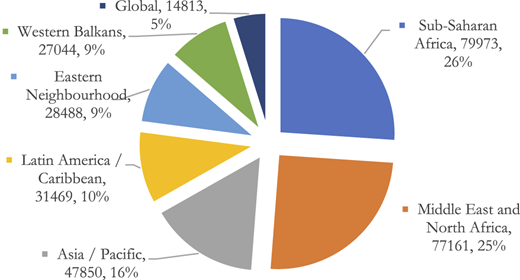
Noteworthy is the geographical concentration of GG investments, more than half of which went to Africa and the Middle East (Figure 1). Geographical priorities have much to do with the EU attempt to create a reliable basis for supplies of energy and strategic raw materials, following the embargo against Russia and the policy of derisking from China. Only less than one-fifth of GG investments go to Western Balkans and Eastern Neighborhood countries, which should be the main concern for the EU [4]. Direct GG support to the countries of the two latter regions moved an estimated financial leverage of 4.28 through other sources, lower than but close to what foreseen when the program was launched. Privileged sectors in these areas have been supporting private-sector development and project for improving energy, transport, digital and green connections and infrastructure.
Global Gateway has been careful in following internationally recognized standards since the beginning. In particular, GG is fully aligned with international development and environmental goals and standards, in particular the UN Agenda 2030 and its Sustainable Development Goals, as well as the Paris Agreement on combatting climate change. So far, GG has financed 286 projects. Unfortunately, according to a document recently endorsed and published by the Council of the European Union, the implementation of GG projects is apparently slow and most of them are delayed compared to the official timetable [5]. Moreover, there is a serious mismatch between official statements and the reality coming from research and the opinion of involved officers and partners.
A recent resolution by the European Parliament (EP, 2026) repeatedly uses high-sounding expressions to state GG's moral and technical superiority over BRI in a clearly confrontational attitude and at the same time a strategy serving EU interests [6]. However, enquiries into the reality of GG offer a much gloomier picture. For instance, the European Centre for Development Policy Management finds a great amount of skepticism from partners, often clear confusion, about what the EU is trying to achieve: “External criticism generally pools around two poles: a lack of transparency and honesty - such as whether the stated finances add up - and concerns over conflicting aims, such as suspecting development and ‘mutual partnerships’ are now subservient to pure European self-interest.” [7] Drawing on candid interviews with senior diplomats and experts from Africa, Asia and Latin America, Veron (2025) finds that “a clear tension between how Europe sees itself and how it is increasingly viewed by others. Many still see the EU as a highly relevant global actor, appreciated for championing human rights and sustainable development … Yet, its credibility is waning. Perceptions of hypocrisy, double standards and post-colonial attitudes persist, and initiatives such as the Global Gateway are often seen as top-down and lacking consultation or tangible benefits.”
Moreover, GG meets serious implementation challenges, including slowness, bureaucracy, no fresh funding or clear operational direction and limited alignment with partner priorities. “The gap between high-level branding and the complex, sluggish reality on the ground is eroding the strategy's credibility. EU and member state officials are well aware of these shortcomings and, in private, often express strong frustration” (Veron, 2025, p. 17). However, there also is appreciation for the EU values-based approach and standards, that are perceived by some partner countries as a plus of the EU approach (Di Ciommo, Veron, & Ashraf, 2024).
These problems induce to ask for “scaling up” GG and develop its strategy to create a more comprehensive, coherent and competitive financial offer [8]. However, it is interesting to notice that the criticism moved to framing GG in opposition to BRI is seen as an issue of no interest for partner countries and “a strategic misstep that undercuts its relevance” (Veron, 2025; see also Di Ciommo et al., 2024).
6. BRI and GG: a comparison
After the launch of BRI in 2013 and its success, Western countries followed with different initiatives (for an excellent review, see Quah, Jun Rui Tan, & Nursultan, 2025). Either explicitly or indirectly, each of these initiatives have been in contrast to BRI, indirectly showing the latter's importance and success. Neither one, though, has been able so far to reach a comparable impact. Moreover, even when announced in coordination with other similar initiatives, they remained clearly or substantially distinct, even if goals could be shared. However, they may offer complementary and cooperative actions to the advantage of recipient countries. There is an enormous need for infrastructural development in developing countries, estimated at US$ 1–2.7 trillion per year [9]. This means that the ongoing initiatives, even when taken together, cover only a fraction of the needs.
The Blue Dot Network (BDN) was launched in 2019 by the US, Australia and Japan. BDN is a multilateral infrastructural program supported by the three governments, in line with the UN Sustainable Development Goals (SDGs) and aiming at the private sector. BDN is essentially an internationally recognized certification system for quality infrastructure projects that are environmentally and socially sustainable but it provides neither funding nor clear guidelines or coordination (Ashbee, 2021, Link to the website).
The G7 proposed the ‘Build Back Better World initiative’ (B3W) in June 2021, with a goal similar to BRI. Although the initiative was presented as an alternative to BRI under the US leadership, it met various difficulties. It was consequently transformed into the Partnership for Global Infrastructure and Investment (PGII), providing credit to private investments in infrastructural projects in developing countries. The financial goal of PGII is to activate up to $600 billion by 2027 from G7 countries and the private sector (Simonov, 2025), also in coordination with GG.
GG was launched 8 years after BRI, having the advantages and disadvantages of late comers. Main advantages are that GG could gain insights and suggestions from BRI strategy and solutions, organization and used instruments, definition of goals, successes and problems of implementation. Disadvantages are that, by the time when GG took off, BRI was already a well-established initiative. Moreover, GG had to coordinate and compete with other ongoing Western initiatives.
It is interesting to compare BRI and GG because, along with competing with each other, the two initiatives have various idiosyncrasies that are worth considering. Both initiatives intend to contribute to filling the infrastructural gap in poor and developing countries. However, they intend to do so in significantly different ways. The main difference is that BRI prioritizes effectiveness and speed of implementation, thus accepting local institutions and practices. It has well-defined strategic goals under a consistent, unified governance and is supported by substantial financial resources. Conversely, GG is a decentralized initiative with soft governance and lower financial resources, stressing compliance with the fundamental principles of the EU, such as transparency and accountability, with the intent to also upgrade local institutions and practices, but requiring significant administrative conditions.
Its nature makes GG more complex, its strategy and goals less focused, its actions and implementation inevitably slower due to the complex governance system, its organization and instruments more varied with possible consistency and effectiveness problems. However, GG looks more flexible and potentially more apt to deal with problems and target countries of different nature, features and needs. In the present geopolitical landscape, GG may be part of the evolving multipolarity, but also of the EU attempt of derisking from China and of building alternative global value chains (GVC) and sources of strategic materials.
The difference in approaches comes from the history of the two initiatives. BRI was and continues to be a Chinese idea promoted principally by Chinese financial, human, organizational and technical resources, with local cooperation and contribution. This guarantees speed and standards and has the significant advantage of adopting a well-coordinated, systemic approach with limited administrative requirements. Moreover, BRI also better serves Chinese interests, particularly in the development of ambitious transcontinental infrastructural networks. GG follows a decentralized approach, with particular projects coming from local initiative in cooperation with the private sector in EU countries. This guarantees good correspondence to local needs and an active role of local actors and of EU interest, at the cost of greater administrative and governance requirements and weaker coordination among the different projects.
The role of broader goals was clear in BRI since the beginning: promote infrastructural development as a key aspect of the involved countries' development process and as a necessary basis for international cooperation and integration in an increasingly multipolar world. Significant has also been the goal to guarantee an international market for the considerable production and building capacity of Chinese firms and foster their cooperation with firms of the partner countries and favor trade across the implemented corridors. GG was a late comer for which competing with BRI played a role since the beginning. As a latecomer, a prominent has been the will to assert the role and importance of the EU in international development.
The two initiatives also have some differences concerning the geographical and sectoral focus and the variety of projects. BRI is quite wider in its scope and reach, covering large parts of Asia, Africa, Europe, up to Latin America and the Pacific. However, activities are mostly concentrated in those areas and sectors that are most important for connectivity. The GG decentralized approach has less focus and lacks a clear priority for particular geographic areas and sectors, although parallel actions make clear a significant interest in Africa and the Middle East.
Significant differences exist concerning the amount of mobilized resources and the effective support provided to partner countries and local actors. BRI was endowed since the beginning with large financial resources directly provided by China through its financial institutions and government. This went particularly to the advantage of the implementation of projects that pursued the public interest in the partner countries more than private interests, projects that were often part of an overall coordinated transnational vision of connectivity. This is a significant advantage of BRI, although achievements may be exposed to weaker care for financial sustainability by local partners. GG presents more problems concerning the amounts of available resources. Financing of GG projects depends largely, if not totally on the willingness of private actors to contribute to the projects, which in turn makes the coordination of different initiatives more difficult.
Finally, a major difference concerns the potential openness to mutual cooperation and reciprocity. BRI had an interest for the EU since the beginning. The Chinese government showed some willingness to involve the EU. Existing obstacles convinced the BRI authorities to prioritize relations with member countries, with predictable difficulties growing from the EU side. Conversely, GG started as an initiative to counteract BRI and give the EU a corresponding instrument to reach out to the developing countries. Cooperation with BRI was really never pursued.
7. BRI and GG: advantages and disadvantages
Competitive initiatives open an important question: how positive is for developing countries to have different initiatives with similar goals but not cooperating? Why are countries eluding cooperation in supporting the progress of disadvantaged countries and promoting infrastructural development that could help avoid duplication and pursue complementarity and synergy of projects, with mutual advantage? The answer can be found in different factors such as: geopolitical and geostrategic considerations, unilateral advantages (the outcome of investments returning to the investor), the promotion of own technical and political standards, different views of what is effective in promoting development, keeping control of own technologies and strategies.
Cooperation is easier in an open and cooperative global economy and polity; it may be difficult or counterproductive in a world economy and polity that is going through a “dangerous decade” (Haass, 2022) and under the influence of unfriendly international economic and political relations. Moreover, in a tense international situation countries in need of support for their development likely choose the partner which is closer in geopolitical terms, and not the one that provides the best opportunities and conditions. At the same time, the existence of different and diverse initiatives potentially provides countries in need with better opportunities. Much will depend on the ability of developing countries to choose according to their national interest.
BRI enjoys an advantage over GG that explains its superior achievements. First, BRI has the first comer advantage of being the original promoter of massive infrastructural projects as a lever to promote economic development, which matured into significant experience in international cooperation. Second, BRI has the significant advantage of having a coordinated and strategic approach, implicitly based on the successful Chinese strategy to development. Third comes the massive amount of financial resources and the effective approach in taking decisions and pursuing implementation. Fourth, BRI adopts an open, pragmatic approach to local features, which is not only simpler, but is also more appealing and less controversial for the partner countries.
In spite of its initial disadvantage, GG is apparently reaching fair results and may have some advantages over BRI. A first significant advantage is that GG is based on the EU experience and views, i.e. the integration of 27 different countries with different experiences of development. This makes GG more of a platform for projects than a single initiative. Although more difficult to coordinate and transmit a unitary development message, GG offers financial support and expertise for projects that partner countries and their private sectors propose. A second potential advantage is that GG lives from bottom-up initiatives, which should provide greater incentives and responsibility to proponents and better correspondence to their needs and experience, admittedly at the risk of missing a coordinated strategic view and being hostage to local particular interests. A third aspect is that GG is framed in a set of principles and practices that should provide transparency and accountability, fostering the participation and interest of local constituencies, with potential beneficial effect on social development and social interaction. However, whether this plays an important role for development depends significantly on local participants and the actual influence of GG principles and practices. If so, GG may have a fourth advantage in terms of long-term sustainability through the bottom-up interaction between EU and partner constituencies.
The existence of different types of advantages and problems of BRI and GG suggest that in reality the two initiatives are not necessarily alternatives. They actually show potential complementarities and synergies that could create opportunities for cooperation also between China and the EU, to the benefit of partner countries. It is important to notice that harsh EU criticism of BRI and pressure on EU countries participating in BRI has been softened recently and a more pragmatic attitude is taking hold. This change was promoted by the difficulties that GG met in reaching success, including cases of failures to deliver the substance of a project (Van Damme, 2026) and the spread criticism of the initiative (ecdpm 2026; Veron, 2025) [10].
These problems with GG and the difficult international situation induced the EU to significantly change the features and strategic goals of GG (Bilal, 2025). This rises a final question deserving mention: is GG undergoing a U-turn on its nature and content? According to Bilal (2025), “Once rooted firmly in development policy, GG is now being reshaped to serve a broader strategic purpose – prioritising European economic, geopolitical and security interests. The shift reflects the EU's desire to project power through a value-driven investment framework that emphasises mutually beneficial partnerships with third countries.” The new paradigm “demands updated tools, deeper engagement with European private companies and investors, and a balancing act between Europe's self-interests and sustainable development goals.” This change promises to be pragmatic, realistic and sustainable, yet it must overcome a fundamental challenge: “becoming a platform for projecting Europe's strategic and economic interests in a way that aligns with global development goals.” A proper delivery of this ambitious agenda, which would make GG more similar to BRI, is the challenge for the next years.
8. Conclusions
There are two main questions on the experience of BRI and GG discussed in the previous sections open: Are GG and BRI really different or are they fundamentally similar and perhaps complementary? Hence: Should they compete or would it be better to find ways and spaces of cooperation?
The simple answer to the first question is that they are both similar and different. They are similar because both BRI and GG pursue support to development in developing and poor countries mainly through infrastructural projects, with attention to the national interest of China and that of the EU and its member countries. These are important similarities that show that there is no structural incompatibility between the two initiatives, unless we maintain that China and the EU are incompatible. The fact that, in spite of the massive financial and technical support provided, this is still insufficient to bridge the infrastructural gap of developing countries further strengthens this observation. There is ample room for both initiatives and further ones.
Along with similarities, there are also important differences in the nature of the two initiatives, their approach and the instruments they use. As ECDPM observes, “Both initiatives use large infrastructure and connectivity investments to advance economic and geopolitical interests, but they are presented very differently” [11]. Actually, in many cases, they also have different approaches of dissimilar nature. BRI has a pragmatic approach aiming at effectiveness, speed and good administration, while avoiding to deal with political issues or particular value standards or ideal principles. Particularly important is that BRI has a systemic approach which aims at implementing complex projects as parts of a broader and coordinated set of infrastructural corridors. This has allowed BRI to pursue significant achievements also in large transcontinental investments, albeit with problems in some cases.
In principle, the systemic approach exists also in the case of GG. This approach concentrates on the involvement and coordination of different actors within each independent project, including EU organs, financial institutions and banks, private sector companies, assessment and control organs related to each particular project, but under strict scrutiny of value-based principles and practices. GG projects are generally standing alone, independent and uncoordinated with other projects. They are chosen for their own merit and their relevance for local constituencies (a developing country, a region, a community, an industry, an infrastructure, connection with EU countries), but different projects are not seen as a coordinated part of a broader initiative, such as a transcontinental infrastructural corridor.
Fundamental in GG are standards: “The EU is keen to market Global Gateway as a “values-based” offer that emphasises high environmental, social and governance standards, transparency, and debt sustainability, partially drawing on the EU's history of global development aid.” One of the reasons for the accent placed on value standards and not on a systemic approach to implementation is that GG supports projects through EU grants and guarantees, which are primarily aimed at mobilizing private capital more than state-led finance. Value standards are fundamental to have a coordinated approach shared by different participants and guarantee transparency, compliance and enforcement of rules. At the same time, the fundamental role of private sector agents requires that these are able to pursue their own interest, which makes difficult to have one holistic and coherent project. In GG coordination is more within each project that among different projects.
Value-based standards are important because they may give predictability and also deal with issues that go beyond a particular project and promise to take care of aspects which are important for the general development of the partner country or community. However, they may present critical aspects that may jeopardize their official goal. Value-based approaches are more complex to manage, more difficult to streamline to their promised aims and perhaps less effective in promoting the implementation of individual projects. Their complexity may also make it difficult to assess their long-term effect on development. Simpler, more pragmatic direct approaches may be superior in terms of precise implementations of physical goals, although they are less ambitious in managing the multifaceted reality of development. Given the relatively short historical experience with these approaches to development, it is premature to assess whether the direct approach is also superior in terms of sustainability and its enduring effect on development.
The final question to consider is whether the two initiatives represent incompatible alternatives or whether there exist possibilities to cooperation. One possible obstacle is that GG was “Initially positioned as a response to the rising influence of other global powers, particularly China and its Belt and Road Initiative” [12]. Understandably, it is also meant to support EU's geostrategic interests, similarly to China's approach. The role of the donors' interest is important for guaranteeing the sustainability of the initiative. However, both BRI and GG are pursuing the development of their partner countries, which may open a door for mutual cooperation (Gallagher et al., 2023).
With experience in solving complex problems comes adaptation and wisdom. For years, China has consistently tried to involve the EU member countries in European BRI projects, although this did not mean involving EU actors in BRI projects in other areas of the world. Recently, an interesting proposal to go further appeared in the EU. In 2024–2025, ECDPM investigated the potential for EU-China cooperation on Africa's green transition and concluded that “…the best course of action for Europe is to strategically assess where, when and how to work with China, rather than avoid it at all costs.” (Di Ciommo, Karkare, & Veron, 2026). However, the European Parliament recently adopted a report in which the anti-BRI stance is particularly harsh and calling for strengthening oversight of Chinese firms' participation in GG projects (EP, 2026).
Yet this Parliament attitude is at odds with the ongoing rapprochement of various EU member countries and apparently also of other EU organs that are aiming at a less confrontational EU stance and in favor of a more pragmatic, business-like relation. Moreover, field research reports that criticism moved to framing GG in opposition to BRI as an issue of no interest for partner countries and as a“a strategic misstep that undercuts its relevance” (Veron, 2025) and suggests that “arrangements that exploit compatibility and complementarity between Europe and China to support partner countries' agendas, rather than direct cooperation, are also possible” (Di Ciommo et al., 2024). This may suggest the need for a more relaxed, partially cooperative future for BRI and GG, hopefully increasing openness between the two initiatives based on reciprocity. It is to be seen whether these ideas will translate into effective cooperation on the ground.
Notes
Western Balkans comprise six countries (“partners”): Albania, Bosnia and Herzegovina, Kosovo, Montenegro, North Macedonia and Serbia). The majority of these countries are foreseen to become EU member countries. The EU's Eastern Neighborhood includes six countries in Eastern Europe and South Caucasus (Armenia, Azerbaijan, Belarus, Georgia, Moldova and Ukraine). Along with GG, other EU programs provide support to these countries. See Link to the website, Link to the website.
See Link to the website, released on 5 December 2025 and including the list of 256 GG projects.
“…the Global Gateway must be a credible alternative to China's Belt and Road Initiative and Russian-backed projects, delivering concrete advantages to the EU in terms of secure access to critical raw materials, diversified transport corridors, trusted digital connectivity and resilient supply chains”. The Parliament also calls “… for an immediate investigation into the involvement of all Chinese companies in the Global Gateway”.
The gap is the amount of investment necessary to meet infrastructure demand in developing economies. The World Bank (2024, p. 14) estimates that the “infrastructure financing gap is substantial, with annual investments totaling approximately $2.7 trillion in 2020 trillion, leaving a shortfall of $0.7 trillion. This gap widens when considering various country targets to achieve net-zero emissions by 2050, as the energy and transport sectors account for around 60 percent of emissions.”
“External criticism generally pools around two poles: a lack of transparency and honesty - such as whether the stated finances add up - and concerns over conflicting aims, such as suspecting development and ‘mutual partnerships’ are now subservient to pure European self-interest. ECDPM research has shown a great amount of skepticism from partners, often clear confusion, about what the EU is trying to achieve.” (ecdpm 2026)
“In practice, ECDPM research has shown that the Global Gateway is often understood by partners as a direct counteroffer to the Belt and Road Initiative” (Link to the website).