This perspective paper examines how no-regret thinking (NrT) can support climate-adaptive flood defence planning (FDP) in Vietnam under increasing climate uncertainty. It argues that conventional flood defence approaches remain constrained by short-term planning priorities and proposes a broader resilience-oriented perspective to support long-term infrastructure decision-making.
The paper adopts a conceptual and policy perspective informed by climate adaptation, resilience and flood risk management literature. Drawing on the Vietnamese context, it critically discusses the limitations of conventional FDP and synthesises existing adaptation concepts to develop a no-regret perspective for climate-adaptive FDP.
The paper argues that no-regret approaches (NrAs) provide an overarching decision-making philosophy that complements existing adaptation approaches by promoting long-term societal protection, preventative adaptation, integrated planning and intergenerational responsibility. Rather than replacing existing strategies, NrAs offer a common framework for evaluating, prioritising and integrating flood defence investments under conditions of deep climate uncertainty.
This paper is conceptual in nature and does not include empirical testing or quantitative modelling. Future research may further operationalise NrAs through adaptive planning frameworks, governance analysis and resilience-oriented decision support systems.
The paper highlights the importance of integrating long-term resilience considerations into FDP, governance, and infrastructure investment decisions under uncertain future climate conditions.
The paper emphasises the societal importance of flood defence infrastructure in protecting communities, reducing long-term vulnerability, and supporting intergenerational resilience under climate uncertainty.
This paper extends the discussion of NrT into the context of FDP in Vietnam. By positioning NrAs as an overarching planning philosophy rather than a standalone adaptation measure, the paper provides a novel conceptual perspective for supporting more robust, flexible and climate-adaptive infrastructure decision-making in Vietnam and other climate-vulnerable developing countries.
Introduction
Climate change is increasingly challenging the long-term reliability of conventional flood defence (CFD) systems worldwide, particularly in rapidly urbanising and climate-vulnerable developing countries (Akinsanola et al., 2025; Aziz et al., 2024). Vietnam represents a particularly important context within this broader challenge due to its extensive coastline, low-lying delta systems, rapid urbanisation and increasing concentration of infrastructure and population within flood-prone urban areas (Bangalore et al., 2019). Structural flood mitigation measures such as floodwalls, levees, embankments and drainage upgrades remain central to Vietnam's flood risk management strategies despite growing concerns regarding their long-term adaptability under uncertain climate conditions (Pilarczyk and Nuoi, 2005). CFD investment approaches have traditionally prioritised short-to medium-term economic efficiency, engineering feasibility and optimisation against projected design conditions. However, under conditions of deep climate uncertainty, such approaches become increasingly problematic. Infrastructure investments designed primarily around fixed prediction-based assumptions may become maladaptive, underperforming or require costly retrofitting over time. Furthermore, traditional cost-benefit analyses (CBA) often struggle to adequately account for resilience benefits, avoided future damages, adaptive flexibility and long-term social and environmental co-benefits associated with resilient infrastructure investment (Kind et al., 2020; Oanh et al., 2020).
In response to these challenges, increasing attention has been directed towards more adaptive and resilience-oriented approaches to climate adaptation planning. One emerging concept within climate adaptation and resilience literature is the notion of “no-regret” investment and decision-making, which has been increasingly discussed as a means of supporting decision-making under uncertainty (Ommer et al., 2025; Siedenburg, 2012). Broadly, no-regret approaches (NrAs) refer to strategies that remain beneficial under uncertain future conditions. Rather than seeking optimal solutions under a single predicted future, NrAs prioritise robustness, flexibility, adaptive capacity and long-term resilience across multiple possible futures.
This paper argues that the concept of no-regret investment provides a valuable perspective for rethinking flood defence planning (FDP) and decision-making in Vietnam under conditions of deep climate uncertainty. Drawing upon resilience and adaptation literature, alongside emerging practitioner insights from the Vietnamese flood management context, this paper presents a conceptual discussion on how no-regret thinking (NrT) may support more climate-adaptive, flexible and long-term approaches to flood defence investment. Rather than proposing a deterministic technical solution, the paper advocates for a shift in planning philosophy: from reactive and prediction-dependent infrastructure investment towards more robust and resilience-oriented decision-making capable of operating under uncertain future conditions.
The problem with conventional flood defence decision-making
CFD planning (FDP) has historically been dominated by engineering optimisation, economic efficiency and prediction-based infrastructure design. In many countries, including Vietnam, structural flood mitigation systems (e.g. levees, floodwalls, embankments, drainage infrastructure, etc.) have traditionally been developed using historical hydrological records, predefined design thresholds and cost-efficiency considerations (Long et al., 2022; Pilarczyk and Nuoi, 2005). However, the increasing impacts of climate change are progressively challenging the assumptions that underpin these conventional decision-making approaches. Consequently, infrastructure systems designed primarily around historical conditions may progressively lose reliability and effectiveness under future climate conditions. In many developing countries, flood defence investments are also frequently implemented incrementally in response to visible flood events or infrastructure failures rather than through long-term adaptive planning (Vu et al., 2025; Luu et al., 2022).
At the same time, infrastructure investments are commonly influenced by short political and economic cycles. Flood defence infrastructure (FDI) is frequently evaluated based on immediate engineering feasibility, visible outcomes and short-to medium-term cost efficiency. Under conditions of deep climate uncertainty, however, highly optimised infrastructure solutions may become increasingly vulnerable if future climatic conditions differ substantially from original assumptions (Deng and Cheng, 2025; Scussolini et al., 2017). Similarly, conventional economic evaluation tools such as CBA may struggle to adequately capture broader resilience benefits, including avoided future damages, adaptive flexibility, environmental protection and long-term social stability (Wharton and Mcguire, 2026; Ekins and Zenghelis, 2021). Collectively, these limitations suggest that conventional FDP frameworks may no longer be fully adequate for managing increasingly uncertain future climate risks (Table 1). In response, increasing attention has been directed towards alternative and complementary adaptation approaches, including nature-based solutions (NbS), ecosystem-based adaptation (EbA), and hybrid flood management strategies that seek to enhance resilience while accommodating uncertainty and long-term environmental change (Herath et al., 2025; Green et al., 2021). It is within this broader context that NrAs are becoming increasingly relevant as an alternative framework for climate-adaptive flood defence decision-making.
Understanding the “no-regret” philosophy
The concept of “no-regret” adaptation has emerged as an increasingly important principle within climate adaptation and resilience planning literature, particularly under conditions of deep uncertainty. The origins of NrT can be traced to early climate adaptation and environmental economics literature during the 1990s and early 2000s, when researchers recognised that increasing uncertainty surrounding future climate conditions limited the effectiveness of prediction-based planning (Smit and Pilifosova, 2001; Heltberg et al., 2009). Rather than delaying adaptation until more accurate climate projections became available, scholars argued that priority should be given to measures capable of delivering benefits regardless of which climate scenario ultimately occurred. Hallegatte (2009) further advanced this idea by demonstrating that adaptation decisions should favour flexible and robust investments that reduce vulnerability even when future climate projections remain uncertain. These early conceptual developments were largely advanced within the international climate adaptation and environmental economics literature, particularly by researchers and institutions in Europe and other high-income countries, before subsequently informing broader climate adaptation policy and practice internationally. Building on these foundations, Siedenburg (2012) formally described NrAs as strategies that generate net societal benefits under both current and future climate conditions, while more recent work by Ommer et al. (2025) has further developed NrT as a practical framework for supporting climate-resilient decision-making under deep uncertainty. Building on the basic definition introduced earlier, the following discussion focuses on how NrT informs infrastructure planning under uncertain futures.
As climate change increasingly challenged the reliability of prediction-based planning, adaptation scholars began recognising uncertainty itself as a central planning problem (Orderud and Naustdalslid, 2018; Duan et al., 2025). Rather than attempting to identify a single “best” solution for one projected climate future, NrT encourages decision-makers to select measures that continue to perform satisfactorily across multiple plausible futures. In practice, this means prioritising robustness over optimisation, flexibility over rigidity, and adaptability over fixed long-term designs. This perspective aligns closely with resilience-based planning approaches, which emphasise robustness, flexibility and adaptive adjustment over time (de Bruijn et al., 2017; Valente and Pinho, 2025). Similarly, adaptive pathways advocate staged and iterative decision-making processes that allow systems and infrastructure to evolve progressively as future climatic and societal conditions become clearer. However, unlike adaptive pathways, which primarily address when adaptation actions should occur, and NbS and EbA, which focus on what interventions may strengthen resilience, NrT addresses how infrastructure decisions should be evaluated by asking whether a proposed investment is likely to remain beneficial across multiple uncertain futures.
Examples reported in the literature include flexible infrastructure investment, adaptive water management, strengthening institutional coordination, improving flood forecasting and early warning systems, incorporating modular infrastructure designs that allow future upgrading, improving maintenance programmes and integrating risk-informed land-use planning into development decisions (Nwogu et al., 2025; Das, 2025; Choorapulakkal et al., 2024). These measures generally provide immediate benefits under current climate conditions while simultaneously increasing adaptive capacity under a range of uncertain future scenarios. Consequently, the objective of NrT is not to predict future climate conditions more accurately but to increase the capacity of infrastructure systems and institutions to remain functional, effective, and adaptable regardless of how future conditions evolve.
Importantly, NrAs do not seek to eliminate uncertainty. Instead, they acknowledge uncertainty as an unavoidable component of long-term climate adaptation planning. Under such conditions, the objective of decision-making shifts from achieving perfect optimisation towards reducing the likelihood of catastrophic failure, maladaptation or costly lock-in effects. In this regard, NrT shares important similarities with the precautionary principle, which argues that uncertainty should not justify delaying preventative action where future risks may be severe or irreversible.
At the same time, NrT should not be viewed as a replacement for other adaptation approaches such as adaptive pathways, NbS, EbA or transformative adaptation. Rather, it provides a decision-making philosophy through which these approaches may be assessed and integrated. Adaptive pathways primarily focus on sequencing adaptation actions over time, while NbS and EbA focus on ecosystem-based interventions that enhance resilience. By contrast, NrT asks a different question: whether a particular decision or investment is likely to remain beneficial across multiple uncertain futures, regardless of which adaptation option is ultimately selected. In this sense, NrT functions less as a specific adaptation measure and more as an overarching planning philosophy that guides infrastructure investment and policy decisions under uncertainty.
NrAs also carry important implications for infrastructure evaluation and investment decision-making. Conventional planning approaches often prioritise immediate economic efficiency and direct measurable returns. By contrast, NrAs recognise that resilience benefits may extend beyond short-term financial calculations alone. Avoided future damages, improved system reliability, adaptive flexibility, institutional confidence and long-term social stability may all generate significant value even where such benefits remain difficult to quantify using traditional economic evaluation methods.
Although the application of NrAs remains an evolving area of research, recent studies have illustrated their potential across climate adaptation, infrastructure planning, and disaster risk management by supporting more robust and flexible decision-making under uncertainty (Ommer et al., 2025; Schlumberger et al., 2022). More broadly, the concept reflects an important philosophical shift within climate adaptation – from prediction-dependent optimisation towards flexible, robust and resilience-oriented decision-making capable of operating under uncertain future conditions.
Why a no-regret approach matters for Vietnam
Vietnam is widely recognised as one of the countries that are most vulnerable to climate-related flooding due to its extensive coastline, low-lying delta systems and growing concentration of population and economic activity within flood-prone urban areas. These pressures are especially visible in major cities, where recurring flooding, tidal intrusion, drainage overload, sea-level rise and land subsidence continue to intensify existing vulnerabilities (Toan, 2014; Tran et al., 2023). Several studies have highlighted the growing interaction between climate change, rapid urbanisation and flood risk in Vietnam's major urban centres, such as Ho Chi Minh City and Hanoi, where increasing development pressures continue to challenge the effectiveness of existing flood management systems (Duy et al., 2017; Luu et al., 2019; Hieu et al., 2025). At the same time, CFD systems remain the primary structural response to flood risk management in Vietnam. However, many of these systems were originally designed using hydrological assumptions derived largely from historical climate conditions, and under increasing climatic non-stationarity, the reliability of such assumptions is progressively weakening. Recurring flooding, overtopping events, drainage congestion, subsidence-related performance issues and repeated infrastructure upgrading have increasingly highlighted the limitations of reactive flood management approaches in Vietnam over recent decades (Thien et al., 2026). Importantly, these challenges are not solely technical or engineering-related. Their effectiveness is also strongly influenced by broader urban planning practices, land-use management and development pressures. In many cases, short-term development interests may continue to prioritise immediate economic gains while overlooking broader community-scale resilience and long-term urban sustainability. As a result, even highly advanced structural systems may still struggle to perform effectively if surrounding urbanisation patterns continue to intensify exposure and vulnerability. While this discussion focuses primarily on urban FDP, similar challenges can also be observed across Vietnam's coastal, deltaic, riverine and mountainous regions, where climate risks and adaptation needs differ substantially (Luu et al., 2018; Sett et al., 2024; Hoang and Liou, 2024). These conditions highlight why NrT provides a valuable planning philosophy by encouraging infrastructure decisions to prioritise long-term resilience and societal protection rather than short-term development objectives alone.
These limitations are also closely linked to governance and political decision-making structures. FDP in Vietnam is often influenced by fragmented institutional responsibilities, short political timelines, competing development priorities and pressure to deliver highly visible outcomes within limited administrative terms (Luu et al., 2022; Bruun and Rubin, 2022). Recent governance reforms in Vietnam have introduced substantial administrative restructuring aimed at improving institutional efficiency and coordination across different levels of government. Widely regarded as one of the most significant governance reforms since the Doi Moi period, these changes have the potential to provide new opportunities to strengthen policy integration and coordination for climate adaptation and flood risk management (Fritzen, 2006). However, translating such institutional reforms into effective long-term flood resilience planning will require stronger cross-sectoral collaboration, clearer governance responsibilities and sustained adaptation commitments (Baca and Nguyen, 2017; Rana et al., 2022). Under such conditions, projects that generate immediate public recognition or economic visibility (e.g. transport infrastructure, airports, hospitals or commercial developments) may receive greater support than preventative adaptation infrastructure whose benefits remain largely invisible unless failure occurs. Consequently, adaptation investments may become politically undervalued despite their long-term societal importance. Decision-makers may hesitate to support large-scale resilience investments where immediate political or economic returns remain difficult to observe, causing adaptation planning to become increasingly reactive rather than preventative. Maintenance, long-term adaptability and resilience performance may also receive less attention once initial construction objectives have been achieved, gradually locking infrastructure systems into rigid development pathways that become increasingly difficult and expensive to modify as climate risks intensify. Importantly, NrT does not eliminate these governance challenges. Rather, it provides a common decision-making philosophy through which competing investment priorities can be evaluated according to their long-term robustness, flexibility and societal benefits under uncertainty instead of short-term political visibility alone.
Although many of Vietnam's climate adaptation and flood management policies already promote long-term resilience, integrated planning, climate adaptation and sustainable development, these objectives are often implemented through different policy instruments and sectoral programmes. Consequently, challenges remain in translating these broad policy ambitions into consistent infrastructure investment decisions. Rather than introducing another adaptation approach, NrT provides a common decision framework through which existing adaptation options, including CFD, NbS, EbA, hybrid grey-green infrastructure, adaptive pathways and land-use planning, can be evaluated against shared principles of long-term robustness, flexibility and societal benefit. In this sense, the contribution of NrT lies not in replacing existing adaptation strategies but in helping governments and planning agencies prioritise, coordinate and integrate them more consistently under conditions of deep uncertainty.
Closely related to these governance challenges are the financial and investment constraints associated with long-term adaptation infrastructure. Unlike projects that generate immediate economic visibility, FDI often does not generate direct or immediate financial returns. Its primary value lies in protection, prevention and long-term reduction of societal vulnerability rather than visible short-term profitability. However, these long-term protective benefits are often undervalued by both the broader public and investment sectors. As a result, flood defence investments may struggle to attract the same level of financial or institutional support as projects associated with clearer short-term economic returns. Previous studies on climate adaptation finance have similarly shown that preventative infrastructure investments are frequently disadvantaged because their benefits are realised through avoided losses and reduced future risks rather than direct revenue generation (Meyricke et al., 2025; Kapetanakis et al., 2025). From this perspective, NrT reframes FDI not as profit-generating infrastructure, but as strategic protective infrastructure whose societal value extends beyond immediate economic return by explicitly recognising avoided future losses, adaptive flexibility and long-term resilience as central investment outcomes. More importantly, NrT also requires a broader shift in public and institutional mindset, encouraging communities to recognise the long-term protection and resilience benefits provided by FDI even where direct short-term economic returns remain limited.
Closely related to this issue is the challenge of long-term intergenerational responsibility. Large-scale FDI is often designed to provide protection over multiple decades, extending beyond current political administrations and financial planning cycles. However, adaptation investments are frequently assessed according to short-term affordability rather than long-term societal protection across generations. This creates an important governance dilemma in which current societies may hesitate to commit substantial resources towards infrastructure whose benefits may only become fully visible in future decades. This challenge has been widely discussed within climate adaptation and environmental justice literature, where resilience investments are increasingly viewed as intergenerational decisions because current actions shape the risks and opportunities faced by future generations (Goër de Herve, 2022; Eakin et al., 2021; Petz, 2024). Accordingly, NrT encourages decision-makers to view climate adaptation as a continuing intergenerational investment rather than one-off infrastructure expenditure. Rather than viewing FDI solely as a short-term obligation or economic burden, NrT recognises climate adaptation as part of a broader intergenerational responsibility in which resilience must be progressively strengthened over time before climatic pressures exceed the adaptive capacity of existing systems. In this sense, long-term flood resilience is not achieved through a single perfect intervention but through continuous and shared contributions across generations to support societal protection under uncertain future conditions.
Towards a no-regret flood defence approach
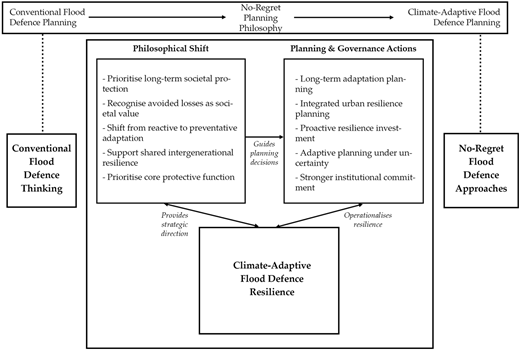
The challenges discussed in the previous section suggest that FDP in Vietnam requires more than technical upgrades or stronger engineering standards alone. Instead, it requires a broader shift in how flood defence itself is understood, valued, planned and implemented under conditions of long-term climate uncertainty. In response, a key shift proposed by NrAs is the transition from short-term visibility towards long-term societal protection. FDI is often deprioritised compared to other infrastructure projects because it does not provide immediate political visibility, economic return or public recognition. NrAs therefore encourage governments and institutions to prioritise long-term protective value and avoided future losses rather than relying solely on immediate visibility or short-term political recognition. Although FDIs may not generate immediate political or economic returns, their value fundamentally lies in preventing disasters and protecting communities, economies and long-term urban stability. NrAs therefore promote a transition away from narrow profitability-focused thinking towards recognising resilience, avoided damages and societal protection as critical forms of infrastructure value (GWP-C and CCCCC, 2014).
Importantly, elements of NrT are not entirely absent from the Vietnamese policy landscape. Recent climate adaptation and flood management policies have increasingly recognised the importance of long-term resilience, climate adaptation, integrated water management and sustainable development objectives (UNDP, 2024). Similarly, growing interest in NbS, EbA and hybrid grey-green infrastructure approaches reflects broader efforts to strengthen adaptive capacity under uncertain future climate conditions (Nguyen et al., 2025; Ngoc et al., 2024, 2026). However, these initiatives are often developed through different policy instruments, planning frameworks and sectoral responsibilities, meaning that they do not always provide a common basis for evaluating infrastructure investment decisions under deep uncertainty. Consequently, challenges remain in translating broad resilience objectives into consistent planning and investment priorities. Rather than introducing another adaptation approach, NrT provides an overarching decision-making philosophy through which existing adaptation options can be more consistently evaluated, prioritised and integrated according to common principles of long-term robustness, flexibility and societal benefit. In this sense, NrT complements rather than replaces existing adaptation strategies by providing a coherent framework for prioritising, coordinating and integrating them within FDP.
Another important shift associated with NrAs is the transition from reactive adaptation towards preventative resilience planning. In many contexts, FDIs continue to be implemented incrementally only after visible failures, major flood events or infrastructure underperformance occur. However, under accelerating climate uncertainty, waiting for complete certainty before acting may itself become a major source of future vulnerability. Preventative adaptation therefore becomes increasingly important for reducing long-term exposure, retrofit costs and system fragility before climatic pressures exceed the adaptive capacity of existing infrastructure systems (Rathnayaka et al., 2023; Akinsanola et al., 2025). Rather than focusing solely on short-term crisis response, NrAs emphasise proactive resilience-building capable of supporting long-term societal protection under uncertain future conditions. This perspective aligns closely with resilience-based planning and adaptive pathways approaches that advocate early intervention, iterative learning and flexible decision-making under uncertainty (Haasnoot et al., 2013; Werners et al., 2021; Birchall and Bonnett, 2021).
NrAs also encourage a transition from fragmented project-based planning towards broader system-oriented resilience thinking. Long-term flood resilience cannot be achieved solely through individual FDIs operating independently from their surrounding urban systems. Instead, flood resilience requires coordinated planning approaches that integrate flood defence, land-use management, urban development, drainage systems and long-term adaptation strategies (Das, 2025; Mannucci et al., 2022; Ersoy et al., 2024). In this sense, NrAs may also help reduce intergenerational inequality by encouraging each generation to contribute progressively, within its own financial and institutional capacity, towards strengthening long-term societal resilience rather than transferring the entire adaptation burden to future generations.
Finally, NrAs challenge growing assumptions that FDIs must necessarily maximise multiple economic or infrastructural functions simultaneously. While multifunctional infrastructure approaches may offer certain advantages, excessive multifunctionality may also unintentionally compromise long-term protective performance where additional functions interfere with the primary resilience role of the infrastructure itself (Marijnissen, 2021; van Loon-Steensma and Vellinga, 2014). From a no-regret perspective, FDIs should first and foremost prioritise reliable and effective protection under uncertain future conditions. In many cases, ensuring that infrastructure performs one core protective function effectively may ultimately provide greater long-term resilience than attempting to optimise multiple objectives simultaneously.
Figure 1 summarises the philosophical transition proposed by NrAs for FDP. The transitions illustrated should not be interpreted as independent changes, but as interconnected shifts in planning philosophy. For example, prioritising long-term societal protection naturally encourages preventative resilience planning, which in turn requires more integrated systems thinking across flood defence, land-use planning, governance and urban development. Likewise, recognising resilience as an intergenerational responsibility reinforces the need to evaluate infrastructure investments according to long-term societal benefits rather than short-term political visibility or economic returns. Accordingly, the arrows illustrate how philosophical shifts shape planning and governance actions, which together contribute to climate-adaptive flood defence resilience, rather than representing a fixed or sequential process.
Implications for policy and future research
From a policy perspective within the Vietnamese context, NrAs imply that FDIs should be planned and maintained according to long-term societal resilience objectives rather than short-term political visibility or administrative achievements alone. Because FDIs often require long operational lifespans, continuous maintenance and adaptive upgrading, resilience planning should extend beyond short political cycles and support stronger institutional continuity across generations. This implication is particularly relevant as Vietnam continues to strengthen its climate adaptation agenda and institutional reforms, creating opportunities to embed long-term resilience considerations more explicitly within FDP and infrastructure governance.
From an economic perspective, NrAs imply that FDIs should not necessarily be forced to maximise multiple economic or infrastructural functions simultaneously in order to justify investment. While multifunctional infrastructure may provide certain advantages, excessive emphasis on economic optimisation may unintentionally compromise the primary protective function of flood defence systems. Under uncertain future climate conditions, ensuring reliable and effective protection may ultimately become more important than maximising short-term economic efficiency or infrastructure visibility. Accordingly, NrAs encourage investment appraisal approaches that consider resilience, adaptability and long-term societal protection alongside conventional economic efficiency measures.
Ultimately, NrAs highlight the importance of broader governance coordination and integrated resilience planning. Flood defence systems cannot operate effectively in isolation from surrounding urban development, drainage systems, land-use planning and socio-economic pressures. Within the Vietnamese context, existing governance structures may provide certain advantages in supporting coordinated adaptation planning when guided by a unified strategic vision and stronger institutional commitment. Future research may explore how NrAs can be operationalised across different flood contexts in Vietnam, including urban, coastal, deltaic and riverine environments characterised by diverse climate risks and adaptation needs.
Conclusion
This paper has argued that improving climate-adaptive flood resilience in Vietnam requires more than stronger engineering standards or larger structural systems alone. Under conditions of accelerating climate uncertainty, rapid urbanisation and increasing flood exposure, conventional FDP approaches based primarily on short-term visibility, reactive adaptation and narrow economic logic may become increasingly insufficient for supporting long-term societal resilience.
In response, the paper proposed a broader transition towards NrAs for FDP. Rather than viewing FDI solely through the lens of immediate profitability, political visibility or isolated engineering performance, NrAs encourage a longer-term resilience-oriented perspective that recognises avoided losses, preventative adaptation, intergenerational responsibility and strategic societal protection as critical forms of infrastructure value.
While the discussion focused primarily on the Vietnamese context, many of the broader challenges identified in this paper may also hold relevance for other developing countries facing increasing climate uncertainty and flood risk pressures. Ultimately, under conditions of deep climate uncertainty, the greatest long-term risk may no longer be over-investment in resilience, but under-investment caused by waiting for certainty before acting.
Declaration of AI use
During the preparation of this manuscript, the author used OpenAI ChatGPT (GPT-5 series) to assist with grammar correction, sentence restructuring and improving the clarity of academic writing. All outputs were reviewed, revised and verified by the author, who takes full responsibility for the content of this manuscript.
The author acknowledges financial support through the Research Training Program Stipend Scholarship (RSS) provided by Royal Melbourne Institute of Technology (RMIT) University, Melbourne, Australia. The author also acknowledges that insights gained through the broader PhD research journey have informed the conceptual reflections presented in this paper. Special thanks are extended to Professor Peter S.P. Wong and Dr Alireza Ahankoob for their supervision, guidance, and mentorship throughout the research journey.